Finding Coherence 
Focus, Measure, & Connect 
Jonathan P. Costa, Sr. 
September, 23rd 2014 
http://digitallearningforallnow.com 
http://www.slideshare.net/jpcostasr 
costa@educationconnection.org 
Jonathan P. Costa
Building Coherence 
Resources & Links 
1. Go to http://www.slideshare.net/jpcostasr and look for…. 
A. Slides - Coherence CAS COP 1 Post 
2. Coherence Blog - http://cascoherencecosta.blogspot.com/ 
3. Survey Link - https://www.surveymonkey.com/s/CCCOP-C1 
4. My contact information - costa@educationconnection.org 
(860) 567-0863 
5. My book about the end of books - http://digitallearningforallnow.com 
Jonathan P. Costa
Coherence Community of Practice 
• Step/Session One: Committing to Coherence - this first session explores the rationale 
and requirements of building a coherence framework for improving student learning in 
your district. Participants will explore the role that systems, alignment, and focus play in 
a coherent approach to sustained improvement. 
• Step/Session Two: Goals for Learning - coherence requires focus and the focus of 
public school is student learning. This session will introduce participants to a process 
they can use to identify the highest impact/leverage skills upon which to focus their 
coherence improvement efforts. Particular attention will be paid to the convergence of 
21st century and Common Core skills. 
• Step/Session Three: Assessment - a district cannot improve anything unless they have 
agreement on what success would look like. This step will walk participants through an 
assessment inventory based on their selected skills from session two. Data and 
assessment strategies needed to guide practice will be the focus of the session. 
• Step/Session Four: Instructional Practices - an examination of how professional 
learning practices are goal driven and aligned with the high leverage skills selected in 
session two. 
• Step/Session Five: Adult/Organizational Measures - an analysis of how adult measures 
of performance (SLOs/Focus Goals) and aggregated data collected at the building and 
district level align and reflect the focus on the goals selected in session two. 
• Step/Session Six: Adult/Organizational Practices - an analysis of how adult plans and 
practices at the building and district level align and reflect the focus on the goals 
selected in session two. 
Jonathan P. Costa
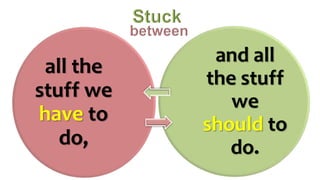
all the 
stuff we 
have to 
do, 
and all 
the stuff 
we 
should to 
do.
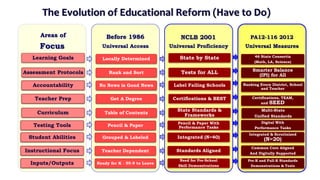
The Evolution of Educational Reform (Have to Do) 
Areas of Before 1986 NCLB 2001 PA12-116 2012 
Focus 
Learning Goals 
Assessment Protocols 
Accountability 
Teacher Prep 
Curriculum 
Testing Tools 
Student Abilities 
Instructional Focus 
Inputs/Outputs 
Universal Access 
Locally Determined 
Rank and Sort 
No News is Good News 
Get A Degree 
Table of Contents 
Pencil & Paper 
Grouped & Labeled 
Teacher Dependent 
Ready for K - 59.9 to Leave 
Universal Proficiency 
State by State 
Tests for ALL 
Label Failing Schools 
Certifications & BEST 
State Standards & 
Frameworks 
Pencil & Paper With 
Performance Tasks 
Integrated (N=40) 
Standards Aligned 
Need for Pre-School 
Skill Demonstrations 
Universal Measures 
46 State Consortia 
(Math, LA, Science) 
Smarter Balance 
(IPI) for All 
Ranking Every District, School 
and Teacher 
Certifications, TEAM, 
and SEED 
Multi-State 
Unified Standards 
Digital With 
Performance Tasks 
Integrated & Scrutinized 
(N=20) 
Common Core Aligned 
And Digitally Supported 
Pre-K and Full-K Standards 
Demonstrations & Tests
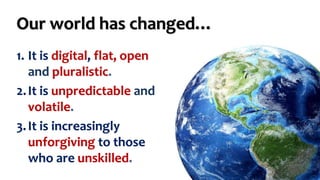
Our world has changed… 
1. It is digital, flat, open 
and pluralistic. 
2. It is unpredictable and 
volatile. 
3. It is increasingly 
unforgiving to those 
who are unskilled.
Less 
paper, 
more 
pixels.
Less single 
source, 
more 
crowd 
source.
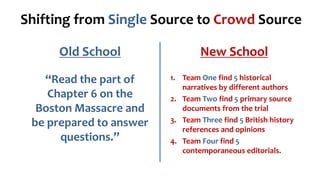
Shifting from Single Source to Crowd Source 
Old School 
“Read the part of 
Chapter 6 on the 
Boston Massacre and 
be prepared to answer 
questions.” 
New School 
1. Team One find 5 historical 
narratives by different authors 
2. Team Two find 5 primary source 
documents from the trial 
3. Team Three find 5 British history 
references and opinions 
4. Team Four find 5 
contemporaneous editorials.
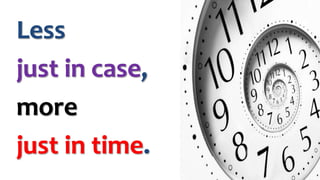
Less 
just in case, 
more 
just in time.
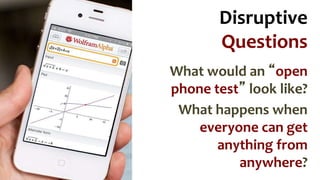
Disruptive 
Questions 
What would an “open 
phone test” look like? 
What happens when 
everyone can get 
anything from 
anywhere?
Our Mission 
To prepare 
EVERY student 
for learning, life, 
and work 
in the 21st century.
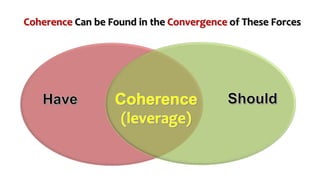
Coherence Can be Found in the Convergence of These Forces
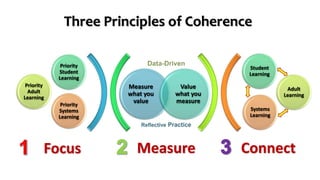
Three Principles of Coherence 
Measure 
what you 
value 
Value 
what you 
measure 
Measure Connect 
Priority 
Student 
Learning 
Priority 
Adult 
Learning 
Priority 
Systems 
Learning 
Focus 
Student 
Learning 
Adult 
Learning 
Systems 
Learning
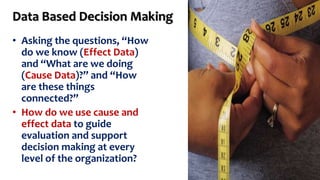
Data Based Decision Making 
• Asking the questions, “How 
do we know (Effect Data) 
and “What are we doing 
(Cause Data)?” and “How 
are these things 
connected?” 
• How do we use cause and 
effect data to guide 
evaluation and support 
decision making at every 
level of the organization?
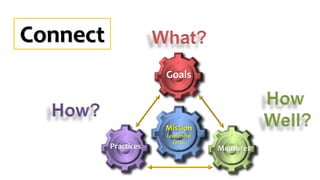
Connect 
Goals 
Mission 
Leadership 
Focus 
Practices Measures
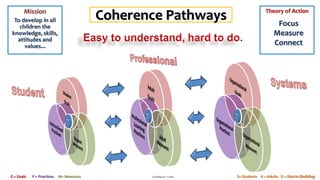
Coherence Pathways 
Mission 
To develop in all 
children the 
knowledge, skills, 
attitudes and 
values... 
Theory of Action 
Focus 
Measure 
Connect 
G = Goals P = Practices M= Measures Jonathan P. Costa S= Students A = Adults O = District/Building
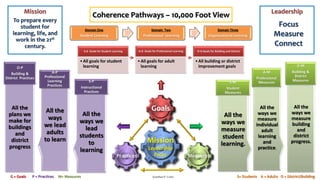
Coherence Pathways – 10,000 Foot View Leadership 
Domain One 
Student Learning 
S-G Goals for Student Learning 
• All goals for student 
learning 
A-G Goals for Professional Learning 
• All goals for adult 
learning 
O-G Goals for Building and District 
• All building or district 
improvement goals 
Focus 
Measure 
Connect 
O-M 
Building & 
District 
Measures 
All the 
ways we 
measure 
building 
and 
district 
progress. 
A-M 
Professional 
Measures 
All the 
ways we 
measure 
individual 
adult 
learning 
and 
practice. 
S-M 
Student 
Measures 
All the 
ways we 
measure 
student 
learning. 
To prepare every 
student for 
learning, life, and 
work in the 21st 
O-P 
Mission 
century. 
Building & 
District Practices 
All the 
plans we 
make for 
buildings 
and 
district 
progress 
A-P 
Professional 
Learning 
Practices 
All the 
ways 
we lead 
adults 
to learn 
S-P 
Instructional 
Practices 
All the 
ways we 
lead 
students 
to 
learning 
Domain Two 
Professional Learning 
Domain Three 
Organizational Learning 
Goals 
Mission 
Leadership 
Practices Focus Measures 
G = Goals P = Practices M= Measures Jonathan P. Costa S= Students A = Adults O = District/Building
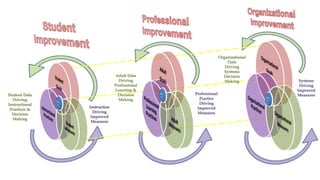
Student Data 
Driving 
Instructional 
Practices & 
Decision 
Making 
Instruction 
Driving 
Improved 
Measures 
Professional 
Practice 
Driving 
Improved 
Measures 
Systems 
Driving 
Improved 
Measures 
Adult Data 
Driving 
Professional 
Learning & 
Decision 
Making 
Organizational 
Data 
Driving 
Systems 
Decision 
Making
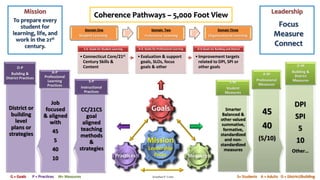
Coherence Pathways – 5,000 Foot View Leadership 
Domain One 
Student Learning 
S-G Goals for Student Learning 
• Connecticut Core/21st 
Century Skills & 
Content 
A-G Goals for Professional Learning 
• Evaluation & support 
goals, SLOs, focus 
goals & other 
O-G Goals for Building and District 
• Improvement targets 
related to DPI, SPI or 
other goals 
Focus 
Measure 
Connect 
O-M 
Building & 
District 
Measures 
DPI 
SPI 
5 
10 
Other… 
A-M 
Professional 
Measures 
45 
40 
(5/10) 
S-M 
Student 
Measures 
Smarter 
Balanced & 
other valued 
summative, 
formative, 
standardized 
and non-standardized 
measures 
To prepare every 
student for 
learning, life, and 
work in the 21st 
O-P 
Mission 
century. 
Building & 
District Practices 
District or 
building 
level 
plans or 
strategies 
A-P 
Professional 
Learning 
Practices 
Job 
focused 
& aligned 
with 
45 
5 
40 
10 
S-P 
Instructional 
Practices 
CC/21CS 
goal 
aligned 
teaching 
methods 
& 
strategies 
Domain Two 
Professional Learning 
Domain Three 
Organizational Learning 
Goals 
Mission 
Leadership 
Practices Focus Measures 
G = Goals P = Practices M= Measures Jonathan P. Costa S= Students A = Adults O = District/Building
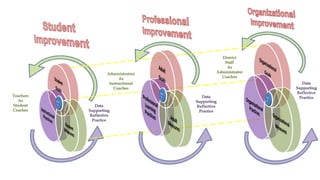
Teachers 
As 
Student 
Coaches 
Data 
Supporting 
Reflective 
Practice 
Data 
Supporting 
Reflective 
Practice 
Data 
Supporting 
Reflective 
Practice 
Administrators 
As 
Instructional 
Coaches 
District 
Staff 
As 
Administrator 
Coaches
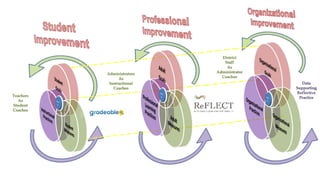
Teachers 
As 
Student 
Coaches 
Data 
Supporting 
Reflective 
Practice 
Administrators 
As 
Instructional 
Coaches 
District 
Staff 
As 
Administrator 
Coaches
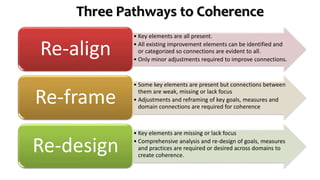
Three Pathways to Coherence 
• Key elements are all present. 
• All existing improvement elements can be identified and 
or categorized so connections are evident to all. 
• Only minor adjustments required to improve connections. Re-align 
• Some key elements are present but connections between 
them are weak, missing or lack focus 
• Adjustments and reframing of key goals, measures and 
domain connections are required for coherence Re-frame 
• Key elements are missing or lack focus 
• Comprehensive analysis and re-design of goals, measures 
and practices are required or desired across domains to 
create coherence. Re-design
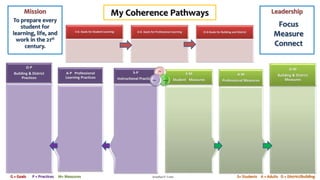
My Coherence Pathways Leadership 
S-G Goals for Student Learning A-G Goals for Professional Learning O-G Goals for Building and District 
Focus 
Measure 
Connect 
O-M 
Building & District 
Measures 
A-M 
Professional Measures 
S-M 
Student Measures 
Mission 
To prepare every 
student for 
learning, life, and 
work in the 21st 
century. 
O-P 
Building & District 
Practices 
S-P 
Instructional Practices 
A-P Professional 
Learning Practices 
Goals 
Practices Measures 
G = Goals P = Practices M= Measures Jonathan P. Costa S= Students A = Adults O = District/Building
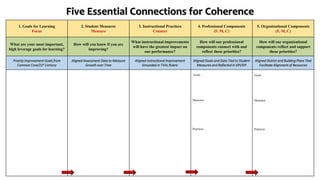
Five Essential Connections for Coherence 
1. Goals for Learning 
Focus 
2. Student Measures 
Measure 
3. Instructional Practices 
Connect 
4. Professional Components 
(F, M, C) 
5. Organizational Components 
(F, M, C) 
What are your most important, 
high leverage goals for learning? 
How will you know if you are 
improving? 
What instructional improvements 
will have the greatest impact on 
our performance? 
How will our professional 
components connect with and 
reflect these priorities? 
How will our organizational 
components reflect and support 
these priorities? 
Priority Improvement Goals from 
Common Core/21st Century 
Aligned Assessment Data to Measure 
Growth over Time 
Aligned instructional Improvement 
Grounded in TVAL Rubric 
Aligned Goals and Data Tied to Student 
Measures and Reflected in DPI/SPI 
Aligned District and Building Plans That 
Facilitate Alignment of Resources 
Goals 
Measures 
Practices 
Goals 
Measures 
Practices
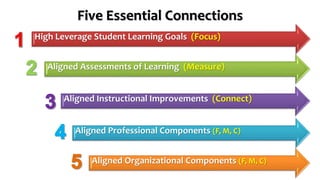
Five Essential Connections 
High Leverage Student Learning Goals (Focus) 
Aligned Assessments of Learning (Measure) 
Aligned Instructional Improvements (Connect) 
Aligned Professional Components (F, M, C) 
Aligned Organizational Components (F, M, C)

Coherence cas cop 1 post

  • 1.
    Finding Coherence Focus,Measure, & Connect Jonathan P. Costa, Sr. September, 23rd 2014 http://digitallearningforallnow.com http://www.slideshare.net/jpcostasr costa@educationconnection.org Jonathan P. Costa
  • 2.
    Building Coherence Resources& Links 1. Go to http://www.slideshare.net/jpcostasr and look for…. A. Slides - Coherence CAS COP 1 Post 2. Coherence Blog - http://cascoherencecosta.blogspot.com/ 3. Survey Link - https://www.surveymonkey.com/s/CCCOP-C1 4. My contact information - costa@educationconnection.org (860) 567-0863 5. My book about the end of books - http://digitallearningforallnow.com Jonathan P. Costa
  • 3.
    Coherence Community ofPractice • Step/Session One: Committing to Coherence - this first session explores the rationale and requirements of building a coherence framework for improving student learning in your district. Participants will explore the role that systems, alignment, and focus play in a coherent approach to sustained improvement. • Step/Session Two: Goals for Learning - coherence requires focus and the focus of public school is student learning. This session will introduce participants to a process they can use to identify the highest impact/leverage skills upon which to focus their coherence improvement efforts. Particular attention will be paid to the convergence of 21st century and Common Core skills. • Step/Session Three: Assessment - a district cannot improve anything unless they have agreement on what success would look like. This step will walk participants through an assessment inventory based on their selected skills from session two. Data and assessment strategies needed to guide practice will be the focus of the session. • Step/Session Four: Instructional Practices - an examination of how professional learning practices are goal driven and aligned with the high leverage skills selected in session two. • Step/Session Five: Adult/Organizational Measures - an analysis of how adult measures of performance (SLOs/Focus Goals) and aggregated data collected at the building and district level align and reflect the focus on the goals selected in session two. • Step/Session Six: Adult/Organizational Practices - an analysis of how adult plans and practices at the building and district level align and reflect the focus on the goals selected in session two. Jonathan P. Costa
  • 4.
    all the stuffwe have to do, and all the stuff we should to do.
  • 5.
    The Evolution ofEducational Reform (Have to Do) Areas of Before 1986 NCLB 2001 PA12-116 2012 Focus Learning Goals Assessment Protocols Accountability Teacher Prep Curriculum Testing Tools Student Abilities Instructional Focus Inputs/Outputs Universal Access Locally Determined Rank and Sort No News is Good News Get A Degree Table of Contents Pencil & Paper Grouped & Labeled Teacher Dependent Ready for K - 59.9 to Leave Universal Proficiency State by State Tests for ALL Label Failing Schools Certifications & BEST State Standards & Frameworks Pencil & Paper With Performance Tasks Integrated (N=40) Standards Aligned Need for Pre-School Skill Demonstrations Universal Measures 46 State Consortia (Math, LA, Science) Smarter Balance (IPI) for All Ranking Every District, School and Teacher Certifications, TEAM, and SEED Multi-State Unified Standards Digital With Performance Tasks Integrated & Scrutinized (N=20) Common Core Aligned And Digitally Supported Pre-K and Full-K Standards Demonstrations & Tests
  • 6.
    Our world haschanged… 1. It is digital, flat, open and pluralistic. 2. It is unpredictable and volatile. 3. It is increasingly unforgiving to those who are unskilled.
  • 7.
  • 8.
    Less single source, more crowd source.
  • 9.
    Shifting from SingleSource to Crowd Source Old School “Read the part of Chapter 6 on the Boston Massacre and be prepared to answer questions.” New School 1. Team One find 5 historical narratives by different authors 2. Team Two find 5 primary source documents from the trial 3. Team Three find 5 British history references and opinions 4. Team Four find 5 contemporaneous editorials.
  • 10.
    Less just incase, more just in time.
  • 11.
    Disruptive Questions Whatwould an “open phone test” look like? What happens when everyone can get anything from anywhere?
  • 12.
    Our Mission Toprepare EVERY student for learning, life, and work in the 21st century.
  • 13.
    Coherence Can beFound in the Convergence of These Forces
  • 14.
    Three Principles ofCoherence Measure what you value Value what you measure Measure Connect Priority Student Learning Priority Adult Learning Priority Systems Learning Focus Student Learning Adult Learning Systems Learning
  • 15.
    Data Based DecisionMaking • Asking the questions, “How do we know (Effect Data) and “What are we doing (Cause Data)?” and “How are these things connected?” • How do we use cause and effect data to guide evaluation and support decision making at every level of the organization?
  • 16.
    Connect Goals Mission Leadership Focus Practices Measures
  • 17.
    Coherence Pathways Mission To develop in all children the knowledge, skills, attitudes and values... Theory of Action Focus Measure Connect G = Goals P = Practices M= Measures Jonathan P. Costa S= Students A = Adults O = District/Building
  • 18.
    Coherence Pathways –10,000 Foot View Leadership Domain One Student Learning S-G Goals for Student Learning • All goals for student learning A-G Goals for Professional Learning • All goals for adult learning O-G Goals for Building and District • All building or district improvement goals Focus Measure Connect O-M Building & District Measures All the ways we measure building and district progress. A-M Professional Measures All the ways we measure individual adult learning and practice. S-M Student Measures All the ways we measure student learning. To prepare every student for learning, life, and work in the 21st O-P Mission century. Building & District Practices All the plans we make for buildings and district progress A-P Professional Learning Practices All the ways we lead adults to learn S-P Instructional Practices All the ways we lead students to learning Domain Two Professional Learning Domain Three Organizational Learning Goals Mission Leadership Practices Focus Measures G = Goals P = Practices M= Measures Jonathan P. Costa S= Students A = Adults O = District/Building
  • 19.
    Student Data Driving Instructional Practices & Decision Making Instruction Driving Improved Measures Professional Practice Driving Improved Measures Systems Driving Improved Measures Adult Data Driving Professional Learning & Decision Making Organizational Data Driving Systems Decision Making
  • 20.
    Coherence Pathways –5,000 Foot View Leadership Domain One Student Learning S-G Goals for Student Learning • Connecticut Core/21st Century Skills & Content A-G Goals for Professional Learning • Evaluation & support goals, SLOs, focus goals & other O-G Goals for Building and District • Improvement targets related to DPI, SPI or other goals Focus Measure Connect O-M Building & District Measures DPI SPI 5 10 Other… A-M Professional Measures 45 40 (5/10) S-M Student Measures Smarter Balanced & other valued summative, formative, standardized and non-standardized measures To prepare every student for learning, life, and work in the 21st O-P Mission century. Building & District Practices District or building level plans or strategies A-P Professional Learning Practices Job focused & aligned with 45 5 40 10 S-P Instructional Practices CC/21CS goal aligned teaching methods & strategies Domain Two Professional Learning Domain Three Organizational Learning Goals Mission Leadership Practices Focus Measures G = Goals P = Practices M= Measures Jonathan P. Costa S= Students A = Adults O = District/Building
  • 21.
    Teachers As Student Coaches Data Supporting Reflective Practice Data Supporting Reflective Practice Data Supporting Reflective Practice Administrators As Instructional Coaches District Staff As Administrator Coaches
  • 22.
    Teachers As Student Coaches Data Supporting Reflective Practice Administrators As Instructional Coaches District Staff As Administrator Coaches
  • 23.
    Three Pathways toCoherence • Key elements are all present. • All existing improvement elements can be identified and or categorized so connections are evident to all. • Only minor adjustments required to improve connections. Re-align • Some key elements are present but connections between them are weak, missing or lack focus • Adjustments and reframing of key goals, measures and domain connections are required for coherence Re-frame • Key elements are missing or lack focus • Comprehensive analysis and re-design of goals, measures and practices are required or desired across domains to create coherence. Re-design
  • 24.
    My Coherence PathwaysLeadership S-G Goals for Student Learning A-G Goals for Professional Learning O-G Goals for Building and District Focus Measure Connect O-M Building & District Measures A-M Professional Measures S-M Student Measures Mission To prepare every student for learning, life, and work in the 21st century. O-P Building & District Practices S-P Instructional Practices A-P Professional Learning Practices Goals Practices Measures G = Goals P = Practices M= Measures Jonathan P. Costa S= Students A = Adults O = District/Building
  • 25.
    Five Essential Connectionsfor Coherence 1. Goals for Learning Focus 2. Student Measures Measure 3. Instructional Practices Connect 4. Professional Components (F, M, C) 5. Organizational Components (F, M, C) What are your most important, high leverage goals for learning? How will you know if you are improving? What instructional improvements will have the greatest impact on our performance? How will our professional components connect with and reflect these priorities? How will our organizational components reflect and support these priorities? Priority Improvement Goals from Common Core/21st Century Aligned Assessment Data to Measure Growth over Time Aligned instructional Improvement Grounded in TVAL Rubric Aligned Goals and Data Tied to Student Measures and Reflected in DPI/SPI Aligned District and Building Plans That Facilitate Alignment of Resources Goals Measures Practices Goals Measures Practices
  • 26.
    Five Essential Connections High Leverage Student Learning Goals (Focus) Aligned Assessments of Learning (Measure) Aligned Instructional Improvements (Connect) Aligned Professional Components (F, M, C) Aligned Organizational Components (F, M, C)

Editor's Notes

  • #13 This is the defining challenge of our times in public school.