Change Management

      Training
Purpose of this presentation
  •    Help you understand what YOU can do to trigger organizational change
  •    Ask questions to trigger ideas
  •    Ideas that lead to change
  •    Discuss it in the context of Agile Transformation


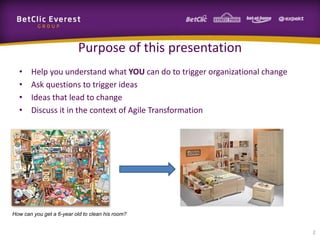
How can you get a 6-year old to clean his room?


                                                                              2
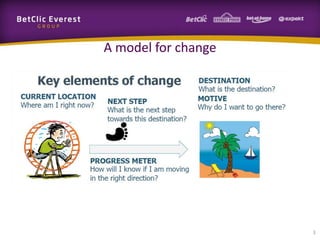
A model for change


                     3
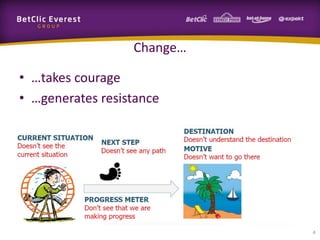
Change…

• …takes courage
• …generates resistance


                            4
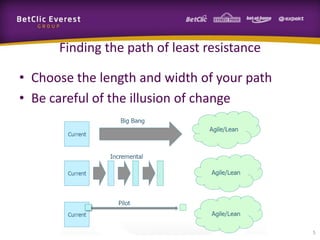
Finding the path of least resistance

• Choose the length and width of your path
• Be careful of the illusion of change


                                             5
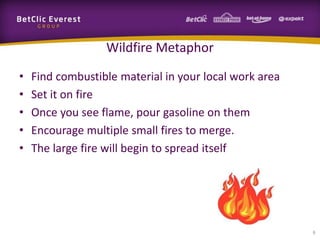
Wildfire Metaphor
•   Find combustible material in your local work area
•   Set it on fire
•   Once you see flame, pour gasoline on them
•   Encourage multiple small fires to merge.
•   The large fire will begin to spread itself


                                                        6
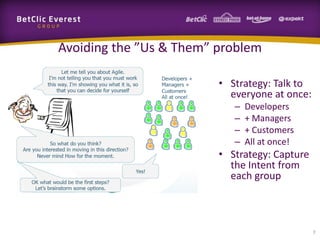
Avoiding the ”Us & Them” problem

                         • Strategy: Talk to
                           everyone at once:
                            –   Developers
                            –   + Managers
                            –   + Customers
                            –   All at once!
                         • Strategy: Capture
                           the Intent from
                           each group


                                               7
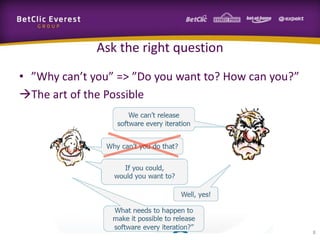
Ask the right question
• ”Why can’t you” => ”Do you want to? How can you?”
The art of the Possible


                                                      8
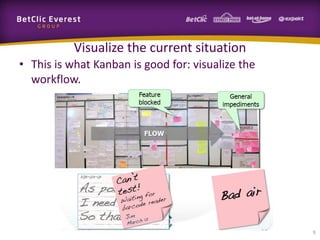
Visualize the current situation
• This is what Kanban is good for: visualize the
  workflow.


                                                   9
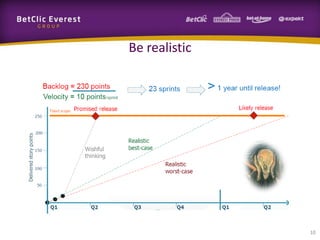
Be realistic


               10
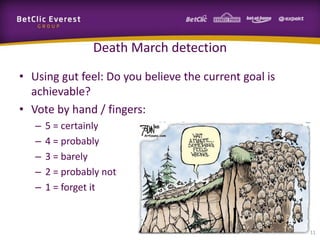
Death March detection
• Using gut feel: Do you believe the current goal is
  achievable?
• Vote by hand / fingers:
   –   5 = certainly
   –   4 = probably
   –   3 = barely
   –   2 = probably not
   –   1 = forget it


                                                       11
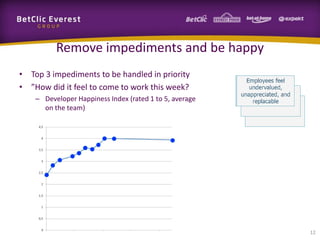
Remove impediments and be happy
• Top 3 impediments to be handled in priority
• ”How did it feel to come to work this week?
    – Developer Happiness Index (rated 1 to 5, average
      on the team)


                                                         12
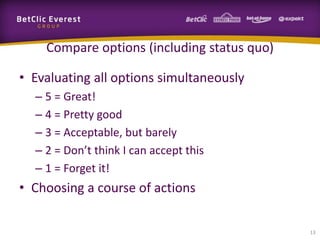
Compare options (including status quo)

• Evaluating all options simultaneously
  – 5 = Great!
  – 4 = Pretty good
  – 3 = Acceptable, but barely
  – 2 = Don’t think I can accept this
  – 1 = Forget it!
• Choosing a course of actions

                                             13
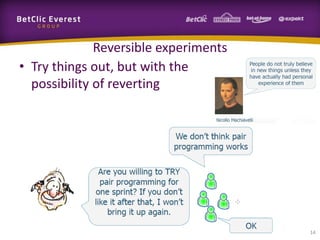
Reversible experiments
• Try things out, but with the
  possibility of reverting


                                       14
Make a business case for your change
• Use figures to motivate change
   – Team estimates that our velocity would increase by 50% if
     we sit together.
   – This means we can release 2 months early. What is the
     business value of that?
   – What is the cost of tearing down this wall so that the team
     can sit together?
• …in practice not so easy to evaluate the benefits, but
  try anyway

                                                                   15
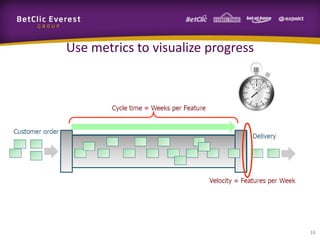
Use metrics to visualize progress


                                    16
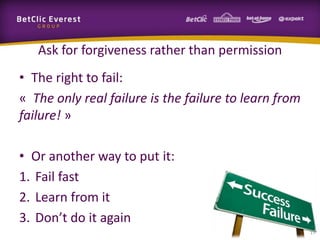
Ask for forgiveness rather than permission
• The right to fail:
« The only real failure is the failure to learn from
failure! »

• Or another way to put it:
1. Fail fast
2. Learn from it
3. Don’t do it again
                                                       17
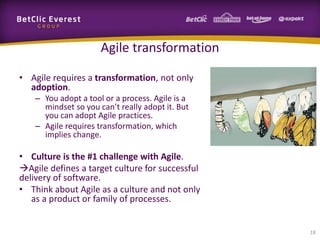
Agile transformation

• Agile requires a transformation, not only
  adoption.
    – You adopt a tool or a process. Agile is a
      mindset so you can’t really adopt it. But
      you can adopt Agile practices.
    – Agile requires transformation, which
      implies change.

• Culture is the #1 challenge with Agile.
Agile defines a target culture for successful
delivery of software.
• Think about Agile as a culture and not only
   as a product or family of processes.


                                                  18
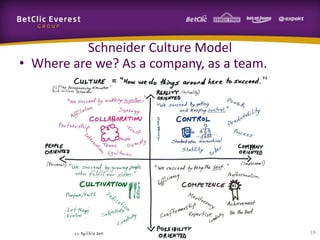
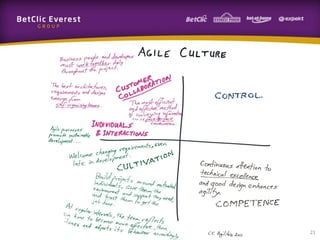
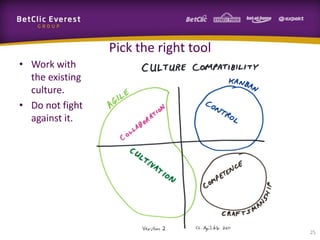
Schneider Culture Model
• Where are we? As a company, as a team.


                                           19
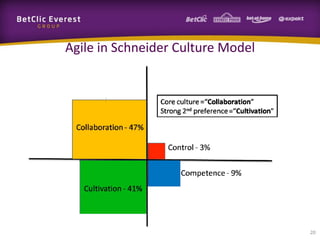
Agile in Schneider Culture Model


                                   20
21
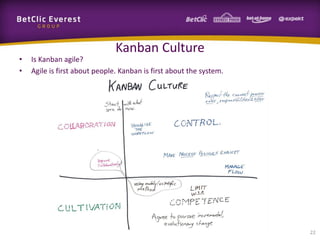
Kanban Culture
•   Is Kanban agile?
•   Agile is first about people. Kanban is first about the system.


                                                                     22
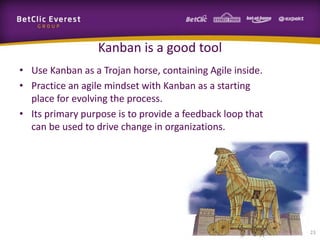
Kanban is a good tool
• Use Kanban as a Trojan horse, containing Agile inside.
• Practice an agile mindset with Kanban as a starting
  place for evolving the process.
• Its primary purpose is to provide a feedback loop that
  can be used to drive change in organizations.


                                                           23
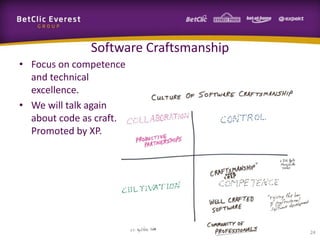
Software Craftsmanship
• Focus on competence
  and technical
  excellence.
• We will talk again
  about code as craft.
  Promoted by XP.


                                       24
Pick the right tool
• Work with
  the existing
  culture.
• Do not fight
  against it.


                                       25
Disruption

• Change in one place will create disruption in
  the rest of the organization.
• Care and attention is required to accomodate
  disruption.
• Design culture « adapters » to satisfy the
  organization while driving change.


                                                  26
Leaders go first!

•   Live the values
•   Lead by example
•   Seek to truly understand their culture
•   Be as transparent as the teams they lead


                                               27
Another perspective

 Agile is an evolutionary approach to
innovation and growth, respecting the
       people who create value.


                                        28
Summary

• Don’t change other people, motivate them to
  change themselves
  – Give them a reason to change (visualization)
  – Show them a way to change. (Small, clear steps)
  – Give them support, encouragement, and feedback


                                                      29
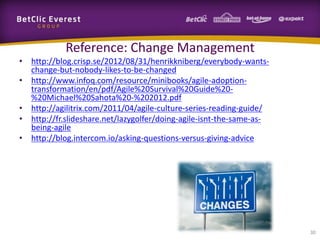
Reference: Change Management
• http://blog.crisp.se/2012/08/31/henrikkniberg/everybody-wants-
  change-but-nobody-likes-to-be-changed
• http://www.infoq.com/resource/minibooks/agile-adoption-
  transformation/en/pdf/Agile%20Survival%20Guide%20-
  %20Michael%20Sahota%20-%202012.pdf
• http://agilitrix.com/2011/04/agile-culture-series-reading-guide/
• http://fr.slideshare.net/lazygolfer/doing-agile-isnt-the-same-as-
  being-agile
• http://blog.intercom.io/asking-questions-versus-giving-advice


                                                                      30

Change Management

  • 1.
  • 2.
    Purpose of thispresentation • Help you understand what YOU can do to trigger organizational change • Ask questions to trigger ideas • Ideas that lead to change • Discuss it in the context of Agile Transformation How can you get a 6-year old to clean his room? 2
  • 3.
    A model forchange 3
  • 4.
    Change… • …takes courage •…generates resistance 4
  • 5.
    Finding the pathof least resistance • Choose the length and width of your path • Be careful of the illusion of change 5
  • 6.
    Wildfire Metaphor • Find combustible material in your local work area • Set it on fire • Once you see flame, pour gasoline on them • Encourage multiple small fires to merge. • The large fire will begin to spread itself 6
  • 7.
    Avoiding the ”Us& Them” problem • Strategy: Talk to everyone at once: – Developers – + Managers – + Customers – All at once! • Strategy: Capture the Intent from each group 7
  • 8.
    Ask the rightquestion • ”Why can’t you” => ”Do you want to? How can you?” The art of the Possible 8
  • 9.
    Visualize the currentsituation • This is what Kanban is good for: visualize the workflow. 9
  • 10.
  • 11.
    Death March detection •Using gut feel: Do you believe the current goal is achievable? • Vote by hand / fingers: – 5 = certainly – 4 = probably – 3 = barely – 2 = probably not – 1 = forget it 11
  • 12.
    Remove impediments andbe happy • Top 3 impediments to be handled in priority • ”How did it feel to come to work this week? – Developer Happiness Index (rated 1 to 5, average on the team) 12
  • 13.
    Compare options (includingstatus quo) • Evaluating all options simultaneously – 5 = Great! – 4 = Pretty good – 3 = Acceptable, but barely – 2 = Don’t think I can accept this – 1 = Forget it! • Choosing a course of actions 13
  • 14.
    Reversible experiments • Trythings out, but with the possibility of reverting 14
  • 15.
    Make a businesscase for your change • Use figures to motivate change – Team estimates that our velocity would increase by 50% if we sit together. – This means we can release 2 months early. What is the business value of that? – What is the cost of tearing down this wall so that the team can sit together? • …in practice not so easy to evaluate the benefits, but try anyway 15
  • 16.
    Use metrics tovisualize progress 16
  • 17.
    Ask for forgivenessrather than permission • The right to fail: « The only real failure is the failure to learn from failure! » • Or another way to put it: 1. Fail fast 2. Learn from it 3. Don’t do it again 17
  • 18.
    Agile transformation • Agilerequires a transformation, not only adoption. – You adopt a tool or a process. Agile is a mindset so you can’t really adopt it. But you can adopt Agile practices. – Agile requires transformation, which implies change. • Culture is the #1 challenge with Agile. Agile defines a target culture for successful delivery of software. • Think about Agile as a culture and not only as a product or family of processes. 18
  • 19.
    Schneider Culture Model •Where are we? As a company, as a team. 19
  • 20.
    Agile in SchneiderCulture Model 20
  • 21.
  • 22.
    Kanban Culture • Is Kanban agile? • Agile is first about people. Kanban is first about the system. 22
  • 23.
    Kanban is agood tool • Use Kanban as a Trojan horse, containing Agile inside. • Practice an agile mindset with Kanban as a starting place for evolving the process. • Its primary purpose is to provide a feedback loop that can be used to drive change in organizations. 23
  • 24.
    Software Craftsmanship • Focuson competence and technical excellence. • We will talk again about code as craft. Promoted by XP. 24
  • 25.
    Pick the righttool • Work with the existing culture. • Do not fight against it. 25
  • 26.
    Disruption • Change inone place will create disruption in the rest of the organization. • Care and attention is required to accomodate disruption. • Design culture « adapters » to satisfy the organization while driving change. 26
  • 27.
    Leaders go first! • Live the values • Lead by example • Seek to truly understand their culture • Be as transparent as the teams they lead 27
  • 28.
    Another perspective Agileis an evolutionary approach to innovation and growth, respecting the people who create value. 28
  • 29.
    Summary • Don’t changeother people, motivate them to change themselves – Give them a reason to change (visualization) – Show them a way to change. (Small, clear steps) – Give them support, encouragement, and feedback 29
  • 30.
    Reference: Change Management •http://blog.crisp.se/2012/08/31/henrikkniberg/everybody-wants- change-but-nobody-likes-to-be-changed • http://www.infoq.com/resource/minibooks/agile-adoption- transformation/en/pdf/Agile%20Survival%20Guide%20- %20Michael%20Sahota%20-%202012.pdf • http://agilitrix.com/2011/04/agile-culture-series-reading-guide/ • http://fr.slideshare.net/lazygolfer/doing-agile-isnt-the-same-as- being-agile • http://blog.intercom.io/asking-questions-versus-giving-advice 30