企业敏捷转型所面临的文化挑战
Enterprise Cultural Challenges
 To Agile Transition

          王明兰
Enterprise Cultural Challenges
     To Agile Transition


       Wang Minglan
        2012.06.07


                                 2
Agenda

 Culture and Agile
 Agile Challenges In Chinese Traditional Culture
 Cases In Given Enterprise Culture
 Ramp up – Do’s and Don’ts
Culture And Agile
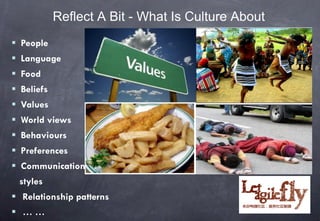
Reflect A Bit - What Is Culture About
 People
 Language
 Food
 Beliefs
 Values
 World views
 Behaviours
 Preferences
 Communication
 styles
 Relationship patterns
 ……                                          5
“A way of life of a group of people.
Culture is learned, not innate. Culture includes a group's shared
values, beliefs, behaviors, preferences, verbal and nonverbal
communication styles, relationship patterns..”
----- (Chen, Chan, Brekken, Lynch, Valverde 1998)


                                                     6
Culture And Agile
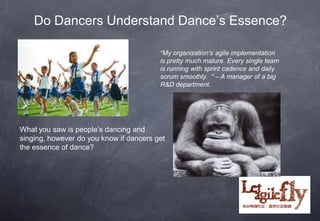
Do Dancers Understand Dance’s Essence?

                                         “My organization’s agile implementation
                                         is pretty much mature. Every single team
                                         is running with sprint cadence and daily
                                         scrum smoothly. “ – A manager of a big
                                         R&D department.


What you saw is people’s dancing and
singing, however do you know if dancers get
the essence of dance?


                                                                      8
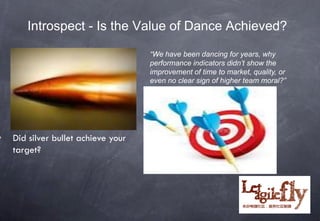
Introspect - Is the Value of Dance Achieved?

                                     “We have been dancing for years, why
                                     performance indicators didn’t show the
                                     improvement of time to market, quality, or
                                     even no clear sign of higher team moral?”


•   Did silver bullet achieve your
    target?


                                                                   9
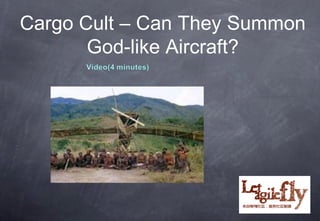
Cargo Cult – Can They Summon
       God-like Aircraft?


                      10
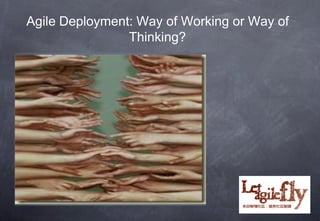
Agile Deployment: Way of Working or Way of
                Thinking?


                                   11
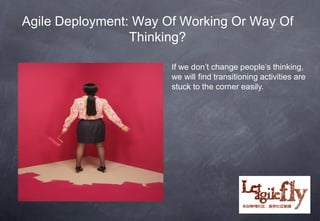
Agile Deployment: Way Of Working Or Way Of
                 Thinking?

                       If we don’t change people’s thinking,
                       we will find transitioning activities are
                       stuck to the corner easily.


                                              12
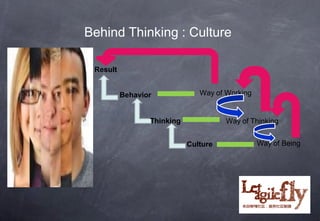
Behind Thinking : Culture

 Result


          Behavior             Way of Working


                 Thinking             Way of Thinking


                            Culture              Way of Being


                                            13
Agile Culture VS. Chinese Traditional Culture


                                      14
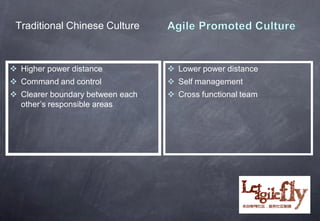
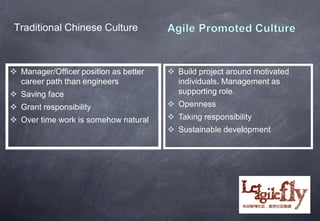
Traditional Chinese Culture


 Higher power distance            Lower power distance
 Command and control              Self management
 Clearer boundary between each    Cross functional team
  other’s responsible areas


                                                      15
Traditional Chinese Culture


 Manager/Officer position as better    Build project around motivated
  career path than engineers             individuals. Management as
 Saving face                            supporting role.
 Grant responsibility                  Openness
 Over time work is somehow natural     Taking responsibility
                                        Sustainable development


                                                             16
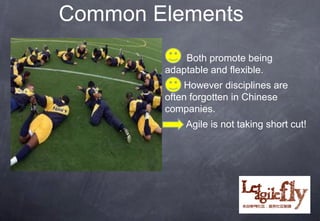
Common Elements
            Both promote being
        adaptable and flexible.
            However disciplines are
        often forgotten in Chinese
        companies.
            Agile is not taking short cut!


                           17
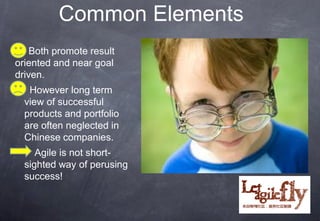
Common Elements
    Both promote result
oriented and near goal
driven.
    However long term
    view of successful
    products and portfolio
    are often neglected in
    Chinese companies.

      Agile is not short-
    sighted way of perusing
    success!


                              18
Cases In Given Enterprise Culture
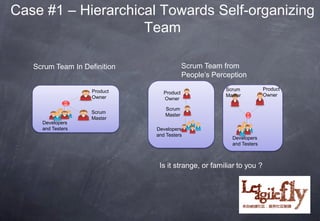
Case #1 – Hierarchical Towards Self-organizing
                    Team

   Scrum Team In Definition                Scrum Team from
                                           People’s Perception

                    Product                            Scrum           Product
                                 Product                               Owner
                    Owner                              Master
                                 Owner

                                 Scrum
                    Scrum
                                 Master
                    Master
     Developers
     and Testers              Developers
                              and Testers
                                                         Developers
                                                         and Testers


                               Is it strange, or familiar to you ?


                                                                 20
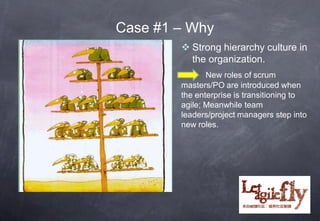
Case #1 – Why
         Strong hierarchy culture in
          the organization.
               New roles of scrum
        masters/PO are introduced when
        the enterprise is transitioning to
        agile; Meanwhile team
        leaders/project managers step into
        new roles.


                          21
Case #1 – How To Deal With It?
Correct roles and
 responsibility definitions
 and misunderstandings.
Remove hierarchy. Make
 PO/Scrum masters use
 right leadership style.


                                    22
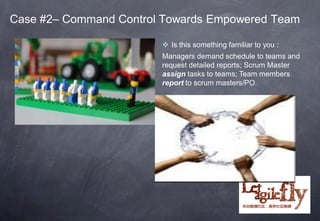
Case #2– Command Control Towards Empowered Team

                         Is this something familiar to you :
                        Managers demand schedule to teams and
                        request detailed reports; Scrum Master
                        assign tasks to teams; Team members
                        report to scrum masters/PO.
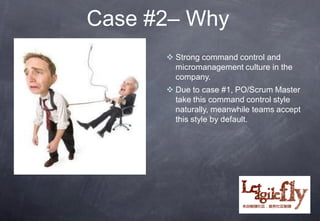
Case #2– Why
       Strong command control and
        micromanagement culture in the
        company.
       Due to case #1, PO/Scrum Master
        take this command control style
        naturally, meanwhile teams accept
        this style by default.
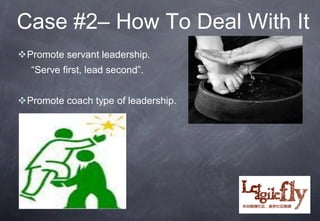
Case #2– How To Deal With It
Promote servant leadership.
  “Serve first, lead second”.


Promote coach type of leadership.
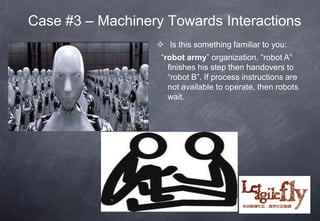
Case #3 – Machinery Towards Interactions
                   Is this something familiar to you:
                   “robot army” organization. “robot A”
                     finishes his step then handovers to
                     “robot B”. If process instructions are
                     not available to operate, then robots
                     wait.
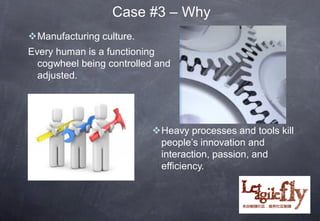
Case #3 – Why
Manufacturing culture.
Every human is a functioning
  cogwheel being controlled and
  adjusted.


                          Heavy processes and tools kill
                           people’s innovation and
                           interaction, passion, and
                           efficiency.
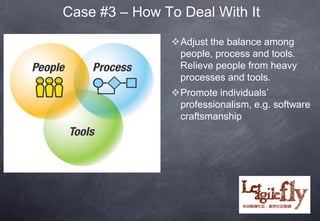
Case #3 – How To Deal With It
               Adjust the balance among
                people, process and tools.
                Relieve people from heavy
                processes and tools.
               Promote individuals’
                professionalism, e.g. software
                craftsmanship
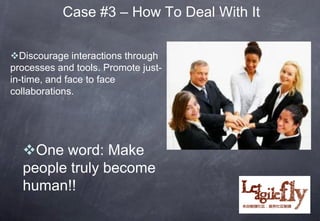
Case #3 – How To Deal With It

Discourage interactions through
processes and tools. Promote just-
in-time, and face to face
collaborations.


  One word: Make
  people truly become
  human!!
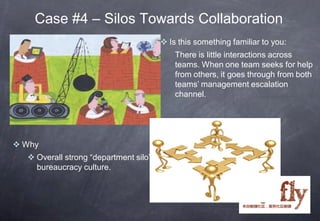
Case #4 – Silos Towards Collaboration
                                        Is this something familiar to you:
                                           There is little interactions across
                                           teams. When one team seeks for help
                                           from others, it goes through from both
                                           teams’ management escalation
                                           channel.


 Why
   Overall strong “department silo”
    bureaucracy culture.
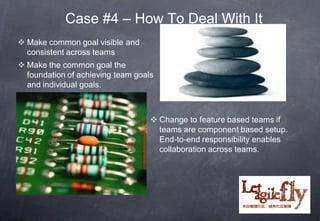
Case #4 – How To Deal With It
 Make common goal visible and
  consistent across teams
 Make the common goal the
  foundation of achieving team goals
  and individual goals.


                                    Change to feature based teams if
                                     teams are component based setup.
                                     End-to-end responsibility enables
                                     collaboration across teams.
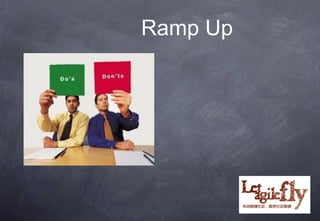
Ramp Up
Do’s
 ...Why...
 ...Way of Being...
 ...Consistant Vision...
 ...Explictly...
 …Leadership
 …upstream and downstream…
 ...Seeds
 Evolve …
Do’s
 Communicate clearly and repeatively on why to transit to agile.
 Incorpate Way Of Thinking into Way Of Working Transition Program towards Way of
  Being.
 Provide consistant vision and direction across the organization

 Repeat the voice of promoted culture explictly on daily basis, again and over
  again.
 Change managers first! Managers become road blockers if not shifting from
  commanding and controlling to servant leading and coaching leadership.

 change of the people in upstream      and downstream              of scrum teams

 Open eyes, eudcate potential seeds to change themselves. Let the ”seeds”
  influence others to embrace agile culture.

 Help teams evolve in stead of predefining everything in PowerPoint then implement
Don’ts
 Go all in...
 ...one size...
 ...wrong people...
 ...titles...
 Reorganize…
 …regression…
 …superficial…
 …lose belief…
 …Ignore disciplines…
Don’ts
 Go all in overnight without piloting

 Try one    size fits all.
 Nominate wrong       people playing key roles in scrum teams.
 Make key roles in scrum teams permantly with   titles.
Reorganize teams frequently.
 Let teams transitioning progress regress to old way of working and thinking.

 Make scrum ceremonies become superficial as a result making agile essence
  not exposed.

 Make teams lose belief in agile

 Let teams ignore disciplines when being flexible.
Scrum Gathering 2012 Shanghai_领导力与组织转型:企业敏捷转型所面临的文化挑战

Scrum Gathering 2012 Shanghai_领导力与组织转型:企业敏捷转型所面临的文化挑战

  • 1.
  • 2.
    Enterprise Cultural Challenges To Agile Transition Wang Minglan 2012.06.07 2
  • 3.
    Agenda  Culture andAgile  Agile Challenges In Chinese Traditional Culture  Cases In Given Enterprise Culture  Ramp up – Do’s and Don’ts
  • 4.
  • 5.
    Reflect A Bit- What Is Culture About  People  Language  Food  Beliefs  Values  World views  Behaviours  Preferences  Communication styles  Relationship patterns  …… 5
  • 6.
    “A way oflife of a group of people. Culture is learned, not innate. Culture includes a group's shared values, beliefs, behaviors, preferences, verbal and nonverbal communication styles, relationship patterns..” ----- (Chen, Chan, Brekken, Lynch, Valverde 1998) 6
  • 7.
  • 8.
    Do Dancers UnderstandDance’s Essence? “My organization’s agile implementation is pretty much mature. Every single team is running with sprint cadence and daily scrum smoothly. “ – A manager of a big R&D department. What you saw is people’s dancing and singing, however do you know if dancers get the essence of dance? 8
  • 9.
    Introspect - Isthe Value of Dance Achieved? “We have been dancing for years, why performance indicators didn’t show the improvement of time to market, quality, or even no clear sign of higher team moral?” • Did silver bullet achieve your target? 9
  • 10.
    Cargo Cult –Can They Summon God-like Aircraft? 10
  • 11.
    Agile Deployment: Wayof Working or Way of Thinking? 11
  • 12.
    Agile Deployment: WayOf Working Or Way Of Thinking? If we don’t change people’s thinking, we will find transitioning activities are stuck to the corner easily. 12
  • 13.
    Behind Thinking :Culture Result Behavior Way of Working Thinking Way of Thinking Culture Way of Being 13
  • 14.
    Agile Culture VS.Chinese Traditional Culture 14
  • 15.
    Traditional Chinese Culture Higher power distance  Lower power distance  Command and control  Self management  Clearer boundary between each  Cross functional team other’s responsible areas 15
  • 16.
    Traditional Chinese Culture Manager/Officer position as better  Build project around motivated career path than engineers individuals. Management as  Saving face supporting role.  Grant responsibility  Openness  Over time work is somehow natural  Taking responsibility  Sustainable development 16
  • 17.
    Common Elements Both promote being adaptable and flexible. However disciplines are often forgotten in Chinese companies. Agile is not taking short cut! 17
  • 18.
    Common Elements Both promote result oriented and near goal driven.  However long term view of successful products and portfolio are often neglected in Chinese companies.  Agile is not short- sighted way of perusing success! 18
  • 19.
    Cases In GivenEnterprise Culture
  • 20.
    Case #1 –Hierarchical Towards Self-organizing Team Scrum Team In Definition Scrum Team from People’s Perception Product Scrum Product Product Owner Owner Master Owner Scrum Scrum Master Master Developers and Testers Developers and Testers Developers and Testers Is it strange, or familiar to you ? 20
  • 21.
    Case #1 –Why  Strong hierarchy culture in the organization. New roles of scrum masters/PO are introduced when the enterprise is transitioning to agile; Meanwhile team leaders/project managers step into new roles. 21
  • 22.
    Case #1 –How To Deal With It? Correct roles and responsibility definitions and misunderstandings. Remove hierarchy. Make PO/Scrum masters use right leadership style. 22
  • 23.
    Case #2– CommandControl Towards Empowered Team  Is this something familiar to you : Managers demand schedule to teams and request detailed reports; Scrum Master assign tasks to teams; Team members report to scrum masters/PO.
  • 24.
    Case #2– Why  Strong command control and micromanagement culture in the company.  Due to case #1, PO/Scrum Master take this command control style naturally, meanwhile teams accept this style by default.
  • 25.
    Case #2– HowTo Deal With It Promote servant leadership. “Serve first, lead second”. Promote coach type of leadership.
  • 26.
    Case #3 –Machinery Towards Interactions  Is this something familiar to you: “robot army” organization. “robot A” finishes his step then handovers to “robot B”. If process instructions are not available to operate, then robots wait.
  • 27.
    Case #3 –Why Manufacturing culture. Every human is a functioning cogwheel being controlled and adjusted. Heavy processes and tools kill people’s innovation and interaction, passion, and efficiency.
  • 28.
    Case #3 –How To Deal With It Adjust the balance among people, process and tools. Relieve people from heavy processes and tools. Promote individuals’ professionalism, e.g. software craftsmanship
  • 29.
    Case #3 –How To Deal With It Discourage interactions through processes and tools. Promote just- in-time, and face to face collaborations. One word: Make people truly become human!!
  • 30.
    Case #4 –Silos Towards Collaboration  Is this something familiar to you: There is little interactions across teams. When one team seeks for help from others, it goes through from both teams’ management escalation channel.  Why  Overall strong “department silo” bureaucracy culture.
  • 31.
    Case #4 –How To Deal With It  Make common goal visible and consistent across teams  Make the common goal the foundation of achieving team goals and individual goals.  Change to feature based teams if teams are component based setup. End-to-end responsibility enables collaboration across teams.
  • 32.
  • 33.
    Do’s  ...Why...  ...Wayof Being...  ...Consistant Vision...  ...Explictly...  …Leadership  …upstream and downstream…  ...Seeds  Evolve …
  • 34.
    Do’s  Communicate clearlyand repeatively on why to transit to agile.  Incorpate Way Of Thinking into Way Of Working Transition Program towards Way of Being.  Provide consistant vision and direction across the organization  Repeat the voice of promoted culture explictly on daily basis, again and over again.  Change managers first! Managers become road blockers if not shifting from commanding and controlling to servant leading and coaching leadership.  change of the people in upstream and downstream of scrum teams  Open eyes, eudcate potential seeds to change themselves. Let the ”seeds” influence others to embrace agile culture.  Help teams evolve in stead of predefining everything in PowerPoint then implement
  • 35.
    Don’ts  Go allin...  ...one size...  ...wrong people...  ...titles...  Reorganize…  …regression…  …superficial…  …lose belief…  …Ignore disciplines…
  • 36.
    Don’ts  Go allin overnight without piloting  Try one size fits all.  Nominate wrong people playing key roles in scrum teams.  Make key roles in scrum teams permantly with titles. Reorganize teams frequently.  Let teams transitioning progress regress to old way of working and thinking.  Make scrum ceremonies become superficial as a result making agile essence not exposed.  Make teams lose belief in agile  Let teams ignore disciplines when being flexible.