



PERSONALIZATION & RECOMMENDATION DEMYSTIFIED 
PEOPLE WHO READ THIS PRESENTATION ALSO READ …. 
MAXIME LEMAITRE – 03/07/14
Agenda 
• Introduction 
• Brief History 
• Paradigms 
• An example 
• This is not ended 
Recommender/recommendation 
systems/engines are a subclass 
of information filtering system 
that seek to predict the rating or 
preference that user would give 
to an item
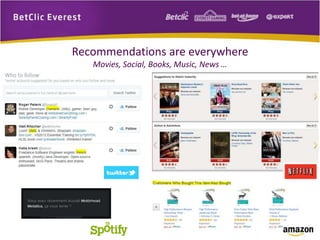
Recommendations are everywhere 
Movies, Social, Books, Music, News …
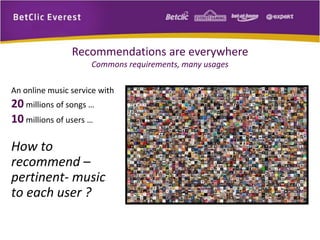
Recommendations are everywhere 
Commons requirements, many usages 
An online music service with 
20 millions of songs … 
10 millions of users … 
How to 
recommend – 
pertinent- music 
to each user ?
Drive Traffic 
A recommendation engine can bring traffic to your site. 
(with personalized email messages and targeted blasts) 
Deliver Relevant Content 
By analyzing the customer’s current site usage and his 
previous browsing history, a recommendation engine can 
deliver relevant product recommendations as he shops. The 
data is collected in real-time so the software can react as his 
shopping habits change. 
Engage Shoppers 
Shoppers become more engaged in the site when 
personalized product recommendations are made. They are 
able to delve more deeply into the product line without 
having to perform search after search. 
Convert Shoppers to Customers 
Converting shoppers into customers takes a special touch. 
Personalized interactions from a recommendation 
engine show your customer that he is valued as an 
individual. In turn, this engenders his loyalty. 
Reduce Workload and Overhead 
Using an engine automates creation of a personal shopping 
experience, easing the workload of your IT staff and your 
budget. 
5 
Recommendation System Benefits (TL;DR) 
Increase Order Value / Number of Items per Order 
Average order values typically go up when 
a recommendation engine in uses to display personalized 
options. Advanced metrics and reporting can definitively 
show the effectiveness of a campaign. 
When the customer is shown options that meet his interest, 
he is more likely to add items to his purchase. 
Control Merchandising and Inventory Rules 
A recommendation engine can add your own marketing and 
inventory control directives to the customer’s profile to 
feature products that are promotionally prices, on clearance 
or overstocked. It gives you’re the flexibility to control what 
items are highlighted by the recommendation system. 
Provide Reports 
Providing reports is an integral part of a personalization 
system. Giving the client accurate and up to the minute 
reporting allows him to make solid decisions about his site 
and the direction of a campaign. 
Offer Advice and Direction 
An experienced provider can offer advice on how to use the 
data collected and reported to the client. Acting as a partner 
and a consultant, the provider should have the know-how to 
help guide the ecommerce site to a prosperous future.
6 
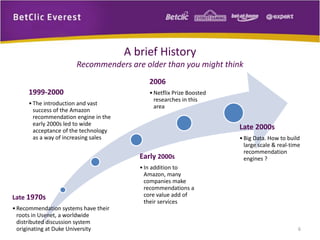
A brief History 
Recommenders are older than you might think 
1999-2000 
• The introduction and vast 
success of the Amazon 
recommendation engine in the 
early 2000s led to wide 
acceptance of the technology 
as a way of increasing sales 
Late 1970s 
• Recommendation systems have their 
roots in Usenet, a worldwide 
distributed discussion system 
originating at Duke University 
2006 
•Netflix Prize Boosted 
researches in this 
area 
Early 2000s 
• In addition to 
Amazon, many 
companies make 
recommendations a 
core value add of 
their services 
Late 2000s 
• Big Data. How to build 
large scale & real-time 
recommendation 
engines ?
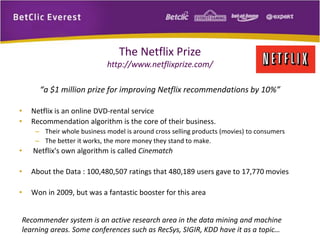
The Netflix Prize 
http://www.netflixprize.com/ 
“a $1 million prize for improving Netflix recommendations by 10%” 
• Netflix is an online DVD-rental service 
• Recommendation algorithm is the core of their business. 
– Their whole business model is around cross selling products (movies) to consumers 
– The better it works, the more money they stand to make. 
• Netflix's own algorithm is called Cinematch 
• About the Data : 100,480,507 ratings that 480,189 users gave to 17,770 movies 
• Won in 2009, but was a fantastic booster for this area 
Recommender system is an active research area in the data mining and machine 
learning areas. Some conferences such as RecSys, SIGIR, KDD have it as a topic…
“The Web, they say, is leaving the era of search and entering one of discovery. What's 
the difference? Search is what you do when you're looking for something. Discovery is 
when something wonderful that you didn't know existed, or didn't know how to ask 
for, finds you.”, Fortune Magazine 
8 
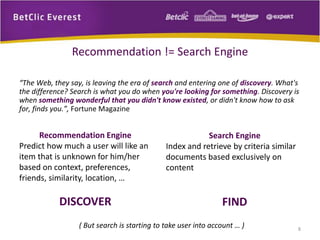
Recommendation != Search Engine 
Recommendation Engine 
Predict how much a user will like an 
item that is unknown for him/her 
based on context, preferences, 
friends, similarity, location, … 
DISCOVER 
Search Engine 
Index and retrieve by criteria similar 
documents based exclusively on 
content 
FIND 
( But search is starting to take user into account … )
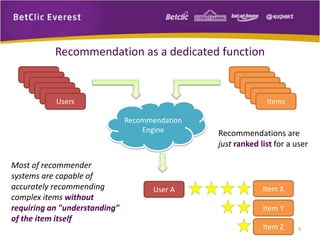
Recommendations are 
just ranked list for a user 
9 
Recommendation as a dedicated function 
Item A 
Item A 
Item A 
Item A 
Item A 
Items 
Item X 
Item Y 
Item Z 
Recommendation 
Engine 
Item A 
Item A 
Item A 
Item A 
Item A 
Users 
User A 
Most of recommender 
systems are capable of 
accurately recommending 
complex items without 
requiring an "understanding" 
of the item itself
• Collaborative filtering 
filtering methods based on collecting and analyzing a large amount of 
information on users’ behaviors, activities or preferences and predicting what 
users will like based on their similarity to other users 
• Content-based filtering 
filtering methods based on a description of the item and a profile of the 
user’s preference. Keywords/Meta are used to describe the items; beside, a 
user profile is built to indicate the type of item this user likes 
• Hybrid Recommender Systems 
Mix collaborative filtering and content-based filtering in several ways ; it 
could be more effective in some cases 
10 
Paradigms
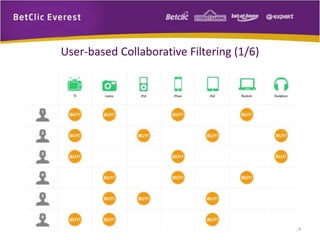
• The most prominent approach to generate recommendations 
– used by large, commercial e‐commerce sites 
– well‐understood, various algorithms and variations exist 
– applicable in many domains (book, movies, DVDs, ..) 
• Approach 
– use the "wisdom of the crowd" to recommend items 
• Basic assumption and idea 
– Users give ratings to catalog items (implicitly or explicitly) 
– Customers who had similar tastes in the past, will have similar tastes in the fu 
ture 
11 
Paradigms – Collaborative Filtering 
The most prominent approach to generate recommendations
Paradigms – Collaborative Filtering 
Plethora of different techniques proposed in the last years 
• Memory‐based approaches 
– the rating matrix is directly used to find neighbors / make predictions 
– does not scale for most real‐world scenarios 
– large e‐commerce sites have tens of millions of customers and millions of ite 
ms 
Ex : kNN, Slope One … 
• Model‐based approaches 
– based on an offline pre‐processing or "model‐learning" phase 
– at run‐time, only the learned model is used to make predictions 
– models are updated / re‐trained periodically 
– large variety of techniques used 
– model‐building and updating can be computationally expensive 
Ex : Matrix Factorization (SVD), clustering models, Bayesian networks, 
probabilistic Latent Semantic Analysis , … 12
13 
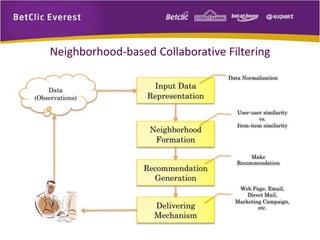
Neighborhood-based Collaborative Filtering
14 
User-based Collaborative Filtering (1/6)
15 
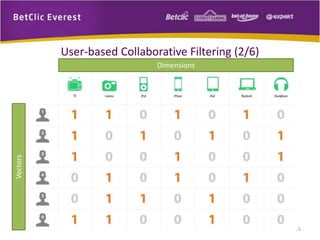
User-based Collaborative Filtering (2/6) 
Dimensions 
Vectors
16 
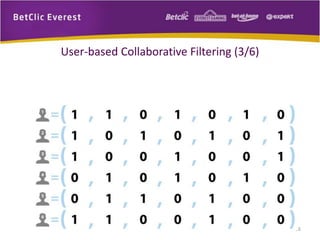
User-based Collaborative Filtering (3/6)
17 
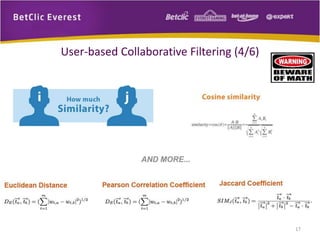
User-based Collaborative Filtering (4/6)
18 
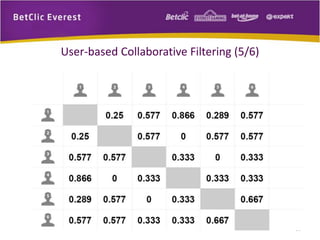
User-based Collaborative Filtering (5/6)
19 
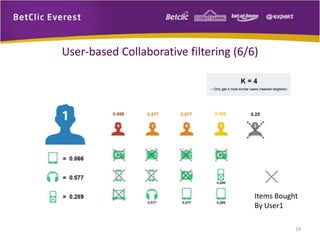
User-based Collaborative filtering (6/6) 
Items Bought 
By User1
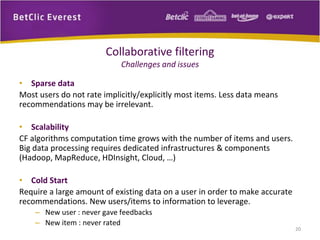
• Sparse data 
Most users do not rate implicitly/explicitly most items. Less data means 
recommendations may be irrelevant. 
• Scalability 
CF algorithms computation time grows with the number of items and users. 
Big data processing requires dedicated infrastructures & components 
(Hadoop, MapReduce, HDInsight, Cloud, …) 
• Cold Start 
Require a large amount of existing data on a user in order to make accurate 
recommendations. New users/items to information to leverage. 
– New user : never gave feedbacks 
– New item : never rated 
20 
Collaborative filtering 
Challenges and issues
• Evaluating Recommender Systems 
– Is a RS efficient with respect to a specific criteria like accuracy, user 
satisfaction, response time, serendipity, online conversion, … 
– Do customers like/buy recommended items? 
– Do customers buy items they otherwise would have not? 
– Are they satisfied with a recommendation after purchase? 
21 
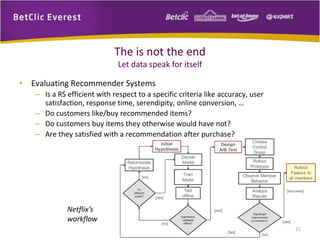
The is not the end 
Let data speak for itself 
Netflix’s 
workflow
22 
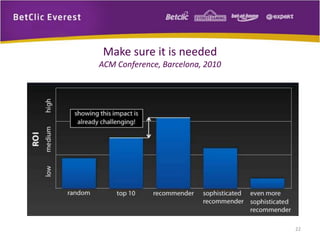
Make sure it is needed 
ACM Conference, Barcelona, 2010
Questions
References 
• http://en.wikipedia.org/wiki/Recommender_system 
• http://en.wikipedia.org/wiki/Collaborative_filtering 
• http://en.wikipedia.org/wiki/Slope_One 
• http://www.slideshare.net/ErnestoMislej/recommender-systems-asai-2011 
• http://www.slideshare.net/torrens/top-10-lessons-learned-developing-deploying-and-operating-realworld- 
recommender-systems-5351028 
• http://www.recsyswiki.com/wiki/Main_Page 
• http://www.slideshare.net/WorapotJakkhupan/basic-of-recommender-system 
• http://pkghosh.wordpress.com/2010/10/19/recommendation-engine-powered-by-hadoop-part-1/ 
• http://web4.cs.ucl.ac.uk/staff/jun.wang/blog/topics/research-resources/collaborative-filtering/ 
• http://techblog.netflix.com/2012/06/netflix-recommendations-beyond-5-stars.html 
• http://www.hindawi.com/journals/aai/2009/421425/ 
• http://www.certona.com/recommendation-software/benefit-of-recommendation-engines 
• http://www.recommenderbook.net/teaching-material 
• http://www.slideshare.net/lonelywolf/how-to-build-a-recommender-system 
• http://www.slideshare.net/kerveros99/essir-2013-recsysfinal-25957057 
• https://github.com/neo4j-contrib/graphgist/wiki
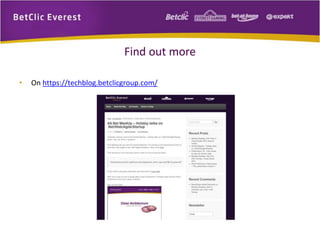
Find out more 
• On https://techblog.betclicgroup.com/
We’re hiring ! 
We want our Sports betting, Poker, Horse 
racing and Casino & Games brands to be easy 
to use for every gamer around the world. 
Code with us to make that happen. 
Look at all the challenges we offer HERE 
Check our Employer Page 
Follow us on LinkedIn
About Us 
• Betclic Everest Group, one of the world leaders in online 
gaming, has a unique portfolio comprising various 
complementary international brands: Betclic, Everest, Bet-at-home. 
com, Expekt, Monte-Carlo Casino… 
• Through our brands, Betclic Everest Group places expertise, 
technological know-how and security at the heart of our 
strategy to deliver an on-line gaming offer attuned to the 
passion of our players. We want our brands to be easy to use 
for every gamer around the world. We’re building our 
company to make that happen. 
• Active in 100 countries with more than 12 million customers 
worldwide, the Group is committed to promoting secure and 
responsible gaming and is a member of several international 
professional associations including the EGBA (European 
Gaming and Betting Association) and the ESSA (European 
Sports Security Association).

Mini-training: Personalization & Recommendation Demystified

  • 1.
    PERSONALIZATION & RECOMMENDATIONDEMYSTIFIED PEOPLE WHO READ THIS PRESENTATION ALSO READ …. MAXIME LEMAITRE – 03/07/14
  • 2.
    Agenda • Introduction • Brief History • Paradigms • An example • This is not ended Recommender/recommendation systems/engines are a subclass of information filtering system that seek to predict the rating or preference that user would give to an item
  • 3.
    Recommendations are everywhere Movies, Social, Books, Music, News …
  • 4.
    Recommendations are everywhere Commons requirements, many usages An online music service with 20 millions of songs … 10 millions of users … How to recommend – pertinent- music to each user ?
  • 5.
    Drive Traffic Arecommendation engine can bring traffic to your site. (with personalized email messages and targeted blasts) Deliver Relevant Content By analyzing the customer’s current site usage and his previous browsing history, a recommendation engine can deliver relevant product recommendations as he shops. The data is collected in real-time so the software can react as his shopping habits change. Engage Shoppers Shoppers become more engaged in the site when personalized product recommendations are made. They are able to delve more deeply into the product line without having to perform search after search. Convert Shoppers to Customers Converting shoppers into customers takes a special touch. Personalized interactions from a recommendation engine show your customer that he is valued as an individual. In turn, this engenders his loyalty. Reduce Workload and Overhead Using an engine automates creation of a personal shopping experience, easing the workload of your IT staff and your budget. 5 Recommendation System Benefits (TL;DR) Increase Order Value / Number of Items per Order Average order values typically go up when a recommendation engine in uses to display personalized options. Advanced metrics and reporting can definitively show the effectiveness of a campaign. When the customer is shown options that meet his interest, he is more likely to add items to his purchase. Control Merchandising and Inventory Rules A recommendation engine can add your own marketing and inventory control directives to the customer’s profile to feature products that are promotionally prices, on clearance or overstocked. It gives you’re the flexibility to control what items are highlighted by the recommendation system. Provide Reports Providing reports is an integral part of a personalization system. Giving the client accurate and up to the minute reporting allows him to make solid decisions about his site and the direction of a campaign. Offer Advice and Direction An experienced provider can offer advice on how to use the data collected and reported to the client. Acting as a partner and a consultant, the provider should have the know-how to help guide the ecommerce site to a prosperous future.
  • 6.
    6 A briefHistory Recommenders are older than you might think 1999-2000 • The introduction and vast success of the Amazon recommendation engine in the early 2000s led to wide acceptance of the technology as a way of increasing sales Late 1970s • Recommendation systems have their roots in Usenet, a worldwide distributed discussion system originating at Duke University 2006 •Netflix Prize Boosted researches in this area Early 2000s • In addition to Amazon, many companies make recommendations a core value add of their services Late 2000s • Big Data. How to build large scale & real-time recommendation engines ?
  • 7.
    The Netflix Prize http://www.netflixprize.com/ “a $1 million prize for improving Netflix recommendations by 10%” • Netflix is an online DVD-rental service • Recommendation algorithm is the core of their business. – Their whole business model is around cross selling products (movies) to consumers – The better it works, the more money they stand to make. • Netflix's own algorithm is called Cinematch • About the Data : 100,480,507 ratings that 480,189 users gave to 17,770 movies • Won in 2009, but was a fantastic booster for this area Recommender system is an active research area in the data mining and machine learning areas. Some conferences such as RecSys, SIGIR, KDD have it as a topic…
  • 8.
    “The Web, theysay, is leaving the era of search and entering one of discovery. What's the difference? Search is what you do when you're looking for something. Discovery is when something wonderful that you didn't know existed, or didn't know how to ask for, finds you.”, Fortune Magazine 8 Recommendation != Search Engine Recommendation Engine Predict how much a user will like an item that is unknown for him/her based on context, preferences, friends, similarity, location, … DISCOVER Search Engine Index and retrieve by criteria similar documents based exclusively on content FIND ( But search is starting to take user into account … )
  • 9.
    Recommendations are justranked list for a user 9 Recommendation as a dedicated function Item A Item A Item A Item A Item A Items Item X Item Y Item Z Recommendation Engine Item A Item A Item A Item A Item A Users User A Most of recommender systems are capable of accurately recommending complex items without requiring an "understanding" of the item itself
  • 10.
    • Collaborative filtering filtering methods based on collecting and analyzing a large amount of information on users’ behaviors, activities or preferences and predicting what users will like based on their similarity to other users • Content-based filtering filtering methods based on a description of the item and a profile of the user’s preference. Keywords/Meta are used to describe the items; beside, a user profile is built to indicate the type of item this user likes • Hybrid Recommender Systems Mix collaborative filtering and content-based filtering in several ways ; it could be more effective in some cases 10 Paradigms
  • 11.
    • The mostprominent approach to generate recommendations – used by large, commercial e‐commerce sites – well‐understood, various algorithms and variations exist – applicable in many domains (book, movies, DVDs, ..) • Approach – use the "wisdom of the crowd" to recommend items • Basic assumption and idea – Users give ratings to catalog items (implicitly or explicitly) – Customers who had similar tastes in the past, will have similar tastes in the fu ture 11 Paradigms – Collaborative Filtering The most prominent approach to generate recommendations
  • 12.
    Paradigms – CollaborativeFiltering Plethora of different techniques proposed in the last years • Memory‐based approaches – the rating matrix is directly used to find neighbors / make predictions – does not scale for most real‐world scenarios – large e‐commerce sites have tens of millions of customers and millions of ite ms Ex : kNN, Slope One … • Model‐based approaches – based on an offline pre‐processing or "model‐learning" phase – at run‐time, only the learned model is used to make predictions – models are updated / re‐trained periodically – large variety of techniques used – model‐building and updating can be computationally expensive Ex : Matrix Factorization (SVD), clustering models, Bayesian networks, probabilistic Latent Semantic Analysis , … 12
  • 13.
  • 14.
  • 15.
    15 User-based CollaborativeFiltering (2/6) Dimensions Vectors
  • 16.
  • 17.
  • 18.
  • 19.
    19 User-based Collaborativefiltering (6/6) Items Bought By User1
  • 20.
    • Sparse data Most users do not rate implicitly/explicitly most items. Less data means recommendations may be irrelevant. • Scalability CF algorithms computation time grows with the number of items and users. Big data processing requires dedicated infrastructures & components (Hadoop, MapReduce, HDInsight, Cloud, …) • Cold Start Require a large amount of existing data on a user in order to make accurate recommendations. New users/items to information to leverage. – New user : never gave feedbacks – New item : never rated 20 Collaborative filtering Challenges and issues
  • 21.
    • Evaluating RecommenderSystems – Is a RS efficient with respect to a specific criteria like accuracy, user satisfaction, response time, serendipity, online conversion, … – Do customers like/buy recommended items? – Do customers buy items they otherwise would have not? – Are they satisfied with a recommendation after purchase? 21 The is not the end Let data speak for itself Netflix’s workflow
  • 22.
    22 Make sureit is needed ACM Conference, Barcelona, 2010
  • 23.
  • 24.
    References • http://en.wikipedia.org/wiki/Recommender_system • http://en.wikipedia.org/wiki/Collaborative_filtering • http://en.wikipedia.org/wiki/Slope_One • http://www.slideshare.net/ErnestoMislej/recommender-systems-asai-2011 • http://www.slideshare.net/torrens/top-10-lessons-learned-developing-deploying-and-operating-realworld- recommender-systems-5351028 • http://www.recsyswiki.com/wiki/Main_Page • http://www.slideshare.net/WorapotJakkhupan/basic-of-recommender-system • http://pkghosh.wordpress.com/2010/10/19/recommendation-engine-powered-by-hadoop-part-1/ • http://web4.cs.ucl.ac.uk/staff/jun.wang/blog/topics/research-resources/collaborative-filtering/ • http://techblog.netflix.com/2012/06/netflix-recommendations-beyond-5-stars.html • http://www.hindawi.com/journals/aai/2009/421425/ • http://www.certona.com/recommendation-software/benefit-of-recommendation-engines • http://www.recommenderbook.net/teaching-material • http://www.slideshare.net/lonelywolf/how-to-build-a-recommender-system • http://www.slideshare.net/kerveros99/essir-2013-recsysfinal-25957057 • https://github.com/neo4j-contrib/graphgist/wiki
  • 25.
    Find out more • On https://techblog.betclicgroup.com/
  • 26.
    We’re hiring ! We want our Sports betting, Poker, Horse racing and Casino & Games brands to be easy to use for every gamer around the world. Code with us to make that happen. Look at all the challenges we offer HERE Check our Employer Page Follow us on LinkedIn
  • 27.
    About Us •Betclic Everest Group, one of the world leaders in online gaming, has a unique portfolio comprising various complementary international brands: Betclic, Everest, Bet-at-home. com, Expekt, Monte-Carlo Casino… • Through our brands, Betclic Everest Group places expertise, technological know-how and security at the heart of our strategy to deliver an on-line gaming offer attuned to the passion of our players. We want our brands to be easy to use for every gamer around the world. We’re building our company to make that happen. • Active in 100 countries with more than 12 million customers worldwide, the Group is committed to promoting secure and responsible gaming and is a member of several international professional associations including the EGBA (European Gaming and Betting Association) and the ESSA (European Sports Security Association).