WELCOME

 Workshop Room 2
         © Agile Experience Ltd


Rachel Davies - Surfing
    the Agile Wave


         © Agile Experience Ltd


                                  1
Surfing the Agile Wave

                  by Rachel Davies


             Introductions
About me:
• Independent consultant / trainer
• Used Agile approaches since 2000
• Author of “Agile Coaching” book

About you:
• Not tried Agile yet?
• Just got started with Agile?
• Been Agile for a while?
                        © Agile Experience Ltd


                                                 2
Desire
 Many companies attracted to Agile benefits:
 • Getting software out earlier
 • Being responsive to customers
 • Lightweight approach

 They are often struggling to cope with pace
  of change and being able to predict what
  will be ready when.
                     © Agile Experience Ltd


How do we get started?


                     © Agile Experience Ltd


                                               3
Try It
Most companies start with pilot
  projects to prove approach can
  work for them.
• Often safe candidates
• Isolated from mainstream issues

Make do with current infrastructure:
 tools, environment, organisation
 structure


                       © Agile Experience Ltd


                   Jumping In

  Subsequent Agile projects don’t get the same
    attention:
  • Not ideal candidates for Agile
  • Core principles ignored
  • Support for Agile is weak


                       © Agile Experience Ltd


                                                 4
No Time
Rushing so not doing things properly


         Cargo Cult
           Looks Agile


                                       5
Scrum But
      Only do the easy parts


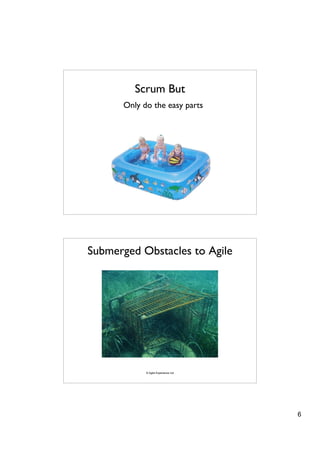
Submerged Obstacles to Agile


            © Agile Experience Ltd


                                     6
Agile is pervasive


Agile can have impact on many areas:
• Team composition
• Office furniture
• Build environments
• Hiring policy
• Line management
• Incentives
                        © Agile Experience Ltd


          Traditional Approach


       Phases of activity focused on a fixed-
       scope release.
       • Divide the work
       • Resist change
       • Communicate via documents
                        © Agile Experience Ltd


                                                 7
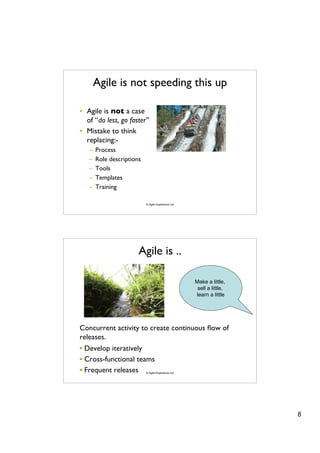
Agile is not speeding this up

• Agile is not a case
  of “do less, go faster”
• Mistake to think
  replacing:-
   –   Process
   –   Role descriptions
   –   Tools
   –   Templates
   –   Training

                           © Agile Experience Ltd


                       Agile is ..

                                                    Make a little,
                                                     sell a little,
                                                    learn a little


Concurrent activity to create continuous flow of
releases.
• Develop iteratively
• Cross-functional teams
• Frequent releases        © Agile Experience Ltd


                                                                      8
Agile depends on Teamwork


      Real-time interactions rather than process orchestrated
      via artefacts.          © Agile Experience Ltd


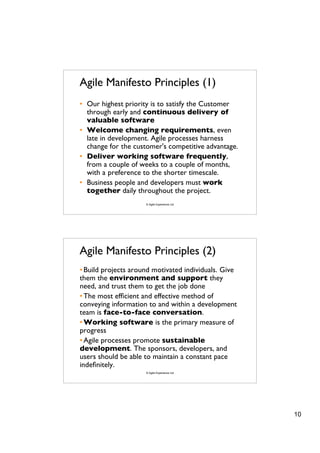
                                 Agile Values
We are uncovering better ways of developing software by doing it and helping
others do it. Through this work we have come to value:

Individuals & Interactions over Processes & Tools
Working software over Comprehensive documentation
Customer collaboration over Contract negotiation
Responding to change over Following a plan

While there is value in the items on the right,
we value the items on the left more.


www.agilemanifesto.org
                                      © Agile Experience Ltd


                                                                               9
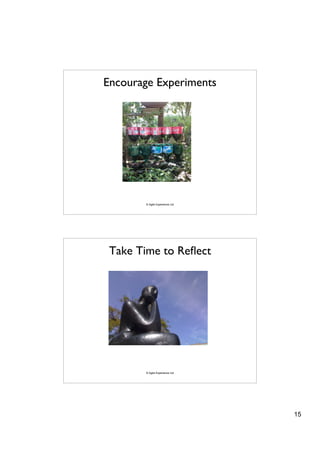
Agile Manifesto Principles (1)
• Our highest priority is to satisfy the Customer
  through early and continuous delivery of
     valuable software
• Welcome changing requirements, even
     late in development. Agile processes harness
     change for the customer's competitive advantage.
• Deliver working software frequently,
     from a couple of weeks to a couple of months,
     with a preference to the shorter timescale.
• Business people and developers must work
     together daily throughout the project.
                       © Agile Experience Ltd


Agile Manifesto Principles (2)
• Build projects around motivated individuals. Give
them the environment and support they
need, and trust them to get the job done
• The most efficient and effective method of
conveying information to and within a development
team is face-to-face conversation.
• Working software is the primary measure of
progress
• Agile processes promote sustainable
development. The sponsors, developers, and
users should be able to maintain a constant pace
indefinitely.
                       © Agile Experience Ltd


                                                           10
Agile Manifesto Principles (3)

• Continuous attention to technical excellence
and good design enhances agility.
   • Simplicity--the art of maximizing the amount of
   work not done--is essential.
   • The best architectures, requirements, and designs
   emerge from self-organizing teams
      • At regular intervals, the team reflects on how to
      become more effective, then tunes and adjusts its
      behavior accordingly.


                          © Agile Experience Ltd


        What Support Is Needed?


                          © Agile Experience Ltd


                                                              11
Get Serious about Delivery


          © Agile Experience Ltd


  Environment matters


                                   12
Broken Pipelines
• How we build
  software needs
  attention to improve
  flow.
• Often the pipeline to
  live is broken and
  requires manual
  intervention to get
  software out to
  customers.

                     © Agile Experience Ltd


 Teamwork relies on Motivation
• Make vision and
  benefits clear
• Permission to try new
  approach
• Empower team to
  make choices about
  how they work
• Build awareness and
  responsibility


                     © Agile Experience Ltd


                                              13
New Skills Take Time


Becoming agile requires:
• Understanding principles
• Time to practice
• Coaching to avoid old habits

                     © Agile Experience Ltd


            Strive for Quality


                     © Agile Experience Ltd


                                              14
Encourage Experiments


       © Agile Experience Ltd


 Take Time to Reflect


       © Agile Experience Ltd


                                15
Be Patient


                    Change takes time
                             © Agile Experience Ltd


                     Further Reading
Mike Cohn
• “Succeeding with Agile”

Rachel Davies  Liz Sedley
• “Agile Coaching”

James Shore  Shane Warden
• “The Art of Agile Development”

Jez Humble  Dave Farley
• “Continuous Deployment”

                             © Agile Experience Ltd


                                                      16
Any Questions?

Get in touch
   –   Email: rachel@agilexp.com
   –   Twitter: @rachelcdavies
   –   Blog: http://agilecoach.typepad.com/
   –   Web: http://www.agilexp.com


                              © Agile Experience Ltd


                                                       17

Surfing the Agile Wave

  • 1.
    WELCOME Workshop Room2 © Agile Experience Ltd Rachel Davies - Surfing the Agile Wave © Agile Experience Ltd 1
  • 2.
    Surfing the AgileWave by Rachel Davies Introductions About me: • Independent consultant / trainer • Used Agile approaches since 2000 • Author of “Agile Coaching” book About you: • Not tried Agile yet? • Just got started with Agile? • Been Agile for a while? © Agile Experience Ltd 2
  • 3.
    Desire Many companiesattracted to Agile benefits: • Getting software out earlier • Being responsive to customers • Lightweight approach They are often struggling to cope with pace of change and being able to predict what will be ready when. © Agile Experience Ltd How do we get started? © Agile Experience Ltd 3
  • 4.
    Try It Most companiesstart with pilot projects to prove approach can work for them. • Often safe candidates • Isolated from mainstream issues Make do with current infrastructure: tools, environment, organisation structure © Agile Experience Ltd Jumping In Subsequent Agile projects don’t get the same attention: • Not ideal candidates for Agile • Core principles ignored • Support for Agile is weak © Agile Experience Ltd 4
  • 5.
    No Time Rushing sonot doing things properly Cargo Cult Looks Agile 5
  • 6.
    Scrum But Only do the easy parts Submerged Obstacles to Agile © Agile Experience Ltd 6
  • 7.
    Agile is pervasive Agilecan have impact on many areas: • Team composition • Office furniture • Build environments • Hiring policy • Line management • Incentives © Agile Experience Ltd Traditional Approach Phases of activity focused on a fixed- scope release. • Divide the work • Resist change • Communicate via documents © Agile Experience Ltd 7
  • 8.
    Agile is notspeeding this up • Agile is not a case of “do less, go faster” • Mistake to think replacing:- – Process – Role descriptions – Tools – Templates – Training © Agile Experience Ltd Agile is .. Make a little, sell a little, learn a little Concurrent activity to create continuous flow of releases. • Develop iteratively • Cross-functional teams • Frequent releases © Agile Experience Ltd 8
  • 9.
    Agile depends onTeamwork Real-time interactions rather than process orchestrated via artefacts. © Agile Experience Ltd Agile Values We are uncovering better ways of developing software by doing it and helping others do it. Through this work we have come to value: Individuals & Interactions over Processes & Tools Working software over Comprehensive documentation Customer collaboration over Contract negotiation Responding to change over Following a plan While there is value in the items on the right, we value the items on the left more. www.agilemanifesto.org © Agile Experience Ltd 9
  • 10.
    Agile Manifesto Principles(1) • Our highest priority is to satisfy the Customer through early and continuous delivery of valuable software • Welcome changing requirements, even late in development. Agile processes harness change for the customer's competitive advantage. • Deliver working software frequently, from a couple of weeks to a couple of months, with a preference to the shorter timescale. • Business people and developers must work together daily throughout the project. © Agile Experience Ltd Agile Manifesto Principles (2) • Build projects around motivated individuals. Give them the environment and support they need, and trust them to get the job done • The most efficient and effective method of conveying information to and within a development team is face-to-face conversation. • Working software is the primary measure of progress • Agile processes promote sustainable development. The sponsors, developers, and users should be able to maintain a constant pace indefinitely. © Agile Experience Ltd 10
  • 11.
    Agile Manifesto Principles(3) • Continuous attention to technical excellence and good design enhances agility. • Simplicity--the art of maximizing the amount of work not done--is essential. • The best architectures, requirements, and designs emerge from self-organizing teams • At regular intervals, the team reflects on how to become more effective, then tunes and adjusts its behavior accordingly. © Agile Experience Ltd What Support Is Needed? © Agile Experience Ltd 11
  • 12.
    Get Serious aboutDelivery © Agile Experience Ltd Environment matters 12
  • 13.
    Broken Pipelines • Howwe build software needs attention to improve flow. • Often the pipeline to live is broken and requires manual intervention to get software out to customers. © Agile Experience Ltd Teamwork relies on Motivation • Make vision and benefits clear • Permission to try new approach • Empower team to make choices about how they work • Build awareness and responsibility © Agile Experience Ltd 13
  • 14.
    New Skills TakeTime Becoming agile requires: • Understanding principles • Time to practice • Coaching to avoid old habits © Agile Experience Ltd Strive for Quality © Agile Experience Ltd 14
  • 15.
    Encourage Experiments © Agile Experience Ltd Take Time to Reflect © Agile Experience Ltd 15
  • 16.
    Be Patient Change takes time © Agile Experience Ltd Further Reading Mike Cohn • “Succeeding with Agile” Rachel Davies Liz Sedley • “Agile Coaching” James Shore Shane Warden • “The Art of Agile Development” Jez Humble Dave Farley • “Continuous Deployment” © Agile Experience Ltd 16
  • 17.
    Any Questions? Get intouch – Email: rachel@agilexp.com – Twitter: @rachelcdavies – Blog: http://agilecoach.typepad.com/ – Web: http://www.agilexp.com © Agile Experience Ltd 17