- 1 -
The Lean Change Method
- 2 -
I first talked about the Change Canvas in my book the
Lean Change Method
• A good metaphor for an agile change team is a (lean)
startup
• Minimum Viable Change
• Co-Creative Change
• Validated Change
Take a look, download the book for free at
goo.gl/8be7mz
A bit about Jeff Anderson (that’s me!)…
• Been trying out agile since Junit first became a thing…
• I like to help (technology) knowledge workers be
awesome at what they do!
• Help enterprise move along the path to agility, all
shapes an size
• President of Agile By Design, we have a lot of agile
change stories, lots of experience, mistakes!
http://agilebydesign.com/
- 3 -
Brief Agenda
• A quick intro on the Lean Change Method
• Different ways to validate your adoption
• The Change Canvas Workshop
Get this presentation (and a bunch of others )
https://www.slideshare.net/agilebydesign/presentations http://agilebydesign.com/
- 4 -
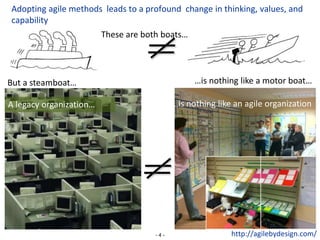
These are both boats…
…is nothing like a motor boat…But a steamboat…
A legacy organization… …is nothing like an agile organization
Adopting agile methods leads to a profound change in thinking, values, and
capability
http://agilebydesign.com/
- 5 -
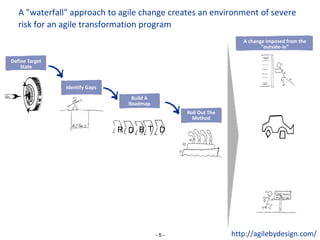
A "continuous delivery programA "waterfall" approach to agile change creates an environment of severe
risk for an agile transformation program
Identify Gaps
Build a Change
Backlog
Build A
Roadmap
Build a Change
Backlog
Roll Out The
Method
R D B T D
A change imposed from the
"outside-in"
Define Target
State
http://agilebydesign.com/
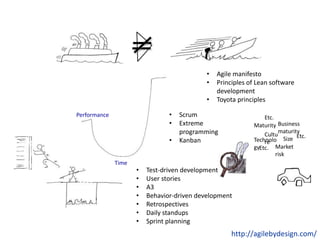
• Agile manifesto
• Principles of Lean software
development
• Toyota principles
Performance
Time
• Test-driven development
• User stories
• A3
• Behavior-driven development
• Retrospectives
• Daily standups
• Sprint planning
• Scrum
• Extreme
programming
• Kanban
Etc.
Business
maturity
Maturity
Cultu
reTechnolo
gy
Size
Market
risk
Etc.
Etc.
http://agilebydesign.com/
- 7 -
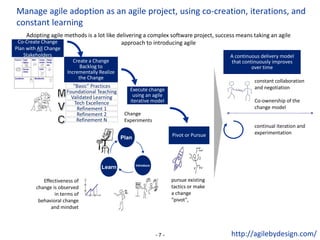
Manage agile adoption as an agile project, using co-creation, iterations, and
constant learning
Adopting agile methods is a lot like delivering a complex software project, success means taking an agile
approach to introducing agileCo-Create Change
Plan with All Change
Stakeholders
pursue existing
tactics or make
a change
“pivot",
Build a Change
Backlog
“Basic” Practices
Foundational Teaching
Validated Learning
Tech Excellence
Refinement 1
Refinement 2
Refinement N
Build a Change
Backlog
Effectiveness of
change is observed
in terms of
behavioral change
and mindset
Change
Experiments
constant collaboration
and negotiation
Co-ownership of the
change model
continual iteration and
experimentation
Create a Change
Backlog to
Incrementally Realize
the Change
Execute change
using an agile
iterative model
Pivot or Pursue
A continuous delivery model
that continuously improves
over time
Plan
Introduce
Learn
http://agilebydesign.com/
- 8 - http://agilebydesign.com/
- 9 -
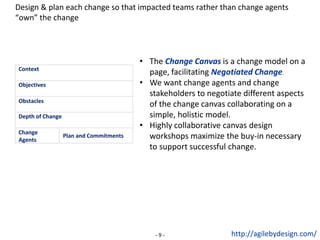
Design & plan each change so that impacted teams rather than change agents
“own” the change
• The Change Canvas is a change model on a
page, facilitating Negotiated Change.
• We want change agents and change
stakeholders to negotiate different aspects
of the change canvas collaborating on a
simple, holistic model.
• Highly collaborative canvas design
workshops maximize the buy-in necessary
to support successful change.
http://agilebydesign.com/
Context
Change
Agents
Objectives
Obstacles
Depth of Change
Plan and Commitments
- 10 -
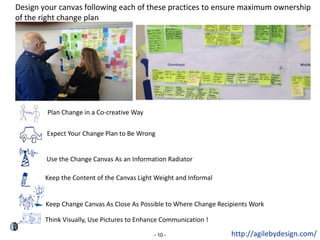
Design your canvas following each of these practices to ensure maximum ownership
of the right change plan
Plan Change in a Co-creative Way
Expect Your Change Plan to Be Wrong
Use the Change Canvas As an Information Radiator
Keep the Content of the Canvas Light Weight and Informal
Think Visually, Use Pictures to Enhance Communication !
Keep Change Canvas As Close As Possible to Where Change Recipients Work
http://agilebydesign.com/
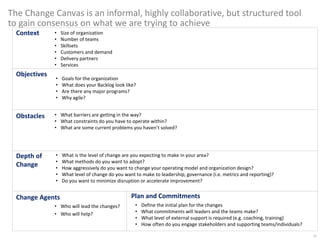
The Change Canvas is an informal, highly collaborative, but structured tool
to gain consensus on what we are trying to achieve
11
Context
Change Agents
• Who will lead the changes?
• Who will help?
• Size of organization
• Number of teams
• Skillsets
• Customers and demand
• Delivery partners
• Services
• Technology
• Capability, methods and/or processes
Objectives
• Goals for the organization
• What does your Backlog look like?
• Are there any major programs?
• Why agile?
Obstacles • What barriers are getting in the way?
• What constraints do you have to operate within?
• What are some current problems you haven’t solved?
Depth of
Change
• What is the level of change are you expecting to make in your area?
• What methods do you want to adopt?
• How aggressively do you want to change your operating model and organization design?
• What level of change do you want to make to leadership, governance (i.e. metrics and reporting)?
• Do you want to minimize disruption or accelerate improvement?
Plan and Commitments
• Define the initial plan for the changes
• What commitments will leaders and the teams make?
• What level of external support is required (e.g. coaching, training)
• How often do you engage stakeholders and supporting teams/individuals?
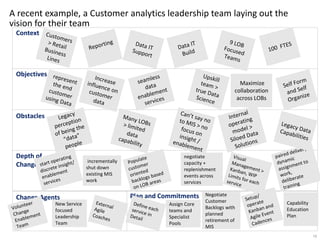
A recent example, a Customer analytics leadership team laying out the
vision for their team
12
Context
Change Agents
Objectives
Obstacles
Depth of
Change
Plan and Commitments
Maximize
collaboration
across LOBs
incrementally
shut down
existing MIS
work
negotiate
capacity +
replenishment
events across
services
New Service
focused
Leadership
Team
Assign Core
teams and
Specialist
Pools
Negotiate
Customer
Backlogs with
planned
retirement of
MIS
Capability
Education
Plan
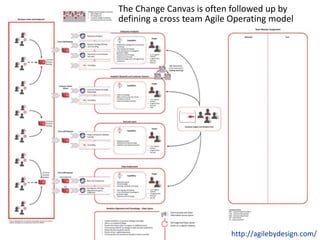
The Change Canvas is often followed up by
defining a cross team Agile Operating model
http://agilebydesign.com/
14 http://agilebydesign.com/
15
Dec 14th (3) Dec 1st (3) Next(2) Prepare (1) Introduce(2) Learn(1) Done
Contextualize
agilesolution
On boardcurrent
workas user
stories (x2
sessions)
3vsm sessions
willreveal
urgencys
teamcan
collaborateon
workingagile
solutionin2
weeks
Facilitate
retrospective1
(x1)
Introduce/coach
classresponsibility
cardsmodeling
(x4 sessions)
Establish monthly
releaseplanning
Establish
bi-weekly
replenish-
ment of stories
Co-facilitatehigh
levelstory
mappingsessions
(x3)
Co-facilitatestory
mappingfor
release2
(x2)
MVC: Foundational Agile
Bootstrapping for WebDev
Team
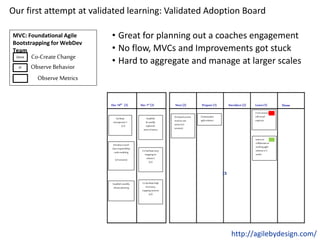
Our first attempt at validated learning: Validated Adoption Board
Done Co-CreateChange
Observe Behavior
Observe Metrics
IP
• Great for planning out a coaches engagement
• No flow, MVCs and Improvements got stuck
• Hard to aggregate and manage at larger scales
http://agilebydesign.com/
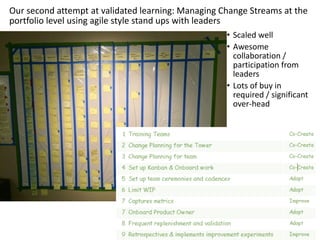
Our second attempt at validated learning: Managing Change Streams at the
portfolio level using agile style stand ups with leaders
• Scaled well
• Awesome
collaboration /
participation from
leaders
• Lots of buy in
required / significant
over-head
Open collaboration trumps
working in a silo
Teams constantly collaborating
through visual task management and
agile events
We own our process, and
want to improve it
Teams are agreeing on definitions of
done, and actively improving them
through qualitative feedback
Agile is worth the effort
Teams and leaders spend the time
and energy required to establish a
new system of work
Initiate Foundational DominateAccelerate
Stop starting and start finishing
eliminates organizational dysfunction
Teams visually manage the workflow of
story delivery, minimizing unfinished
stories, and leaders actively tackle
impediments
Experimentation driven
improvement accelerates our
ability to deliver
Teams are constantly innovating on their
system of work, and actively improving it
through the scientific method
Team trump role, department, or
function
Leaders and workers promote an
environment where value gets delivered
in cross-functional teams that are open,
safe, and based on trust
Radical Decentralization fuels
agility
Leaders adapt org structure based on
market demand, with minimizing hand-
offs
Delivering value frequently while
minimizing delay leads to superior
business outcomes
Teams visually manage the workflow of
end to end delivery, minimizing scope and
delay of business releases
Our focus is on solving complex
problems
Teams automate all repeatable work,
and drive out manual processes through
software
Our organization is structured
around customer experience
Business/Tech/Ops Teams self form
and even self direct based on market
change
Validating assumptions through
customer experimentation lead to
winning the market
Teams visually manage the workflow of
validated learning, minimizing the lead
time to Learning
Unrelenting commitment to
excellence in the face of short term
pressure
Teams pro-actively adopt engineering and
other best practices, because they know it
will make them faster
Frequent Feedback from real
users drives our direction
Team strive to validate their work
with end users as frequently, and
incorporate that work into their
backlog
Design starts with the customer
experience
Teams deliver value using UCD /UX,
designing using a Just in Time and just
enough approach
We define success in terms of our
ability to influence user behavior
Teams us qualitative techniques to
define and validate features based on
expected behavioral change required to
meet business outcomes
Validating assumptions through
customer experimentation lead
to winning the market
Teams validate user impact through
experiments supported by analytics
with statistical significance
Business actively owns our
backlog is critical to our success
Team are actively managing work
through and incremental backlog of
work, managed by active business
stakeholders
All work is described in terms of fined
grained increments of value
The business expresses backlogs in terms
of stories that guide all discussions and
collaboration around value creation
Don't deliver more stories, deliver
smaller value with less delay
Everyone start to optimize work based
on the economics of value over effort,
and delay over efficiency
Accelerate the pace of market
learning over value delivery
The business expresses work in terms of
increments of market learning and
customer hypothesis
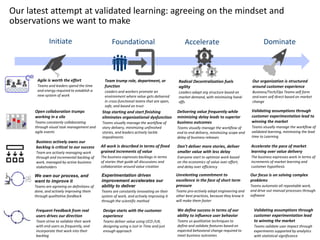
Our latest attempt at validated learning: agreeing on the mindset and
observations we want to make
Open collaboration trumps
working in a silo
Teams constantly collaborating
through visual task management and
agile events
We own our process, and
want to improve it
Teams are agreeing on definitions of
done, and actively improving them
through qualitative feedback
Agile is worth the effort
Teams and leaders spend the time
and energy required to establish a
new system of work
Initiate Foundational DominateAccelerate
Stop starting and start finishing
eliminates organizational dysfunction
Teams visually manage the workflow of
story delivery, minimizing unfinished
stories, and leaders actively tackle
impediments
Experimentation driven
improvement accelerates our
ability to deliver
Teams are constantly innovating on their
system of work, and actively improving it
through the scientific method
Team trump role, department, or
function
Leaders and workers promote an
environment where value gets delivered
in cross-functional teams that are open,
safe, and based on trust
Radical Decentralization fuels
agility
Leaders adapt org structure based on
market demand, with minimizing hand-
offs
Delivering value frequently while
minimizing delay leads to superior
business outcomes
Teams visually manage the workflow of
end to end delivery, minimizing scope and
delay of business releases
Our focus is on solving complex
problems
Teams automate all repeatable work,
and drive out manual processes through
software
Our organization is structured
around customer experience
Business/Tech/Ops Teams self form
and even self direct based on market
change
Validating assumptions through
customer experimentation lead to
winning the market
Teams visually manage the workflow of
validated learning, minimizing the lead
time to Learning
Unrelenting commitment to
excellence in the face of short term
pressure
Teams pro-actively adopt engineering and
other best practices, because they know it
will make them faster
Frequent Feedback from real
users drives our direction
Team strive to validate their work
with end users as frequently, and
incorporate that work into their
backlog
Design starts with the customer
experience
Teams deliver value using UCD /UX,
designing using a Just in Time and just
enough approach
We define success in terms of our
ability to influence user behavior
Teams us qualitative techniques to
define and validate features based on
expected behavioral change required to
meet business outcomes
Validating assumptions through
customer experimentation lead
to winning the market
Teams validate user impact through
experiments supported by analytics
with statistical significance
Business actively owns our
backlog is critical to our success
Team are actively managing work
through and incremental backlog of
work, managed by active business
stakeholders
All work is described in terms of fined
grained increments of value
The business expresses backlogs in terms
of stories that guide all discussions and
collaboration around value creation
Don't deliver more stories, deliver
smaller value with less delay
Everyone start to optimize work based
on the economics of value over effort,
and delay over efficiency
Accelerate the pace of market
learning over value delivery
The business expresses work in terms of
increments of market learning and
customer hypothesis
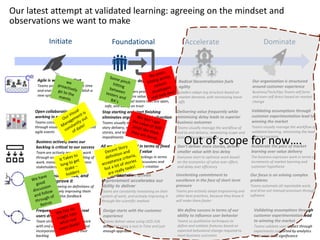
Out of scope for now….
Our latest attempt at validated learning: agreeing on the mindset and
observations we want to make
Done+4 Months
Team 2
Team 3
3 Months 2 Months Next Month Not Started
B
B
B
B
B
B
B
BB
BB
B
B
MentoringDoing / Teaching Coaching Independent
B BB
B
B
B
B
B
B B BB
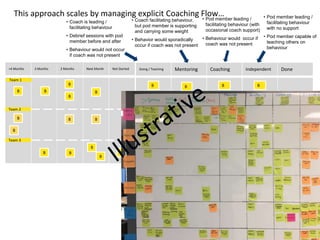
This approach scales by managing explicit Coaching Flow…
Team 1
B
• Coach is leading /
facilitating behaviour
• Debrief sessions with pod
member before and after
• Behaviour would not occur
if coach was not present
• Coach facilitating behaviour,
but pod member is supporting
and carrying some weight
• Behavior would sporadically
occur if coach was not present
• Pod member leading /
facilitating behaviour (with
occasional coach support)
• Behaviour would occur if
coach was not present
• Pod member leading /
facilitating behaviour
with no support
• Pod member capable of
teaching others on
behaviour
20
0
20
40
60
80
100
120
140
160
180
200
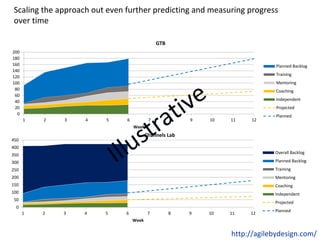
1 2 3 4 5 6 7 8 9 10 11 12
Week
GTB
Planned Backlog
Training
Mentoring
Coaching
Independent
Projected
Planned
0
50
100
150
200
250
300
350
400
450
1 2 3 4 5 6 7 8 9 10 11 12
Week
Channels Lab
Overall Backlog
Planned Backlog
Training
Mentoring
Coaching
Independent
Projected
Planned
Scaling the approach out even further predicting and measuring progress
over time
http://agilebydesign.com/
Lean Change is really a set of principles you can apply to your agile adoption
21
• Two key principles
• Co-Creative Change
• Validated Adoption
• Lots of ways to apply the method, come up with your own approach!
• Staying true to these principles is a constant challenge, keep reminding yourself
• A quick Side Note: Agile Ecosystem Design 2 Day Workshop
• Looking for a first cohort for MVP1 of this course
• Focus is on figuring out teams structure and setting up the supporting Agile
operating model
• If interested connect with me at Jeff.Anderson@agilebydesign.com
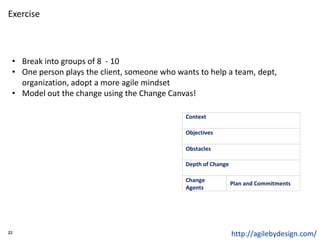
Exercise
22
• Break into groups of 8 - 10
• One person plays the client, someone who wants to help a team, dept,
organization, adopt a more agile mindset
• Model out the change using the Change Canvas!
Context
Change
Agents
Objectives
Obstacles
Depth of Change
Plan and Commitments
http://agilebydesign.com/

Lean change method toronto agile meetup

  • 1.
    - 1 - TheLean Change Method
  • 2.
    - 2 - Ifirst talked about the Change Canvas in my book the Lean Change Method • A good metaphor for an agile change team is a (lean) startup • Minimum Viable Change • Co-Creative Change • Validated Change Take a look, download the book for free at goo.gl/8be7mz A bit about Jeff Anderson (that’s me!)… • Been trying out agile since Junit first became a thing… • I like to help (technology) knowledge workers be awesome at what they do! • Help enterprise move along the path to agility, all shapes an size • President of Agile By Design, we have a lot of agile change stories, lots of experience, mistakes! http://agilebydesign.com/
  • 3.
    - 3 - BriefAgenda • A quick intro on the Lean Change Method • Different ways to validate your adoption • The Change Canvas Workshop Get this presentation (and a bunch of others ) https://www.slideshare.net/agilebydesign/presentations http://agilebydesign.com/
  • 4.
    - 4 - Theseare both boats… …is nothing like a motor boat…But a steamboat… A legacy organization… …is nothing like an agile organization Adopting agile methods leads to a profound change in thinking, values, and capability http://agilebydesign.com/
  • 5.
    - 5 - A"continuous delivery programA "waterfall" approach to agile change creates an environment of severe risk for an agile transformation program Identify Gaps Build a Change Backlog Build A Roadmap Build a Change Backlog Roll Out The Method R D B T D A change imposed from the "outside-in" Define Target State http://agilebydesign.com/
  • 6.
    • Agile manifesto •Principles of Lean software development • Toyota principles Performance Time • Test-driven development • User stories • A3 • Behavior-driven development • Retrospectives • Daily standups • Sprint planning • Scrum • Extreme programming • Kanban Etc. Business maturity Maturity Cultu reTechnolo gy Size Market risk Etc. Etc. http://agilebydesign.com/
  • 7.
    - 7 - Manageagile adoption as an agile project, using co-creation, iterations, and constant learning Adopting agile methods is a lot like delivering a complex software project, success means taking an agile approach to introducing agileCo-Create Change Plan with All Change Stakeholders pursue existing tactics or make a change “pivot", Build a Change Backlog “Basic” Practices Foundational Teaching Validated Learning Tech Excellence Refinement 1 Refinement 2 Refinement N Build a Change Backlog Effectiveness of change is observed in terms of behavioral change and mindset Change Experiments constant collaboration and negotiation Co-ownership of the change model continual iteration and experimentation Create a Change Backlog to Incrementally Realize the Change Execute change using an agile iterative model Pivot or Pursue A continuous delivery model that continuously improves over time Plan Introduce Learn http://agilebydesign.com/
  • 8.
    - 8 -http://agilebydesign.com/
  • 9.
    - 9 - Design& plan each change so that impacted teams rather than change agents “own” the change • The Change Canvas is a change model on a page, facilitating Negotiated Change. • We want change agents and change stakeholders to negotiate different aspects of the change canvas collaborating on a simple, holistic model. • Highly collaborative canvas design workshops maximize the buy-in necessary to support successful change. http://agilebydesign.com/ Context Change Agents Objectives Obstacles Depth of Change Plan and Commitments
  • 10.
    - 10 - Designyour canvas following each of these practices to ensure maximum ownership of the right change plan Plan Change in a Co-creative Way Expect Your Change Plan to Be Wrong Use the Change Canvas As an Information Radiator Keep the Content of the Canvas Light Weight and Informal Think Visually, Use Pictures to Enhance Communication ! Keep Change Canvas As Close As Possible to Where Change Recipients Work http://agilebydesign.com/
  • 11.
    The Change Canvasis an informal, highly collaborative, but structured tool to gain consensus on what we are trying to achieve 11 Context Change Agents • Who will lead the changes? • Who will help? • Size of organization • Number of teams • Skillsets • Customers and demand • Delivery partners • Services • Technology • Capability, methods and/or processes Objectives • Goals for the organization • What does your Backlog look like? • Are there any major programs? • Why agile? Obstacles • What barriers are getting in the way? • What constraints do you have to operate within? • What are some current problems you haven’t solved? Depth of Change • What is the level of change are you expecting to make in your area? • What methods do you want to adopt? • How aggressively do you want to change your operating model and organization design? • What level of change do you want to make to leadership, governance (i.e. metrics and reporting)? • Do you want to minimize disruption or accelerate improvement? Plan and Commitments • Define the initial plan for the changes • What commitments will leaders and the teams make? • What level of external support is required (e.g. coaching, training) • How often do you engage stakeholders and supporting teams/individuals?
  • 12.
    A recent example,a Customer analytics leadership team laying out the vision for their team 12 Context Change Agents Objectives Obstacles Depth of Change Plan and Commitments Maximize collaboration across LOBs incrementally shut down existing MIS work negotiate capacity + replenishment events across services New Service focused Leadership Team Assign Core teams and Specialist Pools Negotiate Customer Backlogs with planned retirement of MIS Capability Education Plan
  • 13.
    The Change Canvasis often followed up by defining a cross team Agile Operating model http://agilebydesign.com/
  • 14.
  • 15.
    15 Dec 14th (3)Dec 1st (3) Next(2) Prepare (1) Introduce(2) Learn(1) Done Contextualize agilesolution On boardcurrent workas user stories (x2 sessions) 3vsm sessions willreveal urgencys teamcan collaborateon workingagile solutionin2 weeks Facilitate retrospective1 (x1) Introduce/coach classresponsibility cardsmodeling (x4 sessions) Establish monthly releaseplanning Establish bi-weekly replenish- ment of stories Co-facilitatehigh levelstory mappingsessions (x3) Co-facilitatestory mappingfor release2 (x2) MVC: Foundational Agile Bootstrapping for WebDev Team Our first attempt at validated learning: Validated Adoption Board Done Co-CreateChange Observe Behavior Observe Metrics IP • Great for planning out a coaches engagement • No flow, MVCs and Improvements got stuck • Hard to aggregate and manage at larger scales http://agilebydesign.com/
  • 16.
    Our second attemptat validated learning: Managing Change Streams at the portfolio level using agile style stand ups with leaders • Scaled well • Awesome collaboration / participation from leaders • Lots of buy in required / significant over-head
  • 17.
    Open collaboration trumps workingin a silo Teams constantly collaborating through visual task management and agile events We own our process, and want to improve it Teams are agreeing on definitions of done, and actively improving them through qualitative feedback Agile is worth the effort Teams and leaders spend the time and energy required to establish a new system of work Initiate Foundational DominateAccelerate Stop starting and start finishing eliminates organizational dysfunction Teams visually manage the workflow of story delivery, minimizing unfinished stories, and leaders actively tackle impediments Experimentation driven improvement accelerates our ability to deliver Teams are constantly innovating on their system of work, and actively improving it through the scientific method Team trump role, department, or function Leaders and workers promote an environment where value gets delivered in cross-functional teams that are open, safe, and based on trust Radical Decentralization fuels agility Leaders adapt org structure based on market demand, with minimizing hand- offs Delivering value frequently while minimizing delay leads to superior business outcomes Teams visually manage the workflow of end to end delivery, minimizing scope and delay of business releases Our focus is on solving complex problems Teams automate all repeatable work, and drive out manual processes through software Our organization is structured around customer experience Business/Tech/Ops Teams self form and even self direct based on market change Validating assumptions through customer experimentation lead to winning the market Teams visually manage the workflow of validated learning, minimizing the lead time to Learning Unrelenting commitment to excellence in the face of short term pressure Teams pro-actively adopt engineering and other best practices, because they know it will make them faster Frequent Feedback from real users drives our direction Team strive to validate their work with end users as frequently, and incorporate that work into their backlog Design starts with the customer experience Teams deliver value using UCD /UX, designing using a Just in Time and just enough approach We define success in terms of our ability to influence user behavior Teams us qualitative techniques to define and validate features based on expected behavioral change required to meet business outcomes Validating assumptions through customer experimentation lead to winning the market Teams validate user impact through experiments supported by analytics with statistical significance Business actively owns our backlog is critical to our success Team are actively managing work through and incremental backlog of work, managed by active business stakeholders All work is described in terms of fined grained increments of value The business expresses backlogs in terms of stories that guide all discussions and collaboration around value creation Don't deliver more stories, deliver smaller value with less delay Everyone start to optimize work based on the economics of value over effort, and delay over efficiency Accelerate the pace of market learning over value delivery The business expresses work in terms of increments of market learning and customer hypothesis Our latest attempt at validated learning: agreeing on the mindset and observations we want to make
  • 18.
    Open collaboration trumps workingin a silo Teams constantly collaborating through visual task management and agile events We own our process, and want to improve it Teams are agreeing on definitions of done, and actively improving them through qualitative feedback Agile is worth the effort Teams and leaders spend the time and energy required to establish a new system of work Initiate Foundational DominateAccelerate Stop starting and start finishing eliminates organizational dysfunction Teams visually manage the workflow of story delivery, minimizing unfinished stories, and leaders actively tackle impediments Experimentation driven improvement accelerates our ability to deliver Teams are constantly innovating on their system of work, and actively improving it through the scientific method Team trump role, department, or function Leaders and workers promote an environment where value gets delivered in cross-functional teams that are open, safe, and based on trust Radical Decentralization fuels agility Leaders adapt org structure based on market demand, with minimizing hand- offs Delivering value frequently while minimizing delay leads to superior business outcomes Teams visually manage the workflow of end to end delivery, minimizing scope and delay of business releases Our focus is on solving complex problems Teams automate all repeatable work, and drive out manual processes through software Our organization is structured around customer experience Business/Tech/Ops Teams self form and even self direct based on market change Validating assumptions through customer experimentation lead to winning the market Teams visually manage the workflow of validated learning, minimizing the lead time to Learning Unrelenting commitment to excellence in the face of short term pressure Teams pro-actively adopt engineering and other best practices, because they know it will make them faster Frequent Feedback from real users drives our direction Team strive to validate their work with end users as frequently, and incorporate that work into their backlog Design starts with the customer experience Teams deliver value using UCD /UX, designing using a Just in Time and just enough approach We define success in terms of our ability to influence user behavior Teams us qualitative techniques to define and validate features based on expected behavioral change required to meet business outcomes Validating assumptions through customer experimentation lead to winning the market Teams validate user impact through experiments supported by analytics with statistical significance Business actively owns our backlog is critical to our success Team are actively managing work through and incremental backlog of work, managed by active business stakeholders All work is described in terms of fined grained increments of value The business expresses backlogs in terms of stories that guide all discussions and collaboration around value creation Don't deliver more stories, deliver smaller value with less delay Everyone start to optimize work based on the economics of value over effort, and delay over efficiency Accelerate the pace of market learning over value delivery The business expresses work in terms of increments of market learning and customer hypothesis Out of scope for now…. Our latest attempt at validated learning: agreeing on the mindset and observations we want to make
  • 19.
    Done+4 Months Team 2 Team3 3 Months 2 Months Next Month Not Started B B B B B B B BB BB B B MentoringDoing / Teaching Coaching Independent B BB B B B B B B B BB This approach scales by managing explicit Coaching Flow… Team 1 B • Coach is leading / facilitating behaviour • Debrief sessions with pod member before and after • Behaviour would not occur if coach was not present • Coach facilitating behaviour, but pod member is supporting and carrying some weight • Behavior would sporadically occur if coach was not present • Pod member leading / facilitating behaviour (with occasional coach support) • Behaviour would occur if coach was not present • Pod member leading / facilitating behaviour with no support • Pod member capable of teaching others on behaviour
  • 20.
    20 0 20 40 60 80 100 120 140 160 180 200 1 2 34 5 6 7 8 9 10 11 12 Week GTB Planned Backlog Training Mentoring Coaching Independent Projected Planned 0 50 100 150 200 250 300 350 400 450 1 2 3 4 5 6 7 8 9 10 11 12 Week Channels Lab Overall Backlog Planned Backlog Training Mentoring Coaching Independent Projected Planned Scaling the approach out even further predicting and measuring progress over time http://agilebydesign.com/
  • 21.
    Lean Change isreally a set of principles you can apply to your agile adoption 21 • Two key principles • Co-Creative Change • Validated Adoption • Lots of ways to apply the method, come up with your own approach! • Staying true to these principles is a constant challenge, keep reminding yourself • A quick Side Note: Agile Ecosystem Design 2 Day Workshop • Looking for a first cohort for MVP1 of this course • Focus is on figuring out teams structure and setting up the supporting Agile operating model • If interested connect with me at Jeff.Anderson@agilebydesign.com
  • 22.
    Exercise 22 • Break intogroups of 8 - 10 • One person plays the client, someone who wants to help a team, dept, organization, adopt a more agile mindset • Model out the change using the Change Canvas! Context Change Agents Objectives Obstacles Depth of Change Plan and Commitments http://agilebydesign.com/