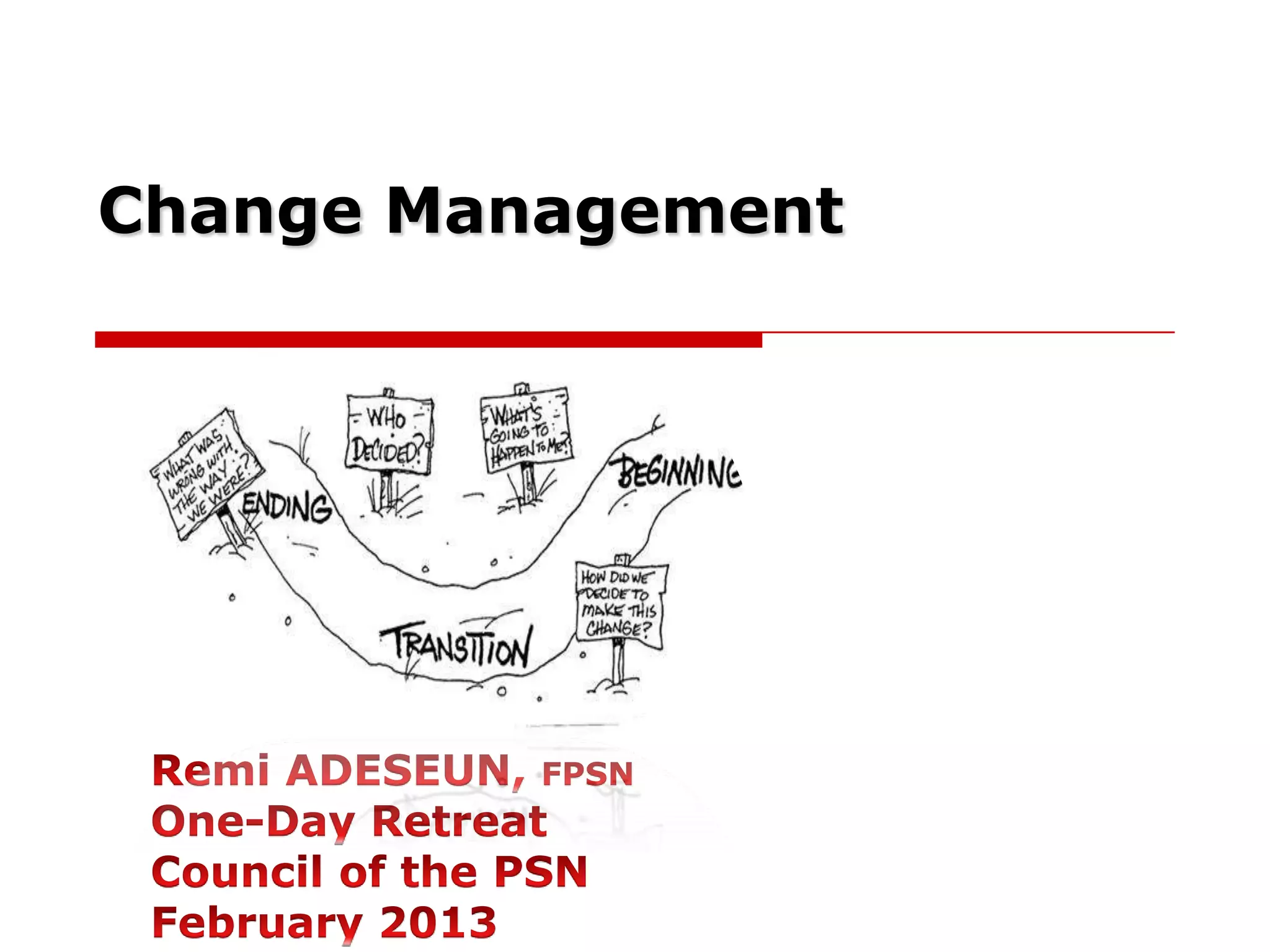

Change Management
Introduction...I have a Dream!
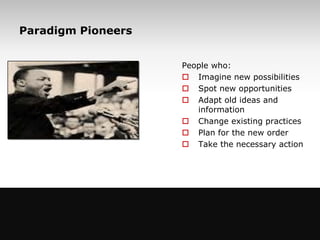
Paradigm Pioneers


                                     People who:
                                      Imagine new possibilities
                                      Spot new opportunities
                                      Adapt old ideas and
                                        information
                                      Change existing practices
                                      Plan for the new order
                                      Take the necessary action


                 www.managementstudyguide.com
3
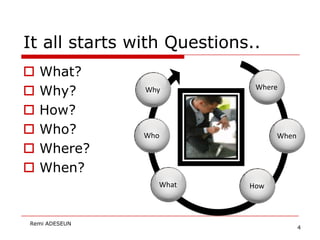
It all starts with Questions..
   What?
   Why?       Why           Where


   How?
   Who?       Who                When
   Where?
   When?
                 What       How


Remi ADESEUN
                                         4
Key Questions...What?
 What is Change?
 What is Change Management?
 What are the Best Practices in
  Change Managent?


 Remi ADESEUN
Key Questions...Why?
 Why do we need Change?
 Why manage Change?
 Why does Change Management fail?


Remi ADESEUN
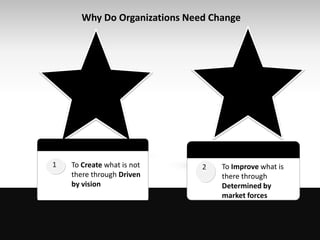
Why Do Organizations Need Change


1   To Create what is not               2     To Improve what is
    there through Driven                      there through
    by vision                                 Determined by
                                              market forces

               www.managementstudyguide.com
Key Questions...How?
 How do we know where we are?
 How do we decide where we want to
  be?
 How do we get there?


Remi ADESEUN
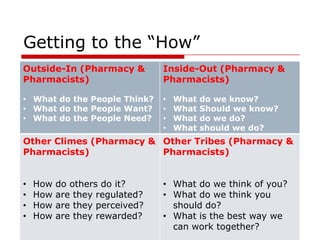
Getting to the “How”
Outside-In (Pharmacy &          Inside-Out (Pharmacy &
Pharmacists)                    Pharmacists)

• What do the People Think?     •   What   do we know?
• What do the People Want?      •   What   Should we know?
• What do the People Need?      •   What   do we do?
                                •   What   should we do?
Other Climes (Pharmacy & Other Tribes (Pharmacy &
Pharmacists)             Pharmacists)


•   How   do others do it?      • What do we think of you?
•   How   are they regulated?   • What do we think you
•   How   are they perceived?     should do?
•   How   are they rewarded?    • What is the best way we
                                  can work together?
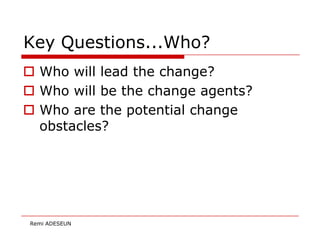
Key Questions...Who?
 Who will lead the change?
 Who will be the change agents?
 Who are the potential change
  obstacles?


Remi ADESEUN
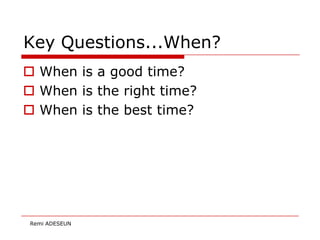
Key Questions...When?
 When is a good time?
 When is the right time?
 When is the best time?


 Remi ADESEUN
When Is Organizational Change Inevitable?


                       Gliecher’s Equation
                        Organisational dissatisfaction [D]
                        Vision for the future [V]
                        Possibility of immediate tactical action/
                           first steps [F]

                       When D x V x F > Resistance to change
                       Then, organisational change becomes
                          acceptable


                www.managementstudyguide.com
                                                                     12
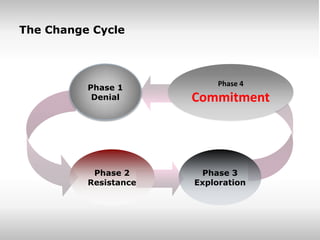
The Change Cycle


                            Phase 4
          Phase 1
           Denial      Commitment


           Phase 2      Phase 3
          Resistance   Exploration
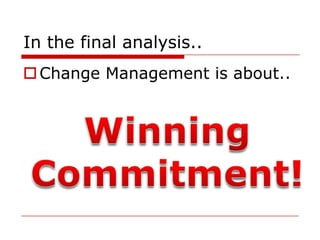
In the final analysis..
 Change Management is about..
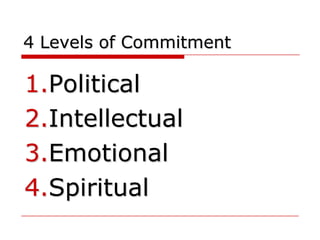
4 Levels of Commitment

1.Political
2.Intellectual
3.Emotional
4.Spiritual
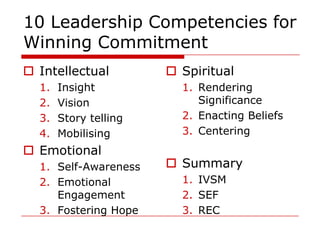
10 Leadership Competencies for
Winning Commitment
 Intellectual          Spiritual
  1.   Insight           1. Rendering
  2.   Vision               Significance
  3.   Story telling     2. Enacting Beliefs
  4.   Mobilising        3. Centering
 Emotional
  1. Self-Awareness     Summary
  2. Emotional           1. IVSM
     Engagement          2. SEF
  3. Fostering Hope      3. REC
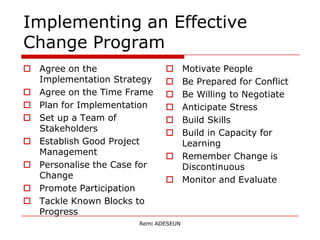
Implementing an Effective
Change Program
 Agree on the                 Motivate People
  Implementation Strategy      Be Prepared for Conflict
 Agree on the Time Frame      Be Willing to Negotiate
 Plan for Implementation      Anticipate Stress
 Set up a Team of             Build Skills
  Stakeholders                 Build in Capacity for
 Establish Good Project        Learning
  Management                   Remember Change is
 Personalise the Case for      Discontinuous
  Change                       Monitor and Evaluate
 Promote Participation
 Tackle Known Blocks to
  Progress
                       Remi ADESEUN
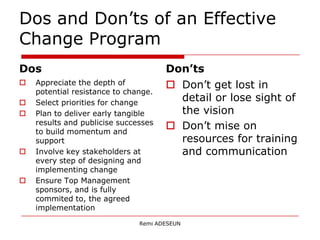
Dos and Don’ts of an Effective
Change Program
Dos                                   Don’ts
   Appreciate the depth of            Don’t get lost in
    potential resistance to change.
   Select priorities for change
                                        detail or lose sight of
   Plan to deliver early tangible      the vision
    results and publicise successes
    to build momentum and
                                       Don’t mise on
    support                             resources for training
   Involve key stakeholders at         and communication
    every step of designing and
    implementing change
   Ensure Top Management
    sponsors, and is fully
    commited to, the agreed
    implementation
                               Remi ADESEUN
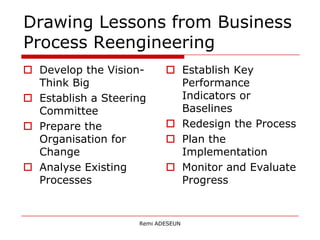
Drawing Lessons from Business
Process Reengineering
 Develop the Vision-       Establish Key
  Think Big                  Performance
 Establish a Steering       Indicators or
  Committee                  Baselines
 Prepare the               Redesign the Process
  Organisation for          Plan the
  Change                     Implementation
 Analyse Existing          Monitor and Evaluate
  Processes                  Progress


                    Remi ADESEUN
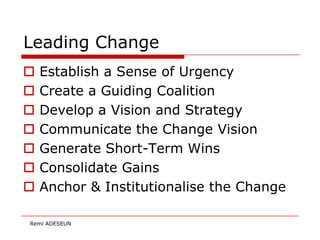
Leading Change
   Establish a Sense of Urgency
   Create a Guiding Coalition
   Develop a Vision and Strategy
   Communicate the Change Vision
   Generate Short-Term Wins
   Consolidate Gains
   Anchor & Institutionalise the Change

Remi ADESEUN
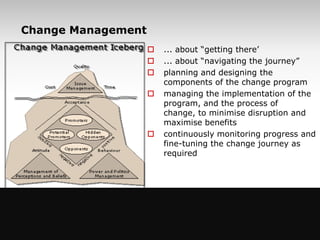
Change Management
                              ... about “getting there’
                              ... about “navigating the journey”
                              planning and designing the
                               components of the change program
                              managing the implementation of the
                               program, and the process of
                               change, to minimise disruption and
                               maximise benefits
                              continuously monitoring progress and
                               fine-tuning the change journey as
                               required


                www.managementstudyguide.com
21
Common Causes of Failure
 Underestimating Peoples attachment to
  Status Quo
 Not having the right reasons for change
 Not making fundamental changes to the
  way things are done
 Poor redesign of processes
 Introducing technology in isolation
 Not involving Key Stakeholders at every
  stage
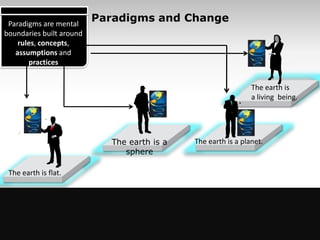
Paradigms are mental
                          Paradigms and Change
boundaries built around
    rules, concepts,
   assumptions and
       practices


                                                                     The earth is
                                                                     a living being.


                            The earth is a         The earth is a planet.
                               sphere

 The earth is flat.


                            www.managementstudyguide.com
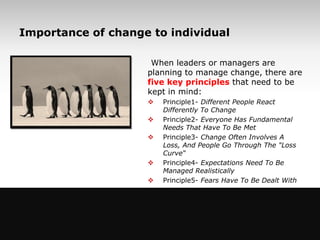
Importance of change to individual

                              When leaders or managers are
                             planning to manage change, there are
                             five key principles that need to be
                             kept in mind:
                                Principle1- Different People React
                                 Differently To Change
                                Principle2- Everyone Has Fundamental
                                 Needs That Have To Be Met
                                Principle3- Change Often Involves A
                                 Loss, And People Go Through The "Loss
                                 Curve“
                                Principle4- Expectations Need To Be
                                 Managed Realistically
                                Principle5- Fears Have To Be Dealt With


                   www.managementstudyguide.com
24
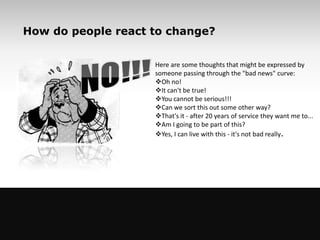
How do people react to change?


                          Here are some thoughts that might be expressed by
                          someone passing through the "bad news" curve:
                          Oh no!
                          It can't be true!
                          You cannot be serious!!!
                          Can we sort this out some other way?
                          That's it - after 20 years of service they want me to...
                          Am I going to be part of this?
                          Yes, I can live with this - it's not bad really.


              www.managementstudyguide.com
25
Getting it Right
 The Right Spirit    The Right People
 The Right Attitude  The Right
 The Right            Envinroment
  Questions           The Right Time
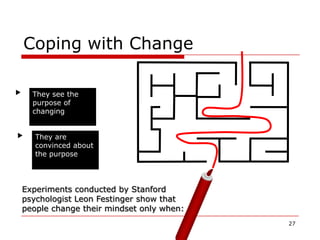
Coping with Change

 They see the purpose
 of They see the
    changing
  purpose of
  changing

 They are convinced
 about theare
   They purpose
   convinced about
   the purpose


Experiments conducted by Stanford
psychologist Leon Festinger show that
people change their mindset only when:
                                         27
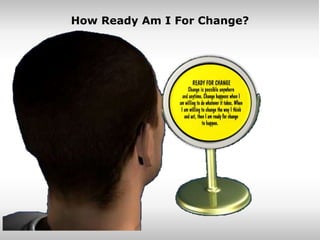
How Ready Am I For Change?


28
Conclusion
 “There is nothing more difficult to
   take in hand, more perilous to
   conduct or more uncertain in its
   success, than to take the lead in the
   introduction of a new order of things.”
- The Prince by Niccolo Machiavelli.
Thank You!
Contact Information:
Remi ADESEUN

Chairman

Rodot Group

.Healthcare

.Water Technology

.Architecture

.Consulting

08057713769/07065156473

r.adeseun@rodot.org
kojere@yahoo.com

Change management

  • 1.
  • 2.
  • 3.
    Paradigm Pioneers People who:  Imagine new possibilities  Spot new opportunities  Adapt old ideas and information  Change existing practices  Plan for the new order  Take the necessary action www.managementstudyguide.com 3
  • 4.
    It all startswith Questions..  What?  Why? Why Where  How?  Who? Who When  Where?  When? What How Remi ADESEUN 4
  • 5.
    Key Questions...What?  Whatis Change?  What is Change Management?  What are the Best Practices in Change Managent? Remi ADESEUN
  • 6.
    Key Questions...Why?  Whydo we need Change?  Why manage Change?  Why does Change Management fail? Remi ADESEUN
  • 7.
    Why Do OrganizationsNeed Change 1 To Create what is not 2 To Improve what is there through Driven there through by vision Determined by market forces www.managementstudyguide.com
  • 8.
    Key Questions...How?  Howdo we know where we are?  How do we decide where we want to be?  How do we get there? Remi ADESEUN
  • 9.
    Getting to the“How” Outside-In (Pharmacy & Inside-Out (Pharmacy & Pharmacists) Pharmacists) • What do the People Think? • What do we know? • What do the People Want? • What Should we know? • What do the People Need? • What do we do? • What should we do? Other Climes (Pharmacy & Other Tribes (Pharmacy & Pharmacists) Pharmacists) • How do others do it? • What do we think of you? • How are they regulated? • What do we think you • How are they perceived? should do? • How are they rewarded? • What is the best way we can work together?
  • 10.
    Key Questions...Who?  Whowill lead the change?  Who will be the change agents?  Who are the potential change obstacles? Remi ADESEUN
  • 11.
    Key Questions...When?  Whenis a good time?  When is the right time?  When is the best time? Remi ADESEUN
  • 12.
    When Is OrganizationalChange Inevitable? Gliecher’s Equation  Organisational dissatisfaction [D]  Vision for the future [V]  Possibility of immediate tactical action/ first steps [F] When D x V x F > Resistance to change Then, organisational change becomes acceptable www.managementstudyguide.com 12
  • 13.
    The Change Cycle Phase 4 Phase 1 Denial Commitment Phase 2 Phase 3 Resistance Exploration
  • 14.
    In the finalanalysis..  Change Management is about..
  • 15.
    4 Levels ofCommitment 1.Political 2.Intellectual 3.Emotional 4.Spiritual
  • 16.
    10 Leadership Competenciesfor Winning Commitment  Intellectual  Spiritual 1. Insight 1. Rendering 2. Vision Significance 3. Story telling 2. Enacting Beliefs 4. Mobilising 3. Centering  Emotional 1. Self-Awareness  Summary 2. Emotional 1. IVSM Engagement 2. SEF 3. Fostering Hope 3. REC
  • 17.
    Implementing an Effective ChangeProgram  Agree on the  Motivate People Implementation Strategy  Be Prepared for Conflict  Agree on the Time Frame  Be Willing to Negotiate  Plan for Implementation  Anticipate Stress  Set up a Team of  Build Skills Stakeholders  Build in Capacity for  Establish Good Project Learning Management  Remember Change is  Personalise the Case for Discontinuous Change  Monitor and Evaluate  Promote Participation  Tackle Known Blocks to Progress Remi ADESEUN
  • 18.
    Dos and Don’tsof an Effective Change Program Dos Don’ts  Appreciate the depth of  Don’t get lost in potential resistance to change.  Select priorities for change detail or lose sight of  Plan to deliver early tangible the vision results and publicise successes to build momentum and  Don’t mise on support resources for training  Involve key stakeholders at and communication every step of designing and implementing change  Ensure Top Management sponsors, and is fully commited to, the agreed implementation Remi ADESEUN
  • 19.
    Drawing Lessons fromBusiness Process Reengineering  Develop the Vision-  Establish Key Think Big Performance  Establish a Steering Indicators or Committee Baselines  Prepare the  Redesign the Process Organisation for  Plan the Change Implementation  Analyse Existing  Monitor and Evaluate Processes Progress Remi ADESEUN
  • 20.
    Leading Change  Establish a Sense of Urgency  Create a Guiding Coalition  Develop a Vision and Strategy  Communicate the Change Vision  Generate Short-Term Wins  Consolidate Gains  Anchor & Institutionalise the Change Remi ADESEUN
  • 21.
    Change Management  ... about “getting there’  ... about “navigating the journey”  planning and designing the components of the change program  managing the implementation of the program, and the process of change, to minimise disruption and maximise benefits  continuously monitoring progress and fine-tuning the change journey as required www.managementstudyguide.com 21
  • 22.
    Common Causes ofFailure  Underestimating Peoples attachment to Status Quo  Not having the right reasons for change  Not making fundamental changes to the way things are done  Poor redesign of processes  Introducing technology in isolation  Not involving Key Stakeholders at every stage
  • 23.
    Paradigms are mental Paradigms and Change boundaries built around rules, concepts, assumptions and practices The earth is a living being. The earth is a The earth is a planet. sphere The earth is flat. www.managementstudyguide.com
  • 24.
    Importance of changeto individual When leaders or managers are planning to manage change, there are five key principles that need to be kept in mind:  Principle1- Different People React Differently To Change  Principle2- Everyone Has Fundamental Needs That Have To Be Met  Principle3- Change Often Involves A Loss, And People Go Through The "Loss Curve“  Principle4- Expectations Need To Be Managed Realistically  Principle5- Fears Have To Be Dealt With www.managementstudyguide.com 24
  • 25.
    How do peoplereact to change? Here are some thoughts that might be expressed by someone passing through the "bad news" curve: Oh no! It can't be true! You cannot be serious!!! Can we sort this out some other way? That's it - after 20 years of service they want me to... Am I going to be part of this? Yes, I can live with this - it's not bad really. www.managementstudyguide.com 25
  • 26.
    Getting it Right The Right Spirit  The Right People  The Right Attitude  The Right  The Right Envinroment Questions  The Right Time
  • 27.
    Coping with Change They see the purpose of They see the changing purpose of changing They are convinced about theare They purpose convinced about the purpose Experiments conducted by Stanford psychologist Leon Festinger show that people change their mindset only when: 27
  • 28.
    How Ready AmI For Change? 28
  • 29.
    Conclusion  “There isnothing more difficult to take in hand, more perilous to conduct or more uncertain in its success, than to take the lead in the introduction of a new order of things.” - The Prince by Niccolo Machiavelli.
  • 30.
    Thank You! Contact Information: RemiADESEUN Chairman Rodot Group .Healthcare .Water Technology .Architecture .Consulting 08057713769/07065156473 r.adeseun@rodot.org kojere@yahoo.com