Agile Values
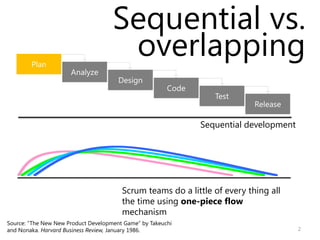
Sequential vs.
                                      overlapping

                                                             Sequential development


                                        Scrum teams do a little of every thing all
                                        the time using one-piece flow
                                        mechanism
Source: “The New New Product Development Game” by Takeuchi
and Nonaka. Harvard Business Review, January 1986.                                    2
Success rate


           3
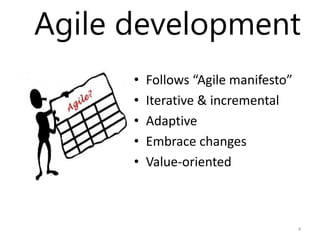
Agile development
      •   Follows “Agile manifesto”
      •   Iterative & incremental
      •   Adaptive
      •   Embrace changes
      •   Value-oriented


                                      4
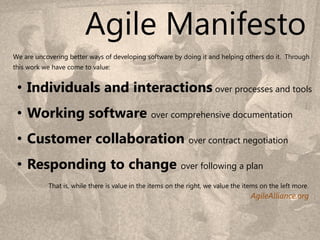
Agile Manifesto
We are uncovering better ways of developing software by doing it and helping others do it. Through
this work we have come to value:


 • Individuals and interactions over processes and tools
 • Working software over comprehensive documentation
 • Customer collaboration over contract negotiation
 • Responding to change over following a plan
           That is, while there is value in the items on the right, we value the items on the left more.
                                                                                   AgileAlliance.org


                                                                                                    5
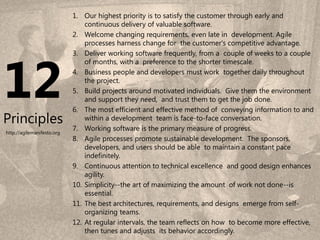
1. Our highest priority is to satisfy the customer through early and
                                continuous delivery of valuable software.
                            2. Welcome changing requirements, even late in development. Agile
                                processes harness change for the customer's competitive advantage.


12
                            3. Deliver working software frequently, from a couple of weeks to a couple
                                of months, with a preference to the shorter timescale.
                            4. Business people and developers must work together daily throughout
                                the project.
                            5. Build projects around motivated individuals. Give them the environment
                                and support they need, and trust them to get the job done.
                            6. The most efficient and effective method of conveying information to and
Principles                      within a development team is face-to-face conversation.
                            7. Working software is the primary measure of progress.
http://agilemanifesto.org
                            8. Agile processes promote sustainable development. The sponsors,
                                developers, and users should be able to maintain a constant pace
                                indefinitely.
                            9. Continuous attention to technical excellence and good design enhances
                                agility.
                            10. Simplicity--the art of maximizing the amount of work not done--is
                                essential.
                            11. The best architectures, requirements, and designs emerge from self-
                                organizing teams.
                            12. At regular intervals, the team reflects on how to become more effective,
                                then tunes and adjusts its behavior accordingly.                   6
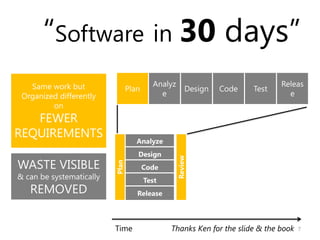
“Software in 30 days”


     Time   Thanks Ken for the slide & the book   7
Value Proposition
   Visibility    Adaptability


Business Value   Risk


                                8
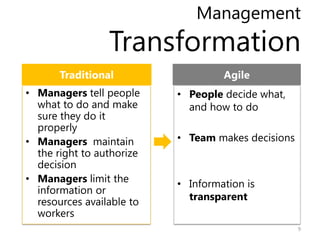
Management
                 Transformation
• Managers tell people     • People decide what,
  what to do and make        and how to do
  sure they do it
  properly
• Managers maintain        • Team makes decisions
  the right to authorize
  decision
• Managers limit the       • Information is
  information or
  resources available to     transparent
  workers
                                                    9
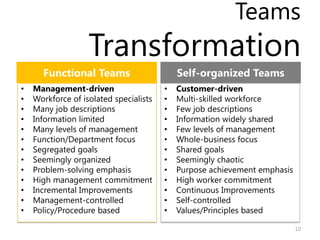
Teams
                   Transformation
•   Management-driven                   •   Customer-driven
•   Workforce of isolated specialists   •   Multi-skilled workforce
•   Many job descriptions               •   Few job descriptions
•   Information limited                 •   Information widely shared
•   Many levels of management           •   Few levels of management
•   Function/Department focus           •   Whole-business focus
•   Segregated goals                    •   Shared goals
•   Seemingly organized                 •   Seemingly chaotic
•   Problem-solving emphasis            •   Purpose achievement emphasis
•   High management commitment          •   High worker commitment
•   Incremental Improvements            •   Continuous Improvements
•   Management-controlled               •   Self-controlled
•   Policy/Procedure based              •   Values/Principles based

                                                                           10
Scrum ‘Process’


              11
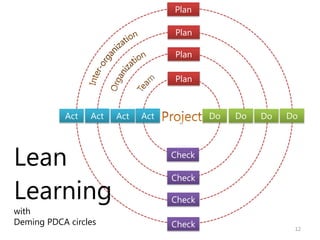
Plan

                                   Plan

                                   Plan

                                   Plan


           Act   Act   Act   Act           Do   Do   Do   Do


Lean                               Check

                                   Check

Learning                           Check
with
Deming PDCA circles                Check                   12
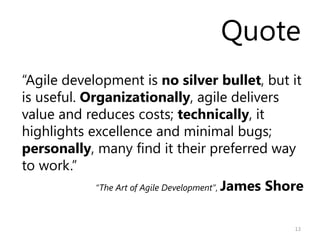
Quote
“Agile development is no silver bullet, but it
is useful. Organizationally, agile delivers
value and reduces costs; technically, it
highlights excellence and minimal bugs;
personally, many find it their preferred way
to work.”
             “The Art of Agile Development”, James Shore


                                                      13
Observation
from some Teams in Vietnam


                         14
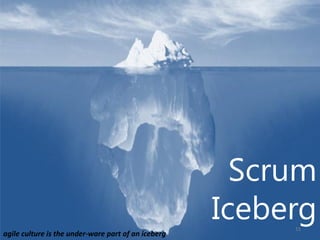
Scrum
                                                     Iceberg
                                                          15
agile culture is the under-ware part of an iceberg
OPTIONAL
SECTIONS
        16
Methods used


         Source: Forrester Research
                             17
Test-Driven
                                  Development
• You don’t start programming until you have
  designed your tests!
• Strategy
  – Make it Fail
     • No code without a failing test
  – Make it Work
     • As simply as possible
  – Make it Better
     • Refactor(code, design, test, documentation)
  – Believe in testing
                                                     18
TDD Rationale


            19
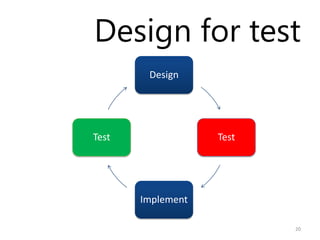
Design for test
        Design


Test               Test


       Implement

                          20
Next steps
Stay Connected with Community
         Monthly Gathering, see:
         www.hanoiscrum.net
         www.agilevietnam.org

         //hanoiscrum


Contact Tan
                                     /duongtrongtan


                   http://vn.linkedin.com/in/tandt


                                                      21

Agile values

  • 1.
  • 2.
    Sequential vs. overlapping Sequential development Scrum teams do a little of every thing all the time using one-piece flow mechanism Source: “The New New Product Development Game” by Takeuchi and Nonaka. Harvard Business Review, January 1986. 2
  • 3.
  • 4.
    Agile development • Follows “Agile manifesto” • Iterative & incremental • Adaptive • Embrace changes • Value-oriented 4
  • 5.
    Agile Manifesto We areuncovering better ways of developing software by doing it and helping others do it. Through this work we have come to value: • Individuals and interactions over processes and tools • Working software over comprehensive documentation • Customer collaboration over contract negotiation • Responding to change over following a plan That is, while there is value in the items on the right, we value the items on the left more. AgileAlliance.org 5
  • 6.
    1. Our highestpriority is to satisfy the customer through early and continuous delivery of valuable software. 2. Welcome changing requirements, even late in development. Agile processes harness change for the customer's competitive advantage. 12 3. Deliver working software frequently, from a couple of weeks to a couple of months, with a preference to the shorter timescale. 4. Business people and developers must work together daily throughout the project. 5. Build projects around motivated individuals. Give them the environment and support they need, and trust them to get the job done. 6. The most efficient and effective method of conveying information to and Principles within a development team is face-to-face conversation. 7. Working software is the primary measure of progress. http://agilemanifesto.org 8. Agile processes promote sustainable development. The sponsors, developers, and users should be able to maintain a constant pace indefinitely. 9. Continuous attention to technical excellence and good design enhances agility. 10. Simplicity--the art of maximizing the amount of work not done--is essential. 11. The best architectures, requirements, and designs emerge from self- organizing teams. 12. At regular intervals, the team reflects on how to become more effective, then tunes and adjusts its behavior accordingly. 6
  • 7.
    “Software in 30days” Time Thanks Ken for the slide & the book 7
  • 8.
    Value Proposition Visibility Adaptability Business Value Risk 8
  • 9.
    Management Transformation • Managers tell people • People decide what, what to do and make and how to do sure they do it properly • Managers maintain • Team makes decisions the right to authorize decision • Managers limit the • Information is information or resources available to transparent workers 9
  • 10.
    Teams Transformation • Management-driven • Customer-driven • Workforce of isolated specialists • Multi-skilled workforce • Many job descriptions • Few job descriptions • Information limited • Information widely shared • Many levels of management • Few levels of management • Function/Department focus • Whole-business focus • Segregated goals • Shared goals • Seemingly organized • Seemingly chaotic • Problem-solving emphasis • Purpose achievement emphasis • High management commitment • High worker commitment • Incremental Improvements • Continuous Improvements • Management-controlled • Self-controlled • Policy/Procedure based • Values/Principles based 10
  • 11.
  • 12.
    Plan Plan Plan Plan Act Act Act Act Do Do Do Do Lean Check Check Learning Check with Deming PDCA circles Check 12
  • 13.
    Quote “Agile development isno silver bullet, but it is useful. Organizationally, agile delivers value and reduces costs; technically, it highlights excellence and minimal bugs; personally, many find it their preferred way to work.” “The Art of Agile Development”, James Shore 13
  • 14.
  • 15.
    Scrum Iceberg 15 agile culture is the under-ware part of an iceberg
  • 16.
  • 17.
    Methods used Source: Forrester Research 17
  • 18.
    Test-Driven Development • You don’t start programming until you have designed your tests! • Strategy – Make it Fail • No code without a failing test – Make it Work • As simply as possible – Make it Better • Refactor(code, design, test, documentation) – Believe in testing 18
  • 19.
  • 20.
    Design for test Design Test Test Implement 20
  • 21.
    Next steps Stay Connectedwith Community Monthly Gathering, see: www.hanoiscrum.net www.agilevietnam.org //hanoiscrum Contact Tan /duongtrongtan http://vn.linkedin.com/in/tandt 21