


Luca Sturaro – Meetup 05/06/2017
Agile Leaders & Agile Managers
About me
15+ in IT Software as consultant or
employee
• Areas: embedded systems, desktop, web
• Domains: Energy/Automation, Telecom,
currently Medical Product
R&D Program/Project Manager@
Omnilab (Abbott Group)
Luca Sturaro
Mail: hcsturix74@gmail.com
Linkedin:
https://it.linkedin.com/in/lucasturaro
Ansatz:
Ansatz:
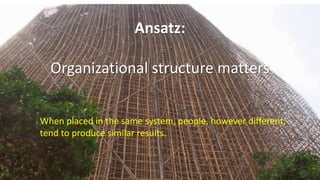
Organizational structure matters
When placed in the same system, people, however different,
tend to produce similar results.
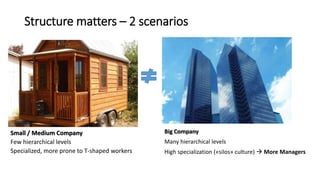
Structure matters – 2 scenarios
Small / Medium Company
Few hierarchical levels
Specialized, more prone to T-shaped workers
Big Company
Many hierarchical levels
High specialization («silos» culture)  More Managers
Top-down & bottom-up
Agile Adoptions
Agile Adoptions
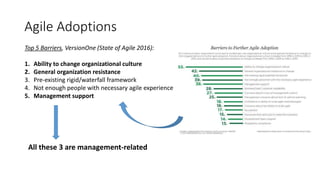
Top 5 Barriers, VersionOne (State of Agile 2016):
1. Ability to change organizational culture
2. General organization resistance
3. Pre-existing rigid/waterfall framework
4. Not enough people with necessary agile experience
5. Management support
All these 3 are management-related
Ansatz
Leadership is not a role
Management is, by definition
Scrum
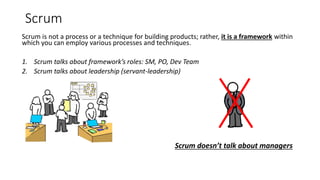
Scrum is not a process or a technique for building products; rather, it is a framework within
which you can employ various processes and techniques.
1. Scrum talks about framework’s roles: SM, PO, Dev Team
2. Scrum talks about leadership (servant-leadership)
Scrum doesn’t talk about managers
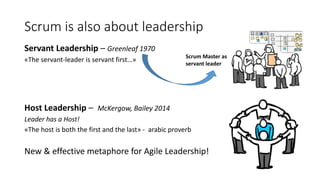
Servant Leadership – Greenleaf 1970
«The servant-leader is servant first…»
Host Leadership – McKergow, Bailey 2014
Leader has a Host!
«The host is both the first and the last» - arabic proverb
New & effective metaphore for Agile Leadership!
Scrum is also about leadership
Scrum Master as
servant leader
• Listening & Understanding
• Empathy & Acceptance
• Healing
• Awareness
• Persuasion
• Conceptualization
• Foresight
• Building community
• Stewardship
• Commitment to growth
Servant Leader’s key concepts
Your turn:
Examples?
Can we use this for Sr. Managers &
Executives?
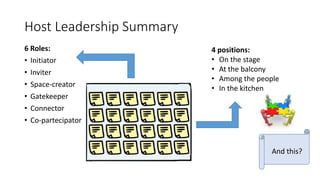
6 Roles:
• Initiator
• Inviter
• Space-creator
• Gatekeeper
• Connector
• Co-partecipator
Host Leadership Summary
4 positions:
• On the stage
• At the balcony
• Among the people
• In the kitchen
And this?
Managers in Agility?
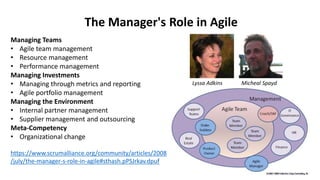
Managing Teams
• Agile team management
• Resource management
• Performance management
Managing Investments
• Managing through metrics and reporting
• Agile portfolio management
Managing the Environment
• Internal partner management
• Supplier management and outsourcing
Meta-Competency
• Organizational change
https://www.scrumalliance.org/community/articles/2008
/july/the-manager-s-role-in-agile#sthash.pPSJrkav.dpuf
The Manager's Role in Agile
Lyssa Adkins Micheal Spayd
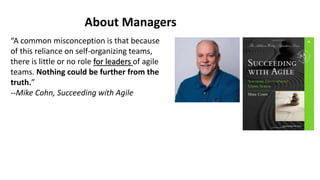
“A common misconception is that because
of this reliance on self-organizing teams,
there is little or no role for leaders of agile
teams. Nothing could be further from the
truth.”
--Mike Cohn, Succeeding with Agile
About Managers
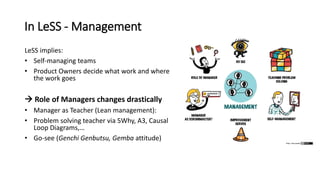
In LeSS - Management
LeSS implies:
• Self-managing teams
• Product Owners decide what work and where
the work goes
 Role of Managers changes drastically
• Manager as Teacher (Lean management):
• Problem solving teacher via 5Why, A3, Causal
Loop Diagrams,…
• Go-see (Genchi Genbutsu, Gemba attitude)
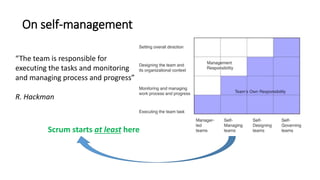
On self-management
Scrum starts at least here
“The team is responsible for
executing the tasks and monitoring
and managing process and progress”
R. Hackman
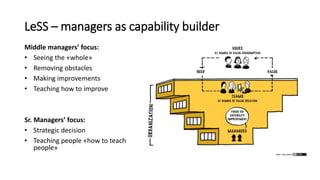
LeSS – managers as capability builder
Middle managers’ focus:
• Seeing the «whole»
• Removing obstacles
• Making improvements
• Teaching how to improve
Sr. Managers’ focus:
• Strategic decision
• Teaching people «how to teach
people»
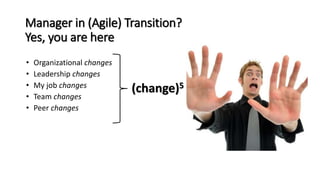
Manager in (Agile) Transition?
Yes, you are here
• Organizational changes
• Leadership changes
• My job changes
• Team changes
• Peer changes
(change)5
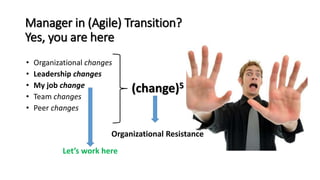
Manager in (Agile) Transition?
Yes, you are here
• Organizational changes
• Leadership changes
• My job change
• Team changes
• Peer changes
(change)5
Organizational Resistance
Let’s work here
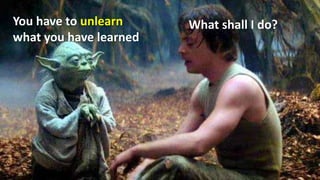
What shall I do?You have to unlearn
what you have learned
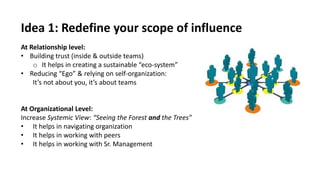
Idea 1: Redefine your scope of influence
At Relationship level:
• Building trust (inside & outside teams)
o It helps in creating a sustainable “eco-system”
• Reducing “Ego” & relying on self-organization:
It’s not about you, it’s about teams
At Organizational Level:
Increase Systemic View: “Seeing the Forest and the Trees”
• It helps in navigating organization
• It helps in working with peers
• It helps in working with Sr. Management
Idea 1: Redefine your scope of influence
Idea 2: Invest in learning
Coaching & Mentoring:
• Internal coaches:
o Grow people in the organization
• External coaches:
o Business Coaching (Sr. Managers included)
o Counseling & mentoring
Training Programs:
• Workshops
• Presentation & Courses
Don’t look at Agility just like a process or tool
Idea 2: Invest in learning
Towards Learning Organizations?
“…organizations where people continually expand
their capacity to create the results they truly desire,
where new and expansive patterns of thinking are
nurtured, where collective aspiration is set free, and
where people are continually learning to see the
whole together.”
Peter Senge,
The Fifth Discipline (1990)New emerging paradigm for
organizations?
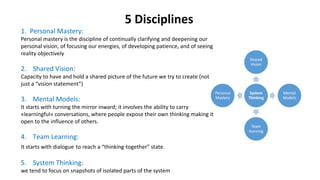
5 Disciplines
System
Thinking
Shared
Vision
Mental
Models
Team
learning
Personal
Mastery
1. Personal Mastery:
Personal mastery is the discipline of continually clarifying and deepening our
personal vision, of focusing our energies, of developing patience, and of seeing
reality objectively
2. Shared Vision:
Capacity to have and hold a shared picture of the future we try to create (not
just a “vision statement”)
3. Mental Models:
It starts with turning the mirror inward; it involves the ability to carry
«learningful» conversations, where people expose their own thinking making it
open to the influence of others.
4. Team Learning:
It starts with dialogue to reach a “thinking-together” state.
5. System Thinking:
we tend to focus on snapshots of isolated parts of the system
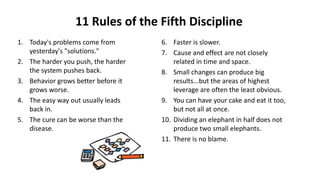
11 Rules of the Fifth Discipline
1. Today's problems come from
yesterday's "solutions."
2. The harder you push, the harder
the system pushes back.
3. Behavior grows better before it
grows worse.
4. The easy way out usually leads
back in.
5. The cure can be worse than the
disease.
6. Faster is slower.
7. Cause and effect are not closely
related in time and space.
8. Small changes can produce big
results...but the areas of highest
leverage are often the least obvious.
9. You can have your cake and eat it too,
but not all at once.
10. Dividing an elephant in half does not
produce two small elephants.
11. There is no blame.
Design Policies, strategies, and structures looking
at the «whole»
Leader as Designer
Leader as designer of the learning processes
It’s not about teaching people how to achieve their vision
It’s about fostering learning for everyone
Leader as teacher of underlying structures rather
than “local” trends
Leader as Teacher
Have your own vision but be prepared to look at it as part
of something larger (outcome of active listening and
conversation)
Responsibility without possessiveness
Leader as Steward of a vision
Leader as Steward
Roles of Manager - Summary
• Empowering Self-Organization & Excellence
• Remove impediments
• Problem Solving teacher
• Stimulate Continuous Improvement & Growth
• Organization sustainability
• Lean thinking
• Lead People / Lead a Team!
• Managing Up, Out, and Yourself
• Counseling, Coaching and Mentoring
Questions?
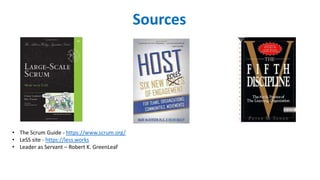
• The Scrum Guide - https://www.scrum.org/
• LeSS site - https://less.works
• Leader as Servant – Robert K. GreenLeaf
Sources

Agile Leaders and Agile Managers

  • 1.
    Luca Sturaro –Meetup 05/06/2017 Agile Leaders & Agile Managers
  • 2.
    About me 15+ inIT Software as consultant or employee • Areas: embedded systems, desktop, web • Domains: Energy/Automation, Telecom, currently Medical Product R&D Program/Project Manager@ Omnilab (Abbott Group) Luca Sturaro Mail: hcsturix74@gmail.com Linkedin: https://it.linkedin.com/in/lucasturaro
  • 3.
    Ansatz: Ansatz: Organizational structure matters Whenplaced in the same system, people, however different, tend to produce similar results.
  • 4.
    Structure matters –2 scenarios Small / Medium Company Few hierarchical levels Specialized, more prone to T-shaped workers Big Company Many hierarchical levels High specialization («silos» culture)  More Managers
  • 5.
  • 6.
    Agile Adoptions Top 5Barriers, VersionOne (State of Agile 2016): 1. Ability to change organizational culture 2. General organization resistance 3. Pre-existing rigid/waterfall framework 4. Not enough people with necessary agile experience 5. Management support All these 3 are management-related
  • 7.
    Ansatz Leadership is nota role Management is, by definition
  • 8.
    Scrum Scrum is nota process or a technique for building products; rather, it is a framework within which you can employ various processes and techniques. 1. Scrum talks about framework’s roles: SM, PO, Dev Team 2. Scrum talks about leadership (servant-leadership) Scrum doesn’t talk about managers
  • 9.
    Servant Leadership –Greenleaf 1970 «The servant-leader is servant first…» Host Leadership – McKergow, Bailey 2014 Leader has a Host! «The host is both the first and the last» - arabic proverb New & effective metaphore for Agile Leadership! Scrum is also about leadership Scrum Master as servant leader
  • 10.
    • Listening &Understanding • Empathy & Acceptance • Healing • Awareness • Persuasion • Conceptualization • Foresight • Building community • Stewardship • Commitment to growth Servant Leader’s key concepts Your turn: Examples? Can we use this for Sr. Managers & Executives?
  • 11.
    6 Roles: • Initiator •Inviter • Space-creator • Gatekeeper • Connector • Co-partecipator Host Leadership Summary 4 positions: • On the stage • At the balcony • Among the people • In the kitchen And this?
  • 12.
  • 13.
    Managing Teams • Agileteam management • Resource management • Performance management Managing Investments • Managing through metrics and reporting • Agile portfolio management Managing the Environment • Internal partner management • Supplier management and outsourcing Meta-Competency • Organizational change https://www.scrumalliance.org/community/articles/2008 /july/the-manager-s-role-in-agile#sthash.pPSJrkav.dpuf The Manager's Role in Agile Lyssa Adkins Micheal Spayd
  • 14.
    “A common misconceptionis that because of this reliance on self-organizing teams, there is little or no role for leaders of agile teams. Nothing could be further from the truth.” --Mike Cohn, Succeeding with Agile About Managers
  • 15.
    In LeSS -Management LeSS implies: • Self-managing teams • Product Owners decide what work and where the work goes  Role of Managers changes drastically • Manager as Teacher (Lean management): • Problem solving teacher via 5Why, A3, Causal Loop Diagrams,… • Go-see (Genchi Genbutsu, Gemba attitude)
  • 16.
    On self-management Scrum startsat least here “The team is responsible for executing the tasks and monitoring and managing process and progress” R. Hackman
  • 17.
    LeSS – managersas capability builder Middle managers’ focus: • Seeing the «whole» • Removing obstacles • Making improvements • Teaching how to improve Sr. Managers’ focus: • Strategic decision • Teaching people «how to teach people»
  • 18.
    Manager in (Agile)Transition? Yes, you are here • Organizational changes • Leadership changes • My job changes • Team changes • Peer changes (change)5
  • 19.
    Manager in (Agile)Transition? Yes, you are here • Organizational changes • Leadership changes • My job change • Team changes • Peer changes (change)5 Organizational Resistance Let’s work here
  • 20.
    What shall Ido?You have to unlearn what you have learned
  • 21.
    Idea 1: Redefineyour scope of influence
  • 22.
    At Relationship level: •Building trust (inside & outside teams) o It helps in creating a sustainable “eco-system” • Reducing “Ego” & relying on self-organization: It’s not about you, it’s about teams At Organizational Level: Increase Systemic View: “Seeing the Forest and the Trees” • It helps in navigating organization • It helps in working with peers • It helps in working with Sr. Management Idea 1: Redefine your scope of influence
  • 23.
    Idea 2: Investin learning
  • 24.
    Coaching & Mentoring: •Internal coaches: o Grow people in the organization • External coaches: o Business Coaching (Sr. Managers included) o Counseling & mentoring Training Programs: • Workshops • Presentation & Courses Don’t look at Agility just like a process or tool Idea 2: Invest in learning
  • 25.
    Towards Learning Organizations? “…organizationswhere people continually expand their capacity to create the results they truly desire, where new and expansive patterns of thinking are nurtured, where collective aspiration is set free, and where people are continually learning to see the whole together.” Peter Senge, The Fifth Discipline (1990)New emerging paradigm for organizations?
  • 26.
    5 Disciplines System Thinking Shared Vision Mental Models Team learning Personal Mastery 1. PersonalMastery: Personal mastery is the discipline of continually clarifying and deepening our personal vision, of focusing our energies, of developing patience, and of seeing reality objectively 2. Shared Vision: Capacity to have and hold a shared picture of the future we try to create (not just a “vision statement”) 3. Mental Models: It starts with turning the mirror inward; it involves the ability to carry «learningful» conversations, where people expose their own thinking making it open to the influence of others. 4. Team Learning: It starts with dialogue to reach a “thinking-together” state. 5. System Thinking: we tend to focus on snapshots of isolated parts of the system
  • 27.
    11 Rules ofthe Fifth Discipline 1. Today's problems come from yesterday's "solutions." 2. The harder you push, the harder the system pushes back. 3. Behavior grows better before it grows worse. 4. The easy way out usually leads back in. 5. The cure can be worse than the disease. 6. Faster is slower. 7. Cause and effect are not closely related in time and space. 8. Small changes can produce big results...but the areas of highest leverage are often the least obvious. 9. You can have your cake and eat it too, but not all at once. 10. Dividing an elephant in half does not produce two small elephants. 11. There is no blame.
  • 28.
    Design Policies, strategies,and structures looking at the «whole» Leader as Designer Leader as designer of the learning processes
  • 29.
    It’s not aboutteaching people how to achieve their vision It’s about fostering learning for everyone Leader as teacher of underlying structures rather than “local” trends Leader as Teacher
  • 30.
    Have your ownvision but be prepared to look at it as part of something larger (outcome of active listening and conversation) Responsibility without possessiveness Leader as Steward of a vision Leader as Steward
  • 31.
    Roles of Manager- Summary • Empowering Self-Organization & Excellence • Remove impediments • Problem Solving teacher • Stimulate Continuous Improvement & Growth • Organization sustainability • Lean thinking • Lead People / Lead a Team! • Managing Up, Out, and Yourself • Counseling, Coaching and Mentoring
  • 32.
  • 34.
    • The ScrumGuide - https://www.scrum.org/ • LeSS site - https://less.works • Leader as Servant – Robert K. GreenLeaf Sources