

Penicillin
KRVS Chaitanya
Bacterial Cell structure
Gram positive vs. Gram negative
bacteria
Source: Google Images
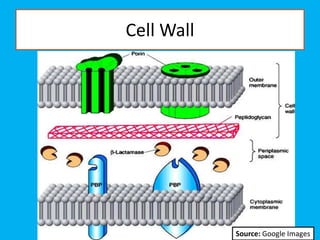
Cell Wall
Source: Google Images
Structure of Peptidoglycan layer
•Peptidoglycan is a carbohydrate composed of alternating
units of NAMA and NAGA.
•The NAMA units have a peptide side chain which can be
cross linked from the L-Lys residue to the terminal D-Ala-D-
Ala link on a neighboring NAMA unit.
Source: Google Images
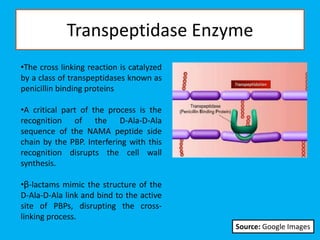
Transpeptidase Enzyme
•The cross linking reaction is catalyzed
by a class of transpeptidases known as
penicillin binding proteins
•A critical part of the process is the
recognition of the D-Ala-D-Ala
sequence of the NAMA peptide side
chain by the PBP. Interfering with this
recognition disrupts the cell wall
synthesis.
•β-lactams mimic the structure of the
D-Ala-D-Ala link and bind to the active
site of PBPs, disrupting the cross-
linking process.
Source: Google Images
Beta–lactam Drugs
Beta-Lactam Antibiotics
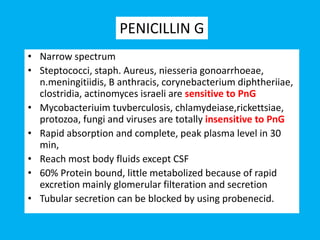
β-lactam ring
•Contains a beta-lactam ring in their molecular structures.
•Nitrogen is attached to the beta carbon relative to the
carbonyl ring and hence the name.
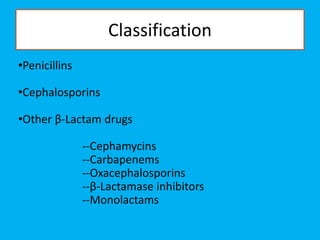
Classification
•Penicillins
•Cephalosporins
•Other β-Lactam drugs
--Cephamycins
--Carbapenems
--Oxacephalosporins
--β-Lactamase inhibitors
--Monolactams
Semisynthetic Penicillins
1.Acid resistant alternative to PnG
Penicillin V (phenoxymethy peniciillin)
2. Penicillinase resistant penicillins
methicillin and cloxacillin
3.Extended specturm penicillins
A)Aminopenicillins: ampicillin, bacampicillin,
amoxicillin
B)Carboxypenicillins: carbenicillin, ticarcillin
C)Ureidopeniciilins: pipercillin and mezlocillin
4. Beta lactamase inhibitors
Clavulanic acid, sulbactam and tazobactam
Beta-Lactam Structure
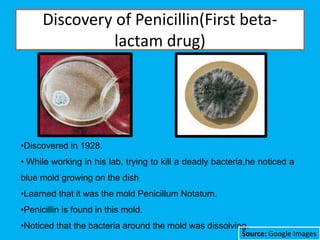
Discovery of Penicillin(First beta-
lactam drug)
•Discovered in 1928.
• While working in his lab, trying to kill a deadly bacteria,he noticed a
blue mold growing on the dish
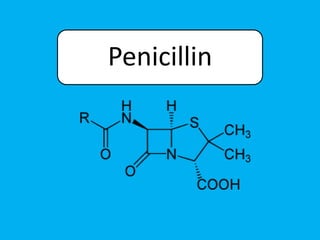
•Learned that it was the mold Penicillum Notatum.
•Penicillin is found in this mold.
•Noticed that the bacteria around the mold was dissolving.
Source: Google Images
How it is was Developed
• For 9 years, nobody could purify the Penicillum Notatum
to get the pure penicillin.
Finally, in 1938, a team of Oxford University Scientists,
headed by Howard Florey and Ernst B. Chain helped to
develop penicillin.
Source: Google Images
Penicillin
Natural Penicillin
How do they work?
1. The β-lactam binds to Penicillin Binding
Protein (PBP)
2. PBP is unable to crosslink peptidoglycan
chains
3. The bacteria is unable to synthesize a stable
cell wall
4. The bacteria is lysed
• Narrow spectrum
• Steptococci, staph. Aureus, niesseria gonoarrhoeae,
n.meningitiidis, B anthracis, corynebacterium diphtheriiae,
clostridia, actinomyces israeli are sensitive to PnG
• Mycobacteriuim tuvberculosis, chlamydeiase,rickettsiae,
protozoa, fungi and viruses are totally insensitive to PnG
• Rapid absorption and complete, peak plasma level in 30
min,
• Reach most body fluids except CSF
• 60% Protein bound, little metabolized because of rapid
excretion mainly glomerular filteration and secretion
• Tubular secretion can be blocked by using probenecid.
PENICILLIN G
USES
• Streptococcal infections
• Penumococcal infections
• Meningococcal infections
• Gonorrhoea
• Syphilis
• Dyptheria
• Tetanus and gas gangrene
• Drug of choice for rare
diseases like anthrax,
actinomycetes, trench
mouth, rat bite fever and
those caused by listeria
monocyotogenes
Prophylactic uses
• Rheumatic fever
• Bacteria endocarditis
• Agranulocytosis patients
Adverse effects of penicillin G
• PnG is one of the most nontoxic antibiotic up to
20 MU has been injected in a day without any
organ toxicity
• Pain at i.m injection site,
• Nauseas on oral ingestion
• Thrombophlebitis of injected vein
• Mental confusion
• Muscular wasting/ twitching
• Convulsion and coma
• Bleeding.
• Arachnoiditis and degenerative changes in spinal
cord.
• Hallucinations and convulsion .
• hypersensitivity
• Allergy
• Rashes, itching, urticarial and fever
• Wheezing, angioneurotic edema, serum sickness
• Exofoliative dermatitis
• Anaphylaxis is rare
Adverse effects of penicillin G
Preparation of penicillin G
• Sod.penicillin G (crystalline penicillin) –i.m/i.v
• Repository penicillin G injections: insoluble
salts of PnG,
Must be deep i.m
They release slowly at the site of injection
e.g: Procaine penicillin G (Inj)
Benzathine penicillin G (Inj)
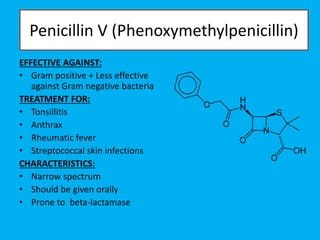
Penicillin V (Phenoxymethylpenicillin)
EFFECTIVE AGAINST:
• Gram positive + Less effective
against Gram negative bacteria
TREATMENT FOR:
• Tonsillitis
• Anthrax
• Rheumatic fever
• Streptococcal skin infections
CHARACTERISTICS:
• Narrow spectrum
• Should be given orally
• Prone to beta-lactamase
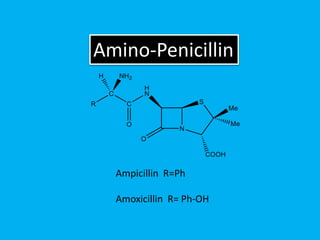
Amino-Penicillin
Ampicillin R=Ph
Amoxicillin R= Ph-OH
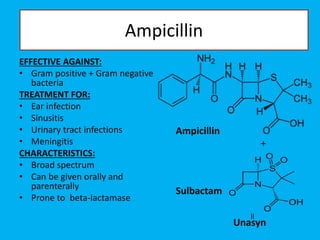
Ampicillin
EFFECTIVE AGAINST:
• Gram positive + Gram negative
bacteria
TREATMENT FOR:
• Ear infection
• Sinusitis
• Urinary tract infections
• Meningitis
CHARACTERISTICS:
• Broad spectrum
• Can be given orally and
parenterally
• Prone to beta-lactamase
Ampicillin
Sulbactam
+
ll
Unasyn
Amoxicillin
EFFECTIVE AGAINST:
• Gram positive + Gram negative
bacteria
TREATMENT FOR:
• Skin infection
• Sinusitis
• Urinary tract infections
• Streptococcal pharyngitis
CHARACTERISTICS:
• Broad spectrum
• Can be given orally and parenterally
• Prone to beta-lactamase
SIDE-EFFECTS:
• Rash, diarrhea, vomiting, nausea,
edema, stomatitis, and easy
fatigue.
Amoxicillin
Clavulanic Acid
+
ll
Augmentin
Anti-Staphylococcal Penicillin
Methicillin
EFFECTIVE AGAINST:
• Gram positive bacteria
TREATMENT FOR:
Nosocomial infection
CHARACTERISTICS:
• Very narrow Spectrum
• Should be given parenterally
SIDE-EFFECT:
• Interstitial nephritis
Oxacillin
EFFECTIVE AGAINST:
• Gram positive bacteria
TREATMENT AGAINST:
• penicillin-resistant Staphylococcus
aureus
CHARACTERISTICS:
• Very narrow Spectrum
• Should be given parenterally
SIDE-EFFECT:
• Hypersensitivity and local reactions
• In high doses, renal, hepatic, or
nervous system effects can occur
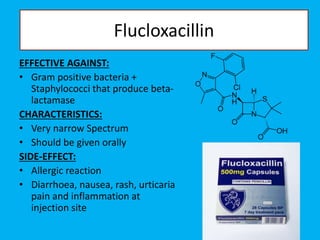
Flucloxacillin
EFFECTIVE AGAINST:
• Gram positive bacteria +
Staphylococci that produce beta-
lactamase
CHARACTERISTICS:
• Very narrow Spectrum
• Should be given orally
SIDE-EFFECT:
• Allergic reaction
• Diarrhoea, nausea, rash, urticaria
pain and inflammation at
injection site
Anti-Pseudomonal Penicillin
Piperacillin
EFFECTIVE AGAINST:
• Gram positive +Gram negative
CHARACTERISTICS:
• Extended Spectrum
• Should be given
by intravenous or intramuscular injection
SIDE-EFFECT:
• Hypersensitivity
• Gastrointestinal
• Renal
• Nervous system
*Piperacillin+Tazobactam=Zosyn
Carbenicillin
EFFECTIVE AGAINST:
• Gram negative + Limited Gram
positive
TREATMENT FOR:
• Urinary tract infections
CHARACTERISTICS:
• Highly soluble in water and acid-
labile
SIDE-EFFECT:
• High doses can cause bleeding
• Hypokalemia
BETA-LACTAMASE INHIBITORS
• Resemble β-lactam antibiotic structure
• Bind to β-lactamase and protect the antibiotic from destruction
• Most successful when they bind the β-lactamase irreversibly
• Three important in medicine:
» Clavulanic Acid
» Sulbactam
» Tazobactam
Beta–lactam Resistance
Resistance-The Global Battle.!!!
What is Resistance?
•Drug resistance refers to unresponsiveness of a microorganism
to an antimicrobial agent.
•Drug resistance are of two types:
---Natural Resistance
---Acquired Resistance
Porins
Altered penicillin binding proteins
b-lactamases
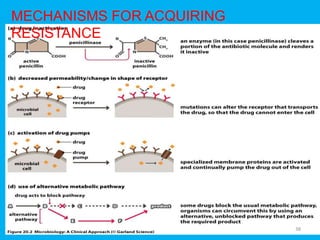
MECHANISMS OF RESISTANCE
MECHANISMS FOR ACQUIRING
RESISTANCE
38
CHALLENGES OF b-LACTAMASES
1940 : Introduction of penicillins
1940 : First description of b-lactamases published
1944 : Strains of staphylococcus aureus producing
b-lactamase
1960s : Clinical use of expanded spectrum penicillins
- such as ampicillin and carbenicillin
1970s : plasmid mediated b-lactamases assumed prominence in
enterobacteriaceae and gram-negative bacteria
1980-90 : Development of broad-spectrum cephalosporins, cephamycins,
monobactams and carbapenems
1990 : Increased resistance among gram-negative bacteria with inducible
chromosomally-mediated b lactamases
JAC (1993); suppl A: 1-8
Beta–lactamases
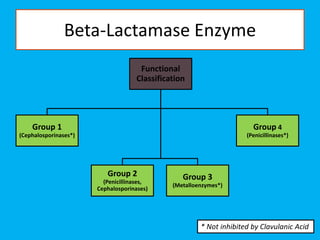
Beta-Lactamase Enzyme
Functional
Classification
Group 1
(Cephalosporinases*)
Group 2
(Penicillinases,
Cephalosporinases)
Group 3
(Metalloenzymes*)
Group 4
(Penicillinases*)
* Not inhibited by Clavulanic Acid
Beta-Lactamase Enzyme
Molecular
Classification
Serine Based
Class A Class C Class D
Metallo
B-lactamases
Class B
BETA-LACTAMASE INHIBITORS
• Resemble β-lactam antibiotic structure
• Bind to β-lactamase and protect the antibiotic from destruction
• Most successful when they bind the β-lactamase irreversibly
• Three important in medicine:
» Clavulanic Acid
» Sulbactam
» Tazobactam
Beta latam antibiotics

Beta latam antibiotics

  • 1.
  • 2.
  • 3.
    Gram positive vs.Gram negative bacteria Source: Google Images
  • 4.
  • 5.
    Structure of Peptidoglycanlayer •Peptidoglycan is a carbohydrate composed of alternating units of NAMA and NAGA. •The NAMA units have a peptide side chain which can be cross linked from the L-Lys residue to the terminal D-Ala-D- Ala link on a neighboring NAMA unit. Source: Google Images
  • 6.
    Transpeptidase Enzyme •The crosslinking reaction is catalyzed by a class of transpeptidases known as penicillin binding proteins •A critical part of the process is the recognition of the D-Ala-D-Ala sequence of the NAMA peptide side chain by the PBP. Interfering with this recognition disrupts the cell wall synthesis. •β-lactams mimic the structure of the D-Ala-D-Ala link and bind to the active site of PBPs, disrupting the cross- linking process. Source: Google Images
  • 7.
  • 8.
    Beta-Lactam Antibiotics β-lactam ring •Containsa beta-lactam ring in their molecular structures. •Nitrogen is attached to the beta carbon relative to the carbonyl ring and hence the name.
  • 9.
  • 10.
    Semisynthetic Penicillins 1.Acid resistantalternative to PnG Penicillin V (phenoxymethy peniciillin) 2. Penicillinase resistant penicillins methicillin and cloxacillin 3.Extended specturm penicillins A)Aminopenicillins: ampicillin, bacampicillin, amoxicillin B)Carboxypenicillins: carbenicillin, ticarcillin C)Ureidopeniciilins: pipercillin and mezlocillin 4. Beta lactamase inhibitors Clavulanic acid, sulbactam and tazobactam
  • 11.
  • 12.
    Discovery of Penicillin(Firstbeta- lactam drug) •Discovered in 1928. • While working in his lab, trying to kill a deadly bacteria,he noticed a blue mold growing on the dish •Learned that it was the mold Penicillum Notatum. •Penicillin is found in this mold. •Noticed that the bacteria around the mold was dissolving. Source: Google Images
  • 13.
    How it iswas Developed • For 9 years, nobody could purify the Penicillum Notatum to get the pure penicillin. Finally, in 1938, a team of Oxford University Scientists, headed by Howard Florey and Ernst B. Chain helped to develop penicillin. Source: Google Images
  • 15.
  • 16.
  • 17.
    How do theywork? 1. The β-lactam binds to Penicillin Binding Protein (PBP) 2. PBP is unable to crosslink peptidoglycan chains 3. The bacteria is unable to synthesize a stable cell wall 4. The bacteria is lysed
  • 18.
    • Narrow spectrum •Steptococci, staph. Aureus, niesseria gonoarrhoeae, n.meningitiidis, B anthracis, corynebacterium diphtheriiae, clostridia, actinomyces israeli are sensitive to PnG • Mycobacteriuim tuvberculosis, chlamydeiase,rickettsiae, protozoa, fungi and viruses are totally insensitive to PnG • Rapid absorption and complete, peak plasma level in 30 min, • Reach most body fluids except CSF • 60% Protein bound, little metabolized because of rapid excretion mainly glomerular filteration and secretion • Tubular secretion can be blocked by using probenecid. PENICILLIN G
  • 19.
    USES • Streptococcal infections •Penumococcal infections • Meningococcal infections • Gonorrhoea • Syphilis • Dyptheria • Tetanus and gas gangrene • Drug of choice for rare diseases like anthrax, actinomycetes, trench mouth, rat bite fever and those caused by listeria monocyotogenes Prophylactic uses • Rheumatic fever • Bacteria endocarditis • Agranulocytosis patients
  • 20.
    Adverse effects ofpenicillin G • PnG is one of the most nontoxic antibiotic up to 20 MU has been injected in a day without any organ toxicity • Pain at i.m injection site, • Nauseas on oral ingestion • Thrombophlebitis of injected vein • Mental confusion • Muscular wasting/ twitching • Convulsion and coma
  • 21.
    • Bleeding. • Arachnoiditisand degenerative changes in spinal cord. • Hallucinations and convulsion . • hypersensitivity • Allergy • Rashes, itching, urticarial and fever • Wheezing, angioneurotic edema, serum sickness • Exofoliative dermatitis • Anaphylaxis is rare Adverse effects of penicillin G
  • 22.
    Preparation of penicillinG • Sod.penicillin G (crystalline penicillin) –i.m/i.v • Repository penicillin G injections: insoluble salts of PnG, Must be deep i.m They release slowly at the site of injection e.g: Procaine penicillin G (Inj) Benzathine penicillin G (Inj)
  • 23.
    Penicillin V (Phenoxymethylpenicillin) EFFECTIVEAGAINST: • Gram positive + Less effective against Gram negative bacteria TREATMENT FOR: • Tonsillitis • Anthrax • Rheumatic fever • Streptococcal skin infections CHARACTERISTICS: • Narrow spectrum • Should be given orally • Prone to beta-lactamase
  • 24.
  • 25.
    Ampicillin EFFECTIVE AGAINST: • Grampositive + Gram negative bacteria TREATMENT FOR: • Ear infection • Sinusitis • Urinary tract infections • Meningitis CHARACTERISTICS: • Broad spectrum • Can be given orally and parenterally • Prone to beta-lactamase Ampicillin Sulbactam + ll Unasyn
  • 26.
    Amoxicillin EFFECTIVE AGAINST: • Grampositive + Gram negative bacteria TREATMENT FOR: • Skin infection • Sinusitis • Urinary tract infections • Streptococcal pharyngitis CHARACTERISTICS: • Broad spectrum • Can be given orally and parenterally • Prone to beta-lactamase SIDE-EFFECTS: • Rash, diarrhea, vomiting, nausea, edema, stomatitis, and easy fatigue. Amoxicillin Clavulanic Acid + ll Augmentin
  • 27.
  • 28.
    Methicillin EFFECTIVE AGAINST: • Grampositive bacteria TREATMENT FOR: Nosocomial infection CHARACTERISTICS: • Very narrow Spectrum • Should be given parenterally SIDE-EFFECT: • Interstitial nephritis
  • 29.
    Oxacillin EFFECTIVE AGAINST: • Grampositive bacteria TREATMENT AGAINST: • penicillin-resistant Staphylococcus aureus CHARACTERISTICS: • Very narrow Spectrum • Should be given parenterally SIDE-EFFECT: • Hypersensitivity and local reactions • In high doses, renal, hepatic, or nervous system effects can occur
  • 30.
    Flucloxacillin EFFECTIVE AGAINST: • Grampositive bacteria + Staphylococci that produce beta- lactamase CHARACTERISTICS: • Very narrow Spectrum • Should be given orally SIDE-EFFECT: • Allergic reaction • Diarrhoea, nausea, rash, urticaria pain and inflammation at injection site
  • 31.
  • 32.
    Piperacillin EFFECTIVE AGAINST: • Grampositive +Gram negative CHARACTERISTICS: • Extended Spectrum • Should be given by intravenous or intramuscular injection SIDE-EFFECT: • Hypersensitivity • Gastrointestinal • Renal • Nervous system *Piperacillin+Tazobactam=Zosyn
  • 33.
    Carbenicillin EFFECTIVE AGAINST: • Gramnegative + Limited Gram positive TREATMENT FOR: • Urinary tract infections CHARACTERISTICS: • Highly soluble in water and acid- labile SIDE-EFFECT: • High doses can cause bleeding • Hypokalemia
  • 34.
    BETA-LACTAMASE INHIBITORS • Resembleβ-lactam antibiotic structure • Bind to β-lactamase and protect the antibiotic from destruction • Most successful when they bind the β-lactamase irreversibly • Three important in medicine: » Clavulanic Acid » Sulbactam » Tazobactam
  • 35.
  • 36.
    Resistance-The Global Battle.!!! Whatis Resistance? •Drug resistance refers to unresponsiveness of a microorganism to an antimicrobial agent. •Drug resistance are of two types: ---Natural Resistance ---Acquired Resistance
  • 37.
    Porins Altered penicillin bindingproteins b-lactamases MECHANISMS OF RESISTANCE
  • 38.
  • 39.
    CHALLENGES OF b-LACTAMASES 1940: Introduction of penicillins 1940 : First description of b-lactamases published 1944 : Strains of staphylococcus aureus producing b-lactamase 1960s : Clinical use of expanded spectrum penicillins - such as ampicillin and carbenicillin 1970s : plasmid mediated b-lactamases assumed prominence in enterobacteriaceae and gram-negative bacteria 1980-90 : Development of broad-spectrum cephalosporins, cephamycins, monobactams and carbapenems 1990 : Increased resistance among gram-negative bacteria with inducible chromosomally-mediated b lactamases JAC (1993); suppl A: 1-8
  • 40.
  • 41.
    Beta-Lactamase Enzyme Functional Classification Group 1 (Cephalosporinases*) Group2 (Penicillinases, Cephalosporinases) Group 3 (Metalloenzymes*) Group 4 (Penicillinases*) * Not inhibited by Clavulanic Acid
  • 42.
    Beta-Lactamase Enzyme Molecular Classification Serine Based ClassA Class C Class D Metallo B-lactamases Class B
  • 43.
    BETA-LACTAMASE INHIBITORS • Resembleβ-lactam antibiotic structure • Bind to β-lactamase and protect the antibiotic from destruction • Most successful when they bind the β-lactamase irreversibly • Three important in medicine: » Clavulanic Acid » Sulbactam » Tazobactam

Editor's Notes

  • #24 Adding the oxygen decreases the nucleophilicity of the carbonyl group, making penicillin V acid stable and orally viable
  • #26 Ampicillin is active against Gram-(+) bacteria including Streptococcus pneumoniae, Streptococcus pyogenes, Staphylococcus aureus (but not methicillin-resistant strains), and some Enterococci Ampicillin is relatively non-toxic. Its most common side effects include rash, diarrhea, nausea and vomiting.[4] In very rare cases it causes severe side effects such as anaphylaxis and Clostridium difficile diarrhea.
  • #27 Side effects are similar to those for other β-lactam antibiotics, including nausea, vomiting, rashes, and antibiotic-associated colitis. Loose bowel movements (diarrhea) may also occur. Rarer side effects include mental changes, lightheadedness, insomnia, confusion, anxiety, sensitivity to lights and sounds, and unclear thinking.
  • #31 Dicloxacillin is insensitive to beta-lactamase (also known as penicillinase) enzymes secreted by many penicillin-resistant bacteria. The presence of theisoxazolyl group on the side chain of the penicillin nucleus facilitates the β-lactamase resistance, since they are relatively intolerant of side-chain steric hindrance. Thus, it is able to bind to penicillin-binding proteins (PBPs) and inhibit peptidoglycan crosslinking, but is not bound by or inactivated by β-lactamases.