PENTAGASTRIN
VIGNESH M
I YEAR- M.TECH
(Bio-Pharmaceutical Technology)
Anna University, Trichy
A synthetic pentapeptide that has effects like gastrin when
given parenterally. It stimulates the secretion of gastric acid,
pepsin, and intrinsic factor, and has been used as a diagnostic
aid.
Pentagastrin binds to the cholecystokinin-B receptor,
which is expressed widely in the brain. Activation of
these receptors activates the phospholipase C second
messenger system.
Pentagastrin’s IUPAC chemical name is
“N-((1,1-dimethylethoxy)carbonyl)-beta-alanyl-L-tryptophyl
Lmethionyl-L-alpha-aspartyl-L-phenylalaninamide”.
DEFINITION
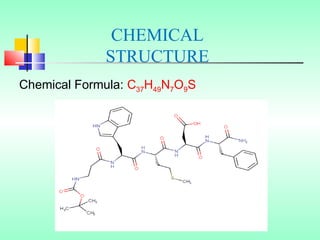
Chemical Formula: C37H49N7O9S
CHEMICAL
STRUCTURE
Pharmacology of
Pentagastrin
Pentagastrin is indicated as a diagnostic aid for evaluation
of gastric acid secretory function. It is effective in testing for
anacidity (achlorhydria) in patients with suspected pernicious
anemia, atrophic gastritis, or gastric carcinoma. It is also effective
in determining the reduction in acid output after operations for
peptic ulcer, such as vagotomy or gastric resection.
Pharmacodynamics
The exact mechanism by which pentagastrin stimulates
gastric acid, pepsin, and intrinsic factor secretion is
unknown; however, since Pentagastrin is an analogue of
natural gastrin, it is believed that it excites the oxyntic cells
of the stomach to secrete to their maximum capacity.
Pentagastrin stimulates pancreatic secretion, especially when
administered in large intramuscular doses. Pentagastrin also
increases gastrointestinal motility by a direct effect on the
intestinal smooth muscle. However, it delays gastric
emptying time probably by stimulation of terminal antral
contractions, which enhance retropulsion.
*OXYNTIC CELL- one of the cells of the gastric gland
Mechanism of action
Pentagastrin increases blood flow in the gastric mucosa,
inhibits absorption of water and electrolytes from the ileum,
and promotes sodium and chloride diuresis. It causes
contraction of the smooth muscle of the lower esophageal
sphincter when administered intravenously. Pentagastrin
produces an increase in the motor activity of the colon and
rectum.
*esophageal—the food pipe that runs between the throat and
the stomach
OTHER ACTIONS/EFFECTS
ONSET OF ACTION 10 minutes
TIME TO PEAK EFFECT 20 to 30 minutes
DURATION OF ACTION 60 to 80 minutes
Clinical Pharmacology
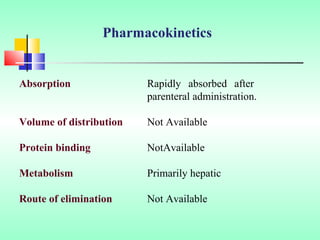
Absorption Rapidly absorbed after
parenteral administration.
Volume of distribution Not Available
Protein binding NotAvailable
Metabolism Primarily hepatic
Route of elimination Not Available
Pharmacokinetics
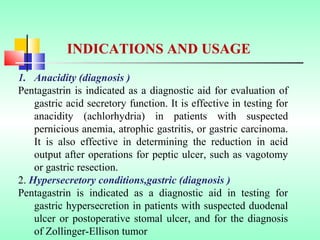
1. Anacidity (diagnosis )
Pentagastrin is indicated as a diagnostic aid for evaluation of
gastric acid secretory function. It is effective in testing for
anacidity (achlorhydria) in patients with suspected
pernicious anemia, atrophic gastritis, or gastric carcinoma.
It is also effective in determining the reduction in acid
output after operations for peptic ulcer, such as vagotomy
or gastric resection.
2. Hypersecretory conditions,gastric (diagnosis )
Pentagastrin is indicated as a diagnostic aid in testing for
gastric hypersecretion in patients with suspected duodenal
ulcer or postoperative stomal ulcer, and for the diagnosis
of Zollinger-Ellison tumor
INDICATIONS AND USAGE
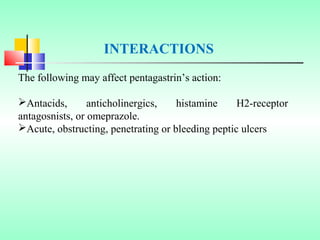
The following may affect pentagastrin’s action:
Antacids, anticholinergics, histamine H2-receptor
antagosnists, or omeprazole.
Acute, obstructing, penetrating or bleeding peptic ulcers
INTERACTIONS
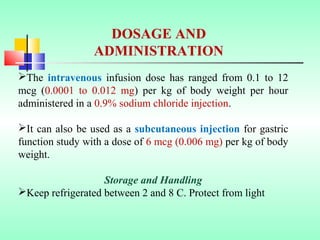
The intravenous infusion dose has ranged from 0.1 to 12
mcg (0.0001 to 0.012 mg) per kg of body weight per hour
administered in a 0.9% sodium chloride injection.
It can also be used as a subcutaneous injection for gastric
function study with a dose of 6 mcg (0.006 mg) per kg of body
weight.
Storage and Handling
Keep refrigerated between 2 and 8 C. Protect from light
DOSAGE AND
ADMINISTRATION
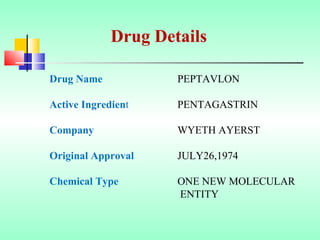
Drug Details
Drug Name PEPTAVLON
Active Ingredient PENTAGASTRIN
Company WYETH AYERST
Original Approval JULY26,1974
Chemical Type ONE NEW MOLECULAR
ENTITY
Reference:
1. http://www.drugbank.ca/drugs/DB00183
2. www.fda.gov
THANK
YOU!
ANY QUESTIONS?

Pentagastrin

  • 1.
    PENTAGASTRIN VIGNESH M I YEAR-M.TECH (Bio-Pharmaceutical Technology) Anna University, Trichy
  • 2.
    A synthetic pentapeptidethat has effects like gastrin when given parenterally. It stimulates the secretion of gastric acid, pepsin, and intrinsic factor, and has been used as a diagnostic aid. Pentagastrin binds to the cholecystokinin-B receptor, which is expressed widely in the brain. Activation of these receptors activates the phospholipase C second messenger system. Pentagastrin’s IUPAC chemical name is “N-((1,1-dimethylethoxy)carbonyl)-beta-alanyl-L-tryptophyl Lmethionyl-L-alpha-aspartyl-L-phenylalaninamide”. DEFINITION
  • 3.
  • 4.
  • 5.
    Pentagastrin is indicatedas a diagnostic aid for evaluation of gastric acid secretory function. It is effective in testing for anacidity (achlorhydria) in patients with suspected pernicious anemia, atrophic gastritis, or gastric carcinoma. It is also effective in determining the reduction in acid output after operations for peptic ulcer, such as vagotomy or gastric resection. Pharmacodynamics
  • 6.
    The exact mechanismby which pentagastrin stimulates gastric acid, pepsin, and intrinsic factor secretion is unknown; however, since Pentagastrin is an analogue of natural gastrin, it is believed that it excites the oxyntic cells of the stomach to secrete to their maximum capacity. Pentagastrin stimulates pancreatic secretion, especially when administered in large intramuscular doses. Pentagastrin also increases gastrointestinal motility by a direct effect on the intestinal smooth muscle. However, it delays gastric emptying time probably by stimulation of terminal antral contractions, which enhance retropulsion. *OXYNTIC CELL- one of the cells of the gastric gland Mechanism of action
  • 7.
    Pentagastrin increases bloodflow in the gastric mucosa, inhibits absorption of water and electrolytes from the ileum, and promotes sodium and chloride diuresis. It causes contraction of the smooth muscle of the lower esophageal sphincter when administered intravenously. Pentagastrin produces an increase in the motor activity of the colon and rectum. *esophageal—the food pipe that runs between the throat and the stomach OTHER ACTIONS/EFFECTS
  • 8.
    ONSET OF ACTION10 minutes TIME TO PEAK EFFECT 20 to 30 minutes DURATION OF ACTION 60 to 80 minutes Clinical Pharmacology
  • 9.
    Absorption Rapidly absorbedafter parenteral administration. Volume of distribution Not Available Protein binding NotAvailable Metabolism Primarily hepatic Route of elimination Not Available Pharmacokinetics
  • 10.
    1. Anacidity (diagnosis) Pentagastrin is indicated as a diagnostic aid for evaluation of gastric acid secretory function. It is effective in testing for anacidity (achlorhydria) in patients with suspected pernicious anemia, atrophic gastritis, or gastric carcinoma. It is also effective in determining the reduction in acid output after operations for peptic ulcer, such as vagotomy or gastric resection. 2. Hypersecretory conditions,gastric (diagnosis ) Pentagastrin is indicated as a diagnostic aid in testing for gastric hypersecretion in patients with suspected duodenal ulcer or postoperative stomal ulcer, and for the diagnosis of Zollinger-Ellison tumor INDICATIONS AND USAGE
  • 11.
    The following mayaffect pentagastrin’s action: Antacids, anticholinergics, histamine H2-receptor antagosnists, or omeprazole. Acute, obstructing, penetrating or bleeding peptic ulcers INTERACTIONS
  • 12.
    The intravenous infusiondose has ranged from 0.1 to 12 mcg (0.0001 to 0.012 mg) per kg of body weight per hour administered in a 0.9% sodium chloride injection. It can also be used as a subcutaneous injection for gastric function study with a dose of 6 mcg (0.006 mg) per kg of body weight. Storage and Handling Keep refrigerated between 2 and 8 C. Protect from light DOSAGE AND ADMINISTRATION
  • 13.
    Drug Details Drug NamePEPTAVLON Active Ingredient PENTAGASTRIN Company WYETH AYERST Original Approval JULY26,1974 Chemical Type ONE NEW MOLECULAR ENTITY
  • 14.
  • 15.