Anticancer Antibiotics
Prepared by,
Chinnu Suresh
1st sem Mpharm
Pharmaceutical Chemistry
i)Anthracyclines eg: Doxorubicin, Daunorubicin, Idarubicin.
ii)Bleomycin eg: Bleomycin sulfate
iii)Mitomycin eg: Mitomycin C
iv)Dactinomycin eg: Actinomycin D
v)Plicamycin eg. Mithramycin
A. Anthracycline
• Anthracycline are large and complex family of antibiotics
• They have a tetracycline ring structure with unusual sugar daunosamine
attached by glycosidic linkage.
Mechanism of Action
 The anthraquinone nucleus of the anthracyclines intercalate with DNA,
which leads to single and double stranded DNA breaks.
 In addition, anthraquinone is also capable of generating reactive oxygen
species such as hydroxy radical (OH) and super oxide radical anion (0-0).
These free radicals may produce destructive effect upon the cell which may
include damage of DNA.
 The generation of free radicals leads to cardio toxicity, a major side effect of
anthracycline.
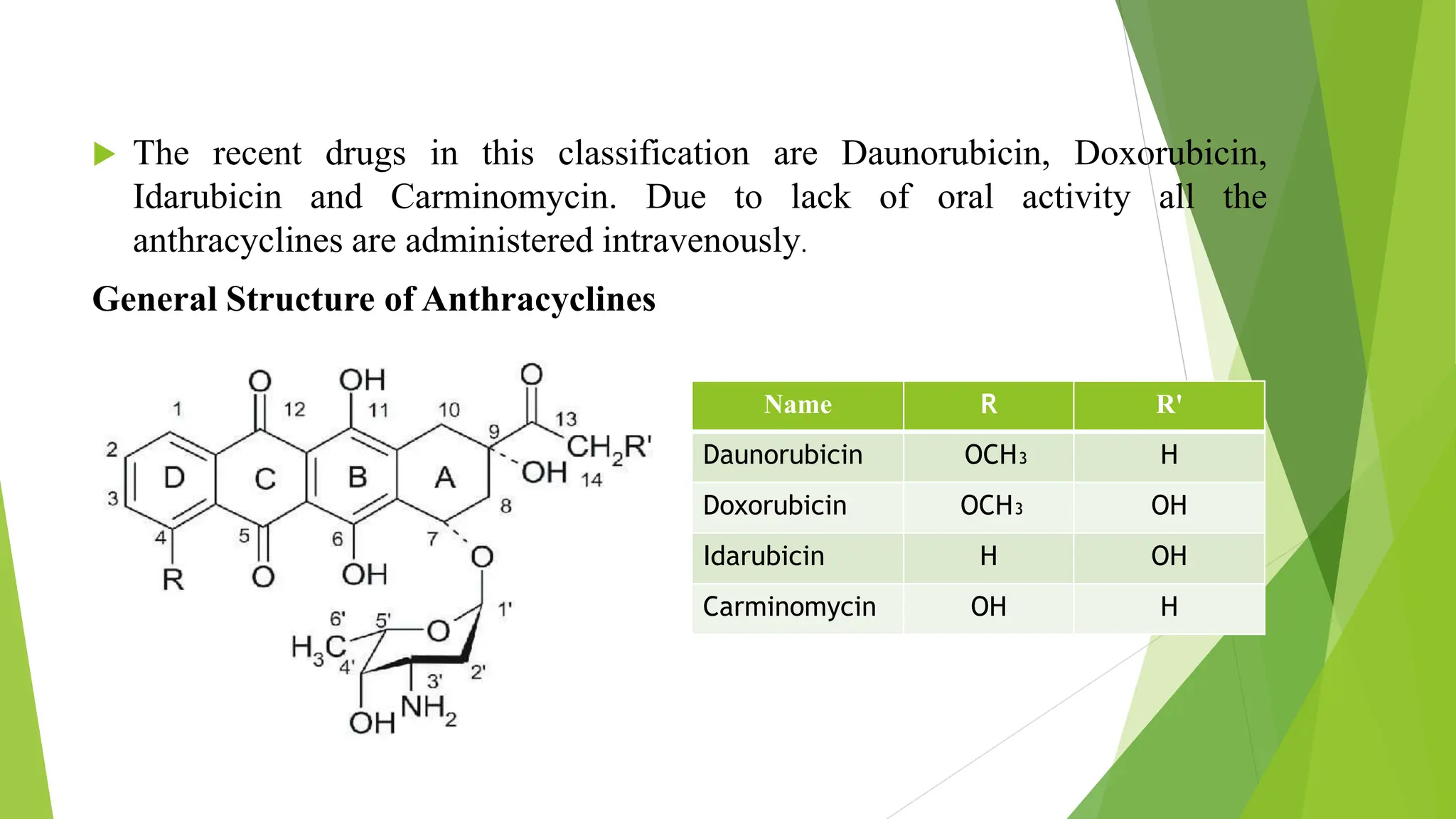
 The recent drugs in this classification are Daunorubicin, Doxorubicin,
Idarubicin and Carminomycin. Due to lack of oral activity all the
anthracyclines are administered intravenously.
General Structure of Anthracyclines
Name R R'
Daunorubicin OCH₃ H
Doxorubicin OCH₃ OH
Idarubicin H OH
Carminomycin OH H
Daunorubicin
 Obtained from streptomyces peucetius
 It intercalates DNA and Inhibits tropoisomerase-Ⅱ.
 Used in treatment of acute lymphocytic and granulocytic
leukaemia.
Doxorubicin
 It is obtained from streptomyces peucetius
 One of the most effective antitumor agent
 It has been used for acute lymphoblastic and myeloblastic leukaemia
B. Bleomycin
 Glycopeptide isolated from Streptomyces verticillus
 Mixture of closely related compounds with bleomycin A,
and B, which are available in nature as blue copper
chelates.
 MOA: The cytotoxic property of bleomycin are due to
fragmentation of DNA.
 It appears to cause scission of DNA by interacting with
O2 and Fe.
 It binds with DNA through its amino terminal peptide and
the activated complex generates free radicals that
causes DNA breaking
 Structure: pyrimidine moiety joined to propionamide, B-
amino alanine amine, sidechain, sugar l-glucose, 3-o
carbonyl D-mannose.
C. Mytomycin C
 It inhibit DNA synthesis by crosslinking double stranded DNA through
guanine and tyrosine
 It is used in gastric and pancreatic carcinoma.
D. Dactinomycin
Actinomycin-D is produced by Streptomyces chrysomallus and other species of
Streptomyces. It is made up of amino acids.
MOA: It binds to double helical DNA, intercalate in the minor groove of DNA between
adjacent guanosine-cytosine pairs, block DNA dependent RNA polymerase and hence
transcription of DNA molecule is blocked.
Used in the treatment of carcinoma of uterus, testis, Kaposi's sarcoma, osteogenic rcoma,
Wilm's tumour and Ewing's sarcoma.
. .Chemically it is a bicyclic chromopeptide
lactone sharing phenoxazinone dicarboxylic
acid with 2 pentapeptide lactone of nonribo-
somal orgin
Plant Products
 Vinca alkaloids: eg. Vincristine, Vinblastine,Vinorelbine
 Epipodophyllotoxins: eg. Etoposide, Teniposide
 Taxol: eg. Paclitaxel.
A. vinca Alkaloids
 Vinca alkaloids are derived from plant Vinca rosea,
these are vincristine and vinblastine.
 Vinca alkaloids are "spindle poisons". They bind to the
microtubule protein "tubulin" and causes
depolymerization of microtubules, which are essential
for formation of mitotic spindle.
 Vincristine: Used in the treatment of acute
lymphoblastic leukemia in children, Hodgkin's & non-
Hodgkin's lymphomas, Ewing's soft-tissue sarcoma and
Wilm's tumour.
 Vinblastine: Used along with bleomycin and cisplatin
for the treatment of metastatic testicular carcinoma, Also
used in the treatment of systemic Hodgkin's and non-
Hodgkin's lymphomas
B. Epipodophyllotoxins: Etoposide
 Etoposide is a semisynthetic derivative of podophyllotoxin.
 Etoposide induce strand breaks in DNA via topoisomerare Il
cleavage, inhibition of nucleoside transport and inhibition of
mitochondrial transport.
 uses: Used in refractory testicular tumours, Kaposi's sarcoma,
non-Hodgkin lymphoma, small cell lung cancer, Wilm's tumour
& hepatocellular carcinoma
 Etoposide-R-CH₃
Tenoposide-R-
S
C
H3
2-methylthiophene
HORMONES
A. Tamoxifen
Uses: useful in the treatment of breast cancer in postmenopausal
women
Miscellaneous Agents
1. Cisplatin
Cisplatin is a platinum complex containing two ammonia molecule
and two chlorine atom in cis-configuration.
it used in treatment of various cancer including testicular cancer,
esophageal cancer, ovarian cancer, and brain tumor
2. Mitotane
It is dichloro diphenyl trichloroethane (DDT)
Uses: Treatment of adrenocortical carcinoma and cushing
syndrome.
1
6
2
5
3
4
8
11
12
16
13
15
14
Cl
17
Cl
7
9
Cl
10
1-chloro-2-[2-chloro-1-(4-chlorophenyl)ethyl]benzene
Synthesis
Uses: Treatment of adrenocortical carcinoma and cushing
syndrome.
REFERENCE
1. Textbook of medicinal chemistry by k.llango, p
valentine. Vol-2, page nbr:253
THANK YOU

Anticancer Antibiotics.pptx-cMpharm pharmaceutical chemistry

  • 1.
    Anticancer Antibiotics Prepared by, ChinnuSuresh 1st sem Mpharm Pharmaceutical Chemistry
  • 2.
    i)Anthracyclines eg: Doxorubicin,Daunorubicin, Idarubicin. ii)Bleomycin eg: Bleomycin sulfate iii)Mitomycin eg: Mitomycin C iv)Dactinomycin eg: Actinomycin D v)Plicamycin eg. Mithramycin
  • 3.
    A. Anthracycline • Anthracyclineare large and complex family of antibiotics • They have a tetracycline ring structure with unusual sugar daunosamine attached by glycosidic linkage. Mechanism of Action  The anthraquinone nucleus of the anthracyclines intercalate with DNA, which leads to single and double stranded DNA breaks.  In addition, anthraquinone is also capable of generating reactive oxygen species such as hydroxy radical (OH) and super oxide radical anion (0-0). These free radicals may produce destructive effect upon the cell which may include damage of DNA.  The generation of free radicals leads to cardio toxicity, a major side effect of anthracycline.
  • 4.
     The recentdrugs in this classification are Daunorubicin, Doxorubicin, Idarubicin and Carminomycin. Due to lack of oral activity all the anthracyclines are administered intravenously. General Structure of Anthracyclines Name R R' Daunorubicin OCH₃ H Doxorubicin OCH₃ OH Idarubicin H OH Carminomycin OH H
  • 5.
    Daunorubicin  Obtained fromstreptomyces peucetius  It intercalates DNA and Inhibits tropoisomerase-Ⅱ.  Used in treatment of acute lymphocytic and granulocytic leukaemia.
  • 6.
    Doxorubicin  It isobtained from streptomyces peucetius  One of the most effective antitumor agent  It has been used for acute lymphoblastic and myeloblastic leukaemia
  • 7.
    B. Bleomycin  Glycopeptideisolated from Streptomyces verticillus  Mixture of closely related compounds with bleomycin A, and B, which are available in nature as blue copper chelates.  MOA: The cytotoxic property of bleomycin are due to fragmentation of DNA.  It appears to cause scission of DNA by interacting with O2 and Fe.  It binds with DNA through its amino terminal peptide and the activated complex generates free radicals that causes DNA breaking  Structure: pyrimidine moiety joined to propionamide, B- amino alanine amine, sidechain, sugar l-glucose, 3-o carbonyl D-mannose.
  • 8.
    C. Mytomycin C It inhibit DNA synthesis by crosslinking double stranded DNA through guanine and tyrosine  It is used in gastric and pancreatic carcinoma.
  • 9.
    D. Dactinomycin Actinomycin-D isproduced by Streptomyces chrysomallus and other species of Streptomyces. It is made up of amino acids. MOA: It binds to double helical DNA, intercalate in the minor groove of DNA between adjacent guanosine-cytosine pairs, block DNA dependent RNA polymerase and hence transcription of DNA molecule is blocked. Used in the treatment of carcinoma of uterus, testis, Kaposi's sarcoma, osteogenic rcoma, Wilm's tumour and Ewing's sarcoma. . .Chemically it is a bicyclic chromopeptide lactone sharing phenoxazinone dicarboxylic acid with 2 pentapeptide lactone of nonribo- somal orgin
  • 11.
    Plant Products  Vincaalkaloids: eg. Vincristine, Vinblastine,Vinorelbine  Epipodophyllotoxins: eg. Etoposide, Teniposide  Taxol: eg. Paclitaxel.
  • 12.
    A. vinca Alkaloids Vinca alkaloids are derived from plant Vinca rosea, these are vincristine and vinblastine.  Vinca alkaloids are "spindle poisons". They bind to the microtubule protein "tubulin" and causes depolymerization of microtubules, which are essential for formation of mitotic spindle.
  • 13.
     Vincristine: Usedin the treatment of acute lymphoblastic leukemia in children, Hodgkin's & non- Hodgkin's lymphomas, Ewing's soft-tissue sarcoma and Wilm's tumour.  Vinblastine: Used along with bleomycin and cisplatin for the treatment of metastatic testicular carcinoma, Also used in the treatment of systemic Hodgkin's and non- Hodgkin's lymphomas
  • 14.
    B. Epipodophyllotoxins: Etoposide Etoposide is a semisynthetic derivative of podophyllotoxin.  Etoposide induce strand breaks in DNA via topoisomerare Il cleavage, inhibition of nucleoside transport and inhibition of mitochondrial transport.  uses: Used in refractory testicular tumours, Kaposi's sarcoma, non-Hodgkin lymphoma, small cell lung cancer, Wilm's tumour & hepatocellular carcinoma  Etoposide-R-CH₃ Tenoposide-R- S C H3 2-methylthiophene
  • 15.
    HORMONES A. Tamoxifen Uses: usefulin the treatment of breast cancer in postmenopausal women
  • 16.
    Miscellaneous Agents 1. Cisplatin Cisplatinis a platinum complex containing two ammonia molecule and two chlorine atom in cis-configuration. it used in treatment of various cancer including testicular cancer, esophageal cancer, ovarian cancer, and brain tumor
  • 17.
    2. Mitotane It isdichloro diphenyl trichloroethane (DDT) Uses: Treatment of adrenocortical carcinoma and cushing syndrome. 1 6 2 5 3 4 8 11 12 16 13 15 14 Cl 17 Cl 7 9 Cl 10 1-chloro-2-[2-chloro-1-(4-chlorophenyl)ethyl]benzene
  • 18.
    Synthesis Uses: Treatment ofadrenocortical carcinoma and cushing syndrome.
  • 19.
    REFERENCE 1. Textbook ofmedicinal chemistry by k.llango, p valentine. Vol-2, page nbr:253
  • 20.