Brunauer–Emmett–Teller
(BET) Analysis
Contents
Introduction
Historical background
Porosity
measurement methods
Absorption
Absorption isotherm
Langmuir's theory
BET Theorem
Method of analysis
BET Method Limitations
Discussion and conclusion
2
INSTRUCTIONS
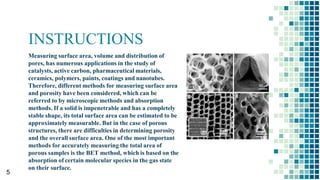
Measuring surface area, volume and distribution of
pores, has numerous applications in the study of
catalysts, active carbon, pharmaceutical materials,
ceramics, polymers, paints, coatings and nanotubes.
Therefore, different methods for measuring surface area
and porosity have been considered, which can be
referred to by microscopic methods and absorption
methods. If a solid is impenetrable and has a completely
stable shape, its total surface area can be estimated to be
approximately measurable. But in the case of porous
structures, there are difficulties in determining porosity
and the overall surface area. One of the most important
methods for accurately measuring the total area of
porous samples is the BET method, which is based on the
absorption of certain molecular species in the gas state
on their surface.
5
Historical background
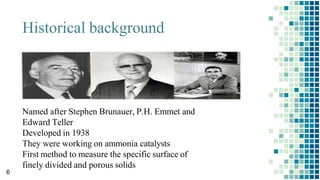
Named after Stephen Brunauer, P.H. Emmet and
Edward Teller
Developed in 1938
They were working on ammonia catalysts
First method to measure the specific surface of
finely divided and porous solids
6
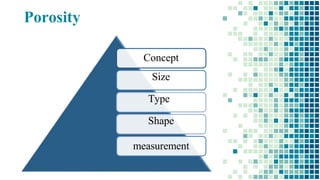
Porosity
Concept
Size
Type
Shape
measurement
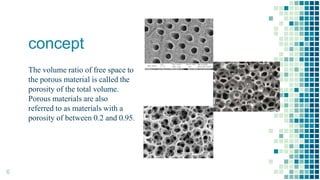
The volume ratio of free space to
the porous material is called the
porosity of the total volume.
Porous materials are also
referred to as materials with a
porosity of between 0.2 and 0.95.
concept
6
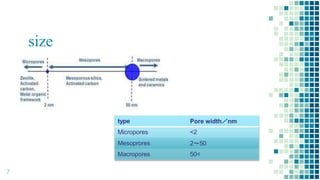
size
type Pore width/nm
Micropores <2
Mesoprores 2~50
Macropores 50<
7
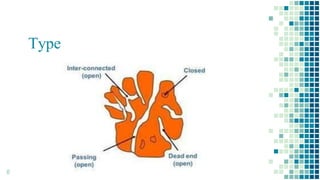
Type
8
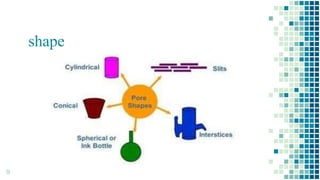
shape
9
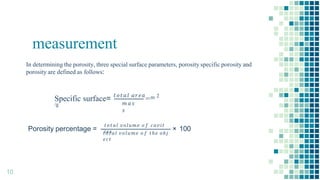
measurement
In determining the porosity, three special surface parameters, porosity specific porosity and
porosity are defined as follows:
𝑚𝑎𝑠
𝑠
Specific surface= 𝑡𝑜𝑡𝑎𝑙 𝑎𝑟𝑒𝑎
=m 2
/g
Porosity percentage =
𝑡𝑜𝑡𝑎𝑙 𝑣𝑜𝑙𝑢𝑚𝑒 𝑜 𝑓 𝑐𝑎𝑣𝑖𝑡
𝑖𝑒𝑠
10
𝑡𝑜𝑡𝑎𝑙 𝑣𝑜𝑙𝑢𝑚𝑒 𝑜 𝑓 𝑡ℎ𝑒 𝑜𝑏𝑗
𝑒𝑐𝑡
× 100
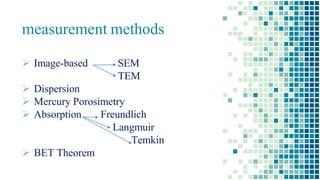
measurement methods
 Image-based SEM
TEM
 Dispersion
 Mercury Porosimetry
 Absorption Freundlich
Langmuir
Temkin
 BET Theorem
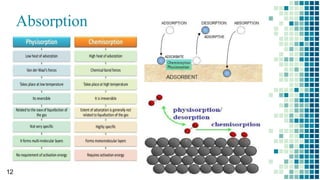
Absorption
12
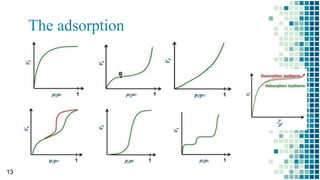
The adsorption
13
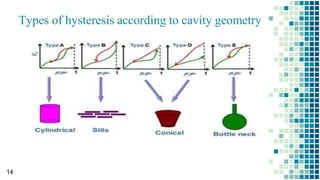
Types of hysteresis according to cavity geometry
14
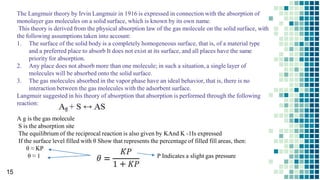
The Langmuir theory by Irvin Langmuir in 1916 is expressed in connection with the absorption of
monolayer gas molecules on a solid surface, which is known by its own name.
This theory is derived from the physical absorption law of the gas molecule on the solid surface, with
the following assumptions taken into account:
1. The surface of the solid body is a completely homogeneous surface, that is, of a material type
and a preferred place to absorb It does not exist at its surface, and all places have the same
priority for absorption.
2. Any place does not absorb more than one molecule; in such a situation, a single layer of
molecules will be absorbed onto the solid surface.
3. The gas molecules absorbed in the vapor phase have an ideal behavior, that is, there is no
interaction between the gas molecules with the adsorbent surface.
Langmuir suggested in his theory of absorption that absorption is performed through the following
reaction:
A g is the gas molecule
S is the absorption site
The equilibrium of the reciprocal reaction is also given by KAnd K -1Is expressed
If the surface level filled with θ Show that represents the percentage of filled fill areas, then:
θ ≈ KP
θ ≈ 1 P Indicates a slight gas pressure
15
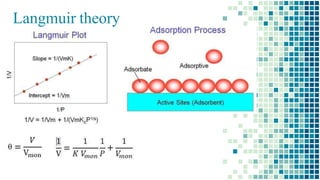
Langmuir theory
The BET Theorem
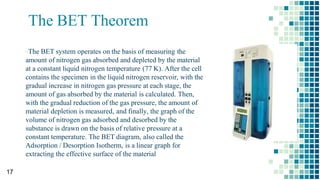
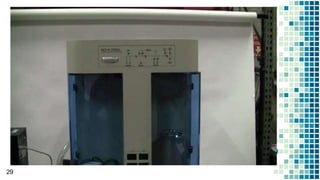
▪The BET system operates on the basis of measuring the
amount of nitrogen gas absorbed and depleted by the material
at a constant liquid nitrogen temperature (77 K). After the cell
contains the specimen in the liquid nitrogen reservoir, with the
gradual increase in nitrogen gas pressure at each stage, the
amount of gas absorbed by the material is calculated. Then,
with the gradual reduction of the gas pressure, the amount of
material depletion is measured, and finally, the graph of the
volume of nitrogen gas adsorbed and desorbed by the
substance is drawn on the basis of relative pressure at a
constant temperature. The BET diagram, also called the
Adsorption / Desorption Isotherm, is a linear graph for
extracting the effective surface of the material
17
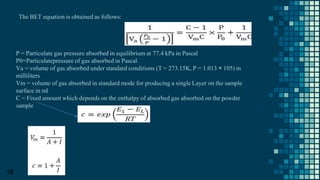
The BET equation is obtained as follows:
P = Particulate gas pressure absorbed in equilibrium at 77.4 kPa in Pascal
P0=Particulatepressure of gas absorbed in Pascal
Va = volume of gas absorbed under standard conditions (T = 273.15K, P = 1.013 × 10⁵) in
milliliters
Vm = volume of gas absorbed in standard mode for producing a single Layer on the sample
surface in ml
C = Fixed amount which depends on the enthalpy of absorbed gas absorbed on the powder
sample
18
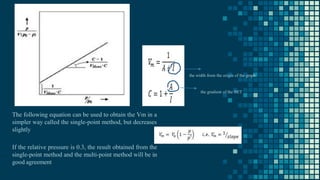
the width from the origin of the graph
the gradient of the BET
The following equation can be used to obtain the Vm in a
simpler way called the single-point method, but decreases
slightly
If the relative pressure is 0.3, the result obtained from the
single-point method and the multi-point method will be in
good agreement
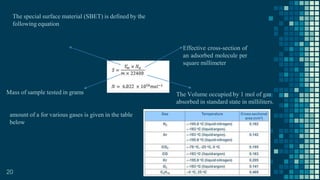
The special surface material (SBET) is defined by the
following equation
Effective cross-section of
an adsorbed molecule per
square millimeter
Mass of sample tested in grams The Volume occupied by 1 mol of gas
absorbed in standard state in milliliters.
amount of a for various gases is given in the table
below
20
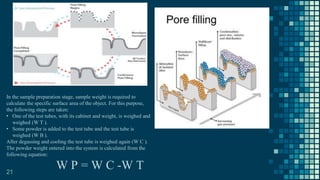
In the sample preparation stage, sample weight is required to
calculate the specific surface area of the object. For this purpose,
the following steps are taken:
• One of the test tubes, with its cabinet and weight, is weighed and
weighed (W T ).
• Some powder is added to the test tube and the test tube is
weighed (W B ).
After degassing and cooling the test tube is weighed again (W C ).
The powder weight entered into the system is calculated from the
following equation:
W P = W C -W T
21
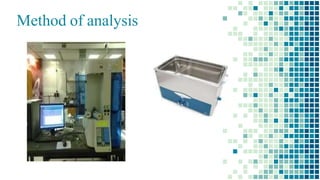
Method of analysis
BET Method Limitations
23
The BET method is an estimated method, and it is critically criticized for assuming that absorption
in the n layer occurs when the n-1 layer is completely filled Therefore, in order to overcome this
problem, it is necessary to correct the constant C according to some experimental parameters. Of
course, doing so will not change the surface area of the calculated level, because when the P / P0
ratio is in the range of 0.3 to 0.05, in most cases, multi-layer adsorption does not occur. When the
relative pressure P / P0 is between 0.3 and 0.05, absorption data is well suited to the BET
equation, and at this time, it is usually possible to accurately measure the surface area. But when
the P / P0 value is above the above limit, complexities arise from adsorption at more than one
layer or from compaction. When the P / P0 ratio is less than the upper limit, in most cases, the
amount of absorption is so low that it can not be measured accurately
In porous materials, only the holes in the passage allow gas to pass. But the BET method
measures the level of cavities in the path and closed cavities.
If the sample contains significant cavity values, the BET method measures the amount of surface
that does not actually pass through some of the gas. So the measurement error in this method is
high. Also, this method is a time-consuming method and is not sufficient to measure low-level
surfaces, and this technique is not suitable for powder samples with a micrometric particle size
General advantages of The BET method
24
Among the methods used to determine porosity and surface area, adsorption-
based methods, especially the BET method, have the ability to measure porosity
a magnitude of 0.4 to 50 nm, as well as the ease of measurement and its low
cost to take advantage of it.
It turns out. This method also allows the type, size, and form of porosity
contained in the material to be absorbed from the type of isotherm.
Discussion and conclusion
Among the methods used to determine porosity and surface
area, absorption methods, especially the BET method, have
the ability to measure porosity at a magnitude of 0.4 to 50 nm,
and also the ease of measurement and its low cost are
considered as benefits. It turns out. It also allows the type of
porosity found in the material to be derived from the type of
absorption isotherm. Limitations of this method include time-
consuming, low accuracy of this method for low levels and
the need for powder samples
29
Resources and references
 http://edu.nano.ir/paper/301
 Measurement of active surface and pore
volume in nanomaterials/Selected Articles
of the Nanotechnology Monthly
 Characterization of Nanostructures/
SVERRE MYHRA • JOHN C. RIVIÈREK12508ISBN

BET Analysis.pptx

  • 1.
  • 2.
    Contents Introduction Historical background Porosity measurement methods Absorption Absorptionisotherm Langmuir's theory BET Theorem Method of analysis BET Method Limitations Discussion and conclusion 2
  • 3.
    INSTRUCTIONS Measuring surface area,volume and distribution of pores, has numerous applications in the study of catalysts, active carbon, pharmaceutical materials, ceramics, polymers, paints, coatings and nanotubes. Therefore, different methods for measuring surface area and porosity have been considered, which can be referred to by microscopic methods and absorption methods. If a solid is impenetrable and has a completely stable shape, its total surface area can be estimated to be approximately measurable. But in the case of porous structures, there are difficulties in determining porosity and the overall surface area. One of the most important methods for accurately measuring the total area of porous samples is the BET method, which is based on the absorption of certain molecular species in the gas state on their surface. 5
  • 4.
    Historical background Named afterStephen Brunauer, P.H. Emmet and Edward Teller Developed in 1938 They were working on ammonia catalysts First method to measure the specific surface of finely divided and porous solids 6
  • 5.
  • 6.
    The volume ratioof free space to the porous material is called the porosity of the total volume. Porous materials are also referred to as materials with a porosity of between 0.2 and 0.95. concept 6
  • 7.
    size type Pore width/nm Micropores<2 Mesoprores 2~50 Macropores 50< 7
  • 8.
  • 9.
  • 10.
    measurement In determining theporosity, three special surface parameters, porosity specific porosity and porosity are defined as follows: 𝑚𝑎𝑠 𝑠 Specific surface= 𝑡𝑜𝑡𝑎𝑙 𝑎𝑟𝑒𝑎 =m 2 /g Porosity percentage = 𝑡𝑜𝑡𝑎𝑙 𝑣𝑜𝑙𝑢𝑚𝑒 𝑜 𝑓 𝑐𝑎𝑣𝑖𝑡 𝑖𝑒𝑠 10 𝑡𝑜𝑡𝑎𝑙 𝑣𝑜𝑙𝑢𝑚𝑒 𝑜 𝑓 𝑡ℎ𝑒 𝑜𝑏𝑗 𝑒𝑐𝑡 × 100
  • 11.
    measurement methods  Image-basedSEM TEM  Dispersion  Mercury Porosimetry  Absorption Freundlich Langmuir Temkin  BET Theorem
  • 12.
  • 13.
  • 14.
    Types of hysteresisaccording to cavity geometry 14
  • 15.
    The Langmuir theoryby Irvin Langmuir in 1916 is expressed in connection with the absorption of monolayer gas molecules on a solid surface, which is known by its own name. This theory is derived from the physical absorption law of the gas molecule on the solid surface, with the following assumptions taken into account: 1. The surface of the solid body is a completely homogeneous surface, that is, of a material type and a preferred place to absorb It does not exist at its surface, and all places have the same priority for absorption. 2. Any place does not absorb more than one molecule; in such a situation, a single layer of molecules will be absorbed onto the solid surface. 3. The gas molecules absorbed in the vapor phase have an ideal behavior, that is, there is no interaction between the gas molecules with the adsorbent surface. Langmuir suggested in his theory of absorption that absorption is performed through the following reaction: A g is the gas molecule S is the absorption site The equilibrium of the reciprocal reaction is also given by KAnd K -1Is expressed If the surface level filled with θ Show that represents the percentage of filled fill areas, then: θ ≈ KP θ ≈ 1 P Indicates a slight gas pressure 15
  • 16.
  • 17.
    The BET Theorem ▪TheBET system operates on the basis of measuring the amount of nitrogen gas absorbed and depleted by the material at a constant liquid nitrogen temperature (77 K). After the cell contains the specimen in the liquid nitrogen reservoir, with the gradual increase in nitrogen gas pressure at each stage, the amount of gas absorbed by the material is calculated. Then, with the gradual reduction of the gas pressure, the amount of material depletion is measured, and finally, the graph of the volume of nitrogen gas adsorbed and desorbed by the substance is drawn on the basis of relative pressure at a constant temperature. The BET diagram, also called the Adsorption / Desorption Isotherm, is a linear graph for extracting the effective surface of the material 17
  • 18.
    The BET equationis obtained as follows: P = Particulate gas pressure absorbed in equilibrium at 77.4 kPa in Pascal P0=Particulatepressure of gas absorbed in Pascal Va = volume of gas absorbed under standard conditions (T = 273.15K, P = 1.013 × 10⁵) in milliliters Vm = volume of gas absorbed in standard mode for producing a single Layer on the sample surface in ml C = Fixed amount which depends on the enthalpy of absorbed gas absorbed on the powder sample 18
  • 19.
    the width fromthe origin of the graph the gradient of the BET The following equation can be used to obtain the Vm in a simpler way called the single-point method, but decreases slightly If the relative pressure is 0.3, the result obtained from the single-point method and the multi-point method will be in good agreement
  • 20.
    The special surfacematerial (SBET) is defined by the following equation Effective cross-section of an adsorbed molecule per square millimeter Mass of sample tested in grams The Volume occupied by 1 mol of gas absorbed in standard state in milliliters. amount of a for various gases is given in the table below 20
  • 21.
    In the samplepreparation stage, sample weight is required to calculate the specific surface area of the object. For this purpose, the following steps are taken: • One of the test tubes, with its cabinet and weight, is weighed and weighed (W T ). • Some powder is added to the test tube and the test tube is weighed (W B ). After degassing and cooling the test tube is weighed again (W C ). The powder weight entered into the system is calculated from the following equation: W P = W C -W T 21
  • 22.
  • 23.
    BET Method Limitations 23 TheBET method is an estimated method, and it is critically criticized for assuming that absorption in the n layer occurs when the n-1 layer is completely filled Therefore, in order to overcome this problem, it is necessary to correct the constant C according to some experimental parameters. Of course, doing so will not change the surface area of the calculated level, because when the P / P0 ratio is in the range of 0.3 to 0.05, in most cases, multi-layer adsorption does not occur. When the relative pressure P / P0 is between 0.3 and 0.05, absorption data is well suited to the BET equation, and at this time, it is usually possible to accurately measure the surface area. But when the P / P0 value is above the above limit, complexities arise from adsorption at more than one layer or from compaction. When the P / P0 ratio is less than the upper limit, in most cases, the amount of absorption is so low that it can not be measured accurately In porous materials, only the holes in the passage allow gas to pass. But the BET method measures the level of cavities in the path and closed cavities. If the sample contains significant cavity values, the BET method measures the amount of surface that does not actually pass through some of the gas. So the measurement error in this method is high. Also, this method is a time-consuming method and is not sufficient to measure low-level surfaces, and this technique is not suitable for powder samples with a micrometric particle size
  • 24.
    General advantages ofThe BET method 24 Among the methods used to determine porosity and surface area, adsorption- based methods, especially the BET method, have the ability to measure porosity a magnitude of 0.4 to 50 nm, as well as the ease of measurement and its low cost to take advantage of it. It turns out. This method also allows the type, size, and form of porosity contained in the material to be absorbed from the type of isotherm.
  • 25.
    Discussion and conclusion Amongthe methods used to determine porosity and surface area, absorption methods, especially the BET method, have the ability to measure porosity at a magnitude of 0.4 to 50 nm, and also the ease of measurement and its low cost are considered as benefits. It turns out. It also allows the type of porosity found in the material to be derived from the type of absorption isotherm. Limitations of this method include time- consuming, low accuracy of this method for low levels and the need for powder samples
  • 26.
  • 27.
    Resources and references http://edu.nano.ir/paper/301  Measurement of active surface and pore volume in nanomaterials/Selected Articles of the Nanotechnology Monthly  Characterization of Nanostructures/ SVERRE MYHRA • JOHN C. RIVIÈREK12508ISBN