Brunauer–Emmett–Teller (BET)
surface area analysis: brief theory
and instrumentation
OUTLINE
1. Definition-discovery & what technique does
2. Definition-theory of BET
, adsorption vs.
desorption and adsorbates
3. Types of pores
4. Equipment
5. Sample preparation
6. Results obtained from instrument/software
DEFINITION
• Discovered by Stephen Brunauer, Paul Hugh
Emmett and Edward Teller in 1938
• Studies physical adsorption of gas molecules
on a solid surface
• Can therefore be used to study surface area &
pore size distribution in given material
• Depends on T
, P
, surface energy distribution
and surface area
DEFINITION
• Gases that adsorb onto material surface are
called adsorbates
react
• These gases should not chemically
with material surfaces
• Most common adsorbate is N2
• Ar, CO, CO2, and O2 may also be used
• Volume of gas adsorbed is measured at
boiling point of nitrogen (-196 ºC)
DEFINITION
• Adsorption vs. desorption:
• Adsorption is the sticking of gas
molecules onto the surface of a solid
• Desorption is the removal of gas
molecules from the surface of a solid
• These include surfaces inside open
pores
DEFINITION
• When the interaction between a surface and an
adsorbate is relatively weak only physisorption
takes place
When electrons available for formation of
Chemical bond on surface atoms, Chemisorption
occurs.
• Activation energy-adsorbate molecules must
overcome an energy barrier
BASIC PRINCIPLE
3
Ideal PV = nRT
P/Po
Q
Ads
No gas molecules
Q
Ads
P/Po
Nitrogen gas molecules
Saturated Nitrogen gas molecules
P/Po
Q
Ads
Actual
 Never start from no gas molecules
 Monolayer: Gas molecules clump
together
 Multilayer: Gas molecules clump
together
 Some pores are not filled
 BET is an extension of Langmuir model
BASIC PRINCIPLE CONT.
Kinetic behavior of the adsorption process
Rate of arrival of adsorption is equal to the rate of
desorption
Heat of adsorption was taken to be constant and
unchanging with the degree of coverage, θ 9
BASIC PRINCIPLE
Assumptions
Gas molecules behave ideally
Only 1 monolayer forms
All sites on the surface are equal
No adsorbate-adsorbate interaction
Adsorbate molecule is immobile
5
BASIC PRINCIPLE
 Homogeneous surface
 No lateral interactions between molecules
 Uppermost layer is in equilibrium with vapour phase
 First and Higher layer: Heat adsorption
 All surface sites have same adsorption energy for
adsorbate
 Adsorption on the adsorbent occurs in infinite layers
 The theory can be applied to each layer
BET Theory
PORE CLASSIFICATION
Pore Size:
• Microporus <2nm
• Mesoporus 2-50nm
• Macroporous >50nm
DEFINITION
• across the entire surface with no preference for one
or more sites
• Each site is either unoccupied or occupied by a single adsorbate
molecule
• Once adsorbed, molecule can act as
sorption site for another gas molecule
• Assumptions:
1. Homogeneous surface- adsorption Occurs
DEFINITION
• Assumptions:
2. All sites on the surface are equal
3. No lateral interactions between molecules
4. Adsorbate molecule is immobile
5.The rate of adsorption is equal to the rate of
desorption
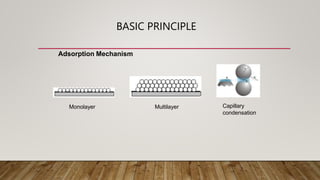
BASIC PRINCIPLE
Adsorption Mechanism
Monolayer Multilayer Capillary
condensation
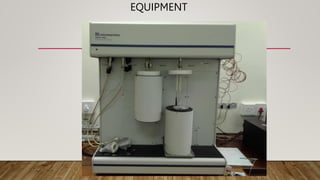
INSTRUMENTATION:
• Basic Construction
–Removable sample cell
–Dosing manifold
–Pressure transducers
–Vacuum system
–Analysis gas
–Valves to move gas in and out of manifold
and sample cell
–Sample thermostat (dewar, furnace, cryostat)
*** Before performing gas sorption expts, solid surfaces must be freed from
contaminants like water and oils
Sample cell
Analysisgas to vacuum
Manifold
Pressure transducer(s)
EQUIPMENT
EQUIPMENT
EQUIPMENT
SAMPLE PREPARATION
• Weigh solid sample (200 ≈ 300 mg)
• Clean, pure & dry sample
• Measurement of sample mass
• Degassing the sample using heat & vacuum
• Heating releases water vapor
• Measuring adsorption
• Analyzing measurement
SAMPLE PREPARATION
ISOTHERMS
• 6 isotherms & BET applicable to:
type II (disperse, nonporous or macroporous solids)
type IV (mesoporous solids; pore diameter 2-50 nm)
THE BET LINEAR EQUATION
RESULTS OBTAINED
RESULTS OBTAINED
RESULTS OBTAINED
Limitations
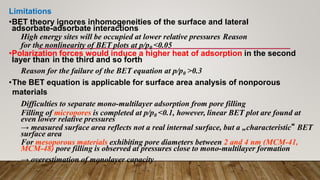
•BET theory ignores inhomogeneities of the surface and lateral
adsorbate-adsorbate interactions
High energy sites will be occupied at lower relative pressures Reason
for the nonlinearity of BET plots at p/p0 <0.05
•Polarization forces would induce a higher heat of adsorption in the second
layer than in the third and so forth
Reason for the failure of the BET equation at p/p0 >0.3
•The BET equation is applicable for surface area analysis of nonporous
materials
Difficulties to separate mono-multilayer adsorption from pore filling
Filling of micropores is completed at p/p0 <0.1, however, linear BET plot are found at
even lower relative pressures
→ measured surface area reflects not a real internal surface, but a „characteristic“ BET
surface area
For mesoporous materials exhibiting pore diameters between 2 and 4 nm (MCM-41,
MCM-48) pore filling is observed at pressures close to mono-multilayer formation
→ overestimation of monolayer capacity
CONCLUSIONS
• BET can be used for:
1. Fibers
2. Nanocatalysts (chemisorption)
3. Nanotubes
4. Polymer membranes
REFERENCES
HTTPS://WWW.IITK.AC.IN/CHE/PDF/RESOURCES/BET-TPX-CHEMI-READING-
MATERIAL.PDF
https://en.wikipedia.org/wiki/BET_theory
https://apps.dtic.mil/dtic/tr/fulltext/u2/1017934.pdf
https://www.micromeritics.com/Repository/Files/ASAP_2020_Brochure
_3.pdf
https://andyjconnelly.wordpress.com/2017/03/13/bet-surface-area/

BET.pptx

  • 1.
    Brunauer–Emmett–Teller (BET) surface areaanalysis: brief theory and instrumentation
  • 2.
    OUTLINE 1. Definition-discovery &what technique does 2. Definition-theory of BET , adsorption vs. desorption and adsorbates 3. Types of pores 4. Equipment 5. Sample preparation 6. Results obtained from instrument/software
  • 3.
    DEFINITION • Discovered byStephen Brunauer, Paul Hugh Emmett and Edward Teller in 1938 • Studies physical adsorption of gas molecules on a solid surface • Can therefore be used to study surface area & pore size distribution in given material • Depends on T , P , surface energy distribution and surface area
  • 5.
    DEFINITION • Gases thatadsorb onto material surface are called adsorbates react • These gases should not chemically with material surfaces • Most common adsorbate is N2 • Ar, CO, CO2, and O2 may also be used • Volume of gas adsorbed is measured at boiling point of nitrogen (-196 ºC)
  • 6.
    DEFINITION • Adsorption vs.desorption: • Adsorption is the sticking of gas molecules onto the surface of a solid • Desorption is the removal of gas molecules from the surface of a solid • These include surfaces inside open pores
  • 7.
    DEFINITION • When theinteraction between a surface and an adsorbate is relatively weak only physisorption takes place When electrons available for formation of Chemical bond on surface atoms, Chemisorption occurs. • Activation energy-adsorbate molecules must overcome an energy barrier
  • 8.
    BASIC PRINCIPLE 3 Ideal PV= nRT P/Po Q Ads No gas molecules Q Ads P/Po Nitrogen gas molecules Saturated Nitrogen gas molecules P/Po Q Ads Actual  Never start from no gas molecules  Monolayer: Gas molecules clump together  Multilayer: Gas molecules clump together  Some pores are not filled
  • 9.
     BET isan extension of Langmuir model BASIC PRINCIPLE CONT. Kinetic behavior of the adsorption process Rate of arrival of adsorption is equal to the rate of desorption Heat of adsorption was taken to be constant and unchanging with the degree of coverage, θ 9
  • 10.
    BASIC PRINCIPLE Assumptions Gas moleculesbehave ideally Only 1 monolayer forms All sites on the surface are equal No adsorbate-adsorbate interaction Adsorbate molecule is immobile 5
  • 11.
    BASIC PRINCIPLE  Homogeneoussurface  No lateral interactions between molecules  Uppermost layer is in equilibrium with vapour phase  First and Higher layer: Heat adsorption  All surface sites have same adsorption energy for adsorbate  Adsorption on the adsorbent occurs in infinite layers  The theory can be applied to each layer BET Theory
  • 12.
    PORE CLASSIFICATION Pore Size: •Microporus <2nm • Mesoporus 2-50nm • Macroporous >50nm
  • 13.
    DEFINITION • across theentire surface with no preference for one or more sites • Each site is either unoccupied or occupied by a single adsorbate molecule • Once adsorbed, molecule can act as sorption site for another gas molecule • Assumptions: 1. Homogeneous surface- adsorption Occurs
  • 14.
    DEFINITION • Assumptions: 2. Allsites on the surface are equal 3. No lateral interactions between molecules 4. Adsorbate molecule is immobile 5.The rate of adsorption is equal to the rate of desorption
  • 15.
    BASIC PRINCIPLE Adsorption Mechanism MonolayerMultilayer Capillary condensation
  • 16.
    INSTRUMENTATION: • Basic Construction –Removablesample cell –Dosing manifold –Pressure transducers –Vacuum system –Analysis gas –Valves to move gas in and out of manifold and sample cell –Sample thermostat (dewar, furnace, cryostat) *** Before performing gas sorption expts, solid surfaces must be freed from contaminants like water and oils Sample cell Analysisgas to vacuum Manifold Pressure transducer(s)
  • 17.
  • 18.
  • 19.
  • 20.
    SAMPLE PREPARATION • Weighsolid sample (200 ≈ 300 mg) • Clean, pure & dry sample • Measurement of sample mass • Degassing the sample using heat & vacuum • Heating releases water vapor • Measuring adsorption • Analyzing measurement
  • 21.
  • 22.
    ISOTHERMS • 6 isotherms& BET applicable to: type II (disperse, nonporous or macroporous solids) type IV (mesoporous solids; pore diameter 2-50 nm)
  • 23.
  • 24.
  • 25.
  • 26.
  • 27.
    Limitations •BET theory ignoresinhomogeneities of the surface and lateral adsorbate-adsorbate interactions High energy sites will be occupied at lower relative pressures Reason for the nonlinearity of BET plots at p/p0 <0.05 •Polarization forces would induce a higher heat of adsorption in the second layer than in the third and so forth Reason for the failure of the BET equation at p/p0 >0.3 •The BET equation is applicable for surface area analysis of nonporous materials Difficulties to separate mono-multilayer adsorption from pore filling Filling of micropores is completed at p/p0 <0.1, however, linear BET plot are found at even lower relative pressures → measured surface area reflects not a real internal surface, but a „characteristic“ BET surface area For mesoporous materials exhibiting pore diameters between 2 and 4 nm (MCM-41, MCM-48) pore filling is observed at pressures close to mono-multilayer formation → overestimation of monolayer capacity
  • 28.
    CONCLUSIONS • BET canbe used for: 1. Fibers 2. Nanocatalysts (chemisorption) 3. Nanotubes 4. Polymer membranes
  • 29.