Surface Area Analysis Using the
BrunauerEmmett-Teller (BET) Method
By:
Neveen Atallah
Adsorption
 Is the adhesion of atoms, ions, biomolecules or molecules of gas, liquid, or
dissolved solids to a surface.
This process creates a film of the adsorbate (the molecules or atoms being
accumulated) on the surface of the adsorbent.
The adsorption process is generally classified as physisorption(characteristic of weak
Van der Waals force) or chemisorption(characteristic of covalent bonding)
 Desorption is the reverse process of adsorption.
Is the amount of adsorbate on the adsorbent as a function of its pressure(if gas) or
concentration (if liquid) at constant temperature.
 Freundlich adsorption isotherm
 The first mathematical fit to an isotherm was published by Freundlich and Kuster (1906)
and is a purely empirical formula for gaseous adsorbates:
X/m =KP1/n
 where x is the quantity adsorbed, m is the mass of the adsorbent, P is the pressure of
adsorbate and k and n are empirical constants for each adsorbent–adsorbate
pair at a given temperature.
Adsorption Isotherm
Langmuir adsorption isotherm
It is based on four assumptions:
1. All of the adsorption sites are equivalent, and each site can only accommodate one
molecule.
2. The surface is energetically homogeneous, and adsorbed molecules do not interact.
3. All adsorbtion occurs through the same mechanism.
4. At the maximum adsorption, only a monolayer is formed. Adsorption only occurs on localized sites on the
surface, not with other adsorbates.
 Limitation of Langmuir adsorption isotherm
 These four assumptions are seldom all true:
1. There are always imperfections on the surface.
2. Adsorbed molecules are not necessarily inert.
3. The mechanism is clearly not the same for the very first molecules to adsorb to a surface as for the last.
4. Not only monolayer is formed.
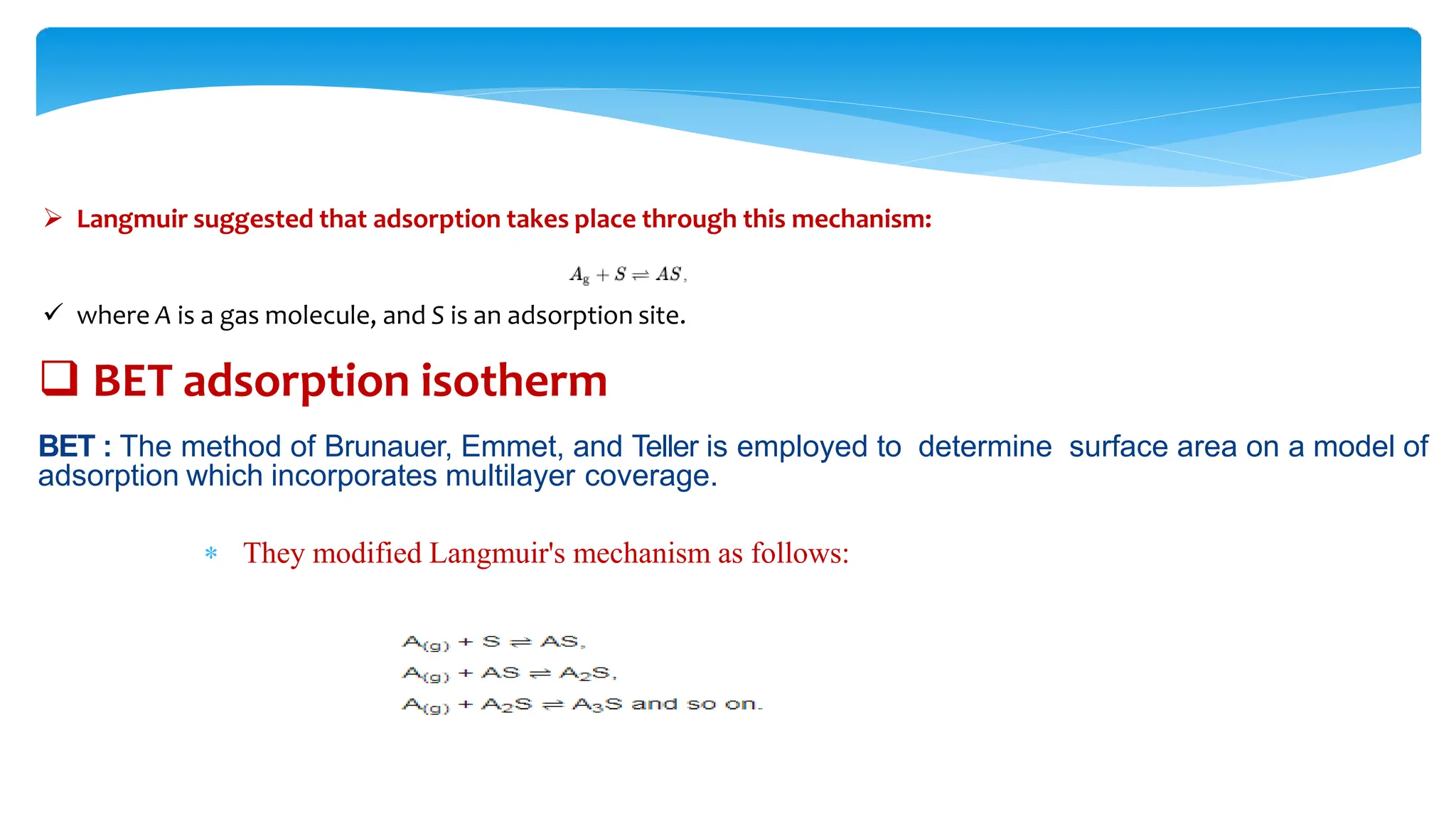
 Langmuir suggested that adsorption takes place through this mechanism:
 where A is a gas molecule, and S is an adsorption site.
 BET adsorption isotherm
BET : The method of Brunauer, Emmet, and Teller is employed to determine surface area on a model of
adsorption which incorporates multilayer coverage.
 They modified Langmuir's mechanism as follows:
BET theory
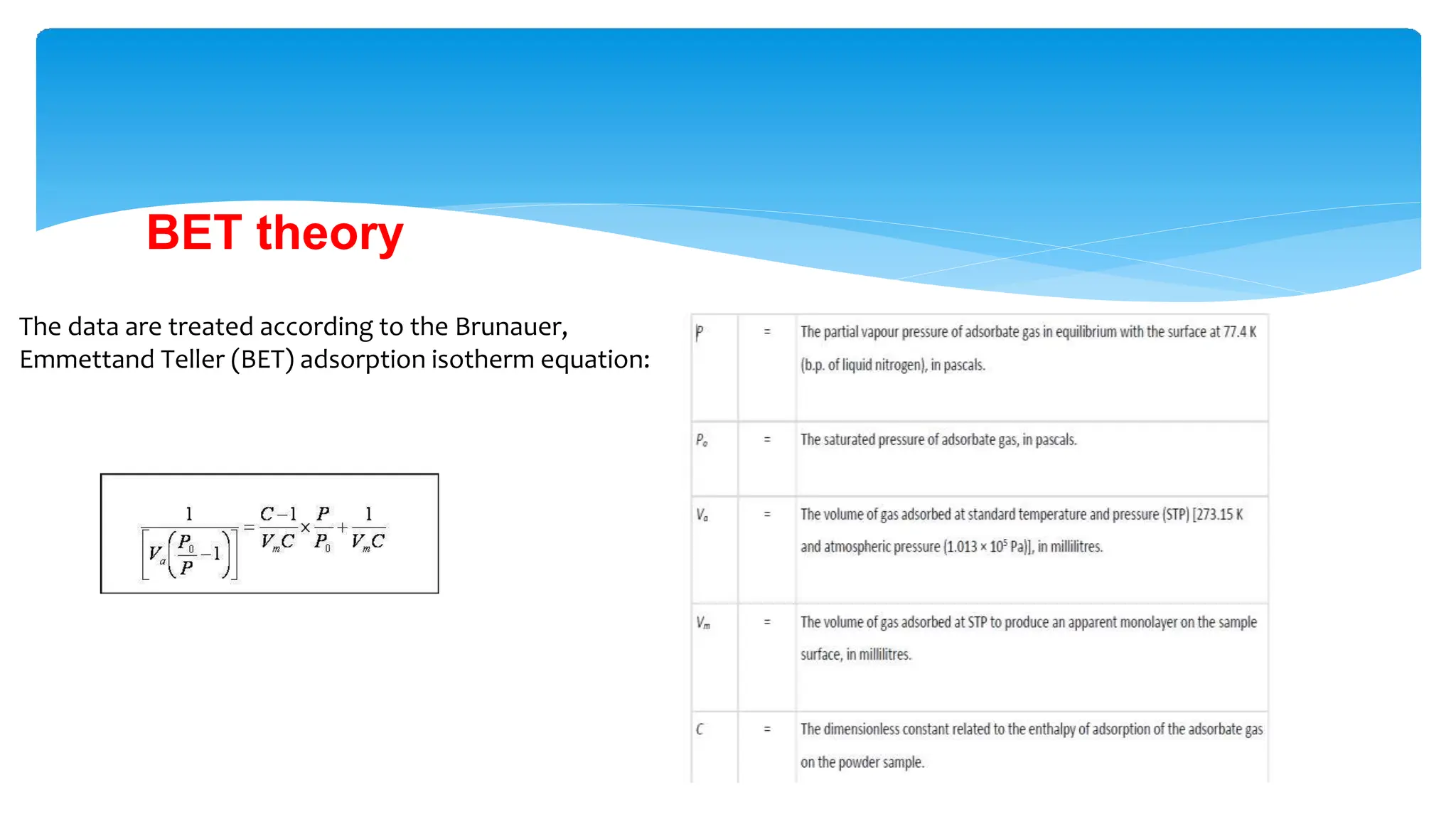
The data are treated according to the Brunauer,
Emmettand Teller (BET) adsorption isotherm equation:
 Type of Adsorption Isotherm
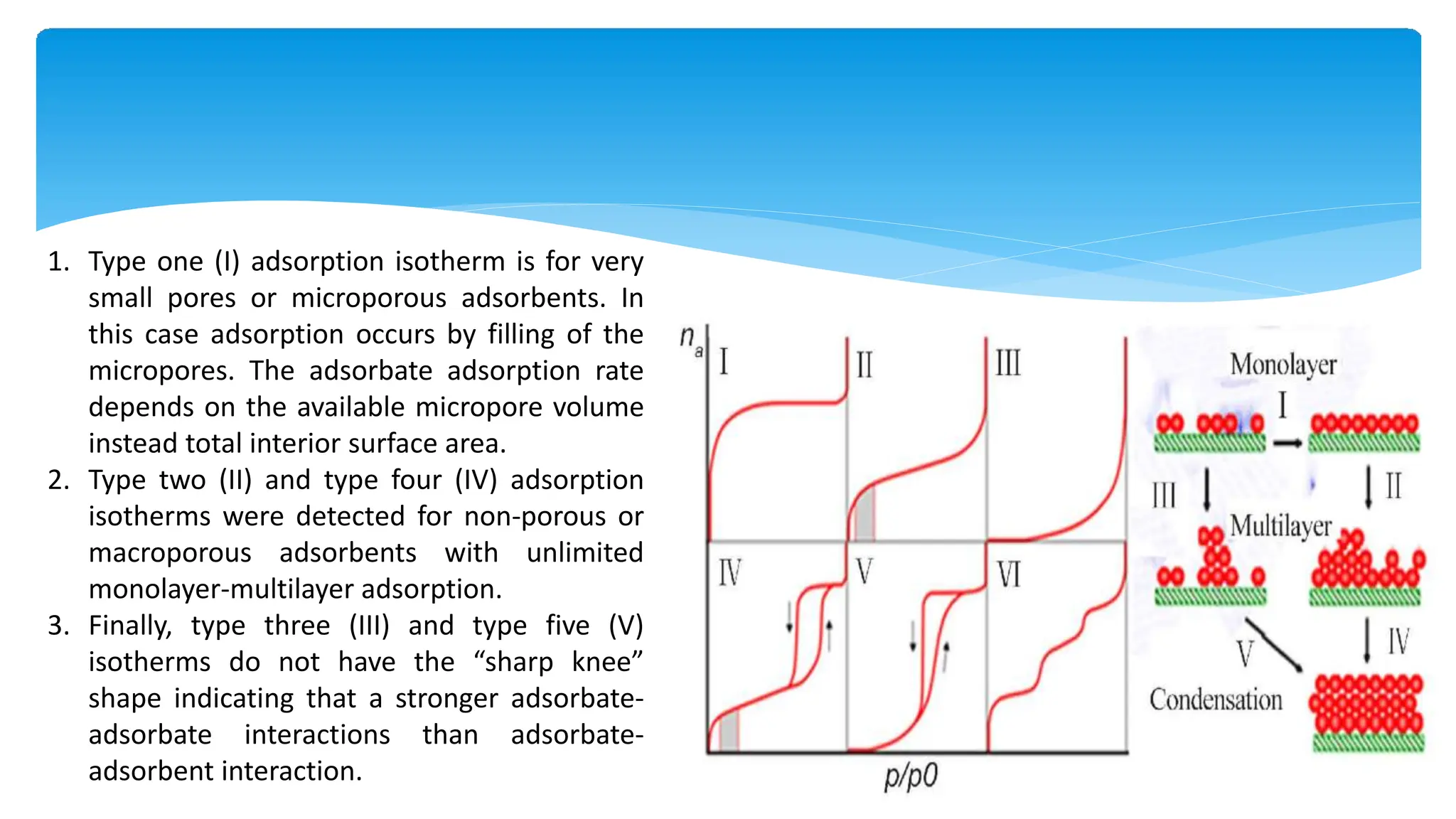
 There are six different types of adsorption
isotherms as shown in Figure.
 First the adsorption volume quickly increases at
low relative pressures due to contact of the
adsorbate molecules with the higher energetic
section followed by the interaction with less
energetic section.
 When the monolayer formation of the adsorbed
molecules is complete, multilayer formation
starts to take place corresponding to the “sharp
knee” of the isotherms.
 As the relative pressure approaches unity a
sudden rise shows the bulk condensation of
adsorbate gas to liquid.
1. Type one (I) adsorption isotherm is for very
small pores or microporous adsorbents. In
this case adsorption occurs by filling of the
micropores. The adsorbate adsorption rate
depends on the available micropore volume
instead total interior surface area.
2. Type two (II) and type four (IV) adsorption
isotherms were detected for non-porous or
macroporous adsorbents with unlimited
monolayer-multilayer adsorption.
3. Finally, type three (III) and type five (V)
isotherms do not have the “sharp knee”
shape indicating that a stronger adsorbate-
adsorbate interactions than adsorbate-
adsorbent interaction.
 Brunauer-Emmett-Teller (BET) model is
one of the most widely used isotherm to
measure the specific surface area including
the pore size distribution.
 BET is an extension of the Langmuir theory
where the Langmuir theory related to the
monolayer adsorption, while BET related to
the multilayer adsorption.
 In BET surface area analysis, nitrogen gas is
usually used due to its strong interaction with
most solid and its availability in high purity.
INTRODUCTION
 Apparatus
1. Liquid nitrogen
2. Helium gas (99.9% pure)
3. Nitrogen gas (99.999% pure)
4. BET surface area analysis instrument
5. including: Vacuum system (10-4 Torr),
6. Heating apparatus, Pressure gauge Sample
7. holder (bulb) of known volume
METHODOLOGY
 Multilayer formation
How it works?
 Gas adsorption provides a rapid and quantitative technique for specific surface area
and to determine other textural properties of a solid as pore size, total pore volume,
and pore volume distribution
Pore Volume - Volume of pores accessible to condensed adsorbate
Pore size classification
1. Micropores - Less than 2 nm
2. Mesopores - Between 2 and 50 nm
3. Macropores - Greater than 50 nm
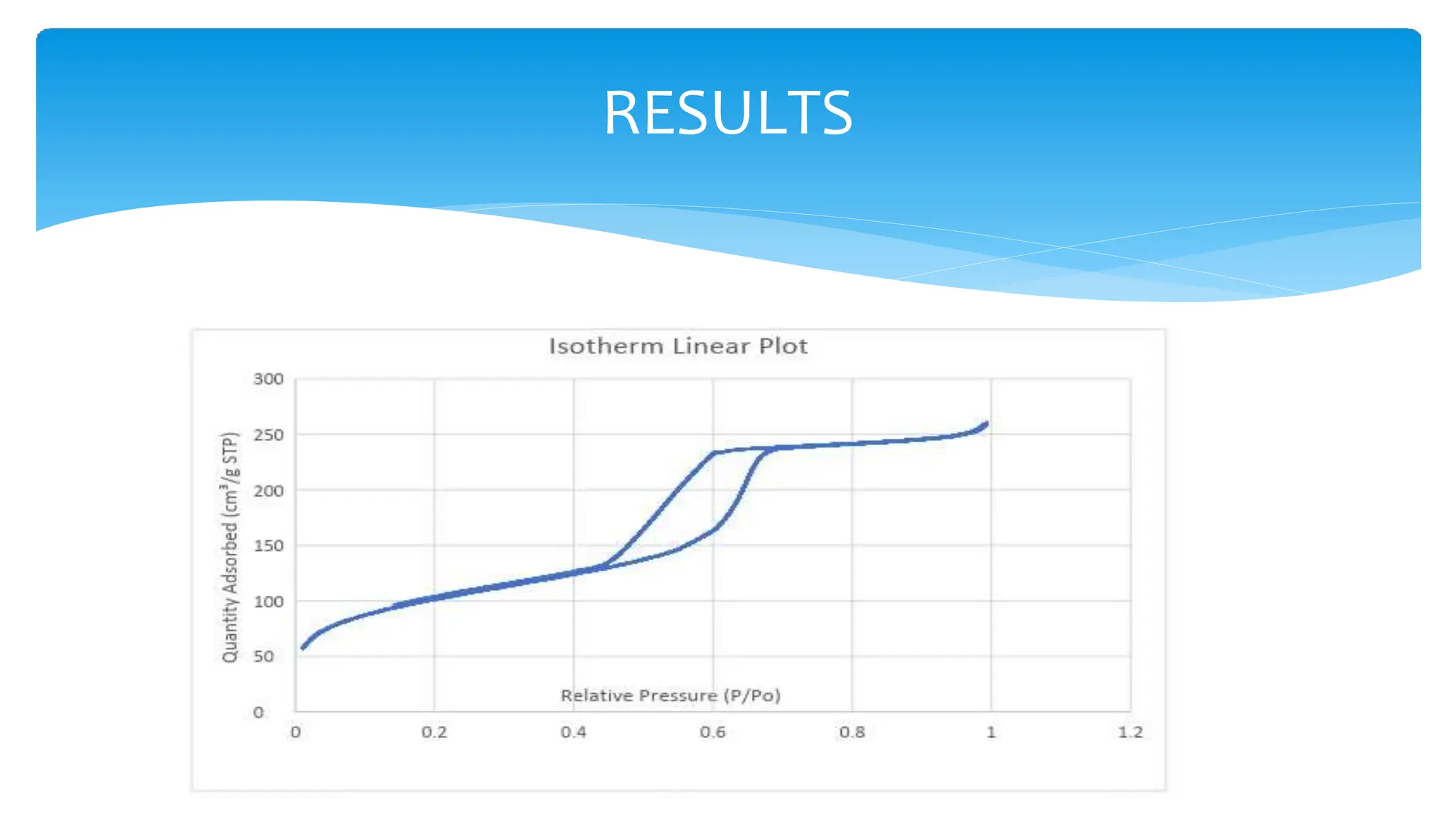
RESULTS
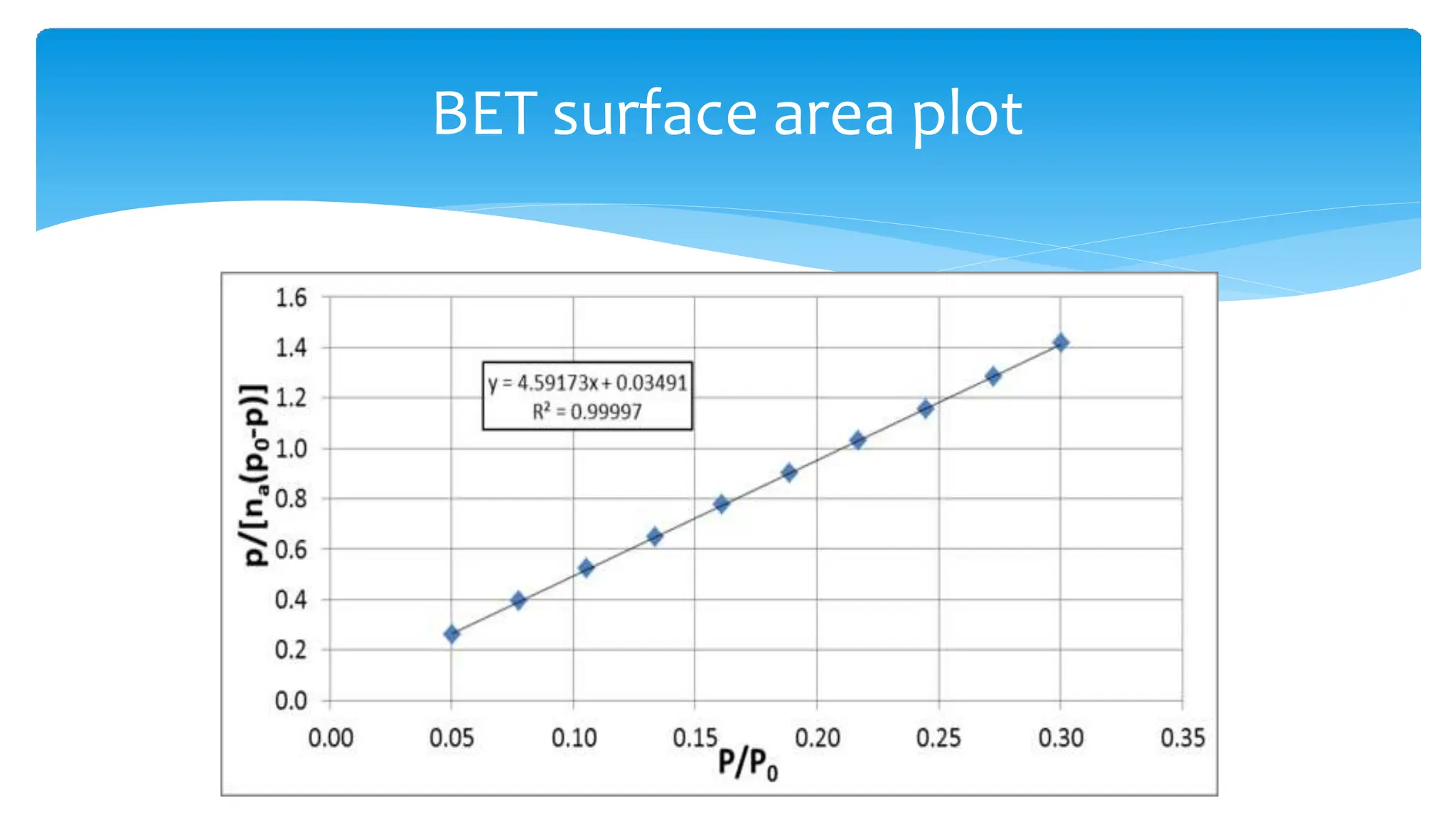
BET surface area plot
Thank You

BET Surface Area Analysis of Nanoparticles.pptx

  • 1.
    Surface Area AnalysisUsing the BrunauerEmmett-Teller (BET) Method By: Neveen Atallah
  • 2.
    Adsorption  Is theadhesion of atoms, ions, biomolecules or molecules of gas, liquid, or dissolved solids to a surface. This process creates a film of the adsorbate (the molecules or atoms being accumulated) on the surface of the adsorbent. The adsorption process is generally classified as physisorption(characteristic of weak Van der Waals force) or chemisorption(characteristic of covalent bonding)  Desorption is the reverse process of adsorption.
  • 3.
    Is the amountof adsorbate on the adsorbent as a function of its pressure(if gas) or concentration (if liquid) at constant temperature.  Freundlich adsorption isotherm  The first mathematical fit to an isotherm was published by Freundlich and Kuster (1906) and is a purely empirical formula for gaseous adsorbates: X/m =KP1/n  where x is the quantity adsorbed, m is the mass of the adsorbent, P is the pressure of adsorbate and k and n are empirical constants for each adsorbent–adsorbate pair at a given temperature. Adsorption Isotherm
  • 4.
    Langmuir adsorption isotherm Itis based on four assumptions: 1. All of the adsorption sites are equivalent, and each site can only accommodate one molecule. 2. The surface is energetically homogeneous, and adsorbed molecules do not interact. 3. All adsorbtion occurs through the same mechanism. 4. At the maximum adsorption, only a monolayer is formed. Adsorption only occurs on localized sites on the surface, not with other adsorbates.  Limitation of Langmuir adsorption isotherm  These four assumptions are seldom all true: 1. There are always imperfections on the surface. 2. Adsorbed molecules are not necessarily inert. 3. The mechanism is clearly not the same for the very first molecules to adsorb to a surface as for the last. 4. Not only monolayer is formed.
  • 5.
     Langmuir suggestedthat adsorption takes place through this mechanism:  where A is a gas molecule, and S is an adsorption site.  BET adsorption isotherm BET : The method of Brunauer, Emmet, and Teller is employed to determine surface area on a model of adsorption which incorporates multilayer coverage.  They modified Langmuir's mechanism as follows:
  • 6.
    BET theory The dataare treated according to the Brunauer, Emmettand Teller (BET) adsorption isotherm equation:
  • 8.
     Type ofAdsorption Isotherm  There are six different types of adsorption isotherms as shown in Figure.  First the adsorption volume quickly increases at low relative pressures due to contact of the adsorbate molecules with the higher energetic section followed by the interaction with less energetic section.  When the monolayer formation of the adsorbed molecules is complete, multilayer formation starts to take place corresponding to the “sharp knee” of the isotherms.  As the relative pressure approaches unity a sudden rise shows the bulk condensation of adsorbate gas to liquid.
  • 9.
    1. Type one(I) adsorption isotherm is for very small pores or microporous adsorbents. In this case adsorption occurs by filling of the micropores. The adsorbate adsorption rate depends on the available micropore volume instead total interior surface area. 2. Type two (II) and type four (IV) adsorption isotherms were detected for non-porous or macroporous adsorbents with unlimited monolayer-multilayer adsorption. 3. Finally, type three (III) and type five (V) isotherms do not have the “sharp knee” shape indicating that a stronger adsorbate- adsorbate interactions than adsorbate- adsorbent interaction.
  • 10.
     Brunauer-Emmett-Teller (BET)model is one of the most widely used isotherm to measure the specific surface area including the pore size distribution.  BET is an extension of the Langmuir theory where the Langmuir theory related to the monolayer adsorption, while BET related to the multilayer adsorption.  In BET surface area analysis, nitrogen gas is usually used due to its strong interaction with most solid and its availability in high purity. INTRODUCTION
  • 11.
     Apparatus 1. Liquidnitrogen 2. Helium gas (99.9% pure) 3. Nitrogen gas (99.999% pure) 4. BET surface area analysis instrument 5. including: Vacuum system (10-4 Torr), 6. Heating apparatus, Pressure gauge Sample 7. holder (bulb) of known volume METHODOLOGY
  • 12.
  • 14.
     Gas adsorptionprovides a rapid and quantitative technique for specific surface area and to determine other textural properties of a solid as pore size, total pore volume, and pore volume distribution Pore Volume - Volume of pores accessible to condensed adsorbate Pore size classification 1. Micropores - Less than 2 nm 2. Mesopores - Between 2 and 50 nm 3. Macropores - Greater than 50 nm
  • 15.
  • 16.
  • 17.