BERT – An In-depth View
PART2
Learning Notes of Senthil Kumar
Agenda
In-depth Technical View (PART2)
Transformer and Attention
BERT Word Embedding
Code Snippets
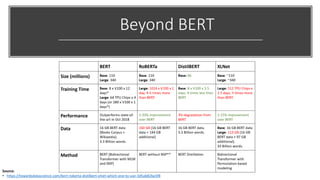
Beyond BERT
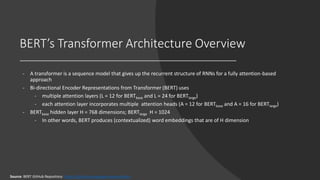
BERT’s Transformer Architecture Overview
- A transformer is a sequence model that gives up the recurrent structure of RNNs for a fully attention-based
approach
- Bi-directional Encoder Representations from Transformer (BERT) uses
- multiple attention layers (L = 12 for BERTbase and L = 24 for BERTlarge)
- each attention layer incorporates multiple attention heads (A = 12 for BERTbase and A = 16 for BERTlarge)
- BERTbase hidden layer H = 768 dimensions; BERTlarge H = 1024
- In other words, BERT produces (contextualized) word embeddings that are of H dimension
Source: BERT GitHub Repository: https://github.com/google-research/bert
What is Attention?
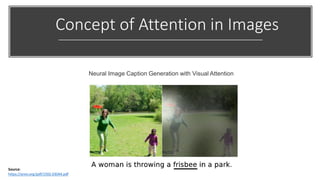
Concept of Attention in Images
Neural Image Caption Generation with Visual Attention
Source:
https://arxiv.org/pdf/1502.03044.pdf
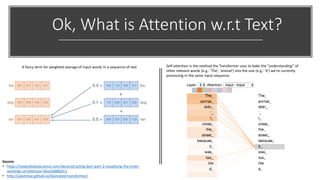
Ok, What is Attention w.r.t Text?
A fancy term for weighted average of input words in a sequence of text Self-attention is the method the Transformer uses to bake the “understanding” of
other relevant words (e.g.: 'The', 'animal') into the one (e.g.: 'it') we’re currently
processing in the same input sequence.
Source:
• https://towardsdatascience.com/deconstructing-bert-part-2-visualizing-the-inner-
workings-of-attention-60a16d86b5c1
• http://jalammar.github.io/illustrated-transformer/
Why Attention?
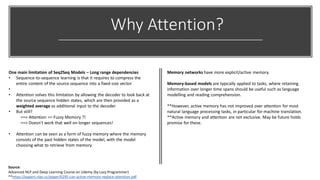
One main limitation of Seq2Seq Models – Long range dependencies
• Sequence-to-sequence learning is that it requires to compress the
entire content of the source sequence into a fixed-size vector
•
• Attention solves this limitation by allowing the decoder to look back at
the source sequence hidden states, which are then provided as a
weighted average as additional input to the decoder
• But still?
==> Attention == Fuzzy Memory ?!
==> Doesn't work that well on longer sequences!
• Attention can be seen as a form of fuzzy memory where the memory
consists of the past hidden states of the model, with the model
choosing what to retrieve from memory.
Memory networks have more explicit/active memory.
Memory-based models are typically applied to tasks, where retaining
information over longer time spans should be useful such as language
modelling and reading comprehension.
**However, active memory has not improved over attention for most
natural language processing tasks, in particular for machine translation.
**Active memory and attention are not exclusive. May be future holds
promise for these.
Source:
Advanced NLP and Deep Learning Course on Udemy (by Lazy Programmer)
**https://papers.nips.cc/paper/6295-can-active-memory-replace-attention.pdf
How is Attention
incorporated in a Seq2Seq
Model?
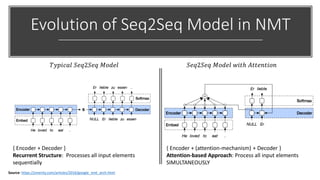
Evolution of Seq2Seq Model in NMT
𝑇𝑦𝑝𝑖𝑐𝑎𝑙 𝑆𝑒𝑞2𝑆𝑒𝑞 𝑀𝑜𝑑𝑒𝑙 𝑆𝑒𝑞2𝑆𝑒𝑞 𝑀𝑜𝑑𝑒𝑙 𝑤𝑖𝑡ℎ 𝐴𝑡𝑡𝑒𝑛𝑡𝑖𝑜𝑛
{ Encoder + (attention-mechanism) + Decoder }
Attention-based Approach: Process all input elements
SIMULTANEOUSLY
{ Encoder + Decoder }
Recurrent Structure: Processes all input elements
sequentially
Source: https://smerity.com/articles/2016/google_nmt_arch.html
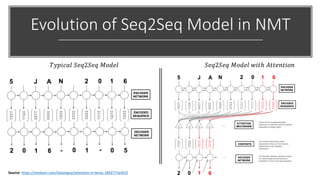
Evolution of Seq2Seq Model in NMT
𝑇𝑦𝑝𝑖𝑐𝑎𝑙 𝑆𝑒𝑞2𝑆𝑒𝑞 𝑀𝑜𝑑𝑒𝑙 𝑆𝑒𝑞2𝑆𝑒𝑞 𝑀𝑜𝑑𝑒𝑙 𝑤𝑖𝑡ℎ 𝐴𝑡𝑡𝑒𝑛𝑡𝑖𝑜𝑛
Source: https://medium.com/datalogue/attention-in-keras-1892773a4f22
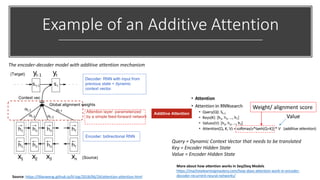
Example of an Additive Attention
The encoder-decoder model with additive attention mechanism
Query = Dynamic Context Vector that needs to be translated
Key = Encoder Hidden State
Value = Encoder Hidden State
Source: https://lilianweng.github.io/lil-log/2018/06/24/attention-attention.html
Weight/ alignment score
Value
More about how attention works in Seq2Seq Models
https://machinelearningmastery.com/how-does-attention-work-in-encoder-
decoder-recurrent-neural-networks/
How is the Attention
employed in Transformer?
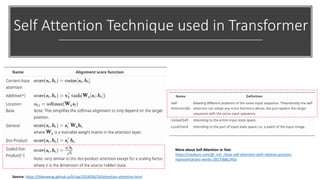
Self Attention Technique used in Transformer
Source: https://lilianweng.github.io/lil-log/2018/06/24/attention-attention.html
More about Self Attention in Text:
https://medium.com/@_init_/how-self-attention-with-relative-position-
representations-works-28173b8c245a
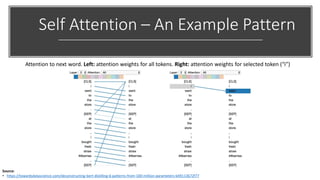
Self Attention – An Example Pattern
Attention to next word. Left: attention weights for all tokens. Right: attention weights for selected token (“i”)
Source:
• https://towardsdatascience.com/deconstructing-bert-distilling-6-patterns-from-100-million-parameters-b49113672f77
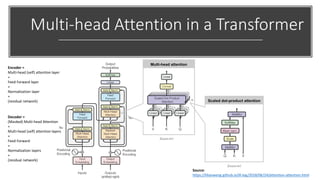
Multi-head Attention in a Transformer
Source:
https://lilianweng.github.io/lil-log/2018/06/24/attention-attention.html
Encoder =
Multi-head (self) attention layer
+
Feed Forward layer
+
Normalization layer
+
(residual network)
Decoder =
(Masked) Multi-head Attention
+
Multi-head (self) attention layers
+
Feed Forward
+
Normalization layers
+
(residual network)
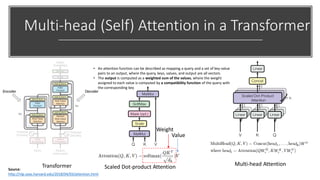
Multi-head (Self) Attention in a Transformer
Scaled Dot-product AttentionTransformer Multi-head Attention
Weight
Value
Source:
http://nlp.seas.harvard.edu/2018/04/03/attention.html
• An attention function can be described as mapping a query and a set of key-value
pairs to an output, where the query, keys, values, and output are all vectors.
• The output is computed as a weighted sum of the values, where the weight
assigned to each value is computed by a compatibility function of the query with
the corresponding key
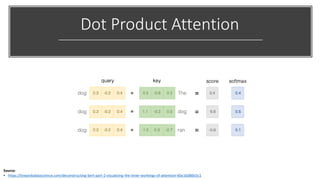
Dot Product Attention
Source:
• https://towardsdatascience.com/deconstructing-bert-part-2-visualizing-the-inner-workings-of-attention-60a16d86b5c1
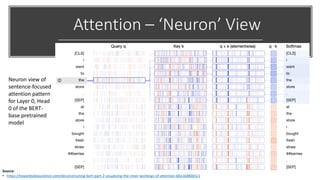
Attention – ‘Neuron’ View
Source:
• https://towardsdatascience.com/deconstructing-bert-part-2-visualizing-the-inner-workings-of-attention-60a16d86b5c1
Neuron view of
sentence-focused
attention pattern
for Layer 0, Head
0 of the BERT-
base pretrained
model
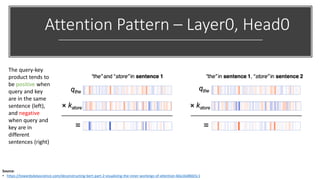
Attention Pattern – Layer0, Head0
Source:
• https://towardsdatascience.com/deconstructing-bert-part-2-visualizing-the-inner-workings-of-attention-60a16d86b5c1
The query-key
product tends to
be positive when
query and key
are in the same
sentence (left),
and negative
when query and
key are in
different
sentences (right)
What powers QKV vectors - Embedding
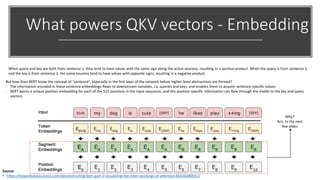
When query and key are both from sentence 1, they tend to have values with the same sign along the active neurons, resulting in a positive product. When the query is from sentence 1,
and the key is from sentence 2, the same neurons tend to have values with opposite signs, resulting in a negative product.
But how does BERT know the concept of “sentence”, especially in the first layer of the network before higher-level abstractions are formed?
- The information encoded in these sentence embeddings flows to downstream variables, i.e. queries and keys, and enables them to acquire sentence-specific values
- BERT learns a unique position embedding for each of the 512 positions in the input sequence, and this position-specific information can flow through the model to the key and query
vectors
Source:
• https://towardsdatascience.com/deconstructing-bert-part-2-visualizing-the-inner-workings-of-attention-60a16d86b5c1
Why?
Ans: In the next
few slides
How BERT Embedding
works?
How BERT Embedding works?
Token Embedding Layer
Source:
• https://medium.com/@_init_/why-bert-has-3-embedding-layers-and-their-implementation-details-9c261108e28a
• In BERTbase, each word is represented as a 768-dimensional vector; In
BERTlarge, each word is represented in 1024d
• The input text is first tokenized before it gets passed to the Token
Embeddings layer
• [CLS] – Extra token for Classification Tasks
• [SEP] – Extra token for Sentence pair classification, Q/A pair, etc.,
• Tokenization method – WordPiece Tokenization
• WordPiece tokenization enables BERT to only store 30,522 “words” in
the vocabulary
More about how WordPiece Tokenization works
https://medium.com/@makcedward/how-subword-helps-on-your-nlp-model-83dd1b836f46
How BERT Embedding works?
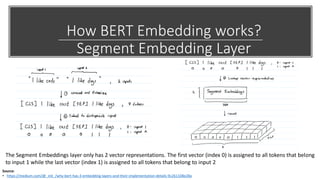
Segment Embedding Layer
Source:
• https://medium.com/@_init_/why-bert-has-3-embedding-layers-and-their-implementation-details-9c261108e28a
The Segment Embeddings layer only has 2 vector representations. The first vector (index 0) is assigned to all tokens that belong
to input 1 while the last vector (index 1) is assigned to all tokens that belong to input 2
How BERT Embedding works?
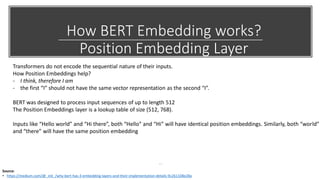
Position Embedding Layer
Source:
• https://medium.com/@_init_/why-bert-has-3-embedding-layers-and-their-implementation-details-9c261108e28a
Transformers do not encode the sequential nature of their inputs.
How Position Embeddings help?
- I think, therefore I am
- the first “I” should not have the same vector representation as the second “I”.
BERT was designed to process input sequences of up to length 512
The Position Embeddings layer is a lookup table of size (512, 768).
Inputs like “Hello world” and “Hi there”, both “Hello” and “Hi” will have identical position embeddings. Similarly, both “world”
and “there” will have the same position embedding
Main Code Sources for BERT
https://github.com/huggingface/transformers/blo
b/master/transformers/modeling_bert.py
https://github.com/huggingface/transformers/blo
b/master/transformers/tokenization_bert.py
https://github.com/google-
research/bert/blob/master/modeling.py
https://github.com/google-
research/bert/blob/master/tokenization.py
PyTorch TensorFlow
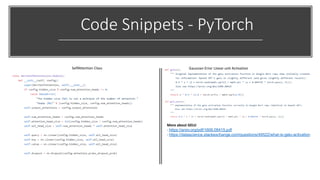
Code Snippets - PyTorch
SelfAttention Class Gaussian Error Linear unit Activation
More about GELU
- https://arxiv.org/pdf/1606.08415.pdf
- https://datascience.stackexchange.com/questions/49522/what-is-gelu-activation
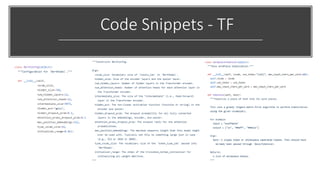
Code Snippets - TF
Code Snippets - TF
Beyond BERT
Source:
• https://towardsdatascience.com/bert-roberta-distilbert-xlnet-which-one-to-use-3d5ab82ba5f8
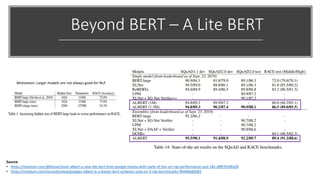
Beyond BERT – A Lite BERT
Source:
• https://medium.com/@lessw/meet-albert-a-new-lite-bert-from-google-toyota-with-state-of-the-art-nlp-performance-and-18x-df8f7b58fa28
• https://medium.com/syncedreview/googles-albert-is-a-leaner-bert-achieves-sota-on-3-nlp-benchmarks-f64466dd583
Motivation: Larger models are not always good for NLP
Appendix
BERT FAQs
https://yashuseth.blog/2019/06/12/bert-explained-faqs-understand-bert-working/
Thank You

BERT - Part 2 Learning Notes

  • 1.
    BERT – AnIn-depth View PART2 Learning Notes of Senthil Kumar
  • 2.
    Agenda In-depth Technical View(PART2) Transformer and Attention BERT Word Embedding Code Snippets Beyond BERT
  • 3.
    BERT’s Transformer ArchitectureOverview - A transformer is a sequence model that gives up the recurrent structure of RNNs for a fully attention-based approach - Bi-directional Encoder Representations from Transformer (BERT) uses - multiple attention layers (L = 12 for BERTbase and L = 24 for BERTlarge) - each attention layer incorporates multiple attention heads (A = 12 for BERTbase and A = 16 for BERTlarge) - BERTbase hidden layer H = 768 dimensions; BERTlarge H = 1024 - In other words, BERT produces (contextualized) word embeddings that are of H dimension Source: BERT GitHub Repository: https://github.com/google-research/bert
  • 4.
  • 5.
    Concept of Attentionin Images Neural Image Caption Generation with Visual Attention Source: https://arxiv.org/pdf/1502.03044.pdf
  • 6.
    Ok, What isAttention w.r.t Text? A fancy term for weighted average of input words in a sequence of text Self-attention is the method the Transformer uses to bake the “understanding” of other relevant words (e.g.: 'The', 'animal') into the one (e.g.: 'it') we’re currently processing in the same input sequence. Source: • https://towardsdatascience.com/deconstructing-bert-part-2-visualizing-the-inner- workings-of-attention-60a16d86b5c1 • http://jalammar.github.io/illustrated-transformer/
  • 7.
    Why Attention? One mainlimitation of Seq2Seq Models – Long range dependencies • Sequence-to-sequence learning is that it requires to compress the entire content of the source sequence into a fixed-size vector • • Attention solves this limitation by allowing the decoder to look back at the source sequence hidden states, which are then provided as a weighted average as additional input to the decoder • But still? ==> Attention == Fuzzy Memory ?! ==> Doesn't work that well on longer sequences! • Attention can be seen as a form of fuzzy memory where the memory consists of the past hidden states of the model, with the model choosing what to retrieve from memory. Memory networks have more explicit/active memory. Memory-based models are typically applied to tasks, where retaining information over longer time spans should be useful such as language modelling and reading comprehension. **However, active memory has not improved over attention for most natural language processing tasks, in particular for machine translation. **Active memory and attention are not exclusive. May be future holds promise for these. Source: Advanced NLP and Deep Learning Course on Udemy (by Lazy Programmer) **https://papers.nips.cc/paper/6295-can-active-memory-replace-attention.pdf
  • 8.
    How is Attention incorporatedin a Seq2Seq Model?
  • 9.
    Evolution of Seq2SeqModel in NMT 𝑇𝑦𝑝𝑖𝑐𝑎𝑙 𝑆𝑒𝑞2𝑆𝑒𝑞 𝑀𝑜𝑑𝑒𝑙 𝑆𝑒𝑞2𝑆𝑒𝑞 𝑀𝑜𝑑𝑒𝑙 𝑤𝑖𝑡ℎ 𝐴𝑡𝑡𝑒𝑛𝑡𝑖𝑜𝑛 { Encoder + (attention-mechanism) + Decoder } Attention-based Approach: Process all input elements SIMULTANEOUSLY { Encoder + Decoder } Recurrent Structure: Processes all input elements sequentially Source: https://smerity.com/articles/2016/google_nmt_arch.html
  • 10.
    Evolution of Seq2SeqModel in NMT 𝑇𝑦𝑝𝑖𝑐𝑎𝑙 𝑆𝑒𝑞2𝑆𝑒𝑞 𝑀𝑜𝑑𝑒𝑙 𝑆𝑒𝑞2𝑆𝑒𝑞 𝑀𝑜𝑑𝑒𝑙 𝑤𝑖𝑡ℎ 𝐴𝑡𝑡𝑒𝑛𝑡𝑖𝑜𝑛 Source: https://medium.com/datalogue/attention-in-keras-1892773a4f22
  • 11.
    Example of anAdditive Attention The encoder-decoder model with additive attention mechanism Query = Dynamic Context Vector that needs to be translated Key = Encoder Hidden State Value = Encoder Hidden State Source: https://lilianweng.github.io/lil-log/2018/06/24/attention-attention.html Weight/ alignment score Value More about how attention works in Seq2Seq Models https://machinelearningmastery.com/how-does-attention-work-in-encoder- decoder-recurrent-neural-networks/
  • 12.
    How is theAttention employed in Transformer?
  • 13.
    Self Attention Techniqueused in Transformer Source: https://lilianweng.github.io/lil-log/2018/06/24/attention-attention.html More about Self Attention in Text: https://medium.com/@_init_/how-self-attention-with-relative-position- representations-works-28173b8c245a
  • 14.
    Self Attention –An Example Pattern Attention to next word. Left: attention weights for all tokens. Right: attention weights for selected token (“i”) Source: • https://towardsdatascience.com/deconstructing-bert-distilling-6-patterns-from-100-million-parameters-b49113672f77
  • 15.
    Multi-head Attention ina Transformer Source: https://lilianweng.github.io/lil-log/2018/06/24/attention-attention.html Encoder = Multi-head (self) attention layer + Feed Forward layer + Normalization layer + (residual network) Decoder = (Masked) Multi-head Attention + Multi-head (self) attention layers + Feed Forward + Normalization layers + (residual network)
  • 16.
    Multi-head (Self) Attentionin a Transformer Scaled Dot-product AttentionTransformer Multi-head Attention Weight Value Source: http://nlp.seas.harvard.edu/2018/04/03/attention.html • An attention function can be described as mapping a query and a set of key-value pairs to an output, where the query, keys, values, and output are all vectors. • The output is computed as a weighted sum of the values, where the weight assigned to each value is computed by a compatibility function of the query with the corresponding key
  • 17.
    Dot Product Attention Source: •https://towardsdatascience.com/deconstructing-bert-part-2-visualizing-the-inner-workings-of-attention-60a16d86b5c1
  • 18.
    Attention – ‘Neuron’View Source: • https://towardsdatascience.com/deconstructing-bert-part-2-visualizing-the-inner-workings-of-attention-60a16d86b5c1 Neuron view of sentence-focused attention pattern for Layer 0, Head 0 of the BERT- base pretrained model
  • 19.
    Attention Pattern –Layer0, Head0 Source: • https://towardsdatascience.com/deconstructing-bert-part-2-visualizing-the-inner-workings-of-attention-60a16d86b5c1 The query-key product tends to be positive when query and key are in the same sentence (left), and negative when query and key are in different sentences (right)
  • 20.
    What powers QKVvectors - Embedding When query and key are both from sentence 1, they tend to have values with the same sign along the active neurons, resulting in a positive product. When the query is from sentence 1, and the key is from sentence 2, the same neurons tend to have values with opposite signs, resulting in a negative product. But how does BERT know the concept of “sentence”, especially in the first layer of the network before higher-level abstractions are formed? - The information encoded in these sentence embeddings flows to downstream variables, i.e. queries and keys, and enables them to acquire sentence-specific values - BERT learns a unique position embedding for each of the 512 positions in the input sequence, and this position-specific information can flow through the model to the key and query vectors Source: • https://towardsdatascience.com/deconstructing-bert-part-2-visualizing-the-inner-workings-of-attention-60a16d86b5c1 Why? Ans: In the next few slides
  • 21.
  • 22.
    How BERT Embeddingworks? Token Embedding Layer Source: • https://medium.com/@_init_/why-bert-has-3-embedding-layers-and-their-implementation-details-9c261108e28a • In BERTbase, each word is represented as a 768-dimensional vector; In BERTlarge, each word is represented in 1024d • The input text is first tokenized before it gets passed to the Token Embeddings layer • [CLS] – Extra token for Classification Tasks • [SEP] – Extra token for Sentence pair classification, Q/A pair, etc., • Tokenization method – WordPiece Tokenization • WordPiece tokenization enables BERT to only store 30,522 “words” in the vocabulary More about how WordPiece Tokenization works https://medium.com/@makcedward/how-subword-helps-on-your-nlp-model-83dd1b836f46
  • 23.
    How BERT Embeddingworks? Segment Embedding Layer Source: • https://medium.com/@_init_/why-bert-has-3-embedding-layers-and-their-implementation-details-9c261108e28a The Segment Embeddings layer only has 2 vector representations. The first vector (index 0) is assigned to all tokens that belong to input 1 while the last vector (index 1) is assigned to all tokens that belong to input 2
  • 24.
    How BERT Embeddingworks? Position Embedding Layer Source: • https://medium.com/@_init_/why-bert-has-3-embedding-layers-and-their-implementation-details-9c261108e28a Transformers do not encode the sequential nature of their inputs. How Position Embeddings help? - I think, therefore I am - the first “I” should not have the same vector representation as the second “I”. BERT was designed to process input sequences of up to length 512 The Position Embeddings layer is a lookup table of size (512, 768). Inputs like “Hello world” and “Hi there”, both “Hello” and “Hi” will have identical position embeddings. Similarly, both “world” and “there” will have the same position embedding
  • 25.
    Main Code Sourcesfor BERT https://github.com/huggingface/transformers/blo b/master/transformers/modeling_bert.py https://github.com/huggingface/transformers/blo b/master/transformers/tokenization_bert.py https://github.com/google- research/bert/blob/master/modeling.py https://github.com/google- research/bert/blob/master/tokenization.py PyTorch TensorFlow
  • 26.
    Code Snippets -PyTorch SelfAttention Class Gaussian Error Linear unit Activation More about GELU - https://arxiv.org/pdf/1606.08415.pdf - https://datascience.stackexchange.com/questions/49522/what-is-gelu-activation
  • 27.
  • 28.
  • 29.
  • 30.
    Beyond BERT –A Lite BERT Source: • https://medium.com/@lessw/meet-albert-a-new-lite-bert-from-google-toyota-with-state-of-the-art-nlp-performance-and-18x-df8f7b58fa28 • https://medium.com/syncedreview/googles-albert-is-a-leaner-bert-achieves-sota-on-3-nlp-benchmarks-f64466dd583 Motivation: Larger models are not always good for NLP
  • 31.
  • 32.
  • 33.