Transformers and sequence-
to-sequence learning
CS 685, Fall 2021
Mohit Iyyer
College of Information and Computer Sciences
University of Massachusetts Amherst
some slides from Emma Strubell
Attention is great
• Attention significantly improves NMT performance
• It’s very useful to allow decoder to focus on certain parts of the source
• Attention solves the bottleneck problem
• Attention allows decoder to look directly at source; bypass bottleneck
• Attention helps with vanishing gradient problem
• Provides shortcut to faraway states
• Attention provides some interpretability
• By inspecting attention distribution, we can see
what the decoder was focusing on
• We get alignment for free!
• This is cool because we never explicitly trained
an alignment system
• The network just learned alignment by itself
Alignments: hardest
The
poor
don’t
have
any
money
Les
pauvres
sont
démunis
The
poor
don t
have
any
money
Les
pauvres
sont
démunis
From last time
• Project proposals now due 10/1!
• Quiz 2 due Friday
• Can TAs record zoom office hours? Maybe
• How did we get this grid in the previous lecture?
Will explain in today’s class.
• Final proj. reports due Dec. 16th
iPad
sequence-to-sequence learning
• we’ll use French (f) to English (e) as a running
example
• goal: given French sentence f with tokens f1, f2,
… fn produce English translation e with tokens
e1, e2, … em
arg max
e
p(e| f )
• real goal: compute
Used when inputs and outputs are
both sequences of words (e.g.,
machine translation, summarization)
This is an instance of
conditional language modeling
p(e| f ) = p(e1, e2, …, em | f )
= p(e1 | f ) ⋅ p(e2 |e1, f ) ⋅ p(e3 |e2, e1, f ) ⋅ …
=
m
∏
i=1
p(ei |e1, …, ei−1, f )
Just like we’ve seen before, except we
additionally condition our prediction of
the next word on some other input
(here, the French sentence)
seq2seq models
• use two different neural networks to model
• first we have the encoder, which encodes the
French sentence f
• then, we have the decoder, which produces
the English sentence e
6
L
∏
i=1
p(ei |e1, …, ei−1, f )
7
Encoder
RNN
Neural Machine Translation (NMT)
2/15/18
23
<START>
Source sentence (input)
les pauvres sont démunis
The sequence-to-sequence model
Target sentence (output)
Decoder
RNN
Encoder RNN produces
an encoding of the
source sentence.
Encoding of the source sentence.
Provides initial hidden state
for Decoder RNN.
Decoder RNN is a Language Model that generates
target sentence conditioned on encoding.
the
argmax
the
argmax
poor
poor
argmax
don’t
Note: This diagram shows test time behavior:
decoder output is fed in as next step’s input
have any money <END>
don’t have any money
argmax
argmax
argmax
argmax
8
Encoder
RNN
Neural Machine Translation (NMT)
2/15/18
23
<START>
Source sentence (input)
les pauvres sont démunis
The sequence-to-sequence model
Target sentence (output)
Decoder
RNN
Encoder RNN produces
an encoding of the
source sentence.
Encoding of the source sentence.
Provides initial hidden state
for Decoder RNN.
Decoder RNN is a Language Model that generates
target sentence conditioned on encoding.
the
argmax
the
argmax
poor
poor
argmax
don’t
Note: This diagram shows test time behavior:
decoder output is fed in as next step’s input
have any money <END>
don’t have any money
argmax
argmax
argmax
argmax
9
Training a Neural Machine Translation system
2/15/18
25
Encoder
RNN
Source sentence (from corpus)
<START> the poor don’t have any money
les pauvres sont démunis
Target sentence (from corpus)
Seq2seq is optimized as a single system.
Backpropagation operates “end to end”.
Decoder
RNN
!
"# !
"$ !
"% !
"& !
"' !
"( !
")
*# *$ *% *& *' *( *)
= negative log
prob of “the”
* =
1
-
.
/0#
1
*/ = + + + + + +
= negative log
prob of <END>
= negative log
prob of “have”
We’ll talk much more about
machine translation / other seq2seq
problems later… but for now, let’s
go back to the Transformer
encoder
encoder
decoder
encoder
decoder
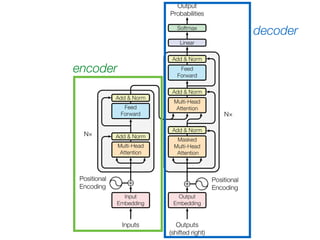
So far we’ve just talked
about self-attention… what
is all this other stuff?
Self-attention (in encoder)
15
committee awards Strickland advanced optics
who
Layer p
Q
K
V
[Vaswani et al. 2017]
Nobel
Slides by Emma Strubell!
16
Layer p
Q
K
V
[Vaswani et al. 2017]
committee awards Strickland advanced optics
who
Nobel
Slides by Emma Strubell!
Self-attention (in encoder)
17
Layer p
Q
K
V
optics
advanced
who
Strickland
awards
committee
Nobel
[Vaswani et al. 2017]
committee awards Strickland advanced optics
who
Nobel
Slides by Emma Strubell!
Self-attention (in encoder)
optics
advanced
who
Strickland
awards
committee
Nobel
18
Layer p
Q
K
V
A
[Vaswani et al. 2017]
committee awards Strickland advanced optics
who
Nobel
Slides by Emma Strubell!
Self-attention (in encoder)
19
Layer p
Q
K
V
[Vaswani et al. 2017]
committee awards Strickland advanced optics
who
Nobel
optics
advanced
who
Strickland
awards
committee
Nobel
A
Slides by Emma Strubell!
Self-attention (in encoder)
20
Layer p
Q
K
V
[Vaswani et al. 2017]
committee awards Strickland advanced optics
who
Nobel
optics
advanced
who
Strickland
awards
committee
Nobel
A
Slides by Emma Strubell!
Self-attention (in encoder)
21
Layer p
Q
K
V
M
[Vaswani et al. 2017]
committee awards Strickland advanced optics
who
Nobel
optics
advanced
who
Strickland
awards
committee
Nobel
A
Slides by Emma Strubell!
Self-attention (in encoder)
22
Layer p
Q
K
V
M
[Vaswani et al. 2017]
committee awards Strickland advanced optics
who
Nobel
optics
advanced
who
Strickland
awards
committee
Nobel
A
Slides by Emma Strubell!
Self-attention (in encoder)
Multi-head self-attention
23
Layer p
Q
K
V
M
M1
MH
[Vaswani et al. 2017]
committee awards Strickland advanced optics
who
Nobel
optics
advanced
who
Strickland
awards
committee
Nobel
A
Slides by Emma Strubell!
24
Layer p
Q
K
V
MH
M1
[Vaswani et al. 2017]
committee awards Strickland advanced optics
who
Nobel
optics
advanced
who
Strickland
awards
committee
Nobel
A
Multi-head self-attention
Slides by Emma Strubell!
25
Layer p
Q
K
V
MH
M1
Layer
p+1
Feed
Forward
Feed
Forward
Feed
Forward
Feed
Forward
Feed
Forward
Feed
Forward
Feed
Forward
committee awards Strickland advanced optics
who
Nobel
[Vaswani et al. 2017]
optics
advanced
who
Strickland
awards
committee
Nobel
A
Multi-head self-attention
Slides by Emma Strubell!
26
committee awards Strickland advanced optics
who
Nobel
[Vaswani et al. 2017]
p+1
Multi-head self-attention
Slides by Emma Strubell!
Multi-head self-attention + feed forward
27
Layer 1
Layer p
Multi-head self-attention + feed forward
Layer J
committee awards Strickland advanced optics
who
Nobel
[Vaswani et al. 2017]
Multi-head self-attention
Slides by Emma Strubell!
Position embeddings are added to each
word embedding. Otherwise, since we
have no recurrence, our model is unaware
of the position of a word in the sequence!
Residual connections, which mean that we
add the input to a particular block to its
output, help improve gradient flow
A feed-forward layer on top of the attention-
weighted averaged value vectors allows us
to add more parameters / nonlinearity
We stack as many of these
Transformer blocks on top of each
other as we can (bigger models are
generally better given enough data!)
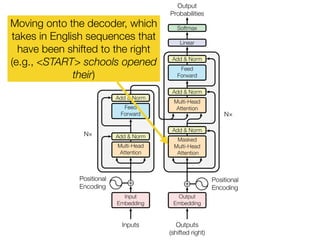
Moving onto the decoder, which
takes in English sequences that
have been shifted to the right
(e.g., <START> schools opened
their)
We first have an instance of
masked self attention. Since
the decoder is responsible
for predicting the English
words, we need to apply
masking as we saw before.
We first have an instance of
masked self attention. Since
the decoder is responsible
for predicting the English
words, we need to apply
masking as we saw before.
Why don’t we do
masked self-attention
in the encoder?
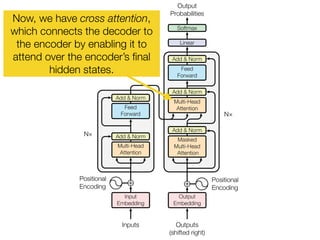
Now, we have cross attention,
which connects the decoder to
the encoder by enabling it to
attend over the encoder’s final
hidden states.
After stacking a bunch of
these decoder blocks, we
finally have our familiar
Softmax layer to predict
the next English word
Positional encoding
Creating positional encodings?
• We could just concatenate a fixed value to each time step
(e.g., 1, 2, 3, … 1000) that corresponds to its position,
but then what happens if we get a sequence with 5000
words at test time?
• We want something that can generalize to arbitrary
sequence lengths. We also may want to make attending
to relative positions (e.g., tokens in a local window to the
current token) easier.
• Distance between two positions should be consistent
with variable-length inputs
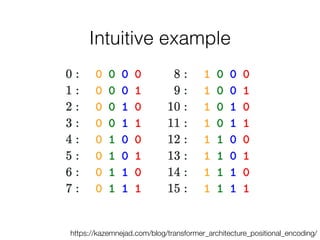
Intuitive example
https://kazemnejad.com/blog/transformer_architecture_positional_encoding/
Transformer positional encoding
Positional encoding is a 512d vector
i = a particular dimension of this vector
pos = dimension of the word
d_model = 512
What does this look like?
(each row is the pos. emb. of a 50-word sentence)
https://kazemnejad.com/blog/transformer_architecture_positional_encoding/
Despite the intuitive flaws, many models
these days use learned positional
embeddings (i.e., they cannot generalize to
longer sequences, but this isn’t a big deal for
their use cases)
Hacks to make
Transformers work
I went to class and took ___
0 0 1 0 0
cats TV notes took sofa
0.025 0.025 0.9 0.025 0.025
with label smoothing
Get penalized for
overconfidence!
Loss
Target word confidence
Why these decisions?
Unsatisfying answer: they empirically worked well.
Neural architecture search finds even better Transformer variants:
Primer: Searching for efficient Transformer architectures… So et al., Sep. 2021
OpenAI’s Transformer LMs
• GPT (Jun 2018): 117 million parameters, trained on
13GB of data (~1 billion tokens)
• GPT2 (Feb 2019): 1.5 billion parameters, trained on
40GB of data
• GPT3 (July 2020): 175 billion parameters, ~500GB
data (300 billion tokens)
Coming up!
• Transfer learning via Transformer models like BERT
• Tokenization (word vs subword vs character/byte)
• Prompt-based learning
• Efficient / long-range Transformers
• Downstream tasks

05-transformers.pdf

  • 1.
    Transformers and sequence- to-sequencelearning CS 685, Fall 2021 Mohit Iyyer College of Information and Computer Sciences University of Massachusetts Amherst some slides from Emma Strubell
  • 2.
    Attention is great •Attention significantly improves NMT performance • It’s very useful to allow decoder to focus on certain parts of the source • Attention solves the bottleneck problem • Attention allows decoder to look directly at source; bypass bottleneck • Attention helps with vanishing gradient problem • Provides shortcut to faraway states • Attention provides some interpretability • By inspecting attention distribution, we can see what the decoder was focusing on • We get alignment for free! • This is cool because we never explicitly trained an alignment system • The network just learned alignment by itself Alignments: hardest The poor don’t have any money Les pauvres sont démunis The poor don t have any money Les pauvres sont démunis From last time • Project proposals now due 10/1! • Quiz 2 due Friday • Can TAs record zoom office hours? Maybe • How did we get this grid in the previous lecture? Will explain in today’s class. • Final proj. reports due Dec. 16th
  • 3.
  • 4.
    sequence-to-sequence learning • we’lluse French (f) to English (e) as a running example • goal: given French sentence f with tokens f1, f2, … fn produce English translation e with tokens e1, e2, … em arg max e p(e| f ) • real goal: compute Used when inputs and outputs are both sequences of words (e.g., machine translation, summarization)
  • 5.
    This is aninstance of conditional language modeling p(e| f ) = p(e1, e2, …, em | f ) = p(e1 | f ) ⋅ p(e2 |e1, f ) ⋅ p(e3 |e2, e1, f ) ⋅ … = m ∏ i=1 p(ei |e1, …, ei−1, f ) Just like we’ve seen before, except we additionally condition our prediction of the next word on some other input (here, the French sentence)
  • 6.
    seq2seq models • usetwo different neural networks to model • first we have the encoder, which encodes the French sentence f • then, we have the decoder, which produces the English sentence e 6 L ∏ i=1 p(ei |e1, …, ei−1, f )
  • 7.
    7 Encoder RNN Neural Machine Translation(NMT) 2/15/18 23 <START> Source sentence (input) les pauvres sont démunis The sequence-to-sequence model Target sentence (output) Decoder RNN Encoder RNN produces an encoding of the source sentence. Encoding of the source sentence. Provides initial hidden state for Decoder RNN. Decoder RNN is a Language Model that generates target sentence conditioned on encoding. the argmax the argmax poor poor argmax don’t Note: This diagram shows test time behavior: decoder output is fed in as next step’s input have any money <END> don’t have any money argmax argmax argmax argmax
  • 8.
    8 Encoder RNN Neural Machine Translation(NMT) 2/15/18 23 <START> Source sentence (input) les pauvres sont démunis The sequence-to-sequence model Target sentence (output) Decoder RNN Encoder RNN produces an encoding of the source sentence. Encoding of the source sentence. Provides initial hidden state for Decoder RNN. Decoder RNN is a Language Model that generates target sentence conditioned on encoding. the argmax the argmax poor poor argmax don’t Note: This diagram shows test time behavior: decoder output is fed in as next step’s input have any money <END> don’t have any money argmax argmax argmax argmax
  • 9.
    9 Training a NeuralMachine Translation system 2/15/18 25 Encoder RNN Source sentence (from corpus) <START> the poor don’t have any money les pauvres sont démunis Target sentence (from corpus) Seq2seq is optimized as a single system. Backpropagation operates “end to end”. Decoder RNN ! "# ! "$ ! "% ! "& ! "' ! "( ! ") *# *$ *% *& *' *( *) = negative log prob of “the” * = 1 - . /0# 1 */ = + + + + + + = negative log prob of <END> = negative log prob of “have”
  • 10.
    We’ll talk muchmore about machine translation / other seq2seq problems later… but for now, let’s go back to the Transformer
  • 12.
  • 13.
  • 14.
    encoder decoder So far we’vejust talked about self-attention… what is all this other stuff?
  • 15.
    Self-attention (in encoder) 15 committeeawards Strickland advanced optics who Layer p Q K V [Vaswani et al. 2017] Nobel Slides by Emma Strubell!
  • 16.
    16 Layer p Q K V [Vaswani etal. 2017] committee awards Strickland advanced optics who Nobel Slides by Emma Strubell! Self-attention (in encoder)
  • 17.
    17 Layer p Q K V optics advanced who Strickland awards committee Nobel [Vaswani etal. 2017] committee awards Strickland advanced optics who Nobel Slides by Emma Strubell! Self-attention (in encoder)
  • 18.
    optics advanced who Strickland awards committee Nobel 18 Layer p Q K V A [Vaswani etal. 2017] committee awards Strickland advanced optics who Nobel Slides by Emma Strubell! Self-attention (in encoder)
  • 19.
    19 Layer p Q K V [Vaswani etal. 2017] committee awards Strickland advanced optics who Nobel optics advanced who Strickland awards committee Nobel A Slides by Emma Strubell! Self-attention (in encoder)
  • 20.
    20 Layer p Q K V [Vaswani etal. 2017] committee awards Strickland advanced optics who Nobel optics advanced who Strickland awards committee Nobel A Slides by Emma Strubell! Self-attention (in encoder)
  • 21.
    21 Layer p Q K V M [Vaswani etal. 2017] committee awards Strickland advanced optics who Nobel optics advanced who Strickland awards committee Nobel A Slides by Emma Strubell! Self-attention (in encoder)
  • 22.
    22 Layer p Q K V M [Vaswani etal. 2017] committee awards Strickland advanced optics who Nobel optics advanced who Strickland awards committee Nobel A Slides by Emma Strubell! Self-attention (in encoder)
  • 23.
    Multi-head self-attention 23 Layer p Q K V M M1 MH [Vaswaniet al. 2017] committee awards Strickland advanced optics who Nobel optics advanced who Strickland awards committee Nobel A Slides by Emma Strubell!
  • 24.
    24 Layer p Q K V MH M1 [Vaswani etal. 2017] committee awards Strickland advanced optics who Nobel optics advanced who Strickland awards committee Nobel A Multi-head self-attention Slides by Emma Strubell!
  • 25.
    25 Layer p Q K V MH M1 Layer p+1 Feed Forward Feed Forward Feed Forward Feed Forward Feed Forward Feed Forward Feed Forward committee awardsStrickland advanced optics who Nobel [Vaswani et al. 2017] optics advanced who Strickland awards committee Nobel A Multi-head self-attention Slides by Emma Strubell!
  • 26.
    26 committee awards Stricklandadvanced optics who Nobel [Vaswani et al. 2017] p+1 Multi-head self-attention Slides by Emma Strubell!
  • 27.
    Multi-head self-attention +feed forward Multi-head self-attention + feed forward 27 Layer 1 Layer p Multi-head self-attention + feed forward Layer J committee awards Strickland advanced optics who Nobel [Vaswani et al. 2017] Multi-head self-attention Slides by Emma Strubell!
  • 28.
    Position embeddings areadded to each word embedding. Otherwise, since we have no recurrence, our model is unaware of the position of a word in the sequence!
  • 29.
    Residual connections, whichmean that we add the input to a particular block to its output, help improve gradient flow
  • 30.
    A feed-forward layeron top of the attention- weighted averaged value vectors allows us to add more parameters / nonlinearity
  • 31.
    We stack asmany of these Transformer blocks on top of each other as we can (bigger models are generally better given enough data!)
  • 32.
    Moving onto thedecoder, which takes in English sequences that have been shifted to the right (e.g., <START> schools opened their)
  • 33.
    We first havean instance of masked self attention. Since the decoder is responsible for predicting the English words, we need to apply masking as we saw before.
  • 34.
    We first havean instance of masked self attention. Since the decoder is responsible for predicting the English words, we need to apply masking as we saw before. Why don’t we do masked self-attention in the encoder?
  • 35.
    Now, we havecross attention, which connects the decoder to the encoder by enabling it to attend over the encoder’s final hidden states.
  • 36.
    After stacking abunch of these decoder blocks, we finally have our familiar Softmax layer to predict the next English word
  • 37.
  • 38.
    Creating positional encodings? •We could just concatenate a fixed value to each time step (e.g., 1, 2, 3, … 1000) that corresponds to its position, but then what happens if we get a sequence with 5000 words at test time? • We want something that can generalize to arbitrary sequence lengths. We also may want to make attending to relative positions (e.g., tokens in a local window to the current token) easier. • Distance between two positions should be consistent with variable-length inputs
  • 39.
  • 40.
    Transformer positional encoding Positionalencoding is a 512d vector i = a particular dimension of this vector pos = dimension of the word d_model = 512
  • 41.
    What does thislook like? (each row is the pos. emb. of a 50-word sentence) https://kazemnejad.com/blog/transformer_architecture_positional_encoding/
  • 42.
    Despite the intuitiveflaws, many models these days use learned positional embeddings (i.e., they cannot generalize to longer sequences, but this isn’t a big deal for their use cases)
  • 43.
  • 45.
    I went toclass and took ___ 0 0 1 0 0 cats TV notes took sofa 0.025 0.025 0.9 0.025 0.025 with label smoothing
  • 46.
  • 47.
    Why these decisions? Unsatisfyinganswer: they empirically worked well. Neural architecture search finds even better Transformer variants: Primer: Searching for efficient Transformer architectures… So et al., Sep. 2021
  • 48.
    OpenAI’s Transformer LMs •GPT (Jun 2018): 117 million parameters, trained on 13GB of data (~1 billion tokens) • GPT2 (Feb 2019): 1.5 billion parameters, trained on 40GB of data • GPT3 (July 2020): 175 billion parameters, ~500GB data (300 billion tokens)
  • 49.
    Coming up! • Transferlearning via Transformer models like BERT • Tokenization (word vs subword vs character/byte) • Prompt-based learning • Efficient / long-range Transformers • Downstream tasks