




Physiology Project
Kazan State Medical
University
By : Mahi
Barbiturates
and
Chloride channel
By : Mahi
Barbiturates
• Barbiturates are drugs that act as central nervous system depressants.
• They are also effective as anxiolytics, hypnotics, and anticonvulsants.
• Barbiturates vs. Benzodiazepines.
• Both these highly addictive classes of drugs are medically prescribed to
treat insomnia, anxiety, and in some cases seizures.
•Derivatives of Barbituric acid or Malonylurea: Combination of urea and
malonic caid
•Depressants of the central nervous system, impair or reduce activity of
the brain by acting as a Gamma Amino Butyric Acid (GABA)
potentiators
•Produce alcohol like symptoms such as ataxia (impaired motor control),
dizziness and slow breathing and heart rateBy : Mahi
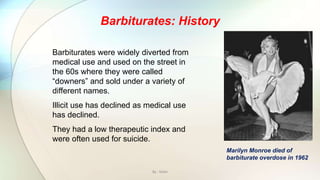
Barbiturates were widely diverted from
medical use and used on the street in
the 60s where they were called
“downers” and sold under a variety of
different names.
Illicit use has declined as medical use
has declined.
They had a low therapeutic index and
were often used for suicide.
Marilyn Monroe died of
barbiturate overdose in 1962
Barbiturates: History
By : Mahi
Mechanism of Action
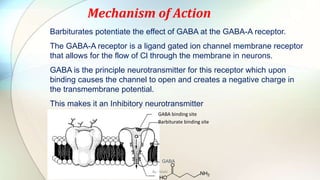
GABA binding site
Barbiturate binding site
Barbiturates potentiate the effect of GABA at the GABA-A receptor.
The GABA-A receptor is a ligand gated ion channel membrane receptor
that allows for the flow of Cl through the membrane in neurons.
GABA is the principle neurotransmitter for this receptor which upon
binding causes the channel to open and creates a negative charge in
the transmembrane potential.
This makes it an Inhibitory neurotransmitter
GABA
By : Mahi
Mechanism of Action
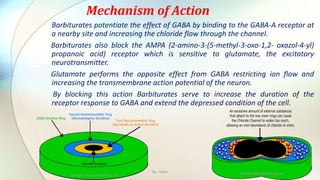
Barbiturates potentiate the effect of GABA by binding to the GABA-A receptor at
a nearby site and increasing the chloride flow through the channel.
Barbiturates also block the AMPA (2-amino-3-(5-methyl-3-oxo-1,2- oxazol-4-yl)
propanoic acid) receptor which is sensitive to glutamate, the excitatory
neurotransmitter.
Glutamate performs the opposite effect from GABA restricting ion flow and
increasing the transmembrane action potential of the neuron.
By blocking this action Barbiturates serve to increase the duration of the
receptor response to GABA and extend the depressed condition of the cell.
By : Mahi
•Treatment of INSOMNIA
• Phenobarbitone for EPILESPY
• Thiopentane for ANAESTHESIA
• Adjuvants in psychosomatic disorders
• Pre-operative sedation
• Treatment of seizure disorder
USES -
BARBITURATES
By : Mahi
Prolongs inhibitory
actions of GABA
Increases
duration of
ionophone
opening
Enhance
GABA
mediated Cl
currents
Mechanism
Of Action
By : Mahi
BARBITURATES ~ adverse
effects
• Residual depression after the main effect of drug
has passed
• Paradoxical excitement
• Hypersensitivity reaction – localized swelling of
eyelid, cheek, or lip, erythematous or exfoliative
dermatitis
• Synergistic action with ethanol and
antihistamines
By : Mahi
BARBITURATES ~ TOXIC
EFFECTS
• Slurred speech, ataxia, lethargy, confusion, headache,
nystagmus
• CNS depression, coma, shock
• Pupils first constrict and then dilate because of hypoxia
• hypothermia
• Cutaneous bullae
• Death due to respiratory arrest of cardiovascular collapse
• Chronic abuse  tolerance.
• Withdrawal reaction: anorexia, tremor, insomnia,
cramps, seizures, delirium, orthostatic hypotension
By : Mahi
Chloride
Channel
By : Mahi
•Chloride channels are a functionally and
structurally diverse group of anion selective
channels involved in processes including the
regulation of the excitability of neurones, skeletal,
cardiac and smooth muscle, cell volume regulation,
transepithelial salt transport, the acidification of
internal and extracellular compartments, the cell
cycle and apoptosis.
By : Mahi
Chloride channels are a superfamily of poorly
understood ion channels specific for chloride. These
channels may conduct many different ions, but are
named for chloride because its concentration in vivo is
much higher than other anions.[1] Several families
of voltage-gated channels and ligand-gated channels
By : Mahi
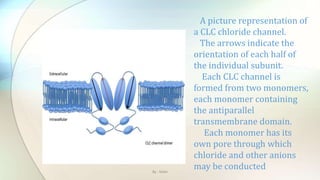
A picture representation of
a CLC chloride channel.
The arrows indicate the
orientation of each half of
the individual subunit.
Each CLC channel is
formed from two monomers,
each monomer containing
the antiparallel
transmembrane domain.
Each monomer has its
own pore through which
chloride and other anions
may be conductedBy : Mahi
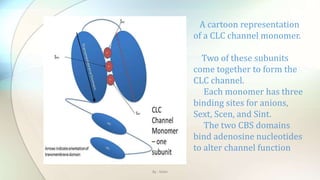
A cartoon representation
of a CLC channel monomer.
Two of these subunits
come together to form the
CLC channel.
Each monomer has three
binding sites for anions,
Sext, Scen, and Sint.
The two CBS domains
bind adenosine nucleotides
to alter channel function
By : Mahi
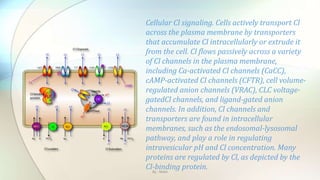
Cellular Cl signaling. Cells actively transport Cl
across the plasma membrane by transporters
that accumulate Cl intracellularly or extrude it
from the cell. Cl flows passively across a variety
of Cl channels in the plasma membrane,
including Ca-activated Cl channels (CaCC),
cAMP-activated Cl channels (CFTR), cell volume-
regulated anion channels (VRAC), CLC voltage-
gatedCl channels, and ligand-gated anion
channels. In addition, Cl channels and
transporters are found in intracellular
membranes, such as the endosomal-lysosomal
pathway, and play a role in regulating
intravesicular pH and Cl concentration. Many
proteins are regulated by Cl, as depicted by the
Cl-binding protein.By : Mahi
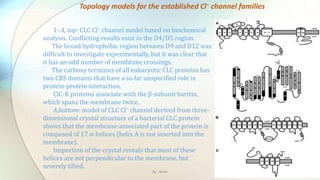
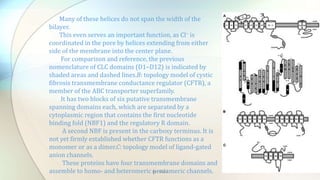
1- A, top: CLC Cl− channel model based on biochemical
analysis. Conflicting results exist in the D4/D5 region.
The broad hydrophobic region between D9 and D12 was
difficult to investigate experimentally, but it was clear that
it has an odd number of membrane crossings.
The carboxy terminus of all eukaryotic CLC proteins has
two CBS domains that have a so far unspecified role in
protein-protein interaction.
ClC-K proteins associate with the β-subunit barttin,
which spans the membrane twice.
A,bottom: model of CLC Cl− channel derived from three-
dimensional crystal structure of a bacterial CLC protein
shows that the membrane-associated part of the protein is
composed of 17 α-helices (helix A is not inserted into the
membrane).
Inspection of the crystal reveals that most of these
helices are not perpendicular to the membrane, but
severely tilted.
Topology models for the established Cl− channel families
By : Mahi
Many of these helices do not span the width of the
bilayer.
This even serves an important function, as Cl− is
coordinated in the pore by helices extending from either
side of the membrane into the center plane.
For comparison and reference, the previous
nomenclature of CLC domains (D1–D12) is indicated by
shaded areas and dashed lines.B: topology model of cystic
fibrosis transmembrane conductance regulator (CFTR), a
member of the ABC transporter superfamily.
It has two blocks of six putative transmembrane
spanning domains each, which are separated by a
cytoplasmic region that contains the first nucleotide
binding fold (NBF1) and the regulatory R domain.
A second NBF is present in the carboxy terminus. It is
not yet firmly established whether CFTR functions as a
monomer or as a dimer.C: topology model of ligand-gated
anion channels.
These proteins have four transmembrane domains and
assemble to homo- and heteromeric pentameric channels.By : Mahi
Transepithelial transport models. A: potassium secretion in the stria vascularis of the cochlea needs basolateral
Cl−channels for recycling Cl− that is transported into the cell by a Na+-K+-2Cl− cotransporter (NKCC1). K+ is secreted apically
via KCNQ1/KCNE1 potassium channels. The basolateral membrane most likely contains parallel heteromeric ClC-
Ka/barttin and ClC-Kb/barttin Cl− channels (147). Mutations in KCNQ1, KCNE1, NKCC1, and BSND (encoding barttin)
cause deafness, but mutations in either ClC-Ka or ClC-Kb alone do not. B: chloride reabsorption in the thick ascending limb
of Henle's loop involves an apical Na+-K+-2Cl− cotransporter (NKCC2) that needs a parallel K+ channel (ROMK1, Kir1.1) for
recycling potassium. Cl− leaves the cell passively across the basolateral membrane through the ClC-Kb/barttin Cl−channel
(147). Mutations in NKCC2, ROMK, or ClC-Kb cause variants of the same disorder, Bartter's syndrome. Mutations in the β-
subunit barttin (BSND) cause Bartter syndrome with deafness, as its loss of function affects both ClC-Ka and ClC-Kb.C:
chloride secretion in intestinal crypt cells. Intracellular Cl− concentration ([Cl−]i) is raised above equilibrium by a Na+-K+-
2Cl− cotransporter that needs a parallel K+ channel (KCNQ1/KCNE3) for recycling and passively leaves the cell via the
apical cAMP-stimulated Cl−channel CFTR. By : Mahi
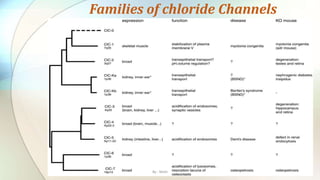
Families of chloride Channels
By : Mahi
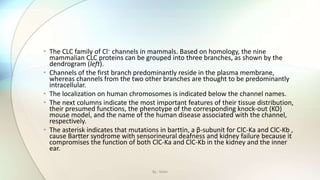
• The CLC family of Cl− channels in mammals. Based on homology, the nine
mammalian CLC proteins can be grouped into three branches, as shown by the
dendrogram (left).
• Channels of the first branch predominantly reside in the plasma membrane,
whereas channels from the two other branches are thought to be predominantly
intracellular.
• The localization on human chromosomes is indicated below the channel names.
• The next columns indicate the most important features of their tissue distribution,
their presumed functions, the phenotype of the corresponding knock-out (KO)
mouse model, and the name of the human disease associated with the channel,
respectively.
• The asterisk indicates that mutations in barttin, a β-subunit for ClC-Ka and ClC-Kb ,
cause Bartter syndrome with sensorineural deafness and kidney failure because it
compromises the function of both ClC-Ka and ClC-Kb in the kidney and the inner
ear.
By : Mahi
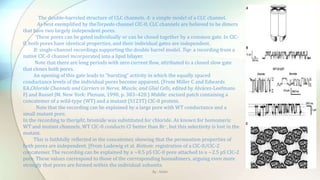
The double-barreled structure of CLC channels. A: a simple model of a CLC channel.
As best exemplified by theTorpedo channel ClC-0, CLC channels are believed to be dimers
that have two largely independent pores.
These pores can be gated individually or can be closed together by a common gate. In ClC-
0, both pores have identical properties, and their individual gates are independent.
B: single-channel recordings supporting the double barrel model. Top: a recording from a
native ClC-0 channel incorporated into a lipid bilayer.
Note that there are long periods with zero current flow, attributed to a closed slow gate
that closes both pores.
An opening of this gate leads to “bursting” activity in which the equally spaced
conductance levels of the individual pores become apparent. (From Miller C and Edwards
EA.Chloride Channels and Carriers in Nerve, Muscle, and Glial Cells, edited by Alvárez-Leefmans
FJ and Russel JM. New York: Plenum, 1990, p. 383–420.) Middle: excised patch containing a
concatemer of a wild-type (WT) and a mutant (S123T) ClC-0 protein.
Note that the recording can be explained by a large pore with WT conductance and a
small mutant pore.
In the recording to theright, bromide was substituted for chloride. As known for homomeric
WT and mutant channels, WT ClC-0 conducts Cl−better than Br−, but this selectivity is lost in the
mutant.
This is faithfully reflected in the concatemer, showing that the permeation properties of
both pores are independent. [From Ludewig et al. Bottom: registration of a ClC-0/ClC-2
concatemer. The recording can be explained by a ∼8.5 pS ClC-0 pore attached to a ∼2.5 pS ClC-2
pore. These values correspond to those of the corresponding homodimers, arguing even more
strongly that pores are formed within the individual subunits.
By : Mahi
By : Mahi
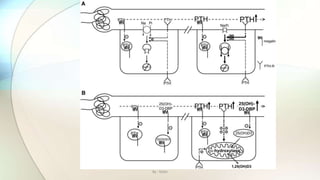
• Proximal tubular defect in endocytosis leads to secondary changes in calciotropic hormone levels and to
phosphaturia in ClC-5 KO mice.
• A: mechanism leading to phosphaturia. Parathyroid hormone (PTH) is filtered into the primary urine across the
glomerular filter (left). It can bind to megalin (symbolized by the zig-zag sign), which leads to its internalization
and degradation in lysosomes.
• The reduced endocytosis (symbolized by hyphens) leads to an increased concentration of PTH in later parts of the
proximal tubule compared with wild-type mice. This leads to an increased binding to apical PTH receptors (Y),
stimulating the endocytosis of apical Na+-Pi cotransporters and their degradation in lysosomes.
• This leads to the phosphaturia observed inClcn5 − mice and in human patients with Dent's disease. B: mechanism
leading to changes in vitamin D metabolism. As shown in A, the defect in endocytosis entails a luminal increase in
PTH concentration, resulting in enhanced PTH signaling.
• This increases the transcription of α-hydroxylase, a mitochondrial enzyme that converts 25-hydroxyvitamin
D3[25(OH)D3] to the active hormone 1,25-dihydroxyvitamin D3 [1,25(OH)2D3]. On the other hand, the precursor
25(OH)D3, bound to its binding protein, is filtered into the primary urine and is normally endocytosed via megalin.
• This constitutes the main supply of 25(OH)D3 for the α-hydroxylase, reducing the availability of the substrate in
the knockout. The supply of 25(OH)D3 is further compromised by a severe loss of this precursor into the urine
that may lead to decreased serum level.
• Thus the impaired endocytosis leads to two opposing effects on the synthesis of 1,25(OH)2D3: a decrease in the
precursor and an increase in enzymatic activity.
• The relative strengths of these effects determine whether there will be an increase or decrease in the serum
concentration of the active hormone. An increase will lead to increased intestinal Ca2+ reabsorption and,
secondarily, increased renal Ca2+ secretion, eventually causing kidney stones.
By : Mahi
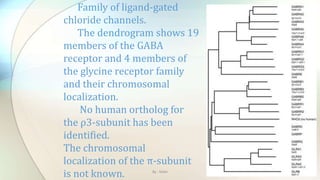
Family of ligand-gated
chloride channels.
The dendrogram shows 19
members of the GABA
receptor and 4 members of
the glycine receptor family
and their chromosomal
localization.
No human ortholog for
the ρ3-subunit has been
identified.
The chromosomal
localization of the π-subunit
is not known. By : Mahi
• http://physrev.physiology.org/content/82/2/503.long
• https://www.emory.edu/HEARTCELL/
• https://en.wikipedia.org/wiki/Chloride_channel
• http://physiologyonline.physiology.org/content/20/5/292
• https://www.ncbi.nlm.nih.gov/pubmed/11917096
Reference
By : Mahi
Name :
Group :
Thank You Very Much
By : Mahi

Barbiturates and Chloride channel

  • 1.
    Physiology Project Kazan StateMedical University By : Mahi
  • 2.
  • 3.
    Barbiturates • Barbiturates aredrugs that act as central nervous system depressants. • They are also effective as anxiolytics, hypnotics, and anticonvulsants. • Barbiturates vs. Benzodiazepines. • Both these highly addictive classes of drugs are medically prescribed to treat insomnia, anxiety, and in some cases seizures. •Derivatives of Barbituric acid or Malonylurea: Combination of urea and malonic caid •Depressants of the central nervous system, impair or reduce activity of the brain by acting as a Gamma Amino Butyric Acid (GABA) potentiators •Produce alcohol like symptoms such as ataxia (impaired motor control), dizziness and slow breathing and heart rateBy : Mahi
  • 4.
    Barbiturates were widelydiverted from medical use and used on the street in the 60s where they were called “downers” and sold under a variety of different names. Illicit use has declined as medical use has declined. They had a low therapeutic index and were often used for suicide. Marilyn Monroe died of barbiturate overdose in 1962 Barbiturates: History By : Mahi
  • 5.
    Mechanism of Action GABAbinding site Barbiturate binding site Barbiturates potentiate the effect of GABA at the GABA-A receptor. The GABA-A receptor is a ligand gated ion channel membrane receptor that allows for the flow of Cl through the membrane in neurons. GABA is the principle neurotransmitter for this receptor which upon binding causes the channel to open and creates a negative charge in the transmembrane potential. This makes it an Inhibitory neurotransmitter GABA By : Mahi
  • 6.
    Mechanism of Action Barbituratespotentiate the effect of GABA by binding to the GABA-A receptor at a nearby site and increasing the chloride flow through the channel. Barbiturates also block the AMPA (2-amino-3-(5-methyl-3-oxo-1,2- oxazol-4-yl) propanoic acid) receptor which is sensitive to glutamate, the excitatory neurotransmitter. Glutamate performs the opposite effect from GABA restricting ion flow and increasing the transmembrane action potential of the neuron. By blocking this action Barbiturates serve to increase the duration of the receptor response to GABA and extend the depressed condition of the cell. By : Mahi
  • 7.
    •Treatment of INSOMNIA •Phenobarbitone for EPILESPY • Thiopentane for ANAESTHESIA • Adjuvants in psychosomatic disorders • Pre-operative sedation • Treatment of seizure disorder USES - BARBITURATES By : Mahi
  • 8.
    Prolongs inhibitory actions ofGABA Increases duration of ionophone opening Enhance GABA mediated Cl currents Mechanism Of Action By : Mahi
  • 9.
    BARBITURATES ~ adverse effects •Residual depression after the main effect of drug has passed • Paradoxical excitement • Hypersensitivity reaction – localized swelling of eyelid, cheek, or lip, erythematous or exfoliative dermatitis • Synergistic action with ethanol and antihistamines By : Mahi
  • 10.
    BARBITURATES ~ TOXIC EFFECTS •Slurred speech, ataxia, lethargy, confusion, headache, nystagmus • CNS depression, coma, shock • Pupils first constrict and then dilate because of hypoxia • hypothermia • Cutaneous bullae • Death due to respiratory arrest of cardiovascular collapse • Chronic abuse  tolerance. • Withdrawal reaction: anorexia, tremor, insomnia, cramps, seizures, delirium, orthostatic hypotension By : Mahi
  • 11.
  • 12.
    •Chloride channels area functionally and structurally diverse group of anion selective channels involved in processes including the regulation of the excitability of neurones, skeletal, cardiac and smooth muscle, cell volume regulation, transepithelial salt transport, the acidification of internal and extracellular compartments, the cell cycle and apoptosis. By : Mahi
  • 13.
    Chloride channels area superfamily of poorly understood ion channels specific for chloride. These channels may conduct many different ions, but are named for chloride because its concentration in vivo is much higher than other anions.[1] Several families of voltage-gated channels and ligand-gated channels By : Mahi
  • 14.
    A picture representationof a CLC chloride channel. The arrows indicate the orientation of each half of the individual subunit. Each CLC channel is formed from two monomers, each monomer containing the antiparallel transmembrane domain. Each monomer has its own pore through which chloride and other anions may be conductedBy : Mahi
  • 15.
    A cartoon representation ofa CLC channel monomer. Two of these subunits come together to form the CLC channel. Each monomer has three binding sites for anions, Sext, Scen, and Sint. The two CBS domains bind adenosine nucleotides to alter channel function By : Mahi
  • 16.
    Cellular Cl signaling.Cells actively transport Cl across the plasma membrane by transporters that accumulate Cl intracellularly or extrude it from the cell. Cl flows passively across a variety of Cl channels in the plasma membrane, including Ca-activated Cl channels (CaCC), cAMP-activated Cl channels (CFTR), cell volume- regulated anion channels (VRAC), CLC voltage- gatedCl channels, and ligand-gated anion channels. In addition, Cl channels and transporters are found in intracellular membranes, such as the endosomal-lysosomal pathway, and play a role in regulating intravesicular pH and Cl concentration. Many proteins are regulated by Cl, as depicted by the Cl-binding protein.By : Mahi
  • 17.
    1- A, top:CLC Cl− channel model based on biochemical analysis. Conflicting results exist in the D4/D5 region. The broad hydrophobic region between D9 and D12 was difficult to investigate experimentally, but it was clear that it has an odd number of membrane crossings. The carboxy terminus of all eukaryotic CLC proteins has two CBS domains that have a so far unspecified role in protein-protein interaction. ClC-K proteins associate with the β-subunit barttin, which spans the membrane twice. A,bottom: model of CLC Cl− channel derived from three- dimensional crystal structure of a bacterial CLC protein shows that the membrane-associated part of the protein is composed of 17 α-helices (helix A is not inserted into the membrane). Inspection of the crystal reveals that most of these helices are not perpendicular to the membrane, but severely tilted. Topology models for the established Cl− channel families By : Mahi
  • 18.
    Many of thesehelices do not span the width of the bilayer. This even serves an important function, as Cl− is coordinated in the pore by helices extending from either side of the membrane into the center plane. For comparison and reference, the previous nomenclature of CLC domains (D1–D12) is indicated by shaded areas and dashed lines.B: topology model of cystic fibrosis transmembrane conductance regulator (CFTR), a member of the ABC transporter superfamily. It has two blocks of six putative transmembrane spanning domains each, which are separated by a cytoplasmic region that contains the first nucleotide binding fold (NBF1) and the regulatory R domain. A second NBF is present in the carboxy terminus. It is not yet firmly established whether CFTR functions as a monomer or as a dimer.C: topology model of ligand-gated anion channels. These proteins have four transmembrane domains and assemble to homo- and heteromeric pentameric channels.By : Mahi
  • 19.
    Transepithelial transport models.A: potassium secretion in the stria vascularis of the cochlea needs basolateral Cl−channels for recycling Cl− that is transported into the cell by a Na+-K+-2Cl− cotransporter (NKCC1). K+ is secreted apically via KCNQ1/KCNE1 potassium channels. The basolateral membrane most likely contains parallel heteromeric ClC- Ka/barttin and ClC-Kb/barttin Cl− channels (147). Mutations in KCNQ1, KCNE1, NKCC1, and BSND (encoding barttin) cause deafness, but mutations in either ClC-Ka or ClC-Kb alone do not. B: chloride reabsorption in the thick ascending limb of Henle's loop involves an apical Na+-K+-2Cl− cotransporter (NKCC2) that needs a parallel K+ channel (ROMK1, Kir1.1) for recycling potassium. Cl− leaves the cell passively across the basolateral membrane through the ClC-Kb/barttin Cl−channel (147). Mutations in NKCC2, ROMK, or ClC-Kb cause variants of the same disorder, Bartter's syndrome. Mutations in the β- subunit barttin (BSND) cause Bartter syndrome with deafness, as its loss of function affects both ClC-Ka and ClC-Kb.C: chloride secretion in intestinal crypt cells. Intracellular Cl− concentration ([Cl−]i) is raised above equilibrium by a Na+-K+- 2Cl− cotransporter that needs a parallel K+ channel (KCNQ1/KCNE3) for recycling and passively leaves the cell via the apical cAMP-stimulated Cl−channel CFTR. By : Mahi
  • 20.
    Families of chlorideChannels By : Mahi
  • 21.
    • The CLCfamily of Cl− channels in mammals. Based on homology, the nine mammalian CLC proteins can be grouped into three branches, as shown by the dendrogram (left). • Channels of the first branch predominantly reside in the plasma membrane, whereas channels from the two other branches are thought to be predominantly intracellular. • The localization on human chromosomes is indicated below the channel names. • The next columns indicate the most important features of their tissue distribution, their presumed functions, the phenotype of the corresponding knock-out (KO) mouse model, and the name of the human disease associated with the channel, respectively. • The asterisk indicates that mutations in barttin, a β-subunit for ClC-Ka and ClC-Kb , cause Bartter syndrome with sensorineural deafness and kidney failure because it compromises the function of both ClC-Ka and ClC-Kb in the kidney and the inner ear. By : Mahi
  • 22.
    The double-barreled structureof CLC channels. A: a simple model of a CLC channel. As best exemplified by theTorpedo channel ClC-0, CLC channels are believed to be dimers that have two largely independent pores. These pores can be gated individually or can be closed together by a common gate. In ClC- 0, both pores have identical properties, and their individual gates are independent. B: single-channel recordings supporting the double barrel model. Top: a recording from a native ClC-0 channel incorporated into a lipid bilayer. Note that there are long periods with zero current flow, attributed to a closed slow gate that closes both pores. An opening of this gate leads to “bursting” activity in which the equally spaced conductance levels of the individual pores become apparent. (From Miller C and Edwards EA.Chloride Channels and Carriers in Nerve, Muscle, and Glial Cells, edited by Alvárez-Leefmans FJ and Russel JM. New York: Plenum, 1990, p. 383–420.) Middle: excised patch containing a concatemer of a wild-type (WT) and a mutant (S123T) ClC-0 protein. Note that the recording can be explained by a large pore with WT conductance and a small mutant pore. In the recording to theright, bromide was substituted for chloride. As known for homomeric WT and mutant channels, WT ClC-0 conducts Cl−better than Br−, but this selectivity is lost in the mutant. This is faithfully reflected in the concatemer, showing that the permeation properties of both pores are independent. [From Ludewig et al. Bottom: registration of a ClC-0/ClC-2 concatemer. The recording can be explained by a ∼8.5 pS ClC-0 pore attached to a ∼2.5 pS ClC-2 pore. These values correspond to those of the corresponding homodimers, arguing even more strongly that pores are formed within the individual subunits. By : Mahi
  • 23.
  • 24.
    • Proximal tubulardefect in endocytosis leads to secondary changes in calciotropic hormone levels and to phosphaturia in ClC-5 KO mice. • A: mechanism leading to phosphaturia. Parathyroid hormone (PTH) is filtered into the primary urine across the glomerular filter (left). It can bind to megalin (symbolized by the zig-zag sign), which leads to its internalization and degradation in lysosomes. • The reduced endocytosis (symbolized by hyphens) leads to an increased concentration of PTH in later parts of the proximal tubule compared with wild-type mice. This leads to an increased binding to apical PTH receptors (Y), stimulating the endocytosis of apical Na+-Pi cotransporters and their degradation in lysosomes. • This leads to the phosphaturia observed inClcn5 − mice and in human patients with Dent's disease. B: mechanism leading to changes in vitamin D metabolism. As shown in A, the defect in endocytosis entails a luminal increase in PTH concentration, resulting in enhanced PTH signaling. • This increases the transcription of α-hydroxylase, a mitochondrial enzyme that converts 25-hydroxyvitamin D3[25(OH)D3] to the active hormone 1,25-dihydroxyvitamin D3 [1,25(OH)2D3]. On the other hand, the precursor 25(OH)D3, bound to its binding protein, is filtered into the primary urine and is normally endocytosed via megalin. • This constitutes the main supply of 25(OH)D3 for the α-hydroxylase, reducing the availability of the substrate in the knockout. The supply of 25(OH)D3 is further compromised by a severe loss of this precursor into the urine that may lead to decreased serum level. • Thus the impaired endocytosis leads to two opposing effects on the synthesis of 1,25(OH)2D3: a decrease in the precursor and an increase in enzymatic activity. • The relative strengths of these effects determine whether there will be an increase or decrease in the serum concentration of the active hormone. An increase will lead to increased intestinal Ca2+ reabsorption and, secondarily, increased renal Ca2+ secretion, eventually causing kidney stones. By : Mahi
  • 25.
    Family of ligand-gated chloridechannels. The dendrogram shows 19 members of the GABA receptor and 4 members of the glycine receptor family and their chromosomal localization. No human ortholog for the ρ3-subunit has been identified. The chromosomal localization of the π-subunit is not known. By : Mahi
  • 26.
    • http://physrev.physiology.org/content/82/2/503.long • https://www.emory.edu/HEARTCELL/ •https://en.wikipedia.org/wiki/Chloride_channel • http://physiologyonline.physiology.org/content/20/5/292 • https://www.ncbi.nlm.nih.gov/pubmed/11917096 Reference By : Mahi
  • 27.
    Name : Group : ThankYou Very Much By : Mahi