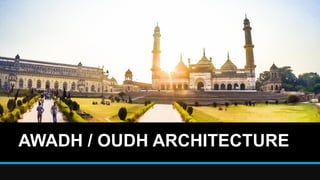
AWADH / OUDH ARCHITECTURE
AWADH / OUDH
ARCHITECTURE
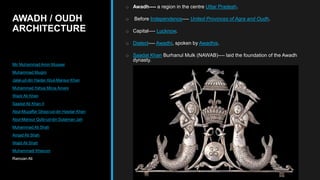
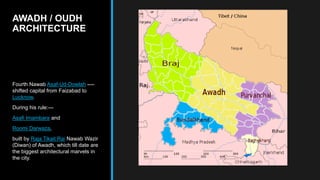
o Awadh---- a region in the centre Uttar Pradesh.
o Before Independence---- United Provinces of Agra and Oudh.
o Capital---- Lucknow.
o Dialect---- Awadhi, spoken by Awadhis.
o Saadat Khan Burhanul Mulk (NAWAB)---- laid the foundation of the Awadh
dynasty.
Mir Muhammad Amin Musawi
Muhammad Muqim
Jalal-ud-din Haider Abul-Mansur Khan
Muhammad Yahya Mirza Amani
Wazir Ali Khan
Saadat Ali Khan II
Abul-Muzaffar Ghazi-ud-din Haydar Khan
Abul-Mansur Qutb-ud-din Sulaiman Jah
Muhammad Ali Shah
Amjad Ali Shah
Wajid Ali Shah
Muhammadi Khanum
Ramzan Ali
AWADH / OUDH
ARCHITECTURE
Fourth Nawab Asaf-Ud-Dowlah ----
shifted capital from Faizabad to
Lucknow.
During his rule:---
Asafi Imambara and
Roomi Darwaza,
built by Raja Tikait Rai Nawab Wazir
(Diwan) of Awadh, which till date are
the biggest architectural marvels in
the city.
AWADH / OUDH
ARCHITECTURE
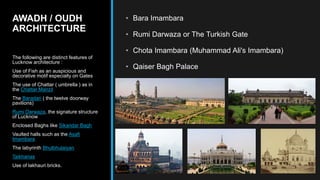
• Bara Imambara
• Rumi Darwaza or The Turkish Gate
• Chota Imambara (Muhammad Ali's Imambara)
• Qaiser Bagh Palace
The following are distinct features of
Lucknow architecture :
Use of Fish as an auspicious and
decorative motif especially on Gates
The use of Chattar ( umbrella ) as in
the Chattar Manzil
The Baradari ( the twelve doorway
pavilions)
Rumi Darwaza, the signature structure
of Lucknow
Enclosed Baghs like Sikandar Bagh
Vaulted halls such as the Asafi
Imambara
The labyrinth Bhulbhulaiyan
Taikhanas
Use of lakhauri bricks.
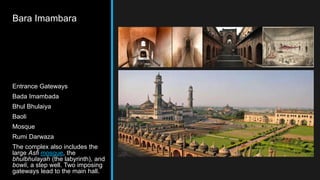
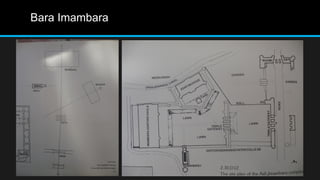
Bara Imambara
Entrance Gateways
Bada Imambada
Bhul Bhulaiya
Baoli
Mosque
Rumi Darwaza
The complex also includes the
large Asfi mosque, the
bhulbhulayah (the labyrinth), and
bowli, a step well. Two imposing
gateways lead to the main hall.
Bara Imambara
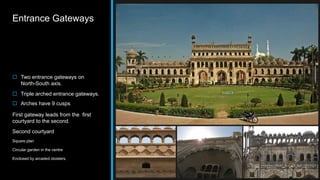
Entrance Gateways
 Two entrance gateways on
North-South axis.
 Triple arched entrance gateways.
 Arches have 9 cusps.
First gateway leads from the first
courtyard to the second.
Second courtyard
Square plan
Circular garden in the centre
Enclosed by arcaded cloisters.
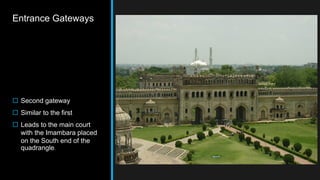
Entrance Gateways
 Second gateway
 Similar to the first
 Leads to the main court
with the Imambara placed
on the South end of the
quadrangle.
Bara Imambara
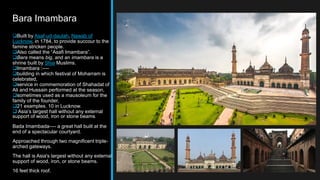
Built by Asaf-ud-daulah, Nawab of
Lucknow, in 1784, to provide succour to the
famine stricken people.
Also called the “Asafi Imambara”.
Bara means big, and an imambara is a
shrine built by Shia Muslims.
Imambara :----
building in which festival of Moharram is
celebrated,
service in commemoration of Shahadat of
Ali and Hussain performed at the season,
sometimes used as a mausoleum for the
family of the founder,
21 examples. 10 in Lucknow.
 Asia’s largest hall without any external
support of wood, iron or stone beams.
Bada Imambada---- a great hall built at the
end of a spectacular courtyard.
Approached through two magnificent triple-
arched gateways.
The hall is Asia's largest without any external
support of wood, iron, or stone beams.
16 feet thick roof.
Bara Imambara
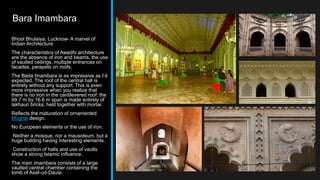
Bhool Bhulaiya, Lucknow- A marvel of
Indian Architecture
The characteristics of Awadhi architecture
are the absence of iron and beams, the use
of vaulted ceilings, multiple entrances on
facades, parapets on roofs.
The Bada Imambara is as impressive as I’d
expected. The roof of the central hall is
entirely without any support. This is even
more impressive when you realize that
there is no iron in the cantilevered roof: the
49.7 m by 16.6 m span is made entirely of
lakhauri bricks, held together with mortar.
Reflects the maturation of ornamented
Mughal design.
No European elements or the use of iron.
Neither a mosque, nor a mausoleum, but a
huge building having interesting elements.
Construction of halls and use of vaults
show a strong Islamic influence.
The main imambara consists of a large
vaulted central chamber containing the
tomb of Asaf-ud-Daula.
Bara Imambara
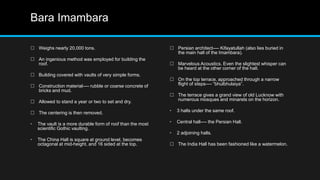
 Weighs nearly 20,000 tons.
 An ingenious method was employed for building the
roof.
 Building covered with vaults of very simple forms.
 Construction material---- rubble or coarse concrete of
bricks and mud.
 Allowed to stand a year or two to set and dry.
 The centering is then removed.
• The vault is a more durable form of roof than the most
scientific Gothic vaulting.
• The China Hall is square at ground level, becomes
octagonal at mid-height, and 16 sided at the top.
 Persian architect---- Kifayatullah (also lies buried in
the main hall of the Imambara).
 Marvelous Acoustics. Even the slightest whisper can
be heard at the other corner of the hall.
 On the top terrace, approached through a narrow
flight of steps---- “bhulbhulaiya”.
 The terrace gives a grand view of old Lucknow with
numerous mosques and minarets on the horizon.
• 3 halls under the same roof.
• Central hall---- the Persian Hall.
• 2 adjoining halls.
 The India Hall has been fashioned like a watermelon.
Bhulbhulayah
(Labyrinth)
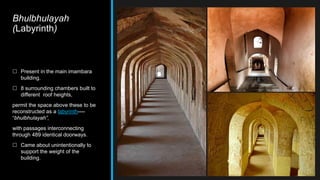
 Present in the main imambara
building.
 8 surrounding chambers built to
different roof heights,
permit the space above these to be
reconstructed as a labyrinth----
“bhulbhulayah”,
with passages interconnecting
through 489 identical doorways.
 Came about unintentionally to
support the weight of the
building.
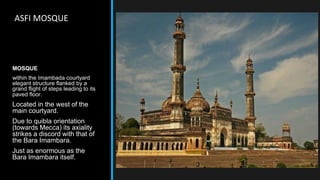
ASFI MOSQUE
MOSQUE
within the Imambada courtyard
elegant structure flanked by a
grand flight of steps leading to its
paved floor.
Located in the west of the
main courtyard.
Due to quibla orientation
(towards Mecca) its axiality
strikes a discord with that of
the Bara Imambara.
Just as enormous as the
Bara Imambara itself.
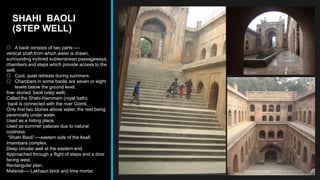
SHAHI BAOLI
(STEP WELL)
 A baoli consists of two parts:----
vertical shaft from which water is drawn,
surrounding inclined subterranean passageways,
chambers and steps which provide access to the
well.
 Cool, quiet retreats during summers.
 Chambers in some baolis are seven or eight
levels below the ground level.
five- storied baoli (step well)
Called the Shahi-Hammam (royal bath),
baoli is connected with the river Gomti.
Only first two stories above water, the rest being
perennially under water.
Used as a hiding place.
Used as summer palaces due to natural
coolness
“Shahi Baoli”----eastern side of the Asafi
Imambara complex.
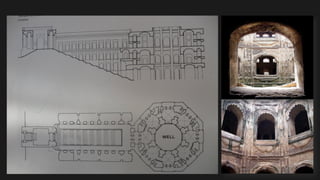
Deep circular well at the eastern end.
Approached through a flight of steps and a door
facing west.
Rectangular plan.
Material---- Lakhauri brick and lime mortar.
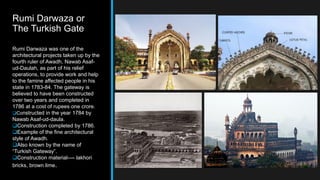
Rumi Darwaza or
The Turkish Gate
Rumi Darwaza was one of the
architectural projects taken up by the
fourth ruler of Awadh, Nawab Asaf-
ud-Daulah, as part of his relief
operations, to provide work and help
to the famine affected people in his
state in 1783-84. The gateway is
believed to have been constructed
over two years and completed in
1786 at a cost of rupees one crore.
Constructed in the year 1784 by
Nawab Asaf-ud-daula.
Construction completed by 1786.
Example of the fine architectural
style of Awadh.
Also known by the name of
“Turkish Gateway”.
Construction material---- lakhori
bricks, brown lime.
Rumi Darwaza or
The Turkish Gate
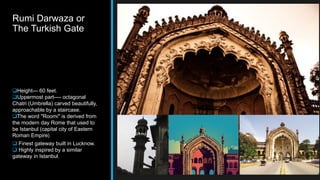
Height--- 60 feet.
Uppermost part---- octagonal
Chatri (Umbrella) carved beautifully,
approachable by a staircase.
The word "Roomi" is derived from
the modern day Rome that used to
be Istanbul (capital city of Eastern
Roman Empire).
 Finest gateway built in Lucknow.
 Highly inspired by a similar
gateway in Istanbul.
Rumi Darwaza or
The Turkish Gate
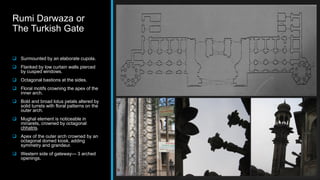
 Surmounted by an elaborate cupola.
 Flanked by low curtain walls pierced
by cusped windows.
 Octagonal bastions at the sides.
 Floral motifs crowning the apex of the
inner arch.
 Bold and broad lotus petals altered by
solid turrets with floral patterns on the
outer arch.
 Mughal element is noticeable in
minarets, crowned by octagonal
chhatris.
 Apex of the outer arch crowned by an
octagonal domed kiosk, adding
symmetry and grandeur.
 Western side of gateway--- 3 arched
openings.
architectnazim@gmail.com
Ar. Nazim Bin Shamshiraz Saifi

Awadh / Oudh Architecture

  • 1.
    AWADH / OUDHARCHITECTURE
  • 2.
    AWADH / OUDH ARCHITECTURE oAwadh---- a region in the centre Uttar Pradesh. o Before Independence---- United Provinces of Agra and Oudh. o Capital---- Lucknow. o Dialect---- Awadhi, spoken by Awadhis. o Saadat Khan Burhanul Mulk (NAWAB)---- laid the foundation of the Awadh dynasty. Mir Muhammad Amin Musawi Muhammad Muqim Jalal-ud-din Haider Abul-Mansur Khan Muhammad Yahya Mirza Amani Wazir Ali Khan Saadat Ali Khan II Abul-Muzaffar Ghazi-ud-din Haydar Khan Abul-Mansur Qutb-ud-din Sulaiman Jah Muhammad Ali Shah Amjad Ali Shah Wajid Ali Shah Muhammadi Khanum Ramzan Ali
  • 3.
    AWADH / OUDH ARCHITECTURE FourthNawab Asaf-Ud-Dowlah ---- shifted capital from Faizabad to Lucknow. During his rule:--- Asafi Imambara and Roomi Darwaza, built by Raja Tikait Rai Nawab Wazir (Diwan) of Awadh, which till date are the biggest architectural marvels in the city.
  • 4.
    AWADH / OUDH ARCHITECTURE •Bara Imambara • Rumi Darwaza or The Turkish Gate • Chota Imambara (Muhammad Ali's Imambara) • Qaiser Bagh Palace The following are distinct features of Lucknow architecture : Use of Fish as an auspicious and decorative motif especially on Gates The use of Chattar ( umbrella ) as in the Chattar Manzil The Baradari ( the twelve doorway pavilions) Rumi Darwaza, the signature structure of Lucknow Enclosed Baghs like Sikandar Bagh Vaulted halls such as the Asafi Imambara The labyrinth Bhulbhulaiyan Taikhanas Use of lakhauri bricks.
  • 5.
    Bara Imambara Entrance Gateways BadaImambada Bhul Bhulaiya Baoli Mosque Rumi Darwaza The complex also includes the large Asfi mosque, the bhulbhulayah (the labyrinth), and bowli, a step well. Two imposing gateways lead to the main hall.
  • 6.
  • 7.
    Entrance Gateways  Twoentrance gateways on North-South axis.  Triple arched entrance gateways.  Arches have 9 cusps. First gateway leads from the first courtyard to the second. Second courtyard Square plan Circular garden in the centre Enclosed by arcaded cloisters.
  • 8.
    Entrance Gateways  Secondgateway  Similar to the first  Leads to the main court with the Imambara placed on the South end of the quadrangle.
  • 9.
    Bara Imambara Built byAsaf-ud-daulah, Nawab of Lucknow, in 1784, to provide succour to the famine stricken people. Also called the “Asafi Imambara”. Bara means big, and an imambara is a shrine built by Shia Muslims. Imambara :---- building in which festival of Moharram is celebrated, service in commemoration of Shahadat of Ali and Hussain performed at the season, sometimes used as a mausoleum for the family of the founder, 21 examples. 10 in Lucknow.  Asia’s largest hall without any external support of wood, iron or stone beams. Bada Imambada---- a great hall built at the end of a spectacular courtyard. Approached through two magnificent triple- arched gateways. The hall is Asia's largest without any external support of wood, iron, or stone beams. 16 feet thick roof.
  • 10.
    Bara Imambara Bhool Bhulaiya,Lucknow- A marvel of Indian Architecture The characteristics of Awadhi architecture are the absence of iron and beams, the use of vaulted ceilings, multiple entrances on facades, parapets on roofs. The Bada Imambara is as impressive as I’d expected. The roof of the central hall is entirely without any support. This is even more impressive when you realize that there is no iron in the cantilevered roof: the 49.7 m by 16.6 m span is made entirely of lakhauri bricks, held together with mortar. Reflects the maturation of ornamented Mughal design. No European elements or the use of iron. Neither a mosque, nor a mausoleum, but a huge building having interesting elements. Construction of halls and use of vaults show a strong Islamic influence. The main imambara consists of a large vaulted central chamber containing the tomb of Asaf-ud-Daula.
  • 11.
    Bara Imambara  Weighsnearly 20,000 tons.  An ingenious method was employed for building the roof.  Building covered with vaults of very simple forms.  Construction material---- rubble or coarse concrete of bricks and mud.  Allowed to stand a year or two to set and dry.  The centering is then removed. • The vault is a more durable form of roof than the most scientific Gothic vaulting. • The China Hall is square at ground level, becomes octagonal at mid-height, and 16 sided at the top.  Persian architect---- Kifayatullah (also lies buried in the main hall of the Imambara).  Marvelous Acoustics. Even the slightest whisper can be heard at the other corner of the hall.  On the top terrace, approached through a narrow flight of steps---- “bhulbhulaiya”.  The terrace gives a grand view of old Lucknow with numerous mosques and minarets on the horizon. • 3 halls under the same roof. • Central hall---- the Persian Hall. • 2 adjoining halls.  The India Hall has been fashioned like a watermelon.
  • 12.
    Bhulbhulayah (Labyrinth)  Present inthe main imambara building.  8 surrounding chambers built to different roof heights, permit the space above these to be reconstructed as a labyrinth---- “bhulbhulayah”, with passages interconnecting through 489 identical doorways.  Came about unintentionally to support the weight of the building.
  • 13.
    ASFI MOSQUE MOSQUE within theImambada courtyard elegant structure flanked by a grand flight of steps leading to its paved floor. Located in the west of the main courtyard. Due to quibla orientation (towards Mecca) its axiality strikes a discord with that of the Bara Imambara. Just as enormous as the Bara Imambara itself.
  • 14.
    SHAHI BAOLI (STEP WELL) A baoli consists of two parts:---- vertical shaft from which water is drawn, surrounding inclined subterranean passageways, chambers and steps which provide access to the well.  Cool, quiet retreats during summers.  Chambers in some baolis are seven or eight levels below the ground level. five- storied baoli (step well) Called the Shahi-Hammam (royal bath), baoli is connected with the river Gomti. Only first two stories above water, the rest being perennially under water. Used as a hiding place. Used as summer palaces due to natural coolness “Shahi Baoli”----eastern side of the Asafi Imambara complex. Deep circular well at the eastern end. Approached through a flight of steps and a door facing west. Rectangular plan. Material---- Lakhauri brick and lime mortar.
  • 16.
    Rumi Darwaza or TheTurkish Gate Rumi Darwaza was one of the architectural projects taken up by the fourth ruler of Awadh, Nawab Asaf- ud-Daulah, as part of his relief operations, to provide work and help to the famine affected people in his state in 1783-84. The gateway is believed to have been constructed over two years and completed in 1786 at a cost of rupees one crore. Constructed in the year 1784 by Nawab Asaf-ud-daula. Construction completed by 1786. Example of the fine architectural style of Awadh. Also known by the name of “Turkish Gateway”. Construction material---- lakhori bricks, brown lime.
  • 17.
    Rumi Darwaza or TheTurkish Gate Height--- 60 feet. Uppermost part---- octagonal Chatri (Umbrella) carved beautifully, approachable by a staircase. The word "Roomi" is derived from the modern day Rome that used to be Istanbul (capital city of Eastern Roman Empire).  Finest gateway built in Lucknow.  Highly inspired by a similar gateway in Istanbul.
  • 18.
    Rumi Darwaza or TheTurkish Gate  Surmounted by an elaborate cupola.  Flanked by low curtain walls pierced by cusped windows.  Octagonal bastions at the sides.  Floral motifs crowning the apex of the inner arch.  Bold and broad lotus petals altered by solid turrets with floral patterns on the outer arch.  Mughal element is noticeable in minarets, crowned by octagonal chhatris.  Apex of the outer arch crowned by an octagonal domed kiosk, adding symmetry and grandeur.  Western side of gateway--- 3 arched openings.
  • 19.