

BEHAVIOURAL FINANCE
FIRDAUS KHAN
Associate Professor, Dept. of Finance.
ICBM-SBE, Hyd. India
firdaus@icbm.ac.in
firdaus@icbm.ac.in
What is Behavioral Finance?
• The study of psychological
factors on financial decision
making.
firdaus@icbm.ac.in
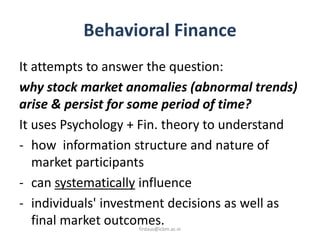
Behavioral Finance
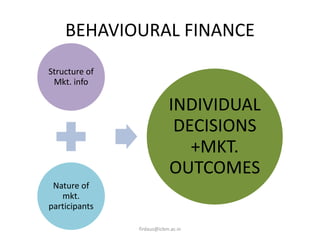
It attempts to answer the question:
why stock market anomalies (abnormal trends)
arise & persist for some period of time?
It uses Psychology + Fin. theory to understand
- how information structure and nature of
market participants
- can systematically influence
- individuals' investment decisions as well as
final market outcomes.firdaus@icbm.ac.in
BEHAVIOURAL FINANCE
Structure of
Mkt. info
Nature of
mkt.
participants
INDIVIDUAL
DECISIONS
+MKT.
OUTCOMES
firdaus@icbm.ac.in
DEFINITION
• Behavioral Finance is a sub-field
of behavioral economics that proposes
psychology-based theories to explain
stock market anomalies, such as severe
rise or fall in stock prices.
• The purpose is to identify and understand
why people make certain financial
choices.
firdaus@icbm.ac.in
W..H..A..T!!
• EMOTIONS???
• MENTAL ERRORS???
• In financial decision making?
firdaus@icbm.ac.in
WHAT IS THIS?
firdaus@icbm.ac.in
Keep distance of 10 feet between your car and
the car in front of you
WHAT ARE THESE?
• Judge the distance of an object by its clarity
• Judge the distance of a person by her size
• Save 10% of your income for retirement
• 100 – age = % to invest in shares (If 25 years
old invest 75% in shares. If 70, invest 30%)
• Never borrow on credit cards
THESE ARE HEURISTICS
firdaus@icbm.ac.in
HEURISTICS
firdaus@icbm.ac.in
HEURISTICS
• Heuristics are rules or strategies for
information processing, which help to make a
quick but not necessarily optimal decision.
• When people are overwhelmed by
information processing they use heuristics to
control extreme complexity
• Heuristics help to find a QUICK (but NOT
NECESSARILY OPTIMAL) SOLUTION.
firdaus@icbm.ac.in
The problem with Heuristics
• Sometimes heuristics are good for making
decisions, while sometimes they are bad.
• It is a mixed verdict…
• …because heuristics act faster than rational
deliberation, but precisely because of their
speed, heuristics can mislead us into
systematic errors in making decisions.
firdaus@icbm.ac.in
What Heuristics do ….
• Speed up cognition
• Give a quick, approximate solution
• Occasionally give incorrect answers
or errors
• Systematic errors are called
“biases”
When does a Bias occur?
• When people’s actions are based on feelings
or perceptions, not on facts.
• Biases are of two types:
1. Cognitive – relating to perception, memory,
judgment, and reasoning
2. Emotional – relating to sentiments
firdaus@icbm.ac.in
firdaus@icbm.ac.in
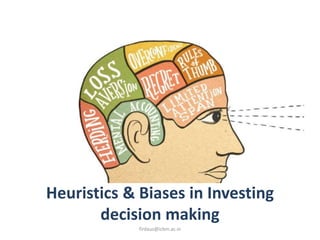
Heuristics & Biases in Investing
decision making
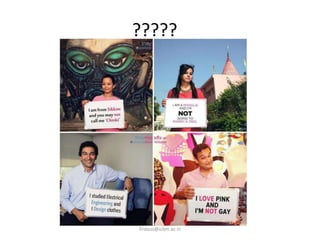
?????
firdaus@icbm.ac.in
1. Representativeness Bias
• A faulty heuristic based on the presumption
that once people or events are categorized,
they share all the features of others members
in that category.
• It is similar to stereo-typing.
• small cap companies ill managed,
fraudulent. Avoid!! Is this the correct decision?
firdaus@icbm.ac.in
Have you seen this?
• Father to son: “You only did something wrong,
I am sure. Your coach will not remove you
from team just like that.”
• Participant in talent show: “I performed so
well, but they didn’t choose me. They don’t
know anything about singing. Who made
them judges!!”
firdaus@icbm.ac.in
2. (Self) Attribution Bias
• When people evaluate or try to find reasons
for their own behavior or other people’s
behavior.
• Attribution can be internal or external.
• SELF – ENHANCING BIAS
The good outcome occurred because of me!
• SELF – PROTECTING BIAS
The bad outcome occurred because of them!
firdaus@icbm.ac.in
Reflect…
• Why parents in India get uneasy when girls are
travelling by Ola or Uber?
• Why do people still feel uneasy to invest in
stock markets?
firdaus@icbm.ac.in
3. Anchoring
• Anchoring is a cognitive bias that describes
the common human tendency to rely too
heavily on the first piece of information
offered (the "anchor") when making decisions.
• During decision making, anchoring occurs
when individuals use an initial piece of
information to make subsequent judgments.
firdaus@icbm.ac.in
Reflect…
• What was the response of Indians to ULIP?
• Why FD is preferred?
• Pension vs. Insurance vs. Provident fund
firdaus@icbm.ac.in
4. Aversion To Ambiguity
• People prefer known risks over unknown risks.
• An ambiguity/uncertainty averse individual
would rather choose an alternative where the
probability distribution of the outcomes is
known over one where the probabilities are
unknown.
firdaus@icbm.ac.in
Virtually Impossible – is it?
• In a lottery in which six numbers are selected
out of fifty, what are the chances that the six
numbers will be 1, 2, 3, 4, 5, and 6?
• Equally probable to any other combination
• 50C6 = 1 in 5,464, 817, 280
firdaus@icbm.ac.in
5. Innumeracy Bias
•People have difficulty in figuring
out "true" probabilities.
•Also, calculation of discounts
and premiums are difficult for
people.
firdaus@icbm.ac.in
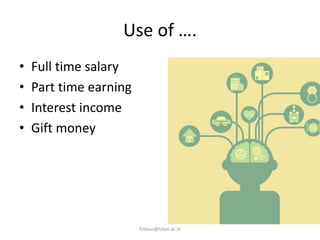
Use of ….
• Full time salary
• Part time earning
• Interest income
• Gift money
firdaus@icbm.ac.in
6. Mental Accounting
• Individuals divide their current and future
assets into separate, non-transferable
portions.
• Individuals assign different levels of utility to
each asset group, which affects their
consumption decisions and other behaviors.
firdaus@icbm.ac.in
Discuss
• Heat or cold waves
• Tiger attack, train/plane crash
• Rich, educated dalits
firdaus@icbm.ac.in
7. Availability Bias
• Human tendency to judge an event by the ease
with which examples of the event can be
retrieved from memory, memorable = common
• People misjudge the frequency and magnitude
of recent events
• Importance of event depends on how easily
and clearly you can remember it…
• Media can influence issues at societal level
firdaus@icbm.ac.in
???
firdaus@icbm.ac.in
8. Confirmation Bias
• Have you noticed that you put more weight
into the opinions of those who agree with
you?
• Confirmation bias occurs when people seek
out information that confirms their existing
opinions and overlook or ignore information
that refutes or challenges their current beliefs.
firdaus@icbm.ac.in
???
firdaus@icbm.ac.in
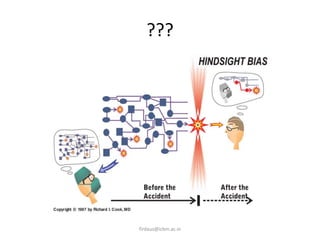
9. Hindsight Bias
• People overestimate their ability to have
predicted an outcome that actually could not
possibly have been predicted.
• After an event, people often believe that they
knew the outcome of the event before it
actually happened. The phenomenon has
been demonstrated in a number of different
situations, including politics, war and sporting
events
firdaus@icbm.ac.in
firdaus@icbm.ac.in
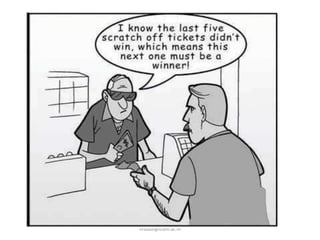
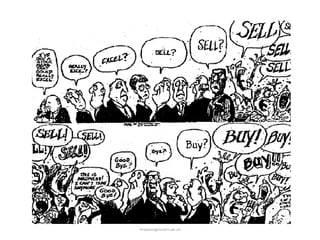
10. Gambler’s Fallacy
If something happens more frequently
than normal during a given period, it will
happen less frequently in the future (or
vice versa).
When an individual falsely believes that
the occurrence of a certain random event
is less likely to happen following a series
of occurrence of that event.
firdaus@icbm.ac.in
firdaus@icbm.ac.in
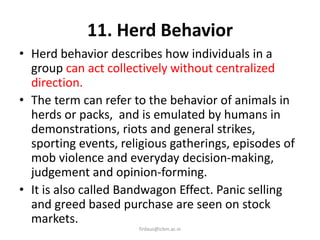
11. Herd Behavior
• Herd behavior describes how individuals in a
group can act collectively without centralized
direction.
• The term can refer to the behavior of animals in
herds or packs, and is emulated by humans in
demonstrations, riots and general strikes,
sporting events, religious gatherings, episodes of
mob violence and everyday decision-making,
judgement and opinion-forming.
• It is also called Bandwagon Effect. Panic selling
and greed based purchase are seen on stock
markets.
firdaus@icbm.ac.in
Think of your mind set in each
• Paying Rs. 200 for something you
thought was free.
firdaus@icbm.ac.in
• Paying Rs.1400 for something
that you thought would cost Rs.
1200
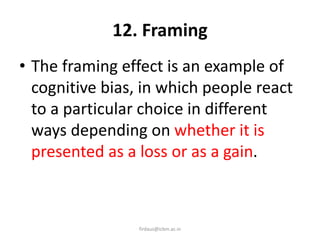
12. Framing
• The framing effect is an example of
cognitive bias, in which people react
to a particular choice in different
ways depending on whether it is
presented as a loss or as a gain.
firdaus@icbm.ac.in
firdaus@icbm.ac.in
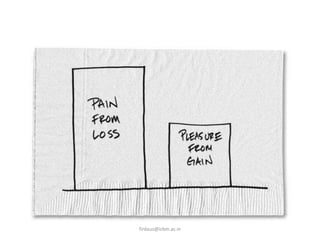
13. Loss Aversion
• People’s tendency to prefer
avoiding losses than to acquiring equivalent
gains: it is better to not lose Rs.500 than to
find Rs.500.
• Sometimes people have a stock (or more
than one stock) in their portfolio that is
down so much that they cannot accept the
thought of selling the stock/s. In reality, if
the stock is sold the money that is left could
be reinvested into a higher quality stock.
firdaus@icbm.ac.in
Thank you!
firdaus@icbm.ac.in

BEHAVIOURAL FINANCE

  • 1.
    BEHAVIOURAL FINANCE FIRDAUS KHAN AssociateProfessor, Dept. of Finance. ICBM-SBE, Hyd. India firdaus@icbm.ac.in
  • 2.
  • 3.
    What is BehavioralFinance? • The study of psychological factors on financial decision making. firdaus@icbm.ac.in
  • 4.
    Behavioral Finance It attemptsto answer the question: why stock market anomalies (abnormal trends) arise & persist for some period of time? It uses Psychology + Fin. theory to understand - how information structure and nature of market participants - can systematically influence - individuals' investment decisions as well as final market outcomes.firdaus@icbm.ac.in
  • 5.
    BEHAVIOURAL FINANCE Structure of Mkt.info Nature of mkt. participants INDIVIDUAL DECISIONS +MKT. OUTCOMES firdaus@icbm.ac.in
  • 6.
    DEFINITION • Behavioral Financeis a sub-field of behavioral economics that proposes psychology-based theories to explain stock market anomalies, such as severe rise or fall in stock prices. • The purpose is to identify and understand why people make certain financial choices. firdaus@icbm.ac.in
  • 7.
    W..H..A..T!! • EMOTIONS??? • MENTALERRORS??? • In financial decision making? firdaus@icbm.ac.in
  • 8.
    WHAT IS THIS? firdaus@icbm.ac.in Keepdistance of 10 feet between your car and the car in front of you
  • 9.
    WHAT ARE THESE? •Judge the distance of an object by its clarity • Judge the distance of a person by her size • Save 10% of your income for retirement • 100 – age = % to invest in shares (If 25 years old invest 75% in shares. If 70, invest 30%) • Never borrow on credit cards THESE ARE HEURISTICS firdaus@icbm.ac.in
  • 10.
  • 11.
    HEURISTICS • Heuristics arerules or strategies for information processing, which help to make a quick but not necessarily optimal decision. • When people are overwhelmed by information processing they use heuristics to control extreme complexity • Heuristics help to find a QUICK (but NOT NECESSARILY OPTIMAL) SOLUTION. firdaus@icbm.ac.in
  • 12.
    The problem withHeuristics • Sometimes heuristics are good for making decisions, while sometimes they are bad. • It is a mixed verdict… • …because heuristics act faster than rational deliberation, but precisely because of their speed, heuristics can mislead us into systematic errors in making decisions. firdaus@icbm.ac.in
  • 13.
    What Heuristics do…. • Speed up cognition • Give a quick, approximate solution • Occasionally give incorrect answers or errors • Systematic errors are called “biases”
  • 14.
    When does aBias occur? • When people’s actions are based on feelings or perceptions, not on facts. • Biases are of two types: 1. Cognitive – relating to perception, memory, judgment, and reasoning 2. Emotional – relating to sentiments firdaus@icbm.ac.in
  • 15.
    firdaus@icbm.ac.in Heuristics & Biasesin Investing decision making
  • 16.
  • 17.
    1. Representativeness Bias •A faulty heuristic based on the presumption that once people or events are categorized, they share all the features of others members in that category. • It is similar to stereo-typing. • small cap companies ill managed, fraudulent. Avoid!! Is this the correct decision? firdaus@icbm.ac.in
  • 18.
    Have you seenthis? • Father to son: “You only did something wrong, I am sure. Your coach will not remove you from team just like that.” • Participant in talent show: “I performed so well, but they didn’t choose me. They don’t know anything about singing. Who made them judges!!” firdaus@icbm.ac.in
  • 19.
    2. (Self) AttributionBias • When people evaluate or try to find reasons for their own behavior or other people’s behavior. • Attribution can be internal or external. • SELF – ENHANCING BIAS The good outcome occurred because of me! • SELF – PROTECTING BIAS The bad outcome occurred because of them! firdaus@icbm.ac.in
  • 20.
    Reflect… • Why parentsin India get uneasy when girls are travelling by Ola or Uber? • Why do people still feel uneasy to invest in stock markets? firdaus@icbm.ac.in
  • 21.
    3. Anchoring • Anchoringis a cognitive bias that describes the common human tendency to rely too heavily on the first piece of information offered (the "anchor") when making decisions. • During decision making, anchoring occurs when individuals use an initial piece of information to make subsequent judgments. firdaus@icbm.ac.in
  • 22.
    Reflect… • What wasthe response of Indians to ULIP? • Why FD is preferred? • Pension vs. Insurance vs. Provident fund firdaus@icbm.ac.in
  • 23.
    4. Aversion ToAmbiguity • People prefer known risks over unknown risks. • An ambiguity/uncertainty averse individual would rather choose an alternative where the probability distribution of the outcomes is known over one where the probabilities are unknown. firdaus@icbm.ac.in
  • 24.
    Virtually Impossible –is it? • In a lottery in which six numbers are selected out of fifty, what are the chances that the six numbers will be 1, 2, 3, 4, 5, and 6? • Equally probable to any other combination • 50C6 = 1 in 5,464, 817, 280 firdaus@icbm.ac.in
  • 25.
    5. Innumeracy Bias •Peoplehave difficulty in figuring out "true" probabilities. •Also, calculation of discounts and premiums are difficult for people. firdaus@icbm.ac.in
  • 26.
    Use of …. •Full time salary • Part time earning • Interest income • Gift money firdaus@icbm.ac.in
  • 27.
    6. Mental Accounting •Individuals divide their current and future assets into separate, non-transferable portions. • Individuals assign different levels of utility to each asset group, which affects their consumption decisions and other behaviors. firdaus@icbm.ac.in
  • 28.
    Discuss • Heat orcold waves • Tiger attack, train/plane crash • Rich, educated dalits firdaus@icbm.ac.in
  • 29.
    7. Availability Bias •Human tendency to judge an event by the ease with which examples of the event can be retrieved from memory, memorable = common • People misjudge the frequency and magnitude of recent events • Importance of event depends on how easily and clearly you can remember it… • Media can influence issues at societal level firdaus@icbm.ac.in
  • 30.
  • 31.
    8. Confirmation Bias •Have you noticed that you put more weight into the opinions of those who agree with you? • Confirmation bias occurs when people seek out information that confirms their existing opinions and overlook or ignore information that refutes or challenges their current beliefs. firdaus@icbm.ac.in
  • 32.
  • 33.
    9. Hindsight Bias •People overestimate their ability to have predicted an outcome that actually could not possibly have been predicted. • After an event, people often believe that they knew the outcome of the event before it actually happened. The phenomenon has been demonstrated in a number of different situations, including politics, war and sporting events firdaus@icbm.ac.in
  • 34.
  • 35.
    10. Gambler’s Fallacy Ifsomething happens more frequently than normal during a given period, it will happen less frequently in the future (or vice versa). When an individual falsely believes that the occurrence of a certain random event is less likely to happen following a series of occurrence of that event. firdaus@icbm.ac.in
  • 36.
  • 37.
    11. Herd Behavior •Herd behavior describes how individuals in a group can act collectively without centralized direction. • The term can refer to the behavior of animals in herds or packs, and is emulated by humans in demonstrations, riots and general strikes, sporting events, religious gatherings, episodes of mob violence and everyday decision-making, judgement and opinion-forming. • It is also called Bandwagon Effect. Panic selling and greed based purchase are seen on stock markets. firdaus@icbm.ac.in
  • 38.
    Think of yourmind set in each • Paying Rs. 200 for something you thought was free. firdaus@icbm.ac.in • Paying Rs.1400 for something that you thought would cost Rs. 1200
  • 39.
    12. Framing • Theframing effect is an example of cognitive bias, in which people react to a particular choice in different ways depending on whether it is presented as a loss or as a gain. firdaus@icbm.ac.in
  • 40.
  • 41.
    13. Loss Aversion •People’s tendency to prefer avoiding losses than to acquiring equivalent gains: it is better to not lose Rs.500 than to find Rs.500. • Sometimes people have a stock (or more than one stock) in their portfolio that is down so much that they cannot accept the thought of selling the stock/s. In reality, if the stock is sold the money that is left could be reinvested into a higher quality stock. firdaus@icbm.ac.in
  • 42.

Editor's Notes

  • #25 1 in 13,983,816.
  • #32 Seeking out people and publications with different opinions than our own can help us overcome confirmation bias and make better-informed decisions.
  • #40 People give twice weightage to looming loss when compared to similar sized gain coming in later.