Behavioural Finance
Overview of the syllabus and
Introduction to Behavioural Finance
Presented by
Mr. B S Surannavar
GFGC Paschapur
Unit-I: Introduction to Behavioural Finance
• Introduction, Meaning, Salient Features, Scope, Objectives and
Significance; Essential Concept of Behavioural Finance;
• Types of Investors in Stock Market; Is Behavioural Finance
Science or Art;
• Themes of Behavioural Finance; Difference between Standard
Finance and Behavioural Finance;
• Theoretical Pillars of Traditional Finance; Theoretical Pillars of
Behavioural Finance; Decision Making Biases and Errors;
• Investment Decision Cycle: Judgment under Uncertainty:
Cognitive Information Perception - Peculiarities(Biases) of
Quantitative and Numerical Information Perception -
Representativeness - Anchoring - Exponential Discounting -
Hyperbolic Discounting
Reference Books:
01. Behavioral Finance - Wiley Finance - Joachim Goldberg, Rüdiger Von Nitzsch
02. Handbook of Behavioral Finance – Brian R. Bruce
03. James Montier, Behavioural Finance: Insights into Irrational Minds and Markets,
John Wiley and Sons Ltd.
04. Julio Lobao, Behavioural Corporate Finance, Cambridge Scholars Publishing
05. Meir Statman, Behavioral Finance: Second Generation, CFA Institute of Research
Foundation
06. Michelle Baddeley, Behavioural Economics and Finance: Revision Edition, Taylor
and Francis
07. Montier, James (2002): Behavioural Finance, John Wiley & Sons, New York.
08. Plous, S. (1993). The Psychology of Judgment and Decision-Making NY:
McGrawHill.
09. Prasanna Chandra, Behavioural Finance: Revised Edition, McGraw Hill Education
Introduction
 Why are we inclined to sell the shares in our portfolio that
are performing well, and hold onto those that are
performing poorly?
 Why should you always buy auto insurance and never buy
electronics insurance?
 Why do we over-estimate the probability of plane crashes
and under-estimate the probability of car crashes?
 Why is it significant that the recent credit crisis, the worst
economic recession that the US has seen since the 1930’s,
took place 75 years after the Great Depression?
Introduction
Behavioral finance is a relatively new school of
thought that addresses and provides insight into
questions like these.
All of us have innate psychological biases that can
lead to predictable “errors” in how we make
important financial decisions.
Behavioral finance catalogues these errors and
helps us to anticipate, and hopefully avoid, these
decision-making “traps.”
Introduction
• We make thousands of decisions every day.
• Do I cross the road now, or wait for the oncoming truck to pass?
• Should I eat fries or a salad for lunch?
• How much should I tip the cab driver?
• We usually make these decisions with almost no thought, using
what psychologists call “heuristics” – rules of thumb that enable
us to navigate our lives. Without these mental shortcuts, we
would be paralyzed by the multitude of daily choices.
• But in certain circumstances, these shortcuts lead to predictable
errors – predictable, that is, if we know what to watch out for.
Introduction
• Did you know, for example, that we are naturally
biased towards selling investments that are doing well
for us, but holding on to those that are doing poorly?
• Or that we often select sub-optimal insurance
payment plans, and routinely purchase insurance that
we don’t even need?
• And why do so many of us fail to enroll in our
employer’s corporate retirement plans, even when
the employer offers to match our contributions?
Introduction
• Behavioral finance is the study of these and dozens of
other financial decision-making errors that can be
avoided, if we are familiar with the biases that cause
them.
• In this subject, we examine these predictable errors,
and discover where we are most susceptible to them.
• This subject is intended to guide participants towards
better financial choices.
• Learn how to improve your spending, saving, and
investing decisions for the future.
Meaning of BF
Behavioural finance, with its roots in the
psychological study of human decision-
making, is a relatively new and evolving
subject in the field of finance.
In brief, behavioural finance is the study of
investors’
Meaning of BF
However, some research studies have revealed
that psychological biases such as emotions,
fear, over- confidence, greed, and risk aversion
influence investors’ behaviour that, in turn,
influences stock markets.
As such, there is a need for studying and
understanding behavioural finance to exploit
investors’ psychology for profits.
Definitions of BF
 Behavioural finance is the study of investors’
psychology while making financial/investment
decisions.
 Sewell (2001) has defined behavioural finance as “the
study of the influence of psychology on the
behaviour of financial practitioners and the
subsequent effect on markets”.
 According to Shefrin (1999), “behavioural finance is the
application of psychology to financial behaviour – the
behaviour of investment practitioners.”
Definitions of BF
 Behavioral finance is the study of psychological
influences on investors and financial markets. At its
core, behavioral finance is about identifying and
explaining inefficiency and mispricing in financial
markets.
 It uses experiments and research to demonstrate that
humans and financial markets are not always rational,
and the decisions they make are often flawed.
 If you are wondering how emotions and biases drive
share prices, behavioral finance offers answers and
explanations.
Definitions of BF
1. Lintner G. (1998) has defined behavioural finance
as being study of human interprets and acts on
information to make informed investment
decisions.
2. Olsen R. (1998) asserts that behavioural finance
seeks to understand and predict systematic
financial market implications of psychological
decision process.
Definitions of BF
3. Shefrin (1999), “Behavioural finance is rapidly
growing area that deals with the influence of
psychology on the behaviour of financial
practitioner”.
4. Belsky and Gilovich (1999) have referred to
behavioural finance as behavioural economics and
further defined behavioural economics as combining
the twin discipline of psychology and economics to
explain why and how people make seemingly
irrational or illogical decisions when they save,
invest, spend and borrow money.
Definitions of BF
5. W. Forbes (2009) defined behavioural finance as a
science regarding how psychology influences
financial market. This view emphasizes that the
individuals are affected by psychological factors like
cognitive biases in their decision-making, rather than
being rational and wealth maximizing.
6. M. Sewell (2007) has stated that behavioural finance
challenges the theory of market efficiency by
providing insights into why and how market can be
inefficient due to irrationality in human behaviour.
Definitions of BF
7. M. Schindler (2007) has given certain examples while
defining behavioural finance:
(a) Investors’ biases when making decisions and thus
letting their choices to be influenced by optimism,
overconfidence, conservatism.
(b) Experience and heuristics help in making complex
decisions.
(c) The mind processes available information, matching it
with the decision’s maker own frame of reference, thus
letting the framing by the decision the maker impact
the decision.
Top 10 Biases in Behavioral Finance
• Behavioral finance seeks an understanding of the impact of personal
biases on investors. Here is a list of common financial biases.
• Common biases include:
• Overconfidence and illusion of control
• Self Attribution Bias
• Hindsight Bias
• Confirmation Bias
• The Narrative Fallacy
• Representative Bias
• Framing Bias
• Anchoring Bias
• Loss Aversion
• Herding Mentality
Overcoming Behavioral Finance Issues
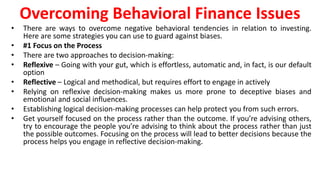
• There are ways to overcome negative behavioral tendencies in relation to investing.
Here are some strategies you can use to guard against biases.
• #1 Focus on the Process
• There are two approaches to decision-making:
• Reflexive – Going with your gut, which is effortless, automatic and, in fact, is our default
option
• Reflective – Logical and methodical, but requires effort to engage in actively
• Relying on reflexive decision-making makes us more prone to deceptive biases and
emotional and social influences.
• Establishing logical decision-making processes can help protect you from such errors.
• Get yourself focused on the process rather than the outcome. If you’re advising others,
try to encourage the people you’re advising to think about the process rather than just
the possible outcomes. Focusing on the process will lead to better decisions because the
process helps you engage in reflective decision-making.
Overcoming Behavioral Finance Issues
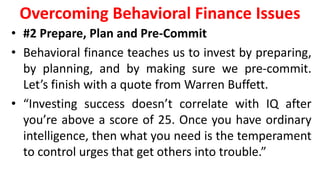
• #2 Prepare, Plan and Pre-Commit
• Behavioral finance teaches us to invest by preparing,
by planning, and by making sure we pre-commit.
Let’s finish with a quote from Warren Buffett.
• “Investing success doesn’t correlate with IQ after
you’re above a score of 25. Once you have ordinary
intelligence, then what you need is the temperament
to control urges that get others into trouble.”

BF Unit-1.1.pptx

  • 1.
    Behavioural Finance Overview ofthe syllabus and Introduction to Behavioural Finance Presented by Mr. B S Surannavar GFGC Paschapur
  • 2.
    Unit-I: Introduction toBehavioural Finance • Introduction, Meaning, Salient Features, Scope, Objectives and Significance; Essential Concept of Behavioural Finance; • Types of Investors in Stock Market; Is Behavioural Finance Science or Art; • Themes of Behavioural Finance; Difference between Standard Finance and Behavioural Finance; • Theoretical Pillars of Traditional Finance; Theoretical Pillars of Behavioural Finance; Decision Making Biases and Errors; • Investment Decision Cycle: Judgment under Uncertainty: Cognitive Information Perception - Peculiarities(Biases) of Quantitative and Numerical Information Perception - Representativeness - Anchoring - Exponential Discounting - Hyperbolic Discounting
  • 3.
    Reference Books: 01. BehavioralFinance - Wiley Finance - Joachim Goldberg, Rüdiger Von Nitzsch 02. Handbook of Behavioral Finance – Brian R. Bruce 03. James Montier, Behavioural Finance: Insights into Irrational Minds and Markets, John Wiley and Sons Ltd. 04. Julio Lobao, Behavioural Corporate Finance, Cambridge Scholars Publishing 05. Meir Statman, Behavioral Finance: Second Generation, CFA Institute of Research Foundation 06. Michelle Baddeley, Behavioural Economics and Finance: Revision Edition, Taylor and Francis 07. Montier, James (2002): Behavioural Finance, John Wiley & Sons, New York. 08. Plous, S. (1993). The Psychology of Judgment and Decision-Making NY: McGrawHill. 09. Prasanna Chandra, Behavioural Finance: Revised Edition, McGraw Hill Education
  • 4.
    Introduction  Why arewe inclined to sell the shares in our portfolio that are performing well, and hold onto those that are performing poorly?  Why should you always buy auto insurance and never buy electronics insurance?  Why do we over-estimate the probability of plane crashes and under-estimate the probability of car crashes?  Why is it significant that the recent credit crisis, the worst economic recession that the US has seen since the 1930’s, took place 75 years after the Great Depression?
  • 5.
    Introduction Behavioral finance isa relatively new school of thought that addresses and provides insight into questions like these. All of us have innate psychological biases that can lead to predictable “errors” in how we make important financial decisions. Behavioral finance catalogues these errors and helps us to anticipate, and hopefully avoid, these decision-making “traps.”
  • 6.
    Introduction • We makethousands of decisions every day. • Do I cross the road now, or wait for the oncoming truck to pass? • Should I eat fries or a salad for lunch? • How much should I tip the cab driver? • We usually make these decisions with almost no thought, using what psychologists call “heuristics” – rules of thumb that enable us to navigate our lives. Without these mental shortcuts, we would be paralyzed by the multitude of daily choices. • But in certain circumstances, these shortcuts lead to predictable errors – predictable, that is, if we know what to watch out for.
  • 7.
    Introduction • Did youknow, for example, that we are naturally biased towards selling investments that are doing well for us, but holding on to those that are doing poorly? • Or that we often select sub-optimal insurance payment plans, and routinely purchase insurance that we don’t even need? • And why do so many of us fail to enroll in our employer’s corporate retirement plans, even when the employer offers to match our contributions?
  • 8.
    Introduction • Behavioral financeis the study of these and dozens of other financial decision-making errors that can be avoided, if we are familiar with the biases that cause them. • In this subject, we examine these predictable errors, and discover where we are most susceptible to them. • This subject is intended to guide participants towards better financial choices. • Learn how to improve your spending, saving, and investing decisions for the future.
  • 9.
    Meaning of BF Behaviouralfinance, with its roots in the psychological study of human decision- making, is a relatively new and evolving subject in the field of finance. In brief, behavioural finance is the study of investors’
  • 10.
    Meaning of BF However,some research studies have revealed that psychological biases such as emotions, fear, over- confidence, greed, and risk aversion influence investors’ behaviour that, in turn, influences stock markets. As such, there is a need for studying and understanding behavioural finance to exploit investors’ psychology for profits.
  • 11.
    Definitions of BF Behavioural finance is the study of investors’ psychology while making financial/investment decisions.  Sewell (2001) has defined behavioural finance as “the study of the influence of psychology on the behaviour of financial practitioners and the subsequent effect on markets”.  According to Shefrin (1999), “behavioural finance is the application of psychology to financial behaviour – the behaviour of investment practitioners.”
  • 12.
    Definitions of BF Behavioral finance is the study of psychological influences on investors and financial markets. At its core, behavioral finance is about identifying and explaining inefficiency and mispricing in financial markets.  It uses experiments and research to demonstrate that humans and financial markets are not always rational, and the decisions they make are often flawed.  If you are wondering how emotions and biases drive share prices, behavioral finance offers answers and explanations.
  • 13.
    Definitions of BF 1.Lintner G. (1998) has defined behavioural finance as being study of human interprets and acts on information to make informed investment decisions. 2. Olsen R. (1998) asserts that behavioural finance seeks to understand and predict systematic financial market implications of psychological decision process.
  • 14.
    Definitions of BF 3.Shefrin (1999), “Behavioural finance is rapidly growing area that deals with the influence of psychology on the behaviour of financial practitioner”. 4. Belsky and Gilovich (1999) have referred to behavioural finance as behavioural economics and further defined behavioural economics as combining the twin discipline of psychology and economics to explain why and how people make seemingly irrational or illogical decisions when they save, invest, spend and borrow money.
  • 15.
    Definitions of BF 5.W. Forbes (2009) defined behavioural finance as a science regarding how psychology influences financial market. This view emphasizes that the individuals are affected by psychological factors like cognitive biases in their decision-making, rather than being rational and wealth maximizing. 6. M. Sewell (2007) has stated that behavioural finance challenges the theory of market efficiency by providing insights into why and how market can be inefficient due to irrationality in human behaviour.
  • 16.
    Definitions of BF 7.M. Schindler (2007) has given certain examples while defining behavioural finance: (a) Investors’ biases when making decisions and thus letting their choices to be influenced by optimism, overconfidence, conservatism. (b) Experience and heuristics help in making complex decisions. (c) The mind processes available information, matching it with the decision’s maker own frame of reference, thus letting the framing by the decision the maker impact the decision.
  • 18.
    Top 10 Biasesin Behavioral Finance • Behavioral finance seeks an understanding of the impact of personal biases on investors. Here is a list of common financial biases. • Common biases include: • Overconfidence and illusion of control • Self Attribution Bias • Hindsight Bias • Confirmation Bias • The Narrative Fallacy • Representative Bias • Framing Bias • Anchoring Bias • Loss Aversion • Herding Mentality
  • 19.
    Overcoming Behavioral FinanceIssues • There are ways to overcome negative behavioral tendencies in relation to investing. Here are some strategies you can use to guard against biases. • #1 Focus on the Process • There are two approaches to decision-making: • Reflexive – Going with your gut, which is effortless, automatic and, in fact, is our default option • Reflective – Logical and methodical, but requires effort to engage in actively • Relying on reflexive decision-making makes us more prone to deceptive biases and emotional and social influences. • Establishing logical decision-making processes can help protect you from such errors. • Get yourself focused on the process rather than the outcome. If you’re advising others, try to encourage the people you’re advising to think about the process rather than just the possible outcomes. Focusing on the process will lead to better decisions because the process helps you engage in reflective decision-making.
  • 20.
    Overcoming Behavioral FinanceIssues • #2 Prepare, Plan and Pre-Commit • Behavioral finance teaches us to invest by preparing, by planning, and by making sure we pre-commit. Let’s finish with a quote from Warren Buffett. • “Investing success doesn’t correlate with IQ after you’re above a score of 25. Once you have ordinary intelligence, then what you need is the temperament to control urges that get others into trouble.”