Questionnaire
Design
Importance of Questionnaires
Questionnaires & interviews are most
popularly used in research.
Whether the results of the research are valid
depends on the quality of these instruments.
•Good questionnaires are difficult to ____
•Bad questionnaires are difficult to _____
construct analyze
firdaus@icbm.ac.in
Quality aims in Survey Research
The goal is to collect information that is:
Valid: measures the concept that is being
surveyed.
Reliable: measures the concept in a
consistent or reproducible manner
Unbiased: measures the concept in a way
that does not systematically underestimate or
overestimate the true value
firdaus@icbm.ac.in
Principles for Composing a Draft
Questionnaire
firdaus@icbm.ac.in
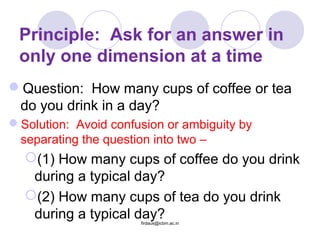
Principle: Ask for an answer in
only one dimension at a time
Question: How many cups of coffee or tea
do you drink in a day?
Solution: Avoid confusion or ambiguity by
separating the question into two –
(1) How many cups of coffee do you drink
during a typical day?
(2) How many cups of tea do you drink
during a typical day?firdaus@icbm.ac.in
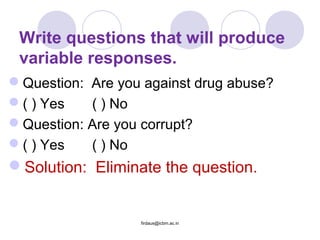
Write questions that will produce
variable responses.
Question: Are you against drug abuse?
( ) Yes ( ) No
Question: Are you corrupt?
( ) Yes ( ) No
Solution: Eliminate the question.
firdaus@icbm.ac.in
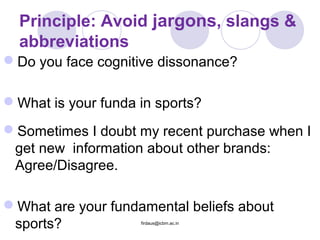
Principle: Avoid jargons, slangs &
abbreviations
Do you face cognitive dissonance?
What is your funda in sports?
Sometimes I doubt my recent purchase when I
get new information about other brands:
Agree/Disagree.
What are your fundamental beliefs about
sports? firdaus@icbm.ac.in
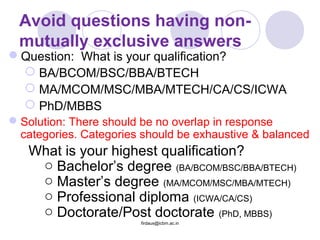
Avoid questions having non-
mutually exclusive answers
Question: What is your qualification?
 BA/BCOM/BSC/BBA/BTECH
 MA/MCOM/MSC/MBA/MTECH/CA/CS/ICWA
 PhD/MBBS
Solution: There should be no overlap in response
categories. Categories should be exhaustive & balanced
What is your highest qualification?
o Bachelor’s degree (BA/BCOM/BSC/BBA/BTECH)
o Master’s degree (MA/MCOM/MSC/MBA/MTECH)
o Professional diploma (ICWA/CA/CS)
o Doctorate/Post doctorate (PhD, MBBS)
firdaus@icbm.ac.in
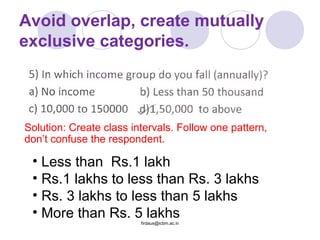
Avoid overlap, create mutually
exclusive categories.
• Less than Rs.1 lakh
• Rs.1 lakhs to less than Rs. 3 lakhs
• Rs. 3 lakhs to less than 5 lakhs
• More than Rs. 5 lakhs
Solution: Create class intervals. Follow one pattern,
don’t confuse the respondent.
firdaus@icbm.ac.in
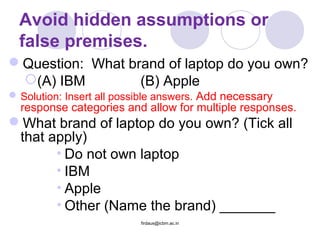
Avoid hidden assumptions or
false premises.
Question: What brand of laptop do you own?
(A) IBM (B) Apple
Solution: Insert all possible answers. Add necessary
response categories and allow for multiple responses.
What brand of laptop do you own? (Tick all
that apply)
• Do not own laptop
• IBM
• Apple
• Other (Name the brand) _______
firdaus@icbm.ac.in
Make sure question and answer
options match
Question: Have you had pain in the last
week?
[ ]Never [ ]Sometimes [ ]Often [ ]Very often
Solution: Reword either question or answer to
match.
How often did you have pain in the last
week?
[ ]Never [ ]Sometimes [ ]Often [ ]Very Often
firdaus@icbm.ac.in
Be clear in your questions. Double
check the meaning of words used
Question: Where are you from?
Rural
Urban
Solution: Rephrase using the right word
Where do you live? or
Where were you born? or
Where did you live in your childhood?
firdaus@icbm.ac.in
For awareness question,
encourage reflection
Question: Which one of the following
increases the chance of having a heart
attack? (Check one.)
[ ]Smoking [ ]Being overweight [ ]Stress
Solution: Make the respondent engage with the qt.
Which of the following increases the chance
of having a heart attack?
1.Smoking: [ ]Yes [ ]No [ ]Don’t know
2.Being overweight: [ ]Yes [ ]No [ ]Don’t know
3.Stress: [ ]Yes [ ]No [ ]Don’t know
firdaus@icbm.ac.in
Avoid branching, avoid confusion
(1) Do you currently have a life insurance policy?
(Circle: Yes or No)
If no, go to qt. 3, if yes go to qt. 2
(2) How much is your annual life insurance
premium?
(3) Why do you not have life insurance policy?
Solution: Avoid linking qts. if possible and write as one
question. Avoid testing respondent’s memory.
How much did you spend last year for life
insurance? (Write 0 if none).firdaus@icbm.ac.in
Phrase questions in the terms in
which respondents think
How many litres of petrol did you buy last
year for your car?
How many movies do you see in a year?
Solution: Break into weekly or monthly numbers &
calculate yearly number for your report.
How many litres of petrol do you buy in a
typical week for your car?
How many movies do you usually see in a
month?
firdaus@icbm.ac.in
Avoid leading / loaded qts.
Did you do your patriotic duty and vote
in the last assembly election? Yes/No
You do not really want SC/ST to take
over the education system, do you?
Yes/No
According to experts, noodles with
monosodiumglutamate are bad for
health. Do you agree? Yes/No
firdaus@icbm.ac.in
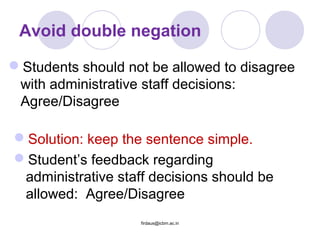
Avoid double negation
Students should not be allowed to disagree
with administrative staff decisions:
Agree/Disagree
Solution: keep the sentence simple.
Student’s feedback regarding
administrative staff decisions should be
allowed: Agree/Disagree
firdaus@icbm.ac.in
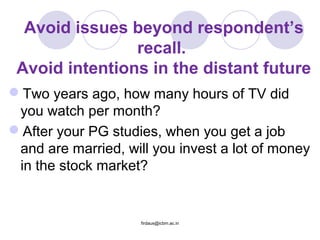
Avoid issues beyond respondent’s
recall.
Avoid intentions in the distant future
Two years ago, how many hours of TV did
you watch per month?
After your PG studies, when you get a job
and are married, will you invest a lot of money
in the stock market?
firdaus@icbm.ac.in
firdaus@icbm.ac.in
KEY ISSUES WHILE DESIGNING A
QUESTIONNAIRE
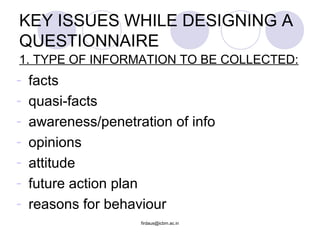
KEY ISSUES WHILE DESIGNING A
QUESTIONNAIRE
- facts
- quasi-facts
- awareness/penetration of info
- opinions
- attitude
- future action plan
- reasons for behaviour
firdaus@icbm.ac.in
1. TYPE OF INFORMATION TO BE COLLECTED:
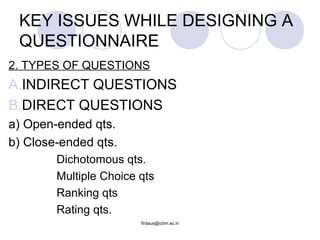
2. TYPES OF QUESTIONS
A.INDIRECT QUESTIONS
B.DIRECT QUESTIONS
a) Open-ended qts.
b) Close-ended qts.
Dichotomous qts.
Multiple Choice qts
Ranking qts
Rating qts.
KEY ISSUES WHILE DESIGNING A
QUESTIONNAIRE
firdaus@icbm.ac.in
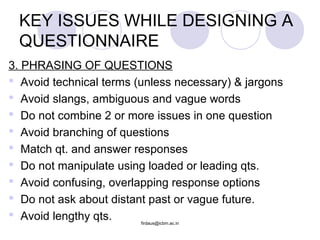
3. PHRASING OF QUESTIONS
 Avoid technical terms (unless necessary) & jargons
 Avoid slangs, ambiguous and vague words
 Do not combine 2 or more issues in one question
 Avoid branching of questions
 Match qt. and answer responses
 Do not manipulate using loaded or leading qts.
 Avoid confusing, overlapping response options
 Do not ask about distant past or vague future.
 Avoid lengthy qts.
KEY ISSUES WHILE DESIGNING A
QUESTIONNAIRE
firdaus@icbm.ac.in
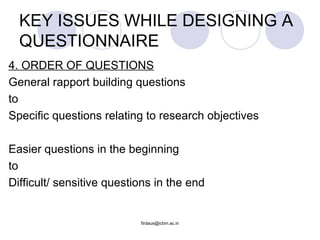
4. ORDER OF QUESTIONS
General rapport building questions
to
Specific questions relating to research objectives
Easier questions in the beginning
to
Difficult/ sensitive questions in the end
KEY ISSUES WHILE DESIGNING A
QUESTIONNAIRE
firdaus@icbm.ac.in
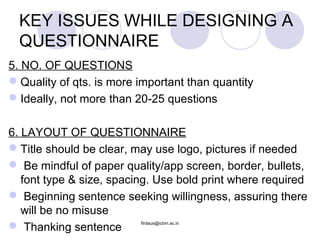
5. NO. OF QUESTIONS
Quality of qts. is more important than quantity
Ideally, not more than 20-25 questions
6. LAYOUT OF QUESTIONNAIRE
Title should be clear, may use logo, pictures if needed
 Be mindful of paper quality/app screen, border, bullets,
font type & size, spacing. Use bold print where required
 Beginning sentence seeking willingness, assuring there
will be no misuse
 Thanking sentence
KEY ISSUES WHILE DESIGNING A
QUESTIONNAIRE
firdaus@icbm.ac.in
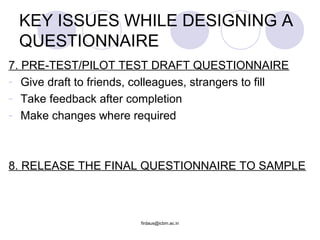
7. PRE-TEST/PILOT TEST DRAFT QUESTIONNAIRE
- Give draft to friends, colleagues, strangers to fill
- Take feedback after completion
- Make changes where required
8. RELEASE THE FINAL QUESTIONNAIRE TO SAMPLE
KEY ISSUES WHILE DESIGNING A
QUESTIONNAIRE
firdaus@icbm.ac.in
Steps in Survey method using
Questionnaire
firdaus@icbm.ac.in
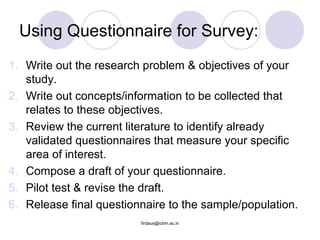
Using Questionnaire for Survey:
1. Write out the research problem & objectives of your
study.
2. Write out concepts/information to be collected that
relates to these objectives.
3. Review the current literature to identify already
validated questionnaires that measure your specific
area of interest.
4. Compose a draft of your questionnaire.
5. Pilot test & revise the draft.
6. Release final questionnaire to the sample/population.
firdaus@icbm.ac.in
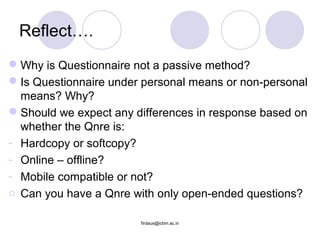
Reflect….
Why is Questionnaire not a passive method?
Is Questionnaire under personal means or non-personal
means? Why?
Should we expect any differences in response based on
whether the Qnre is:
- Hardcopy or softcopy?
- Online – offline?
- Mobile compatible or not?
o Can you have a Qnre with only open-ended questions?
firdaus@icbm.ac.in
THANK YOU!
firdaus@icbm.ac.in

Questionnaire Design

  • 1.
  • 2.
    Importance of Questionnaires Questionnaires& interviews are most popularly used in research. Whether the results of the research are valid depends on the quality of these instruments. •Good questionnaires are difficult to ____ •Bad questionnaires are difficult to _____ construct analyze firdaus@icbm.ac.in
  • 3.
    Quality aims inSurvey Research The goal is to collect information that is: Valid: measures the concept that is being surveyed. Reliable: measures the concept in a consistent or reproducible manner Unbiased: measures the concept in a way that does not systematically underestimate or overestimate the true value firdaus@icbm.ac.in
  • 4.
    Principles for Composinga Draft Questionnaire firdaus@icbm.ac.in
  • 5.
    Principle: Ask foran answer in only one dimension at a time Question: How many cups of coffee or tea do you drink in a day? Solution: Avoid confusion or ambiguity by separating the question into two – (1) How many cups of coffee do you drink during a typical day? (2) How many cups of tea do you drink during a typical day?firdaus@icbm.ac.in
  • 6.
    Write questions thatwill produce variable responses. Question: Are you against drug abuse? ( ) Yes ( ) No Question: Are you corrupt? ( ) Yes ( ) No Solution: Eliminate the question. firdaus@icbm.ac.in
  • 7.
    Principle: Avoid jargons,slangs & abbreviations Do you face cognitive dissonance? What is your funda in sports? Sometimes I doubt my recent purchase when I get new information about other brands: Agree/Disagree. What are your fundamental beliefs about sports? firdaus@icbm.ac.in
  • 8.
    Avoid questions havingnon- mutually exclusive answers Question: What is your qualification?  BA/BCOM/BSC/BBA/BTECH  MA/MCOM/MSC/MBA/MTECH/CA/CS/ICWA  PhD/MBBS Solution: There should be no overlap in response categories. Categories should be exhaustive & balanced What is your highest qualification? o Bachelor’s degree (BA/BCOM/BSC/BBA/BTECH) o Master’s degree (MA/MCOM/MSC/MBA/MTECH) o Professional diploma (ICWA/CA/CS) o Doctorate/Post doctorate (PhD, MBBS) firdaus@icbm.ac.in
  • 9.
    Avoid overlap, createmutually exclusive categories. • Less than Rs.1 lakh • Rs.1 lakhs to less than Rs. 3 lakhs • Rs. 3 lakhs to less than 5 lakhs • More than Rs. 5 lakhs Solution: Create class intervals. Follow one pattern, don’t confuse the respondent. firdaus@icbm.ac.in
  • 10.
    Avoid hidden assumptionsor false premises. Question: What brand of laptop do you own? (A) IBM (B) Apple Solution: Insert all possible answers. Add necessary response categories and allow for multiple responses. What brand of laptop do you own? (Tick all that apply) • Do not own laptop • IBM • Apple • Other (Name the brand) _______ firdaus@icbm.ac.in
  • 11.
    Make sure questionand answer options match Question: Have you had pain in the last week? [ ]Never [ ]Sometimes [ ]Often [ ]Very often Solution: Reword either question or answer to match. How often did you have pain in the last week? [ ]Never [ ]Sometimes [ ]Often [ ]Very Often firdaus@icbm.ac.in
  • 12.
    Be clear inyour questions. Double check the meaning of words used Question: Where are you from? Rural Urban Solution: Rephrase using the right word Where do you live? or Where were you born? or Where did you live in your childhood? firdaus@icbm.ac.in
  • 13.
    For awareness question, encouragereflection Question: Which one of the following increases the chance of having a heart attack? (Check one.) [ ]Smoking [ ]Being overweight [ ]Stress Solution: Make the respondent engage with the qt. Which of the following increases the chance of having a heart attack? 1.Smoking: [ ]Yes [ ]No [ ]Don’t know 2.Being overweight: [ ]Yes [ ]No [ ]Don’t know 3.Stress: [ ]Yes [ ]No [ ]Don’t know firdaus@icbm.ac.in
  • 14.
    Avoid branching, avoidconfusion (1) Do you currently have a life insurance policy? (Circle: Yes or No) If no, go to qt. 3, if yes go to qt. 2 (2) How much is your annual life insurance premium? (3) Why do you not have life insurance policy? Solution: Avoid linking qts. if possible and write as one question. Avoid testing respondent’s memory. How much did you spend last year for life insurance? (Write 0 if none).firdaus@icbm.ac.in
  • 15.
    Phrase questions inthe terms in which respondents think How many litres of petrol did you buy last year for your car? How many movies do you see in a year? Solution: Break into weekly or monthly numbers & calculate yearly number for your report. How many litres of petrol do you buy in a typical week for your car? How many movies do you usually see in a month? firdaus@icbm.ac.in
  • 16.
    Avoid leading /loaded qts. Did you do your patriotic duty and vote in the last assembly election? Yes/No You do not really want SC/ST to take over the education system, do you? Yes/No According to experts, noodles with monosodiumglutamate are bad for health. Do you agree? Yes/No firdaus@icbm.ac.in
  • 17.
    Avoid double negation Studentsshould not be allowed to disagree with administrative staff decisions: Agree/Disagree Solution: keep the sentence simple. Student’s feedback regarding administrative staff decisions should be allowed: Agree/Disagree firdaus@icbm.ac.in
  • 18.
    Avoid issues beyondrespondent’s recall. Avoid intentions in the distant future Two years ago, how many hours of TV did you watch per month? After your PG studies, when you get a job and are married, will you invest a lot of money in the stock market? firdaus@icbm.ac.in
  • 19.
    firdaus@icbm.ac.in KEY ISSUES WHILEDESIGNING A QUESTIONNAIRE
  • 20.
    KEY ISSUES WHILEDESIGNING A QUESTIONNAIRE - facts - quasi-facts - awareness/penetration of info - opinions - attitude - future action plan - reasons for behaviour firdaus@icbm.ac.in 1. TYPE OF INFORMATION TO BE COLLECTED:
  • 21.
    2. TYPES OFQUESTIONS A.INDIRECT QUESTIONS B.DIRECT QUESTIONS a) Open-ended qts. b) Close-ended qts. Dichotomous qts. Multiple Choice qts Ranking qts Rating qts. KEY ISSUES WHILE DESIGNING A QUESTIONNAIRE firdaus@icbm.ac.in
  • 22.
    3. PHRASING OFQUESTIONS  Avoid technical terms (unless necessary) & jargons  Avoid slangs, ambiguous and vague words  Do not combine 2 or more issues in one question  Avoid branching of questions  Match qt. and answer responses  Do not manipulate using loaded or leading qts.  Avoid confusing, overlapping response options  Do not ask about distant past or vague future.  Avoid lengthy qts. KEY ISSUES WHILE DESIGNING A QUESTIONNAIRE firdaus@icbm.ac.in
  • 23.
    4. ORDER OFQUESTIONS General rapport building questions to Specific questions relating to research objectives Easier questions in the beginning to Difficult/ sensitive questions in the end KEY ISSUES WHILE DESIGNING A QUESTIONNAIRE firdaus@icbm.ac.in
  • 24.
    5. NO. OFQUESTIONS Quality of qts. is more important than quantity Ideally, not more than 20-25 questions 6. LAYOUT OF QUESTIONNAIRE Title should be clear, may use logo, pictures if needed  Be mindful of paper quality/app screen, border, bullets, font type & size, spacing. Use bold print where required  Beginning sentence seeking willingness, assuring there will be no misuse  Thanking sentence KEY ISSUES WHILE DESIGNING A QUESTIONNAIRE firdaus@icbm.ac.in
  • 25.
    7. PRE-TEST/PILOT TESTDRAFT QUESTIONNAIRE - Give draft to friends, colleagues, strangers to fill - Take feedback after completion - Make changes where required 8. RELEASE THE FINAL QUESTIONNAIRE TO SAMPLE KEY ISSUES WHILE DESIGNING A QUESTIONNAIRE firdaus@icbm.ac.in
  • 26.
    Steps in Surveymethod using Questionnaire firdaus@icbm.ac.in
  • 27.
    Using Questionnaire forSurvey: 1. Write out the research problem & objectives of your study. 2. Write out concepts/information to be collected that relates to these objectives. 3. Review the current literature to identify already validated questionnaires that measure your specific area of interest. 4. Compose a draft of your questionnaire. 5. Pilot test & revise the draft. 6. Release final questionnaire to the sample/population. firdaus@icbm.ac.in
  • 28.
    Reflect…. Why is Questionnairenot a passive method? Is Questionnaire under personal means or non-personal means? Why? Should we expect any differences in response based on whether the Qnre is: - Hardcopy or softcopy? - Online – offline? - Mobile compatible or not? o Can you have a Qnre with only open-ended questions? firdaus@icbm.ac.in
  • 29.

Editor's Notes

  • #11 How many children do you have?