






Behavioral Finance
Presented By: Nawar Abdelrahman
Table of Content
• What is Behavioral Finance
• Pillars of Behavioral Finance
• Classical Finance vs Behavioral Finance
• Why is Behavioral Finance Important?
• Why Understanding How Investors Make
Investment Decisions Is Important
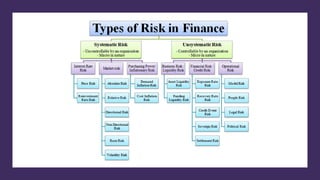
• Types of Risks
• Types of Investors
• Types of Behavioral Finance Biases
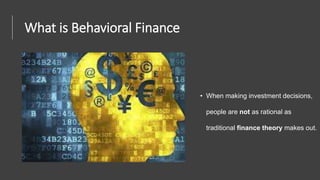
What is Behavioral Finance
• When making investment decisions,
people are not as rational as
traditional finance theory makes out.
Two Pillars of
Behavioral Finance
1) Cognitive psychology (how people think),
2) The limits to arbitrage (when markets will be inefficient).
Classical
Finance vs
Behavioral
Finance
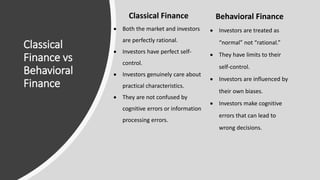
Classical Finance
 Both the market and investors
are perfectly rational.
 Investors have perfect self-
control.
 Investors genuinely care about
practical characteristics.
 They are not confused by
cognitive errors or information
processing errors.
Behavioral Finance
 Investors are treated as
“normal” not “rational.”
 They have limits to their
self-control.
 Investors are influenced by
their own biases.
 Investors make cognitive
errors that can lead to
wrong decisions.
Why is
Behavioral
Finance
Important?
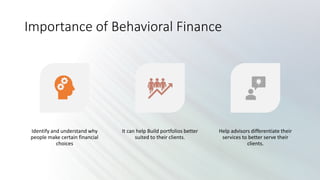
Importance of Behavioral Finance
Identify and understand why
people make certain financial
choices
It can help Build portfolios better
suited to their clients.
Help advisors differentiate their
services to better serve their
clients.
BEHAVIORAL FINANCE
ATTEMPTS TO UNDERSTAND
AND EXPLAIN ACTUAL
INVESTOR BEHAVIOR, IN
CONTRAST TO THEORIZING
ABOUT INVESTOR BEHAVIOR.
IT DIFFERS FROM
TRADITIONAL (OR STANDARD)
FINANCE, WHICH IS BASED ON
ASSUMPTIONS OF HOW
INVESTORS AND MARKETS
SHOULD BEHAVE.
IN OTHER WORDS, THE WAY
INVESTORS THINK AND FEEL
AFFECTS THE WAY THEY
BEHAVE WHEN MAKING
INVESTMENT DECISIONS.
Why Understanding How
Investors Make Investment
Decisions Is Important
• A “nice-to-have” skill. In this new
era of volatile markets,
• Financial advisers must be able to
diagnose irrational behaviors and
advise their clients accordingly.
Types of
Risks
• Known Risk
• when clients can at least
understand and measure
risks they are taking (i.e.,
known risks), they can
accept the results.
• Unknown Risk
• When the risks they
believe they accepted
include outcomes that are
outside the bounds of
what they expect or can
reasonably understand
(i.e., unknown risks),
behavioral problems often
begin.
Types of
Risks
• Risk Capacity
• The ability to absorb losses
without having one’s
financial goals jeopardized
• Risk Appetite
• Is the amount of risk that
one is willing to take in
pursuit of reward.
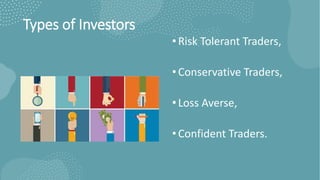
Types of Investors
• Risk Tolerant Traders,
• Conservative Traders,
• Loss Averse,
• Confident Traders.
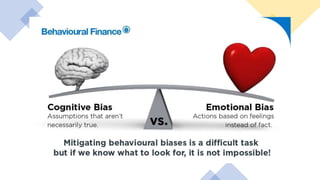
Types of Biases
Decision Making
Biases
 Cognitive biases
 Emotional biases
Behavioral
Finance Biases
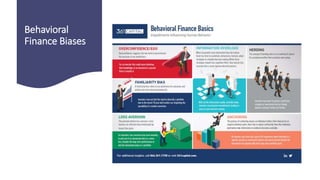
Behavioral Finance Biases
• Heuristics
• Overconfidence
• Loss Aversion
• Representativeness
• Framing
• Anchoring
• Familiarity Bias
• The Issue of Perceived Control
• The Significance of Expert Knowledge
• The Role of Affect (Feelings)
• The Influence of Worry
Behavioral
Biases
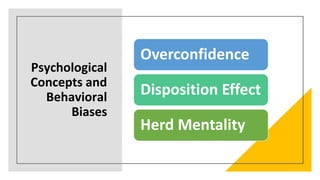
Psychological
Concepts and
Behavioral
Biases
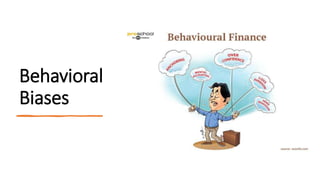
Overconfidence
Disposition Effect
Herd Mentality
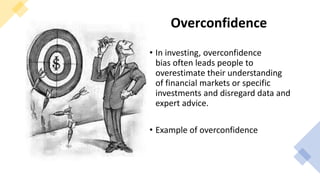
Overconfidence
• In investing, overconfidence
bias often leads people to
overestimate their understanding
of financial markets or specific
investments and disregard data and
expert advice.
• Example of overconfidence
Two Components of
Overconfidence
1. In the quality of your information,
2. In your ability to act on said information at the
right time for maximum gain
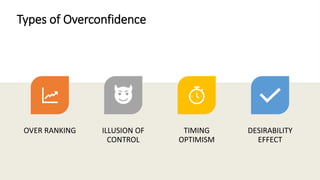
Types of Overconfidence
OVER RANKING ILLUSION OF
CONTROL
TIMING
OPTIMISM
DESIRABILITY
EFFECT
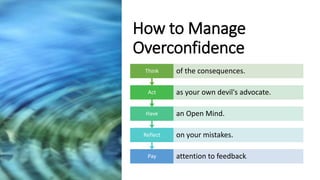
How to Manage
Overconfidence
Pay attention to feedback.
Reflect on your mistakes.
Have an Open Mind.
Act as your own devil's advocate.
Think of the consequences.
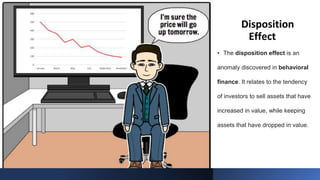
Disposition
Effect
• The disposition effect is an
anomaly discovered in behavioral
finance. It relates to the tendency
of investors to sell assets that have
increased in value, while keeping
assets that have dropped in value.
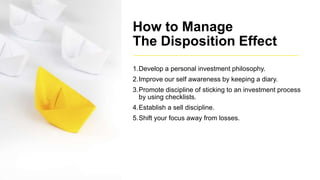
How to Manage
The Disposition Effect
1.Develop a personal investment philosophy.
2.Improve our self awareness by keeping a diary.
3.Promote discipline of sticking to an investment process
by using checklists.
4.Establish a sell discipline.
5.Shift your focus away from losses.
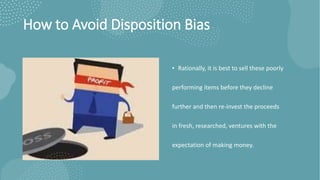
How to Avoid Disposition Bias
• Rationally, it is best to sell these poorly
performing items before they decline
further and then re-invest the proceeds
in fresh, researched, ventures with the
expectation of making money.
Herd
Mentality
Herd Mentality is
• The tendency to follow what other investors
are doing, rather than following the path that
makes sense for your goals. This behavior has
served humans well as a survival technique,
but investors need to stay on their own course.
How to Avoid The Herd
Mentality Bias
1.Think properly before you follow. Humans have a
natural tendency to follow by default.
2.Take more time before you make decisions.
Do not rush into any decisions.
3.Beware of the effects of making decisions under any
stressful situation.
How to Deal With Emotional
and Cognitive Clients
With Emotional Clients Focus on
• How an investment program can affect
important emotional issues like;
• Financial security,
• Retirement.
• The impact on future generations rather
than focusing on sharp facts.
With Cognitive Clients Focus on
• Affect on family members,
• Their legacy,
• Their standard of living,
• Focus on portfolio details like standard
deviations and Sharpe ratios.
Behavioral Finance

Behavioral Finance

  • 1.
  • 2.
    Table of Content •What is Behavioral Finance • Pillars of Behavioral Finance • Classical Finance vs Behavioral Finance • Why is Behavioral Finance Important? • Why Understanding How Investors Make Investment Decisions Is Important • Types of Risks • Types of Investors • Types of Behavioral Finance Biases
  • 3.
    What is BehavioralFinance • When making investment decisions, people are not as rational as traditional finance theory makes out.
  • 4.
    Two Pillars of BehavioralFinance 1) Cognitive psychology (how people think), 2) The limits to arbitrage (when markets will be inefficient).
  • 5.
    Classical Finance vs Behavioral Finance Classical Finance Both the market and investors are perfectly rational.  Investors have perfect self- control.  Investors genuinely care about practical characteristics.  They are not confused by cognitive errors or information processing errors. Behavioral Finance  Investors are treated as “normal” not “rational.”  They have limits to their self-control.  Investors are influenced by their own biases.  Investors make cognitive errors that can lead to wrong decisions.
  • 6.
  • 7.
    Importance of BehavioralFinance Identify and understand why people make certain financial choices It can help Build portfolios better suited to their clients. Help advisors differentiate their services to better serve their clients.
  • 8.
    BEHAVIORAL FINANCE ATTEMPTS TOUNDERSTAND AND EXPLAIN ACTUAL INVESTOR BEHAVIOR, IN CONTRAST TO THEORIZING ABOUT INVESTOR BEHAVIOR. IT DIFFERS FROM TRADITIONAL (OR STANDARD) FINANCE, WHICH IS BASED ON ASSUMPTIONS OF HOW INVESTORS AND MARKETS SHOULD BEHAVE. IN OTHER WORDS, THE WAY INVESTORS THINK AND FEEL AFFECTS THE WAY THEY BEHAVE WHEN MAKING INVESTMENT DECISIONS.
  • 9.
    Why Understanding How InvestorsMake Investment Decisions Is Important • A “nice-to-have” skill. In this new era of volatile markets, • Financial advisers must be able to diagnose irrational behaviors and advise their clients accordingly.
  • 10.
    Types of Risks • KnownRisk • when clients can at least understand and measure risks they are taking (i.e., known risks), they can accept the results. • Unknown Risk • When the risks they believe they accepted include outcomes that are outside the bounds of what they expect or can reasonably understand (i.e., unknown risks), behavioral problems often begin.
  • 11.
    Types of Risks • RiskCapacity • The ability to absorb losses without having one’s financial goals jeopardized • Risk Appetite • Is the amount of risk that one is willing to take in pursuit of reward.
  • 13.
    Types of Investors •Risk Tolerant Traders, • Conservative Traders, • Loss Averse, • Confident Traders.
  • 14.
  • 15.
    Decision Making Biases  Cognitivebiases  Emotional biases
  • 16.
  • 17.
    Behavioral Finance Biases •Heuristics • Overconfidence • Loss Aversion • Representativeness • Framing • Anchoring • Familiarity Bias • The Issue of Perceived Control • The Significance of Expert Knowledge • The Role of Affect (Feelings) • The Influence of Worry
  • 18.
  • 19.
  • 20.
    Overconfidence • In investing,overconfidence bias often leads people to overestimate their understanding of financial markets or specific investments and disregard data and expert advice. • Example of overconfidence
  • 21.
    Two Components of Overconfidence 1.In the quality of your information, 2. In your ability to act on said information at the right time for maximum gain
  • 22.
    Types of Overconfidence OVERRANKING ILLUSION OF CONTROL TIMING OPTIMISM DESIRABILITY EFFECT
  • 23.
    How to Manage Overconfidence Payattention to feedback. Reflect on your mistakes. Have an Open Mind. Act as your own devil's advocate. Think of the consequences.
  • 24.
    Disposition Effect • The dispositioneffect is an anomaly discovered in behavioral finance. It relates to the tendency of investors to sell assets that have increased in value, while keeping assets that have dropped in value.
  • 25.
    How to Manage TheDisposition Effect 1.Develop a personal investment philosophy. 2.Improve our self awareness by keeping a diary. 3.Promote discipline of sticking to an investment process by using checklists. 4.Establish a sell discipline. 5.Shift your focus away from losses.
  • 26.
    How to AvoidDisposition Bias • Rationally, it is best to sell these poorly performing items before they decline further and then re-invest the proceeds in fresh, researched, ventures with the expectation of making money.
  • 27.
  • 28.
    Herd Mentality is •The tendency to follow what other investors are doing, rather than following the path that makes sense for your goals. This behavior has served humans well as a survival technique, but investors need to stay on their own course.
  • 29.
    How to AvoidThe Herd Mentality Bias 1.Think properly before you follow. Humans have a natural tendency to follow by default. 2.Take more time before you make decisions. Do not rush into any decisions. 3.Beware of the effects of making decisions under any stressful situation.
  • 31.
    How to DealWith Emotional and Cognitive Clients With Emotional Clients Focus on • How an investment program can affect important emotional issues like; • Financial security, • Retirement. • The impact on future generations rather than focusing on sharp facts. With Cognitive Clients Focus on • Affect on family members, • Their legacy, • Their standard of living, • Focus on portfolio details like standard deviations and Sharpe ratios.