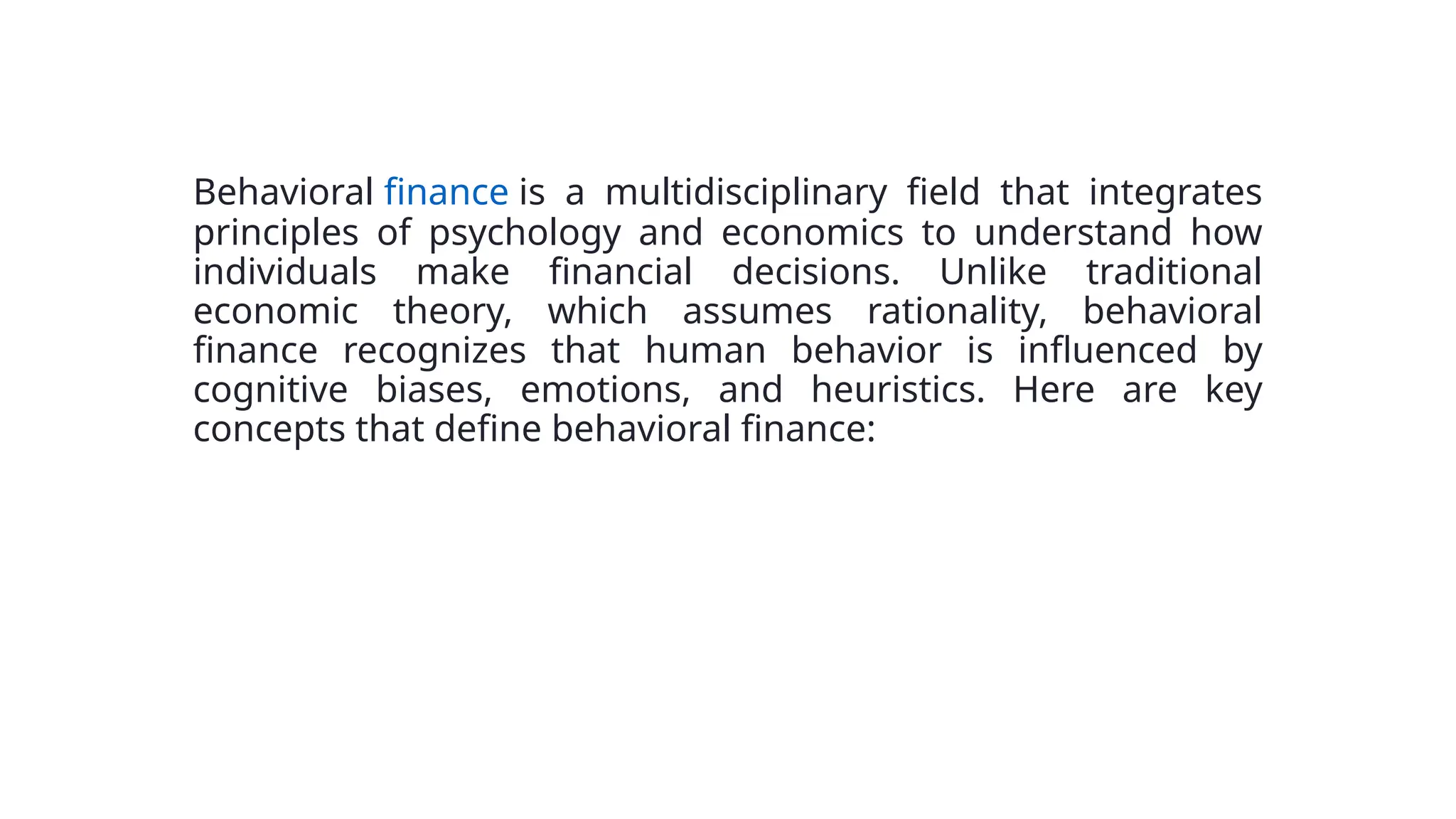
Behavioral finance is a multidisciplinary field that integrates
principles of psychology and economics to understand how
individuals make financial decisions. Unlike traditional
economic theory, which assumes rationality, behavioral
finance recognizes that human behavior is influenced by
cognitive biases, emotions, and heuristics. Here are key
concepts that define behavioral finance:
• Key Concepts of Behavioral Finance
• Biases and Heuristics
Behavioral finance identifies various biases that affect decision-making, such as:
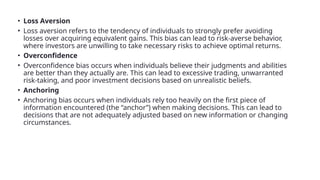
• Loss Aversion
• The tendency to prefer avoiding losses over acquiring equivalent gains.
• Overconfidence
• Believing that one’s judgments and abilities are better than they actually are.
• Anchoring
• Relying heavily on the first piece of information encountered when making
decisions.
• Herding
• Following the behavior of the crowd rather than making independent judgments.
• Confirmation Bias
• Seeking out information that confirms pre-existing beliefs while ignoring
contradictory evidence.
• Prospect Theory
Developed by Daniel Kahneman and Amos Tversky, prospect theory describes how
individuals evaluate risk and make decisions under uncertainty. It posits that people are
more sensitive to losses than gains, leading to risk-averse behavior in potential gains and
risk-seeking behavior in potential losses.
• Emotional Finance
Behavioral finance recognizes the impact of emotions on financial decisions. Fear, greed,
over-excitement, and panic can drive individuals to make irrational investment choices
based on sentiment rather than rational analysis of fundamentals.
• Market Inefficiencies
Behavioral finance challenges the efficient market hypothesis by demonstrating that
markets are not always efficient due to human biases and irrational behavior. This leads
to market anomalies and mispricings that can be exploited by savvy investors.
• Bounded Rationality
Humans have limited cognitive abilities and cannot always process vast amounts of
information rationally. Bounded rationality acknowledges these limitations and
recognizes that decision-making is often based on simplified heuristics or rules of thumb.
• Behavioral Portfolio Theory
This theory extends traditional portfolio theory by incorporating behavioral factors. It suggests
that investors may deviate from optimal portfolio choices due to cognitive biases, resulting in
suboptimal investment outcomes.
• Mental Accounting
Behavioral finance explores how individuals categorize and treat money differently based on
the source, purpose, or emotional attachment. Mental accounting can lead to irrational
financial decisions.
• Time Preferences
Behavioral finance studies how individuals discount future gains and losses differently. This
influences savings behavior, investment decisions, and attitudes towards risk.
• Understanding these key concepts of behavioral finance is essential for investors,
financial professionals, policymakers, and individuals seeking to make informed financial
decisions. By recognizing and addressing behavioral biases, it is possible to enhance
decision-making and improve financial outcomes. Behavioral finance offers valuable
insights into human behavior and its impact on markets, highlighting the importance of
incorporating psychology into economic models.
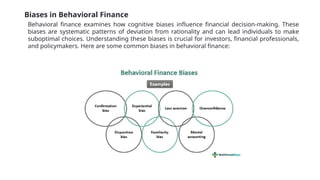
Biases in Behavioral Finance
Behavioral finance examines how cognitive biases influence financial decision-making. These
biases are systematic patterns of deviation from rationality and can lead individuals to make
suboptimal choices. Understanding these biases is crucial for investors, financial professionals,
and policymakers. Here are some common biases in behavioral finance:
• Loss Aversion
• Loss aversion refers to the tendency of individuals to strongly prefer avoiding
losses over acquiring equivalent gains. This bias can lead to risk-averse behavior,
where investors are unwilling to take necessary risks to achieve optimal returns.
• Overconfidence
• Overconfidence bias occurs when individuals believe their judgments and abilities
are better than they actually are. This can lead to excessive trading, unwarranted
risk-taking, and poor investment decisions based on unrealistic beliefs.
• Anchoring
• Anchoring bias occurs when individuals rely too heavily on the first piece of
information encountered (the “anchor”) when making decisions. This can lead to
decisions that are not adequately adjusted based on new information or changing
circumstances.
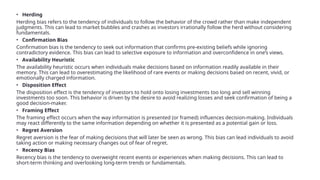
• Herding
Herding bias refers to the tendency of individuals to follow the behavior of the crowd rather than make independent
judgments. This can lead to market bubbles and crashes as investors irrationally follow the herd without considering
fundamentals.
• Confirmation Bias
Confirmation bias is the tendency to seek out information that confirms pre-existing beliefs while ignoring
contradictory evidence. This bias can lead to selective exposure to information and overconfidence in one’s views.
• Availability Heuristic
The availability heuristic occurs when individuals make decisions based on information readily available in their
memory. This can lead to overestimating the likelihood of rare events or making decisions based on recent, vivid, or
emotionally charged information.
• Disposition Effect
The disposition effect is the tendency of investors to hold onto losing investments too long and sell winning
investments too soon. This behavior is driven by the desire to avoid realizing losses and seek confirmation of being a
good decision-maker.
• Framing Effect
The framing effect occurs when the way information is presented (or framed) influences decision-making. Individuals
may react differently to the same information depending on whether it is presented as a potential gain or loss.
• Regret Aversion
Regret aversion is the fear of making decisions that will later be seen as wrong. This bias can lead individuals to avoid
taking action or making necessary changes out of fear of regret.
• Recency Bias
Recency bias is the tendency to overweight recent events or experiences when making decisions. This can lead to
short-term thinking and overlooking long-term trends or fundamentals.

baises.pptxhfdhfdhfdhfddddfddssfdfddfdfdfd

  • 1.
    Behavioral finance isa multidisciplinary field that integrates principles of psychology and economics to understand how individuals make financial decisions. Unlike traditional economic theory, which assumes rationality, behavioral finance recognizes that human behavior is influenced by cognitive biases, emotions, and heuristics. Here are key concepts that define behavioral finance:
  • 2.
    • Key Conceptsof Behavioral Finance • Biases and Heuristics Behavioral finance identifies various biases that affect decision-making, such as: • Loss Aversion • The tendency to prefer avoiding losses over acquiring equivalent gains. • Overconfidence • Believing that one’s judgments and abilities are better than they actually are. • Anchoring • Relying heavily on the first piece of information encountered when making decisions. • Herding • Following the behavior of the crowd rather than making independent judgments. • Confirmation Bias • Seeking out information that confirms pre-existing beliefs while ignoring contradictory evidence.
  • 3.
    • Prospect Theory Developedby Daniel Kahneman and Amos Tversky, prospect theory describes how individuals evaluate risk and make decisions under uncertainty. It posits that people are more sensitive to losses than gains, leading to risk-averse behavior in potential gains and risk-seeking behavior in potential losses. • Emotional Finance Behavioral finance recognizes the impact of emotions on financial decisions. Fear, greed, over-excitement, and panic can drive individuals to make irrational investment choices based on sentiment rather than rational analysis of fundamentals. • Market Inefficiencies Behavioral finance challenges the efficient market hypothesis by demonstrating that markets are not always efficient due to human biases and irrational behavior. This leads to market anomalies and mispricings that can be exploited by savvy investors. • Bounded Rationality Humans have limited cognitive abilities and cannot always process vast amounts of information rationally. Bounded rationality acknowledges these limitations and recognizes that decision-making is often based on simplified heuristics or rules of thumb.
  • 4.
    • Behavioral PortfolioTheory This theory extends traditional portfolio theory by incorporating behavioral factors. It suggests that investors may deviate from optimal portfolio choices due to cognitive biases, resulting in suboptimal investment outcomes. • Mental Accounting Behavioral finance explores how individuals categorize and treat money differently based on the source, purpose, or emotional attachment. Mental accounting can lead to irrational financial decisions. • Time Preferences Behavioral finance studies how individuals discount future gains and losses differently. This influences savings behavior, investment decisions, and attitudes towards risk. • Understanding these key concepts of behavioral finance is essential for investors, financial professionals, policymakers, and individuals seeking to make informed financial decisions. By recognizing and addressing behavioral biases, it is possible to enhance decision-making and improve financial outcomes. Behavioral finance offers valuable insights into human behavior and its impact on markets, highlighting the importance of incorporating psychology into economic models.
  • 5.
    Biases in BehavioralFinance Behavioral finance examines how cognitive biases influence financial decision-making. These biases are systematic patterns of deviation from rationality and can lead individuals to make suboptimal choices. Understanding these biases is crucial for investors, financial professionals, and policymakers. Here are some common biases in behavioral finance:
  • 6.
    • Loss Aversion •Loss aversion refers to the tendency of individuals to strongly prefer avoiding losses over acquiring equivalent gains. This bias can lead to risk-averse behavior, where investors are unwilling to take necessary risks to achieve optimal returns. • Overconfidence • Overconfidence bias occurs when individuals believe their judgments and abilities are better than they actually are. This can lead to excessive trading, unwarranted risk-taking, and poor investment decisions based on unrealistic beliefs. • Anchoring • Anchoring bias occurs when individuals rely too heavily on the first piece of information encountered (the “anchor”) when making decisions. This can lead to decisions that are not adequately adjusted based on new information or changing circumstances.
  • 7.
    • Herding Herding biasrefers to the tendency of individuals to follow the behavior of the crowd rather than make independent judgments. This can lead to market bubbles and crashes as investors irrationally follow the herd without considering fundamentals. • Confirmation Bias Confirmation bias is the tendency to seek out information that confirms pre-existing beliefs while ignoring contradictory evidence. This bias can lead to selective exposure to information and overconfidence in one’s views. • Availability Heuristic The availability heuristic occurs when individuals make decisions based on information readily available in their memory. This can lead to overestimating the likelihood of rare events or making decisions based on recent, vivid, or emotionally charged information. • Disposition Effect The disposition effect is the tendency of investors to hold onto losing investments too long and sell winning investments too soon. This behavior is driven by the desire to avoid realizing losses and seek confirmation of being a good decision-maker. • Framing Effect The framing effect occurs when the way information is presented (or framed) influences decision-making. Individuals may react differently to the same information depending on whether it is presented as a potential gain or loss. • Regret Aversion Regret aversion is the fear of making decisions that will later be seen as wrong. This bias can lead individuals to avoid taking action or making necessary changes out of fear of regret. • Recency Bias Recency bias is the tendency to overweight recent events or experiences when making decisions. This can lead to short-term thinking and overlooking long-term trends or fundamentals.