By,
P Vasavi
B Venkat
M Preethi Bhavani
G Shravya Reddy
B Rajesh Reddy
S Nikhileshwar
P Abhishek
Behavioural Finance
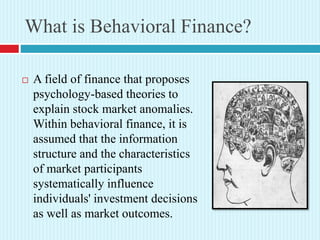
What is Behavioral Finance?
 A field of finance that proposes
psychology-based theories to
explain stock market anomalies.
Within behavioral finance, it is
assumed that the information
structure and the characteristics
of market participants
systematically influence
individuals' investment decisions
as well as market outcomes.
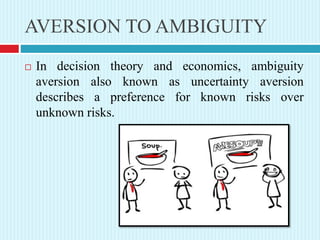
AVERSION TO AMBIGUITY
 In decision theory and economics, ambiguity
aversion also known as uncertainty aversion
describes a preference for known risks over
unknown risks.
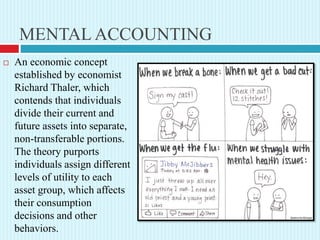
MENTAL ACCOUNTING
 An economic concept
established by economist
Richard Thaler, which
contends that individuals
divide their current and
future assets into separate,
non-transferable portions.
The theory purports
individuals assign different
levels of utility to each
asset group, which affects
their consumption
decisions and other
behaviors.
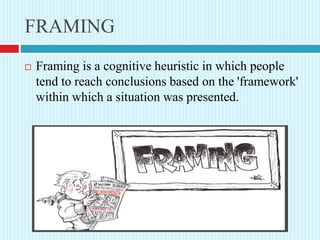
FRAMING
 Framing is a cognitive heuristic in which people
tend to reach conclusions based on the 'framework'
within which a situation was presented.
AVAILABILITY BIAS
 The giving of preference
by decision makers to information and events that
are more recent, that were observed personally, and
were more memorable. This is because memorable
events tend to be more magnified and are likely to
cause an emotional reaction.
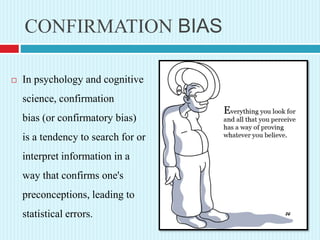
CONFIRMATION BIAS
 In psychology and cognitive
science, confirmation
bias (or confirmatory bias)
is a tendency to search for or
interpret information in a
way that confirms one's
preconceptions, leading to
statistical errors.
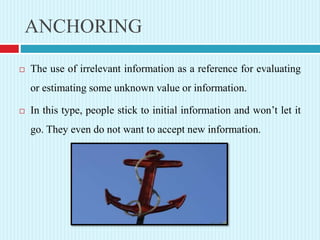
ANCHORING
 The use of irrelevant information as a reference for evaluating
or estimating some unknown value or information.
 In this type, people stick to initial information and won’t let it
go. They even do not want to accept new information.
INNUMERACY BIAS
 Natural inability to cognitively process and evaluate
probability and ratios is called innumeracy bias.
 Difficulty in evaluation of ratios and probabilities.
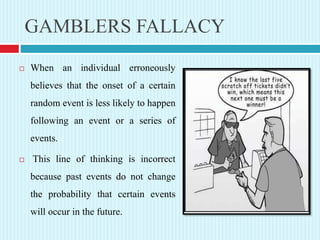
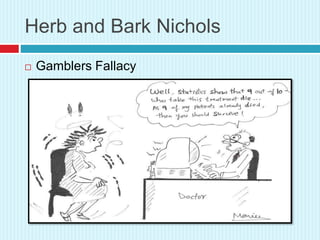
GAMBLERS FALLACY
 When an individual erroneously
believes that the onset of a certain
random event is less likely to happen
following an event or a series of
events.
 This line of thinking is incorrect
because past events do not change
the probability that certain events
will occur in the future.
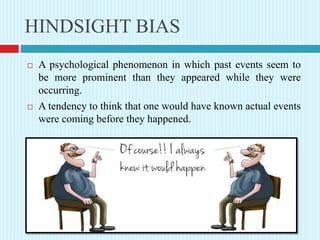
HINDSIGHT BIAS
 A psychological phenomenon in which past events seem to
be more prominent than they appeared while they were
occurring.
 A tendency to think that one would have known actual events
were coming before they happened.
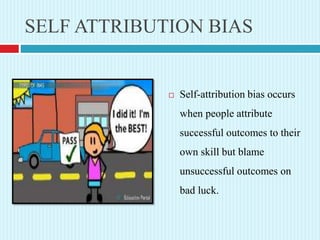
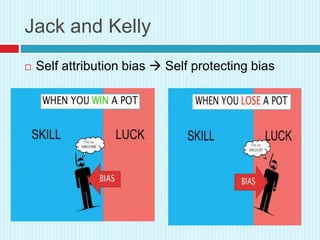
SELF ATTRIBUTION BIAS
 Self-attribution bias occurs
when people attribute
successful outcomes to their
own skill but blame
unsuccessful outcomes on
bad luck.
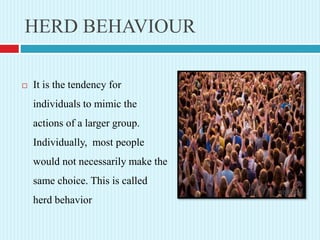
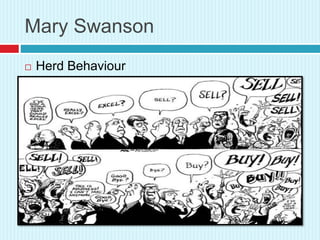
HERD BEHAVIOUR
 It is the tendency for
individuals to mimic the
actions of a larger group.
Individually, most people
would not necessarily make the
same choice. This is called
herd behavior
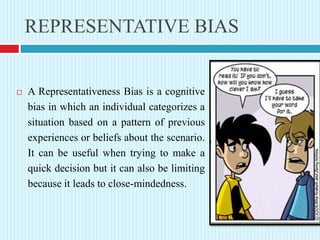
REPRESENTATIVE BIAS
 A Representativeness Bias is a cognitive
bias in which an individual categorizes a
situation based on a pattern of previous
experiences or beliefs about the scenario.
It can be useful when trying to make a
quick decision but it can also be limiting
because it leads to close-mindedness.
Possible
mistakes Rudy’s
clients would
make..
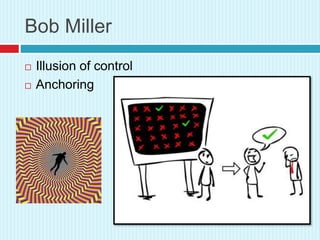
Bob Miller
 Illusion of control
 Anchoring
Mary Swanson
 Herd Behaviour
Jack and Kelly
 Self attribution bias  Self protecting bias
Herb and Bark Nichols
 Gamblers Fallacy
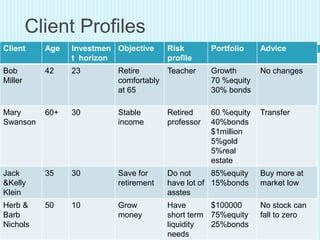
Client Profiles
Client Age Investmen
t horizon
Objective Risk
profile
Portfolio Advice
Bob
Miller
42 23 Retire
comfortably
at 65
Teacher Growth
70 %equity
30% bonds
No changes
Mary
Swanson
60+ 30 Stable
income
Retired
professor
60 %equity
40%bonds
$1million
5%gold
5%real
estate
Transfer
Jack
&Kelly
Klein
35 30 Save for
retirement
Do not
have lot of
asstes
85%equity
15%bonds
Buy more at
market low
Herb &
Barb
Nichols
50 10 Grow
money
Have
short term
liquidity
needs
$100000
75%equity
25%bonds
No stock can
fall to zero

Heuristics- Behavioural finance

  • 1.
    By, P Vasavi B Venkat MPreethi Bhavani G Shravya Reddy B Rajesh Reddy S Nikhileshwar P Abhishek Behavioural Finance
  • 2.
    What is BehavioralFinance?  A field of finance that proposes psychology-based theories to explain stock market anomalies. Within behavioral finance, it is assumed that the information structure and the characteristics of market participants systematically influence individuals' investment decisions as well as market outcomes.
  • 3.
    AVERSION TO AMBIGUITY In decision theory and economics, ambiguity aversion also known as uncertainty aversion describes a preference for known risks over unknown risks.
  • 4.
    MENTAL ACCOUNTING  Aneconomic concept established by economist Richard Thaler, which contends that individuals divide their current and future assets into separate, non-transferable portions. The theory purports individuals assign different levels of utility to each asset group, which affects their consumption decisions and other behaviors.
  • 5.
    FRAMING  Framing isa cognitive heuristic in which people tend to reach conclusions based on the 'framework' within which a situation was presented.
  • 6.
    AVAILABILITY BIAS  Thegiving of preference by decision makers to information and events that are more recent, that were observed personally, and were more memorable. This is because memorable events tend to be more magnified and are likely to cause an emotional reaction.
  • 7.
    CONFIRMATION BIAS  Inpsychology and cognitive science, confirmation bias (or confirmatory bias) is a tendency to search for or interpret information in a way that confirms one's preconceptions, leading to statistical errors.
  • 8.
    ANCHORING  The useof irrelevant information as a reference for evaluating or estimating some unknown value or information.  In this type, people stick to initial information and won’t let it go. They even do not want to accept new information.
  • 9.
    INNUMERACY BIAS  Naturalinability to cognitively process and evaluate probability and ratios is called innumeracy bias.  Difficulty in evaluation of ratios and probabilities.
  • 10.
    GAMBLERS FALLACY  Whenan individual erroneously believes that the onset of a certain random event is less likely to happen following an event or a series of events.  This line of thinking is incorrect because past events do not change the probability that certain events will occur in the future.
  • 11.
    HINDSIGHT BIAS  Apsychological phenomenon in which past events seem to be more prominent than they appeared while they were occurring.  A tendency to think that one would have known actual events were coming before they happened.
  • 12.
    SELF ATTRIBUTION BIAS Self-attribution bias occurs when people attribute successful outcomes to their own skill but blame unsuccessful outcomes on bad luck.
  • 13.
    HERD BEHAVIOUR  Itis the tendency for individuals to mimic the actions of a larger group. Individually, most people would not necessarily make the same choice. This is called herd behavior
  • 14.
    REPRESENTATIVE BIAS  ARepresentativeness Bias is a cognitive bias in which an individual categorizes a situation based on a pattern of previous experiences or beliefs about the scenario. It can be useful when trying to make a quick decision but it can also be limiting because it leads to close-mindedness.
  • 15.
  • 16.
    Bob Miller  Illusionof control  Anchoring
  • 17.
  • 18.
    Jack and Kelly Self attribution bias  Self protecting bias
  • 19.
    Herb and BarkNichols  Gamblers Fallacy
  • 20.
    Client Profiles Client AgeInvestmen t horizon Objective Risk profile Portfolio Advice Bob Miller 42 23 Retire comfortably at 65 Teacher Growth 70 %equity 30% bonds No changes Mary Swanson 60+ 30 Stable income Retired professor 60 %equity 40%bonds $1million 5%gold 5%real estate Transfer Jack &Kelly Klein 35 30 Save for retirement Do not have lot of asstes 85%equity 15%bonds Buy more at market low Herb & Barb Nichols 50 10 Grow money Have short term liquidity needs $100000 75%equity 25%bonds No stock can fall to zero