What is Behavioral Finance?
 Behavioral finance is the study of the influence of psychology on the
behavior of investors or financial analysts. It also includes the subsequent
effects on the markets.
Traditional Financial Theory
Traditional finance includes the following beliefs:
 Both the market and investors are perfectly rational
 Investors truly care about utilitarian characteristics
 Investors have perfect self-control
 They are not confused by cognitive errors or information processing errors
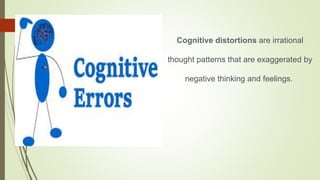
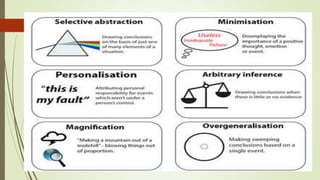
Cognitive distortions are irrational
thought patterns that are exaggerated by
negative thinking and feelings.
Traditional Financial Theory
Traditional finance includes the following beliefs:
 Both the market and investors are perfectly rational
 Investors truly care about utilitarian characteristics
 Investors have perfect self-control
 They are not confused by cognitive errors or information processing errors
Behavioral Finance Theory
Traits of behavioral finance are:
 Investors are treated as “normal” not “rational”
 They actually have limits to their self-control
 Investors are influenced by their own biases
 Investors make cognitive errors that can lead to wrong decisions
Decision-Making Errors and Biases
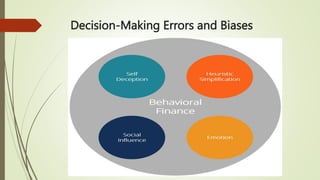
Self-Deception
 The concept of self-deception is a limit to the way we learn. When we mistakenly think we
know more than we actually do, we tend to miss information that we need to make an
informed decision.
Heuristic Simplification
 We can also scope out a bucket that is often called heuristic simplification. Heuristic
simplification refers to information-processing errors.
Decision-Making Errors and Biases
Emotion
 Another behavioral finance bucket is related to emotion, but we’re not going to dwell on this
bucket in this introductory session. Basically, emotion in behavioral finance refers to our
making decisions based on our current emotional state. Our current mood may take our
decision-making off track from rational thinking.
Social Influence
 What we mean by the social bucket is how our decision-making is influenced by others.
Common Biases Include:
1. Overconfidence and illusion of control
2. Self Attribution Bias
3. Hindsight Bias
4. Confirmation Bias
5. The Narrative Deception
6. Framing Bias
Common Biases Include:
1.Overconfidence and illusion of control
Overconfidence refers to our tendency to believe that certain
things are more likely than they really are. For example, most
investors think they are above-average stock pickers.
Common Biases Include:
2. Self Attribution Bias
Self-attribution bias is a long-standing concept in psychology
research and refers to individuals' tendency to attribute
successes to personal skills and failures to factors beyond
their control.
Common Biases Include:
3. Hindsight Bias
Hindsight bias is a psychological phenomenon that allows people to
convince themselves after an event that they accurately predicted it
before it happened. This can lead people to conclude that they can
accurately predict other events.
“I knew it all along phenomenon.”
Common Biases Include:
4. Framing
Framing bias occurs when people make a decision based on the
way the information is presented, as opposed to just on the facts
themselves.
The concept of framing involves attempts to overlay a situation
with an implied sense of gain or loss.
It is easier to pay $3,400 for something that you expected to cost
$3,300 than it is to pay $100 for something you expected to be
free.
Common Biases Include:
5. Confirmation Bias
Confirmation bias is a term from the field of cognitive
psychology that describes how people naturally favor
information that confirms their previously existing
beliefs.
Common Biases Include:
Confirmation bias affects perceptions and decision-making in all aspects of
life, but it can create particular problems for investors. When researching
an investment, they might inadvertently look for or favor information that
supports their preconceived notions about the asset or strategy and fail to
register or to under-weigh any or data that presents different or
contradictory ideas.
Common Biases Include:
6. The Narrative Deception
Narrative bias refers to our tendency to make sense of the world through
stories. To process the great amount of information coming our way, our
brain creates a narrative to link the different inputs together, and drops the
other facts that do not fit in the story.
Common Biases Include:
Stockbrokers have taken advantage of the narrative
fallacy for years, convincing clients to invest in a stock
by telling them a great story about the company.

Behavioral Finance.pptx

  • 1.
  • 2.
    What is BehavioralFinance?  Behavioral finance is the study of the influence of psychology on the behavior of investors or financial analysts. It also includes the subsequent effects on the markets.
  • 3.
    Traditional Financial Theory Traditionalfinance includes the following beliefs:  Both the market and investors are perfectly rational  Investors truly care about utilitarian characteristics  Investors have perfect self-control  They are not confused by cognitive errors or information processing errors
  • 4.
    Cognitive distortions areirrational thought patterns that are exaggerated by negative thinking and feelings.
  • 6.
    Traditional Financial Theory Traditionalfinance includes the following beliefs:  Both the market and investors are perfectly rational  Investors truly care about utilitarian characteristics  Investors have perfect self-control  They are not confused by cognitive errors or information processing errors
  • 7.
    Behavioral Finance Theory Traitsof behavioral finance are:  Investors are treated as “normal” not “rational”  They actually have limits to their self-control  Investors are influenced by their own biases  Investors make cognitive errors that can lead to wrong decisions
  • 8.
  • 9.
    Decision-Making Errors andBiases Self-Deception  The concept of self-deception is a limit to the way we learn. When we mistakenly think we know more than we actually do, we tend to miss information that we need to make an informed decision. Heuristic Simplification  We can also scope out a bucket that is often called heuristic simplification. Heuristic simplification refers to information-processing errors.
  • 10.
    Decision-Making Errors andBiases Emotion  Another behavioral finance bucket is related to emotion, but we’re not going to dwell on this bucket in this introductory session. Basically, emotion in behavioral finance refers to our making decisions based on our current emotional state. Our current mood may take our decision-making off track from rational thinking. Social Influence  What we mean by the social bucket is how our decision-making is influenced by others.
  • 11.
    Common Biases Include: 1.Overconfidence and illusion of control 2. Self Attribution Bias 3. Hindsight Bias 4. Confirmation Bias 5. The Narrative Deception 6. Framing Bias
  • 12.
    Common Biases Include: 1.Overconfidenceand illusion of control Overconfidence refers to our tendency to believe that certain things are more likely than they really are. For example, most investors think they are above-average stock pickers.
  • 13.
    Common Biases Include: 2.Self Attribution Bias Self-attribution bias is a long-standing concept in psychology research and refers to individuals' tendency to attribute successes to personal skills and failures to factors beyond their control.
  • 14.
    Common Biases Include: 3.Hindsight Bias Hindsight bias is a psychological phenomenon that allows people to convince themselves after an event that they accurately predicted it before it happened. This can lead people to conclude that they can accurately predict other events. “I knew it all along phenomenon.”
  • 15.
    Common Biases Include: 4.Framing Framing bias occurs when people make a decision based on the way the information is presented, as opposed to just on the facts themselves. The concept of framing involves attempts to overlay a situation with an implied sense of gain or loss. It is easier to pay $3,400 for something that you expected to cost $3,300 than it is to pay $100 for something you expected to be free.
  • 16.
    Common Biases Include: 5.Confirmation Bias Confirmation bias is a term from the field of cognitive psychology that describes how people naturally favor information that confirms their previously existing beliefs.
  • 17.
    Common Biases Include: Confirmationbias affects perceptions and decision-making in all aspects of life, but it can create particular problems for investors. When researching an investment, they might inadvertently look for or favor information that supports their preconceived notions about the asset or strategy and fail to register or to under-weigh any or data that presents different or contradictory ideas.
  • 18.
    Common Biases Include: 6.The Narrative Deception Narrative bias refers to our tendency to make sense of the world through stories. To process the great amount of information coming our way, our brain creates a narrative to link the different inputs together, and drops the other facts that do not fit in the story.
  • 19.
    Common Biases Include: Stockbrokershave taken advantage of the narrative fallacy for years, convincing clients to invest in a stock by telling them a great story about the company.