ANNUAL SEMINAR
DOCTORATE OF PHILOSOPHY
SUSHILA
Doctoral Research Scholar
Department of Commerce
BPSMV Khanpur Kalan
Sonepat
Dated : 6th Dec, 2019
Title of the study
Impact of Behavioural Biases on Investment
Decision of Individual Equity Investors of NCR
Research Supervisor
Dr. Bhavna Sharma
Outline of the Presentation
• Introduction
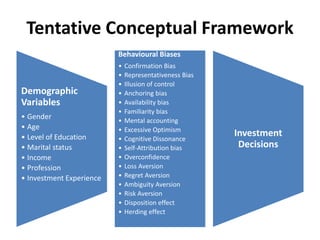
• Overview of Behavioural Finance
• Traditional finance Vs Behavioural finance
• Objectives of the study
• Concept of Behavioural biases
• Types of behavioural biases
• Research work done
• Identification of behavioural biases and conceptual model
development
• Summary of behavioural biases
• Questionnaire Development
• Paper published
Introduction
“One of the funny things about the
stock market is that every time
one person buys, another sells,
and both think they are astute.” -
William Feather
The way of thinking and feeling affects the
behaviour of individuals or our psychology affects
our decision making. This also works in the field
of finance. In 2002, Daniel Kahneman
(psychologist) was awarded the Nobel Memorial
Prize for economic sciences for his work in
applying psychological insights to economic
decision making, particularly in the areas of
judgement and decision making under
uncertainty. In 2017, Richard Thalar an American
economist also won Nobal prize in economics for
his contribution in behavioural economics.
Behavioural Finance
Behavioural finance, a sub-field of behavioural
economics, commonly defined as the application
of psychology to finance, is the study of how
cognitive and emotional factors affect economic
decisions, particularly how they affect rationality
in decision making. In other words Behavioural
finance is the study of the influence of
psychology on the behaviour of investors or
financial analysts. It also includes the subsequent
effects on the markets. It focuses on the fact that
investors are not always rational, have limits to
their self-control, and are influenced by their own
biases.
Behavioral Finance Micro versus
Behavioral Finance Macro
Behavioural Finance
Micro (BFMI) examines
behaviours or biases of
individual investors that
deviate them from
rationality.
Behavioral Finance
Macro (BFMA) detects
and describe anomalies
in the efficient market
hypothesis that
behavioural models
may explain.
Traditional finance Vs Behavioural finance
Traditional finance
• People are rational in the sense that when
they receive information they update their
beliefs correctly.
• People are guided only by utilitarian
wants.
• Expected utility theory describes how
people make decisions under risk.
• People design their portfolios according to
the mean – variance portfolio theory
which looks at expected returns and risk.
• Markets are efficient in the sense that
prices reflect intrinsic values.
Behavioural finance
• People are not fully rational. In forming
their beliefs and making their choices,
they are susceptible to cognitive and
emotional shortcuts and errors.
• In addition to utilitarian wants, people are
guided by emotional wants.
• Prospect theory describes better how
people make decisions under risk.
• People design their portfolios according to
the behavioural portfolio theory; where
by people’s wants extend beyond high
expected returns and low risk, to include
factors like social status and social
responsibility.
• Markets are characterised by inefficiencies
Objectives of the study
• To study the existence of behavioural biases
among individual equity investors of NCR.
• To analyse the differences in behavioural biases
of individual equity investors on the basis of
demographic profile.
• To analyse the impact of behavioural biases on
the investment decisions of individual equity
investors of NCR.
• To recommend the strategies to overcome from
behavioural biases while investing in stock
market.
Behavioural Biases
A bias is an illogical preference or irrational assumption. it is a
tendency to ignore any evidence that does not line up with
that assumption. It is a uniquely human foible, and since
investors are human they can also be affected by it. Any
decision making process requires appropriate use of mental
and financial resources to acquire and process information. In
an attempt to make quick and easy decisions, individuals tend
to deviate from rationality or they use mental or emotional
shortcuts to make quick decisions. These decisions are termed
biases. Michael M. Pompian (2012) in his book “Behavioural
finance and Wealth Management: How to investment
strategies that account for investor’ biases” explains 20 most
important behavioural biases. Behavioural biases given by
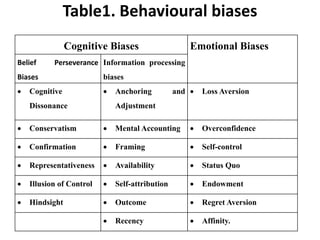
Michael M. Pompian are shown in Table 1.
Table1. Behavioural biases
Cognitive Biases Emotional Biases
Belief Perseverance
Biases
Information processing
biases
 Cognitive
Dissonance
 Anchoring and
Adjustment
 Loss Aversion
 Conservatism  Mental Accounting  Overconfidence
 Confirmation  Framing  Self-control
 Representativeness  Availability  Status Quo
 Illusion of Control  Self-attribution  Endowment
 Hindsight  Outcome  Regret Aversion
 Recency  Affinity.
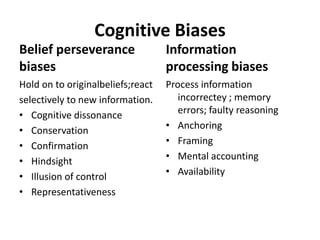
Cognitive Biases
Belief perseverance
biases
Hold on to originalbeliefs;react
selectively to new information.
• Cognitive dissonance
• Conservation
• Confirmation
• Hindsight
• Illusion of control
• Representativeness
Information
processing biases
Process information
incorrectey ; memory
errors; faulty reasoning
• Anchoring
• Framing
• Mental accounting
• Availability
Emotional biases
Biases influenced by feelings and emotions;
avoid pain, produce pleasure
• Loss-aversion
• Overconfidence
• Self-control
• Endowment effect
• Regret-aversion
Research work done
In order to achieve the objectives of the study first of
all a comprehensive review of literature was done to
identify the behavioural biases of individual
investors. I collected research papers using various
databases such as Emerald, PROQUEST, Science
direct, JSTOR and Website of CFA (Chartered
Financial Analyst) of America. Review was searched
using keywords- Behavioural biases, investment
decision making, Individual investor behaviour,
behavioural factors, cognitive and emotional errors
in investing etc. Total 180 full text research papers
were collected. Out of them 100 were found suitable
related to the objectives of the study. Research
papers related to personality, risk tolerance level of
investors and behavioural biases of institutional
investors are not included in the review
Identification of behavioural biases
and conceptual model development
On the bases of review of literature 17
behavioural biases are identified and a
tentative conceptual model of the study
is developed as per the objectives of the
study.
Tentative Conceptual Framework
Demographic
Variables
• Gender
• Age
• Level of Education
• Marital status
• Income
• Profession
• Investment Experience
Behavioural Biases
• Confirmation Bias
• Representativeness Bias
• Illusion of control
• Anchoring bias
• Availability bias
• Familiarity bias
• Mental accounting
• Excessive Optimism
• Cognitive Dissonance
• Self-Attribution bias
• Overconfidence
• Loss Aversion
• Regret Aversion
• Ambiguity Aversion
• Risk Aversion
• Disposition effect
• Herding effect
Investment
Decisions
Confirmation bias
• It the tendency to interpret new evidence as
confirmation of one's existing beliefs or
theories. People tend to look for & notice
what confirms their beliefs & undervalue the
contradict views.
Representativeness bias
• Representativeness refers to the tendency to
make decision based on stereotypes, with
representativeness bias; the characteristics of
something we know are projected onto
something we do not know. In other words
representativeness bias deals investors to
wrongly conclude that good companies are
good investments and good past performer
will be good future performer.
Illusion of control
• The outcome of an investment decision
typically depends on a combination of luck &
skill. In general, investors have an inflated
view of how much control they have over
outcomes. This bias is called illusion of control
and leads to over- optimism.
Anchoring Bias
• It is tendency of investors to attached with a
information that might not be important or relevant.
It may also defined as a strong mental attachment to
a particular price.
• Anchoring bias is the tendency to use first
impressions to form perceptions. These initial
perceptions affect the later decisions. The individuals
with the anchoring bias tend to anchor the thoughts
to an irrelevant reference point. Values are assigned
to one option based on how attractive the option is
compared to the other options, instead of analysing
each option on its own.
Availability bias
• The availability bias is a rule of thumb, or
mental shortcut, that allows people to
estimate the probability of an outcome based
on how prevalent or familiar that outcome
appears in their lives.
• Overemphasis is given on the information that
is easily available.
• Example: investing in highly advertised
companies stocks.
Familiarity bias
• A mental shortcut that treats familiar things as
better than less familiar things (Home bias). In
other words, a familiarity bias can lead
investees to wrongly believe that familiar
companies tend to represent better
investment than less familiar companies.
Example: Investing in local companies stocks.
Mental accounting bias
• Mental accounting also known as “two pocket
theory” is a behavioural bias that occurs when
people put their money into separate
categories.
• Treat one sum of money different from other
depending upon source and the efforts taken
to acquire it.
• Investing some money very conservatively and
the rest in speculative stocks.
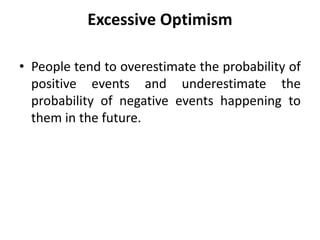
Excessive Optimism
• People tend to overestimate the probability of
positive events and underestimate the
probability of negative events happening to
them in the future.
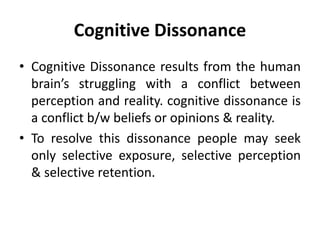
Cognitive Dissonance
• Cognitive Dissonance results from the human
brain’s struggling with a conflict between
perception and reality. cognitive dissonance is
a conflict b/w beliefs or opinions & reality.
• To resolve this dissonance people may seek
only selective exposure, selective perception
& selective retention.
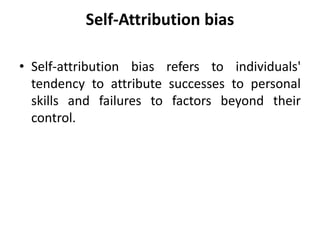
Self-Attribution bias
• Self-attribution bias refers to individuals'
tendency to attribute successes to personal
skills and failures to factors beyond their
control.
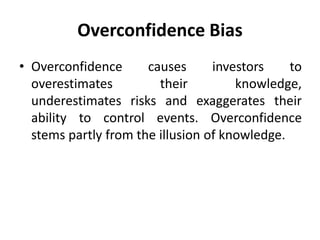
Overconfidence Bias
• Overconfidence causes investors to
overestimates their knowledge,
underestimates risks and exaggerates their
ability to control events. Overconfidence
stems partly from the illusion of knowledge.
Loss Aversion bias
• Pick one of the following options that you regard is more
attractive:
• Option A- Gain of Rs 800 with a probability of 50%.
• Option B- Sure gain of Rs 400.
• If you pick Option B then you have loss aversion bias.
• Pick one of the following options that you regard is more
attractive:
• Option A- Loss of Rs 800 with a probability of 50%.
• Option B- Sure loss of Rs 400
• If you pick option A ten you have loss aversion bias.
• Thus, Loss aversion refers to the tendency to loathe
realizing a loss to the extent that you avoid it even when
it is the better choice. It is because the pain of losing is
felt psychologically twice as powerful as the pleasure of
gaining.
Regret aversion
• Regret is the emotional pain a person
experiences when his decision turns sour.
Regret of commission is disappointment from
taking action, where as the regret of omission
is disappointment from not taking an action.
The concept of regret aversion is also relevant
in investing. As prospect theory explained that
investors sometimes avoid regret by holding
on to stocks that have become losers.
Ambiguity Aversion
• Ambiguity aversion refers to the bias when
people tend to lean towards known outcomes
over unknown ones. They want to avoid
uncertainty and choose what they are confident
of. It is applicable when a choice has to be made
between risky or ambiguous alternatives.
• In the context of investments and investors,
ambiguity aversion bias leads investors to
hesitate in situations that are ambiguous
Risk Aversion
• A risk averse investor is an investor who
prefers lower returns with known risks rather
than higher returns with unknown risks. In
other words, among various investments
giving the same return with different level of
risks, this investor always prefers the
alternative with least risk.
Disposition effect
• It relates to the tendency of investors to sell
assets that have increased in value, while
keeping assets that have dropped in value.
Investors have a propensity to sell winning
stocks early and holding loser too long.
Herding effect
• A Herd Effect exists in the financial market
when a group of investors ignores their own
information and instead only follows the
decisions of other investors.
Questionnaire Development
To achieve the objectives of the study
I developed a questionnaire on the bases of
review. The questionnaire is divided into two
sections. Section A consists the questions
related to demographic profile of equity
investors and section B consists the
statements developed on likert scale related
to behavioural biases and investment
decisions of equity investors.
Research Paper Published
“Implication of Behavioural Finance in
Investment Decision Making in Stock Market”
published in journal “Research Analysis and
Evaluation” UGC approved & accepted No.
41022, March issue, 2019.
Thank you

Behavioural biases

  • 1.
    ANNUAL SEMINAR DOCTORATE OFPHILOSOPHY SUSHILA Doctoral Research Scholar Department of Commerce BPSMV Khanpur Kalan Sonepat Dated : 6th Dec, 2019
  • 2.
    Title of thestudy Impact of Behavioural Biases on Investment Decision of Individual Equity Investors of NCR Research Supervisor Dr. Bhavna Sharma
  • 3.
    Outline of thePresentation • Introduction • Overview of Behavioural Finance • Traditional finance Vs Behavioural finance • Objectives of the study • Concept of Behavioural biases • Types of behavioural biases • Research work done • Identification of behavioural biases and conceptual model development • Summary of behavioural biases • Questionnaire Development • Paper published
  • 4.
    Introduction “One of thefunny things about the stock market is that every time one person buys, another sells, and both think they are astute.” - William Feather
  • 5.
    The way ofthinking and feeling affects the behaviour of individuals or our psychology affects our decision making. This also works in the field of finance. In 2002, Daniel Kahneman (psychologist) was awarded the Nobel Memorial Prize for economic sciences for his work in applying psychological insights to economic decision making, particularly in the areas of judgement and decision making under uncertainty. In 2017, Richard Thalar an American economist also won Nobal prize in economics for his contribution in behavioural economics.
  • 6.
    Behavioural Finance Behavioural finance,a sub-field of behavioural economics, commonly defined as the application of psychology to finance, is the study of how cognitive and emotional factors affect economic decisions, particularly how they affect rationality in decision making. In other words Behavioural finance is the study of the influence of psychology on the behaviour of investors or financial analysts. It also includes the subsequent effects on the markets. It focuses on the fact that investors are not always rational, have limits to their self-control, and are influenced by their own biases.
  • 7.
    Behavioral Finance Microversus Behavioral Finance Macro Behavioural Finance Micro (BFMI) examines behaviours or biases of individual investors that deviate them from rationality. Behavioral Finance Macro (BFMA) detects and describe anomalies in the efficient market hypothesis that behavioural models may explain.
  • 8.
    Traditional finance VsBehavioural finance Traditional finance • People are rational in the sense that when they receive information they update their beliefs correctly. • People are guided only by utilitarian wants. • Expected utility theory describes how people make decisions under risk. • People design their portfolios according to the mean – variance portfolio theory which looks at expected returns and risk. • Markets are efficient in the sense that prices reflect intrinsic values. Behavioural finance • People are not fully rational. In forming their beliefs and making their choices, they are susceptible to cognitive and emotional shortcuts and errors. • In addition to utilitarian wants, people are guided by emotional wants. • Prospect theory describes better how people make decisions under risk. • People design their portfolios according to the behavioural portfolio theory; where by people’s wants extend beyond high expected returns and low risk, to include factors like social status and social responsibility. • Markets are characterised by inefficiencies
  • 9.
    Objectives of thestudy • To study the existence of behavioural biases among individual equity investors of NCR. • To analyse the differences in behavioural biases of individual equity investors on the basis of demographic profile. • To analyse the impact of behavioural biases on the investment decisions of individual equity investors of NCR. • To recommend the strategies to overcome from behavioural biases while investing in stock market.
  • 10.
    Behavioural Biases A biasis an illogical preference or irrational assumption. it is a tendency to ignore any evidence that does not line up with that assumption. It is a uniquely human foible, and since investors are human they can also be affected by it. Any decision making process requires appropriate use of mental and financial resources to acquire and process information. In an attempt to make quick and easy decisions, individuals tend to deviate from rationality or they use mental or emotional shortcuts to make quick decisions. These decisions are termed biases. Michael M. Pompian (2012) in his book “Behavioural finance and Wealth Management: How to investment strategies that account for investor’ biases” explains 20 most important behavioural biases. Behavioural biases given by Michael M. Pompian are shown in Table 1.
  • 11.
    Table1. Behavioural biases CognitiveBiases Emotional Biases Belief Perseverance Biases Information processing biases  Cognitive Dissonance  Anchoring and Adjustment  Loss Aversion  Conservatism  Mental Accounting  Overconfidence  Confirmation  Framing  Self-control  Representativeness  Availability  Status Quo  Illusion of Control  Self-attribution  Endowment  Hindsight  Outcome  Regret Aversion  Recency  Affinity.
  • 12.
    Cognitive Biases Belief perseverance biases Holdon to originalbeliefs;react selectively to new information. • Cognitive dissonance • Conservation • Confirmation • Hindsight • Illusion of control • Representativeness Information processing biases Process information incorrectey ; memory errors; faulty reasoning • Anchoring • Framing • Mental accounting • Availability
  • 13.
    Emotional biases Biases influencedby feelings and emotions; avoid pain, produce pleasure • Loss-aversion • Overconfidence • Self-control • Endowment effect • Regret-aversion
  • 14.
    Research work done Inorder to achieve the objectives of the study first of all a comprehensive review of literature was done to identify the behavioural biases of individual investors. I collected research papers using various databases such as Emerald, PROQUEST, Science direct, JSTOR and Website of CFA (Chartered Financial Analyst) of America. Review was searched using keywords- Behavioural biases, investment decision making, Individual investor behaviour, behavioural factors, cognitive and emotional errors in investing etc. Total 180 full text research papers were collected. Out of them 100 were found suitable related to the objectives of the study. Research papers related to personality, risk tolerance level of investors and behavioural biases of institutional investors are not included in the review
  • 15.
    Identification of behaviouralbiases and conceptual model development On the bases of review of literature 17 behavioural biases are identified and a tentative conceptual model of the study is developed as per the objectives of the study.
  • 16.
    Tentative Conceptual Framework Demographic Variables •Gender • Age • Level of Education • Marital status • Income • Profession • Investment Experience Behavioural Biases • Confirmation Bias • Representativeness Bias • Illusion of control • Anchoring bias • Availability bias • Familiarity bias • Mental accounting • Excessive Optimism • Cognitive Dissonance • Self-Attribution bias • Overconfidence • Loss Aversion • Regret Aversion • Ambiguity Aversion • Risk Aversion • Disposition effect • Herding effect Investment Decisions
  • 17.
    Confirmation bias • Itthe tendency to interpret new evidence as confirmation of one's existing beliefs or theories. People tend to look for & notice what confirms their beliefs & undervalue the contradict views.
  • 18.
    Representativeness bias • Representativenessrefers to the tendency to make decision based on stereotypes, with representativeness bias; the characteristics of something we know are projected onto something we do not know. In other words representativeness bias deals investors to wrongly conclude that good companies are good investments and good past performer will be good future performer.
  • 19.
    Illusion of control •The outcome of an investment decision typically depends on a combination of luck & skill. In general, investors have an inflated view of how much control they have over outcomes. This bias is called illusion of control and leads to over- optimism.
  • 20.
    Anchoring Bias • Itis tendency of investors to attached with a information that might not be important or relevant. It may also defined as a strong mental attachment to a particular price. • Anchoring bias is the tendency to use first impressions to form perceptions. These initial perceptions affect the later decisions. The individuals with the anchoring bias tend to anchor the thoughts to an irrelevant reference point. Values are assigned to one option based on how attractive the option is compared to the other options, instead of analysing each option on its own.
  • 21.
    Availability bias • Theavailability bias is a rule of thumb, or mental shortcut, that allows people to estimate the probability of an outcome based on how prevalent or familiar that outcome appears in their lives. • Overemphasis is given on the information that is easily available. • Example: investing in highly advertised companies stocks.
  • 22.
    Familiarity bias • Amental shortcut that treats familiar things as better than less familiar things (Home bias). In other words, a familiarity bias can lead investees to wrongly believe that familiar companies tend to represent better investment than less familiar companies. Example: Investing in local companies stocks.
  • 23.
    Mental accounting bias •Mental accounting also known as “two pocket theory” is a behavioural bias that occurs when people put their money into separate categories. • Treat one sum of money different from other depending upon source and the efforts taken to acquire it. • Investing some money very conservatively and the rest in speculative stocks.
  • 24.
    Excessive Optimism • Peopletend to overestimate the probability of positive events and underestimate the probability of negative events happening to them in the future.
  • 25.
    Cognitive Dissonance • CognitiveDissonance results from the human brain’s struggling with a conflict between perception and reality. cognitive dissonance is a conflict b/w beliefs or opinions & reality. • To resolve this dissonance people may seek only selective exposure, selective perception & selective retention.
  • 26.
    Self-Attribution bias • Self-attributionbias refers to individuals' tendency to attribute successes to personal skills and failures to factors beyond their control.
  • 27.
    Overconfidence Bias • Overconfidencecauses investors to overestimates their knowledge, underestimates risks and exaggerates their ability to control events. Overconfidence stems partly from the illusion of knowledge.
  • 28.
    Loss Aversion bias •Pick one of the following options that you regard is more attractive: • Option A- Gain of Rs 800 with a probability of 50%. • Option B- Sure gain of Rs 400. • If you pick Option B then you have loss aversion bias. • Pick one of the following options that you regard is more attractive: • Option A- Loss of Rs 800 with a probability of 50%. • Option B- Sure loss of Rs 400 • If you pick option A ten you have loss aversion bias. • Thus, Loss aversion refers to the tendency to loathe realizing a loss to the extent that you avoid it even when it is the better choice. It is because the pain of losing is felt psychologically twice as powerful as the pleasure of gaining.
  • 29.
    Regret aversion • Regretis the emotional pain a person experiences when his decision turns sour. Regret of commission is disappointment from taking action, where as the regret of omission is disappointment from not taking an action. The concept of regret aversion is also relevant in investing. As prospect theory explained that investors sometimes avoid regret by holding on to stocks that have become losers.
  • 30.
    Ambiguity Aversion • Ambiguityaversion refers to the bias when people tend to lean towards known outcomes over unknown ones. They want to avoid uncertainty and choose what they are confident of. It is applicable when a choice has to be made between risky or ambiguous alternatives. • In the context of investments and investors, ambiguity aversion bias leads investors to hesitate in situations that are ambiguous
  • 31.
    Risk Aversion • Arisk averse investor is an investor who prefers lower returns with known risks rather than higher returns with unknown risks. In other words, among various investments giving the same return with different level of risks, this investor always prefers the alternative with least risk.
  • 32.
    Disposition effect • Itrelates to the tendency of investors to sell assets that have increased in value, while keeping assets that have dropped in value. Investors have a propensity to sell winning stocks early and holding loser too long.
  • 33.
    Herding effect • AHerd Effect exists in the financial market when a group of investors ignores their own information and instead only follows the decisions of other investors.
  • 34.
    Questionnaire Development To achievethe objectives of the study I developed a questionnaire on the bases of review. The questionnaire is divided into two sections. Section A consists the questions related to demographic profile of equity investors and section B consists the statements developed on likert scale related to behavioural biases and investment decisions of equity investors.
  • 35.
    Research Paper Published “Implicationof Behavioural Finance in Investment Decision Making in Stock Market” published in journal “Research Analysis and Evaluation” UGC approved & accepted No. 41022, March issue, 2019.
  • 36.