The Behaviorist TheoryBy: Sam Barnette
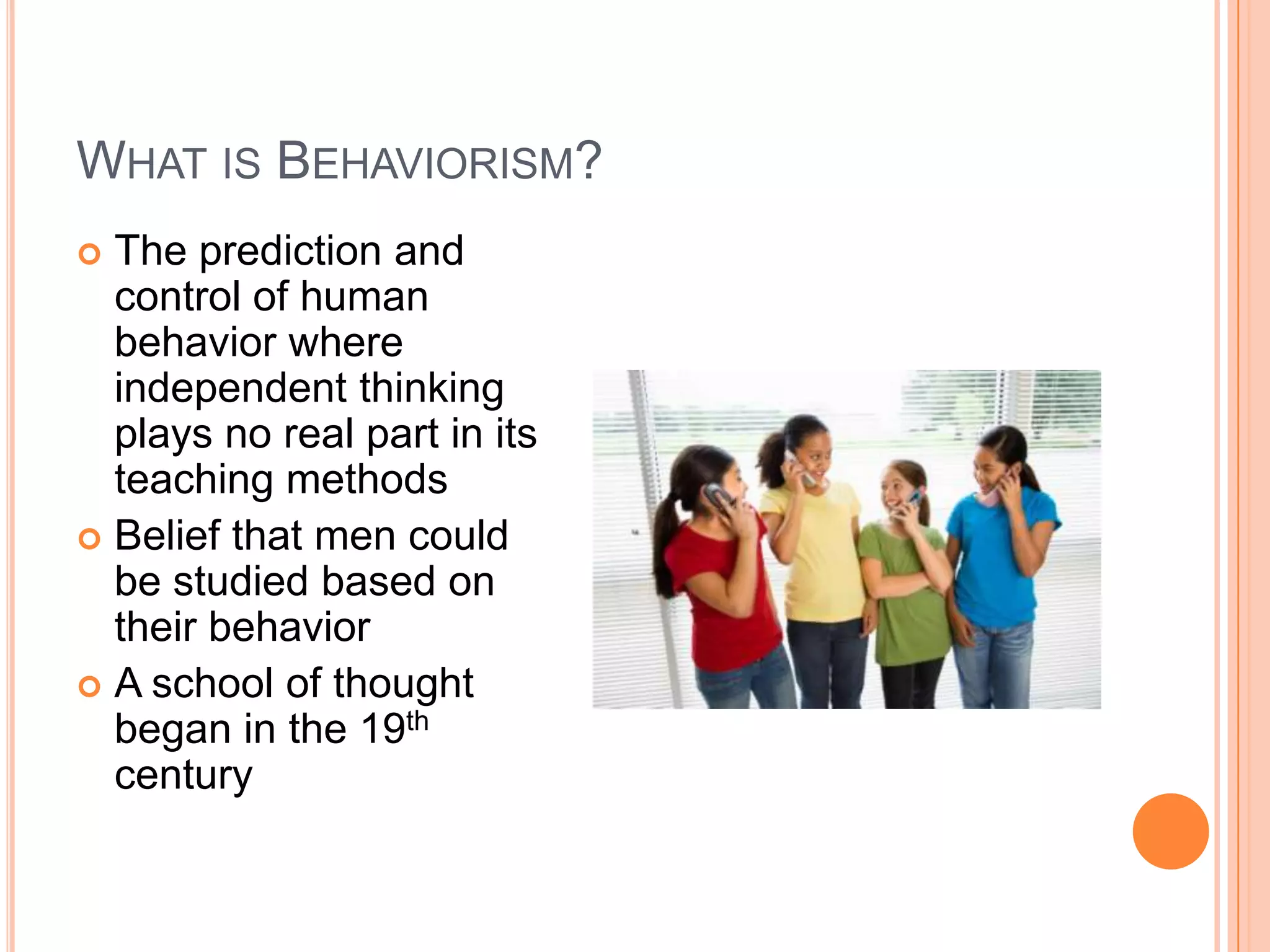
What is Behaviorism?The prediction and control of human behavior where independent thinking plays no real part in its teaching methodsBelief that men could be studied based on their behaviorA school of thought began in the 19th century
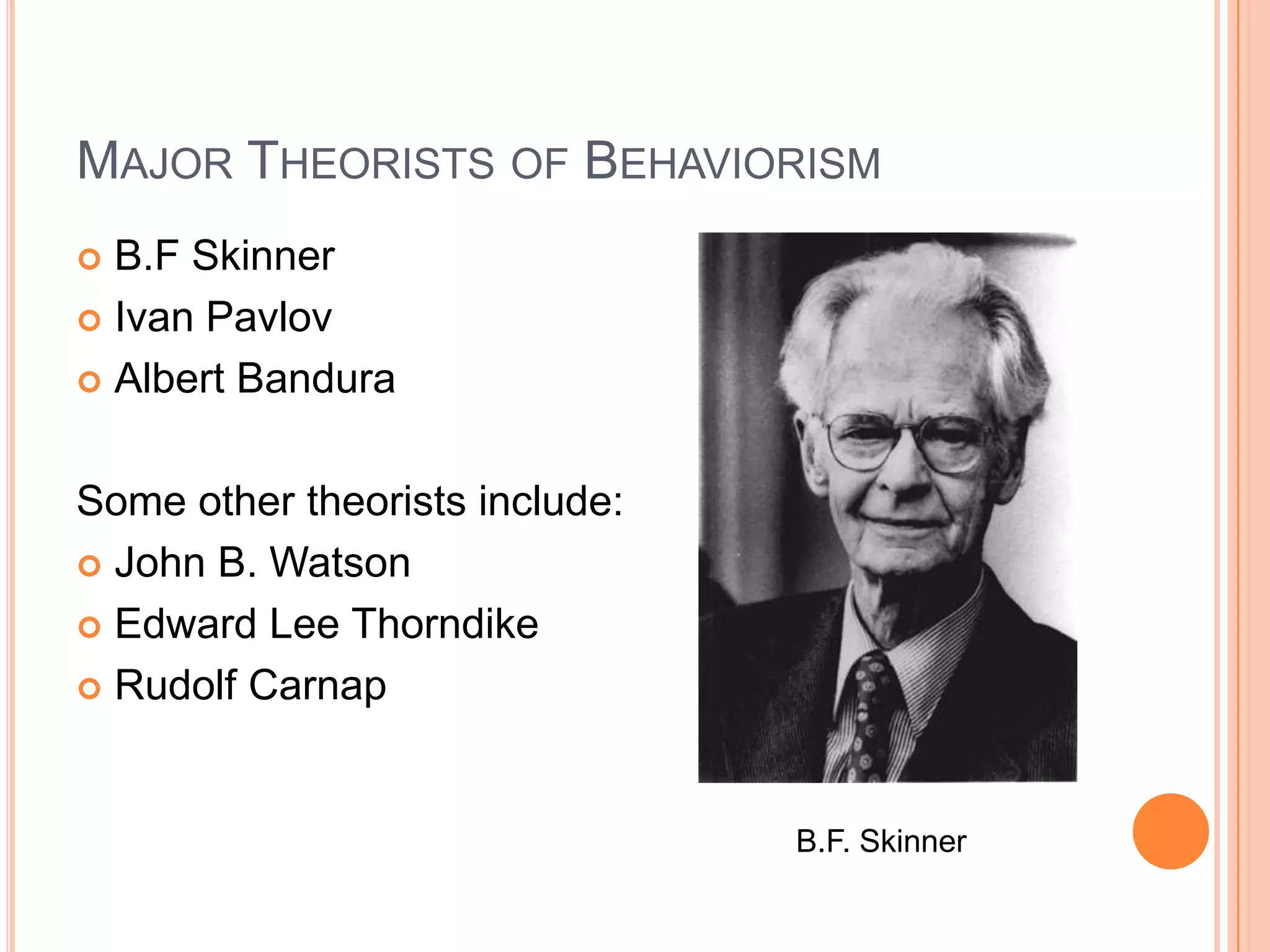
Major Theorists of BehaviorismB.F SkinnerIvan PavlovAlbert BanduraSome other theorists include:John B. WatsonEdward Lee ThorndikeRudolf CarnapB.F. Skinner
Types of BehaviorismMethodical (Watson)Radical (Skinner)Teleological (post-Skinner thought)Theoretical  (post-Skinner thought)Biological (post- Skinner thought)Psychological (Arthur Staats)These movements were the primary, but not only thoughts within the behaviorist movement.  Many thoughts branched from those of Skinner and Watson and focused on the study of human behavior in schools.
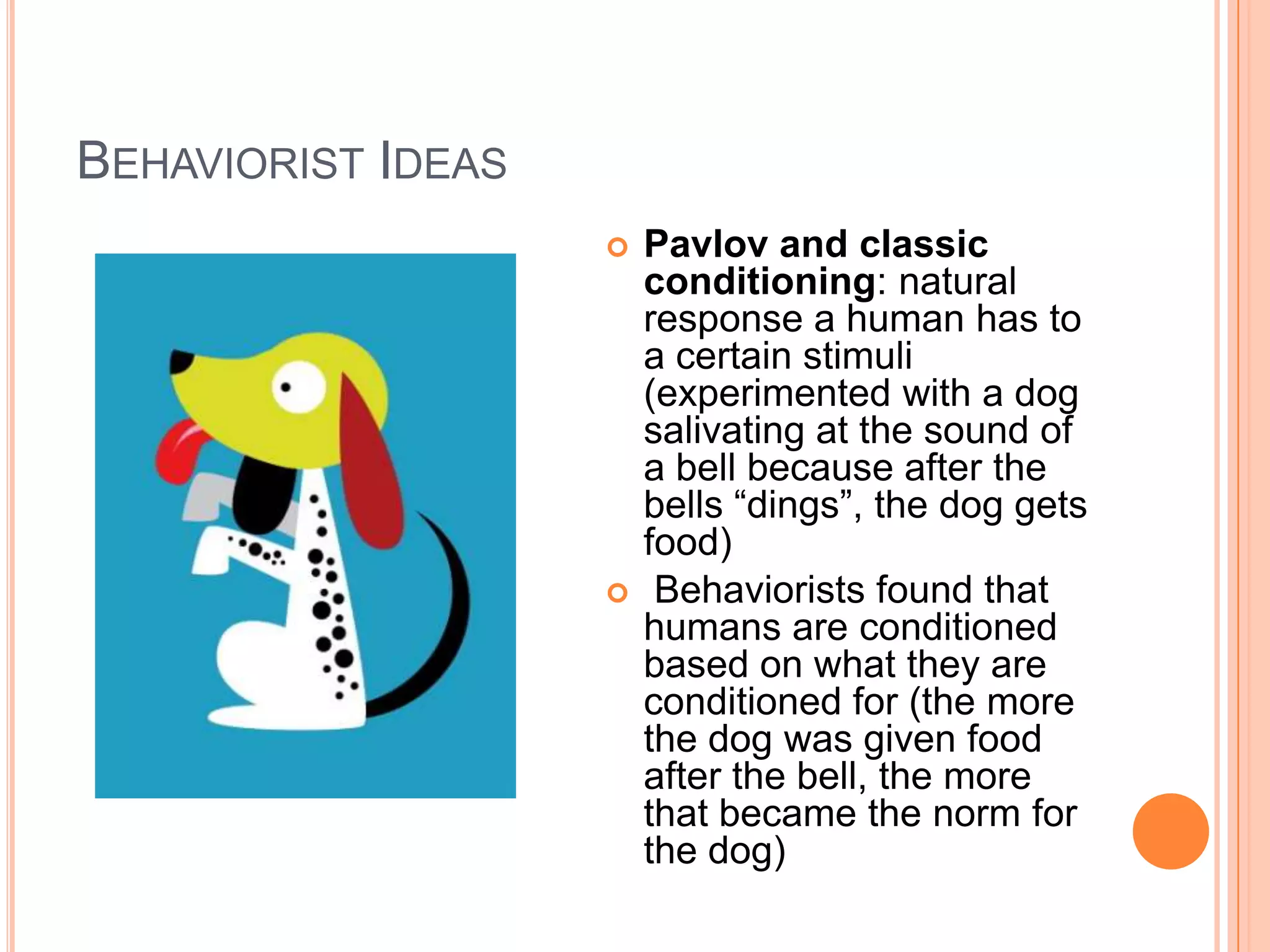
Behaviorist IdeasPavlov and classic conditioning: natural response a human has to a certain stimuli (experimented with a dog salivating at the sound of a bell because after the bells “dings”, the dog gets food) Behaviorists found that humans are conditioned based on what they are conditioned for (the more the dog was given food after the bell, the more that became the norm for the dog)
Behaviorist Ideas (Continued)Skinner and operant conditioning: learning is controlled and results in shaping behavior through the reinforcement of stimulus-response patterns Skinner found that people shape their behavior based on positive reinforcement and rewards (or the stimulus-response theory)Reinforcement is a powerful motivatorBandura’s focus was on social learning to see why it is that Skinner’s theory is true for humans and why we respond well to motivatorsObservational modeling: watching something and then mimicking the observed behavior
Educational ApplicationsWithout technology:Encourage good behavior
Use positive reinforcement (motivators) to reward those students who follow instructions
Show other students they can earn the same rewards for good behaviors

Behaviorist Learning Theory

  • 1.
  • 2.
    What is Behaviorism?Theprediction and control of human behavior where independent thinking plays no real part in its teaching methodsBelief that men could be studied based on their behaviorA school of thought began in the 19th century
  • 3.
    Major Theorists ofBehaviorismB.F SkinnerIvan PavlovAlbert BanduraSome other theorists include:John B. WatsonEdward Lee ThorndikeRudolf CarnapB.F. Skinner
  • 4.
    Types of BehaviorismMethodical(Watson)Radical (Skinner)Teleological (post-Skinner thought)Theoretical (post-Skinner thought)Biological (post- Skinner thought)Psychological (Arthur Staats)These movements were the primary, but not only thoughts within the behaviorist movement. Many thoughts branched from those of Skinner and Watson and focused on the study of human behavior in schools.
  • 5.
    Behaviorist IdeasPavlov andclassic conditioning: natural response a human has to a certain stimuli (experimented with a dog salivating at the sound of a bell because after the bells “dings”, the dog gets food) Behaviorists found that humans are conditioned based on what they are conditioned for (the more the dog was given food after the bell, the more that became the norm for the dog)
  • 6.
    Behaviorist Ideas (Continued)Skinnerand operant conditioning: learning is controlled and results in shaping behavior through the reinforcement of stimulus-response patterns Skinner found that people shape their behavior based on positive reinforcement and rewards (or the stimulus-response theory)Reinforcement is a powerful motivatorBandura’s focus was on social learning to see why it is that Skinner’s theory is true for humans and why we respond well to motivatorsObservational modeling: watching something and then mimicking the observed behavior
  • 7.
  • 8.
    Use positive reinforcement(motivators) to reward those students who follow instructions
  • 9.
    Show other studentsthey can earn the same rewards for good behaviors
  • 10.
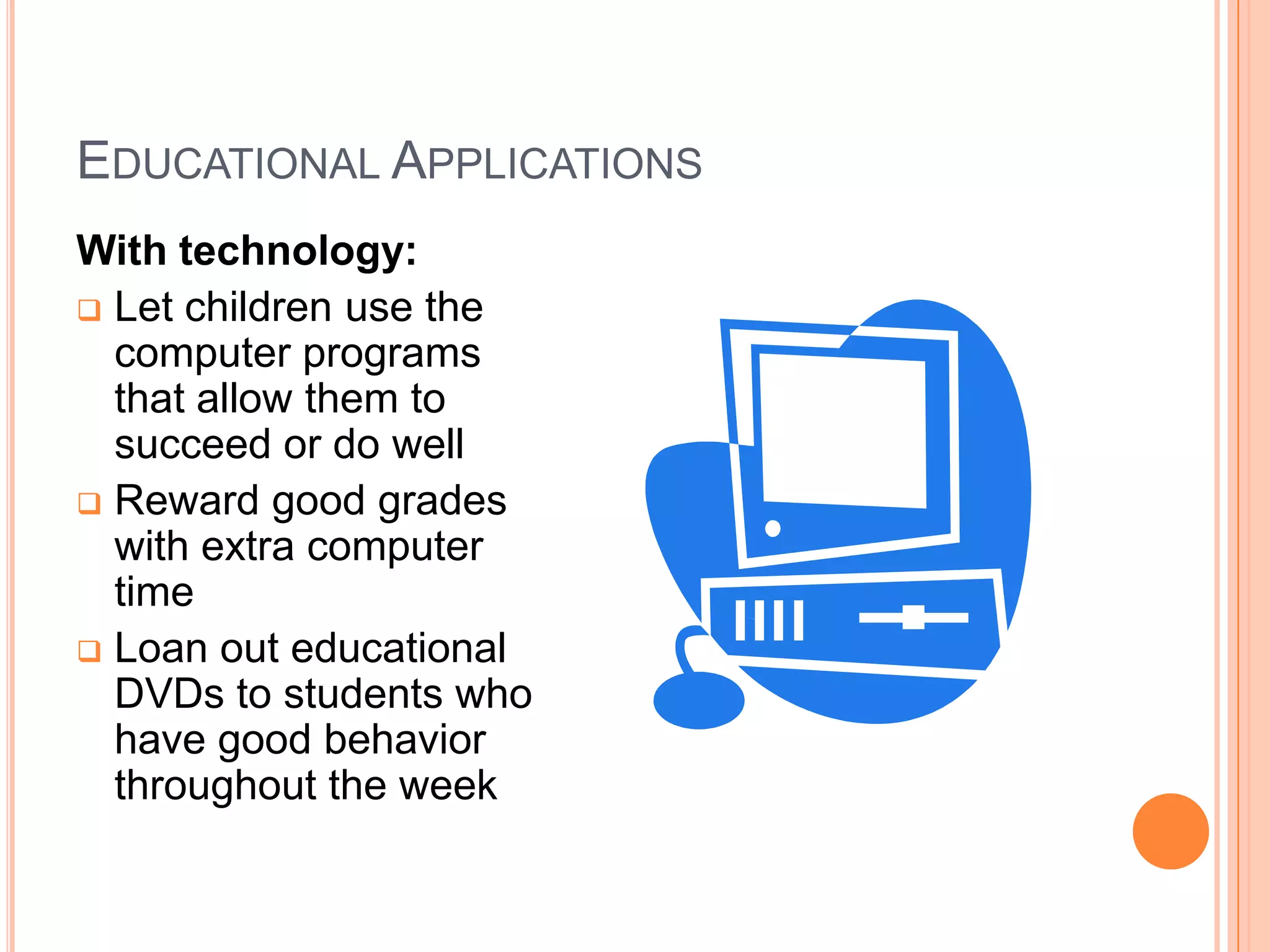
    Give the childrenwho do not have good behavior the chance to do so and receive a motivatorEducational ApplicationsWith technology:Let children use the computer programs that allow them to succeed or do well
  • 11.
    Reward good gradeswith extra computer time
  • 12.
    Loan out educationalDVDs to students who have good behavior throughout the weekSources CitedDe Mar, Gary (1989). http://www.forerunner.com/forerunner/X0497_DeMar_-_Behaviorism.htmlPicture of B.F. Skinner http://images.google.com/imgres?imgurl=http://blog.pucp.edu.pe/media/229/20070830-skinner.jpg&imgrefurl=http://blog.pucp.edu.pe/item/13330&usg=__JJt0y4oF83Ae9e1nAI0jtUd6TTI=&h=452&w=311&sz=31&hl=en&start=3&um=1&itbs=1&tbnid=c5LzrT-LFryoCM:&tbnh=127&tbnw=87&prev=/images%3Fq%3Db.f.%2Bskinner%26um%3D1%26hl%3Den%26tbs%3Disch:1