SKINNER’s Behaviorist Theories of Learning: Building on the S-R Connection Stimulus-Response
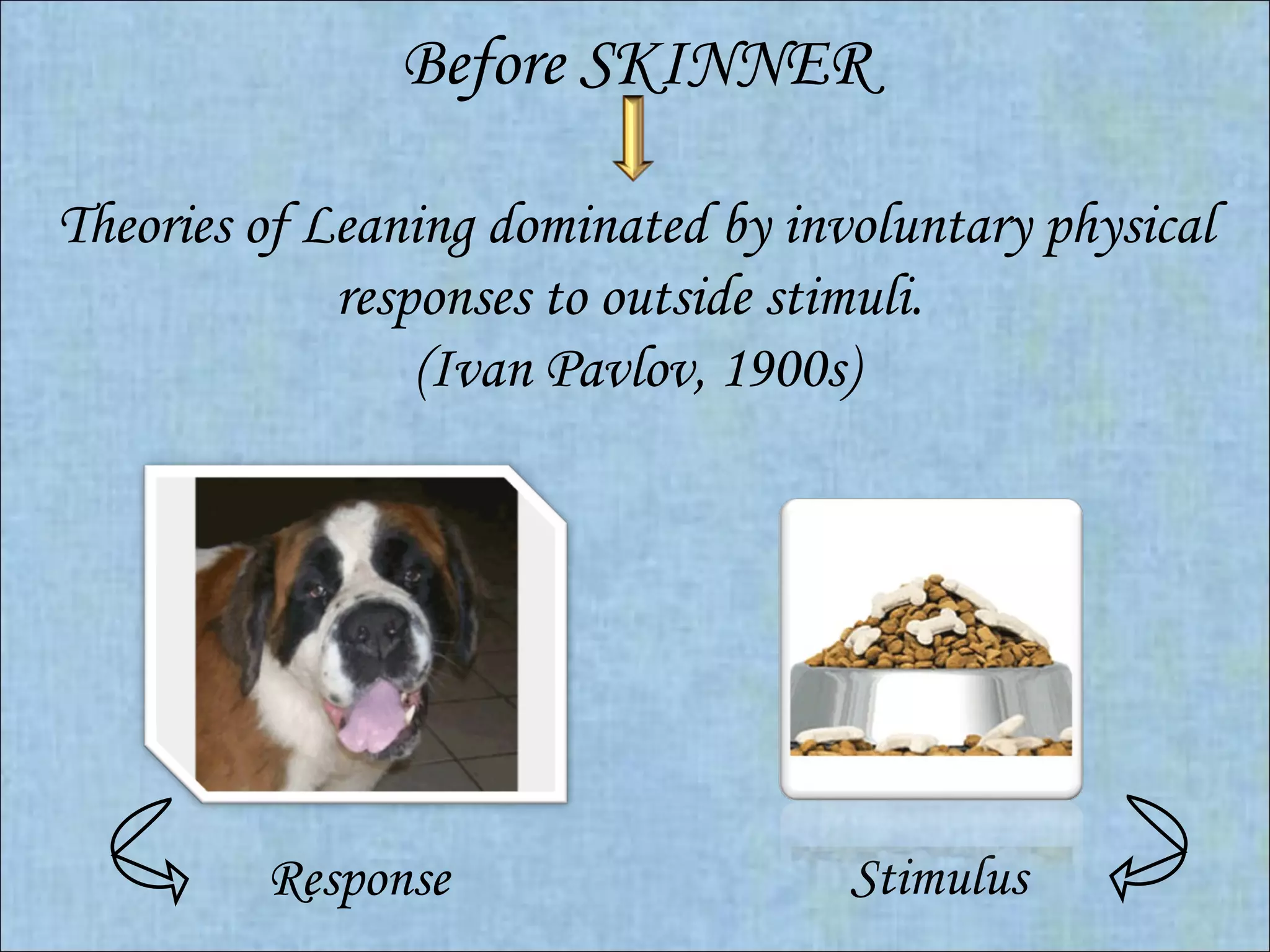
Before SKINNER Theories of Leaning dominated by involuntary physical responses to outside stimuli.  (Ivan Pavlov, 1900s) Response Stimulus
SKINNER’S THEORY    People can have mental control over their responses.  “ behavior is more controlled by the consequences of actions than by  events preceding the actions”  (Eggen & Kauchak, 1999).     Internal processes involved in learning could not be seen directly    cause and effect relationships established by observation.  Human behavior could be shaped by “contingencies of reinforcement” or situations in which  reinforcement   for a learner is made contingent upon a desired response.
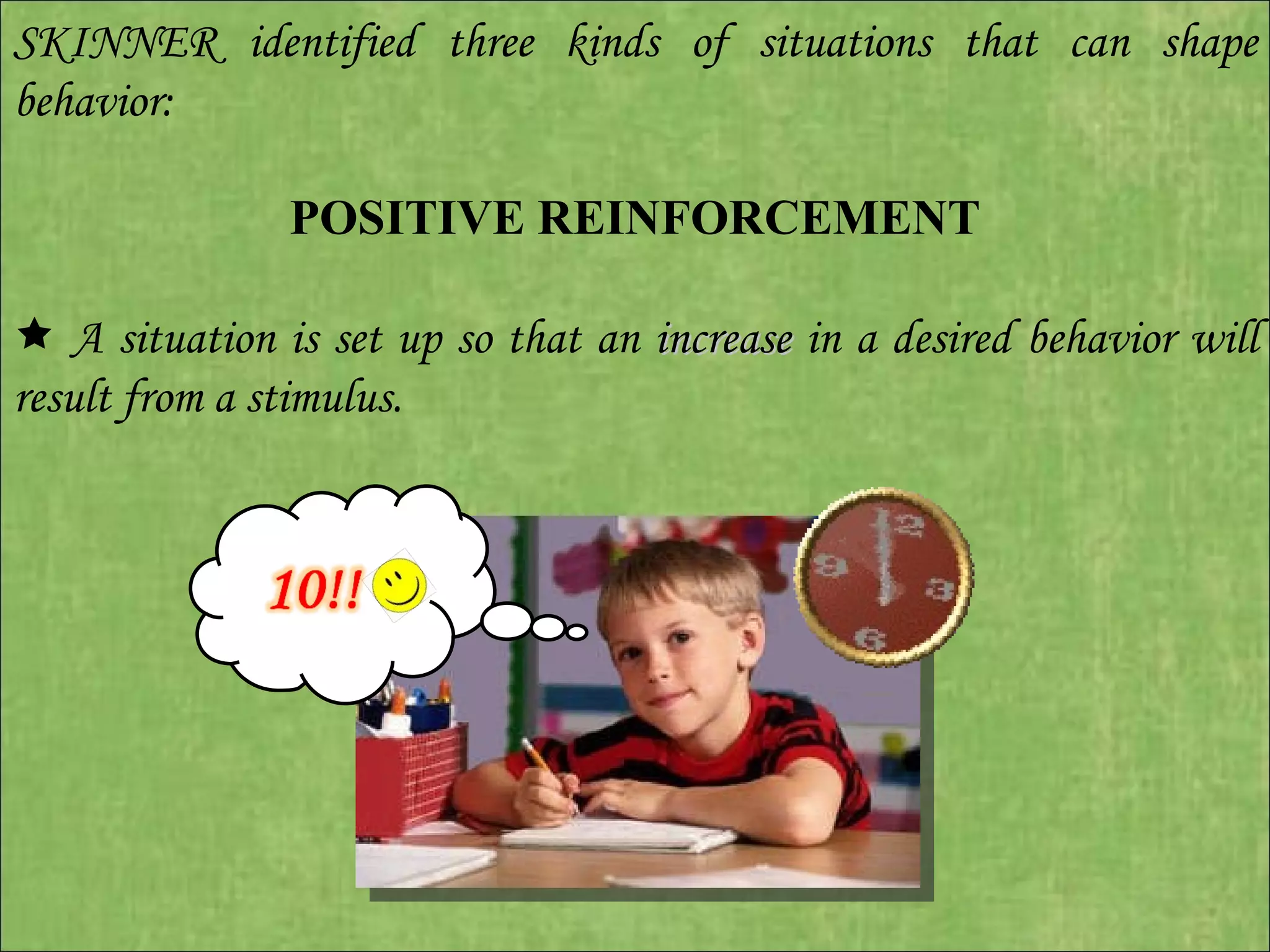
SKINNER identified three kinds of situations that can shape behavior:   POSITIVE REINFORCEMENT      A situation is set up so that an  increase  in a desired behavior will result from a stimulus.
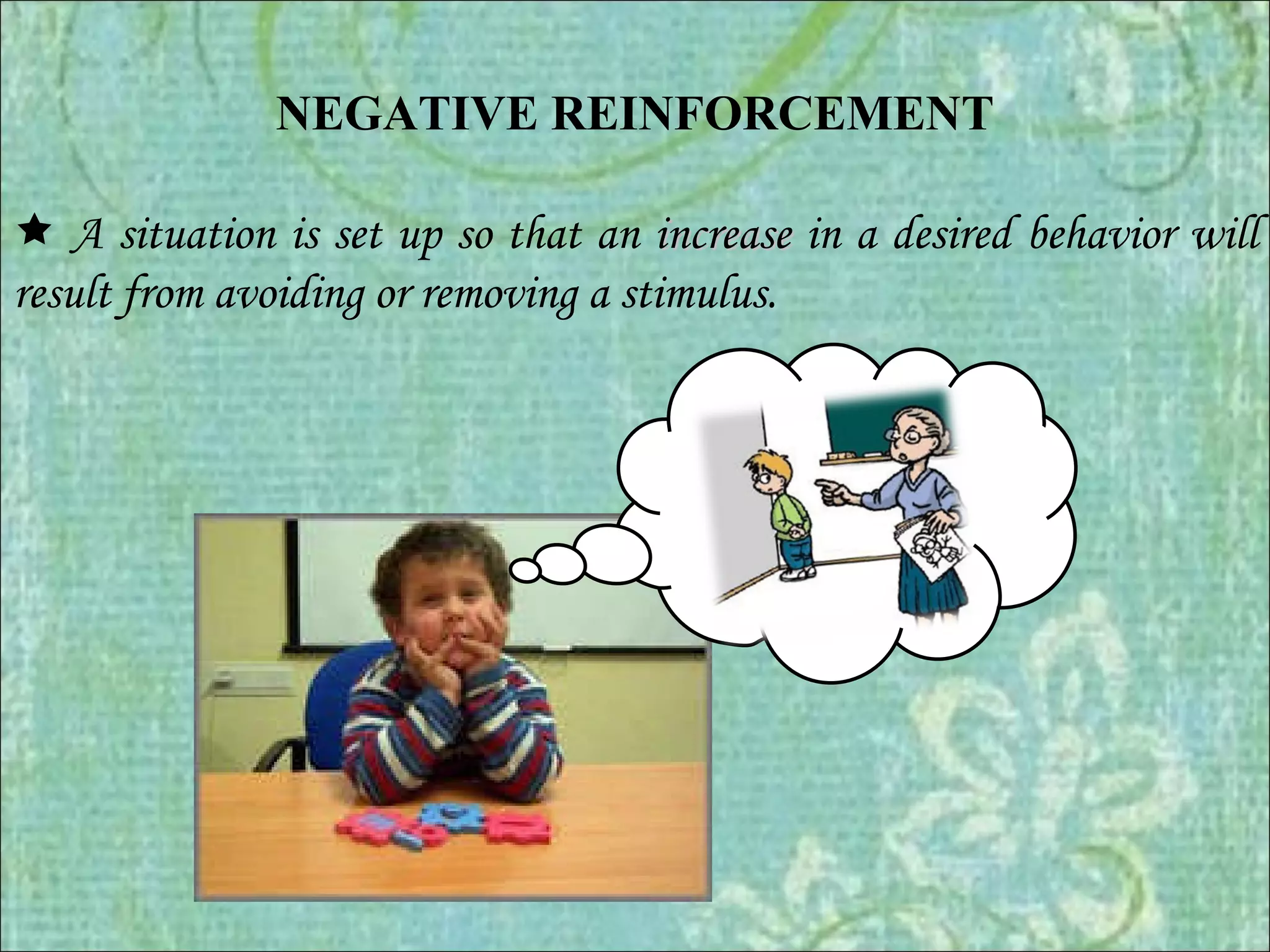
NEGATIVE REINFORCEMENT      A situation is set up so that an  increase   in a desired behavior will result from avoiding or removing a stimulus.
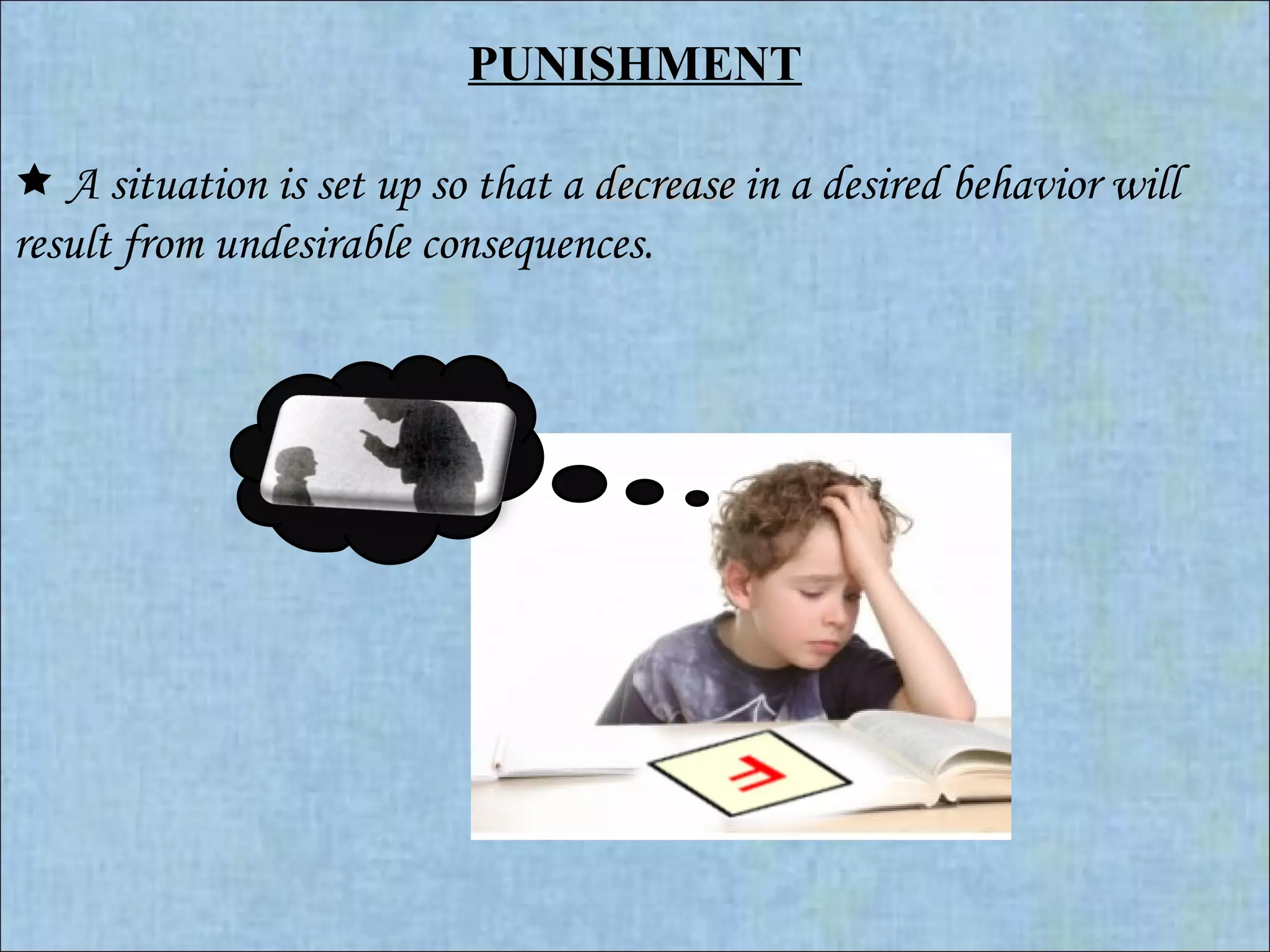
PUNISHMENT      A situation is set up so that a  decrease   in a desired behavior will result from undesirable consequences.
INPLICATIONS FOR EDUCATION   To SKINNER:      Teaching was a process of arranging contingencies of reinforcement effectively to bring about learning    It was simply a matter of establishing chains of behavior through principles of reinforcement    Programmed instruction was the most efficient means available for learning skills.    Many of his classroom management and instructional techniques  are widely used today
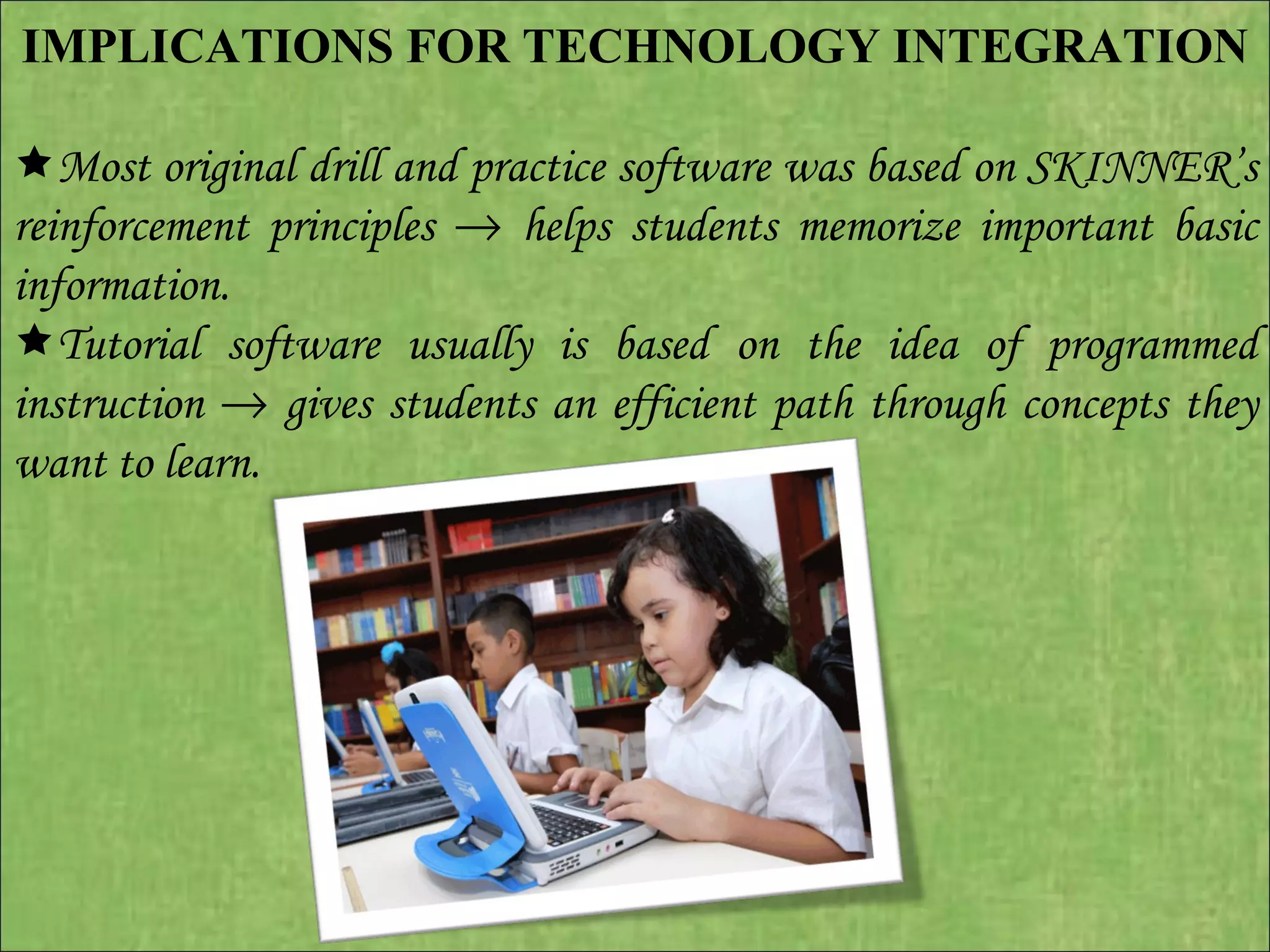
IMPLICATIONS FOR TECHNOLOGY INTEGRATION    Most original drill and practice software was based on SKINNER’s reinforcement principles    helps students memorize important basic information.  Tutorial software usually is based on the idea of programmed instruction    gives students an efficient path through concepts they want to learn.
Carolina García    Romina Hernández Practice II 2010

Skinner

  • 1.
    SKINNER’s Behaviorist Theoriesof Learning: Building on the S-R Connection Stimulus-Response
  • 2.
    Before SKINNER Theoriesof Leaning dominated by involuntary physical responses to outside stimuli. (Ivan Pavlov, 1900s) Response Stimulus
  • 3.
    SKINNER’S THEORY   People can have mental control over their responses.  “ behavior is more controlled by the consequences of actions than by events preceding the actions” (Eggen & Kauchak, 1999).  Internal processes involved in learning could not be seen directly  cause and effect relationships established by observation.  Human behavior could be shaped by “contingencies of reinforcement” or situations in which reinforcement for a learner is made contingent upon a desired response.
  • 4.
    SKINNER identified threekinds of situations that can shape behavior:   POSITIVE REINFORCEMENT    A situation is set up so that an increase in a desired behavior will result from a stimulus.
  • 5.
    NEGATIVE REINFORCEMENT   A situation is set up so that an increase in a desired behavior will result from avoiding or removing a stimulus.
  • 6.
    PUNISHMENT    A situation is set up so that a decrease in a desired behavior will result from undesirable consequences.
  • 7.
    INPLICATIONS FOR EDUCATION  To SKINNER:    Teaching was a process of arranging contingencies of reinforcement effectively to bring about learning  It was simply a matter of establishing chains of behavior through principles of reinforcement  Programmed instruction was the most efficient means available for learning skills.   Many of his classroom management and instructional techniques are widely used today
  • 8.
    IMPLICATIONS FOR TECHNOLOGYINTEGRATION    Most original drill and practice software was based on SKINNER’s reinforcement principles  helps students memorize important basic information.  Tutorial software usually is based on the idea of programmed instruction  gives students an efficient path through concepts they want to learn.
  • 9.
    Carolina García  Romina Hernández Practice II 2010