Unit 3.1 The behaviorist
Perspective
Learning Outcomes :
• Explain the basic principles of behaviorism
• Make a simple plan applying the primary laws of learning
• Determine how to use rewards in the learning process more effectively
The theory of behaviorism focuses on the study of
observable and measurable behavior. It emphasizes
that behavior is mostly learned through
conditioning the reinforcement ( reward and
punishment) . It does not give us much attention to
the mind and possibility of thought processes
occurring in the mind. Contributions in the
development of the behaviorist theory largely
came from Pavlov, Watson, Thorndike and Skinner.
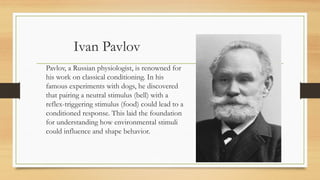
Ivan Pavlov
Pavlov, a Russian physiologist, is renowned for
his work on classical conditioning. In his
famous experiments with dogs, he discovered
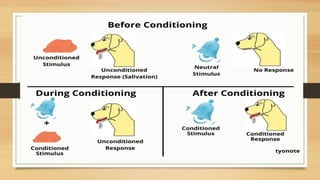
that pairing a neutral stimulus (bell) with a
reflex-triggering stimulus (food) could lead to a
conditioned response. This laid the foundation
for understanding how environmental stimuli
could influence and shape behavior.
Stimulus Generalization
Stimulus generalization occurs when behavior becomes
more probable in the presence of one stimulus or situation
as a result of having been reinforced in the presence of
another stimulus or situation’ (Martin & Pear, 1999, p. 145).
This can occur due to physical similarity or due to
conceptual learning.
Extinction
The conditioned response to a cue that predicted food
delivery decreased and eventually disappeared when food
no longer followed the cue.
Spontaneous Recovery
Spontaneous recovery is the reappearance of a
Conditioned Response (CR) that has been extinguished.
Pavlov and his classical conditioning experiments found
that spontaneous recovery can occur after a period of not
being exposed to the Conditioned Stimulus (CS).
Descrimination
Pavlov’s dogs discriminated between the basic tone that
sounded before they were fed and other tones (e.g., the
doorbell), because the other sounds did not predict the
arrival of food. Similarly, Tiger, the cat, discriminated
between the sound of the can opener and the sound of the
electric mixer
Higher Order Conditioning
Higher order conditioning is commonly seen in animal
learning. When Ivan Pavlov gave dogs food (unconditioned
stimulus) and bell (neutral stimulus) together, he observed
that dogs salivated (conditioned response) even when they
only heard the bell (first order stimulus) without the sight
of food.
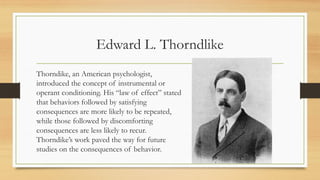
Edward L. Thorndlike
Thorndike, an American psychologist,
introduced the concept of instrumental or
operant conditioning. His “law of effect” stated
that behaviors followed by satisfying
consequences are more likely to be repeated,
while those followed by discomforting
consequences are less likely to recur.
Thorndike’s work paved the way for future
studies on the consequences of behavior.
Law of effect
The law of effect principle developed by Edward Thorndike suggested that
responses that produce a satisfying effect in a particular situation become more
likely to occur again i that situation, and responses that produce a
discomforting effect become less likely to occur again in that situation.
Law of Excercise
The law of exercise stated that behaviour is more strongly established through
frequent connections of stimulus and response. In 1932 Thorndike determined
that the second of his laws was not entirely valid in all cases
Law of Readiness
Edward Thorndike’s Law of Readiness refers to a preparatory set on the part
of the subject to learn. It points out that learning only happens when one is
physically and mentally ready for it. This law states that learning can only take
place when a student is ready to learn.
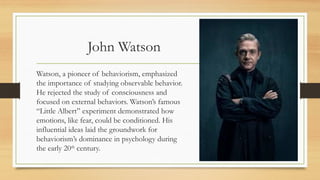
John Watson
Watson, a pioneer of behaviorism, emphasized
the importance of studying observable behavior.
He rejected the study of consciousness and
focused on external behaviors. Watson’s famous
“Little Albert” experiment demonstrated how
emotions, like fear, could be conditioned. His
influential ideas laid the groundwork for
behaviorism’s dominance in psychology during
the early 20th
century.
Experiment on Albert
What happened in the Little Albert experiment? Little Albert entered the
experiment without a fear of white rats. During the experiment, Watson paired
the white rat with a loud bang repeatedly to create an association between the
two unrelated stimuli, and little Albert began fearing the white rat without the
noise.
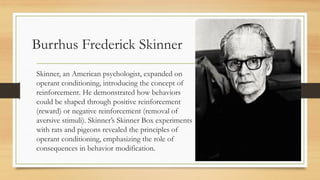
Burrhus Frederick Skinner
Skinner, an American psychologist, expanded on
operant conditioning, introducing the concept of
reinforcement. He demonstrated how behaviors
could be shaped through positive reinforcement
(reward) or negative reinforcement (removal of
aversive stimuli). Skinner’s Skinner Box experiments
with rats and pigeons revealed the principles of
operant conditioning, emphasizing the role of
consequences in behavior modification.
Operant Conditioning
According to this principle, behavior that is followed by pleasant consequences
is likely to be repeated, and behavior followed by unpleasant consequences is
less likely to be repeated. Skinner introduced a new term into the Law of Effect
– Reinforcement.
Reinforcement
B.F Skinner’s work is built on the assumption that behaviour is influenced by its
consequences. Reinforcement theory is the process of shaping behavior by
controlling consequences of the behavior. Reinforcement theory proposes that
you can change someone’s behaviour by using reinforcement, punishment, and
extinction
Positive reinforcer
Positive reinforcement refers to the introduction of desirable or pleasant
stimuli after the performance of a behavior. This reward can be used to further
encourage that behavior, or change a pre-existing one. There are four types of
positive reinforcers: natural, tangible, social, and token
Negative reinforcer
Skinner in his theories on operant conditioning, negative reinforcement is the
removal of an unwanted outcome in order to strengthen a behavioral response.
In simpler terms, if you want a person to behave in a certain way, then reward
good behavior by taking away something that the person views as negative
Punishment
Positive punishment is a type of operant conditioning, a theory proposed by
psychologist B.F Skinner. Its main purpose is to reduce the future frequency of
the behavior by applying an aversive stimulus after the behavior occurs. Positive
punishment in psychology is what we refer to as “punishment” in everyday life
Extinction or none reinforcement
Extinction is a means to stop someone from performing a learned behaviour.
The technical term for these processes is called ‘operant conditioning’. The
fundamental concepts of this theory are reinforcement, punishment, and
extinction.
Shaping of behavior
Shaping. In his operant conditioning experiments, Skinner often used an
approach called shaping . Instead of rewarding only the target behavior, in
shaping, we reward successive approximations of a target behavior. For
instance, parents can break a task into smaller more “attainable” steps
Behavioral chaining
When an individual puts on a t-shirt, placement of the shirt on top of the
individual’s head is a cue for the individual to pull the shirt over the head;
having the shirt around the individual’s neck is a cue for the individual to put
each arm through the armholes, etc.
Reinforcement Schedules
The most notable schedules of reinforcement presented by Skinner were
interval (fixed or variable) and ratio (fixed or variable). Continuous
reinforcement — constant delivery of reinforcement for an action; every time a
specific action was performed the subject instantly and always received a
reinforcement
Fix interval Schedule
• Actions that are followed by unfavorable outcomes become less likely to
occur again in the future. It was noted psychologist B.F. Skinner who first
described this operant conditioning process. By reinforcing actions, he
observed, those actions became stronger.
Fixed interval Schedules
Fixed-interval schedules are those where the first response is rewarded only
after a specified amount of time has elapsed. This schedule causes high
amounts of responding near the end of the interval but slower responding
immediately after the delivery of the reinforcer
Variable interval Schedules
• Variable Interval Schedule (VI) : An operant conditioning principle in which
behaviour is reinforced based on an average time that has expired since the
last reinforcement.
Fixed Ratio Schedule
The fixed ratio schedule involves using a constant number of responses. For
example, if the rabbit is reinforced every time it pulls the lever exactly five
times, it would be reinforced on an FR 5 schedule. Ratio schedules involve
reinforcement after an average number of responses have occurred
Variable ratio Schedules
variable ratio schedule is a schedule of reinforcement where a behavior is
reinforced after a random number of responses. This kind of schedule results
in high, steady rates of response. Organisms are persistent in responding
because of the hope that the next response might be one needed to receive
reinforcement.
Module 8: Neo Behaviorism: Tolman and
Bandura
• Certainly! Tolman and Bandura were influential figures in the development
of Neo-Behaviorism, a psychological perspective that expanded upon
traditional behaviorism by incorporating cognitive processes. Let’s briefly
explore their contributions:
Edward Chace Tolman
Edward Chace Tolman (April 14, 1886 – November 19,
1959) was an American psychologist and a professor of
psychology at the University of California, Berkeley.[1]
[2] Through Tolman’s theories and works, he founded
what is now a branch of psychology known as
purposive behaviorism. Tolman also promoted the
concept known as latent learning first coined by
Blodgett (1929).[3] A Review of General Psychology
survey, published in 2002, ranked Tolman as the 45th
most cited psychologist of the 20th
century.[
Introduced the concept of “latent learning,” suggesting that learning can
occur without immediate reinforcement and might only become evident later.
Emphasized the importance of cognitive maps, mental representations of
spatial relationships, in guiding behavior.
Argued for the existence of intervening variables (cognitive processes) that
mediate between stimuli and responses
Significance
Tolman’s work challenged strict behaviorist views by highlighting the role of
cognitive factors in learning and behavior.
Paved the way for cognitive psychology, as his ideas laid the foundation for
studying mental processes alongside observable behaviors.
Albert Bandura
Bandura was responsible for contributions to the field of
education and to several fields of psychology, including social
cognitive theory, therapy, and personality psychology, and was
also of influence in the transition between behaviorism and
cognitive psychology. He is known as the originator of social
learning theory (also known as the social cognitive theory)[2] and
the theoretical construct of self-efficacy, and is also responsible
for the influential 1961 Bobo doll experiment. This Bobo doll
experiment demonstrated the concept of observational learning.
Developed the social learning theory, suggesting that individuals learn from
observing others (modeling) and the consequences of their actions.
Introduced the concept of self-efficacy, the belief in one’s ability to perform
tasks, influencing motivation and behavior.
Proposed reciprocal determinism, emphasizing the dynamic interplay between
individual factors, behavior, and the environment.
Significance
Bandura’s work expanded behavioral theories to include cognitive processes,
acknowledging the role of mental states in learning and behavior.
Contributed to the understanding of how observational learning and modeling
play a crucial role in shaping behavior.
Commonalities
Both Tolman and Bandura shifted the focus from strict behaviorism to a more inclusive
perspective that recognized the significance of cognitive processes in understanding
behavior.
Emphasized the importance of considering internal mental representations, intervening
variables, and observational learning in explaining human behavior.
In summary, Tolman and Bandura played pivotal roles in the evolution of Neo-
Behaviorism, incorporating cognitive elements into the traditional behaviorist
framework. Their ideas laid the groundwork for a more comprehensive understanding
of learning and behavior, influencing subsequent developments in psychology.
Module 9 Gestalt Psychology ( The Cognitive
Perspective)
The Cognitive Perspective
This approach focuses on how internal thoughts and feelings influence one’s
behavior. The cognitive approach emphasizes the importance of memory,
perception and attention, language, decision-making and problem-solving. This
approach often compares the human mind to that of a computer.
• Gestalt psychology, school of psychology founded in
the 20th
century that provided the foundation for the
modern study of perception. Gestalt theory emphasizes
that the whole of anything is greater than its parts. That

is, the attributes of the whole are not deducible from
analysis of the parts in isolation.
Gastalt principles
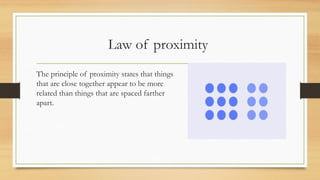
Law of proximity
The principle of proximity states that things
that are close together appear to be more
related than things that are spaced farther
apart.
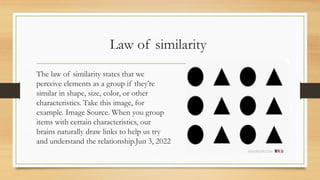
Law of similarity
The law of similarity states that we
perceive elements as a group if they’re
similar in shape, size, color, or other
characteristics. Take this image, for
example. Image Source. When you group
items with certain characteristics, our
brains naturally draw links to help us try
and understand the relationship.Jun 3, 2022
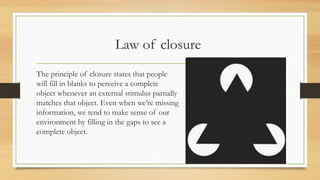
Law of closure
The principle of closure states that people
will fill in blanks to perceive a complete
object whenever an external stimulus partially
matches that object. Even when we’re missing
information, we tend to make sense of our
environment by filling in the gaps to see a
complete object.
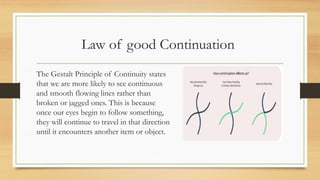
Law of good Continuation
The Gestalt Principle of Continuity states
that we are more likely to see continuous
and smooth flowing lines rather than
broken or jagged ones. This is because
once our eyes begin to follow something,
they will continue to travel in that direction
until it encounters another item or object.
Thank you for Listening
Prepared by: Jullemar Gulada
BTLED-AFA 3

Behaviorism perspectives group reporting

  • 1.
    Unit 3.1 Thebehaviorist Perspective
  • 2.
    Learning Outcomes : •Explain the basic principles of behaviorism • Make a simple plan applying the primary laws of learning • Determine how to use rewards in the learning process more effectively
  • 3.
    The theory ofbehaviorism focuses on the study of observable and measurable behavior. It emphasizes that behavior is mostly learned through conditioning the reinforcement ( reward and punishment) . It does not give us much attention to the mind and possibility of thought processes occurring in the mind. Contributions in the development of the behaviorist theory largely came from Pavlov, Watson, Thorndike and Skinner.
  • 4.
    Ivan Pavlov Pavlov, aRussian physiologist, is renowned for his work on classical conditioning. In his famous experiments with dogs, he discovered that pairing a neutral stimulus (bell) with a reflex-triggering stimulus (food) could lead to a conditioned response. This laid the foundation for understanding how environmental stimuli could influence and shape behavior.
  • 6.
    Stimulus Generalization Stimulus generalizationoccurs when behavior becomes more probable in the presence of one stimulus or situation as a result of having been reinforced in the presence of another stimulus or situation’ (Martin & Pear, 1999, p. 145). This can occur due to physical similarity or due to conceptual learning.
  • 7.
    Extinction The conditioned responseto a cue that predicted food delivery decreased and eventually disappeared when food no longer followed the cue.
  • 8.
    Spontaneous Recovery Spontaneous recoveryis the reappearance of a Conditioned Response (CR) that has been extinguished. Pavlov and his classical conditioning experiments found that spontaneous recovery can occur after a period of not being exposed to the Conditioned Stimulus (CS).
  • 9.
    Descrimination Pavlov’s dogs discriminatedbetween the basic tone that sounded before they were fed and other tones (e.g., the doorbell), because the other sounds did not predict the arrival of food. Similarly, Tiger, the cat, discriminated between the sound of the can opener and the sound of the electric mixer
  • 10.
    Higher Order Conditioning Higherorder conditioning is commonly seen in animal learning. When Ivan Pavlov gave dogs food (unconditioned stimulus) and bell (neutral stimulus) together, he observed that dogs salivated (conditioned response) even when they only heard the bell (first order stimulus) without the sight of food.
  • 11.
    Edward L. Thorndlike Thorndike,an American psychologist, introduced the concept of instrumental or operant conditioning. His “law of effect” stated that behaviors followed by satisfying consequences are more likely to be repeated, while those followed by discomforting consequences are less likely to recur. Thorndike’s work paved the way for future studies on the consequences of behavior.
  • 12.
    Law of effect Thelaw of effect principle developed by Edward Thorndike suggested that responses that produce a satisfying effect in a particular situation become more likely to occur again i that situation, and responses that produce a discomforting effect become less likely to occur again in that situation.
  • 13.
    Law of Excercise Thelaw of exercise stated that behaviour is more strongly established through frequent connections of stimulus and response. In 1932 Thorndike determined that the second of his laws was not entirely valid in all cases
  • 14.
    Law of Readiness EdwardThorndike’s Law of Readiness refers to a preparatory set on the part of the subject to learn. It points out that learning only happens when one is physically and mentally ready for it. This law states that learning can only take place when a student is ready to learn.
  • 15.
    John Watson Watson, apioneer of behaviorism, emphasized the importance of studying observable behavior. He rejected the study of consciousness and focused on external behaviors. Watson’s famous “Little Albert” experiment demonstrated how emotions, like fear, could be conditioned. His influential ideas laid the groundwork for behaviorism’s dominance in psychology during the early 20th century.
  • 16.
    Experiment on Albert Whathappened in the Little Albert experiment? Little Albert entered the experiment without a fear of white rats. During the experiment, Watson paired the white rat with a loud bang repeatedly to create an association between the two unrelated stimuli, and little Albert began fearing the white rat without the noise.
  • 17.
    Burrhus Frederick Skinner Skinner,an American psychologist, expanded on operant conditioning, introducing the concept of reinforcement. He demonstrated how behaviors could be shaped through positive reinforcement (reward) or negative reinforcement (removal of aversive stimuli). Skinner’s Skinner Box experiments with rats and pigeons revealed the principles of operant conditioning, emphasizing the role of consequences in behavior modification.
  • 18.
    Operant Conditioning According tothis principle, behavior that is followed by pleasant consequences is likely to be repeated, and behavior followed by unpleasant consequences is less likely to be repeated. Skinner introduced a new term into the Law of Effect – Reinforcement.
  • 19.
    Reinforcement B.F Skinner’s workis built on the assumption that behaviour is influenced by its consequences. Reinforcement theory is the process of shaping behavior by controlling consequences of the behavior. Reinforcement theory proposes that you can change someone’s behaviour by using reinforcement, punishment, and extinction
  • 20.
    Positive reinforcer Positive reinforcementrefers to the introduction of desirable or pleasant stimuli after the performance of a behavior. This reward can be used to further encourage that behavior, or change a pre-existing one. There are four types of positive reinforcers: natural, tangible, social, and token
  • 21.
    Negative reinforcer Skinner inhis theories on operant conditioning, negative reinforcement is the removal of an unwanted outcome in order to strengthen a behavioral response. In simpler terms, if you want a person to behave in a certain way, then reward good behavior by taking away something that the person views as negative
  • 22.
    Punishment Positive punishment isa type of operant conditioning, a theory proposed by psychologist B.F Skinner. Its main purpose is to reduce the future frequency of the behavior by applying an aversive stimulus after the behavior occurs. Positive punishment in psychology is what we refer to as “punishment” in everyday life
  • 23.
    Extinction or nonereinforcement Extinction is a means to stop someone from performing a learned behaviour. The technical term for these processes is called ‘operant conditioning’. The fundamental concepts of this theory are reinforcement, punishment, and extinction.
  • 24.
    Shaping of behavior Shaping.In his operant conditioning experiments, Skinner often used an approach called shaping . Instead of rewarding only the target behavior, in shaping, we reward successive approximations of a target behavior. For instance, parents can break a task into smaller more “attainable” steps
  • 25.
    Behavioral chaining When anindividual puts on a t-shirt, placement of the shirt on top of the individual’s head is a cue for the individual to pull the shirt over the head; having the shirt around the individual’s neck is a cue for the individual to put each arm through the armholes, etc.
  • 26.
    Reinforcement Schedules The mostnotable schedules of reinforcement presented by Skinner were interval (fixed or variable) and ratio (fixed or variable). Continuous reinforcement — constant delivery of reinforcement for an action; every time a specific action was performed the subject instantly and always received a reinforcement
  • 27.
    Fix interval Schedule •Actions that are followed by unfavorable outcomes become less likely to occur again in the future. It was noted psychologist B.F. Skinner who first described this operant conditioning process. By reinforcing actions, he observed, those actions became stronger.
  • 28.
    Fixed interval Schedules Fixed-intervalschedules are those where the first response is rewarded only after a specified amount of time has elapsed. This schedule causes high amounts of responding near the end of the interval but slower responding immediately after the delivery of the reinforcer
  • 29.
    Variable interval Schedules •Variable Interval Schedule (VI) : An operant conditioning principle in which behaviour is reinforced based on an average time that has expired since the last reinforcement.
  • 30.
    Fixed Ratio Schedule Thefixed ratio schedule involves using a constant number of responses. For example, if the rabbit is reinforced every time it pulls the lever exactly five times, it would be reinforced on an FR 5 schedule. Ratio schedules involve reinforcement after an average number of responses have occurred
  • 31.
    Variable ratio Schedules variableratio schedule is a schedule of reinforcement where a behavior is reinforced after a random number of responses. This kind of schedule results in high, steady rates of response. Organisms are persistent in responding because of the hope that the next response might be one needed to receive reinforcement.
  • 32.
    Module 8: NeoBehaviorism: Tolman and Bandura • Certainly! Tolman and Bandura were influential figures in the development of Neo-Behaviorism, a psychological perspective that expanded upon traditional behaviorism by incorporating cognitive processes. Let’s briefly explore their contributions:
  • 33.
    Edward Chace Tolman EdwardChace Tolman (April 14, 1886 – November 19, 1959) was an American psychologist and a professor of psychology at the University of California, Berkeley.[1] [2] Through Tolman’s theories and works, he founded what is now a branch of psychology known as purposive behaviorism. Tolman also promoted the concept known as latent learning first coined by Blodgett (1929).[3] A Review of General Psychology survey, published in 2002, ranked Tolman as the 45th most cited psychologist of the 20th century.[
  • 34.
    Introduced the conceptof “latent learning,” suggesting that learning can occur without immediate reinforcement and might only become evident later. Emphasized the importance of cognitive maps, mental representations of spatial relationships, in guiding behavior. Argued for the existence of intervening variables (cognitive processes) that mediate between stimuli and responses
  • 35.
    Significance Tolman’s work challengedstrict behaviorist views by highlighting the role of cognitive factors in learning and behavior. Paved the way for cognitive psychology, as his ideas laid the foundation for studying mental processes alongside observable behaviors.
  • 36.
    Albert Bandura Bandura wasresponsible for contributions to the field of education and to several fields of psychology, including social cognitive theory, therapy, and personality psychology, and was also of influence in the transition between behaviorism and cognitive psychology. He is known as the originator of social learning theory (also known as the social cognitive theory)[2] and the theoretical construct of self-efficacy, and is also responsible for the influential 1961 Bobo doll experiment. This Bobo doll experiment demonstrated the concept of observational learning.
  • 37.
    Developed the sociallearning theory, suggesting that individuals learn from observing others (modeling) and the consequences of their actions. Introduced the concept of self-efficacy, the belief in one’s ability to perform tasks, influencing motivation and behavior. Proposed reciprocal determinism, emphasizing the dynamic interplay between individual factors, behavior, and the environment.
  • 38.
    Significance Bandura’s work expandedbehavioral theories to include cognitive processes, acknowledging the role of mental states in learning and behavior. Contributed to the understanding of how observational learning and modeling play a crucial role in shaping behavior.
  • 39.
    Commonalities Both Tolman andBandura shifted the focus from strict behaviorism to a more inclusive perspective that recognized the significance of cognitive processes in understanding behavior. Emphasized the importance of considering internal mental representations, intervening variables, and observational learning in explaining human behavior. In summary, Tolman and Bandura played pivotal roles in the evolution of Neo- Behaviorism, incorporating cognitive elements into the traditional behaviorist framework. Their ideas laid the groundwork for a more comprehensive understanding of learning and behavior, influencing subsequent developments in psychology.
  • 40.
    Module 9 GestaltPsychology ( The Cognitive Perspective) The Cognitive Perspective This approach focuses on how internal thoughts and feelings influence one’s behavior. The cognitive approach emphasizes the importance of memory, perception and attention, language, decision-making and problem-solving. This approach often compares the human mind to that of a computer.
  • 42.
    • Gestalt psychology,school of psychology founded in the 20th century that provided the foundation for the modern study of perception. Gestalt theory emphasizes that the whole of anything is greater than its parts. That is, the attributes of the whole are not deducible from analysis of the parts in isolation.

  • 43.
  • 44.
    Law of proximity Theprinciple of proximity states that things that are close together appear to be more related than things that are spaced farther apart.
  • 45.
    Law of similarity Thelaw of similarity states that we perceive elements as a group if they’re similar in shape, size, color, or other characteristics. Take this image, for example. Image Source. When you group items with certain characteristics, our brains naturally draw links to help us try and understand the relationship.Jun 3, 2022
  • 46.
    Law of closure Theprinciple of closure states that people will fill in blanks to perceive a complete object whenever an external stimulus partially matches that object. Even when we’re missing information, we tend to make sense of our environment by filling in the gaps to see a complete object.
  • 47.
    Law of goodContinuation The Gestalt Principle of Continuity states that we are more likely to see continuous and smooth flowing lines rather than broken or jagged ones. This is because once our eyes begin to follow something, they will continue to travel in that direction until it encounters another item or object.
  • 48.
    Thank you forListening Prepared by: Jullemar Gulada BTLED-AFA 3