"Give me a dozen healthy infants, well-formed,
and my own specified world to bring them up in
and I'll guarantee to take any one at random
and train him to become any type of specialist I
might select –
doctor, lawyer, artist, merchant-chief, and, yes,
even beggar-man
and thief, regardless of his talents, penchants,
tendencies,
abilities, vocations, and race of his ancestors.“
Presuppositions of Behaviorism
• Behaviorism teaches that man is nothing more
than a machine that responds to conditioning.
• Behaviorism teaches that we are not
responsible for our actions
• Behaviorism is manipulative
Founder of Behaviorism
• John B. Watson, (1878-1958) an American
psychologist.
• Watson claimed that psychology was not
concerned with the mind or with human
consciousness
• Watson's work was based on the experiments
of Ivan Pavlov
Forerunners of Behaviorism
• Ivan Pavlov studied animals' responses to
conditioning
• Pavlov's best-known experiment, he rang a
bell as he fed some dogs several meals
Behaviorism
Basic Assumptions of Behaviorism
• Behavior is all that matters, the stimulus and response.
• behaviorists
substitute verbal behavior (e.g. responding appropriately to a
question) for physical
behavior.
• It doesn't matter what goes on inside the mind.
• All behavior is learned. And maladaptive
behavior is no different .
• This learning can be understood in terms of
the principles of conditioning and modeling.
• What was learned can be unlearned, using
the same principles.
• the same laws apply to human and non
human.
Humanistic psychology
The basic themes of Humanistic Psychology
An emphasis on conscious experience
A belief in the wholeness of human nature
A focus on free will ,spontaniety,and the
creative power of the individual.
The study of all factors relevant to the human
condition
• The humanistic psychologists saw behaviorism
as a narrow and artificial approach to the
human nature.
• They also opposed the deterministic
tendencies in Freudian psychology.
Abraham H. Maslow
1908-1970
The spiritual father of humanistic
psychology
He wanted to understand the highest
achievements humans are capable of
reaching.
In his view each person possess an innate
tendency toward self actualization.
• This state involved the active use of all our
qualities and abilities, the development and
fulfillment of our potential.
• To become self actualizing, we must first
satisfy the needs that stand lower in the inner
hierarchy of needs.
1. The physiological needs for food ,water air,
sleep and sex,
2. The safety needs for
security,stability,order,protection,and
freedom from fear and anxiety,
3. The belonging and love needs,
4. The needs from esteem from others and
from oneself,
5. The need for self actualization.
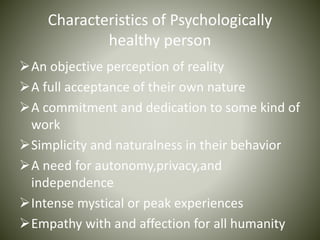
Characteristics of Psychologically
healthy person
An objective perception of reality
A full acceptance of their own nature
A commitment and dedication to some kind of
work
Simplicity and naturalness in their behavior
A need for autonomy,privacy,and
independence
Intense mystical or peak experiences
Empathy with and affection for all humanity
A resistance to conformity
A democratic character structure
An attitude of creativeness
A high degree of social interest
According to Rogers fully functioning persons
are characterized by the following:
• An openness to all experience
• A tendency to live fully in every moment
• An ability to be guided by one's own instincts
rather than by reason or the opinion of others
• A sense of freedom in thought and action
• A high degree of creativity

Behaviorism

  • 1.
    "Give me adozen healthy infants, well-formed, and my own specified world to bring them up in and I'll guarantee to take any one at random and train him to become any type of specialist I might select – doctor, lawyer, artist, merchant-chief, and, yes, even beggar-man and thief, regardless of his talents, penchants, tendencies, abilities, vocations, and race of his ancestors.“
  • 2.
    Presuppositions of Behaviorism •Behaviorism teaches that man is nothing more than a machine that responds to conditioning. • Behaviorism teaches that we are not responsible for our actions • Behaviorism is manipulative
  • 3.
    Founder of Behaviorism •John B. Watson, (1878-1958) an American psychologist. • Watson claimed that psychology was not concerned with the mind or with human consciousness • Watson's work was based on the experiments of Ivan Pavlov
  • 4.
    Forerunners of Behaviorism •Ivan Pavlov studied animals' responses to conditioning • Pavlov's best-known experiment, he rang a bell as he fed some dogs several meals
  • 5.
    Behaviorism Basic Assumptions ofBehaviorism • Behavior is all that matters, the stimulus and response. • behaviorists substitute verbal behavior (e.g. responding appropriately to a question) for physical behavior. • It doesn't matter what goes on inside the mind.
  • 6.
    • All behavioris learned. And maladaptive behavior is no different . • This learning can be understood in terms of the principles of conditioning and modeling. • What was learned can be unlearned, using the same principles. • the same laws apply to human and non human.
  • 7.
    Humanistic psychology The basicthemes of Humanistic Psychology An emphasis on conscious experience A belief in the wholeness of human nature A focus on free will ,spontaniety,and the creative power of the individual. The study of all factors relevant to the human condition
  • 8.
    • The humanisticpsychologists saw behaviorism as a narrow and artificial approach to the human nature. • They also opposed the deterministic tendencies in Freudian psychology.
  • 9.
    Abraham H. Maslow 1908-1970 Thespiritual father of humanistic psychology He wanted to understand the highest achievements humans are capable of reaching. In his view each person possess an innate tendency toward self actualization.
  • 10.
    • This stateinvolved the active use of all our qualities and abilities, the development and fulfillment of our potential. • To become self actualizing, we must first satisfy the needs that stand lower in the inner hierarchy of needs.
  • 11.
    1. The physiologicalneeds for food ,water air, sleep and sex, 2. The safety needs for security,stability,order,protection,and freedom from fear and anxiety, 3. The belonging and love needs, 4. The needs from esteem from others and from oneself, 5. The need for self actualization.
  • 12.
    Characteristics of Psychologically healthyperson An objective perception of reality A full acceptance of their own nature A commitment and dedication to some kind of work Simplicity and naturalness in their behavior A need for autonomy,privacy,and independence Intense mystical or peak experiences Empathy with and affection for all humanity
  • 13.
    A resistance toconformity A democratic character structure An attitude of creativeness A high degree of social interest
  • 14.
    According to Rogersfully functioning persons are characterized by the following: • An openness to all experience • A tendency to live fully in every moment • An ability to be guided by one's own instincts rather than by reason or the opinion of others • A sense of freedom in thought and action • A high degree of creativity