Behavior Support Planning Havar Inc.  Staff Orientation  Day Three
Behavior Support Planning Objectives Some history Intro to Behavior Support Plans (BSP) Review Administrative Code Development of the BSP What is “Behavior”? Unusual Incidents Base line data collection Implementation and Documentation
Behavior Support Planning 5123:2-1-02(J) Ohio Administrative Code
Happy people don’t do mean things. What is a “behavior”?  A behavior is communication   “ Something is wrong in my life!” Physical need or want Emotional need or want Defensive or aggressive? A strategy that has worked A social faux pas A behavior is not a “Behavior” until it is a health and safety threat to self or others. It’s not personal, it’s a message. And you just happen to be here to ‘hear’ it. Please listen.
What is Positive Behavior Support Supports used to decrease problem behaviors though a variety of methods including: Increasing necessary skills to replace the behavior Modifying environments and activities Rewarding positive behaviors Assisting the person in meeting their medical, psychological and psychiatric needs Providing safety for the person and others from problem behaviors with the least intrusive method
What is Positive Behavior Supports? Positive Behavior Supports Uses: Functional Behavioral Assessment A formal or informal assessment to identify the purpose of function the behavior serves for the person, as well as any other factors involved in the behaviors of concern (i.e. medical factors, lack of skill, environmental contributors) Behavior Support Plan An intervention or set of strategies that follows a hierarchy of less intrusive techniques to more intrusive if necessary Data Collection Provides information that may modify the interventions and supports, AND protects in the person and staff
What is Positive Behavior Supports  cont. FOUR FUNDIMENTAL ASSUMPTIONS ABOUT BEHAVIOR SUPPORTS Challenging behaviors are context related Challenging behaviors serve a purpose for the individual Effective interventions are based on a thorough understanding of the individual (e.g. listen to them) Positive behavior supports must be grounded in a person centered values that respect the dignity, preferences and goals of each individual (e.g. understand their learning style).
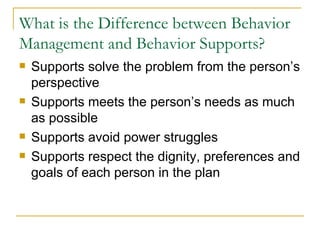
What is the Difference between Behavior Management and Behavior Supports? Supports solve the problem from the person’s perspective Supports meets the person’s needs as much as possible Supports avoid power struggles Supports respect the dignity, preferences and goals of each person in the plan
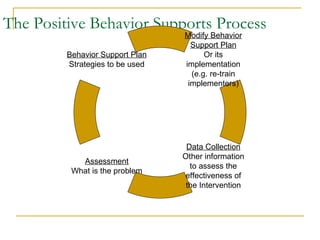
The Positive Behavior Supports Process Behavior Support Plan Strategies to be used Modify Behavior Support Plan Or its implementation (e.g. re-train implementers) Assessment What is the problem Data Collection Other information to assess the effectiveness of the Intervention
Functional Behavioral Assessment The goal is to identify the function, purpose or benefits a particular behavior has for a person All behavior is reinforced by its consequences Behavior is a form or communication Challenging behaviors are not as mysterious as they may seem. They occur in specific situations, under certain circumstances, and with certain people
Functional Behavioral Assessment Contains A description of the whole person A description of the target behavior Data collection on the target behavior A predication of the occurrence and the non-occurrences of the target behavior The payoff/outcome the behavior has for the person Hypothesis:  as informed guess of the factors that contribute to the target behavior
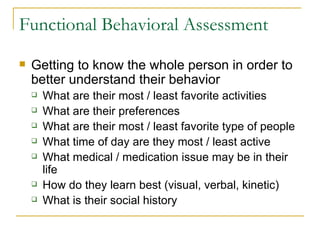
Functional Behavioral Assessment Getting to know the whole person in order to better understand their behavior What are their most / least favorite activities What are their preferences What are their most / least favorite type of people What time of day are they most / least active What medical / medication issue may be in their life How do they learn best (visual, verbal, kinetic) What is their social history
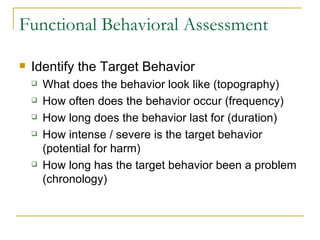
Functional Behavioral Assessment Identify the Target Behavior What does the behavior look like (topography) How often does the behavior occur (frequency) How long does the behavior last for (duration) How intense / severe is the target behavior (potential for harm) How long has the target behavior been a problem (chronology)
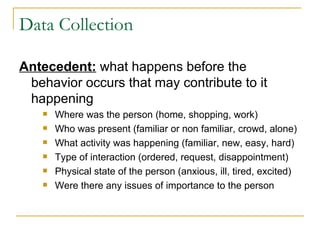
Data Collection Antecedent:  what happens before the behavior occurs that may contribute to it happening Where was the person (home, shopping, work) Who was present (familiar or non familiar, crowd, alone) What activity was happening (familiar, new, easy, hard) Type of interaction (ordered, request, disappointment) Physical state of the person (anxious, ill, tired, excited) Were there any issues of importance to the person
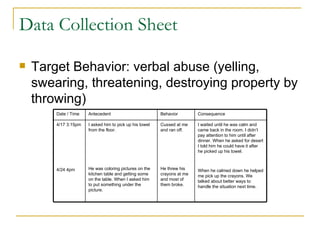
Data Collection Sheet Target Behavior: verbal abuse (yelling, swearing, threatening, destroying property by throwing) I waited until he was calm and came back in the room. I didn’t pay attention to him until after dinner. When he asked for desert I told him he could have it after he picked up his towel. When he calmed down he helped me pick up the crayons. We talked about better ways to handle the situation next time. Cussed at me and ran off. He threw his crayons at me and most of them broke. I asked him to pick up his towel from the floor. He was coloring pictures on the kitchen table and getting some on the table. When I asked him to put something under the picture. 4/17 3:15pm 4/24 4pm Consequence Behavior Antecedent Date / Time
Why Collect Data To identify patterns of behavior So you can better predict the occurrence of the behavior So you can plan ahead to prevent of respond All of which allows you to communicate accurately and professionally with the person, Service Coordinator, ISP Team, physician, therapists and other professionals
Data Collection A – B – C  ANTECEDENT : What happens before the behavior that may or may not contribute to the occurrence of the behavior BEHAVIOR : The Target Behavior as it is observed and measured CONSEQUENCE : What happens as a result of the behavior
HYPOTHESIS Based on the Functional Assessment of the person and behavior, what is your educated guess as to why a behavior occurs?  ?
Behavior is Functional Communication There are FOUR functional categories of behavior Gains attention Positive or Negative Attention is Attention to someone who needs it. Escape / Avoidance Access to tangibles and activities Sensory / Neurological
Attention If the behavior occurs for attention, you would answer the following questions: Does the person draw your attention to the behavior before, during or after it occurs? Does the person engage in the behavior in order to get you to spend time with them: If you left the room would the behavior decrease or stop shortly after?
ATTENTION Suggested interventions Praise and offer attention during times of appropriate behavior (catch them being good) Reward all the positive behavior you see, ignore as much of the negative behavior as you can Use your attention as a reward (offering a special opportunity to help you) Minimize attention when having to intervene in the problem behavior Extinction: eliminate the rewarding attention that the behavior produces
Escape and Avoidance If the behavior occurs for the purpose of escape / avoidance you would ask these questions: Does the behavior occur after a request Does the behavior occur prior to an activity that the person previously indicated some anxiety, excitement, negative feelings Would the behavior stop if you withdraw the request
ESCAPE / AVOIDANCE  Suggested interventions (from non-preferred activities and people) Modify the activities the person seeks to escape to increase the likelihood of success Is the activity necessary (pick your battles) Reward initiation of the task, participation in the task and finally completion of the task Premack principal (following the less-preferred activity with a more-preferred activity) Grandma’s Rule – you can have ice cream after you eat your peas
Access to Tangible objects or activities If the behavior occurs for the purpose of accessing tangible objects or activities would you answer yes to the following questions Does the behavior occur shortly after you take away a preferred object or activity Does the consequence of the behavior lead to an activity or object desired by the person Does the person request the activity or object before the behavior occur
ACCESS TO TANGIBLES Suggested interventions Use routines to establish regular access to desired activities or objects Use the object or activity as a reward for participation in other tasks (use your judgment) Limit temptation by reducing the view of the desired object or activity, or distract the person when it is around Pre-warn prior to being around the object / activity If the object / activity is unable to be had by the person for safety reasons, look for other objects / activities to meet the same need
Sensory / Neurological If the behavior occurs for sensory / neurological reasons would you answer yes to the following questions: Would the behavior occur if no one else was around Does the behavior occur when the person is unoccupied Does it happen regardless of what is going on around the person
SENSORY / NEUROLOGICAL Suggested interventions Offer sensory / stimulatory activites that may help to meet the need the problem behavior is meeting (allow the person to stand rather than sit, give an opportunity to move around, allow them to hold a “fidget” object) Seek advice from a physician, occupational / physical therapist, adaptive PE teacher…
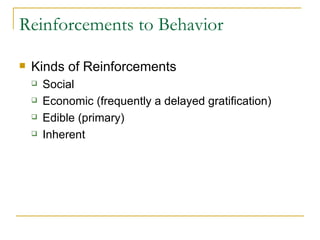
Reinforcements to Behavior Kinds of Reinforcements Social Economic (frequently a delayed gratification) Edible (primary) Inherent
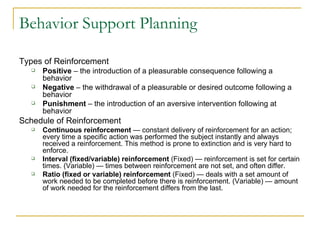
Behavior Support Planning Types of Reinforcement  Positive  – the introduction of a pleasurable consequence following a behavior Negative  – the withdrawal of a pleasurable or desired outcome following a behavior Punishment  – the introduction of an aversive intervention following at behavior Schedule of Reinforcement Continuous reinforcement  — constant delivery of reinforcement for an action; every time a specific action was performed the subject instantly and always received a reinforcement. This method is prone to extinction and is very hard to enforce.  Interval (fixed/variable) reinforcement  (Fixed) — reinforcement is set for certain times. (Variable) — times between reinforcement are not set, and often differ.  Ratio (fixed or variable) reinforcement  (Fixed) — deals with a set amount of work needed to be completed before there is reinforcement. (Variable) — amount of work needed for the reinforcement differs from the last.
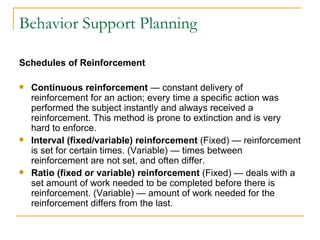
Behavior Support Planning Schedules of Reinforcement  Continuous reinforcement  — constant delivery of reinforcement for an action; every time a specific action was performed the subject instantly and always received a reinforcement. This method is prone to extinction and is very hard to enforce.  Interval (fixed/variable) reinforcement  (Fixed) — reinforcement is set for certain times. (Variable) — times between reinforcement are not set, and often differ.  Ratio (fixed or variable) reinforcement  (Fixed) — deals with a set amount of work needed to be completed before there is reinforcement. (Variable) — amount of work needed for the reinforcement differs from the last.

Behavior Support Planning

  • 1.
    Behavior Support PlanningHavar Inc. Staff Orientation Day Three
  • 2.
    Behavior Support PlanningObjectives Some history Intro to Behavior Support Plans (BSP) Review Administrative Code Development of the BSP What is “Behavior”? Unusual Incidents Base line data collection Implementation and Documentation
  • 3.
    Behavior Support Planning5123:2-1-02(J) Ohio Administrative Code
  • 4.
    Happy people don’tdo mean things. What is a “behavior”? A behavior is communication “ Something is wrong in my life!” Physical need or want Emotional need or want Defensive or aggressive? A strategy that has worked A social faux pas A behavior is not a “Behavior” until it is a health and safety threat to self or others. It’s not personal, it’s a message. And you just happen to be here to ‘hear’ it. Please listen.
  • 5.
    What is PositiveBehavior Support Supports used to decrease problem behaviors though a variety of methods including: Increasing necessary skills to replace the behavior Modifying environments and activities Rewarding positive behaviors Assisting the person in meeting their medical, psychological and psychiatric needs Providing safety for the person and others from problem behaviors with the least intrusive method
  • 6.
    What is PositiveBehavior Supports? Positive Behavior Supports Uses: Functional Behavioral Assessment A formal or informal assessment to identify the purpose of function the behavior serves for the person, as well as any other factors involved in the behaviors of concern (i.e. medical factors, lack of skill, environmental contributors) Behavior Support Plan An intervention or set of strategies that follows a hierarchy of less intrusive techniques to more intrusive if necessary Data Collection Provides information that may modify the interventions and supports, AND protects in the person and staff
  • 7.
    What is PositiveBehavior Supports cont. FOUR FUNDIMENTAL ASSUMPTIONS ABOUT BEHAVIOR SUPPORTS Challenging behaviors are context related Challenging behaviors serve a purpose for the individual Effective interventions are based on a thorough understanding of the individual (e.g. listen to them) Positive behavior supports must be grounded in a person centered values that respect the dignity, preferences and goals of each individual (e.g. understand their learning style).
  • 8.
    What is theDifference between Behavior Management and Behavior Supports? Supports solve the problem from the person’s perspective Supports meets the person’s needs as much as possible Supports avoid power struggles Supports respect the dignity, preferences and goals of each person in the plan
  • 9.
    The Positive BehaviorSupports Process Behavior Support Plan Strategies to be used Modify Behavior Support Plan Or its implementation (e.g. re-train implementers) Assessment What is the problem Data Collection Other information to assess the effectiveness of the Intervention
  • 10.
    Functional Behavioral AssessmentThe goal is to identify the function, purpose or benefits a particular behavior has for a person All behavior is reinforced by its consequences Behavior is a form or communication Challenging behaviors are not as mysterious as they may seem. They occur in specific situations, under certain circumstances, and with certain people
  • 11.
    Functional Behavioral AssessmentContains A description of the whole person A description of the target behavior Data collection on the target behavior A predication of the occurrence and the non-occurrences of the target behavior The payoff/outcome the behavior has for the person Hypothesis: as informed guess of the factors that contribute to the target behavior
  • 12.
    Functional Behavioral AssessmentGetting to know the whole person in order to better understand their behavior What are their most / least favorite activities What are their preferences What are their most / least favorite type of people What time of day are they most / least active What medical / medication issue may be in their life How do they learn best (visual, verbal, kinetic) What is their social history
  • 13.
    Functional Behavioral AssessmentIdentify the Target Behavior What does the behavior look like (topography) How often does the behavior occur (frequency) How long does the behavior last for (duration) How intense / severe is the target behavior (potential for harm) How long has the target behavior been a problem (chronology)
  • 14.
    Data Collection Antecedent: what happens before the behavior occurs that may contribute to it happening Where was the person (home, shopping, work) Who was present (familiar or non familiar, crowd, alone) What activity was happening (familiar, new, easy, hard) Type of interaction (ordered, request, disappointment) Physical state of the person (anxious, ill, tired, excited) Were there any issues of importance to the person
  • 15.
    Data Collection SheetTarget Behavior: verbal abuse (yelling, swearing, threatening, destroying property by throwing) I waited until he was calm and came back in the room. I didn’t pay attention to him until after dinner. When he asked for desert I told him he could have it after he picked up his towel. When he calmed down he helped me pick up the crayons. We talked about better ways to handle the situation next time. Cussed at me and ran off. He threw his crayons at me and most of them broke. I asked him to pick up his towel from the floor. He was coloring pictures on the kitchen table and getting some on the table. When I asked him to put something under the picture. 4/17 3:15pm 4/24 4pm Consequence Behavior Antecedent Date / Time
  • 16.
    Why Collect DataTo identify patterns of behavior So you can better predict the occurrence of the behavior So you can plan ahead to prevent of respond All of which allows you to communicate accurately and professionally with the person, Service Coordinator, ISP Team, physician, therapists and other professionals
  • 17.
    Data Collection A– B – C ANTECEDENT : What happens before the behavior that may or may not contribute to the occurrence of the behavior BEHAVIOR : The Target Behavior as it is observed and measured CONSEQUENCE : What happens as a result of the behavior
  • 18.
    HYPOTHESIS Based onthe Functional Assessment of the person and behavior, what is your educated guess as to why a behavior occurs? ?
  • 19.
    Behavior is FunctionalCommunication There are FOUR functional categories of behavior Gains attention Positive or Negative Attention is Attention to someone who needs it. Escape / Avoidance Access to tangibles and activities Sensory / Neurological
  • 20.
    Attention If thebehavior occurs for attention, you would answer the following questions: Does the person draw your attention to the behavior before, during or after it occurs? Does the person engage in the behavior in order to get you to spend time with them: If you left the room would the behavior decrease or stop shortly after?
  • 21.
    ATTENTION Suggested interventionsPraise and offer attention during times of appropriate behavior (catch them being good) Reward all the positive behavior you see, ignore as much of the negative behavior as you can Use your attention as a reward (offering a special opportunity to help you) Minimize attention when having to intervene in the problem behavior Extinction: eliminate the rewarding attention that the behavior produces
  • 22.
    Escape and AvoidanceIf the behavior occurs for the purpose of escape / avoidance you would ask these questions: Does the behavior occur after a request Does the behavior occur prior to an activity that the person previously indicated some anxiety, excitement, negative feelings Would the behavior stop if you withdraw the request
  • 23.
    ESCAPE / AVOIDANCE Suggested interventions (from non-preferred activities and people) Modify the activities the person seeks to escape to increase the likelihood of success Is the activity necessary (pick your battles) Reward initiation of the task, participation in the task and finally completion of the task Premack principal (following the less-preferred activity with a more-preferred activity) Grandma’s Rule – you can have ice cream after you eat your peas
  • 24.
    Access to Tangibleobjects or activities If the behavior occurs for the purpose of accessing tangible objects or activities would you answer yes to the following questions Does the behavior occur shortly after you take away a preferred object or activity Does the consequence of the behavior lead to an activity or object desired by the person Does the person request the activity or object before the behavior occur
  • 25.
    ACCESS TO TANGIBLESSuggested interventions Use routines to establish regular access to desired activities or objects Use the object or activity as a reward for participation in other tasks (use your judgment) Limit temptation by reducing the view of the desired object or activity, or distract the person when it is around Pre-warn prior to being around the object / activity If the object / activity is unable to be had by the person for safety reasons, look for other objects / activities to meet the same need
  • 26.
    Sensory / NeurologicalIf the behavior occurs for sensory / neurological reasons would you answer yes to the following questions: Would the behavior occur if no one else was around Does the behavior occur when the person is unoccupied Does it happen regardless of what is going on around the person
  • 27.
    SENSORY / NEUROLOGICALSuggested interventions Offer sensory / stimulatory activites that may help to meet the need the problem behavior is meeting (allow the person to stand rather than sit, give an opportunity to move around, allow them to hold a “fidget” object) Seek advice from a physician, occupational / physical therapist, adaptive PE teacher…
  • 28.
    Reinforcements to BehaviorKinds of Reinforcements Social Economic (frequently a delayed gratification) Edible (primary) Inherent
  • 29.
    Behavior Support PlanningTypes of Reinforcement Positive – the introduction of a pleasurable consequence following a behavior Negative – the withdrawal of a pleasurable or desired outcome following a behavior Punishment – the introduction of an aversive intervention following at behavior Schedule of Reinforcement Continuous reinforcement — constant delivery of reinforcement for an action; every time a specific action was performed the subject instantly and always received a reinforcement. This method is prone to extinction and is very hard to enforce. Interval (fixed/variable) reinforcement (Fixed) — reinforcement is set for certain times. (Variable) — times between reinforcement are not set, and often differ. Ratio (fixed or variable) reinforcement (Fixed) — deals with a set amount of work needed to be completed before there is reinforcement. (Variable) — amount of work needed for the reinforcement differs from the last.
  • 30.
    Behavior Support PlanningSchedules of Reinforcement Continuous reinforcement — constant delivery of reinforcement for an action; every time a specific action was performed the subject instantly and always received a reinforcement. This method is prone to extinction and is very hard to enforce. Interval (fixed/variable) reinforcement (Fixed) — reinforcement is set for certain times. (Variable) — times between reinforcement are not set, and often differ. Ratio (fixed or variable) reinforcement (Fixed) — deals with a set amount of work needed to be completed before there is reinforcement. (Variable) — amount of work needed for the reinforcement differs from the last.

Editor's Notes

  • #4 Handout OAC 5123:2-1-02(J)
  • #6 What does “Least Intrusive” mean to you? Your attitude is more important than any other component. Why do you think that is true? For example? if you don’t believe it will work…it won’t.
  • #7 How does data collection protect the person and staff?
  • #8 Even negative attention is a social reward when you don’t get attention any other way.
  • #21 Sometimes I don’t want your attention as much as I don’t want you to give it to someone else. Attention feeds bad behavior like oxygen feeds a fire!
  • #23 Sometimes the anticipation or excitement FOR an activity can build up strong feelings that result in acting out.
  • #24 Is it a lack of skill contributing to the anxiety about the situation?