- JAYVANT MAKWANA
Clinical and Rehabilitation Psychologist
 When children cannot adjust in a complex
environment around them, they become
unable to behave in the socially acceptable
way resulting exhibition of peculiar
behaviours and this is called as behavioural
problems.
 Explain:What is the problem?
 Reason:What is he/she getting out of it or
avoiding? ( what is the function/pay off the )
 Appropriate:What do you want him/ her to
do instead?
 Support: How can you help this happen more
often?
 Evaluate: How will you know if it works?
 A -What happens before (A or antecedent)
the behavior occurs? What is trigger?
 B -What is the Behavior ?
 C –What happens after ( consequence or
outcome) the behavior occurs? What is
outcome?
 Immediate
 Being told begin/ stop task
 Being told ‘NO’
 Teacher attention to peer
 Peer comment
 Noise level
 Lighting
 Non – preferred staff giving directives
 Change of medication/ Side effects
 Birth of new sibling
 Irregular sleep schedule
 Abuse,Trauma
 Hurried routine
 Behavior followed by ‘Pleasant’ response will
likely be repeated.
 Behavior followed by ‘Unpleasant’ response
will likely not.
Behavior Response Will it happen again?
Singing Clapping YES
Booing NO
Making fun of a peer Peer laughter YES
Losing computer time NO
 Behavior serves one of four functions
(purpose)
 As a means to get attention
 To allow us to escape an activity or situation.
 So that we can get tangible items.
 For self – stimulation/ sensory
 A person may engage in certain behaviour to
gain some form of social attention or a
reaction from other people. For example, a
child might engage in behaviour to get other
people to look at them, laugh at them, play
with them, hug them or scold them.
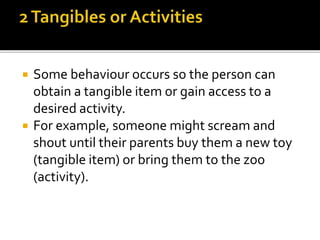
 Some behaviour occurs so the person can
obtain a tangible item or gain access to a
desired activity.
 For example, someone might scream and
shout until their parents buy them a new toy
(tangible item) or bring them to the zoo
(activity).
 Not all behaviours occur so the person can
“obtain” something; many behaviours occur
because the person wants to get away from
something or avoid something altogether
 For example, a child might engage in aggressive
behaviour so his teachers stop running academic
tasks with him or another child might engage in
self-injury to avoid having to go outside to play
with classmates.
 The function of some behaviour does not rely on
anything external to the person and instead are
internally pleasing in some way – they are “self-
stimulating”
 They function only to give the person some form
of internal sensation that is pleasing or to
remove an internal sensation that is displeasing
(e.g. pain).
 these children do not engage in either behaviour
to obtain any attention, any tangible items or to
escape any demands placed on them.
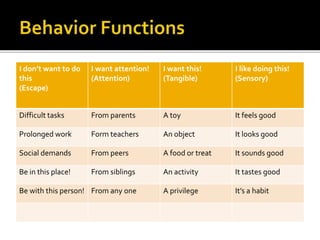
I don’t want to do
this
(Escape)
I want attention!
(Attention)
I want this!
(Tangible)
I like doing this!
(Sensory)
Difficult tasks From parents A toy It feels good
Prolonged work Form teachers An object It looks good
Social demands From peers A food or treat It sounds good
Be in this place! From siblings An activity It tastes good
Be with this person! From any one A privilege It’s a habit
1. Identification of the problem.
2. Defining target behaviour.
3. Behaviour recording.
4. Functional analysis.
5. Treatment procedure and their evaluation.
 The problem exhibited by the child can be
broadly grouped into two
(a) absence of adaptive behaviour (delay in
motor development, poor communication skill,
self help skill etc.
(b) the presence of undesirable behaviour
(beating, head banging, wondering etc.)
 Two ways of collect behavior data
(1) information from care taker
(2) Assessment
 Child Behavior Check List (CBCL)
1) Aggressive Behaviour.
2) Anxious/Depressed.
3) Attention Problems.
4) Rule-Breaking Behaviour.
5) Somatic Complaints.
6) Social Problems.
7) Thought Problems.
8) Withdrawn/Depressed.
 Behavior Assessment Scale for Indian
Children with Mental Retardation
 Part A- Deal with skills behavior
 Part B – Deal with undesirable behavior
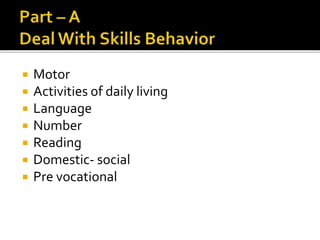
 Motor
 Activities of daily living
 Language
 Number
 Reading
 Domestic- social
 Pre vocational
 Violent and Destructive Behaviors:
 Breaks things
 Throws objects, etc
 Rolls on the floor
 Screams
 Cries excessively etc.
 Pulls objects from others
 Spits on others
 Beats others, etc.
 Bangs head
 Scratches self
 Pulls own hair
 Bites self
 Peels skin, etc.
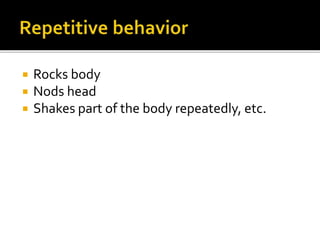
 Rocks body
 Nods head
 Shakes part of the body repeatedly, etc.
 Smiles
 Laughs to self without reason
 Talks to self without reason
 Collect rubbish, etc.
 Does not sit at one place for required time
 Does not complete task at hand, etc.
 Refuses to obey commands
 Does opposite of what is requested, etc.
 Steals
 Cheats in games
 Lies or twists the truth
 Blames other
 Fears of places
 Persons
 Animals
 Objects, etc.
 Part A
 Independent - 5
 Clueing - 4
 Verbal Prompting - 3
 Physical Prompting - 2
 Total dependent - 1
 Not applicable – 0
 Part B
 Never – 0
 Occasional – 1
 Frequently - 2
This involves the following three steps
1. The behaviour identified has to be defined in
observable, objective and measurable terms.
2. A hierarchy of problem behaviours shown by
the persons should be made depending on
the severity of the problem
3. The behaviours to be modified first are
selected and are known as target behaviours.
 Frequency: the target behaviour has to be
counted every time it occurs.Tally marks may be
used to record frequency
 Duration: this is a more sensitive measure than
frequency.The duration of target behaviour is
recorded in seconds minutes or hours.
 Interval recording: the total period of
observation is divided into equal intervals of
time and it is noted whether target behaviour
occurred during each of these periods.
A=Antecedents or events immediately before
the behaviour and environment setting in which
it occurs.
B= Behaviour. Its frequency, duration and
intensity.
C= consequences or following behaviour
 After recording the baseline measures and
analysing the antecedents and consequences
of behaviour, the behaviour management has
to be planned.All therapeutic procedures
involve either changing antecedents or
changing consequences.
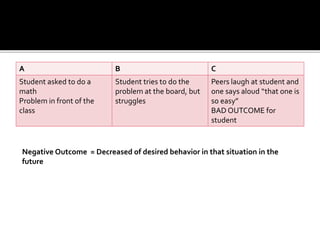
A B C
Student asked to do a
math
Problem in front of the
class
Student tries to do the
problem at the board, but
struggles
Peers laugh at student and
one says aloud “that one is
so easy”
BAD OUTCOME for
student
Negative Outcome = Decreased of desired behavior in that situation in the
future
DATE & TIME
(તારીખ અને સમય)
WHY
(શા માટે)
WHEN
(ક્યાર ે)
WHERE
(ક્યાાં)
WITH WHOM
(કોની સાથે)
CONSEQUENT
(પરરણામ)
 Target behaviors
1. પોતાની સાથે વાત કરવી.
2. ચીડાવવાં
3. બીજાને માર ેછે.
DATE & TIME
(તારીખ અને સમય)
WHY
(શા માટે)
WHEN
(ક્યાર ે)
WHERE
(ક્યાાં)
WITH WHOM
(કોની સાથે)
CONSEQUENT
(પરરણામ)
Day-1
૨૩-૦૧-૨૦૧૭
૧૧-૧૦ કલાકે
(૧)
એકલો બેઠો હતો
ત્યારે
એકલા બેઠો હતો
ત્યારે
Workshop class માાં એકલો
તેને હસવાનાં કારણ
પછવામાાં આવે છે.
૧૧-૨૦ કલાકે
(૨)
એમજ જીભ કાઢીને
ચીડવતો હતો.
બીજાને જોઇને Workshop class માાં બીજા પર
ટીચરે તેને આવાં ન
કરવા નાં કીધાં
૧૨-૦૦
કલા
કે
(૧)
કારણ વગર
ફ્લાવાર શો માાં ગયો
તેની વાત.
ક્લાસ માાં એકલો-એકલો
તેને પછવામાાં આવે
છે.
૧૨-૦૫ કલાકે
(૧)
કારણ વગર
એકલો-એકલો
વાત કરે છે.
ક્લાસ માાં
એકલો પોતાની જાત
સાથે
તેને કામ કરવાનાં
કહેવામાાં આવે છે.
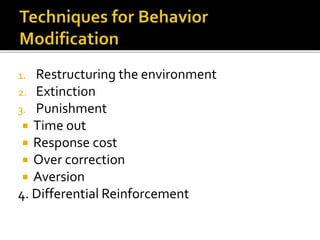
1. Restructuring the environment
2. Extinction
3. Punishment
 Time out
 Response cost
 Over correction
 Aversion
4. Differential Reinforcement
 The occurrence of any behaviour is partly a
function of its present and past antecedents.
This is called as stimulus control.
 This is a powerful tool in decreasing undesirable
behaviour.
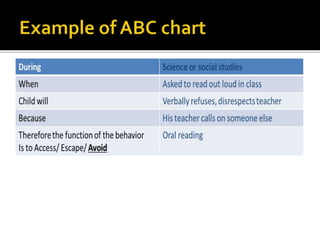
 For example, if a child is very distractible in a
classroom and is talking to his peers, spending
little time on the task in hand, his “off the task”
behaviour can be reduced by isolating him or
placing a screen around him.
 It is possible to reduce the frequency of a behaviour by not
presenting the immediate reinforce of the behaviour.This
process is called extinction.
 For example, a 8 year old child had persistent tantrums of
loud screaming when he was asked to read, this resulted in
the teacher abandoning the task with him.
 The functional analysis suggested that the boy’s tantrums
were being reinforced (teacher abandoning the task) by
being allowed to escape from distasteful tasks consequent
to his screaming.
 The extinction program in him involved non presentation
of the reinforcement on screaming, continuing the task of
reading despite the tantrum.
a) Time out: This means time out from positive
reinforcements. If the reinforcer concerned is a Praise
or social attention,Time out involve either removal of
the child away from the dining table or meal plate.
b) Response cost:This procedure is used with Individual
who are on token program for teaching adaptive
behaviour.When undesirable behaviour occurs, a
fixed number of token, star or points are deducted
from what the individual has already earned.This
procedure can be used as punishment for aggression,
abusive language and late arrival at the classroom.
c) Over correction: This involves two separate
procedures; restitution and positive practice.
Restitution: gives kids an opportunity to
“payback” for their misbehaviour.
Positive practice: positive practices involves,
practising appropriate modes of responding in
situation in which the individual normally
misbehaves.
d) Restraint: Physical restraint is effective in
reducing the behaviours like physical aggression
and self injurious behaviour.
 The restraint can vary according to the individual
such as restraining in a chair, holding the child’s
arms down tightly to his side for a short period,
holding the child’s head tightly between the
trainers palms, keeping the child’s head between
his knees.
 Sometimes an empathic no precedes the
restraint which may be tying the hands for few
minutes for hitting behaviour.
e) Aversion: This method is generally used only when all
other training methods have failed to control the
undesirable behaviour
 Life threatening or self injurious behaviours like
severe head banging, persistent vomiting and biting
behaviours are controlled by aversive stimuli.
 Faradic aversion (battery operated mild shock) is
administered immediately following the undesirable
behaviour.
 Contingent aversive chemical stimuli like strong
pungent odours(ammonia), sour or bitter tasting
substances can be presented instead of shocks in
young children.
There are three types of reinforcers.
1. Primary reinforcers: these are reinforcers which
are essential for life, example food, drink, sleep
etc.
2. Secondary reinforcers: these are events or objects
which have the property of a reinforcer because of
pairing with a primary reinforce. Example, money,
points,etc
3. Social Reinforcer:These are events which have
significance at the emotional level. Example,
attention, praise, smile, hugging and so on.
1. Ask the individual directly
2. Ask the parents, siblings or caretakers.
3. If the above two methods are not useful,
offer a variety of reinforcers like food or
drinks to the child and see what he selects
more often.
4. In children who have no particular
preferences, observe the child and see what
he does most often.
1. Contingency: Reinforcement should be given
only when the desired behaviour occurs.
2. Immediacy: Reinforcement should be given
soon after the desired behaviour occurs.
3. Consistency: The behaviour should be
reinforced every time it occurs specially during
the initial stages of a training programme.
4. Clarity: the child should be clearly aware that
reinforcement has been given
TOKEN PROGRAMME:
 Tokens are one form of generalised
reinforcers like money or points.They
represent the possibility of obtaining
something which the child likes. So they act
as reinforcers. For example while teaching
the names of common objects to a child, give
him a plastic star (token) whenever he
responds. He can exchange these tokens for
money or food later.
 Shaping is a technique which is used in building
up a new behaviour especially with severe cases.
 In shaping, the components of a particular skill
and the behaviour are reinforced step by step.
 The therapist starts shaping by reinforcing the
existing behaviour.
 Once it is established he reinforces the
responses which are closest to the desired
behaviour and ignores other responses.
 Example established eye contact
 Here the therapist initially physically guides
the person to look at him by turning his head
towards him.This is then reinforced.
 Prompting can be effectively used in teaching
self help skills. It speeds up the acquisition of
new skills.
 while the therapist physically guides the
person to look at him. Later just by telling
him to look at the therapist he looks up.
 Gestural cues, visual cues and prompting are
effectively used in language
 fading is always used along with prompting
and cueing .
 once the person learns to do something, the
therapist gradually fades out prompting and
cueing.
 Sometimes to get a response from the child
the therapist may have to change the
environment.
 Consider a situation where the child does not
drink from a cup but is willing to drink only
from a spoon. This is corrected over a period
of several weeks, by deepening the spoon
and shortening its handle to make it more
and more like a cup.
 Chaining is used when a person fails to
perform a complex task.The complex task is
broken into a number of small steps and each
step is to the child.
 This is the basis of chaining technique.The
therapist is basically training the child to
master a chain of behaviours.
 Chaining technique is particularly used in
teaching self help skills.
 Discrimination learning is defined in
psychology as the ability to respond
differently to different stimuli.
 This type of learning is used in studies
regarding operant and classical conditioning.
 ?????????
ABC MODEL - Behaviour therapy and behaviour modification.pptx

ABC MODEL - Behaviour therapy and behaviour modification.pptx

  • 1.
    - JAYVANT MAKWANA Clinicaland Rehabilitation Psychologist
  • 2.
     When childrencannot adjust in a complex environment around them, they become unable to behave in the socially acceptable way resulting exhibition of peculiar behaviours and this is called as behavioural problems.
  • 3.
     Explain:What isthe problem?  Reason:What is he/she getting out of it or avoiding? ( what is the function/pay off the )  Appropriate:What do you want him/ her to do instead?  Support: How can you help this happen more often?  Evaluate: How will you know if it works?
  • 4.
     A -Whathappens before (A or antecedent) the behavior occurs? What is trigger?  B -What is the Behavior ?  C –What happens after ( consequence or outcome) the behavior occurs? What is outcome?
  • 5.
     Immediate  Beingtold begin/ stop task  Being told ‘NO’  Teacher attention to peer  Peer comment  Noise level  Lighting  Non – preferred staff giving directives
  • 6.
     Change ofmedication/ Side effects  Birth of new sibling  Irregular sleep schedule  Abuse,Trauma  Hurried routine
  • 7.
     Behavior followedby ‘Pleasant’ response will likely be repeated.  Behavior followed by ‘Unpleasant’ response will likely not. Behavior Response Will it happen again? Singing Clapping YES Booing NO Making fun of a peer Peer laughter YES Losing computer time NO
  • 8.
     Behavior servesone of four functions (purpose)  As a means to get attention  To allow us to escape an activity or situation.  So that we can get tangible items.  For self – stimulation/ sensory
  • 9.
     A personmay engage in certain behaviour to gain some form of social attention or a reaction from other people. For example, a child might engage in behaviour to get other people to look at them, laugh at them, play with them, hug them or scold them.
  • 10.
     Some behaviouroccurs so the person can obtain a tangible item or gain access to a desired activity.  For example, someone might scream and shout until their parents buy them a new toy (tangible item) or bring them to the zoo (activity).
  • 11.
     Not allbehaviours occur so the person can “obtain” something; many behaviours occur because the person wants to get away from something or avoid something altogether  For example, a child might engage in aggressive behaviour so his teachers stop running academic tasks with him or another child might engage in self-injury to avoid having to go outside to play with classmates.
  • 12.
     The functionof some behaviour does not rely on anything external to the person and instead are internally pleasing in some way – they are “self- stimulating”  They function only to give the person some form of internal sensation that is pleasing or to remove an internal sensation that is displeasing (e.g. pain).  these children do not engage in either behaviour to obtain any attention, any tangible items or to escape any demands placed on them.
  • 13.
    I don’t wantto do this (Escape) I want attention! (Attention) I want this! (Tangible) I like doing this! (Sensory) Difficult tasks From parents A toy It feels good Prolonged work Form teachers An object It looks good Social demands From peers A food or treat It sounds good Be in this place! From siblings An activity It tastes good Be with this person! From any one A privilege It’s a habit
  • 14.
    1. Identification ofthe problem. 2. Defining target behaviour. 3. Behaviour recording. 4. Functional analysis. 5. Treatment procedure and their evaluation.
  • 15.
     The problemexhibited by the child can be broadly grouped into two (a) absence of adaptive behaviour (delay in motor development, poor communication skill, self help skill etc. (b) the presence of undesirable behaviour (beating, head banging, wondering etc.)  Two ways of collect behavior data (1) information from care taker (2) Assessment
  • 16.
     Child BehaviorCheck List (CBCL) 1) Aggressive Behaviour. 2) Anxious/Depressed. 3) Attention Problems. 4) Rule-Breaking Behaviour. 5) Somatic Complaints. 6) Social Problems. 7) Thought Problems. 8) Withdrawn/Depressed.
  • 17.
     Behavior AssessmentScale for Indian Children with Mental Retardation  Part A- Deal with skills behavior  Part B – Deal with undesirable behavior
  • 18.
     Motor  Activitiesof daily living  Language  Number  Reading  Domestic- social  Pre vocational
  • 19.
     Violent andDestructive Behaviors:  Breaks things  Throws objects, etc
  • 20.
     Rolls onthe floor  Screams  Cries excessively etc.
  • 21.
     Pulls objectsfrom others  Spits on others  Beats others, etc.
  • 22.
     Bangs head Scratches self  Pulls own hair  Bites self  Peels skin, etc.
  • 23.
     Rocks body Nods head  Shakes part of the body repeatedly, etc.
  • 24.
     Smiles  Laughsto self without reason  Talks to self without reason  Collect rubbish, etc.
  • 25.
     Does notsit at one place for required time  Does not complete task at hand, etc.
  • 26.
     Refuses toobey commands  Does opposite of what is requested, etc.
  • 27.
     Steals  Cheatsin games  Lies or twists the truth  Blames other
  • 28.
     Fears ofplaces  Persons  Animals  Objects, etc.
  • 29.
     Part A Independent - 5  Clueing - 4  Verbal Prompting - 3  Physical Prompting - 2  Total dependent - 1  Not applicable – 0  Part B  Never – 0  Occasional – 1  Frequently - 2
  • 30.
    This involves thefollowing three steps 1. The behaviour identified has to be defined in observable, objective and measurable terms. 2. A hierarchy of problem behaviours shown by the persons should be made depending on the severity of the problem 3. The behaviours to be modified first are selected and are known as target behaviours.
  • 31.
     Frequency: thetarget behaviour has to be counted every time it occurs.Tally marks may be used to record frequency  Duration: this is a more sensitive measure than frequency.The duration of target behaviour is recorded in seconds minutes or hours.  Interval recording: the total period of observation is divided into equal intervals of time and it is noted whether target behaviour occurred during each of these periods.
  • 32.
    A=Antecedents or eventsimmediately before the behaviour and environment setting in which it occurs. B= Behaviour. Its frequency, duration and intensity. C= consequences or following behaviour
  • 33.
     After recordingthe baseline measures and analysing the antecedents and consequences of behaviour, the behaviour management has to be planned.All therapeutic procedures involve either changing antecedents or changing consequences.
  • 36.
    A B C Studentasked to do a math Problem in front of the class Student tries to do the problem at the board, but struggles Peers laugh at student and one says aloud “that one is so easy” BAD OUTCOME for student Negative Outcome = Decreased of desired behavior in that situation in the future
  • 37.
    DATE & TIME (તારીખઅને સમય) WHY (શા માટે) WHEN (ક્યાર ે) WHERE (ક્યાાં) WITH WHOM (કોની સાથે) CONSEQUENT (પરરણામ)
  • 38.
     Target behaviors 1.પોતાની સાથે વાત કરવી. 2. ચીડાવવાં 3. બીજાને માર ેછે. DATE & TIME (તારીખ અને સમય) WHY (શા માટે) WHEN (ક્યાર ે) WHERE (ક્યાાં) WITH WHOM (કોની સાથે) CONSEQUENT (પરરણામ) Day-1 ૨૩-૦૧-૨૦૧૭ ૧૧-૧૦ કલાકે (૧) એકલો બેઠો હતો ત્યારે એકલા બેઠો હતો ત્યારે Workshop class માાં એકલો તેને હસવાનાં કારણ પછવામાાં આવે છે. ૧૧-૨૦ કલાકે (૨) એમજ જીભ કાઢીને ચીડવતો હતો. બીજાને જોઇને Workshop class માાં બીજા પર ટીચરે તેને આવાં ન કરવા નાં કીધાં ૧૨-૦૦ કલા કે (૧) કારણ વગર ફ્લાવાર શો માાં ગયો તેની વાત. ક્લાસ માાં એકલો-એકલો તેને પછવામાાં આવે છે. ૧૨-૦૫ કલાકે (૧) કારણ વગર એકલો-એકલો વાત કરે છે. ક્લાસ માાં એકલો પોતાની જાત સાથે તેને કામ કરવાનાં કહેવામાાં આવે છે.
  • 39.
    1. Restructuring theenvironment 2. Extinction 3. Punishment  Time out  Response cost  Over correction  Aversion 4. Differential Reinforcement
  • 40.
     The occurrenceof any behaviour is partly a function of its present and past antecedents. This is called as stimulus control.  This is a powerful tool in decreasing undesirable behaviour.  For example, if a child is very distractible in a classroom and is talking to his peers, spending little time on the task in hand, his “off the task” behaviour can be reduced by isolating him or placing a screen around him.
  • 41.
     It ispossible to reduce the frequency of a behaviour by not presenting the immediate reinforce of the behaviour.This process is called extinction.  For example, a 8 year old child had persistent tantrums of loud screaming when he was asked to read, this resulted in the teacher abandoning the task with him.  The functional analysis suggested that the boy’s tantrums were being reinforced (teacher abandoning the task) by being allowed to escape from distasteful tasks consequent to his screaming.  The extinction program in him involved non presentation of the reinforcement on screaming, continuing the task of reading despite the tantrum.
  • 42.
    a) Time out:This means time out from positive reinforcements. If the reinforcer concerned is a Praise or social attention,Time out involve either removal of the child away from the dining table or meal plate. b) Response cost:This procedure is used with Individual who are on token program for teaching adaptive behaviour.When undesirable behaviour occurs, a fixed number of token, star or points are deducted from what the individual has already earned.This procedure can be used as punishment for aggression, abusive language and late arrival at the classroom.
  • 43.
    c) Over correction:This involves two separate procedures; restitution and positive practice. Restitution: gives kids an opportunity to “payback” for their misbehaviour. Positive practice: positive practices involves, practising appropriate modes of responding in situation in which the individual normally misbehaves.
  • 44.
    d) Restraint: Physicalrestraint is effective in reducing the behaviours like physical aggression and self injurious behaviour.  The restraint can vary according to the individual such as restraining in a chair, holding the child’s arms down tightly to his side for a short period, holding the child’s head tightly between the trainers palms, keeping the child’s head between his knees.  Sometimes an empathic no precedes the restraint which may be tying the hands for few minutes for hitting behaviour.
  • 45.
    e) Aversion: Thismethod is generally used only when all other training methods have failed to control the undesirable behaviour  Life threatening or self injurious behaviours like severe head banging, persistent vomiting and biting behaviours are controlled by aversive stimuli.  Faradic aversion (battery operated mild shock) is administered immediately following the undesirable behaviour.  Contingent aversive chemical stimuli like strong pungent odours(ammonia), sour or bitter tasting substances can be presented instead of shocks in young children.
  • 46.
    There are threetypes of reinforcers. 1. Primary reinforcers: these are reinforcers which are essential for life, example food, drink, sleep etc. 2. Secondary reinforcers: these are events or objects which have the property of a reinforcer because of pairing with a primary reinforce. Example, money, points,etc 3. Social Reinforcer:These are events which have significance at the emotional level. Example, attention, praise, smile, hugging and so on.
  • 47.
    1. Ask theindividual directly 2. Ask the parents, siblings or caretakers. 3. If the above two methods are not useful, offer a variety of reinforcers like food or drinks to the child and see what he selects more often. 4. In children who have no particular preferences, observe the child and see what he does most often.
  • 48.
    1. Contingency: Reinforcementshould be given only when the desired behaviour occurs. 2. Immediacy: Reinforcement should be given soon after the desired behaviour occurs. 3. Consistency: The behaviour should be reinforced every time it occurs specially during the initial stages of a training programme. 4. Clarity: the child should be clearly aware that reinforcement has been given
  • 49.
    TOKEN PROGRAMME:  Tokensare one form of generalised reinforcers like money or points.They represent the possibility of obtaining something which the child likes. So they act as reinforcers. For example while teaching the names of common objects to a child, give him a plastic star (token) whenever he responds. He can exchange these tokens for money or food later.
  • 50.
     Shaping isa technique which is used in building up a new behaviour especially with severe cases.  In shaping, the components of a particular skill and the behaviour are reinforced step by step.  The therapist starts shaping by reinforcing the existing behaviour.  Once it is established he reinforces the responses which are closest to the desired behaviour and ignores other responses.  Example established eye contact
  • 51.
     Here thetherapist initially physically guides the person to look at him by turning his head towards him.This is then reinforced.  Prompting can be effectively used in teaching self help skills. It speeds up the acquisition of new skills.
  • 52.
     while thetherapist physically guides the person to look at him. Later just by telling him to look at the therapist he looks up.  Gestural cues, visual cues and prompting are effectively used in language
  • 53.
     fading isalways used along with prompting and cueing .  once the person learns to do something, the therapist gradually fades out prompting and cueing.
  • 54.
     Sometimes toget a response from the child the therapist may have to change the environment.  Consider a situation where the child does not drink from a cup but is willing to drink only from a spoon. This is corrected over a period of several weeks, by deepening the spoon and shortening its handle to make it more and more like a cup.
  • 55.
     Chaining isused when a person fails to perform a complex task.The complex task is broken into a number of small steps and each step is to the child.  This is the basis of chaining technique.The therapist is basically training the child to master a chain of behaviours.  Chaining technique is particularly used in teaching self help skills.
  • 56.
     Discrimination learningis defined in psychology as the ability to respond differently to different stimuli.  This type of learning is used in studies regarding operant and classical conditioning.
  • 57.