Drug Free Workplace Employee Training Havar Inc.
Drug Free Workplace Course Outline Drug Free Workplace (DFWP) basic components Identify commonly abused drugs and recognize street names Describe impact of substance abuse on the workplace Define types of alcohol use Distinguish between substance use, abuse, and dependence Discuss “Enabling”  Recognizing indicators of possible substance abuse Substance Usage Testing Accuracy of drug tests Treatment options Resources Enhancing your DFWP
Drug Free Workplace  Five Basic Components Written  Substance Abuse  Policy Employee Education Awareness Supervisor/Manager Training Drug and Alcohol Testing Employee Assistance Program (EAP)
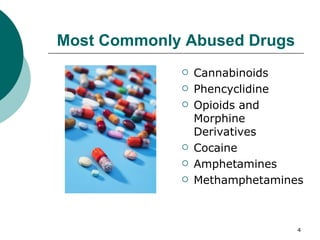
Most Commonly Abused Drugs Cannabinoids Phencyclidine Opioids and Morphine Derivatives Cocaine Amphetamines Methamphetamines
Cannabinoids Marijuana Dope, blunt, ganja, grass, joints, pot, reefer, weed Swallowed or smoked
Cannabinoids Euphoria, slowed thinking and reaction time, confusion, impaired balance and coordination, anxiety, increased heart rate, tolerance.
Phencyclidine PCP and Analogs Angel dust, boat, hog, love boat, peace pill Injected, swallowed, or smoked
Phencyclidine Panic, aggression, violence, loss of appetite, depression, decrease in blood pressure and heart rate
Opioids and Morphine Derivatives Codeine, heroin, morphine, opium Empirin with codeine, Fiorinal with codeine, Tylenol with codeine, Cody, schoolboy, fours and doors, brown sugar, horse smack, monkey, white stuff, laudanum, paregoric Injected, swallowed, smoked, snorted
Opioids and Morphine Derivatives Pain relief, euphoria, nausea, depression, confusion, constipation, sedation, coma
Cocaine Blow, bump, C, candy, coke, crack, Charlie, flake, rock, snow, toot Injected, smoked, snorted
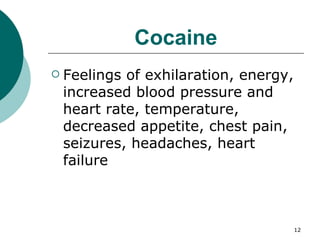
Cocaine Feelings of exhilaration, energy, increased blood pressure and heart rate, temperature, decreased appetite, chest pain, seizures, headaches, heart failure
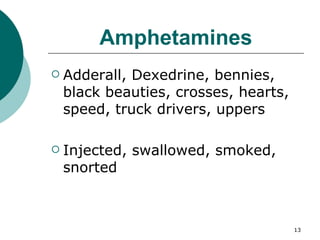
Amphetamines Adderall, Dexedrine, bennies, black beauties, crosses, hearts, speed, truck drivers, uppers Injected, swallowed, smoked, snorted
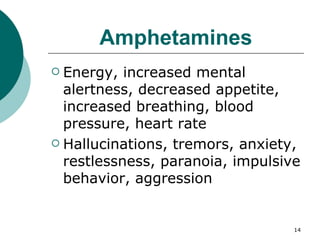
Amphetamines Energy, increased mental alertness, decreased appetite, increased breathing, blood pressure, heart rate Hallucinations, tremors, anxiety, restlessness, paranoia, impulsive behavior, aggression
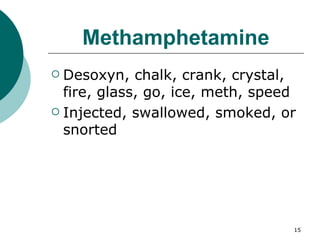
Methamphetamine Desoxyn, chalk, crank, crystal, fire, glass, go, ice, meth, speed Injected, swallowed, smoked, or snorted
Methamphetamine Aggression, violence, psychotic behavior, memory loss, and other symptoms similar to amphetamines
Impact of the Substance-Abusing Employee on the  Workforce Four times more likely to be hospitalized for injury than non-abusers. When injured on the job, off work longer than non-abusers and have higher claims. Have higher absenteeism rates, accidents, poor performance, and turnover.
Impact of Substance Usage  on the Workforce Between 20-40% of all substance abusers are admitted at some time to the hospital because of complications of their usage. Up to 40% of industrial fatalities and 47% of industrial injuries can be linked to alcohol and alcoholism.
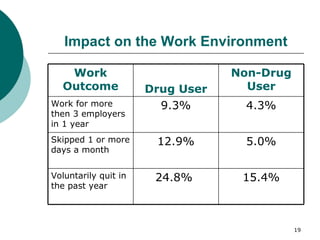
Impact on the Work Environment 15.4% 24.8%  Voluntarily quit in the past year  5.0% 12.9% Skipped 1 or more days a month 4.3% 9.3% Work for more then 3 employers in 1 year Non-Drug User Drug User Work Outcome
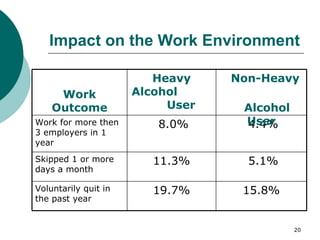
Impact on the Work Environment 15.8% 19.7% Voluntarily quit in the past year 5.1% 11.3% Skipped 1 or more days a month 4.4% 8.0% Work for more then 3 employers in 1 year Non-Heavy  Alcohol User Heavy Alcohol  User Work Outcome
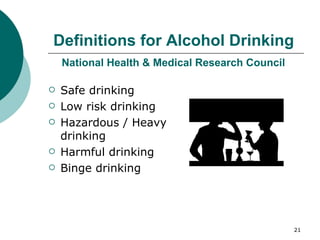
Definitions for Alcohol Drinking  Safe drinking Low risk drinking Hazardous / Heavy drinking Harmful drinking Binge drinking National Health & Medical Research Council
Recommendations for Responsible Drinking Guidelines for men and women Refrain from Binge drinking  Two alcohol-free days per week Pregnant women – abstain Do not drive, operate machinery, or undertake activities in hazardous conditions and drink
Heavy Drinkers vs.  Light Drinkers In a study of 6,549 employees at  16 worksites, it was found that: “ Light alcohol users accounted for more workplace problems overall because there were more of them.”
Total Economic Loss   Lost productivity in the workforce because of substance usage costs companies  $82 billion+  per year and is growing.
Substance Abusers’ Impact On the Work Environment Non-abusers report lower morale and poorer communications because of the presence of substance users. Abusers are more involved in workplace violence then non-abusers. Abusers are implicated more in workplace theft.
Do Drug Free Work Programs Work? Ask the Employee! Non-users and users were asked if their company provided substance abuse information. 75.2% of non-users said yes. 62.1% of users said yes.  Non-users and users were asked if their company had a written policy about substance use. 70.6% of non-users said yes. 57.2% said yes.
Do Drug Free Work  Programs Work? Non-users and users were asked if their company provided an Employee Assistance Program 51.1% of non-users said yes 34.5% of users said yes
Case Study: Mid-Size Company Chamberlain Contractors of Maryland with 75 employees implemented a substance abuse program. The program cost $7,600 per year. Estimated  savings  are in excess of $120,000 in fewer accidents and lower claims and insurance premiums
Case Study: Large Company With the Employee Assistance Program (EAP) at McDonnell Douglas, they estimated saving $5.1 million due to fewer missed days, lower turnover, and lower medical claims. Gillette Company initiated an EAP and found that in-patient substance abuse treatment costs  decreased  75%. Estimated that for every $1 invested in DFWP, saw a $3-$6 ROI.
Many substance abusers cannot see the impact their usage has on their lives and performance.  Why? Substance usage impairs learning, memory recording & retrieval, mental sharpness, and motor skills during and long after usage and has an addiction/disease component. Substance usage acts as a “chemically  induced learning disability” that can have lasting effects and permanent changes in the brain. An impaired brain is impaired in self-evaluation ability.
Addiction The irresistible compulsion to use alcohol and other drugs despite adverse consequences Characterized by repeated failures to control use, increased tolerance, and increased disruption in the family
Use Limited controlled consumption of a drug (in terms of frequency and quantity) No significant toxic, adverse physical, or psychological consequences to the user Experimentation
Abuse A level of use that typically leads to adverse consequences (physical or psychological) Not necessarily associated with any particular frequency but is associated with use in  quantities  that result in some toxicity to the user
Dependence Significant physical and psychological consequences Three   C’s: –  Loss of  Control –  Compulsive  pattern of use –  Continued use despite  negative Consequences
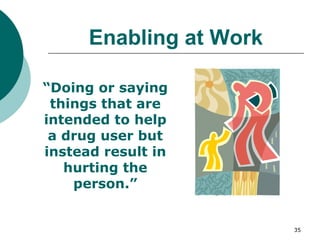
Enabling at Work “ Doing or saying things that are intended to help a drug user but instead result in hurting the person.”
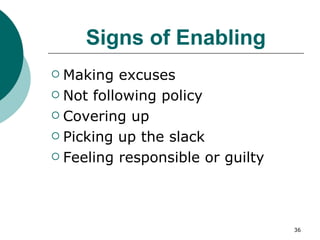
Signs of Enabling Making excuses Not following policy Covering up Picking up the slack Feeling responsible or guilty
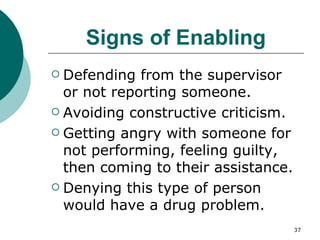
Signs of Enabling Defending from the supervisor or not reporting someone. Avoiding constructive criticism. Getting angry with someone for not performing, feeling guilty, then coming to their assistance. Denying this type of person would have a drug problem.
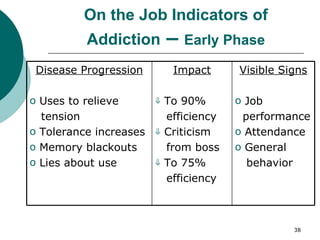
On the Job Indicators of Addiction  –  Early Phase Visible Signs Job  performance Attendance General  behavior Impact To 90%  efficiency Criticism  from boss To 75%  efficiency Disease Progression Uses to relieve  tension Tolerance increases Memory blackouts Lies about use
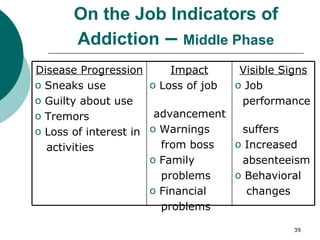
On the Job Indicators of Addiction  –  Middle Phase Visible Signs Job  performance  suffers Increased  absenteeism Behavioral  changes Impact Loss of job  advancement Warnings  from boss Family  problems Financial  problems Disease Progression Sneaks use Guilty about use  Tremors Loss of interest in  activities
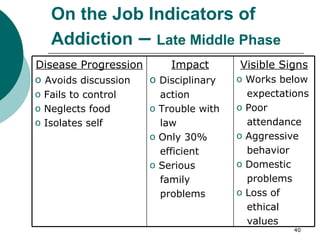
On the Job Indicators of Addiction  –  Late Middle Phase Visible Signs Works below  expectations Poor  attendance Aggressive  behavior Domestic  problems  Loss of  ethical values Impact Disciplinary  action Trouble with  law Only 30%  efficient Serious  family  problems Disease Progression Avoids discussion Fails to control  Neglects food Isolates self
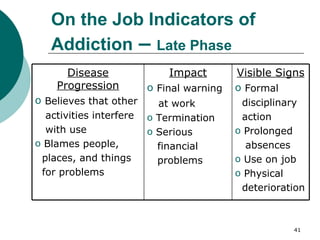
On the Job Indicators of Addiction  –  Late Phase Visible Signs Formal disciplinary  action Prolonged absences Use on job Physical deterioration Impact Final warning at work  Termination Serious financial problems Disease Progression Believes that other activities interfere with use Blames people, places, and things for problems
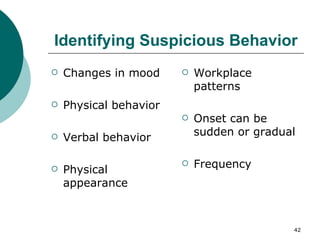
Identifying Suspicious Behavior Changes in mood Physical behavior Verbal behavior Physical appearance Workplace patterns Onset can be sudden or gradual Frequency
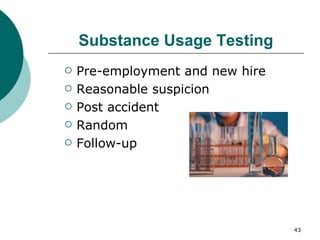
Substance Usage Testing Pre-employment and new hire Reasonable suspicion Post accident Random Follow-up
Accuracy of Drug Tests Chain of Custody Initial Screen Confirmation Test Medical Review Officer (MRO)
Treatment Options Outpatient Treatment Intensive Outpatient Treatment Detoxification Hospitalization Residential Treatment Self Help Groups
National Resources  and Hotlines The Center for Substance Abuse Treatment’s Drug Information,  Treatment and Referral 1-800-662-HELP  www.samhsa.gov NarAnon (310) 547-5800 www.na.org Tough Love 1-800-333-1069 www.toughloveparenting.com
National Resources  and Hotlines Families Anonymous  1-800-736-9805 Alcoholics Anonymous www.alcoholics-anonymous.org
Enhancing Drug Free Workplace Monitor the “drinking & drugging climate” of your workplace and change it if needed. Be proactive in addressing troubled employees. Focus on a “team approach” to prevent workplace substance abuse.

Havar Copy DFWP Employee

  • 1.
    Drug Free WorkplaceEmployee Training Havar Inc.
  • 2.
    Drug Free WorkplaceCourse Outline Drug Free Workplace (DFWP) basic components Identify commonly abused drugs and recognize street names Describe impact of substance abuse on the workplace Define types of alcohol use Distinguish between substance use, abuse, and dependence Discuss “Enabling” Recognizing indicators of possible substance abuse Substance Usage Testing Accuracy of drug tests Treatment options Resources Enhancing your DFWP
  • 3.
    Drug Free Workplace Five Basic Components Written Substance Abuse Policy Employee Education Awareness Supervisor/Manager Training Drug and Alcohol Testing Employee Assistance Program (EAP)
  • 4.
    Most Commonly AbusedDrugs Cannabinoids Phencyclidine Opioids and Morphine Derivatives Cocaine Amphetamines Methamphetamines
  • 5.
    Cannabinoids Marijuana Dope,blunt, ganja, grass, joints, pot, reefer, weed Swallowed or smoked
  • 6.
    Cannabinoids Euphoria, slowedthinking and reaction time, confusion, impaired balance and coordination, anxiety, increased heart rate, tolerance.
  • 7.
    Phencyclidine PCP andAnalogs Angel dust, boat, hog, love boat, peace pill Injected, swallowed, or smoked
  • 8.
    Phencyclidine Panic, aggression,violence, loss of appetite, depression, decrease in blood pressure and heart rate
  • 9.
    Opioids and MorphineDerivatives Codeine, heroin, morphine, opium Empirin with codeine, Fiorinal with codeine, Tylenol with codeine, Cody, schoolboy, fours and doors, brown sugar, horse smack, monkey, white stuff, laudanum, paregoric Injected, swallowed, smoked, snorted
  • 10.
    Opioids and MorphineDerivatives Pain relief, euphoria, nausea, depression, confusion, constipation, sedation, coma
  • 11.
    Cocaine Blow, bump,C, candy, coke, crack, Charlie, flake, rock, snow, toot Injected, smoked, snorted
  • 12.
    Cocaine Feelings ofexhilaration, energy, increased blood pressure and heart rate, temperature, decreased appetite, chest pain, seizures, headaches, heart failure
  • 13.
    Amphetamines Adderall, Dexedrine,bennies, black beauties, crosses, hearts, speed, truck drivers, uppers Injected, swallowed, smoked, snorted
  • 14.
    Amphetamines Energy, increasedmental alertness, decreased appetite, increased breathing, blood pressure, heart rate Hallucinations, tremors, anxiety, restlessness, paranoia, impulsive behavior, aggression
  • 15.
    Methamphetamine Desoxyn, chalk,crank, crystal, fire, glass, go, ice, meth, speed Injected, swallowed, smoked, or snorted
  • 16.
    Methamphetamine Aggression, violence,psychotic behavior, memory loss, and other symptoms similar to amphetamines
  • 17.
    Impact of theSubstance-Abusing Employee on the Workforce Four times more likely to be hospitalized for injury than non-abusers. When injured on the job, off work longer than non-abusers and have higher claims. Have higher absenteeism rates, accidents, poor performance, and turnover.
  • 18.
    Impact of SubstanceUsage on the Workforce Between 20-40% of all substance abusers are admitted at some time to the hospital because of complications of their usage. Up to 40% of industrial fatalities and 47% of industrial injuries can be linked to alcohol and alcoholism.
  • 19.
    Impact on theWork Environment 15.4% 24.8% Voluntarily quit in the past year 5.0% 12.9% Skipped 1 or more days a month 4.3% 9.3% Work for more then 3 employers in 1 year Non-Drug User Drug User Work Outcome
  • 20.
    Impact on theWork Environment 15.8% 19.7% Voluntarily quit in the past year 5.1% 11.3% Skipped 1 or more days a month 4.4% 8.0% Work for more then 3 employers in 1 year Non-Heavy Alcohol User Heavy Alcohol User Work Outcome
  • 21.
    Definitions for AlcoholDrinking Safe drinking Low risk drinking Hazardous / Heavy drinking Harmful drinking Binge drinking National Health & Medical Research Council
  • 22.
    Recommendations for ResponsibleDrinking Guidelines for men and women Refrain from Binge drinking Two alcohol-free days per week Pregnant women – abstain Do not drive, operate machinery, or undertake activities in hazardous conditions and drink
  • 23.
    Heavy Drinkers vs. Light Drinkers In a study of 6,549 employees at 16 worksites, it was found that: “ Light alcohol users accounted for more workplace problems overall because there were more of them.”
  • 24.
    Total Economic Loss Lost productivity in the workforce because of substance usage costs companies $82 billion+ per year and is growing.
  • 25.
    Substance Abusers’ ImpactOn the Work Environment Non-abusers report lower morale and poorer communications because of the presence of substance users. Abusers are more involved in workplace violence then non-abusers. Abusers are implicated more in workplace theft.
  • 26.
    Do Drug FreeWork Programs Work? Ask the Employee! Non-users and users were asked if their company provided substance abuse information. 75.2% of non-users said yes. 62.1% of users said yes. Non-users and users were asked if their company had a written policy about substance use. 70.6% of non-users said yes. 57.2% said yes.
  • 27.
    Do Drug FreeWork Programs Work? Non-users and users were asked if their company provided an Employee Assistance Program 51.1% of non-users said yes 34.5% of users said yes
  • 28.
    Case Study: Mid-SizeCompany Chamberlain Contractors of Maryland with 75 employees implemented a substance abuse program. The program cost $7,600 per year. Estimated savings are in excess of $120,000 in fewer accidents and lower claims and insurance premiums
  • 29.
    Case Study: LargeCompany With the Employee Assistance Program (EAP) at McDonnell Douglas, they estimated saving $5.1 million due to fewer missed days, lower turnover, and lower medical claims. Gillette Company initiated an EAP and found that in-patient substance abuse treatment costs decreased 75%. Estimated that for every $1 invested in DFWP, saw a $3-$6 ROI.
  • 30.
    Many substance abuserscannot see the impact their usage has on their lives and performance. Why? Substance usage impairs learning, memory recording & retrieval, mental sharpness, and motor skills during and long after usage and has an addiction/disease component. Substance usage acts as a “chemically induced learning disability” that can have lasting effects and permanent changes in the brain. An impaired brain is impaired in self-evaluation ability.
  • 31.
    Addiction The irresistiblecompulsion to use alcohol and other drugs despite adverse consequences Characterized by repeated failures to control use, increased tolerance, and increased disruption in the family
  • 32.
    Use Limited controlledconsumption of a drug (in terms of frequency and quantity) No significant toxic, adverse physical, or psychological consequences to the user Experimentation
  • 33.
    Abuse A levelof use that typically leads to adverse consequences (physical or psychological) Not necessarily associated with any particular frequency but is associated with use in quantities that result in some toxicity to the user
  • 34.
    Dependence Significant physicaland psychological consequences Three C’s: – Loss of Control – Compulsive pattern of use – Continued use despite negative Consequences
  • 35.
    Enabling at Work“ Doing or saying things that are intended to help a drug user but instead result in hurting the person.”
  • 36.
    Signs of EnablingMaking excuses Not following policy Covering up Picking up the slack Feeling responsible or guilty
  • 37.
    Signs of EnablingDefending from the supervisor or not reporting someone. Avoiding constructive criticism. Getting angry with someone for not performing, feeling guilty, then coming to their assistance. Denying this type of person would have a drug problem.
  • 38.
    On the JobIndicators of Addiction – Early Phase Visible Signs Job performance Attendance General behavior Impact To 90% efficiency Criticism from boss To 75% efficiency Disease Progression Uses to relieve tension Tolerance increases Memory blackouts Lies about use
  • 39.
    On the JobIndicators of Addiction – Middle Phase Visible Signs Job performance suffers Increased absenteeism Behavioral changes Impact Loss of job advancement Warnings from boss Family problems Financial problems Disease Progression Sneaks use Guilty about use Tremors Loss of interest in activities
  • 40.
    On the JobIndicators of Addiction – Late Middle Phase Visible Signs Works below expectations Poor attendance Aggressive behavior Domestic problems Loss of ethical values Impact Disciplinary action Trouble with law Only 30% efficient Serious family problems Disease Progression Avoids discussion Fails to control Neglects food Isolates self
  • 41.
    On the JobIndicators of Addiction – Late Phase Visible Signs Formal disciplinary action Prolonged absences Use on job Physical deterioration Impact Final warning at work Termination Serious financial problems Disease Progression Believes that other activities interfere with use Blames people, places, and things for problems
  • 42.
    Identifying Suspicious BehaviorChanges in mood Physical behavior Verbal behavior Physical appearance Workplace patterns Onset can be sudden or gradual Frequency
  • 43.
    Substance Usage TestingPre-employment and new hire Reasonable suspicion Post accident Random Follow-up
  • 44.
    Accuracy of DrugTests Chain of Custody Initial Screen Confirmation Test Medical Review Officer (MRO)
  • 45.
    Treatment Options OutpatientTreatment Intensive Outpatient Treatment Detoxification Hospitalization Residential Treatment Self Help Groups
  • 46.
    National Resources and Hotlines The Center for Substance Abuse Treatment’s Drug Information, Treatment and Referral 1-800-662-HELP www.samhsa.gov NarAnon (310) 547-5800 www.na.org Tough Love 1-800-333-1069 www.toughloveparenting.com
  • 47.
    National Resources and Hotlines Families Anonymous 1-800-736-9805 Alcoholics Anonymous www.alcoholics-anonymous.org
  • 48.
    Enhancing Drug FreeWorkplace Monitor the “drinking & drugging climate” of your workplace and change it if needed. Be proactive in addressing troubled employees. Focus on a “team approach” to prevent workplace substance abuse.

Editor's Notes

  • #2 Welcome to the Drug-Free Workplace Employee Training. Introduce yourself. In July 1997 the Ohio Bureau of Worker’s Compensation developed the Drug Free Workplace as an incentive program designed to help employers: Establish safer work environment Protect health and safety of employees Help your company stay competitive by reducing: Accidents Healthcare and other insurance costs Theft Other forms of loss This was actually in response to the federal Drug Free Workplace Act of 1988. This act has made it mandatory that all employers who bid on state-funded work sites and all commercial drivers must participate in Drug Free Workplace. Other administrations required: Federal Avaiation Admin US Coast Guard Federal Railroad Admin Federal Transit
  • #3 Objectives of Drug Free Workplace Program : Improve safety and health in workplace through delivering, detecting, and taking corrective action against substance use Protect employees rights while buffering employers from legal liabilities Reduce Worker’s Compensation and insurance costs Save money through reduction in health care costs, theft, and other forms of loss. Educate the workforce be come more knowledgeable about substance abuse and resources available when help is needed.
  • #4 Drug Free Workplace Five Basic Components Required : (All these are required for every level) Written Substance Abuse Policy Employee Educational Awareness Supervisor/Manager Training Drug & Alcohol Testing Employee Assistance Program We are here for the Employee Education portion. Provide you with information
  • #17 What do you think is the most abused substance in the workplace? None of the substances we just discussed. It is alcohol. Next slide.
  • #18 Research in one study indicated a doubled rate of injury on the job for users in compared to non-users.
  • #19 Not a matter of if; but when for many users that they will need medical services for complications of usage. Hospital trauma rooms report that receive between 15% to 45% of patients under the influence of drug or alcohol. Also need to consider that if they don’t injure themselves they injury someone else.
  • #20 Substance abusing employees cost money in terms of human resources. Recruiting, interviewing, training, and down time in productivity is expensive. During the late 1990’s the employment shortage was such that employers needed to fill positions quickly with whatever available person. Times have changed and selective hiring goes a long way in preventing problems in the workplace and creating a competitive company . Source of data on table: 1997 National Household Survey on Drug Abuse.
  • #21 Heavy alcohol users defined as 5 or more drinks in one setting and on at least five days within the past 30 days. Binge drinking = 5 or more drinks within a day/setting.
  • #22 Heavy alcohol users defined as 5 or more drinks in one setting and on at least five days within the past 30 days. Binge drinking = 5 or more drinks within a day/setting. Heavy alcohol users defined as 5 or more drinks in one setting and on at least five days within the past 30 days. Binge drinking = 5 or more drinks within a day/setting. Heavy alcohol users defined as 5 or more drinks in one setting and on at least five days within the past 30 days. Binge drinking = 5 or more drinks within a day/setting.
  • #24 Both heavy and light alcohol have an impact. Light drinkers were defined as those having 13 or less drinks within 30 days. Because of the shear number of light drinkers, they, too, also have an impact the workplace. Don’t discount the impact of alcohol at all levels of ingestion: Light, medium, and heavy drinkers.
  • #25 This last figure is from 1992. Since then employee substance usage has increased and so has the cost. Employers need to remain competitive in the workforce! Q: How serious is substance use in your company? Can you think of any lost productivity in your workplace in the past? PN :(Names not needed of cases)
  • #26 Substance abuse degrades the work environment and the team approach to accomplishing tasks. Results in Alienation paradigm which increases stress. Non-users relate less cohesion in the workplace. Creates an environment where others have to work harder for the same wage to make up. PN : CAREFUL-If a theft occurs, it doesn't automatically mean the person with the substance abuse problem did it. No witch hunts/backwards logic! Q: Does Anyone have experience working with someone who uses? What was it like?
  • #27 Table 1- 13% difference between the groups. More non-users say there is education provided by their employer. National Household Study. Overall for all business irrespective of size. PN: Caution in explaining: The National House Survey on Drug Abuse involved over 100,000 subjects. They then looked at Employed substance abusers as a whole and their answer as to whether their company provided substance abuse information. The same was done for non-users. Interpretation: Companies that provide information substance information/education are more likely to have more non-users . The same case exists for policy about substance abuse and the next slide.
  • #28 Same source of previous slide.
  • #29 A mid size company.
  • #30 Early intervention helps save money. Even without any incentive from workers compensation in the State of Ohio, a drug free force policy and system makes sense and saves money. ROI=return on investment.
  • #31 The million dollar question. Think about it! Regular substance abuse isn’t too far off from hitting yourself with a ball peen hammer. They both damage the brain. Discuss the differences between abuse and dependence. Both dependence and abuse are problems
  • #35 Loss of Control : When it is a struggle for one to stop using once they start, or they are unable to stop, or they are unable to consistently abstain altogether. Compulsive pattern of use When one’s relationship to their drug of choice becomes central instead of unimportant. When one organizes their lifestyle to support using, and focuses energy on accessing and using their drug. Continued use despite negative Consequences When use goes on despite problems at work, legal or financial difficulties, failing health, physical injury, and breakdown of relationships and/or psychological problems.
  • #36 Making excuses: “He’s having a rough day.” Cover up: “Chris is feeling under the weather today; he won’t be at work.” Picking up the slack: “I’ll take care of the last two parts; go rest a while.”
  • #37 Some people derive great satisfaction out of making others feel better. However, by enabling the drug user to continue denying a problem exists or to ignore the problem, only allows the addiction to become more severe and harder to recover from. When the enabler defends the drug user’s action, or stands between them and the consequences of their behavior, they are hurting that individual, not helping.
  • #38 Defending from supervisor – protecting them from the consequences by hiding or not reporting information Avoiding constructive criticism – again, not helping but hindering person’s recovery Getting angry, feeling guilty, then coming to their assistance. Believing that someone as smart, nice, young, old, responsible, hard working, happy, well off, etc. couldn’t have a problem with drugs or alcohol.
  • #44 Refer to BWC Guide/Handbook / Your Policy All new employment must be tested within 90 days of hire. Reasonable suspicion testing is done as required. Drug testing no later than 32 hours. Alcohol testing within 8 hours. Post accident testing occurs immediately after accident (fatality, injury requiring off-site medical treatment, vehicular damage). Random Testing is an unannounced test that occurs at predetermined frequency. It is usually conducted by a computer program by an outside vendor: Mandatory – Level 2 – 10% of workforce Mandatory – Level 3 – 25% of workforce
  • #45 Chain of Custody The chain of custody form is used to document and insure the safety of the handling and storage of the urine sample from the time it is collected until the time it is disposed of. This form links you to your urine specimen. It is written proof of all that happens to the specimen while at the collection site and the laboratory. Initial Screen The first test done on a urine sample is called the initial screen. This test alone is not always accurate or reliable. If the initial screen is positive, a second test should be done. Confirmed Test A second confirmation test is done with gas chromatography/mass spectrometry. This is a highly accurate test and will rule out any false positives from the initial screen. For a test result to be reported as positive, both test results must agree. Medical Review Officer (MRO) A medical review officer is a licenses medical doctor who has special training in the are of substance abuse. If there is a positive drug test, the MRO reviews the results, makes sure the chain of custody procedures were followed, and contacts the employee to make sure there are no medical or other reasons for the result. It is only at this point that he MRO may report the positive test result to the employer. Medications can sometimes cause a positive test result. If this is the case, and if a doctor prescribed the medicine, the test is reported as negative. Positive Results – Employees cannot return to safety sensitive positions until cleared. Follow-up test serves as return to duty test.
  • #46 Recommended treatment for drug and/or alcohol addiction varies depending on a number of factors: Severity of problem Availability of a support system Financial concerns Individual’s motivation Previous experience in treatment All are considered when counselor determining action plan Outpatient – Can either be individual or group counseling, averaging 1-2 hours weekly for 6 weeks to several months. Intensive Outpatient – Combination of individual and group treatment lasting 3-4 hours a day at least 3 days a week for several months. Detoxification Hospitalization –For 1-3 days to clear one’s body of chemicals while under a doctor’s care. Usually followed by further treatment in an outpatient or residential program. Residential Treatment – Involves living at a facility for 7-21 days while attending individual and group therapy, education assistance, and recreational activities. For those who cannot stop without being in a drug free environment. Self-Help Groups – Groups such as Alcoholics Anonymous.
  • #49 The team approach builds cohesion among members and makes for a better work environment. Make employees feel a partnership. Small alienated groups of employees are not healthy. Be active and interested in your employees as people. Know how they are doing and express interest and recognition to them. Are your policies incongruent? “it’s OK to get smashed at a company picnic.” Allowing employees to drive home intoxicated from the Christmas party. Is there bragging and sensationalized talk about drinking? “I drank a whole case on Friday and was just smashed.” This is most common in adolescence, but also by substance abusers.” Examples from TOP down work best.