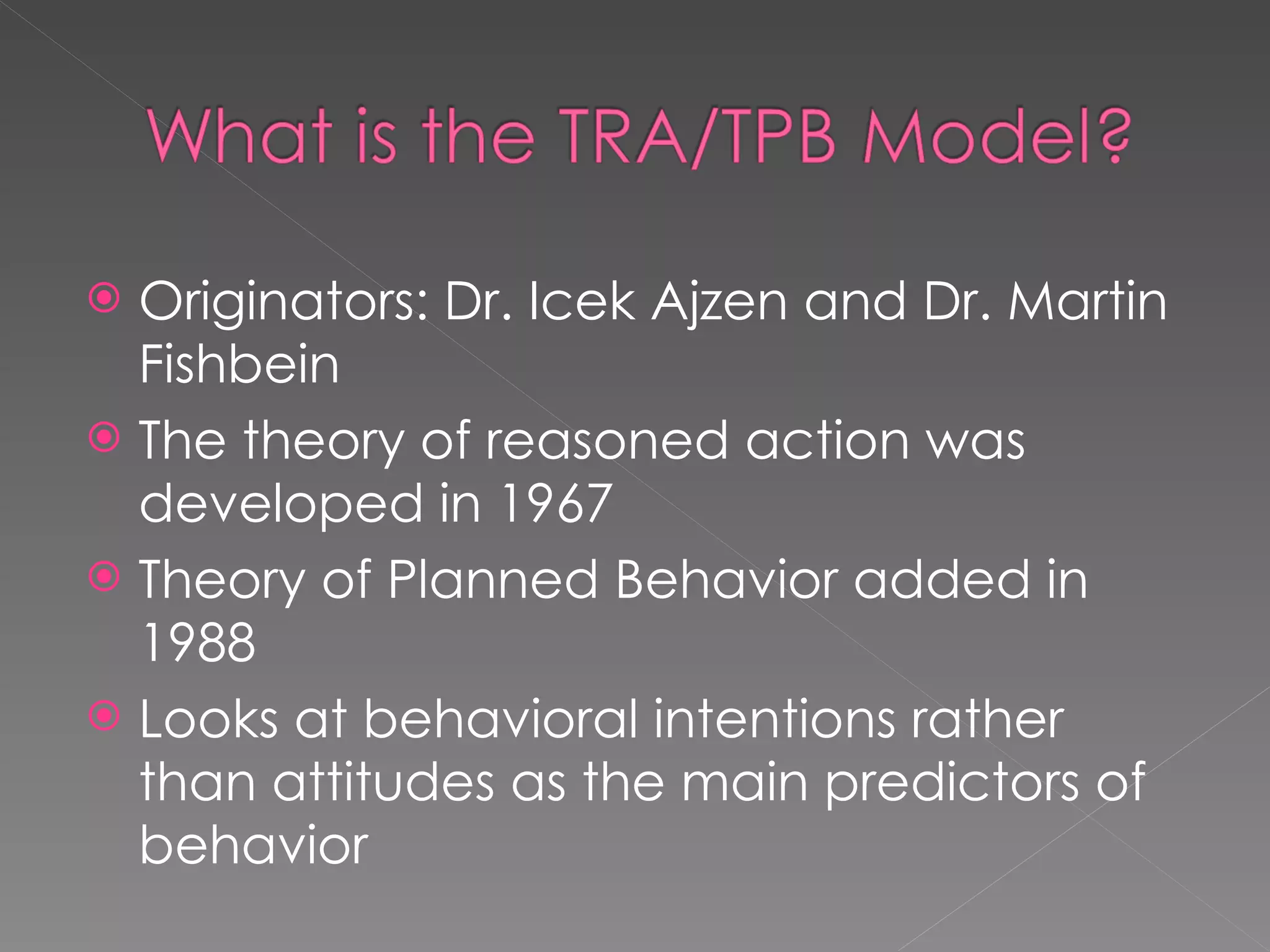
Originators: Dr. Icek Ajzen and Dr. Martin Fishbein The theory of reasoned action was developed in 1967 Theory of Planned Behavior added in 1988 Looks at behavioral intentions rather than attitudes as the main predictors of behavior
 
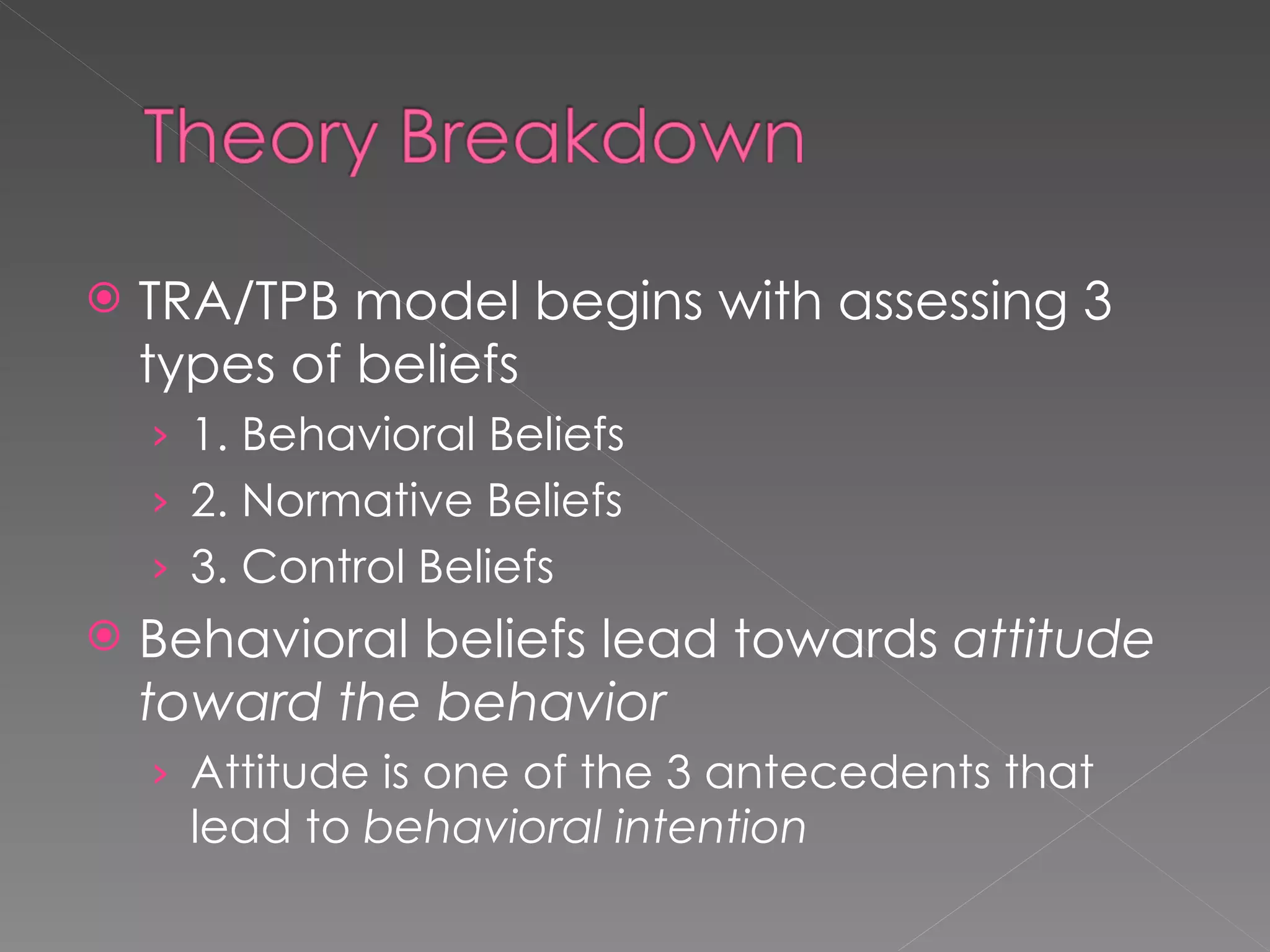
TRA/TPB model begins with assessing 3 types of beliefs 1. Behavioral Beliefs 2. Normative Beliefs 3. Control Beliefs Behavioral beliefs lead towards  attitude toward the behavior   Attitude is one of the 3 antecedents that lead to  behavioral intention
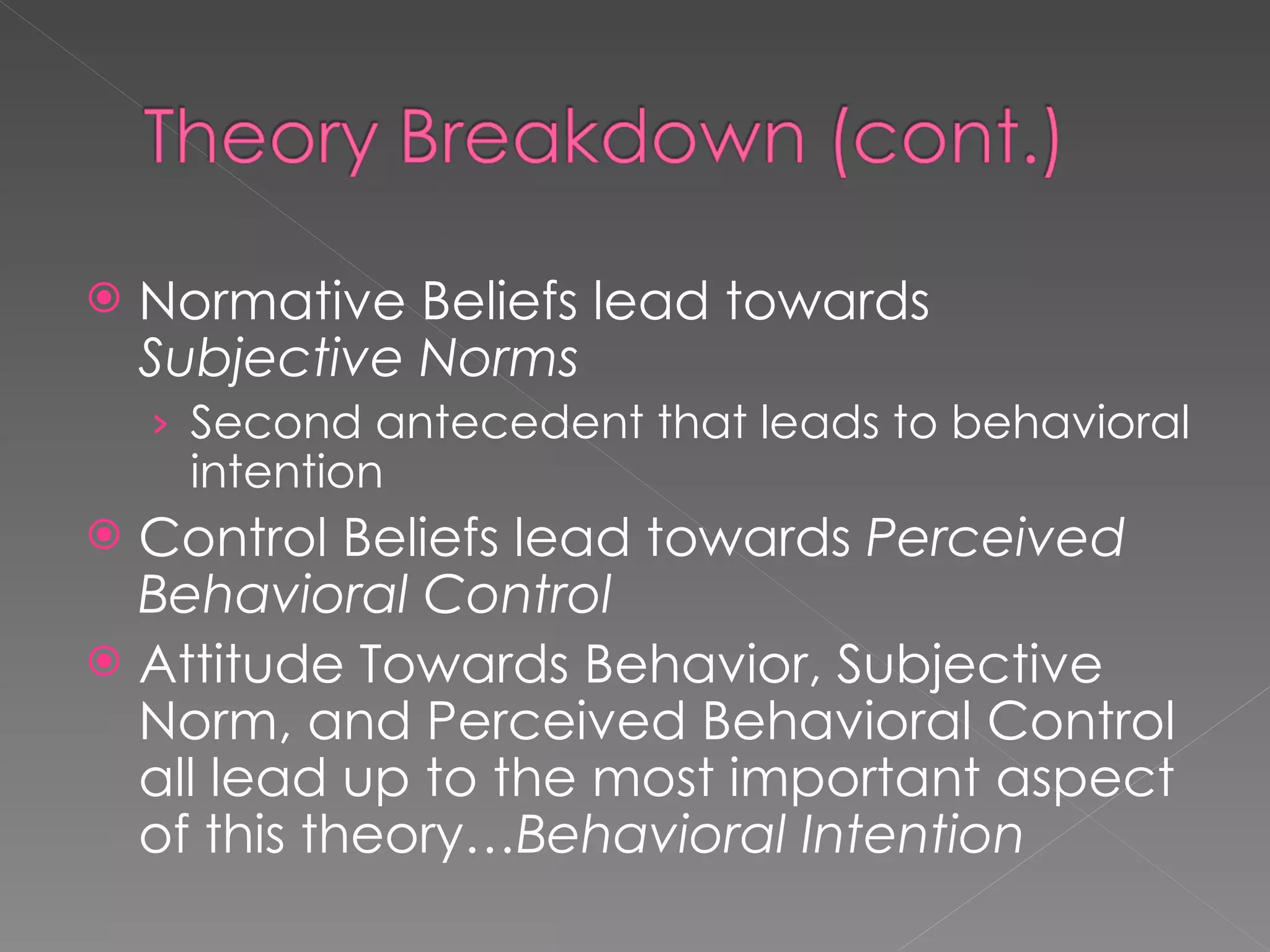
Normative Beliefs lead towards  Subjective Norms Second antecedent that leads to behavioral intention Control Beliefs lead towards  Perceived Behavioral Control Attitude Towards Behavior, Subjective Norm, and Perceived Behavioral Control all lead up to the most important aspect of this theory… Behavioral Intention
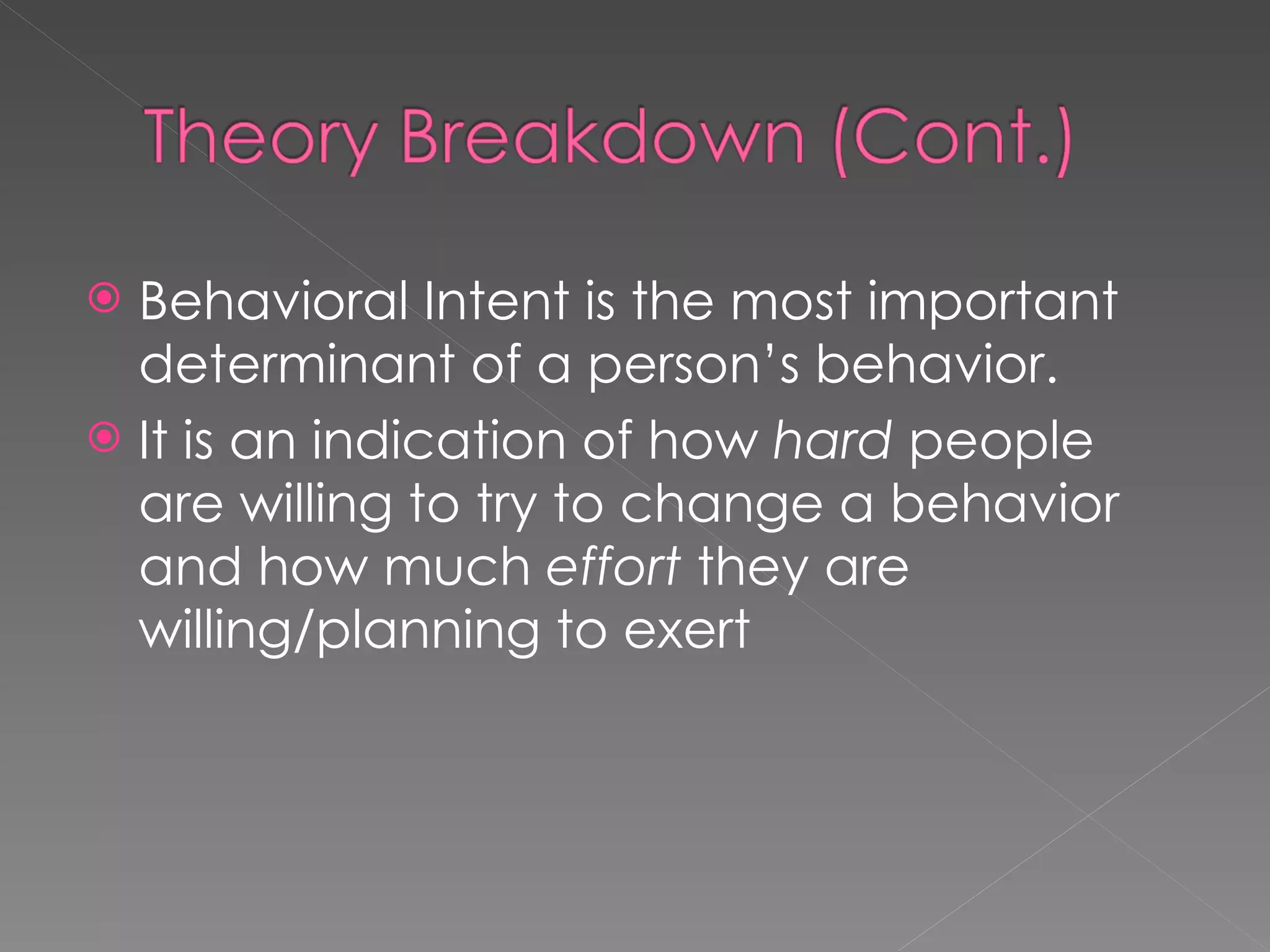
Behavioral Intent is the most important determinant of a person’s behavior. It is an indication of how  hard  people are willing to try to change a behavior and how much  effort  they are willing/planning to exert
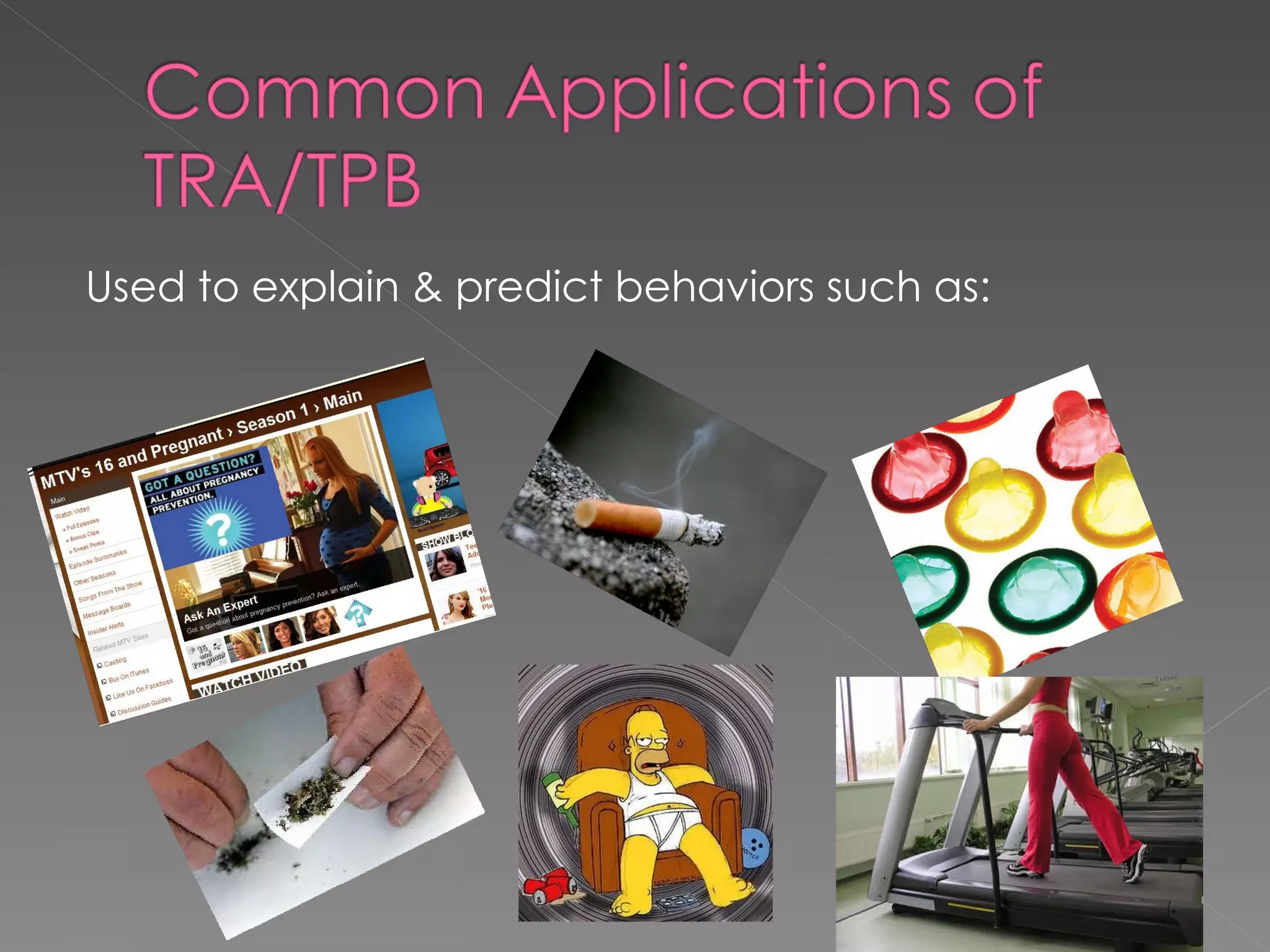
Used to explain & predict behaviors such as:
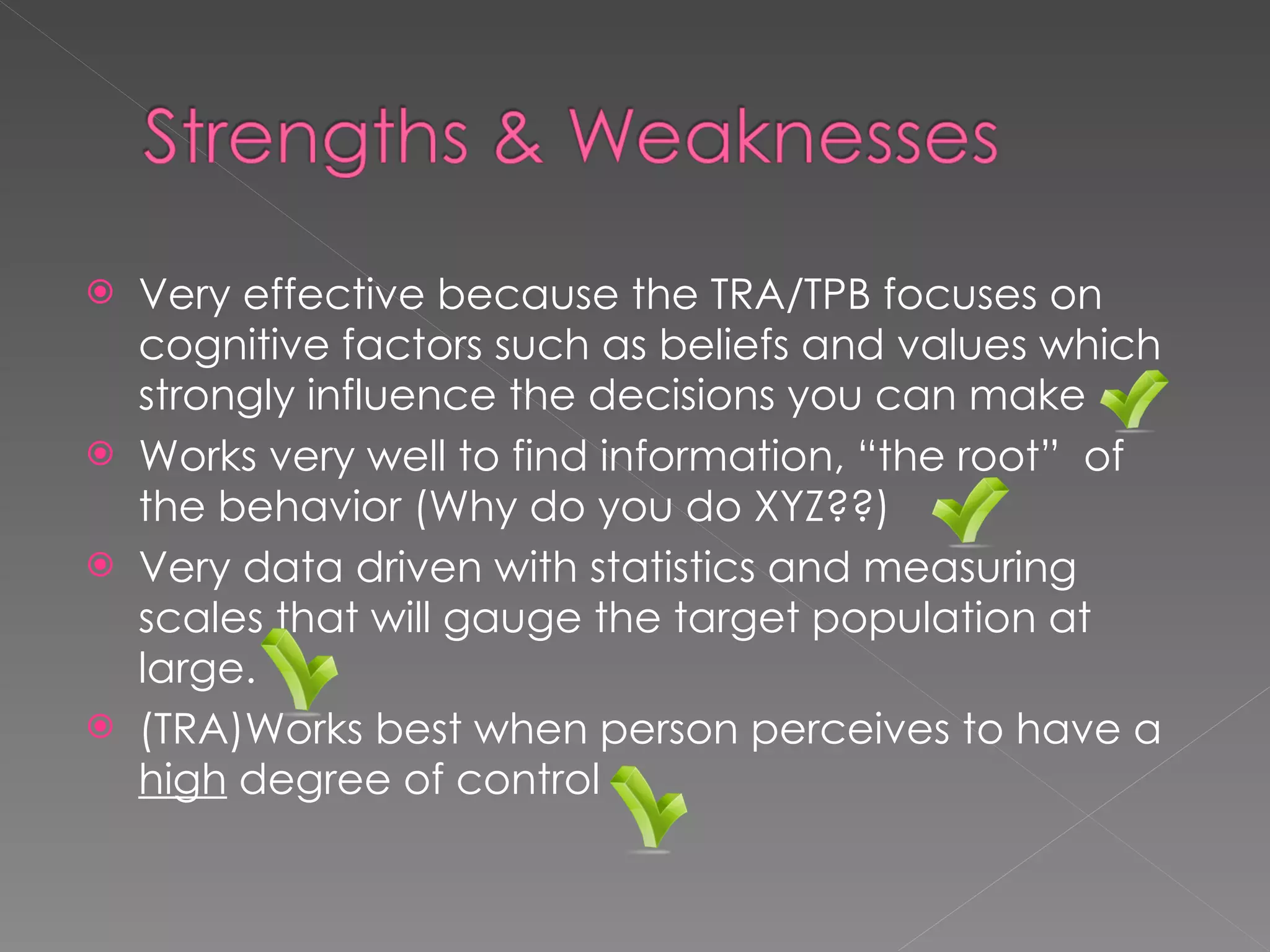
Very effective because the TRA/TPB focuses on cognitive factors such as beliefs and values which strongly influence the decisions you can make Works very well to find information, “the root”  of the behavior (Why do you do XYZ??) Very data driven with statistics and measuring scales that will gauge the target population at large. (TRA)Works best when person perceives to have a  high  degree of control
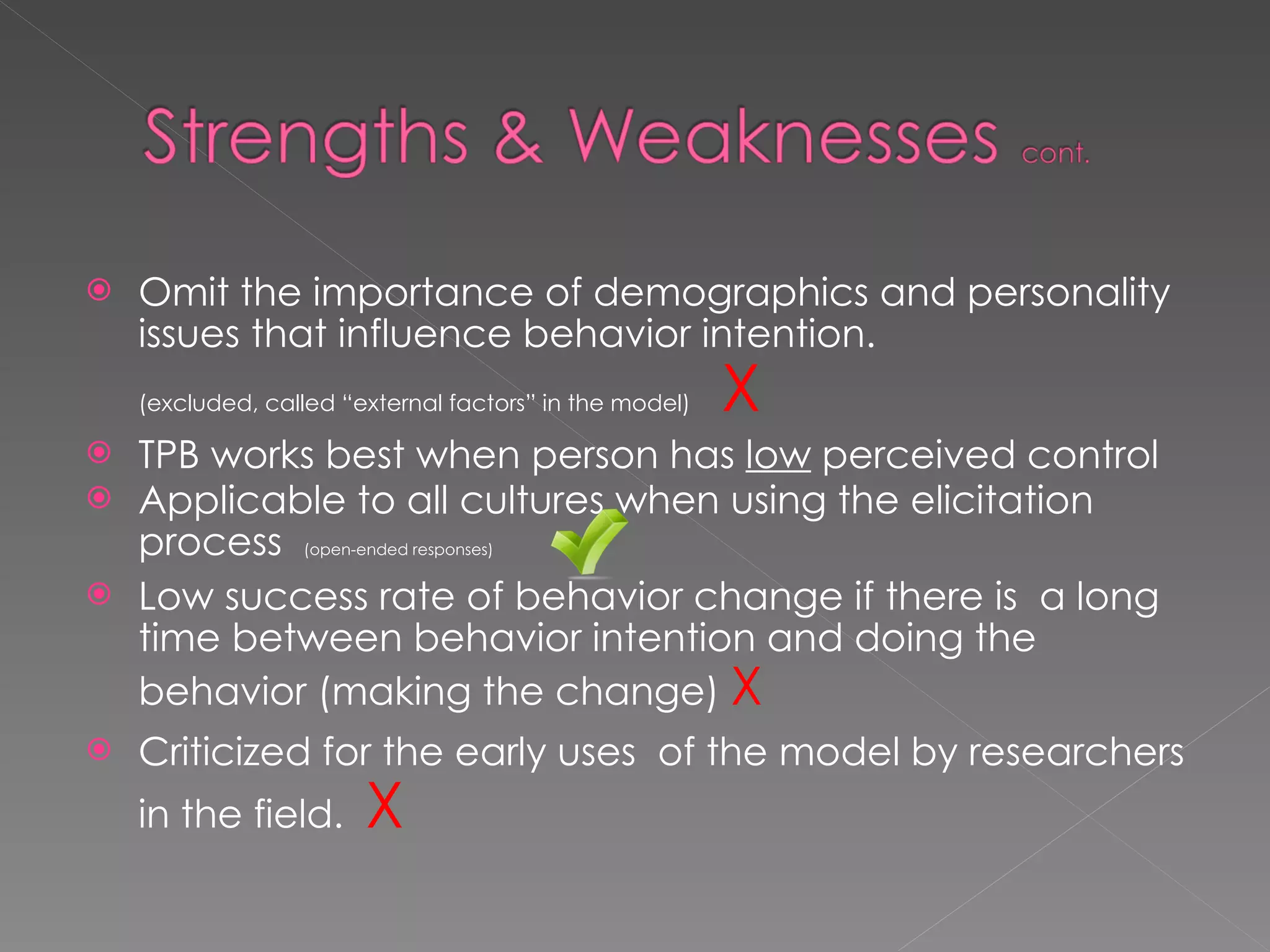
Omit the importance of demographics and personality issues that influence behavior intention. (excluded, called “external factors” in the model)  X TPB works best when person has  low  perceived control Applicable to all cultures when using the elicitation process  (open-ended responses)  Low success rate of behavior change if there is  a long time between behavior intention and doing the behavior (making the change)   X Criticized for the early uses  of the model by researchers in the field.   X
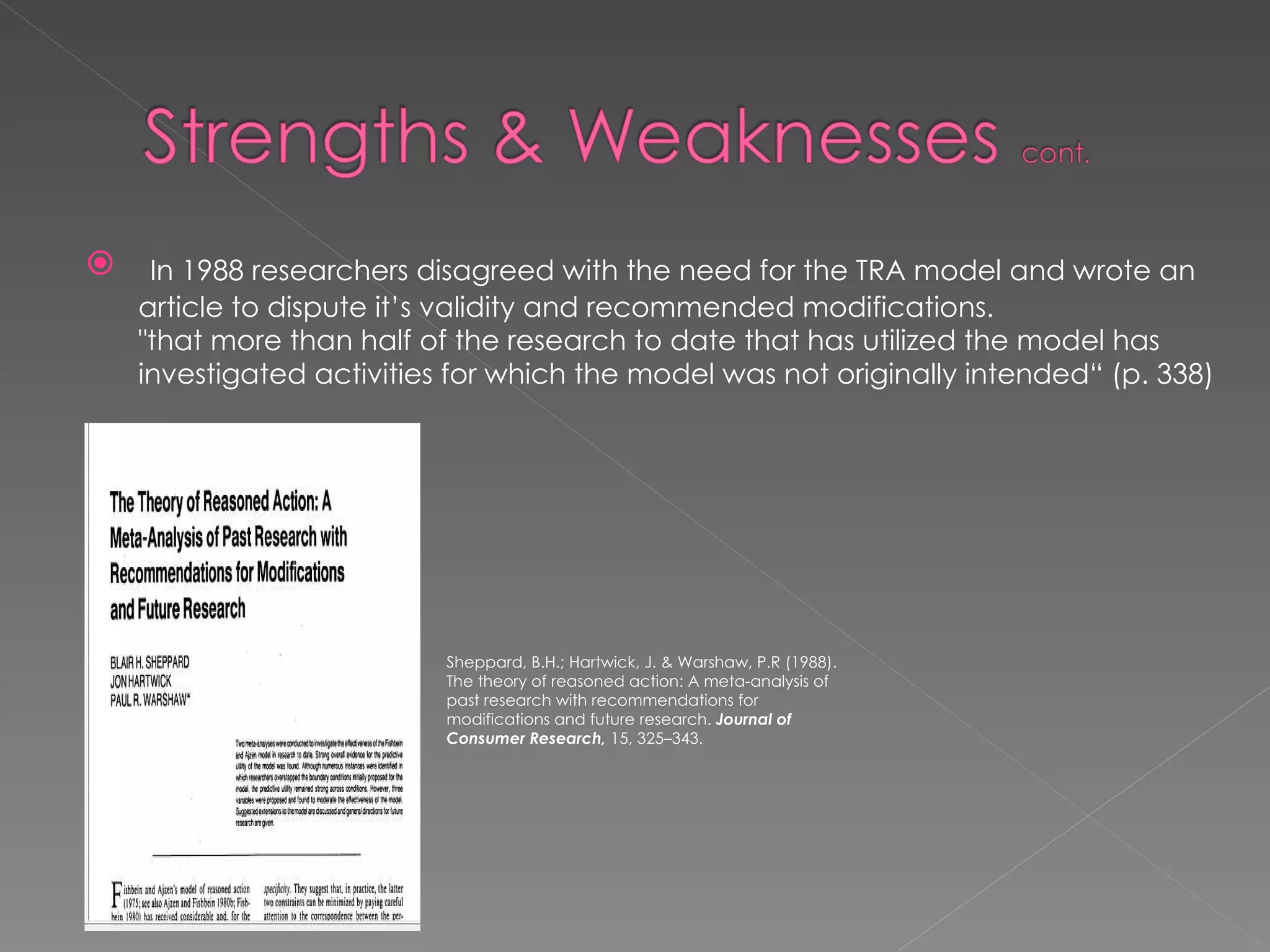
In 1988 researchers disagreed with the need for the TRA model and wrote an article to dispute it’s validity and recommended modifications. "that more than half of the research to date that has utilized the model has investigated activities for which the model was not originally intended“ (p. 338) Sheppard, B.H.; Hartwick, J. & Warshaw, P.R (1988). The theory of reasoned action: A meta-analysis of past research with recommendations for modifications and future research.  Journal of Consumer Research,  15, 325–343.
Target population: sexually active teen girls who have yet to have a pap test (pelvic exam) 13-18 years Should we choose an ethnic background??
According to the Centers for Disease Control, among a study taken in 2009  by HS students: 46% had ever had sexual intercourse  39% did not use a condom the last time they had sex 77% did not use birth control pills or Depo-Provera to prevent pregnancy the last time they had sex Sexual risk behaviors place adolescents at risk for HIV infection, other sexually transmitted diseases (STDs), and unintended pregnancy:  An estimated 8,300 young people aged 13–24 years in the 40 states reporting to CDC had HIV infection in 2009 Nearly half of the 19 million new STDs each year are among young people aged 15–24 years. More than 400,000 teen girls aged 15–19 years gave birth in 2009
 
Pap tests are not normally targeted to young teens even though  rates are at their highest for STI’s and cervical cancers  most do not know the benefits, reasons, procedures of the test. Having a pap test (pelvic exam) once a year can detect many chronic illnesses such as: Cervical cancer Std’s Precancerous cells Source: PAP Test Fact Sheet- Office of Womens Health
American College of Obstetrics and Gynecology (ACOG) recommends that young women have their first visit with an obstetrician-gynecologist (OB/GYN) between the ages of 13 and 15 or when they become sexually active, whichever comes first.
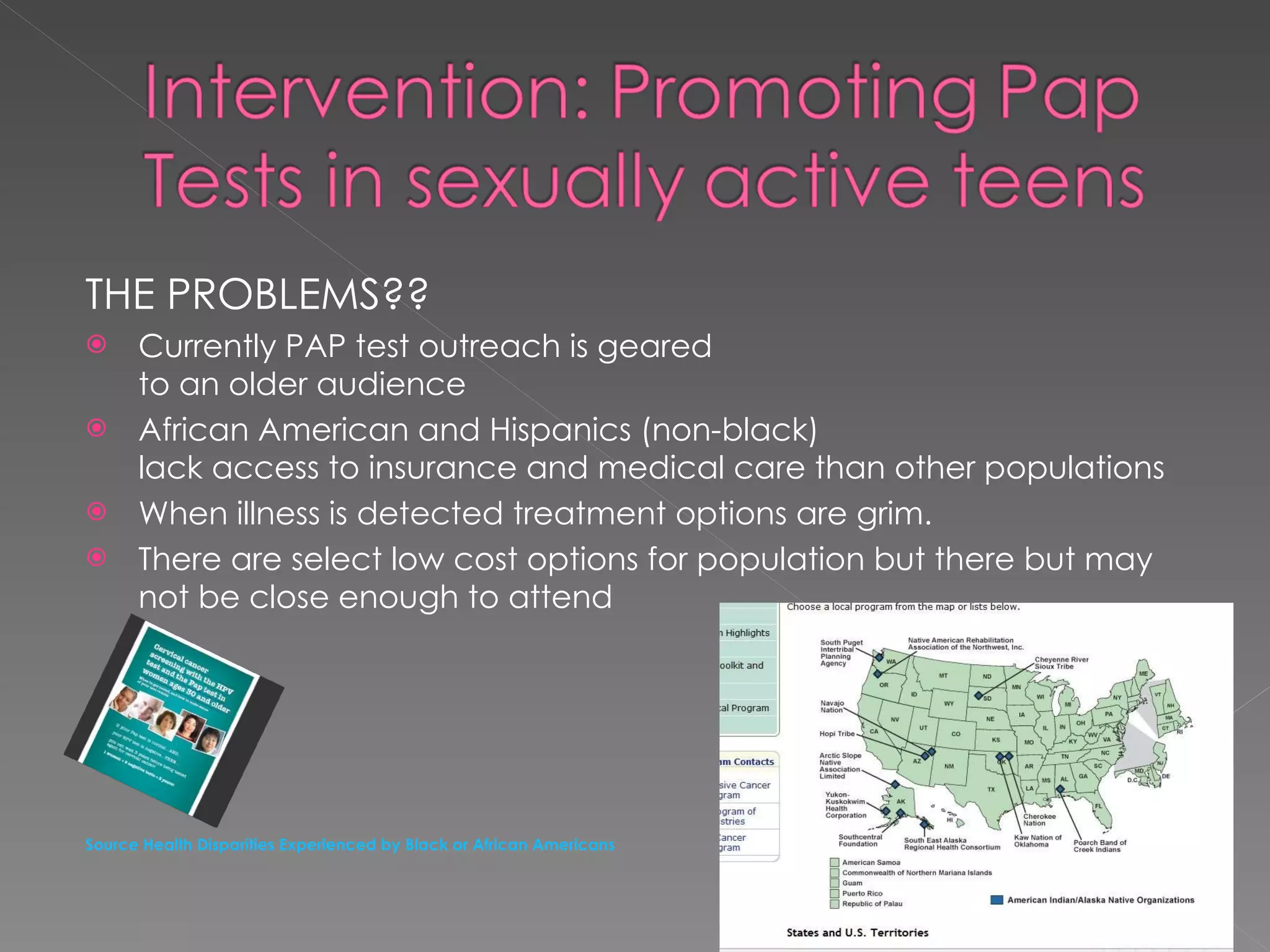
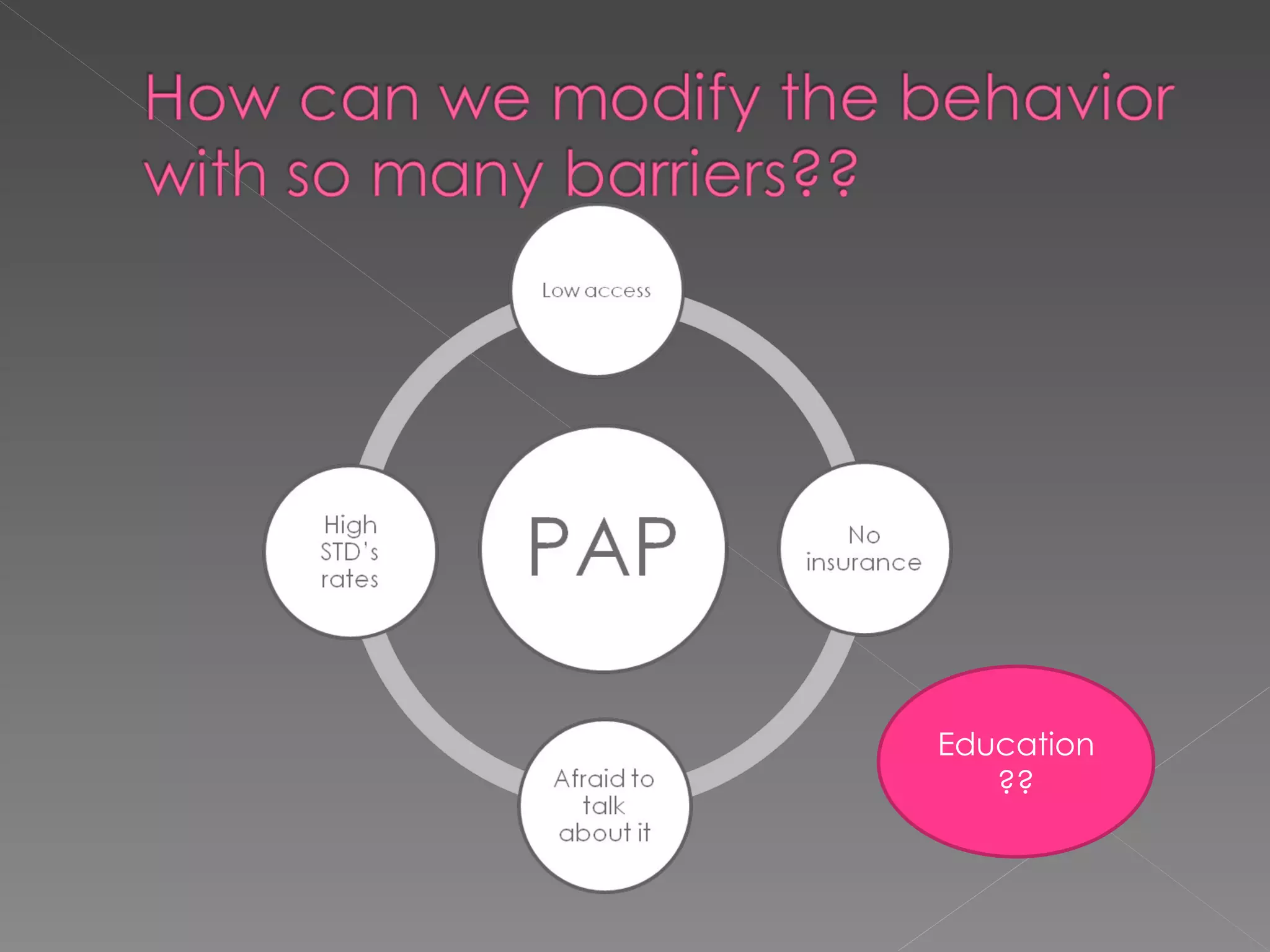
THE PROBLEMS?? Currently PAP test outreach is geared  to an older audience African American and Hispanics (non-black) lack access to insurance and medical care than other populations When illness is detected treatment options are grim. There are select low cost options for population but there but may not be close enough to attend  Source Health Disparities Experienced by Black or African Americans
Education??
Symptoms of a possible STD Unexplained pelvic or abdominal pain Partner with a known or suspected STD More than six months since last pelvic exam Never had a pelvic exam Sex with multiple partners/high-risk partners since last exam Frequent unprotected sex since last exam Source  Cynthia Holland-Hall, MD, Lecturer. 1999.  Using self-collected vaginal introital specimens to screen for sexually transmitted diseases in adolescent detainees.  Presented at North American Society for Pediatric and Adolescent Gynecology Annual Meeting. New Orleans, LA, United States.

Tra presentation draft edit

  • 1.
  • 2.
    Originators: Dr. IcekAjzen and Dr. Martin Fishbein The theory of reasoned action was developed in 1967 Theory of Planned Behavior added in 1988 Looks at behavioral intentions rather than attitudes as the main predictors of behavior
  • 3.
  • 4.
    TRA/TPB model beginswith assessing 3 types of beliefs 1. Behavioral Beliefs 2. Normative Beliefs 3. Control Beliefs Behavioral beliefs lead towards attitude toward the behavior Attitude is one of the 3 antecedents that lead to behavioral intention
  • 5.
    Normative Beliefs leadtowards Subjective Norms Second antecedent that leads to behavioral intention Control Beliefs lead towards Perceived Behavioral Control Attitude Towards Behavior, Subjective Norm, and Perceived Behavioral Control all lead up to the most important aspect of this theory… Behavioral Intention
  • 6.
    Behavioral Intent isthe most important determinant of a person’s behavior. It is an indication of how hard people are willing to try to change a behavior and how much effort they are willing/planning to exert
  • 7.
    Used to explain& predict behaviors such as:
  • 8.
    Very effective becausethe TRA/TPB focuses on cognitive factors such as beliefs and values which strongly influence the decisions you can make Works very well to find information, “the root” of the behavior (Why do you do XYZ??) Very data driven with statistics and measuring scales that will gauge the target population at large. (TRA)Works best when person perceives to have a high degree of control
  • 9.
    Omit the importanceof demographics and personality issues that influence behavior intention. (excluded, called “external factors” in the model) X TPB works best when person has low perceived control Applicable to all cultures when using the elicitation process (open-ended responses) Low success rate of behavior change if there is a long time between behavior intention and doing the behavior (making the change) X Criticized for the early uses of the model by researchers in the field. X
  • 10.
    In 1988 researchersdisagreed with the need for the TRA model and wrote an article to dispute it’s validity and recommended modifications. "that more than half of the research to date that has utilized the model has investigated activities for which the model was not originally intended“ (p. 338) Sheppard, B.H.; Hartwick, J. & Warshaw, P.R (1988). The theory of reasoned action: A meta-analysis of past research with recommendations for modifications and future research. Journal of Consumer Research, 15, 325–343.
  • 11.
    Target population: sexuallyactive teen girls who have yet to have a pap test (pelvic exam) 13-18 years Should we choose an ethnic background??
  • 12.
    According to theCenters for Disease Control, among a study taken in 2009 by HS students: 46% had ever had sexual intercourse 39% did not use a condom the last time they had sex 77% did not use birth control pills or Depo-Provera to prevent pregnancy the last time they had sex Sexual risk behaviors place adolescents at risk for HIV infection, other sexually transmitted diseases (STDs), and unintended pregnancy: An estimated 8,300 young people aged 13–24 years in the 40 states reporting to CDC had HIV infection in 2009 Nearly half of the 19 million new STDs each year are among young people aged 15–24 years. More than 400,000 teen girls aged 15–19 years gave birth in 2009
  • 13.
  • 14.
    Pap tests arenot normally targeted to young teens even though rates are at their highest for STI’s and cervical cancers most do not know the benefits, reasons, procedures of the test. Having a pap test (pelvic exam) once a year can detect many chronic illnesses such as: Cervical cancer Std’s Precancerous cells Source: PAP Test Fact Sheet- Office of Womens Health
  • 15.
    American College ofObstetrics and Gynecology (ACOG) recommends that young women have their first visit with an obstetrician-gynecologist (OB/GYN) between the ages of 13 and 15 or when they become sexually active, whichever comes first.
  • 16.
    THE PROBLEMS?? CurrentlyPAP test outreach is geared to an older audience African American and Hispanics (non-black) lack access to insurance and medical care than other populations When illness is detected treatment options are grim. There are select low cost options for population but there but may not be close enough to attend Source Health Disparities Experienced by Black or African Americans
  • 17.
  • 18.
    Symptoms of apossible STD Unexplained pelvic or abdominal pain Partner with a known or suspected STD More than six months since last pelvic exam Never had a pelvic exam Sex with multiple partners/high-risk partners since last exam Frequent unprotected sex since last exam Source Cynthia Holland-Hall, MD, Lecturer. 1999. Using self-collected vaginal introital specimens to screen for sexually transmitted diseases in adolescent detainees. Presented at North American Society for Pediatric and Adolescent Gynecology Annual Meeting. New Orleans, LA, United States.