By,
Jahanvi P. Tankaria
B.Pharma. Sem 3
Akshar Preet Institute of Pharmacy
Beeswax
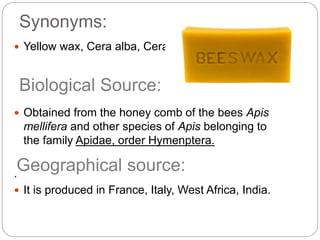
Synonyms:
 Yellow wax, Cera alba, Cera-flava.
 Obtained from the honey comb of the bees Apis
mellifera and other species of Apis belonging to
the family Apidae, order Hymenptera.
.
 It is produced in France, Italy, West Africa, India.
Biological Source:
Geographical source:
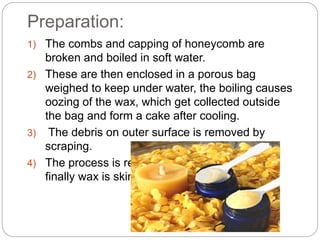
Preparation:
1) The combs and capping of honeycomb are
broken and boiled in soft water.
2) These are then enclosed in a porous bag
weighed to keep under water, the boiling causes
oozing of the wax, which get collected outside
the bag and form a cake after cooling.
3) The debris on outer surface is removed by
scraping.
4) The process is repeated several times and
finally wax is skimmed off.
Description:
 Colour : Yellow to yellowish-brown
 Odour : Agreeable and honey-like
 Non crystalline solid.
 Soft to touch and crumbles under pressure of
fingers to plastic mass.
 Under molten condition, it can be given any
desired shape.
 It breaks with a granular fracture.
 Insoluble in water
 Soluble in hot alcohol, ether, chloroform, carbon
tetrachloride, fixed and volatile oils.
Extra features:
Solubility:
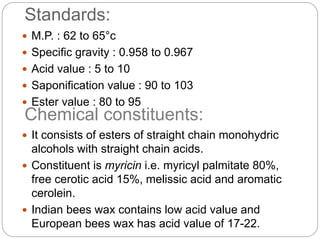
Standards:
 M.P. : 62 to 65°c
 Specific gravity : 0.958 to 0.967
 Acid value : 5 to 10
 Saponification value : 90 to 103
 Ester value : 80 to 95
 It consists of esters of straight chain monohydric
alcohols with straight chain acids.
 Constituent is myricin i.e. myricyl palmitate 80%,
free cerotic acid 15%, melissic acid and aromatic
cerolein.
 Indian bees wax contains low acid value and
European bees wax has acid value of 17-22.
Chemical constituents:
Identification:
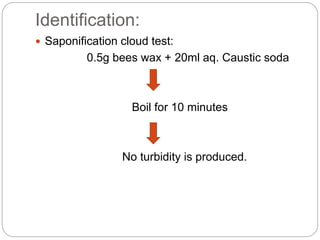
 Saponification cloud test:
0.5g bees wax + 20ml aq. Caustic soda
Boil for 10 minutes
No turbidity is produced.
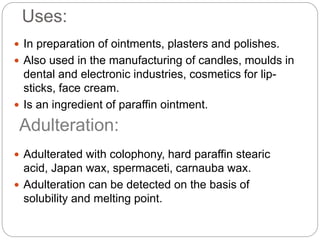
Uses:
 In preparation of ointments, plasters and polishes.
 Also used in the manufacturing of candles, moulds in
dental and electronic industries, cosmetics for lip-
sticks, face cream.
 Is an ingredient of paraffin ointment.
 Adulterated with colophony, hard paraffin stearic
acid, Japan wax, spermaceti, carnauba wax.
 Adulteration can be detected on the basis of
solubility and melting point.
Adulteration:

Beeswax

  • 1.
    By, Jahanvi P. Tankaria B.Pharma.Sem 3 Akshar Preet Institute of Pharmacy Beeswax
  • 2.
    Synonyms:  Yellow wax,Cera alba, Cera-flava.  Obtained from the honey comb of the bees Apis mellifera and other species of Apis belonging to the family Apidae, order Hymenptera. .  It is produced in France, Italy, West Africa, India. Biological Source: Geographical source:
  • 3.
    Preparation: 1) The combsand capping of honeycomb are broken and boiled in soft water. 2) These are then enclosed in a porous bag weighed to keep under water, the boiling causes oozing of the wax, which get collected outside the bag and form a cake after cooling. 3) The debris on outer surface is removed by scraping. 4) The process is repeated several times and finally wax is skimmed off.
  • 4.
    Description:  Colour :Yellow to yellowish-brown  Odour : Agreeable and honey-like  Non crystalline solid.  Soft to touch and crumbles under pressure of fingers to plastic mass.  Under molten condition, it can be given any desired shape.  It breaks with a granular fracture.  Insoluble in water  Soluble in hot alcohol, ether, chloroform, carbon tetrachloride, fixed and volatile oils. Extra features: Solubility:
  • 5.
    Standards:  M.P. :62 to 65°c  Specific gravity : 0.958 to 0.967  Acid value : 5 to 10  Saponification value : 90 to 103  Ester value : 80 to 95  It consists of esters of straight chain monohydric alcohols with straight chain acids.  Constituent is myricin i.e. myricyl palmitate 80%, free cerotic acid 15%, melissic acid and aromatic cerolein.  Indian bees wax contains low acid value and European bees wax has acid value of 17-22. Chemical constituents:
  • 6.
    Identification:  Saponification cloudtest: 0.5g bees wax + 20ml aq. Caustic soda Boil for 10 minutes No turbidity is produced.
  • 7.
    Uses:  In preparationof ointments, plasters and polishes.  Also used in the manufacturing of candles, moulds in dental and electronic industries, cosmetics for lip- sticks, face cream.  Is an ingredient of paraffin ointment.  Adulterated with colophony, hard paraffin stearic acid, Japan wax, spermaceti, carnauba wax.  Adulteration can be detected on the basis of solubility and melting point. Adulteration: