OSTEOPOROSIS
By,
Jahanvi P. Tankaria
B.Pharm. Sem 3
Akshar Preet Institute of Pharmacy
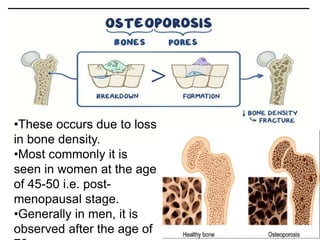
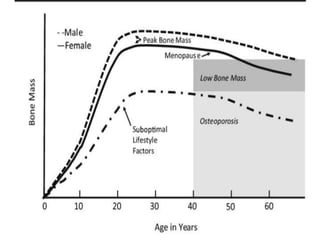
•These occurs due to loss
in bone density.
•Most commonly it is
seen in women at the age
of 45-50 i.e. post-
menopausal stage.
•Generally in men, it is
observed after the age of
DEFINITION
Osteoporosis is “a progressive systemic skeletal
disease characterized by low bone mass and micro-
architectural deterioration of bone tissue, with a
consequent increase in bone fragility and susceptibility
to fracture.”
The most common sites of fracture are vertebrae, wrists
and hips.
CLASSIFICATION WITH
ETIOLOGY
•Osteoporosis is divided into two
types:
(A) Primary osteoporosis
(B) Secondary
osteoporosis
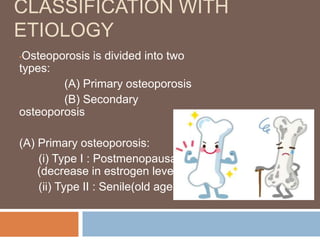
(A) Primary osteoporosis:
(i) Type I : Postmenopausal
(decrease in estrogen level)
(ii) Type II : Senile(old age)
(B) Secondary osteoporosis: caused by other health problems.
1) Metabolic conditions
Eg. Calcium deficiency, Vitamin D deficiency, malnutrition
2) Endocrine conditions
Eg. Hyperthyroidism
3) Renal disease
4) Gastrointestinal-liver disease
5) Bone marrow infiltration
Eg. Leukemia, myeloma
6) Drugs
Eg. Thyroid hormones, corticosteroid(decrease Ca+2 absorption), heparin
7) Lifestyle Eg. Improper nutrition, alcohol, smoking, inactivity, excessive
caffeine intake
8) Miscellaneous Eg. Rheumatoid arthritis, Cushing’s syndrome, DM
9) Others such as low body weight and body mass index, Caucasian and
Asian
SIGNS AND
SYMPTOMS
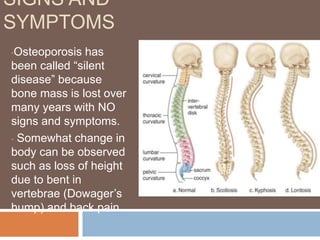
•Osteoporosis has
been called “silent
disease” because
bone mass is lost over
many years with NO
signs and symptoms.
• Somewhat change in
body can be observed
such as loss of height
due to bent in
vertebrae (Dowager’s
hump) and back pain.
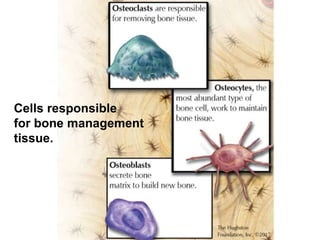
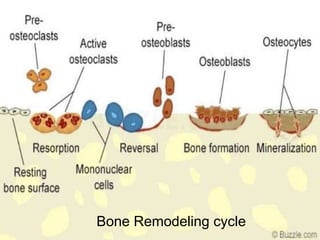
Cells responsible
for bone management
tissue.
Bone Remodeling cycle
PATHOPHYSIOLOGY
•Bone remodeling includes two steps:
1) Bone resorption :
•Bones contain cells called osteoclast that breakdown the
bone tissue.
2) Bone formation :
•Other cells called osteoblast make new bone tissue using
minerals such as calcium and phosphate from the blood.
•Hormones such as estrogen, growth hormone and
testosterone help keep the number and activity of
osteoblast higher than osteoclast so that more bone is
made than removed.
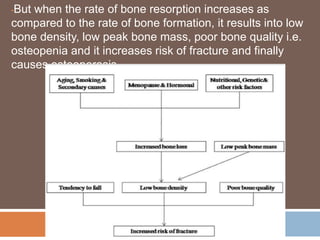
•But when the rate of bone resorption increases as
compared to the rate of bone formation, it results into low
bone density, low peak bone mass, poor bone quality i.e.
osteopenia and it increases risk of fracture and finally
causes osteoporosis.
DIAGNOSIS:
•X-ray: determines bone density.
•Ultrasonography: determines bone
density.
•CT scan and MRI scan of spine: to
measure bone density and determine
whether vertebral fractures are likely to
occur.
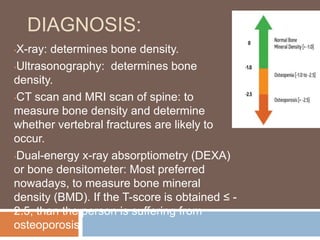
•Dual-energy x-ray absorptiometry (DEXA)
or bone densitometer: Most preferred
nowadays, to measure bone mineral
density (BMD). If the T-score is obtained ≤ -
2.5, than the person is suffering from
osteoporosis.
TREATMENT
•Bisphophonates: antiresorptive drugs i.e. Alendronate
and Risendronate.
•Selective estrogen-receptor modulators (SERM) eg.
Raloxifene which reduces risk of spine fractures in
women after menopause.
•Calcitonin eg. Calcimar, Miacalcin.
•Parathyroid hormone eg. Teriparatide (Forteo).
•RANK ligand (RANKL) inhibitors such as denosumab:
immune therapy.
•Bone marrow transplant (BMT) is used to cure early
onset and malignant infantile osteoporosis. But as there
are less chances of survival after performing this surgery,
is is rarely performed.
Osteoporosis

Osteoporosis

  • 1.
    OSTEOPOROSIS By, Jahanvi P. Tankaria B.Pharm.Sem 3 Akshar Preet Institute of Pharmacy
  • 2.
    •These occurs dueto loss in bone density. •Most commonly it is seen in women at the age of 45-50 i.e. post- menopausal stage. •Generally in men, it is observed after the age of
  • 3.
    DEFINITION Osteoporosis is “aprogressive systemic skeletal disease characterized by low bone mass and micro- architectural deterioration of bone tissue, with a consequent increase in bone fragility and susceptibility to fracture.” The most common sites of fracture are vertebrae, wrists and hips.
  • 4.
    CLASSIFICATION WITH ETIOLOGY •Osteoporosis isdivided into two types: (A) Primary osteoporosis (B) Secondary osteoporosis (A) Primary osteoporosis: (i) Type I : Postmenopausal (decrease in estrogen level) (ii) Type II : Senile(old age)
  • 5.
    (B) Secondary osteoporosis:caused by other health problems. 1) Metabolic conditions Eg. Calcium deficiency, Vitamin D deficiency, malnutrition 2) Endocrine conditions Eg. Hyperthyroidism 3) Renal disease 4) Gastrointestinal-liver disease 5) Bone marrow infiltration Eg. Leukemia, myeloma 6) Drugs Eg. Thyroid hormones, corticosteroid(decrease Ca+2 absorption), heparin 7) Lifestyle Eg. Improper nutrition, alcohol, smoking, inactivity, excessive caffeine intake 8) Miscellaneous Eg. Rheumatoid arthritis, Cushing’s syndrome, DM 9) Others such as low body weight and body mass index, Caucasian and Asian
  • 7.
    SIGNS AND SYMPTOMS •Osteoporosis has beencalled “silent disease” because bone mass is lost over many years with NO signs and symptoms. • Somewhat change in body can be observed such as loss of height due to bent in vertebrae (Dowager’s hump) and back pain.
  • 8.
    Cells responsible for bonemanagement tissue.
  • 9.
  • 10.
    PATHOPHYSIOLOGY •Bone remodeling includestwo steps: 1) Bone resorption : •Bones contain cells called osteoclast that breakdown the bone tissue. 2) Bone formation : •Other cells called osteoblast make new bone tissue using minerals such as calcium and phosphate from the blood. •Hormones such as estrogen, growth hormone and testosterone help keep the number and activity of osteoblast higher than osteoclast so that more bone is made than removed.
  • 11.
    •But when therate of bone resorption increases as compared to the rate of bone formation, it results into low bone density, low peak bone mass, poor bone quality i.e. osteopenia and it increases risk of fracture and finally causes osteoporosis.
  • 12.
    DIAGNOSIS: •X-ray: determines bonedensity. •Ultrasonography: determines bone density. •CT scan and MRI scan of spine: to measure bone density and determine whether vertebral fractures are likely to occur. •Dual-energy x-ray absorptiometry (DEXA) or bone densitometer: Most preferred nowadays, to measure bone mineral density (BMD). If the T-score is obtained ≤ - 2.5, than the person is suffering from osteoporosis.
  • 13.
    TREATMENT •Bisphophonates: antiresorptive drugsi.e. Alendronate and Risendronate. •Selective estrogen-receptor modulators (SERM) eg. Raloxifene which reduces risk of spine fractures in women after menopause. •Calcitonin eg. Calcimar, Miacalcin. •Parathyroid hormone eg. Teriparatide (Forteo). •RANK ligand (RANKL) inhibitors such as denosumab: immune therapy. •Bone marrow transplant (BMT) is used to cure early onset and malignant infantile osteoporosis. But as there are less chances of survival after performing this surgery, is is rarely performed.