SUBMITTED by :
Harsh Kumar Baranwal
Dev Bhoomi Institute of Pharmacy & Research Dehradun
WAXES
• Waxes are unctuous, fusible, variably viscous
solid substance, with characteristic waxy lustre.
• These are the fatty acids with high weight
monohydric alcohol, such as cholesterol, cetyl
alcohol, melissyl alcohol, etc.
• They are insoluble in water, but soluble in most
organic solvents.
• The esters in waxes are generally more resistant
to saponification than the glycerides of oils and
fats.
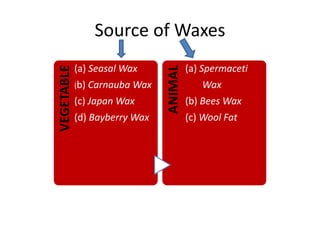
Source of Waxes
VEGETABLE(a) Seasal Wax
(b) Carnauba Wax
(c) Japan Wax
(d) Bayberry Wax
ANIMAL
(a) Spermaceti
Wax
(b) Bees Wax
(c) Wool Fat
BEES WAX
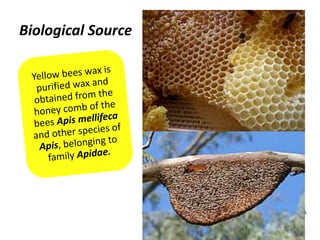
Biological Source
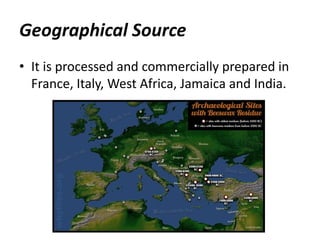
Geographical Source
• It is processed and commercially prepared in
France, Italy, West Africa, Jamaica and India.
Processing and Preparation
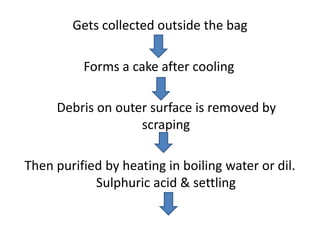
Combs & cappings honeycomb broken
Boiled in soft water
Enclosed in a porous bag weighted to keep
under water
Boiling causes oozing of the wax
Gets collected outside the bag
Forms a cake after cooling
Debris on outer surface is removed by
scraping
Then purified by heating in boiling water or dil.
Sulphuric acid & settling
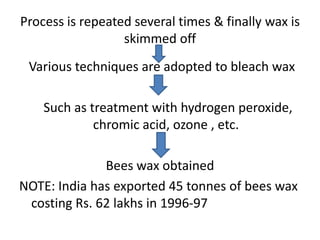
Process is repeated several times & finally wax is
skimmed off
Various techniques are adopted to bleach wax
Such as treatment with hydrogen peroxide,
chromic acid, ozone , etc.
Bees wax obtained
NOTE: India has exported 45 tonnes of bees wax
costing Rs. 62 lakhs in 1996-97
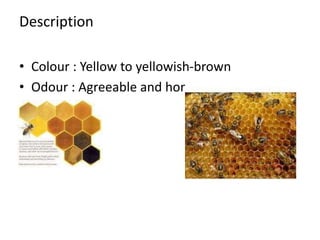
Description
• Colour : Yellow to yellowish-brown
• Odour : Agreeable and honey like
Extra Features
Non-Crystalline solid , it is soft
to touch and crumbles under
the pressure of fingers to plastic
mass
Under molten condition , it can
give desired shape
Breaks with a granular fracture
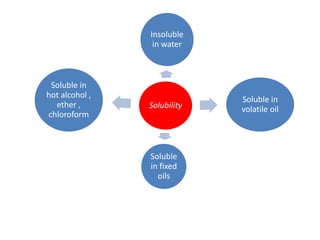
Solubility
Insoluble
in water
Soluble in
volatile oil
Soluble
in fixed
oils
Soluble in
hot alcohol ,
ether ,
chloroform
Standards
Melting point
• 62 to 65 degree C
Specific gravity
• 0.958 to 0.967
Acid value
• 05 to 10
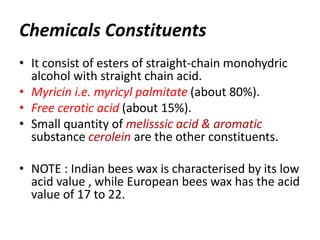
Chemicals Constituents
• It consist of esters of straight-chain monohydric
alcohol with straight chain acid.
• Myricin i.e. myricyl palmitate (about 80%).
• Free cerotic acid (about 15%).
• Small quantity of melisssic acid & aromatic
substance cerolein are the other constituents.
• NOTE : Indian bees wax is characterised by its low
acid value , while European bees wax has the acid
value of 17 to 22.
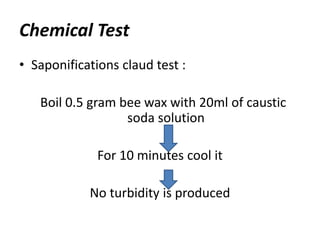
Chemical Test
• Saponifications claud test :
Boil 0.5 gram bee wax with 20ml of caustic
soda solution
For 10 minutes cool it
No turbidity is produced
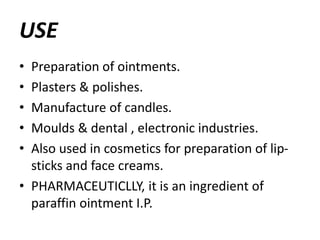
USE
• Preparation of ointments.
• Plasters & polishes.
• Manufacture of candles.
• Moulds & dental , electronic industries.
• Also used in cosmetics for preparation of lip-
sticks and face creams.
• PHARMACEUTICLLY, it is an ingredient of
paraffin ointment I.P.
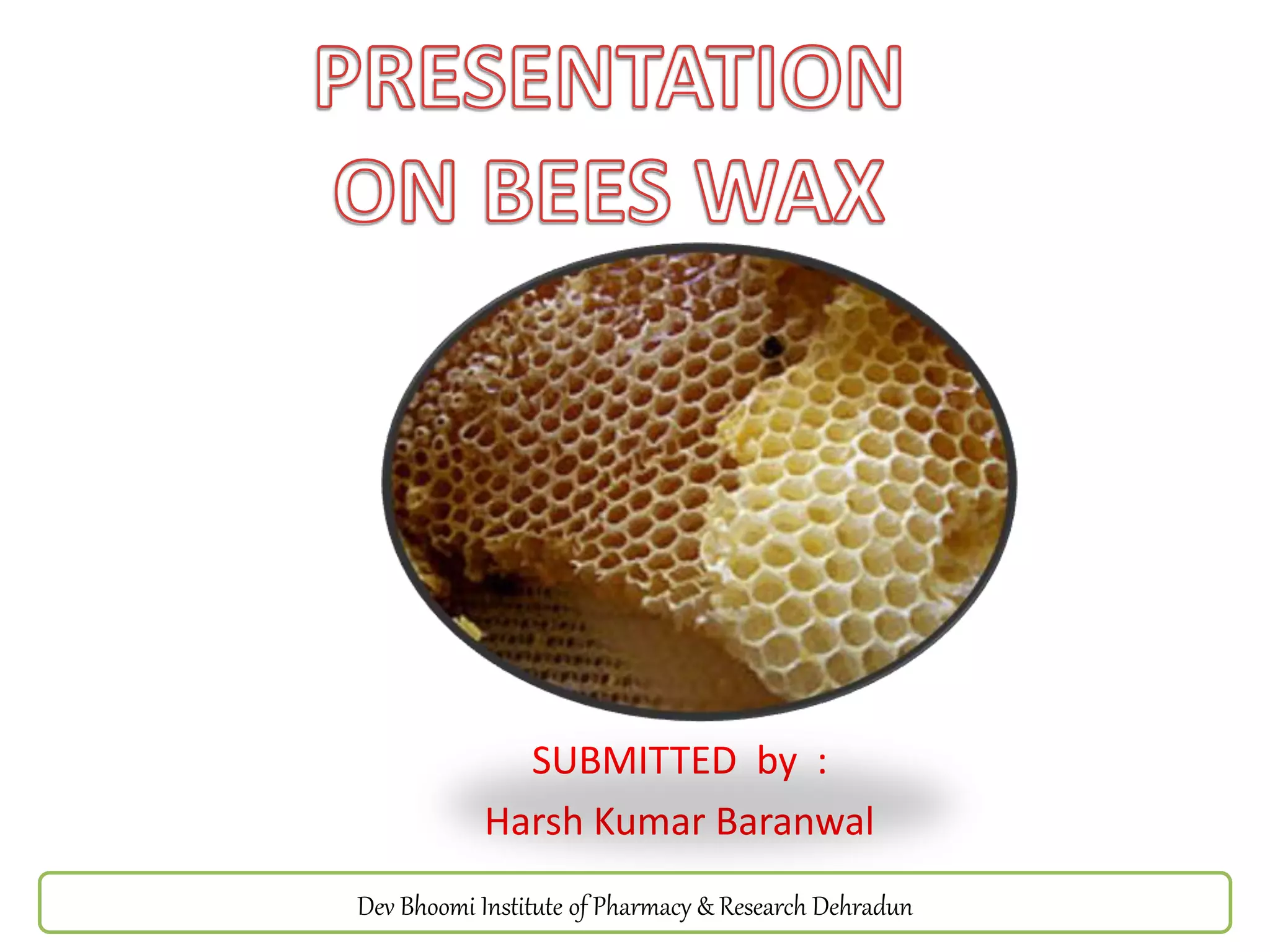
bees wax

bees wax

  • 1.
    SUBMITTED by : HarshKumar Baranwal Dev Bhoomi Institute of Pharmacy & Research Dehradun
  • 2.
    WAXES • Waxes areunctuous, fusible, variably viscous solid substance, with characteristic waxy lustre. • These are the fatty acids with high weight monohydric alcohol, such as cholesterol, cetyl alcohol, melissyl alcohol, etc. • They are insoluble in water, but soluble in most organic solvents. • The esters in waxes are generally more resistant to saponification than the glycerides of oils and fats.
  • 3.
    Source of Waxes VEGETABLE(a)Seasal Wax (b) Carnauba Wax (c) Japan Wax (d) Bayberry Wax ANIMAL (a) Spermaceti Wax (b) Bees Wax (c) Wool Fat
  • 4.
  • 5.
  • 6.
    Geographical Source • Itis processed and commercially prepared in France, Italy, West Africa, Jamaica and India.
  • 7.
    Processing and Preparation Combs& cappings honeycomb broken Boiled in soft water Enclosed in a porous bag weighted to keep under water Boiling causes oozing of the wax
  • 8.
    Gets collected outsidethe bag Forms a cake after cooling Debris on outer surface is removed by scraping Then purified by heating in boiling water or dil. Sulphuric acid & settling
  • 9.
    Process is repeatedseveral times & finally wax is skimmed off Various techniques are adopted to bleach wax Such as treatment with hydrogen peroxide, chromic acid, ozone , etc. Bees wax obtained NOTE: India has exported 45 tonnes of bees wax costing Rs. 62 lakhs in 1996-97
  • 10.
    Description • Colour :Yellow to yellowish-brown • Odour : Agreeable and honey like
  • 11.
    Extra Features Non-Crystalline solid, it is soft to touch and crumbles under the pressure of fingers to plastic mass Under molten condition , it can give desired shape Breaks with a granular fracture
  • 12.
    Solubility Insoluble in water Soluble in volatileoil Soluble in fixed oils Soluble in hot alcohol , ether , chloroform
  • 13.
    Standards Melting point • 62to 65 degree C Specific gravity • 0.958 to 0.967 Acid value • 05 to 10
  • 14.
    Chemicals Constituents • Itconsist of esters of straight-chain monohydric alcohol with straight chain acid. • Myricin i.e. myricyl palmitate (about 80%). • Free cerotic acid (about 15%). • Small quantity of melisssic acid & aromatic substance cerolein are the other constituents. • NOTE : Indian bees wax is characterised by its low acid value , while European bees wax has the acid value of 17 to 22.
  • 15.
    Chemical Test • Saponificationsclaud test : Boil 0.5 gram bee wax with 20ml of caustic soda solution For 10 minutes cool it No turbidity is produced
  • 16.
    USE • Preparation ofointments. • Plasters & polishes. • Manufacture of candles. • Moulds & dental , electronic industries. • Also used in cosmetics for preparation of lip- sticks and face creams. • PHARMACEUTICLLY, it is an ingredient of paraffin ointment I.P.