Anatomy of Epidural Space
Chairperson: Dr.Vinayak Jannu
Presenters: Dr.Niharika R & Dr. Karthavya S L
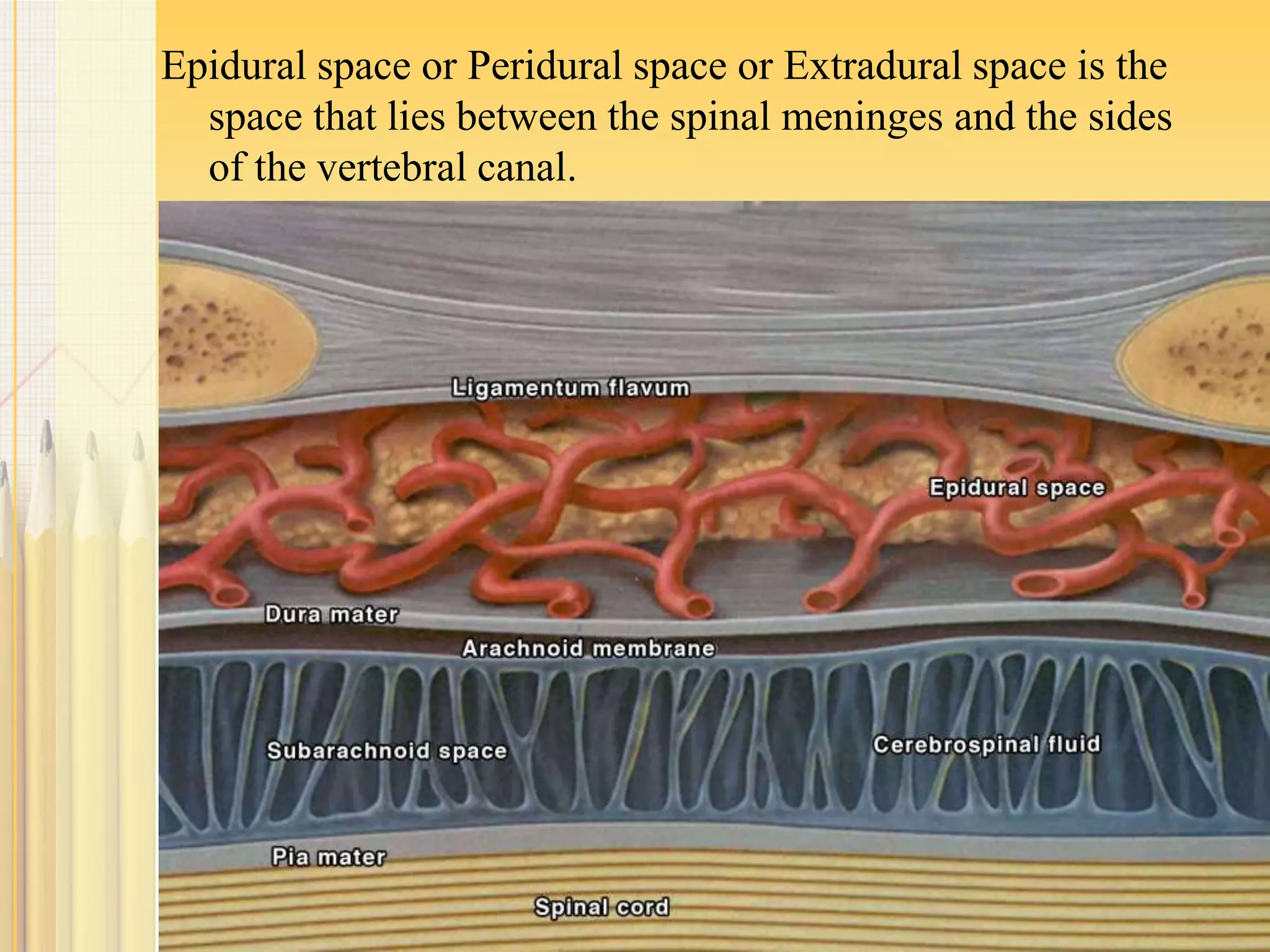
Epidural space or Peridural space or Extradural space is the
space that lies between the spinal meninges and the sides
of the vertebral canal.
History
 1885: Corning first performed epidural anesthesia with
cociane for pain relief in extremity but it was apparently
accidental.
 1895: Cathelin first used epidural in sacral region which is
now called caudal analgesia.
 1921: Fidel Pages first used epidural anaesthesia in his
surgical practice.
 Tuohy introduced the needle used in Epidural Anaesthesia
in 1945.
 1951: Crawford used epidural anesthesia for thoracic
surgery.
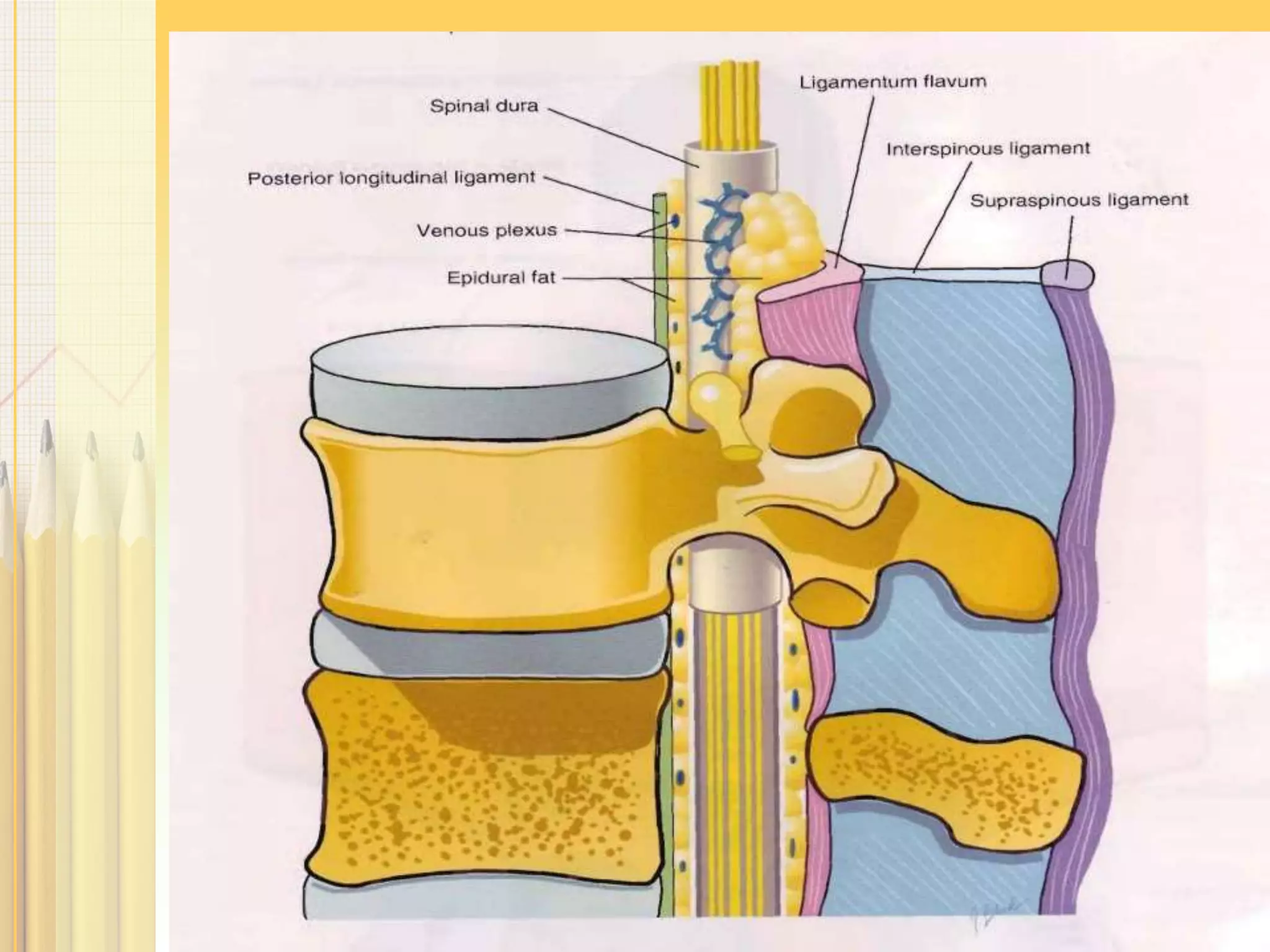
 The epidural space is the potential space between periosteum
lining the vertebral canal and the spinal dura mater.
 It extends from the foramen magnum to the sacral hiatus, and
surrounds the dura mater anteriorly, laterally, and posteriorly
Boundaries
 Cranially by foramen magnum.
 Caudally by sacrococcygeal ligament. (sacral hiatus)
 Anteriorly by posterior longitudinal ligament
 Laterally by vertebral pedicles & intervertebral foramina.
 Posteriorly by ligamentum flavum and the laminae.
Boundaries
 At foramen magnum the vertebral periosteum fuses with
the periosteal layer of the skull
This periosteal layer is the extracranial extension of the
endosteal layer of cranial dura,the spinal dura at the same
point fuses with the meningeal layer of cranial dura.
 The lower limit is the sacrococcygeal ligament.
Boundaries
 The space is more extensive and easily distensible
posteriorly while anteriorly the dura adheres closely to the
periosteum of vertebral bodies.
 Laterally the space accompany the spinal nerves through
the intervertebral foramina into the paravertebral tissue up
to the angle of ribs.
Contents
 Areolar connective tissue
 Fat
 Spinal nerve roots with their dural sleeves
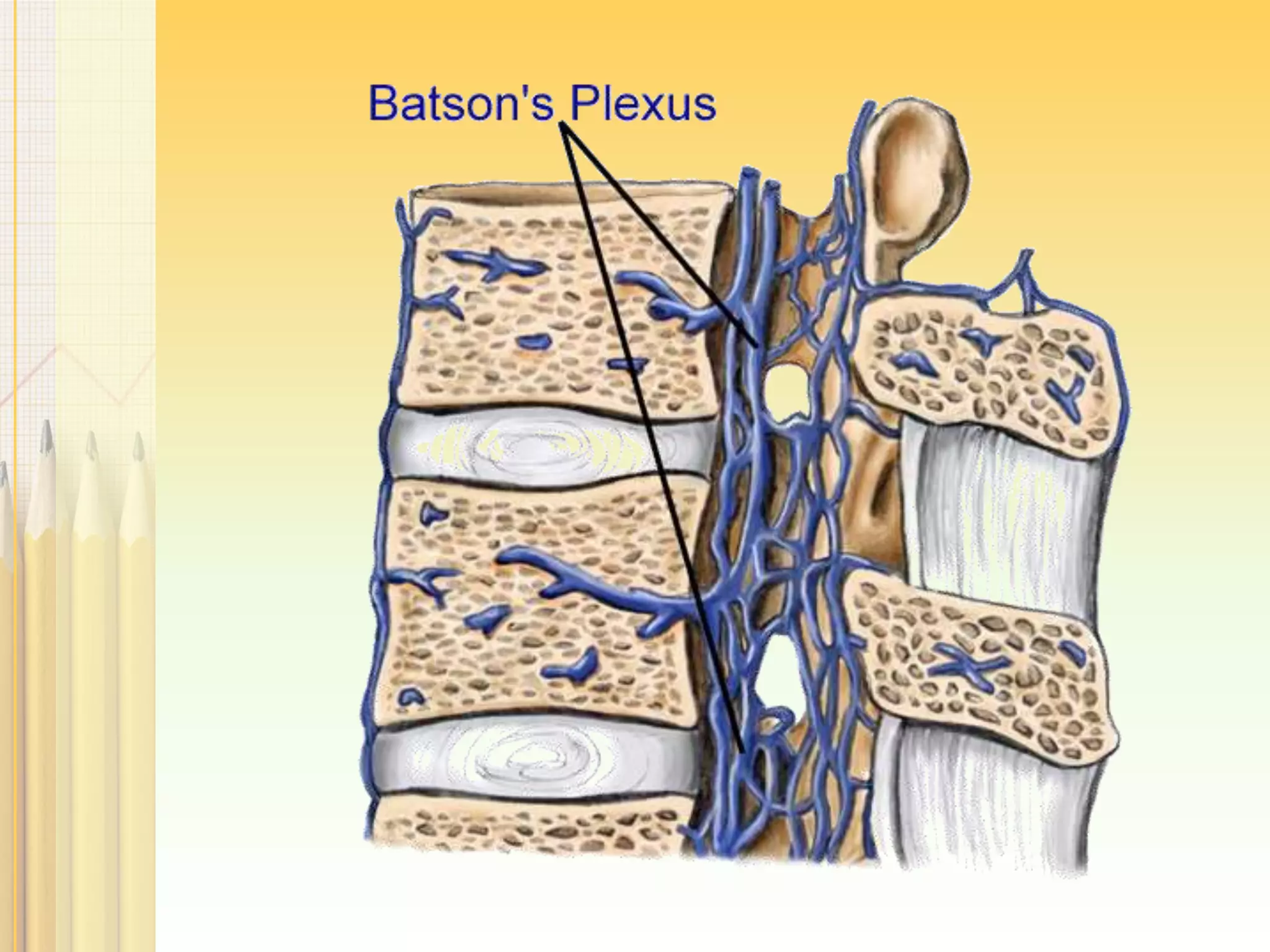
 Blood vessels-spinal arteries and venous plexus (Batson’s
plexus)
 Lymphatics
Areolar connective tissue
 It is present in significant amounts ventrally forming
strong connections between duramater and anterior
longitudinal ligament in the vertebral canal.
 The existence of fibrous connections in the posterior
epidural space called as PLICA MEDIANA DORSALIS of
the duramater extending longitudinally in the midline
connecting the dura and ligamentum flavum is also noted.
PLICA MEDIANA DORSALIS
 This is in form of strands connecting flaval ligament to the
dura.
 It is present in the midline and these bands divide the
epidural space into right and left sides and narrow the
space.
 The connection is well developed in region of vertebral
arches.
 In some instances, it forms a complete membrane in a
dorsomedian sagittal plane.
Epidural Fat
 It is principally present in posterior and lateral space.
 It has effects on pharmacology of drugs injected
intrathecally.
 There is a linear relationship between opiod’s lipid
solubility and its terminal elimination halftime in the
epidural space.
 Increased lipid solubility leads to sequestration of drugs in
fat, thereby reducing bioavailability of drug.
Lymphatics
The lymphatics of the epidural space are concentrated in the
region of the dural roots where they remove foreign
materials including microorganisms from the
subarachnoid and epidural spaces.
Blood vessels
 The epidural arteries located in the lumbar region of the
vertebral column are branches of the ilio-lumbar arteries.
 These arteries are found in the lateral region of the space
and therefore not threatened by an advancing epidural
needle.
Blood vessels
 The internal vertebral venous plexus consists of four
interconnecting longitudinal vessels, two anterior and two
posterior.
 The external vertebral plexus (EVP) in contrast, lies
peripheral to the vertebrae and is made of the anterior and
posterior external vertebral plexuses.
 The EVP is situated anterior to the vertebral bodies and in
relation to the laminae, spinous processes,transverse
processes and articular processes respectively.
Blood vessels
 These veins communicate with the segmental veins of the neck,
the intercostal, azygos and lumbar veins. With the veins of bones
of the vertebral column, the internal and external vertebral
plexuses form Batson’s plexus.
 These veins are predominantly in the antero-lateral part of the
epidural space, and ultimately drain into the azygous system of
veins.
 As the whole system is valveless, increased intrathoracic or intra-
abdominal pressure (e.g. ascites, pregnancy) can lead to major
congestion and vessel enlargement within the spinal canal.
Size of epidural space
 The distance across the semi or half moon circular
epidural space varies.
 In the anterior region it is almost nonexistent while it can
be measured in posterior region, the average values are;
Cervical: 1mm-1.5mm
Upper thoracic: 2.5mm-3mm
Lower thoracic: 4mm-5mm
Lumbar: 5mm-6mm
How to reach?
To reach epidural space in midline these structures have to
be penetrated:
 Skin and subcutaneous tissues
 Supraspinous ligaments
 Interspinous ligaments
 Ligamentum flavum
Anatomy of epidural space

Anatomy of epidural space

  • 1.
    Anatomy of EpiduralSpace Chairperson: Dr.Vinayak Jannu Presenters: Dr.Niharika R & Dr. Karthavya S L
  • 2.
    Epidural space orPeridural space or Extradural space is the space that lies between the spinal meninges and the sides of the vertebral canal.
  • 3.
    History  1885: Corningfirst performed epidural anesthesia with cociane for pain relief in extremity but it was apparently accidental.  1895: Cathelin first used epidural in sacral region which is now called caudal analgesia.  1921: Fidel Pages first used epidural anaesthesia in his surgical practice.  Tuohy introduced the needle used in Epidural Anaesthesia in 1945.  1951: Crawford used epidural anesthesia for thoracic surgery.
  • 4.
     The epiduralspace is the potential space between periosteum lining the vertebral canal and the spinal dura mater.  It extends from the foramen magnum to the sacral hiatus, and surrounds the dura mater anteriorly, laterally, and posteriorly
  • 5.
    Boundaries  Cranially byforamen magnum.  Caudally by sacrococcygeal ligament. (sacral hiatus)  Anteriorly by posterior longitudinal ligament  Laterally by vertebral pedicles & intervertebral foramina.  Posteriorly by ligamentum flavum and the laminae.
  • 6.
    Boundaries  At foramenmagnum the vertebral periosteum fuses with the periosteal layer of the skull This periosteal layer is the extracranial extension of the endosteal layer of cranial dura,the spinal dura at the same point fuses with the meningeal layer of cranial dura.  The lower limit is the sacrococcygeal ligament.
  • 7.
    Boundaries  The spaceis more extensive and easily distensible posteriorly while anteriorly the dura adheres closely to the periosteum of vertebral bodies.  Laterally the space accompany the spinal nerves through the intervertebral foramina into the paravertebral tissue up to the angle of ribs.
  • 8.
    Contents  Areolar connectivetissue  Fat  Spinal nerve roots with their dural sleeves  Blood vessels-spinal arteries and venous plexus (Batson’s plexus)  Lymphatics
  • 9.
    Areolar connective tissue It is present in significant amounts ventrally forming strong connections between duramater and anterior longitudinal ligament in the vertebral canal.  The existence of fibrous connections in the posterior epidural space called as PLICA MEDIANA DORSALIS of the duramater extending longitudinally in the midline connecting the dura and ligamentum flavum is also noted.
  • 10.
    PLICA MEDIANA DORSALIS This is in form of strands connecting flaval ligament to the dura.  It is present in the midline and these bands divide the epidural space into right and left sides and narrow the space.  The connection is well developed in region of vertebral arches.  In some instances, it forms a complete membrane in a dorsomedian sagittal plane.
  • 11.
    Epidural Fat  Itis principally present in posterior and lateral space.  It has effects on pharmacology of drugs injected intrathecally.  There is a linear relationship between opiod’s lipid solubility and its terminal elimination halftime in the epidural space.  Increased lipid solubility leads to sequestration of drugs in fat, thereby reducing bioavailability of drug.
  • 13.
    Lymphatics The lymphatics ofthe epidural space are concentrated in the region of the dural roots where they remove foreign materials including microorganisms from the subarachnoid and epidural spaces.
  • 14.
    Blood vessels  Theepidural arteries located in the lumbar region of the vertebral column are branches of the ilio-lumbar arteries.  These arteries are found in the lateral region of the space and therefore not threatened by an advancing epidural needle.
  • 15.
    Blood vessels  Theinternal vertebral venous plexus consists of four interconnecting longitudinal vessels, two anterior and two posterior.  The external vertebral plexus (EVP) in contrast, lies peripheral to the vertebrae and is made of the anterior and posterior external vertebral plexuses.  The EVP is situated anterior to the vertebral bodies and in relation to the laminae, spinous processes,transverse processes and articular processes respectively.
  • 17.
    Blood vessels  Theseveins communicate with the segmental veins of the neck, the intercostal, azygos and lumbar veins. With the veins of bones of the vertebral column, the internal and external vertebral plexuses form Batson’s plexus.  These veins are predominantly in the antero-lateral part of the epidural space, and ultimately drain into the azygous system of veins.  As the whole system is valveless, increased intrathoracic or intra- abdominal pressure (e.g. ascites, pregnancy) can lead to major congestion and vessel enlargement within the spinal canal.
  • 19.
    Size of epiduralspace  The distance across the semi or half moon circular epidural space varies.  In the anterior region it is almost nonexistent while it can be measured in posterior region, the average values are; Cervical: 1mm-1.5mm Upper thoracic: 2.5mm-3mm Lower thoracic: 4mm-5mm Lumbar: 5mm-6mm
  • 20.
    How to reach? Toreach epidural space in midline these structures have to be penetrated:  Skin and subcutaneous tissues  Supraspinous ligaments  Interspinous ligaments  Ligamentum flavum