GENERAL OBJECTIVES(AIMS)
1.To understandthe importance of proper bed making in promoting patient comfort and
recovery.
2.To identify the different types of hospital beds and types of bed making used in patient
care.
3.To learn and apply the correct procedures for making various types of hospital beds
(closed, open, occupied, surgical).
4.To ensure infection control and maintain hygiene standards during bed making.
5.To develop the skills necessary to provide a safe and comfortable environment for
patients through effective bed making techniques
3.
CONT……………
6.To recognize andavoid common mistakes done during bed making to
improve patient safety and care quality
4.
TABLE OF CONTENT
Definition and importance of bed making
Type of Hospital beds
Types of Bed making
Principles of bed making
Articles and equipments used in bed making
Steps in making an open and closed bed
5.
CONT……….
Steps inmaking an Occupied bed
Steps in making a surgical bed
Infection control method during bed making
Safety precautions during Bed making
Advantages of good Bed making
Consequences of poor bed making
6.
CONT……….
Common mistakesin bed making and how to avoid them
Impact of proper bed making on patient health and well-being
Environmental factors affecting bed making(room temperature ,
lightening , ventilation )
Role of a nurse in Bed making & conclusion
7.
BED MAKING
DEFINITION :
Bedmaking is the process of preparing and
arranging a bed in an orderly manner to ensure
cleanliness, comfort, and safety for the patient.
8.
IMPORTANCE OF BEDMAKING
1. Promotes Patient Comfort:
A well-made bed helps the patient feel relaxed and promotes restful sleep.
2. Prevents Bed Sores (Pressure Ulcers):
Smooth, wrinkle-free linen reduces pressure and friction on the skin.
3. Improves Hygiene:
Regular bed making removes dirt, sweat, and microorganisms, reducing infection risk.
4) Enhances recovery:
A clean, comfortable environment supports healing and reduces stress.
9.
CONT…….
5. Facilitates MedicalExamination and Procedures:
An organized bed allows for easy access during treatment or assessment.
6. Maintains a Pleasant Hospital Environment:
Clean and neat beds contribute to the overall appearance and sanitation of the ward.
7 .Demonstrates Professionalism:
Proper bed making reflects the nurse’s competence, attention to detail, and patient care.
8. Promotes Safety:
Prevents accidents by ensuring bed rails are secure and there are no loose or tangled linens.
10.
HOSPITAL BEDS
DEFINITION :
Ahospital bed is a specially designed bed
used in healthcare settings to provide comfort, safety,
and support for patients.
11.
TYPES OF HOSPITALBEDS
1. Standard Bed
- Also called a general-purpose bed.
- Used for most hospitalized patients.
-Standard beds are found in nearly each and every hospital you go to
-Below is a picture of a standard hospital bed
13.
2. Orthopedic Bed
-Designed for patients with musculoskeletal injuries or surgery (e.g. fractures, spinal issues).
- Often has a firm mattress and traction devices.
14.
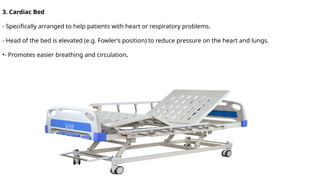
3. Cardiac Bed
-Specifically arranged to help patients with heart or respiratory problems.
- Head of the bed is elevated (e.g. Fowler’s position) to reduce pressure on the heart and lungs.
•- Promotes easier breathing and circulation.
15.
4. Electric Bed
-Operated by remote or control buttons.
- Allows adjustments to height, head, and foot sections with ease.
•- Used in intensive care or for patients with limited mobility.
16.
5. Pediatric Bed
-Designed for children with safety rails and smaller dimensions.
•- Often colorful and engaging to reduce anxiety in children.
17.
6. Gatch Bed
-A type of manual bed with cranks to raise the head, foot, or entire bed.
- Common in low-resource settings or older hospitals
18.
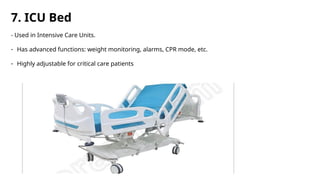
7. ICU Bed
-Used in Intensive Care Units.
- Has advanced functions: weight monitoring, alarms, CPR mode, etc.
- Highly adjustable for critical care patients
TYPES OF BEDMAKING
Bed making refers to the process of preparing and arranging a bed to ensure patient
comfort, hygiene, and safety. Different types are used depending on the patient's
condition and needs.
1. Closed Bed
- A bed made for a new or discharged patient.
- The top covers are tucked in neatly.
- Keeps the bed clean and ready for use.
-The pillow is placed at the heads of the bed with the open end facing away from the door
21.
-the blanket orbedspread is folded evenly at the top edge of the bed
-Note that a closed bed has to have a clean and tidy appearance, ready to receive a patient
•-below is diagram of a closed bed.
22.
2. Open Bed
-A bed prepared for a patient who is about to be admitted or who can move around.
- The top sheet is folded back, making it easy for the patient to get in.
- Usually converted from a closed bed.
23.
3. Occupied Bed
-Made while the patient is still in bed.
- Used for bedridden or immobile patients.
- Requires careful movement to ensure patient safety and comfort.
•-Below is an illustration of the occupied bed.
24.
4. Surgical/Postoperative Bed
-Prepared for a patient after surgery.
- The sheets are arranged to ease transfer from a stretcher.
- Often called a recovery bed, with one side of the bedding folded to receive the patient.
25.
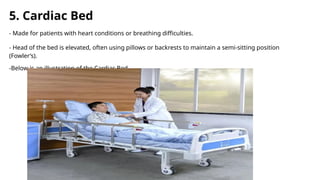
5. Cardiac Bed
-Made for patients with heart conditions or breathing difficulties.
- Head of the bed is elevated, often using pillows or backrests to maintain a semi-sitting position
(Fowler’s).
-Below is an illustration of the Cardiac Bed
26.
6. Fracture Bed
-Prepared for patients with fractures or orthopedic injuries.
•- Uses a firm mattress and may include a bed cradle to keep sheets off injured limbs
27.
PRINCIPLES OF HOSPITALBED MAKING
Infection Control
1. Hand hygiene: Wash hands before and after making a bed.
2. Personal protective equipment (PPE): Wear PPE, such as gloves and gowns, when making a bed.
3. Linens handling: Handle linens carefully to prevent the spread of infection.
Patient Safety
1. Fall prevention: Ensure the bed is at a safe height and use side rails when necessary.
2. Entrapment prevention: Ensure the bed is free from entrapment hazards.
3. Patient comfort: Ensure the bed is made to promote patient comfort and relaxation.
28.
Efficiency and Effectiveness
1.Standardized process: Follow a standardized process for making beds.
2. Time management: Make beds efficiently to minimize delays.
3. Quality control: Check the bed to ensure it meets quality standards.
Patient-Centered Care
1. Patient involvement: Involve patients in the bed-making process when possible.
2. Patient preferences: Accommodate patient preferences for bed linens and comfort.
•3. Cultural sensitivity: Be sensitive to patients' cultural and personal needs.
29.
Ergonomics and BodyMechanics
1. Proper lifting techniques: Use proper lifting techniques to prevent injury.
2. Body mechanics: Use good body mechanics to prevent strain and injury.
3. Ergonomic equipment: Use ergonomic equipment, such as adjustable beds, to reduce strain.
Additional Considerations
1. Bed maintenance: Regularly inspect and maintain beds to ensure they are in good working
condition.
2. Linens management: Manage linens effectively to prevent shortages and ensure adequate
supply.
•3. Staff training: Provide staff with training on bed-making techniques and infection control
protocols.
30.
ARTICLES AND EQUIPMENTSUSED IN
BED MAKING
1•Mattress: base support of the bed
2•Mattress protector: waterproof fabric to protect the mattress
3•Bottom sheet: sheet that covers the mattress
4•draw sheet: A smaller sheet placed over the bottom sheet, usually for easier repositioning of patients.
5•Top Sheet – A flat sheet that goes over the person lying in bed.
6•Blanket:to provide warmth
7•Pillow: For head and upper body support
8•Pillow case: covers pillow to maintain hygiene
31.
There could beadditional articles depending on specific patient conditions
1•Incontinence pads: Absorbent pads placed under patients with urinary issues
2•Bed cradle: Frame used to keep sheets off sensitive body parts(E.g cases like burns and
ulcers)
3•Footboard: A board placed at the foot of the bed to prevent bedsores in the long term
4•Air/Water mattress: special mattresses used to prevent bedsores in long term patients
32.
Equipments and accessoriesinvolved in bed
making
1•Gloves: To aid hygiene while changing linens
2•Trolley: For collecting dirty linen
3•Clean linen cart: For carrying fresh linen
4•Disinfectants: To clean the bed
5•Urinal bed pan: Sometimes placed under or beside the bed
6•Hand sanitizer/Soap:For hand hygiene before and after changing linens
7•towel:to clean up wet surfaces
33.
STEPS IN MAKINGVARIOUS BED
TYPES
UNOCUPIED BED
An unocupied bed is one which is not currently used by a patient it can be both closed and open.
A)CLOSED BED
•It is a smooth, confortable and clean bed, which is prepared for a new patient.
34.
Equipments needed tomake a closed bed
1. mattress
2. Two bed sheets
3. Rubber draw sheet
4. Blanket
5. Pillow case(s)
6. Bed spread
7. Cotton draw sheet
Technique
1. wash hands thoroughly before collecting the required equipments.
2. Place the equipments to be used on a near by chair in order of use.
3. Lower the bed at a convenient level to prevent back strain.
35.
4. Adjust themattress such that it is leveled and tight fitted on the bed.
5. Place bottom sheet with the correct side up and it's center facing n the center of the bed Miter
the top corners to keep the sheet firmly tucked on the bed .
6. Then tuck in the sheet by the sides and foot of the bed such that they are no wrinkles.
7. Always remain on one side of the bed until you have finished making the bed on that side.
8. Place rubber draw sheet to n top of the bottom sheet with its center in the middle of the bed.
9. Tuck in the rubber draw sheet about 38cm from the top of the bed and tuck in the corners
smoothly and tightly.
10. Place top sheet with its center fold on the center of the bed and the right side facing
downward.
11. Tuck the sheet under the foot of the mattress and miter the corners.
12. Place blanket with center at center of the bed and tuck in at foot of mattress and miter the
corners.
13. Fold the top sheet on the blanket about some inches from the top of the bed.
36.
14. Slip thepillow over not a clean case tuck in corners well into the case to
ensure a smooth fit.
15. Place the pillow at the top of the bed with open end away from the
door.
16. Place bed spread with right side up and tuck it .
17. Miter the corners at the foot of the bed.
18. See that the bed wills neat and smooth.
19. Wash hands
37.
B) Open bed
Itis a type of bed made in preparation for ambulatory patients. It is also a type of bed
made for imidiate use by patients.
Equipments needed to m ne an open bed
1. Mattress
2. Two bed sheets
3. Rubber draw sheet
4. Cotton draw sheet
5. Blanket
6. Pillow case (s)
7. Bed spread.
38.
Technique
•The steps inmaking an open bed is same as that of a closed bed the only
difference is that the top covers (top sheet, blanket,bed spread ) are folded
back towards the bottom of the bed they are not tightly fitted as in a closed
bed so as to permit an easy entry of the patient into the bed.
39.
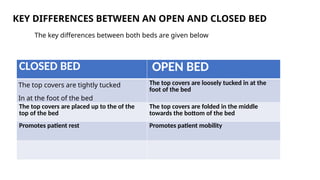
KEY DIFFERENCES BETWEENAN OPEN AND CLOSED BED
The key differences between both beds are given below
CLOSED BED OPEN BED
The top covers are tightly tucked
In at the foot of the bed
The top covers are loosely tucked in at the
foot of the bed
The top covers are placed up to the of the
top of the bed
The top covers are folded in the middle
towards the bottom of the bed
Promotes patient rest Promotes patient mobility
40.
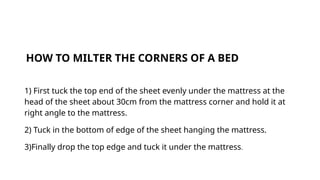
HOW TO MILTERTHE CORNERS OF A BED
1) First tuck the top end of the sheet evenly under the mattress at the
head of the sheet about 30cm from the mattress corner and hold it at
right angle to the mattress.
2) Tuck in the bottom of edge of the sheet hanging the mattress.
3)Finally drop the top edge and tuck it under the mattress.
41.
3)OCCUPIED BED;
-Wash hands, explain procedure and gather materials
- Adjust bed height, ensure patient privacy.
- Turn patient to one side.
- Roll dirty linen toward the center.
- Place clean bottom sheet and roll it under the dirty one.
- Turn patient to the other side, remove dirty linen, and pull clean sheet through.
- Straighten sheets, add draw sheet if needed.
- Place top sheet and blanket over patient, remove old top linen.
- Tuck in at foot, make bed corners.
- Place pillow and ensure patient is comfortable.
- Lower bed, raise rails, and wash hands.
42.
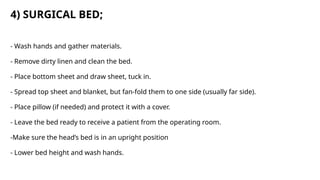
4) SURGICAL BED;
-Wash hands and gather materials.
- Remove dirty linen and clean the bed.
- Place bottom sheet and draw sheet, tuck in.
- Spread top sheet and blanket, but fan-fold them to one side (usually far side).
- Place pillow (if needed) and protect it with a cover.
- Leave the bed ready to receive a patient from the operating room.
-Make sure the head’s bed is in an upright position
- Lower bed height and wash hands.
43.
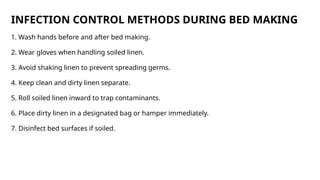
INFECTION CONTROL METHODSDURING BED MAKING
1. Wash hands before and after bed making.
2. Wear gloves when handling soiled linen.
3. Avoid shaking linen to prevent spreading germs.
4. Keep clean and dirty linen separate.
5. Roll soiled linen inward to trap contaminants.
6. Place dirty linen in a designated bag or hamper immediately.
7. Disinfect bed surfaces if soiled.
44.
8. Use freshlinen for each patient.
9. Maintain personal hygiene (e.g. tie back long hair, avoid touching face).
10. Follow hospital infection control
11. Use waterproof aprons if there's risk of body fluid exposure.
12. Don’t place linen on the floor or furniture.
13. Avoid touching your uniform with dirty linen.
14. Report and clean up spills immediately.
15. Ensure proper ventilation
45.
SAFETY PRECAUTIONS INBED MAKING
1. Wash hands before and after the procedure.
2. Use proper body mechanics to avoid back strain.
3. Lock the bed wheels to prevent movement.
4. Adjust bed height to a comfortable working level.
5. Keep the patient covered to maintain privacy and warmth.
6. Ensure side rails are up when necessary.
46.
7. Avoid leavingitems on the bed that could harm the patient.
8. Check for sharp objects or spills before starting.
9. Do not shake linen, to prevent spreading dust or germs.
10. Ensure the floor is dry to avoid slipping
11. Communicate with the patient before and during the procedure.
12. Use clean and undamaged linen to avoid skin irritation or injury.
13. Keep call bell within the patient’s reach after making the bed.
47.
ADVANTAGES OF GOODBED MAKING
1. Promotes patient comfort by providing a neat and clean resting environment.
2. Prevents pressure ulcers by ensuring smooth and wrinkle-free linen.
3. Improves hygiene by keeping the bed clean and free of contaminants.
4. Enhances the appearance of the room, contributing to a positive atmosphere.
5. Reduces the risk of infection by properly handling and changing linen.
6. Boosts patient morale by providing a well-organized and pleasant environment.
7. Facilitates better sleep by ensuring the bed is comfortable and clean.
8. Promotes safety by eliminating wrinkles, which could lead to accidents.
9. Encourages proper infection control by following correct procedures during bed making.
48.
CONSEQUENCES OF POORBED MAKING
1.Unhygienic Environment
Poorly made beds can trap dust, dirt, and bacteria, creating an environment
that promotes the growth of allergens and germs, which can lead to infections
or allergic reactions.
2. Uncomfortable Sleep
•Wrinkled sheets and uneven bedding can cause discomfort, making it difficult
to sleep well, which affects overall rest and recovery.
3. Increased Risk of Pressure Sores
•For patients in hospitals or people with limited mobility, uneven or creased
bedding can create pressure points, increasing the risk of bedsores (pressure
ulcers).
49.
4. Poor RoomAppearance
A messy or poorly made bed makes the whole room look untidy and uninviting, which can
negatively affect mood and motivation.
5. Negative Impression
In professional settings like hospitals or hotels, a poorly made bed gives a bad impression,
suggesting a lack of cleanliness or care.
6. Increased Risk of Falls or Accidents
Loose bedding can fall onto the floor or cause tripping hazards, especially for elderly
individuals or children.
7. Reduced Lifespan of Bedding
•Improperly handled or maintained bedding wears out faster. For example, bunched-up
sheets can lead to tearing or damage during use or washing.
50.
COMMON MISTAKES DONEDURING BED MAKING
AND HOW TO AVOID THEM
1.Wrinkled Sheets – Wrinkles can cause discomfort and pressure sores; ensure sheets are pulled
tight and smooth.
2. Improper Tucking of Linen – Poor tucking can lead to loose bedding that affects patient comfort;
use hospital corners to secure linen properly.
3. Using Soiled or Damaged Linen – Always check linens for stains or tears before use to maintain
hygiene and comfort.
4.Neglecting Hand Hygiene – Failing to wash hands before and after bed making increases
infection risk; always follow hand hygiene protocols.
51.
5. Wrong BedHeight While Working – Making beds at a low height can
cause back strain; adjust bed height to a comfortable working level.
6. Not Checking for Patient Belongings – Forgetting to check for personal
items before removing linen may lead to loss or damage.
•7. Improper Placement of Bed Accessories – Misplacing pillows, side rails,
or blankets can affect safety and posture; arrange items thoughtfully.
52.
IMPACT OF PROPERBED MAKING ON PATIENT RECOVERY AND
WELL-BEING
1.Enhances Patient Comfort – A neatly made bed improves rest and relaxation, which
supports healing.
2. Prevents Bedsores – Smooth, wrinkle-free bedding reduces friction and pressure that
can cause pressure ulcers.
3. Promotes Better Sleep – Clean and well-arranged bedding creates a peaceful
environment for restful sleep.
4. Reduces Risk of Infection – Using clean linens and following hygiene protocols
minimizes exposure to pathogens.
53.
5. Supports EmotionalWell-being – A tidy, comfortable bed can reduce
anxiety and uplift a patient’s mood.
6. Encourages Mobility – Proper bed setup makes it easier and safer for
patients to change position or get out of bed.
7. Boosts Confidence in Care – Patients feel valued and well-cared-for when
beds are neatly and professionally made.
54.
Environmental Factors AffectingBed Making (e.g.
room temperature, lighting, ventilation)
1 Room Temperature – An overly hot or cold room can affect patient comfort and influence the
choice of bedding materials.
2 Lighting – Good lighting ensures visibility during bed making, helping avoid errors like using
stained or torn linen.
3 Ventilation – Proper airflow helps maintain a fresh environment, preventing musty smells and
promoting hygiene.
4 Humidity Levels – High humidity can make linens feel damp, while very low humidity may
cause static and discomfort.
55.
5 Noise Level– A calm and quiet environment helps patients relax
during bed making, especially in occupied beds
6 Space Around the Bed – Limited space can hinder proper bed making
technique and increase the risk of injury.
56.
ROLE OF ANURSE IN BED MAKING
1. Ensure patient comfort by providing a clean, neat, and well-made bed.
2. Prevent pressure ulcers by ensuring the bed is wrinkle-free and properly fitted.
3. Maintain hygiene by regularly changing linen and handling soiled bedding
safely.
4. Ensure patient privacy by appropriately covering the patient during the
procedure.
5. Promote safety by ensuring the bed is properly adjusted and free of obstacles.
6. Monitor patient condition during bed making for any signs of discomfort or
57.
7. Follow infectioncontrol protocols by using gloves, clean linen, and proper
disposal of soiled items.
8. Assist the patient if needed, ensuring their dignity and comfort throughout
the process.
9. Communicate with the patient to explain the procedure and ensure their
consent and comfort.
•10. Adjust the bed position to prevent strain on the nurse and ensure the
patient’s comfort and safety.
58.
CONCLUSION
In conclusion, bedmaking is a vital skill in ensuring patient comfort, safety, and
hygiene in healthcare settings. By following proper techniques, nurses can
prevent complications like pressure ulcers, maintain a clean environment, and
contribute to overall patient well-being. Effective bed making not only enhances
the patient's experience but also plays a key role in infection control and safety.
Therefore, it is crucial for healthcare providers to understand and apply these
practices diligently, ensuring a high standard of care for all patients.
59.
REFERENCES
1. Murray, J.,& Gannon, M. (2013). Fundamentals of Nursing: Caring and Clinical Judgment.
Pearson Education.
2. Potter, P. A., & Perry, A. G. (2017). Fundamentals of Nursing (9th ed.). Elsevier.
3. Timby, B. K., & Smith, N. E. (2015). Introductory Medical-Surgical Nursing. Wolters Kluwer.
4. Berman, A., Snyder, S., & Frandsen, G. (2016). Kozier & Erb’s Fundamentals of Nursing.
Pearson.
5. Barker, R. (2010). The Art of Bed Making: A Practical Guide for Healthcare Providers. Nursing
Times.
6. World Health Organization (WHO). (2009). Infection Control in Health Care Settings. WHO
Press.
7. American Nurses Association (ANA). (2015). Code of Ethics for Nurses with Interpretive
Statements. ANA.
































![beed Making[1].pptx](https://cdn.slidesharecdn.com/ss_thumbnails/beedmaking1-230226055907-d267997c-thumbnail.jpg?width=640&height=640&fit=bounds)


