DIGITAL SCHOLARLY PRACTICES
Digital Literary Studies - 13 May 2019 - Esther De Smet
Senior Research Policy Advisor @ResearchUGent
RESEARCH DEPARTMENT
POLICY & QUALITY ENHANCEMENT UNIT
Contemporary research communication
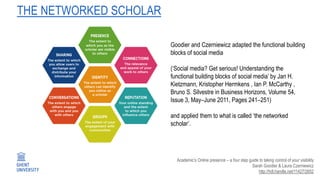
THE NETWORKED SCHOLAR
Goodier and Czerniewicz adapted the functional building
blocks of social media
(‘Social media? Get serious! Understanding the
functional building blocks of social media’ by Jan H.
Kietzmann, Kristopher Hermkens , Ian P. McCarthy ,
Bruno S. Silvestre in Business Horizons, Volume 54,
Issue 3, May–June 2011, Pages 241–251)
and applied them to what is called ‘the networked
scholar’.
Academic’s Online presence – a four step guide to taking control of your visibility
Sarah Goodier & Laura Czerniewicz
http://hdl.handle.net/11427/2652
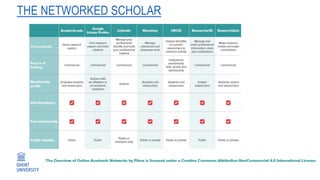
THE NETWORKED SCHOLAR
INNOVATIONS IN SCHOLARLY COMMUNICATION
4
How is information created, shared, and processed
in academia?
Project by Bianca Kramer and Jeroen Bosman
(Utrecht University Library)
2015-2016 survey
https://101innovations.wordpress.com/
http://dx.doi.org/10,6084/m9.figshare.1286826
5
INNOVATIONS IN SCHOLARLY COMMUNICATION
Boom!
INNOVATIONS IN SCHOLARLY COMMUNICATION
Workflow examples
7
INNOVATIONS IN SCHOLARLY COMMUNICATION
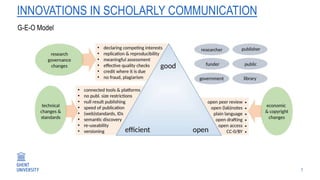
G-E-O Model
8
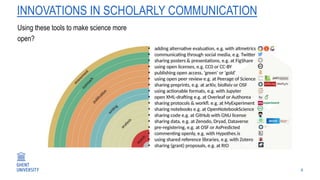
Using these tools to make science more
open?
INNOVATIONS IN SCHOLARLY COMMUNICATION
9
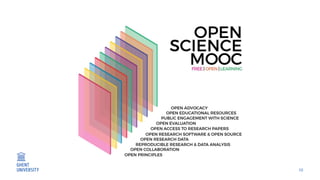
OPEN SCIENCE http://fosteropenscience.eu
10
11
Melanie Imming & Jon Tennant. (2018, June 8). Sticker open science: just science done right. Zenodo.
http://doi.org/10.5281/zenodo.128557
WHEN SCHOLARLY COMMUNICATION BECOMES
RESEARCH COMMUNICATION (AND THE OTHER WAY
ROUND)
13
WHEN SCHOLARLY COMMUNICATION BECOMES
RESEARCH COMMUNICATION (AND THE OTHER WAY
ROUND)
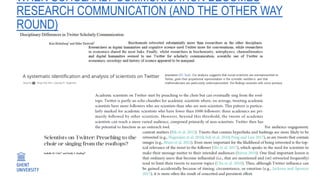
Online collaboration: Scientists and the social network, Richard van Noorden (Nature, August 2014)
14
WHEN SCHOLARLY COMMUNICATION BECOMES
RESEARCH COMMUNICATION (AND THE OTHER WAY
ROUND)
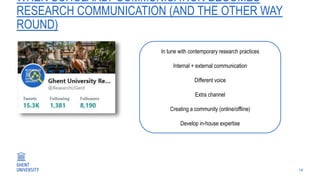
In tune with contemporary research practices
Internal + external communication
Different voice
Extra channel
Creating a community (online/offline)
Develop in-house expertise
15
WHEN SCHOLARLY COMMUNICATION BECOMES
RESEARCH COMMUNICATION (AND THE OTHER WAY
ROUND)
16
WHEN SCHOLARLY COMMUNICATION BECOMES
RESEARCH COMMUNICATION (AND THE OTHER WAY
ROUND)
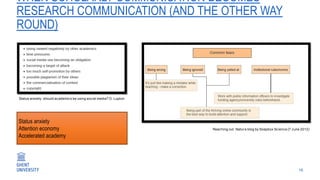
Status anxiety: should academics be using social media? D. Lupton
Reaching out. Nature blog by Soapbox Science (7 June 2012)
Status anxiety
Attention economy
Accelerated academy
17
WHEN SCHOLARLY COMMUNICATION BECOMES
RESEARCH COMMUNICATION (AND THE OTHER WAY
ROUND)
What doyouwant toachievebyengagingwith
social media?What isyour
communication/outreachstrategy?
Considerproducingsocial mediacontent asa
normal part of your (working)life
Developasenseof theadvantagesand
limitationsof eachdifferent platform
Berealisticabout thetimeavailabletoyou.
Knowwhocanhelpyou.
Beawareof your digital footprint.Invest in
visibility.
Re-usecontent but adapt.Get your timingand
storyright.
Allaboutfindingabalance&havingfun!
AdaptationofTopTipsforacademicsonbloggingandsocialmediabyMarkCarrigan
18
19
NEXT GENERATION METRICS
“Highly tweeted articles were
11 times more likely to be
highly cited.” (Eysenbach
2011)
“Papers mentioned on Twitter
are more downloaded and
cited than papers which are
not.” (Shuai 2011)
“Twitter activity was a more
important predictor of citation
than 5-year journal impact
factor.” (Peoples 2016)
“Twitter activity was not driven
by journal impact factor, the
‘highest-impact’ journals were
not necessarily the most
discussed online.” (Peoples
2016)
“Factors driving social media
and citations are different.
Social media metrics cannot
be seen as alternative to
citations.” (Haustein 2015)
“Among social media metrics,
citations correlate the most
with Twitter, although tweets
are not a good predictor of
citation impact.” (Haustein
2015)
20
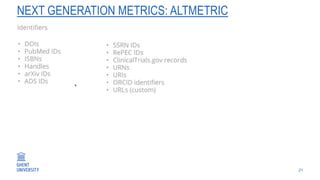
NEXT GENERATION METRICS: ALTMETRIC
21
NEXT GENERATION METRICS: ALTMETRIC
22
NEXT GENERATION METRICS: ALTMETRIC
23
NEXT GENERATION METRICS: ALTMETRIC
There must be an ID
Not about body of work or
general expertise
Different traditions in different
disciplines
Dependent on Altmetric
inclusion/tracking
Esther De Smet
Senior Research Policy Advisor
@ResearchUGent
https://www.ugent.be/en/research/soc-impact.htm
24

Digital Scholarly Practices

  • 1.
    DIGITAL SCHOLARLY PRACTICES DigitalLiterary Studies - 13 May 2019 - Esther De Smet Senior Research Policy Advisor @ResearchUGent RESEARCH DEPARTMENT POLICY & QUALITY ENHANCEMENT UNIT Contemporary research communication
  • 2.
    THE NETWORKED SCHOLAR Goodierand Czerniewicz adapted the functional building blocks of social media (‘Social media? Get serious! Understanding the functional building blocks of social media’ by Jan H. Kietzmann, Kristopher Hermkens , Ian P. McCarthy , Bruno S. Silvestre in Business Horizons, Volume 54, Issue 3, May–June 2011, Pages 241–251) and applied them to what is called ‘the networked scholar’. Academic’s Online presence – a four step guide to taking control of your visibility Sarah Goodier & Laura Czerniewicz http://hdl.handle.net/11427/2652
  • 3.
  • 4.
    INNOVATIONS IN SCHOLARLYCOMMUNICATION 4 How is information created, shared, and processed in academia? Project by Bianca Kramer and Jeroen Bosman (Utrecht University Library) 2015-2016 survey https://101innovations.wordpress.com/ http://dx.doi.org/10,6084/m9.figshare.1286826
  • 5.
    5 INNOVATIONS IN SCHOLARLYCOMMUNICATION Boom!
  • 6.
    INNOVATIONS IN SCHOLARLYCOMMUNICATION Workflow examples
  • 7.
    7 INNOVATIONS IN SCHOLARLYCOMMUNICATION G-E-O Model
  • 8.
    8 Using these toolsto make science more open? INNOVATIONS IN SCHOLARLY COMMUNICATION
  • 9.
  • 10.
  • 11.
    11 Melanie Imming &Jon Tennant. (2018, June 8). Sticker open science: just science done right. Zenodo. http://doi.org/10.5281/zenodo.128557
  • 12.
    WHEN SCHOLARLY COMMUNICATIONBECOMES RESEARCH COMMUNICATION (AND THE OTHER WAY ROUND)
  • 13.
    13 WHEN SCHOLARLY COMMUNICATIONBECOMES RESEARCH COMMUNICATION (AND THE OTHER WAY ROUND) Online collaboration: Scientists and the social network, Richard van Noorden (Nature, August 2014)
  • 14.
    14 WHEN SCHOLARLY COMMUNICATIONBECOMES RESEARCH COMMUNICATION (AND THE OTHER WAY ROUND) In tune with contemporary research practices Internal + external communication Different voice Extra channel Creating a community (online/offline) Develop in-house expertise
  • 15.
    15 WHEN SCHOLARLY COMMUNICATIONBECOMES RESEARCH COMMUNICATION (AND THE OTHER WAY ROUND)
  • 16.
    16 WHEN SCHOLARLY COMMUNICATIONBECOMES RESEARCH COMMUNICATION (AND THE OTHER WAY ROUND) Status anxiety: should academics be using social media? D. Lupton Reaching out. Nature blog by Soapbox Science (7 June 2012) Status anxiety Attention economy Accelerated academy
  • 17.
    17 WHEN SCHOLARLY COMMUNICATIONBECOMES RESEARCH COMMUNICATION (AND THE OTHER WAY ROUND) What doyouwant toachievebyengagingwith social media?What isyour communication/outreachstrategy? Considerproducingsocial mediacontent asa normal part of your (working)life Developasenseof theadvantagesand limitationsof eachdifferent platform Berealisticabout thetimeavailabletoyou. Knowwhocanhelpyou. Beawareof your digital footprint.Invest in visibility. Re-usecontent but adapt.Get your timingand storyright. Allaboutfindingabalance&havingfun! AdaptationofTopTipsforacademicsonbloggingandsocialmediabyMarkCarrigan
  • 18.
  • 19.
    19 NEXT GENERATION METRICS “Highlytweeted articles were 11 times more likely to be highly cited.” (Eysenbach 2011) “Papers mentioned on Twitter are more downloaded and cited than papers which are not.” (Shuai 2011) “Twitter activity was a more important predictor of citation than 5-year journal impact factor.” (Peoples 2016) “Twitter activity was not driven by journal impact factor, the ‘highest-impact’ journals were not necessarily the most discussed online.” (Peoples 2016) “Factors driving social media and citations are different. Social media metrics cannot be seen as alternative to citations.” (Haustein 2015) “Among social media metrics, citations correlate the most with Twitter, although tweets are not a good predictor of citation impact.” (Haustein 2015)
  • 20.
  • 21.
  • 22.
  • 23.
    23 NEXT GENERATION METRICS:ALTMETRIC There must be an ID Not about body of work or general expertise Different traditions in different disciplines Dependent on Altmetric inclusion/tracking
  • 24.
    Esther De Smet SeniorResearch Policy Advisor @ResearchUGent https://www.ugent.be/en/research/soc-impact.htm 24

Editor's Notes

  • #3 Central to your attitude as a networked scholar is your identity, and in this case we focus on your online identity – defined as ‘the extent to which others can identify you online as a scholar’. This is why it is critical to become aware of your online presence and to shape and maintain this presence.” Shadow versus footprint
  • #4 “Scientists have been harnessing the power of social media to fundamentally speed up the pace at which they are developing and sharing knowledge, both within scientific communities and with the general public (Bik and Goldstein, Ogden 2013). There is a growing diversity of “social ecosystems” that support the scientific and scholarly use of social media (Bar-Ilan et al. 2012). For example, scientists are using collaborative project spaces (Wikipedia, Google Docs, figshare, GitHub), blogs and microblogs (Research Blogging, Twitter), online content communities (YouTube, Mendeley, CiteULike, Zotero), and professional networking sites (Facebook, Academia.edu, LinkedIn, ResearchGate) to develop new ideas and collaborations that culminate in concrete scientific outputs.” (Darling 2011)
  • #5 https://blogs.lse.ac.uk/impactofsocialsciences/2015/11/11/101-innovations-in-scholarly-communication/ Almost half of the tools in this survey database of scholarly communication tools were created since 2013.
  • #6 The push for new tools comes from funders (e.g. demanding data archiving of Open Access) but also from researchers themselves that want to capitalize on the possibilities of the internet in collaborating. Especially for experimenting / collecting / mining data, writing, journal selection, publishing and outreach we witness a surge of new tools.
  • #7 For researchers it is important to know whether using a new tool will reduce time needed to get desired results or even get results that were hitherto impossible to get. Assessing this is not straightforward, because the use of tools, platforms and websites is tied together over the entire research cycle. Researchers like an efficient workflow, but big players are also taking a workflow/ecosystem view to developing their portfolio of tools. Interoperability of tools is key.
  • #8 The researchers use a simple model to get a grip on this abundance and variety of tools. The G-E-O model looks at whether the tool makes science Good, Efficient or Open. So far, we see enormous amounts of efficiency tools, a fair share of openness tools but only a handful of tools that explicitly aim for reproducible or fair science.
  • #13 Buzzfeed community post
  • #17 “Just like a taller, more powerful radio tower will boost a signal so it can be heard at a greater distance; it makes sense that more people will read a paper if the writer is active on social media. Of course, because we wrote it, we think it’s great that our paper has proved so popular, but we have to ask: in the future, will the highest quality papers be read most? Or will it be only those papers backed up by the loudest voices?” - Academic blogging is part of a complex online academic attention economy, leading to unprecedented readership, I. Mewburn and P. Thomson for LSE Impact blog (Dec 2013)