Presentation :
Gears and Bearings
Name: Waqar Shehbaz
& Shams Ul Wahab
Mechanical Department
Gears
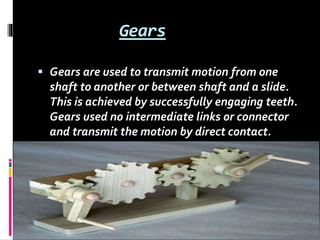
 Gears are used to transmit motion from one
shaft to another or between shaft and a slide.
This is achieved by successfully engaging teeth.
Gears used no intermediate links or connector
and transmit the motion by direct contact.
Types of Gears:
 Spur gears
 Helical gears
 Bevel gears
 Worm gears
 Rack & Pinion gears
Types of Gears:
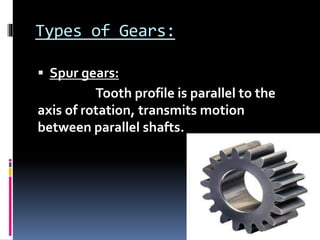
 Spur gears:
Tooth profile is parallel to the
axis of rotation, transmits motion
between parallel shafts.
Types of Gears:
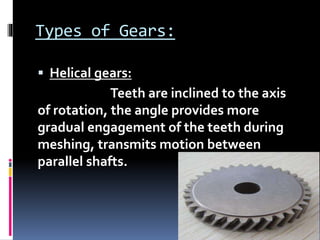
 Helical gears:
Teeth are inclined to the axis
of rotation, the angle provides more
gradual engagement of the teeth during
meshing, transmits motion between
parallel shafts.
Types of Gears:
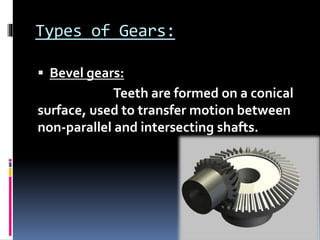
 Bevel gears:
Teeth are formed on a conical
surface, used to transfer motion between
non-parallel and intersecting shafts.
Types of Gears:
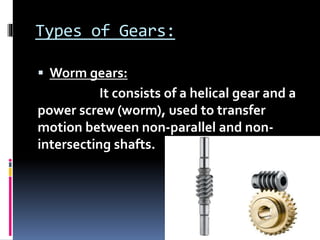
 Worm gears:
It consists of a helical gear and a
power screw (worm), used to transfer
motion between non-parallel and non-
intersecting shafts.
Types of Gears:
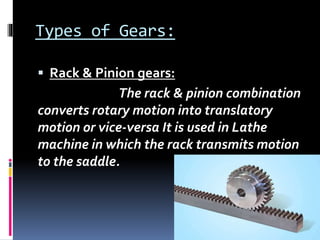
 Rack & Pinion gears:
The rack & pinion combination
converts rotary motion into translatory
motion or vice-versa It is used in Lathe
machine in which the rack transmits motion
to the saddle.
Advantages And Disadvantages
 Advantages:
1. It transmit exact velocity ratio.
2. It has high efficiency.
3. It has reliable service.
4. It may be used to transmit large power.
 Disadvantages:
1. The manufacture of gears requires special tools
and equipments.
2. The error in cutting teeth may cause vibration &
noise during operation.
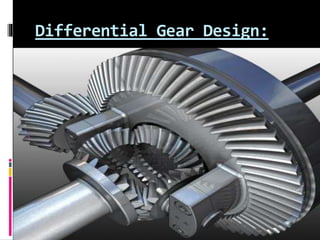
Differential Gear Design:
• Gear Box Design:
B E A R I N G S
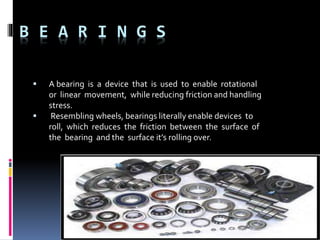
 A bearing is a device that is used to enable rotational
or linear movement, while reducing friction and handling
stress.
 Resembling wheels, bearings literally enable devices to
roll, which reduces the friction between the surface of
the bearing and the surface it’s rolling over.
Types of Bearings:
 Different application require bearings that are
designed to handle a specific type of load,
normally bearings are designed to handle
Radial orThrust load or a combination of two.
 Radial Load:
A radial load, as in a pulley, simply puts weight
on the bearing in a manner that causes the bearing
to roll or rotate as a result of tension.
Radial Load:
Types of Bearings:
 Thrust loads :
Thrust loads are force that is
applied parallel to the bearing's axis.They are
also called axial or linear loads.
Types of Bearings:
 Ball bearings
 Roller bearings
 Ball thrust bearings
 Roller thrust bearings
 Tapered roller bearings
 Specialized bearings
Types of Bearings:
 Ball Bearing:
Ball bearings are extremely common because
they can handle both radial and thrust loads, but
can only handle a small amount of weight.
Applications:
They are found in a wide array of applications,
such as roller blades and even cycles, but are
prone to deforming if they are overloaded.
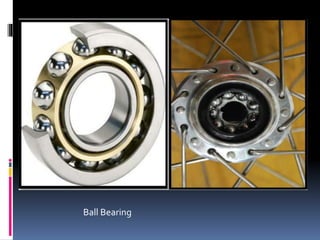
Ball Bearing
Types of Bearings:
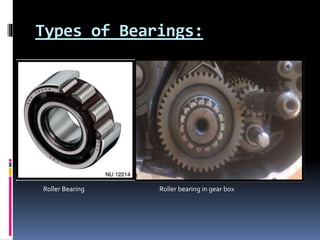
 Roller Bearing:
Roller bearings are designed to carry heavy
loads the primary roller is a cylinder, which
means the load is distributed over a larger
area, enabling the bearing to handle larger
amounts of weight.
Types of Bearings:
Roller Bearing Roller bearing in gear box
Types of Bearings:
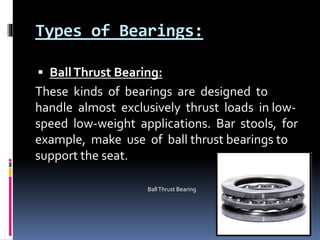
 BallThrust Bearing:
These kinds of bearings are designed to
handle almost exclusively thrust loads in low-
speed low-weight applications. Bar stools, for
example, make use of ball thrust bearings to
support the seat.
BallThrust Bearing
Types of Bearings:
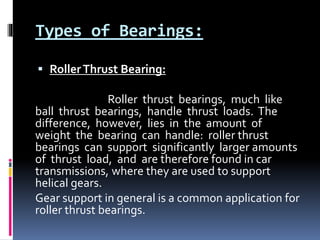
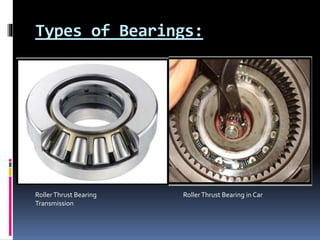
 RollerThrust Bearing:
Roller thrust bearings, much like
ball thrust bearings, handle thrust loads. The
difference, however, lies in the amount of
weight the bearing can handle: roller thrust
bearings can support significantly larger amounts
of thrust load, and are therefore found in car
transmissions, where they are used to support
helical gears.
Gear support in general is a common application for
roller thrust bearings.
Types of Bearings:
RollerThrust Bearing RollerThrust Bearing in Car
Transmission
Types of Bearings:
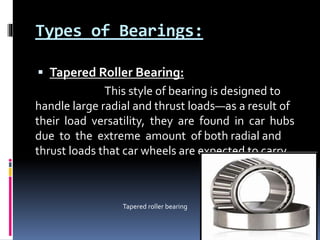
 Tapered Roller Bearing:
This style of bearing is designed to
handle large radial and thrust loads—as a result of
their load versatility, they are found in car hubs
due to the extreme amount of both radial and
thrust loads that car wheels are expected to carry.
Tapered roller bearing
Types of Bearings:
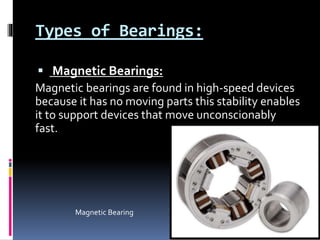
 Magnetic Bearings:
Magnetic bearings are found in high-speed devices
because it has no moving parts this stability enables
it to support devices that move unconscionably
fast.
Magnetic Bearing
Types of Bearings:
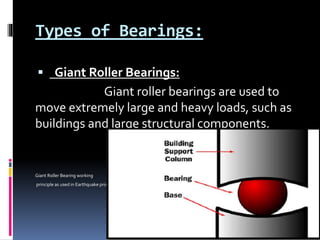
 Giant Roller Bearings:
Giant roller bearings are used to
move extremely large and heavy loads, such as
buildings and large structural components.
Giant Roller Bearing working
principle as used in Earthquake proofing
Gear and bearings

Gear and bearings

  • 1.
    Presentation : Gears andBearings Name: Waqar Shehbaz & Shams Ul Wahab Mechanical Department
  • 2.
    Gears  Gears areused to transmit motion from one shaft to another or between shaft and a slide. This is achieved by successfully engaging teeth. Gears used no intermediate links or connector and transmit the motion by direct contact.
  • 3.
    Types of Gears: Spur gears  Helical gears  Bevel gears  Worm gears  Rack & Pinion gears
  • 4.
    Types of Gears: Spur gears: Tooth profile is parallel to the axis of rotation, transmits motion between parallel shafts.
  • 5.
    Types of Gears: Helical gears: Teeth are inclined to the axis of rotation, the angle provides more gradual engagement of the teeth during meshing, transmits motion between parallel shafts.
  • 6.
    Types of Gears: Bevel gears: Teeth are formed on a conical surface, used to transfer motion between non-parallel and intersecting shafts.
  • 7.
    Types of Gears: Worm gears: It consists of a helical gear and a power screw (worm), used to transfer motion between non-parallel and non- intersecting shafts.
  • 8.
    Types of Gears: Rack & Pinion gears: The rack & pinion combination converts rotary motion into translatory motion or vice-versa It is used in Lathe machine in which the rack transmits motion to the saddle.
  • 9.
    Advantages And Disadvantages Advantages: 1. It transmit exact velocity ratio. 2. It has high efficiency. 3. It has reliable service. 4. It may be used to transmit large power.  Disadvantages: 1. The manufacture of gears requires special tools and equipments. 2. The error in cutting teeth may cause vibration & noise during operation.
  • 10.
  • 11.
    • Gear BoxDesign:
  • 12.
    B E AR I N G S  A bearing is a device that is used to enable rotational or linear movement, while reducing friction and handling stress.  Resembling wheels, bearings literally enable devices to roll, which reduces the friction between the surface of the bearing and the surface it’s rolling over.
  • 13.
    Types of Bearings: Different application require bearings that are designed to handle a specific type of load, normally bearings are designed to handle Radial orThrust load or a combination of two.  Radial Load: A radial load, as in a pulley, simply puts weight on the bearing in a manner that causes the bearing to roll or rotate as a result of tension.
  • 14.
  • 15.
    Types of Bearings: Thrust loads : Thrust loads are force that is applied parallel to the bearing's axis.They are also called axial or linear loads.
  • 16.
    Types of Bearings: Ball bearings  Roller bearings  Ball thrust bearings  Roller thrust bearings  Tapered roller bearings  Specialized bearings
  • 17.
    Types of Bearings: Ball Bearing: Ball bearings are extremely common because they can handle both radial and thrust loads, but can only handle a small amount of weight. Applications: They are found in a wide array of applications, such as roller blades and even cycles, but are prone to deforming if they are overloaded.
  • 18.
  • 19.
    Types of Bearings: Roller Bearing: Roller bearings are designed to carry heavy loads the primary roller is a cylinder, which means the load is distributed over a larger area, enabling the bearing to handle larger amounts of weight.
  • 20.
    Types of Bearings: RollerBearing Roller bearing in gear box
  • 21.
    Types of Bearings: BallThrust Bearing: These kinds of bearings are designed to handle almost exclusively thrust loads in low- speed low-weight applications. Bar stools, for example, make use of ball thrust bearings to support the seat. BallThrust Bearing
  • 22.
    Types of Bearings: RollerThrust Bearing: Roller thrust bearings, much like ball thrust bearings, handle thrust loads. The difference, however, lies in the amount of weight the bearing can handle: roller thrust bearings can support significantly larger amounts of thrust load, and are therefore found in car transmissions, where they are used to support helical gears. Gear support in general is a common application for roller thrust bearings.
  • 23.
    Types of Bearings: RollerThrustBearing RollerThrust Bearing in Car Transmission
  • 24.
    Types of Bearings: Tapered Roller Bearing: This style of bearing is designed to handle large radial and thrust loads—as a result of their load versatility, they are found in car hubs due to the extreme amount of both radial and thrust loads that car wheels are expected to carry. Tapered roller bearing
  • 25.
    Types of Bearings: Magnetic Bearings: Magnetic bearings are found in high-speed devices because it has no moving parts this stability enables it to support devices that move unconscionably fast. Magnetic Bearing
  • 26.
    Types of Bearings: Giant Roller Bearings: Giant roller bearings are used to move extremely large and heavy loads, such as buildings and large structural components. Giant Roller Bearing working principle as used in Earthquake proofing