
BIOCHEMISTRY
 PRACTICALS

 FOR FIRST YEAR MBBS
         Byโ€”
    Aheed Khan
Contents---
1-Colorimetry
2-Abnormal Urine
that
interpretation
    and the
procedures are
  hereby not
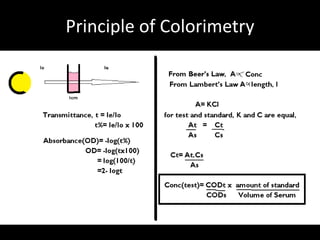
Principle of Colorimetry
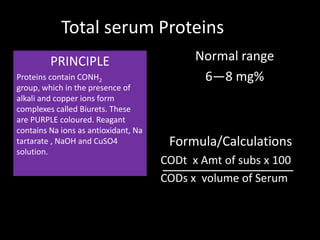
Total serum Proteins
         PRINCIPLE                          Normal range
Proteins contain CONH2                       6โ€”8 mg%
group, which in the presence of
alkali and copper ions form
complexes called Biurets. These
are PURPLE coloured. Reagant
contains Na ions as antioxidant, Na
tartarate , NaOH and CuSO4             Formula/Calculations
solution.
                                      CODt x Amt of subs x 100
                                      CODs x volume of Serum
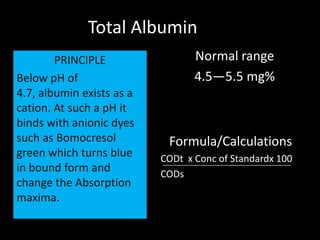
Total Albumin
        PRINCIPLE                 Normal range
Below pH of                       4.5โ€”5.5 mg%
4.7, albumin exists as a
cation. At such a pH it
binds with anionic dyes
such as Bomocresol          Formula/Calculations
green which turns blue     CODt x Conc of Standardx 100
in bound form and          CODs
change the Absorption
maxima.
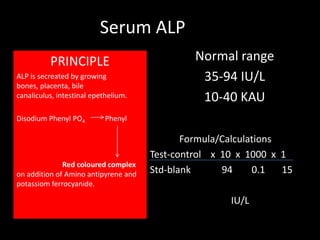
Serum ALP
          PRINCIPLE                            Normal range
ALP is secreated by growing                     35-94 IU/L
bones, placenta, bile
canaliculus, intestinal epethelium.             10-40 KAU
Disodium Phenyl PO4         Phenyl

                                             Formula/Calculations
                                      Test-control x 10 x 1000 x 1
              Red coloured complex
on addition of Amino antipyrene and   Std-blank      94     0.1   15
potassiom ferrocyanide.

                                                       IU/L
ALP Km Estimation.
         PRINCIPLE                   Double reciprocal graph
The principle is same as was for
ALP. Only that different standards     1/[COD]
are first formed which are then
subjected for OD calculation. The
procedure involves reciprocating
the OD and the standards
concentrations for the double
reciprocal curve. When the valued    -1/Km
are plotted, the curve is produced                 1/[S]
backwards till it intersects the
negative x-axis, i.e it gives us -
1/Km. The graph is also known a      Formula/Calculations
Lineweaver-Burk plot.
                                          -1/Km= -a
                                           Km= 1/a
Effect of pH and temp on ALP
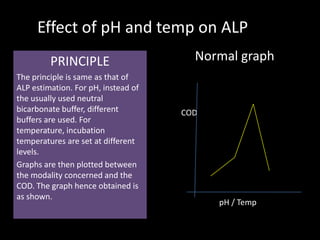
         PRINCIPLE                     Normal graph
The principle is same as that of
ALP estimation. For pH, instead of
the usually used neutral
bicarbonate buffer, different        COD
buffers are used. For
temperature, incubation
temperatures are set at different
levels.
Graphs are then plotted between
the modality concerned and the
COD. The graph hence obtained is
as shown.
                                           pH / Temp
Serum transaminase(SGPT)
                                         Normal range
     PRINCIPLE
On addition of alpha keto
                                          5-45 IU/L
glutarate and alanine as the     Formula/Calculations
substrate, Serum glutamate
                               Test-control x 1 1000 x 0.4   IU/L
pyruvate transaminase forms
                               Std-blank     30 0.1
pyruvate and glumate.
                               T-C x 134 IU/L
Pyruvate combines with         S-B
Dinitro phenyl hydrazine
(DNPH) to form a brown
colored hydrazone complex
Serum Bilirubin
             PRINCIPLE                              Normal range
Van der Berg reaction from the basis                      0.2-1 mg%
of the bilirubin test. Bilirubin exist as            Directโ€”0.2-0.4 mg &
conjugated and non-conjugated form
in blood. Bilirubin reacts with                     Indirect---0.2-0.7 mg &
Diazotized Sulphanilic acid to form
Azobilirubin, which is reddish purple.
This is called Malloy and Evelyn
method. The reagant used is Ehrlichโ€™s
reagant. Diazo blank is also used
                                              Formula/Calculations
which is only HCl.                          CODtest x amount of subs x 100
                                            COD control x volume of Serum
Urea Estimation
      PRINCIPLE                  Normal range
Urea combine with              Serum-15-40 mg%
Diacetyl Monooxime to
form Diacetyl and
Hydroxylamine. Diacetyl
combines with Urea to       Formula/Calculations
give a pink colour in     CODt x amount of standardx 100 x DF
boiling water.            CODs x Volume of serum
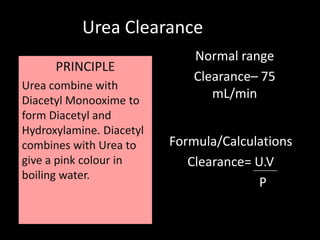
Urea Clearance
     PRINCIPLE                Normal range
      PRINCIPLE
                              Clearanceโ€“ 75
Urea combine with
Diacetyl Monooxime to
                                 mL/min
form Diacetyl and
Hydroxylamine. Diacetyl
combines with Urea to     Formula/Calculations
give a pink colour in        Clearance= U.V
boiling water.
                                         P
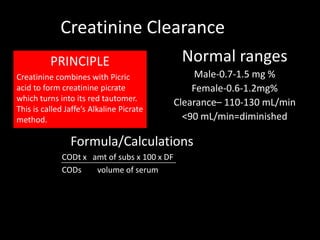
Creatinine Clearance
          PRINCIPLE                           Normal ranges
Creatinine combines with Picric                   Male-0.7-1.5 mg %
acid to form creatinine picrate                  Female-0.6-1.2mg%
which turns into its red tautomer.           Clearanceโ€“ 110-130 mL/min
This is called Jaffeโ€™s Alkaline Picrate
method.                                        <90 mL/min=diminished

                Formula/Calculations
             CODt x amt of subs x 100 x DF
             CODs    volume of serum
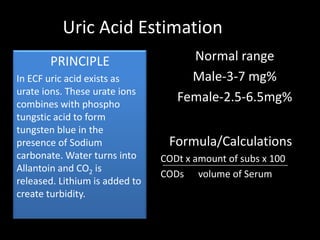
Uric Acid Estimation
       PRINCIPLE                     Normal range
In ECF uric acid exists as           Male-3-7 mg%
urate ions. These urate ions
combines with phospho
                                   Female-2.5-6.5mg%
tungstic acid to form
tungsten blue in the
presence of Sodium               Formula/Calculations
carbonate. Water turns into     CODt x amount of subs x 100
Allantoin and CO2 is
                                CODs volume of Serum
released. Lithium is added to
create turbidity.
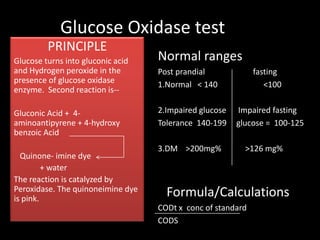
Glucose Oxidase test
         PRINCIPLE
Glucose turns into gluconic acid   Normal ranges
and Hydrogen peroxide in the       Post prandial             fasting
presence of glucose oxidase        1.Normal < 140               <100
enzyme. Second reaction is--

Gluconic Acid + 4-                 2.Impaired glucose   Impaired fasting
aminoantipyrene + 4-hydroxy        Tolerance 140-199    glucose = 100-125
benzoic Acid
                                   3.DM >200mg%           >126 mg%
  Quinone- imine dye
         + water
The reaction is catalyzed by
Peroxidase. The quinoneimine dye
is pink.
                                     Formula/Calculations
                                   CODt x conc of standard
                                   CODS
Glucose tolerance Test
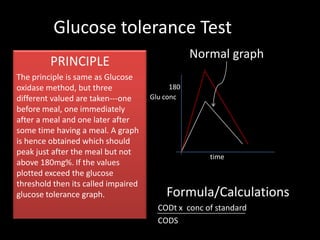
                                                 Normal graph
         PRINCIPLE
The principle is same as Glucose
oxidase method, but three                  180
different valued are taken---one     Glu conc
before meal, one immediately
after a meal and one later after
some time having a meal. A graph
is hence obtained which should
peak just after the meal but not
                                                    time
above 180mg%. If the values
plotted exceed the glucose
threshold then its called impaired
glucose tolerance graph.                 Formula/Calculations
                                       CODt x conc of standard
                                       CODS
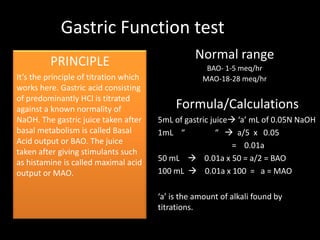
Gastric Function test
         PRINCIPLE                                Normal range
                                                     BAO- 1-5 meq/hr
Itโ€™s the principle of titration which               MAO-18-28 meq/hr
works here. Gastric acid consisting
of predominantly HCl is titrated
against a known normality of                 Formula/Calculations
NaOH. The gastric juice taken after     5mL of gastric juice๏ƒ  โ€˜aโ€™ mL of 0.05N NaOH
basal metabolism is called Basal        1mL โ€œ            โ€œ ๏ƒ  a/5 x 0.05
Acid output or BAO. The juice                                = 0.01a
taken after giving stimulants such
as histamine is called maximal acid     50 mL ๏ƒ  0.01a x 50 = a/2 = BAO
output or MAO.                          100 mL ๏ƒ  0.01a x 100 = a = MAO

                                        โ€˜aโ€™ is the amount of alkali found by
                                        titrations.
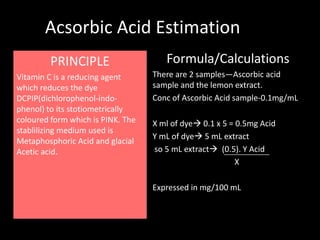
Acsorbic Acid Estimation
         PRINCIPLE                    Formula/Calculations
Vitamin C is a reducing agent      There are 2 samplesโ€”Ascorbic acid
which reduces the dye              sample and the lemon extract.
DCPIP(dichlorophenol-indo-         Conc of Ascorbic Acid sample-0.1mg/mL
phenol) to its stotiometrically
coloured form which is PINK. The   X ml of dye๏ƒ  0.1 x 5 = 0.5mg Acid
stablilizing medium used is
                                   Y mL of dye๏ƒ  5 mL extract
Metaphosphoric Acid and glacial
Acetic acid.                       so 5 mL extract๏ƒ  (0.5). Y Acid
                                                          X

                                   Expressed in mg/100 mL
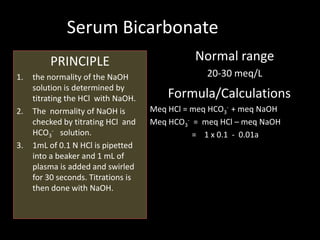
Serum Bicarbonate
          PRINCIPLE                            Normal range
1.   the normality of the NaOH                    20-30 meq/L
     solution is determined by
     titrating the HCl with NaOH.        Formula/Calculations
2.   The normality of NaOH is        Meq HCl = meq HCO3- + meq NaOH
     checked by titrating HCl and    Meq HCO3- = meq HCl โ€“ meq NaOH
     HCO3- solution.                           = 1 x 0.1 - 0.01a
3.   1mL of 0.1 N HCl is pipetted
     into a beaker and 1 mL of
     plasma is added and swirled
     for 30 seconds. Titrations is
     then done with NaOH.
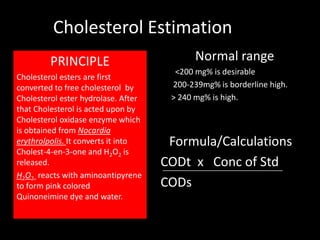
Cholesterol Estimation
         PRINCIPLE                          Normal range
                                       <200 mg% is desirable
Cholesterol esters are first
converted to free cholesterol by      200-239mg% is borderline high.
Cholesterol ester hydrolase. After    > 240 mg% is high.
that Cholesterol is acted upon by
Cholesterol oxidase enzyme which
is obtained from Nocardia
erythrolpolis. It converts it into    Formula/Calculations
Cholest-4-en-3-one and H2O2 is
released.                            CODt x Conc of Std
H2O2 reacts with aminoantipyrene
to form pink colored                 CODs
Quinoneimine dye and water.
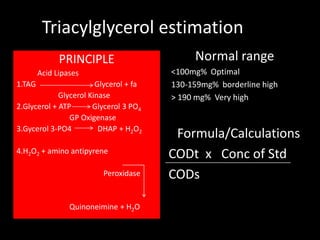
Triacylglycerol estimation
              PRINCIPLE                      Normal range
        Acid Lipases                    <100mg% Optimal
1.TAG                   Glycerol + fa   130-159mg% borderline high
             Glycerol Kinase            > 190 mg% Very high
2.Glycerol + ATP       Glycerol 3 PO4
                GP Oxigenase
3.Gycerol 3-PO4          DHAP + H2O2
                                         Formula/Calculations
4.H2O2 + amino antipyrene
                                        CODt x Conc of Std
                         Peroxidase     CODs

                 Quinoneimine + H2O
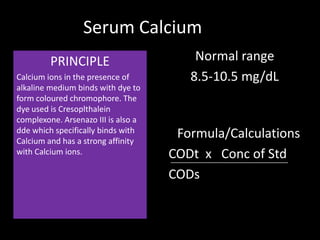
Serum Calcium
         PRINCIPLE                       Normal range
Calcium ions in the presence of         8.5-10.5 mg/dL
alkaline medium binds with dye to
form coloured chromophore. The
dye used is Cresoplthalein
complexone. Arsenazo III is also a
dde which specifically binds with
Calcium and has a strong affinity
                                      Formula/Calculations
with Calcium ions.                   CODt x Conc of Std
                                     CODs
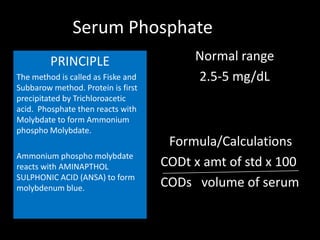
Serum Phosphate
         PRINCIPLE                       Normal range
The method is called as Fiske and        2.5-5 mg/dL
Subbarow method. Protein is first
precipitated by Trichloroacetic
acid. Phosphate then reacts with
Molybdate to form Ammonium
phospho Molybdate.
                                     Formula/Calculations
Ammonium phospho molybdate
reacts with AMINAPTHOL              CODt x amt of std x 100
SULPHONIC ACID (ANSA) to form
molybdenum blue.                    CODs volume of serum
Abnormal
Constituents of Urine
Carbohydrates
โ€ข Benedictsโ€™ Test: 8 drops of urine are added to
  5 mL of Benedicts reagant.
โ€ข This is a semi quantitative test which shows
  different colors for different concentrations of
  sugars.
โ€ข Presence of sugars, especially glucose idicates
  glycosuria and Diabetes mellitus.
Proteins
โ€ข Coagulation test: A serum test tube is taken and its upper part is heated
  and the lower part is left for as control. The heated urine sample is then
  acidized with acetic acid so that turbidity cause d by phosphates is
  eliminated.
โ€ข Esbachโ€™s test: some urine is added to Esbachโ€™s reagant. A yellow ppt
  indicates protein.
โ€ข Hellerโ€™s test: take 3-5 mL of conc HNO3 in a test tube. Incline the tube and
  add 2-3 mL of urine. White zone of precipitated protein formed confirms
  the test.
Bile Salts
โ€ข Hayโ€™s surface tension test: the urine is first put
  in a serum test tube and sulphur powder is
  then added to it. If the sulphur particles sink
  then bile salts are present as they reduce the
  surface tension. Otherwise the S particles will
  float on the surface.
Bile pigments
โ€ข Gmelinโ€™s test : to 5mL of conc HNO3 add an equal amount of urine. Add
  urine carefully so that the two fluids donโ€™t mix. At the junction there is
  formation of coloured rings. This confirms bile pigments.

โ€ข Fouchetโ€™s test: to 5mL of urine add an equal amount of 10% BaCl2. Filter
  the contents which are collected over a filter paper. Few drops of
  Fouchetโ€™s reagant are then added. A green colour is obtained which
  confirms presence of bile salts.
โ€ข           fouchetโ€™s reagant
โ€ข Bilirubin              Biliverdin
Ketone bodies
โ€ข Nitroprusside test: 2 mL of urine is added to 5% aq solution of sodium
  nitroprusside. The solution is made alkaline with the addition of NaOH. A
  red color indicates presence of acetone.


โ€ข Modified Nitroprusside test: to few drops of urine add few drops of
  nitroprusside. Then add few drops of NH4OH. A purpe ring will be formed.
Blood
โ€ข Benzidine test: to 3 mL of urine add drops of
  saturated solution of benzidine in glacial
  acetic acid and 1mL of 3% H2O2. immediate
  blue or green colour indicates presence of
  blood in urine.
THANK YOU

Bc prac

  • 1.
    BIOCHEMISTRY PRACTICALS FORFIRST YEAR MBBS Byโ€” Aheed Khan
  • 2.
  • 3.
    that interpretation and the procedures are hereby not
  • 4.
  • 5.
    Total serum Proteins PRINCIPLE Normal range Proteins contain CONH2 6โ€”8 mg% group, which in the presence of alkali and copper ions form complexes called Biurets. These are PURPLE coloured. Reagant contains Na ions as antioxidant, Na tartarate , NaOH and CuSO4 Formula/Calculations solution. CODt x Amt of subs x 100 CODs x volume of Serum
  • 6.
    Total Albumin PRINCIPLE Normal range Below pH of 4.5โ€”5.5 mg% 4.7, albumin exists as a cation. At such a pH it binds with anionic dyes such as Bomocresol Formula/Calculations green which turns blue CODt x Conc of Standardx 100 in bound form and CODs change the Absorption maxima.
  • 7.
    Serum ALP PRINCIPLE Normal range ALP is secreated by growing 35-94 IU/L bones, placenta, bile canaliculus, intestinal epethelium. 10-40 KAU Disodium Phenyl PO4 Phenyl Formula/Calculations Test-control x 10 x 1000 x 1 Red coloured complex on addition of Amino antipyrene and Std-blank 94 0.1 15 potassiom ferrocyanide. IU/L
  • 8.
    ALP Km Estimation. PRINCIPLE Double reciprocal graph The principle is same as was for ALP. Only that different standards 1/[COD] are first formed which are then subjected for OD calculation. The procedure involves reciprocating the OD and the standards concentrations for the double reciprocal curve. When the valued -1/Km are plotted, the curve is produced 1/[S] backwards till it intersects the negative x-axis, i.e it gives us - 1/Km. The graph is also known a Formula/Calculations Lineweaver-Burk plot. -1/Km= -a Km= 1/a
  • 9.
    Effect of pHand temp on ALP PRINCIPLE Normal graph The principle is same as that of ALP estimation. For pH, instead of the usually used neutral bicarbonate buffer, different COD buffers are used. For temperature, incubation temperatures are set at different levels. Graphs are then plotted between the modality concerned and the COD. The graph hence obtained is as shown. pH / Temp
  • 10.
    Serum transaminase(SGPT) Normal range PRINCIPLE On addition of alpha keto 5-45 IU/L glutarate and alanine as the Formula/Calculations substrate, Serum glutamate Test-control x 1 1000 x 0.4 IU/L pyruvate transaminase forms Std-blank 30 0.1 pyruvate and glumate. T-C x 134 IU/L Pyruvate combines with S-B Dinitro phenyl hydrazine (DNPH) to form a brown colored hydrazone complex
  • 11.
    Serum Bilirubin PRINCIPLE Normal range Van der Berg reaction from the basis 0.2-1 mg% of the bilirubin test. Bilirubin exist as Directโ€”0.2-0.4 mg & conjugated and non-conjugated form in blood. Bilirubin reacts with Indirect---0.2-0.7 mg & Diazotized Sulphanilic acid to form Azobilirubin, which is reddish purple. This is called Malloy and Evelyn method. The reagant used is Ehrlichโ€™s reagant. Diazo blank is also used Formula/Calculations which is only HCl. CODtest x amount of subs x 100 COD control x volume of Serum
  • 12.
    Urea Estimation PRINCIPLE Normal range Urea combine with Serum-15-40 mg% Diacetyl Monooxime to form Diacetyl and Hydroxylamine. Diacetyl combines with Urea to Formula/Calculations give a pink colour in CODt x amount of standardx 100 x DF boiling water. CODs x Volume of serum
  • 13.
    Urea Clearance PRINCIPLE Normal range PRINCIPLE Clearanceโ€“ 75 Urea combine with Diacetyl Monooxime to mL/min form Diacetyl and Hydroxylamine. Diacetyl combines with Urea to Formula/Calculations give a pink colour in Clearance= U.V boiling water. P
  • 14.
    Creatinine Clearance PRINCIPLE Normal ranges Creatinine combines with Picric Male-0.7-1.5 mg % acid to form creatinine picrate Female-0.6-1.2mg% which turns into its red tautomer. Clearanceโ€“ 110-130 mL/min This is called Jaffeโ€™s Alkaline Picrate method. <90 mL/min=diminished Formula/Calculations CODt x amt of subs x 100 x DF CODs volume of serum
  • 15.
    Uric Acid Estimation PRINCIPLE Normal range In ECF uric acid exists as Male-3-7 mg% urate ions. These urate ions combines with phospho Female-2.5-6.5mg% tungstic acid to form tungsten blue in the presence of Sodium Formula/Calculations carbonate. Water turns into CODt x amount of subs x 100 Allantoin and CO2 is CODs volume of Serum released. Lithium is added to create turbidity.
  • 16.
    Glucose Oxidase test PRINCIPLE Glucose turns into gluconic acid Normal ranges and Hydrogen peroxide in the Post prandial fasting presence of glucose oxidase 1.Normal < 140 <100 enzyme. Second reaction is-- Gluconic Acid + 4- 2.Impaired glucose Impaired fasting aminoantipyrene + 4-hydroxy Tolerance 140-199 glucose = 100-125 benzoic Acid 3.DM >200mg% >126 mg% Quinone- imine dye + water The reaction is catalyzed by Peroxidase. The quinoneimine dye is pink. Formula/Calculations CODt x conc of standard CODS
  • 17.
    Glucose tolerance Test Normal graph PRINCIPLE The principle is same as Glucose oxidase method, but three 180 different valued are taken---one Glu conc before meal, one immediately after a meal and one later after some time having a meal. A graph is hence obtained which should peak just after the meal but not time above 180mg%. If the values plotted exceed the glucose threshold then its called impaired glucose tolerance graph. Formula/Calculations CODt x conc of standard CODS
  • 18.
    Gastric Function test PRINCIPLE Normal range BAO- 1-5 meq/hr Itโ€™s the principle of titration which MAO-18-28 meq/hr works here. Gastric acid consisting of predominantly HCl is titrated against a known normality of Formula/Calculations NaOH. The gastric juice taken after 5mL of gastric juice๏ƒ  โ€˜aโ€™ mL of 0.05N NaOH basal metabolism is called Basal 1mL โ€œ โ€œ ๏ƒ  a/5 x 0.05 Acid output or BAO. The juice = 0.01a taken after giving stimulants such as histamine is called maximal acid 50 mL ๏ƒ  0.01a x 50 = a/2 = BAO output or MAO. 100 mL ๏ƒ  0.01a x 100 = a = MAO โ€˜aโ€™ is the amount of alkali found by titrations.
  • 19.
    Acsorbic Acid Estimation PRINCIPLE Formula/Calculations Vitamin C is a reducing agent There are 2 samplesโ€”Ascorbic acid which reduces the dye sample and the lemon extract. DCPIP(dichlorophenol-indo- Conc of Ascorbic Acid sample-0.1mg/mL phenol) to its stotiometrically coloured form which is PINK. The X ml of dye๏ƒ  0.1 x 5 = 0.5mg Acid stablilizing medium used is Y mL of dye๏ƒ  5 mL extract Metaphosphoric Acid and glacial Acetic acid. so 5 mL extract๏ƒ  (0.5). Y Acid X Expressed in mg/100 mL
  • 20.
    Serum Bicarbonate PRINCIPLE Normal range 1. the normality of the NaOH 20-30 meq/L solution is determined by titrating the HCl with NaOH. Formula/Calculations 2. The normality of NaOH is Meq HCl = meq HCO3- + meq NaOH checked by titrating HCl and Meq HCO3- = meq HCl โ€“ meq NaOH HCO3- solution. = 1 x 0.1 - 0.01a 3. 1mL of 0.1 N HCl is pipetted into a beaker and 1 mL of plasma is added and swirled for 30 seconds. Titrations is then done with NaOH.
  • 21.
    Cholesterol Estimation PRINCIPLE Normal range <200 mg% is desirable Cholesterol esters are first converted to free cholesterol by 200-239mg% is borderline high. Cholesterol ester hydrolase. After > 240 mg% is high. that Cholesterol is acted upon by Cholesterol oxidase enzyme which is obtained from Nocardia erythrolpolis. It converts it into Formula/Calculations Cholest-4-en-3-one and H2O2 is released. CODt x Conc of Std H2O2 reacts with aminoantipyrene to form pink colored CODs Quinoneimine dye and water.
  • 22.
    Triacylglycerol estimation PRINCIPLE Normal range Acid Lipases <100mg% Optimal 1.TAG Glycerol + fa 130-159mg% borderline high Glycerol Kinase > 190 mg% Very high 2.Glycerol + ATP Glycerol 3 PO4 GP Oxigenase 3.Gycerol 3-PO4 DHAP + H2O2 Formula/Calculations 4.H2O2 + amino antipyrene CODt x Conc of Std Peroxidase CODs Quinoneimine + H2O
  • 23.
    Serum Calcium PRINCIPLE Normal range Calcium ions in the presence of 8.5-10.5 mg/dL alkaline medium binds with dye to form coloured chromophore. The dye used is Cresoplthalein complexone. Arsenazo III is also a dde which specifically binds with Calcium and has a strong affinity Formula/Calculations with Calcium ions. CODt x Conc of Std CODs
  • 24.
    Serum Phosphate PRINCIPLE Normal range The method is called as Fiske and 2.5-5 mg/dL Subbarow method. Protein is first precipitated by Trichloroacetic acid. Phosphate then reacts with Molybdate to form Ammonium phospho Molybdate. Formula/Calculations Ammonium phospho molybdate reacts with AMINAPTHOL CODt x amt of std x 100 SULPHONIC ACID (ANSA) to form molybdenum blue. CODs volume of serum
  • 25.
  • 26.
    Carbohydrates โ€ข Benedictsโ€™ Test:8 drops of urine are added to 5 mL of Benedicts reagant. โ€ข This is a semi quantitative test which shows different colors for different concentrations of sugars. โ€ข Presence of sugars, especially glucose idicates glycosuria and Diabetes mellitus.
  • 27.
    Proteins โ€ข Coagulation test:A serum test tube is taken and its upper part is heated and the lower part is left for as control. The heated urine sample is then acidized with acetic acid so that turbidity cause d by phosphates is eliminated. โ€ข Esbachโ€™s test: some urine is added to Esbachโ€™s reagant. A yellow ppt indicates protein. โ€ข Hellerโ€™s test: take 3-5 mL of conc HNO3 in a test tube. Incline the tube and add 2-3 mL of urine. White zone of precipitated protein formed confirms the test.
  • 28.
    Bile Salts โ€ข Hayโ€™ssurface tension test: the urine is first put in a serum test tube and sulphur powder is then added to it. If the sulphur particles sink then bile salts are present as they reduce the surface tension. Otherwise the S particles will float on the surface.
  • 29.
    Bile pigments โ€ข Gmelinโ€™stest : to 5mL of conc HNO3 add an equal amount of urine. Add urine carefully so that the two fluids donโ€™t mix. At the junction there is formation of coloured rings. This confirms bile pigments. โ€ข Fouchetโ€™s test: to 5mL of urine add an equal amount of 10% BaCl2. Filter the contents which are collected over a filter paper. Few drops of Fouchetโ€™s reagant are then added. A green colour is obtained which confirms presence of bile salts. โ€ข fouchetโ€™s reagant โ€ข Bilirubin Biliverdin
  • 30.
    Ketone bodies โ€ข Nitroprussidetest: 2 mL of urine is added to 5% aq solution of sodium nitroprusside. The solution is made alkaline with the addition of NaOH. A red color indicates presence of acetone. โ€ข Modified Nitroprusside test: to few drops of urine add few drops of nitroprusside. Then add few drops of NH4OH. A purpe ring will be formed.
  • 31.
    Blood โ€ข Benzidine test:to 3 mL of urine add drops of saturated solution of benzidine in glacial acetic acid and 1mL of 3% H2O2. immediate blue or green colour indicates presence of blood in urine.
  • 32.