3/8/2017 3:56 AM Nirsuba gurung 1
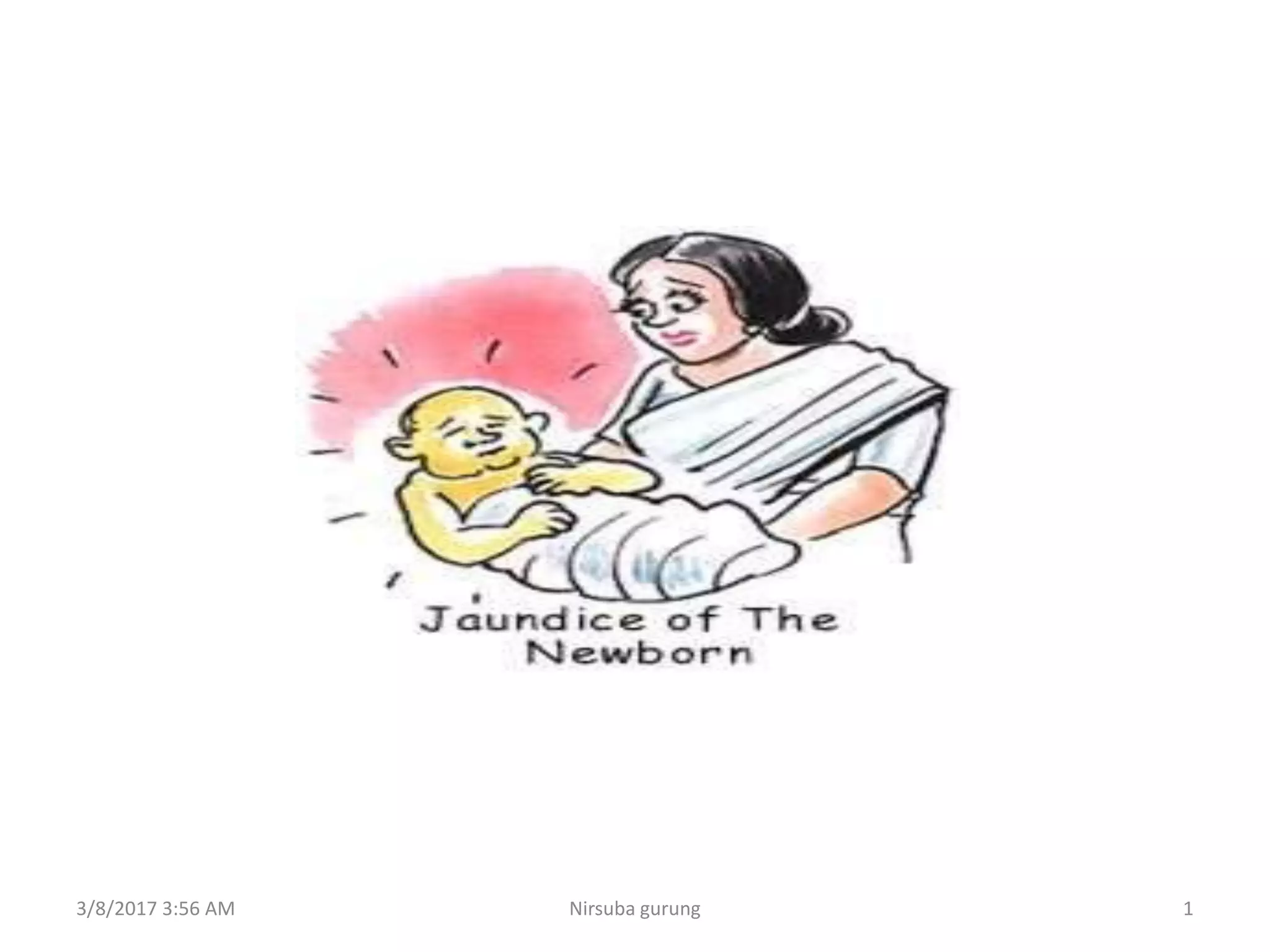
Physiological Jaundice
Presented By:
Nirsuba gurung
General objective
• At the end of this teaching learning session
students will be able to know in detail about
physiological jaundice
3/8/2017 3:56 AM Nirsuba gurung 3
Specific objective
At the end of the class students will be able to
• define jaundice and physiological jaundice;
• explain the physiology of physiological
jaundice;
• enlist the causes of physiological jaundice;
• enlist the risk factor associated with
physiological jaundice;
3/8/2017 3:56 AM Nirsuba gurung 4
Contd……….
• verbalise the sign and symptom of
physiological jaundice;
• describe the assessment and diagnosis of
physiological jaundice;
• describe the management and care of a baby
with physiological jaundice.
3/8/2017 3:56 AM Nirsuba gurung 5
Jaundice:
• A yellow discolouration of the skin, sclera and
mucous membrane due to an increase in the
serum bilirubin level. This becomes clinically
evident when serum bilirubin reaches about
5-7 mg/dl
3/8/2017 3:56 AM 6Nirsuba gurung
• The yellow discoloration of the skin is first
noted in the face and as the bilirubin level
rises proceeds caudal to the trunk and then to
the extremities.
Physiological jaundice
• Jaundice occurring in most newborns, this
mild jaundice is due to the immaturity of the
baby's liver, which leads to a slow processing
of bilirubin.
3/8/2017 3:56 AM Nirsuba gurung 9
Physiological jaundice:
• Most neonates develops visible jaundice due
to elevation of unconjugated bilirubin
concentration during 1st week . This
common condition is called physiological
jaundice.
3/8/2017 3:56 AM 10Nirsuba gurung
Physiological Jaundice
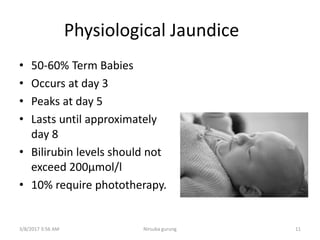
• 50-60% Term Babies
• Occurs at day 3
• Peaks at day 5
• Lasts until approximately
day 8
• Bilirubin levels should not
exceed 200μmol/l
• 10% require phototherapy.
3/8/2017 3:56 AM 11Nirsuba gurung
Contd…….
The pattern of hyperbilirubinemia in
physiological jaundice has been classified
into two functionally distinct periods;
• Phase 1:
– last for 5 days in term infants and
– about 7 days in preterm infants when there is
rapid rise in serum levels to 12 to 15
mg/dl,respectively.
3/8/2017 3:56 AM 12Nirsuba gurung
Phase two -
• In phase two bilirubin levels decline to about
34 μmol/l (2 mg/dL) for two weeks, eventually
mimicking adult values.
– Preterm infants - phase two can last more than
one month.
– Exclusively breastfed infants - phase two can last
more than one month.
3/8/2017 3:56 AM 13Nirsuba gurung
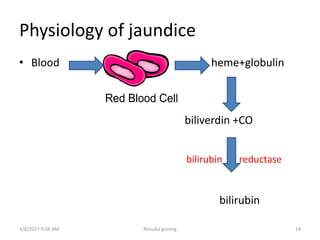
Physiology of jaundice
• Blood heme+globulin
biliverdin +CO
bilirubin reductase
bilirubin
3/8/2017 3:56 AM 14Nirsuba gurung
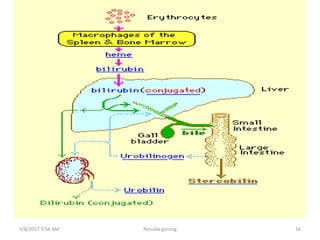
Pathway of Bilirubin
• After the liver, the bilirubin enters the gall bladder and is
excreted in bile into the intestine.
• In the gut under the action of bacteria bilirubin is reduced to
urobilinogen, a small proportion is excreted in urine with the
majority excreted in faeces as stercobilinogen.
• An enzyme β glucuronidase is also present in the gut and
converts conjugated bilirubin back to unconjugated bilirubin.
There is 10times the amount of β glucuronidasae in the
neonate compared with the adult.
3/8/2017 3:56 AM 15Nirsuba gurung
3/8/2017 3:56 AM Nirsuba gurung 16
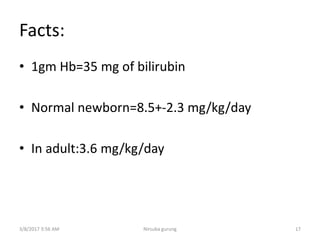
Facts:
• 1gm Hb=35 mg of bilirubin
• Normal newborn=8.5+-2.3 mg/kg/day
• In adult:3.6 mg/kg/day
3/8/2017 3:56 AM 17Nirsuba gurung
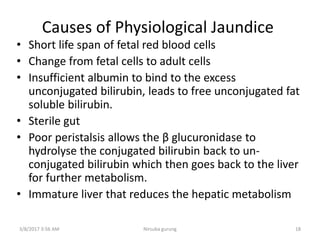
Causes of Physiological Jaundice
• Short life span of fetal red blood cells
• Change from fetal cells to adult cells
• Insufficient albumin to bind to the excess
unconjugated bilirubin, leads to free unconjugated fat
soluble bilirubin.
• Sterile gut
• Poor peristalsis allows the β glucuronidase to
hydrolyse the conjugated bilirubin back to un-
conjugated bilirubin which then goes back to the liver
for further metabolism.
• Immature liver that reduces the hepatic metabolism
3/8/2017 3:56 AM 18Nirsuba gurung
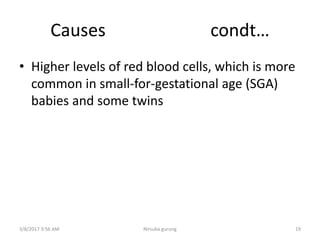
Causes condt…
• Higher levels of red blood cells, which is more
common in small-for-gestational age (SGA)
babies and some twins
3/8/2017 3:56 AM Nirsuba gurung 19
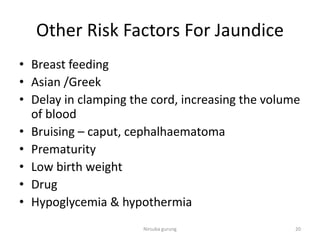
Other Risk Factors For Jaundice
• Breast feeding
• Asian /Greek
• Delay in clamping the cord, increasing the volume
of blood
• Bruising – caput, cephalhaematoma
• Prematurity
• Low birth weight
• Drug
• Hypoglycemia & hypothermia
20Nirsuba gurung
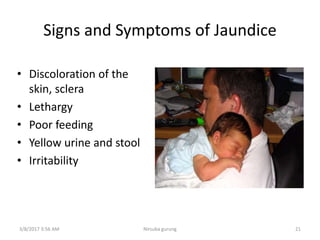
Signs and Symptoms of Jaundice
• Discoloration of the
skin, sclera
• Lethargy
• Poor feeding
• Yellow urine and stool
• Irritability
3/8/2017 3:56 AM 21Nirsuba gurung
Complications of Jaundice
High levels of bilirubin — usually above 25 mg
— can cause deafness, cerebral palsy, or other
forms of brain damage in some babies.
Risk that the fat soluble bilirubin crosses to
the brain to cause Bilirubin Encephalopathy
known as Kernicterus.
3/8/2017 3:56 AM 22Nirsuba gurung
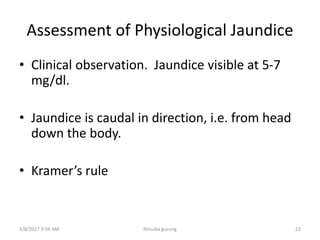
Assessment of Physiological Jaundice
• Clinical observation. Jaundice visible at 5-7
mg/dl.
• Jaundice is caudal in direction, i.e. from head
down the body.
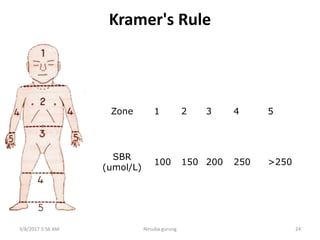
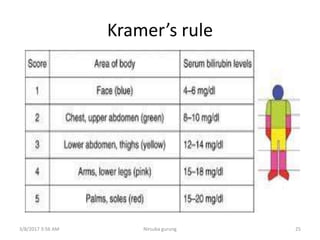
• Kramer’s rule
3/8/2017 3:56 AM 23Nirsuba gurung
Kramer's Rule
Zone 1 2 3 4 5
SBR
(umol/L)
100 150 200 250 >250
3/8/2017 3:56 AM 24Nirsuba gurung
Kramer’s rule
3/8/2017 3:56 AM Nirsuba gurung 25
Investigation
• Clinical history of mother/family.
• History of bruising / cephalohematoma / birth
trauma.
• Blood grouping and rhesus factor.
• Feeding pattern.
• Infection.
• Drugs.
3/8/2017 3:56 AM 26Nirsuba gurung
Management
• No action for the vast majority of babies with
physiological jaundice
• Measure the Serum Bilirubin
• The level of serum bilirubin actually indicates
what treatment is required:
– To continue to observe but no additional
intervention
– Repeat test
– Phototherapy
– Exchange blood transfusion (unlikely for
physiological jaundice)
3/8/2017 3:56 AM 27Nirsuba gurung
Medical Management
Phenobarbital
Increases liver metabolism and thus
lowering bilirubin levels.
3/8/2017 3:56 AM Nirsuba gurung 28
Phototherapy
• First discovered, accidentally, at Rochford Hospital
in Essex, England
• Ward sister of the premature baby unit firmly
believed that the infants under her care benefited
from fresh air and sunlight in the courtyard
• When serum bilirubin was checked indicated a
much lower level of bilirubin tha earlier
3/8/2017 3:56 AM Nirsuba gurung 29
• Dr. Cremer's published the facts in
the Lancet in 1958
3/8/2017 3:56 AM Nirsuba gurung 30
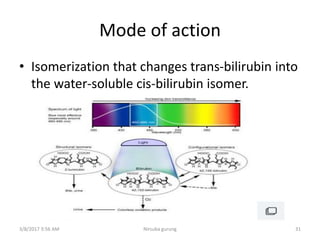
Mode of action
• Isomerization that changes trans-bilirubin into
the water-soluble cis-bilirubin isomer.
3/8/2017 3:56 AM Nirsuba gurung 31
• Blue-green light in the range of 460-490 nm is
most effective for phototherapy.
• The absorption of light by the normal bilirubin
(4Z,15Z-bilirubin) generates configuration
isomers, structural isomers, and
photooxidation products.
3/8/2017 3:56 AM Nirsuba gurung 32
Factors affecting dose of phototherapy
• Irradiance of light used,
• The distance from the light source, and
• The amount of skin exposed.
3/8/2017 3:56 AM 33
• Standard phototherapy is provided at an
irradiance of 8-10 microwatts per square
centimeter per nanometer (mW/cm2 per nm).
• Intensive phototherapy is provided at an
irradiance of 30 mW/cm2 per nm or more
(430–490 nm).
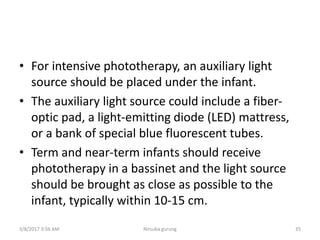
• For intensive phototherapy, an auxiliary light
source should be placed under the infant.
• The auxiliary light source could include a fiber-
optic pad, a light-emitting diode (LED) mattress,
or a bank of special blue fluorescent tubes.
• Term and near-term infants should receive
phototherapy in a bassinet and the light source
should be brought as close as possible to the
infant, typically within 10-15 cm.
3/8/2017 3:56 AM Nirsuba gurung 35
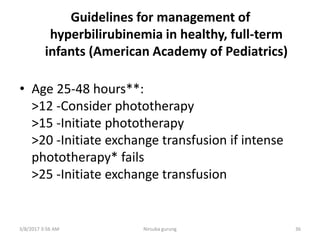
Guidelines for management of
hyperbilirubinemia in healthy, full-term
infants (American Academy of Pediatrics)
• Age 25-48 hours**:
>12 -Consider phototherapy
>15 -Initiate phototherapy
>20 -Initiate exchange transfusion if intense
phototherapy* fails
>25 -Initiate exchange transfusion
3/8/2017 3:56 AM Nirsuba gurung 36
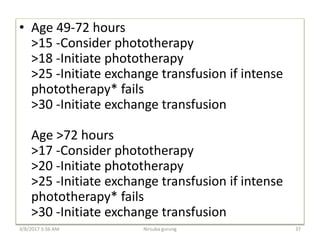
• Age 49-72 hours
>15 -Consider phototherapy
>18 -Initiate phototherapy
>25 -Initiate exchange transfusion if intense
phototherapy* fails
>30 -Initiate exchange transfusion
Age >72 hours
>17 -Consider phototherapy
>20 -Initiate phototherapy
>25 -Initiate exchange transfusion if intense
phototherapy* fails
>30 -Initiate exchange transfusion
3/8/2017 3:56 AM 37Nirsuba gurung
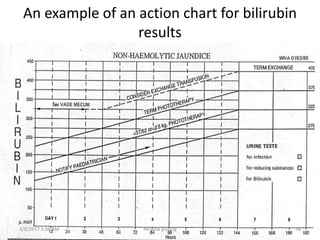
An example of an action chart for bilirubin
results
www.ich.ucl.ac.uk/clinical_information/clinical_guidelines/downloads/phototherapy.pdf
3/8/2017 3:56 AM 38Nirsuba gurung
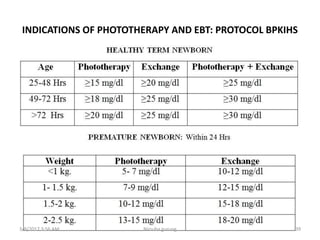
INDICATIONS OF PHOTOTHERAPY AND EBT: PROTOCOL BPKIHS
3/8/2017 3:56 AM 39Nirsuba gurung
3/8/2017 3:56 AM Nirsuba gurung 40
Care of baby
• Early feeding/ Nutrition/ Hydration
• Increase frequency of breast feeding
• Neutral thermal environment
• Prevent hypoglycaemia and hypoxia
• Avoid constipation
• Hygiene
•
3/8/2017 3:56 AM 41Nirsuba gurung
Summary
3/8/2017 3:56 AM Nirsuba gurung 42
3/8/2017 3:56 AM 43Nirsuba gurung
Reference
• Ghai . OP.Essential Paediatric. 6th edition CBS
publication and distributors page no:169-171
• Dutta D.C. Text book of obstretics. 7th
edition.New book agency(p)ltd page no:476
3/8/2017 3:56 AM Nirsuba gurung 44
Contd……..
• College of Family Physicians of Canada (1999)
Approach to the
management of hyperbilirubinemia in term
newborn infants paeditrics & Child Health 4(2);
161-164
http://www.cps.ca/english/statements/FN/fn98-
02.html (retrived on 11 dec 2o11)
•
3/8/2017 3:56 AM Nirsuba gurung 45
Contd……
• Dutta Parul. Paediatric Nursing. 2nd edition
Jaypee brothers mediccal publisher(p) ltd page
no:313-314.
3/8/2017 3:56 AM Nirsuba gurung 46
Multiple choice questions
1.physiological jaundice starts to appear on:
A. At the time of birth;
B. 2-3 day of life;
C. 7 days of life;
D. 15 days of life
3/8/2017 3:56 AM Nirsuba gurung 47
2.End product of R.B.C destruction which causes
yellowish discoloration of body is:
A. Globulin
B. Albumin
C. Biliverdin
D. Bilirubin
3/8/2017 3:56 AM Nirsuba gurung 48
3. Conjugation of bilirubin takes place in:
A. Intestine
B. Lung
C. Liver
D. kidney
3/8/2017 3:56 AM Nirsuba gurung 49
4. All of the following are the causes of
physiological jaundice, except:
A. Sterile gut
B. Short life span of R.B.C
C. Constipation
D. Mature liver
3/8/2017 3:56 AM Nirsuba gurung 50
5. Jaundice first appears in
A. Foot
B. Hands
C. Sclera of eyes
D. abdomen
3/8/2017 3:56 AM Nirsuba gurung 51
Assignment
• While you are posted in pediatric ward:1 a 5
days old baby is having serum total bilirubin
level 10 mg/dl , and not sucking breast milk .
Make a nursing care plan for the baby.
3/8/2017 3:56 AM Nirsuba gurung 52
3/8/2017 3:56 AM Nirsuba gurung 53

Physiological jaundice

  • 1.
    3/8/2017 3:56 AMNirsuba gurung 1
  • 2.
  • 3.
    General objective • Atthe end of this teaching learning session students will be able to know in detail about physiological jaundice 3/8/2017 3:56 AM Nirsuba gurung 3
  • 4.
    Specific objective At theend of the class students will be able to • define jaundice and physiological jaundice; • explain the physiology of physiological jaundice; • enlist the causes of physiological jaundice; • enlist the risk factor associated with physiological jaundice; 3/8/2017 3:56 AM Nirsuba gurung 4
  • 5.
    Contd………. • verbalise thesign and symptom of physiological jaundice; • describe the assessment and diagnosis of physiological jaundice; • describe the management and care of a baby with physiological jaundice. 3/8/2017 3:56 AM Nirsuba gurung 5
  • 6.
    Jaundice: • A yellowdiscolouration of the skin, sclera and mucous membrane due to an increase in the serum bilirubin level. This becomes clinically evident when serum bilirubin reaches about 5-7 mg/dl 3/8/2017 3:56 AM 6Nirsuba gurung
  • 7.
    • The yellowdiscoloration of the skin is first noted in the face and as the bilirubin level rises proceeds caudal to the trunk and then to the extremities.
  • 9.
    Physiological jaundice • Jaundiceoccurring in most newborns, this mild jaundice is due to the immaturity of the baby's liver, which leads to a slow processing of bilirubin. 3/8/2017 3:56 AM Nirsuba gurung 9
  • 10.
    Physiological jaundice: • Mostneonates develops visible jaundice due to elevation of unconjugated bilirubin concentration during 1st week . This common condition is called physiological jaundice. 3/8/2017 3:56 AM 10Nirsuba gurung
  • 11.
    Physiological Jaundice • 50-60%Term Babies • Occurs at day 3 • Peaks at day 5 • Lasts until approximately day 8 • Bilirubin levels should not exceed 200μmol/l • 10% require phototherapy. 3/8/2017 3:56 AM 11Nirsuba gurung
  • 12.
    Contd……. The pattern ofhyperbilirubinemia in physiological jaundice has been classified into two functionally distinct periods; • Phase 1: – last for 5 days in term infants and – about 7 days in preterm infants when there is rapid rise in serum levels to 12 to 15 mg/dl,respectively. 3/8/2017 3:56 AM 12Nirsuba gurung
  • 13.
    Phase two - •In phase two bilirubin levels decline to about 34 μmol/l (2 mg/dL) for two weeks, eventually mimicking adult values. – Preterm infants - phase two can last more than one month. – Exclusively breastfed infants - phase two can last more than one month. 3/8/2017 3:56 AM 13Nirsuba gurung
  • 14.
    Physiology of jaundice •Blood heme+globulin biliverdin +CO bilirubin reductase bilirubin 3/8/2017 3:56 AM 14Nirsuba gurung
  • 15.
    Pathway of Bilirubin •After the liver, the bilirubin enters the gall bladder and is excreted in bile into the intestine. • In the gut under the action of bacteria bilirubin is reduced to urobilinogen, a small proportion is excreted in urine with the majority excreted in faeces as stercobilinogen. • An enzyme β glucuronidase is also present in the gut and converts conjugated bilirubin back to unconjugated bilirubin. There is 10times the amount of β glucuronidasae in the neonate compared with the adult. 3/8/2017 3:56 AM 15Nirsuba gurung
  • 16.
    3/8/2017 3:56 AMNirsuba gurung 16
  • 17.
    Facts: • 1gm Hb=35mg of bilirubin • Normal newborn=8.5+-2.3 mg/kg/day • In adult:3.6 mg/kg/day 3/8/2017 3:56 AM 17Nirsuba gurung
  • 18.
    Causes of PhysiologicalJaundice • Short life span of fetal red blood cells • Change from fetal cells to adult cells • Insufficient albumin to bind to the excess unconjugated bilirubin, leads to free unconjugated fat soluble bilirubin. • Sterile gut • Poor peristalsis allows the β glucuronidase to hydrolyse the conjugated bilirubin back to un- conjugated bilirubin which then goes back to the liver for further metabolism. • Immature liver that reduces the hepatic metabolism 3/8/2017 3:56 AM 18Nirsuba gurung
  • 19.
    Causes condt… • Higherlevels of red blood cells, which is more common in small-for-gestational age (SGA) babies and some twins 3/8/2017 3:56 AM Nirsuba gurung 19
  • 20.
    Other Risk FactorsFor Jaundice • Breast feeding • Asian /Greek • Delay in clamping the cord, increasing the volume of blood • Bruising – caput, cephalhaematoma • Prematurity • Low birth weight • Drug • Hypoglycemia & hypothermia 20Nirsuba gurung
  • 21.
    Signs and Symptomsof Jaundice • Discoloration of the skin, sclera • Lethargy • Poor feeding • Yellow urine and stool • Irritability 3/8/2017 3:56 AM 21Nirsuba gurung
  • 22.
    Complications of Jaundice Highlevels of bilirubin — usually above 25 mg — can cause deafness, cerebral palsy, or other forms of brain damage in some babies. Risk that the fat soluble bilirubin crosses to the brain to cause Bilirubin Encephalopathy known as Kernicterus. 3/8/2017 3:56 AM 22Nirsuba gurung
  • 23.
    Assessment of PhysiologicalJaundice • Clinical observation. Jaundice visible at 5-7 mg/dl. • Jaundice is caudal in direction, i.e. from head down the body. • Kramer’s rule 3/8/2017 3:56 AM 23Nirsuba gurung
  • 24.
    Kramer's Rule Zone 12 3 4 5 SBR (umol/L) 100 150 200 250 >250 3/8/2017 3:56 AM 24Nirsuba gurung
  • 25.
    Kramer’s rule 3/8/2017 3:56AM Nirsuba gurung 25
  • 26.
    Investigation • Clinical historyof mother/family. • History of bruising / cephalohematoma / birth trauma. • Blood grouping and rhesus factor. • Feeding pattern. • Infection. • Drugs. 3/8/2017 3:56 AM 26Nirsuba gurung
  • 27.
    Management • No actionfor the vast majority of babies with physiological jaundice • Measure the Serum Bilirubin • The level of serum bilirubin actually indicates what treatment is required: – To continue to observe but no additional intervention – Repeat test – Phototherapy – Exchange blood transfusion (unlikely for physiological jaundice) 3/8/2017 3:56 AM 27Nirsuba gurung
  • 28.
    Medical Management Phenobarbital Increases livermetabolism and thus lowering bilirubin levels. 3/8/2017 3:56 AM Nirsuba gurung 28
  • 29.
    Phototherapy • First discovered,accidentally, at Rochford Hospital in Essex, England • Ward sister of the premature baby unit firmly believed that the infants under her care benefited from fresh air and sunlight in the courtyard • When serum bilirubin was checked indicated a much lower level of bilirubin tha earlier 3/8/2017 3:56 AM Nirsuba gurung 29
  • 30.
    • Dr. Cremer'spublished the facts in the Lancet in 1958 3/8/2017 3:56 AM Nirsuba gurung 30
  • 31.
    Mode of action •Isomerization that changes trans-bilirubin into the water-soluble cis-bilirubin isomer. 3/8/2017 3:56 AM Nirsuba gurung 31
  • 32.
    • Blue-green lightin the range of 460-490 nm is most effective for phototherapy. • The absorption of light by the normal bilirubin (4Z,15Z-bilirubin) generates configuration isomers, structural isomers, and photooxidation products. 3/8/2017 3:56 AM Nirsuba gurung 32
  • 33.
    Factors affecting doseof phototherapy • Irradiance of light used, • The distance from the light source, and • The amount of skin exposed. 3/8/2017 3:56 AM 33
  • 34.
    • Standard phototherapyis provided at an irradiance of 8-10 microwatts per square centimeter per nanometer (mW/cm2 per nm). • Intensive phototherapy is provided at an irradiance of 30 mW/cm2 per nm or more (430–490 nm).
  • 35.
    • For intensivephototherapy, an auxiliary light source should be placed under the infant. • The auxiliary light source could include a fiber- optic pad, a light-emitting diode (LED) mattress, or a bank of special blue fluorescent tubes. • Term and near-term infants should receive phototherapy in a bassinet and the light source should be brought as close as possible to the infant, typically within 10-15 cm. 3/8/2017 3:56 AM Nirsuba gurung 35
  • 36.
    Guidelines for managementof hyperbilirubinemia in healthy, full-term infants (American Academy of Pediatrics) • Age 25-48 hours**: >12 -Consider phototherapy >15 -Initiate phototherapy >20 -Initiate exchange transfusion if intense phototherapy* fails >25 -Initiate exchange transfusion 3/8/2017 3:56 AM Nirsuba gurung 36
  • 37.
    • Age 49-72hours >15 -Consider phototherapy >18 -Initiate phototherapy >25 -Initiate exchange transfusion if intense phototherapy* fails >30 -Initiate exchange transfusion Age >72 hours >17 -Consider phototherapy >20 -Initiate phototherapy >25 -Initiate exchange transfusion if intense phototherapy* fails >30 -Initiate exchange transfusion 3/8/2017 3:56 AM 37Nirsuba gurung
  • 38.
    An example ofan action chart for bilirubin results www.ich.ucl.ac.uk/clinical_information/clinical_guidelines/downloads/phototherapy.pdf 3/8/2017 3:56 AM 38Nirsuba gurung
  • 39.
    INDICATIONS OF PHOTOTHERAPYAND EBT: PROTOCOL BPKIHS 3/8/2017 3:56 AM 39Nirsuba gurung
  • 40.
    3/8/2017 3:56 AMNirsuba gurung 40
  • 41.
    Care of baby •Early feeding/ Nutrition/ Hydration • Increase frequency of breast feeding • Neutral thermal environment • Prevent hypoglycaemia and hypoxia • Avoid constipation • Hygiene • 3/8/2017 3:56 AM 41Nirsuba gurung
  • 42.
    Summary 3/8/2017 3:56 AMNirsuba gurung 42
  • 43.
    3/8/2017 3:56 AM43Nirsuba gurung
  • 44.
    Reference • Ghai .OP.Essential Paediatric. 6th edition CBS publication and distributors page no:169-171 • Dutta D.C. Text book of obstretics. 7th edition.New book agency(p)ltd page no:476 3/8/2017 3:56 AM Nirsuba gurung 44
  • 45.
    Contd…….. • College ofFamily Physicians of Canada (1999) Approach to the management of hyperbilirubinemia in term newborn infants paeditrics & Child Health 4(2); 161-164 http://www.cps.ca/english/statements/FN/fn98- 02.html (retrived on 11 dec 2o11) • 3/8/2017 3:56 AM Nirsuba gurung 45
  • 46.
    Contd…… • Dutta Parul.Paediatric Nursing. 2nd edition Jaypee brothers mediccal publisher(p) ltd page no:313-314. 3/8/2017 3:56 AM Nirsuba gurung 46
  • 47.
    Multiple choice questions 1.physiologicaljaundice starts to appear on: A. At the time of birth; B. 2-3 day of life; C. 7 days of life; D. 15 days of life 3/8/2017 3:56 AM Nirsuba gurung 47
  • 48.
    2.End product ofR.B.C destruction which causes yellowish discoloration of body is: A. Globulin B. Albumin C. Biliverdin D. Bilirubin 3/8/2017 3:56 AM Nirsuba gurung 48
  • 49.
    3. Conjugation ofbilirubin takes place in: A. Intestine B. Lung C. Liver D. kidney 3/8/2017 3:56 AM Nirsuba gurung 49
  • 50.
    4. All ofthe following are the causes of physiological jaundice, except: A. Sterile gut B. Short life span of R.B.C C. Constipation D. Mature liver 3/8/2017 3:56 AM Nirsuba gurung 50
  • 51.
    5. Jaundice firstappears in A. Foot B. Hands C. Sclera of eyes D. abdomen 3/8/2017 3:56 AM Nirsuba gurung 51
  • 52.
    Assignment • While youare posted in pediatric ward:1 a 5 days old baby is having serum total bilirubin level 10 mg/dl , and not sucking breast milk . Make a nursing care plan for the baby. 3/8/2017 3:56 AM Nirsuba gurung 52
  • 53.
    3/8/2017 3:56 AMNirsuba gurung 53