Amino Acids
Dr. M . A
Learning objectives
• To understand
- the structural features of amino acids
- the classifications of amino acids
- the properties of amino acids
Introduction
• Amino acids are the building block of protein
• There are 20 naturally occurring amino acids
Structural features of Amino acids
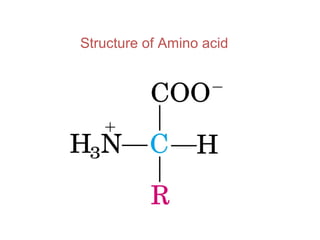
• All 20 amino acids have common structural features
• All amino acids have an amino group (-NH3
+
), a
carboxylate (-COO-
) group and a hydrogen bonded to the
same carbon atom (the -carbon)
• They differ from each other in their side chain called R
group.
• R groups vary in structure, size and electric charges and
influence the solubility of amino acids in water.
Structure of Amino acid
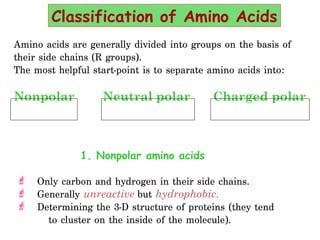
Amino acids are generally divided into groups on the basis of
their side chains (R groups). 
The most helpful start-point is to separate amino acids into:
Nonpolar Neutral polar Charged polar
1. Nonpolar amino acids
 Only carbon and hydrogen in their side chains. 
 Generally unreactive but hydrophobic.
 Determining the 3-D structure of proteins (they tend
to cluster on the inside of the molecule). 
Classification of Amino Acids
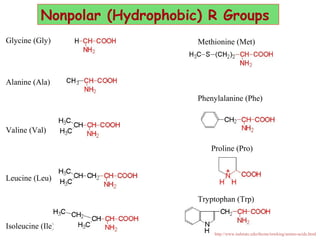
Glycine (Gly)
Alanine (Ala)
Valine (Val)
Leucine (Leu)
Isoleucine (Ile)
Nonpolar (Hydrophobic) R Groups
http://www.indstate.edu/thcme/mwking/amino-acids.html
Proline (Pro)
Tryptophan (Trp)
Phenylalanine (Phe)
Methionine (Met)
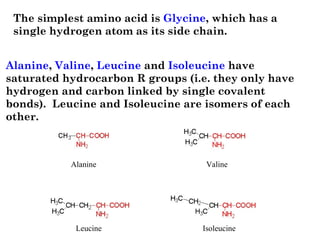
Alanine, Valine, Leucine and Isoleucine have
saturated hydrocarbon R groups (i.e. they only have
hydrogen and carbon linked by single covalent
bonds).  Leucine and Isoleucine are isomers of each
other.
The simplest amino acid is Glycine, which has a
single hydrogen atom as its side chain. 
Alanine Valine
Leucine Isoleucine
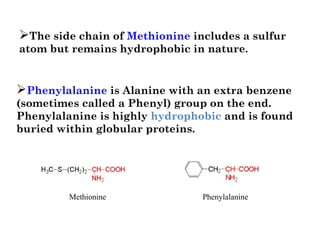
Phenylalanine is Alanine with an extra benzene
(sometimes called a Phenyl) group on the end. 
Phenylalanine is highly hydrophobic and is found
buried within globular proteins. 
Methionine Phenylalanine
The side chain of Methionine includes a sulfur
atom but remains hydrophobic in nature. 
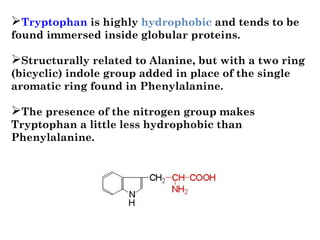
Tryptophan is highly hydrophobic and tends to be
found immersed inside globular proteins. 
Structurally related to Alanine, but with a two ring
(bicyclic) indole group added in place of the single
aromatic ring found in Phenylalanine. 
The presence of the nitrogen group makes
Tryptophan a little less hydrophobic than
Phenylalanine.
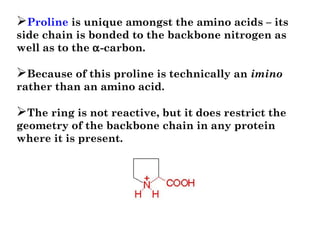
Proline is unique amongst the amino acids – its
side chain is bonded to the backbone nitrogen as
well as to the α-carbon. 
Because of this proline is technically an imino
rather than an amino acid. 
The ring is not reactive, but it does restrict the
geometry of the backbone chain in any protein
where it is present.  
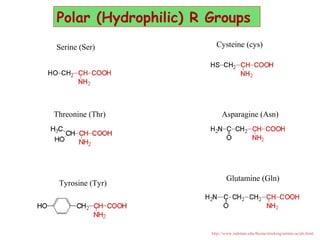
Polar (Hydrophilic) R Groups
Serine (Ser) Cysteine (cys)
Glutamine (Gln)
Asparagine (Asn)
Tyrosine (Tyr)
Threonine (Thr)
http://www.indstate.edu/thcme/mwking/amino-acids.html
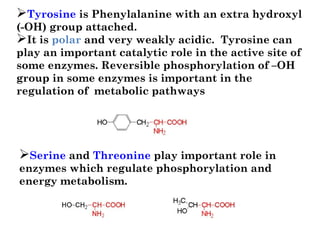
Tyrosine is Phenylalanine with an extra hydroxyl
(-OH) group attached. 
It is polar and very weakly acidic.  Tyrosine can
play an important catalytic role in the active site of
some enzymes. Reversible phosphorylation of –OH
group in some enzymes is important in the
regulation of  metabolic pathways
Serine and Threonine play important role in
enzymes which regulate phosphorylation and
energy metabolism.
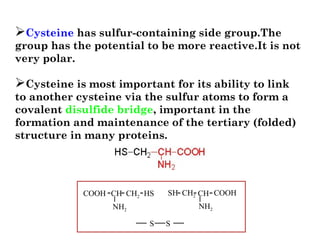
Cysteine has sulfur-containing side group.The
group has the potential to be more reactive.It is not
very polar.
Cysteine is most important for its ability to link
to another cysteine via the sulfur atoms to form a
covalent disulfide bridge, important in the
formation and maintenance of the tertiary (folded)
structure in many proteins.
SHHS CH2CH2CH CH COOHCOOH
NH2
NH2
- - - - - -
SS
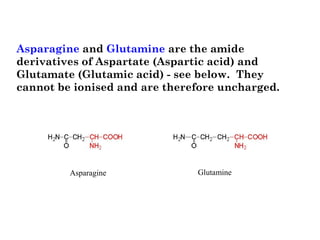
Asparagine and Glutamine are the amide
derivatives of Aspartate (Aspartic acid) and
Glutamate (Glutamic acid) - see below.  They
cannot be ionised and are therefore uncharged. 
Asparagine Glutamine
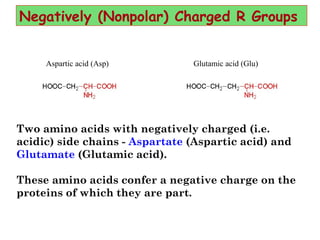
Aspartic acid (Asp) Glutamic acid (Glu)
Negatively (Nonpolar) Charged R Groups
Two amino acids with negatively charged (i.e.
acidic) side chains - Aspartate (Aspartic acid) and
Glutamate (Glutamic acid). 
These amino acids confer a negative charge on the
proteins of which they are part. 
Positively Charged R Groups
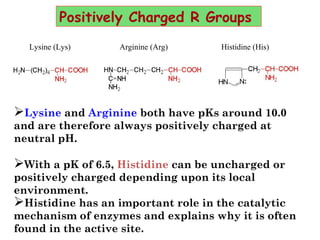
Lysine (Lys) Arginine (Arg) Histidine (His)
Lysine and Arginine both have pKs around 10.0
and are therefore always positively charged at
neutral pH. 
With a pK of 6.5, Histidine can be uncharged or
positively charged depending upon its local
environment. 
Histidine has an important role in the catalytic
mechanism of enzymes and explains why it is often
found in the active site.
Classification Based on Chemical
Constitution
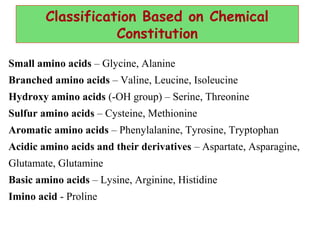
Small amino acids – Glycine, Alanine
Branched amino acids – Valine, Leucine, Isoleucine
Hydroxy amino acids (-OH group) – Serine, Threonine
Sulfur amino acids – Cysteine, Methionine
Aromatic amino acids – Phenylalanine, Tyrosine, Tryptophan
Acidic amino acids and their derivatives – Aspartate, Asparagine,
Glutamate, Glutamine
Basic amino acids – Lysine, Arginine, Histidine
Imino acid - Proline
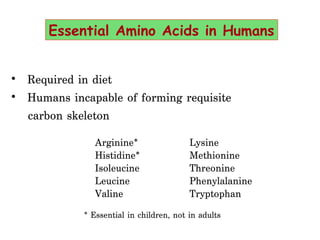
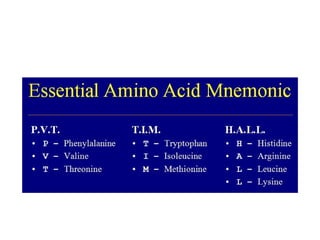
• Required in diet
• Humans incapable of forming requisite
carbon skeleton
Arginine*
Histidine*
Isoleucine
Leucine
Valine
Lysine
Methionine
Threonine
Phenylalanine
Tryptophan
* Essential in children, not in adults
Essential Amino Acids in Humans
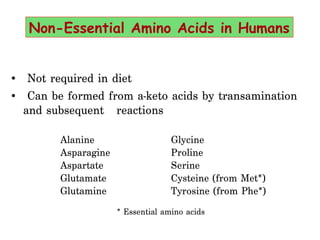
• Not required in diet
• Can be formed from a-keto acids by transamination
and subsequent reactions
Alanine
Asparagine
Aspartate
Glutamate
Glutamine
Glycine
Proline
Serine
Cysteine (from Met*)
Tyrosine (from Phe*)
* Essential amino acids
Non-Essential Amino Acids in Humans
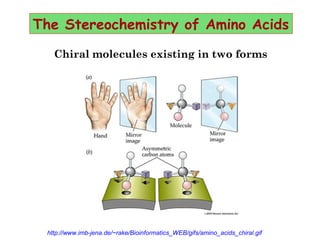
The Stereochemistry of Amino Acids
Chiral molecules existing in two forms
http://www.imb-jena.de/~rake/Bioinformatics_WEB/gifs/amino_acids_chiral.gif
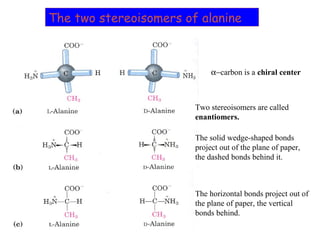
The two stereoisomers of alanine
α−carbon is a chiral center
Two stereoisomers are called
enantiomers.
The solid wedge-shaped bonds
project out of the plane of paper,
the dashed bonds behind it.
The horizontal bonds project out of
the plane of paper, the vertical
bonds behind.
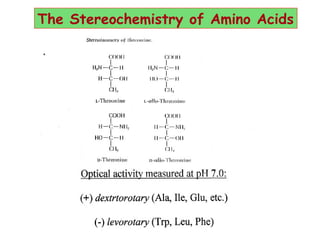
The Stereochemistry of Amino Acids
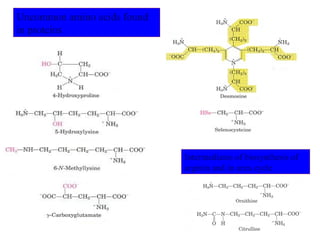
Uncommon amino acids found
in proteins
Intermediates of biosynthesis of
arginin and in urea cycle
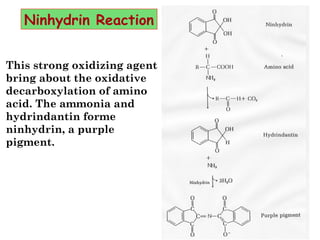
This strong oxidizing agent
bring about the oxidative
decarboxylation of amino
acid. The ammonia and
hydrindantin forme
ninhydrin, a purple
pigment.
Ninhydrin Reaction
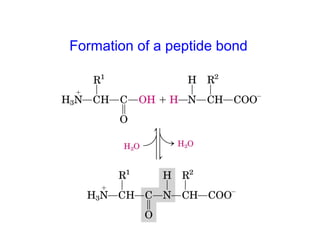
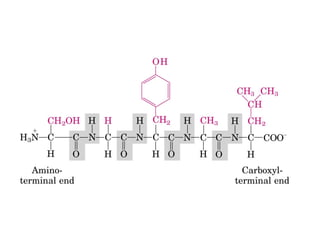
Formation of a peptide bond
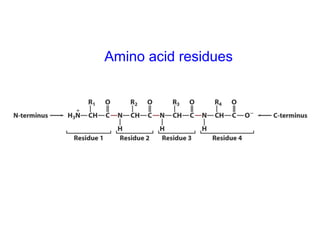
Amino acid residues
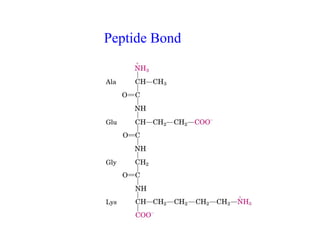
Peptide Bond
THANKS

Bc amino-acids

  • 1.
  • 2.
    Learning objectives • Tounderstand - the structural features of amino acids - the classifications of amino acids - the properties of amino acids
  • 3.
    Introduction • Amino acidsare the building block of protein • There are 20 naturally occurring amino acids
  • 4.
    Structural features ofAmino acids • All 20 amino acids have common structural features • All amino acids have an amino group (-NH3 + ), a carboxylate (-COO- ) group and a hydrogen bonded to the same carbon atom (the -carbon) • They differ from each other in their side chain called R group. • R groups vary in structure, size and electric charges and influence the solubility of amino acids in water.
  • 5.
  • 6.
    Amino acids aregenerally divided into groups on the basis of their side chains (R groups).  The most helpful start-point is to separate amino acids into: Nonpolar Neutral polar Charged polar 1. Nonpolar amino acids  Only carbon and hydrogen in their side chains.   Generally unreactive but hydrophobic.  Determining the 3-D structure of proteins (they tend to cluster on the inside of the molecule).  Classification of Amino Acids
  • 7.
    Glycine (Gly) Alanine (Ala) Valine(Val) Leucine (Leu) Isoleucine (Ile) Nonpolar (Hydrophobic) R Groups http://www.indstate.edu/thcme/mwking/amino-acids.html Proline (Pro) Tryptophan (Trp) Phenylalanine (Phe) Methionine (Met)
  • 8.
    Alanine, Valine, Leucineand Isoleucine have saturated hydrocarbon R groups (i.e. they only have hydrogen and carbon linked by single covalent bonds).  Leucine and Isoleucine are isomers of each other. The simplest amino acid is Glycine, which has a single hydrogen atom as its side chain.  Alanine Valine Leucine Isoleucine
  • 9.
    Phenylalanine is Alaninewith an extra benzene (sometimes called a Phenyl) group on the end.  Phenylalanine is highly hydrophobic and is found buried within globular proteins.  Methionine Phenylalanine The side chain of Methionine includes a sulfur atom but remains hydrophobic in nature. 
  • 10.
    Tryptophan is highlyhydrophobic and tends to be found immersed inside globular proteins.  Structurally related to Alanine, but with a two ring (bicyclic) indole group added in place of the single aromatic ring found in Phenylalanine.  The presence of the nitrogen group makes Tryptophan a little less hydrophobic than Phenylalanine.
  • 11.
    Proline is uniqueamongst the amino acids – its side chain is bonded to the backbone nitrogen as well as to the α-carbon.  Because of this proline is technically an imino rather than an amino acid.  The ring is not reactive, but it does restrict the geometry of the backbone chain in any protein where it is present.  
  • 12.
    Polar (Hydrophilic) RGroups Serine (Ser) Cysteine (cys) Glutamine (Gln) Asparagine (Asn) Tyrosine (Tyr) Threonine (Thr) http://www.indstate.edu/thcme/mwking/amino-acids.html
  • 13.
    Tyrosine is Phenylalaninewith an extra hydroxyl (-OH) group attached.  It is polar and very weakly acidic.  Tyrosine can play an important catalytic role in the active site of some enzymes. Reversible phosphorylation of –OH group in some enzymes is important in the regulation of  metabolic pathways Serine and Threonine play important role in enzymes which regulate phosphorylation and energy metabolism.
  • 14.
    Cysteine has sulfur-containingside group.The group has the potential to be more reactive.It is not very polar. Cysteine is most important for its ability to link to another cysteine via the sulfur atoms to form a covalent disulfide bridge, important in the formation and maintenance of the tertiary (folded) structure in many proteins. SHHS CH2CH2CH CH COOHCOOH NH2 NH2 - - - - - - SS
  • 15.
    Asparagine and Glutamineare the amide derivatives of Aspartate (Aspartic acid) and Glutamate (Glutamic acid) - see below.  They cannot be ionised and are therefore uncharged.  Asparagine Glutamine
  • 16.
    Aspartic acid (Asp)Glutamic acid (Glu) Negatively (Nonpolar) Charged R Groups Two amino acids with negatively charged (i.e. acidic) side chains - Aspartate (Aspartic acid) and Glutamate (Glutamic acid).  These amino acids confer a negative charge on the proteins of which they are part. 
  • 17.
    Positively Charged RGroups Lysine (Lys) Arginine (Arg) Histidine (His) Lysine and Arginine both have pKs around 10.0 and are therefore always positively charged at neutral pH.  With a pK of 6.5, Histidine can be uncharged or positively charged depending upon its local environment.  Histidine has an important role in the catalytic mechanism of enzymes and explains why it is often found in the active site.
  • 18.
    Classification Based onChemical Constitution Small amino acids – Glycine, Alanine Branched amino acids – Valine, Leucine, Isoleucine Hydroxy amino acids (-OH group) – Serine, Threonine Sulfur amino acids – Cysteine, Methionine Aromatic amino acids – Phenylalanine, Tyrosine, Tryptophan Acidic amino acids and their derivatives – Aspartate, Asparagine, Glutamate, Glutamine Basic amino acids – Lysine, Arginine, Histidine Imino acid - Proline
  • 19.
    • Required indiet • Humans incapable of forming requisite carbon skeleton Arginine* Histidine* Isoleucine Leucine Valine Lysine Methionine Threonine Phenylalanine Tryptophan * Essential in children, not in adults Essential Amino Acids in Humans
  • 21.
    • Not requiredin diet • Can be formed from a-keto acids by transamination and subsequent reactions Alanine Asparagine Aspartate Glutamate Glutamine Glycine Proline Serine Cysteine (from Met*) Tyrosine (from Phe*) * Essential amino acids Non-Essential Amino Acids in Humans
  • 22.
    The Stereochemistry ofAmino Acids Chiral molecules existing in two forms http://www.imb-jena.de/~rake/Bioinformatics_WEB/gifs/amino_acids_chiral.gif
  • 23.
    The two stereoisomersof alanine α−carbon is a chiral center Two stereoisomers are called enantiomers. The solid wedge-shaped bonds project out of the plane of paper, the dashed bonds behind it. The horizontal bonds project out of the plane of paper, the vertical bonds behind.
  • 24.
  • 25.
    Uncommon amino acidsfound in proteins Intermediates of biosynthesis of arginin and in urea cycle
  • 26.
    This strong oxidizingagent bring about the oxidative decarboxylation of amino acid. The ammonia and hydrindantin forme ninhydrin, a purple pigment. Ninhydrin Reaction
  • 27.
    Formation of apeptide bond
  • 28.
  • 30.
  • 32.