AMINO ACIDS
Structural Feature of Proteins
Proteins functionally diverse molecules in living systems
such as:
 Enzymes and polypeptide hormones.
 Myosin, a contractile protein of muscle.
 Bone, consisted from the protein collagen.
 Blood proteins, such as hemoglobin and plasma
albumin and immunoglobulins.
All share the common structural feature of being linear
polymers of amino acids
Amino acids are building blocks of proteins.
Proteins are composed of 20 different amino acid (encoded by standard
genetic code, construct proteins in all species ).
Their molecules containing both amino and carboxyl groups attached to
the same α-carbon (L- α -amino acids).
Their chemical structure influences three dimensional structure of
proteins.
They are important intermediates in metabolism (porphyrins, purines,
pyrimidines, creatine, urea etc).
They can have hormonal and catalytic function.
Several genetic disorders are caused due to amino acid metabolism
errors. (aminoaciduria - presence of amino acids in urine)
Structure of the amino acids
Each amino acid has:
1. A carboxyl group (-COO-
) .
2. An amino group (-NH3
+
) .
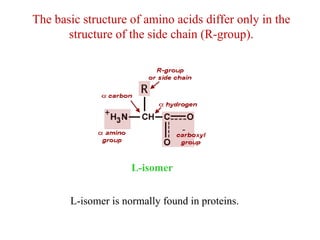
3. Side chain ("R-group") bonded to the α-carbon atom.
 These carboxyl and amino groups are combined in
peptide linkage.
 R groups vary in structure, size and electric charges and
influence the solubility of amino acids in water.
L-isomer is normally found in proteins.
The basic structure of amino acids differ only in the
structure of the side chain (R-group).
L-isomer
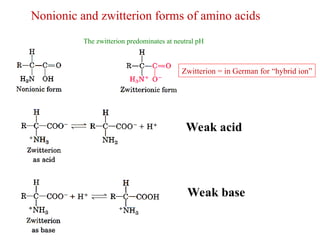
Nonionic and zwitterion forms of amino acids
The zwitterion predominates at neutral pH
Weak acid
Weak base
Zwitterion = in German for “hybrid ion”
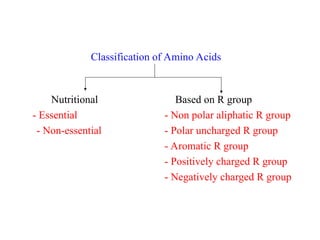
Classification of Amino Acids
Nutritional Based on R group
- Essential - Non polar aliphatic R group
- Non-essential - Polar uncharged R group
- Aromatic R group
- Positively charged R group
- Negatively charged R group
Only carbon and hydrogen in their side chains.
Generally unreactive but hydrophobic.
Determining the 3-D structure of proteins (they tend to
cluster on the inside of the molecule).
The hydrocarbon R group in this class of amino acids is
nonpolar and hydrophobic.
Glycine has the simplest amino acid structure.
The bulky side chain of valine, isoleucine and leucine are
important in promoting hydrophobic interactions within
protein structures.
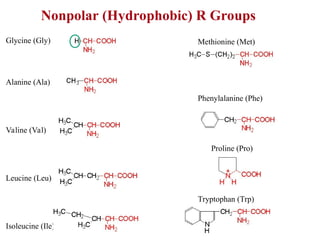
Non-Polar , aliphatic aminoacids
Glycine (Gly)
Alanine (Ala)
Valine (Val)
Leucine (Leu)
Isoleucine (Ile))
Nonpolar (Hydrophobic) R Groups
Proline (Pro)
Tryptophan (Trp)
Phenylalanine (Phe)
Methionine (Met)
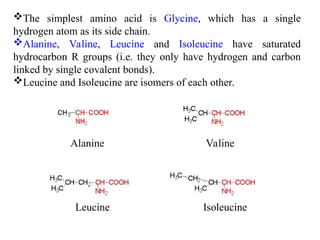
The simplest amino acid is Glycine, which has a single
hydrogen atom as its side chain.
Alanine, Valine, Leucine and Isoleucine have saturated
hydrocarbon R groups (i.e. they only have hydrogen and carbon
linked by single covalent bonds).
Leucine and Isoleucine are isomers of each other.
Alanine Valine
Leucine Isoleucine
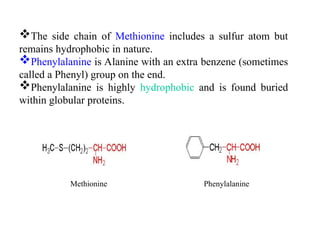
Methionine Phenylalanine
The side chain of Methionine includes a sulfur atom but
remains hydrophobic in nature.
Phenylalanine is Alanine with an extra benzene (sometimes
called a Phenyl) group on the end.
Phenylalanine is highly hydrophobic and is found buried
within globular proteins.
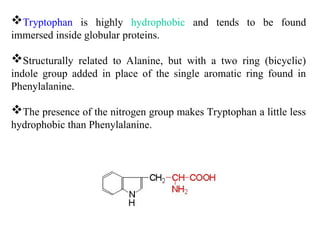
Tryptophan is highly hydrophobic and tends to be found
immersed inside globular proteins.
Structurally related to Alanine, but with a two ring (bicyclic)
indole group added in place of the single aromatic ring found in
Phenylalanine.
The presence of the nitrogen group makes Tryptophan a little less
hydrophobic than Phenylalanine.
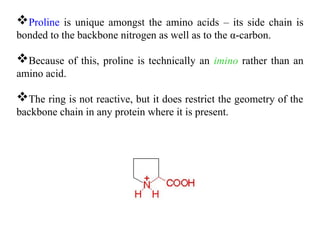
Proline is unique amongst the amino acids – its side chain is
bonded to the backbone nitrogen as well as to the α-carbon.
Because of this, proline is technically an imino rather than an
amino acid.
The ring is not reactive, but it does restrict the geometry of the
backbone chain in any protein where it is present.
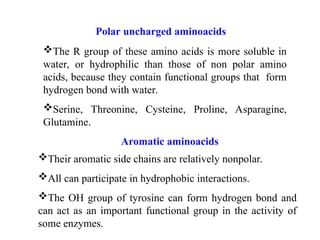
The R group of these amino acids is more soluble in
water, or hydrophilic than those of non polar amino
acids, because they contain functional groups that form
hydrogen bond with water.
Serine, Threonine, Cysteine, Proline, Asparagine,
Glutamine.
Polar uncharged aminoacids
Their aromatic side chains are relatively nonpolar.
All can participate in hydrophobic interactions.
The OH group of tyrosine can form hydrogen bond and
can act as an important functional group in the activity of
some enzymes.
Aromatic aminoacids
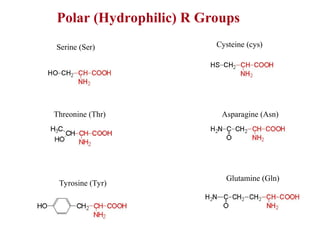
Polar (Hydrophilic) R Groups
Serine (Ser) Cysteine (cys)
Glutamine (Gln)
Asparagine (Asn)
Tyrosine (Tyr)
Threonine (Thr)
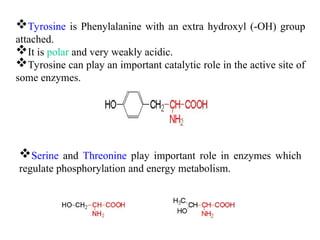
Tyrosine is Phenylalanine with an extra hydroxyl (-OH) group
attached.
It is polar and very weakly acidic.
Tyrosine can play an important catalytic role in the active site of
some enzymes.
Serine and Threonine play important role in enzymes which
regulate phosphorylation and energy metabolism.
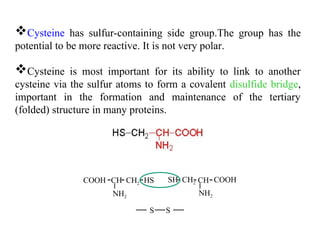
Cysteine has sulfur-containing side group.The group has the
potential to be more reactive. It is not very polar.
Cysteine is most important for its ability to link to another
cysteine via the sulfur atoms to form a covalent disulfide bridge,
important in the formation and maintenance of the tertiary
(folded) structure in many proteins.
SH
HS CH2
CH2
CH CH COOH
COOH
NH2
NH2
- - - - - -
S
S
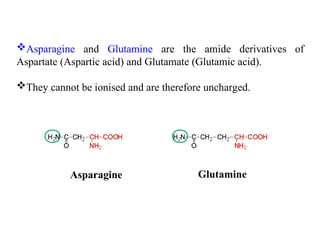
Asparagine and Glutamine are the amide derivatives of
Aspartate (Aspartic acid) and Glutamate (Glutamic acid).
They cannot be ionised and are therefore uncharged.
Asparagine Glutamine
Aspartic acid (Asp) Glutamic acid (Glu)
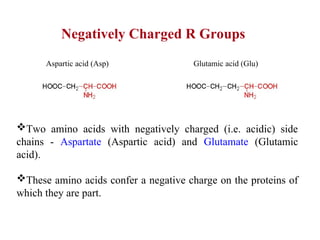
Negatively Charged R Groups
Two amino acids with negatively charged (i.e. acidic) side
chains - Aspartate (Aspartic acid) and Glutamate (Glutamic
acid).
These amino acids confer a negative charge on the proteins of
which they are part.
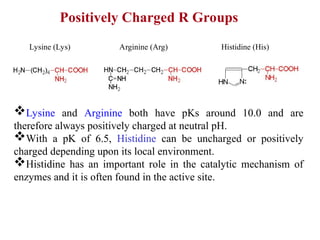
Positively Charged R Groups
Lysine (Lys) Arginine (Arg) Histidine (His)
Lysine and Arginine both have pKs around 10.0 and are
therefore always positively charged at neutral pH.
With a pK of 6.5, Histidine can be uncharged or positively
charged depending upon its local environment.
Histidine has an important role in the catalytic mechanism of
enzymes and it is often found in the active site.
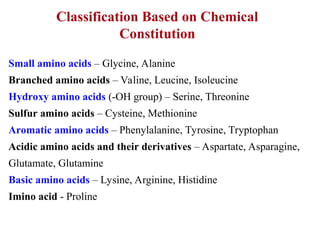
Classification Based on Chemical
Constitution
Small amino acids – Glycine, Alanine
Branched amino acids – Valine, Leucine, Isoleucine
Hydroxy amino acids (-OH group) – Serine, Threonine
Sulfur amino acids – Cysteine, Methionine
Aromatic amino acids – Phenylalanine, Tyrosine, Tryptophan
Acidic amino acids and their derivatives – Aspartate, Asparagine,
Glutamate, Glutamine
Basic amino acids – Lysine, Arginine, Histidine
Imino acid - Proline
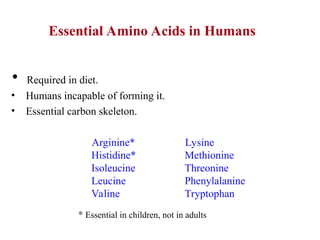
• Required in diet.
• Humans incapable of forming it.
• Essential carbon skeleton.
Arginine*
Histidine*
Isoleucine
Leucine
Valine
Lysine
Methionine
Threonine
Phenylalanine
Tryptophan
* Essential in children, not in adults
Essential Amino Acids in Humans
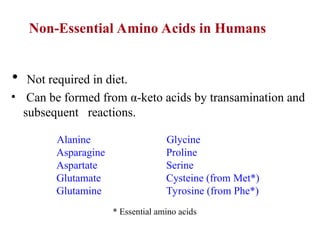
• Not required in diet.
• Can be formed from α-keto acids by transamination and
subsequent reactions.
Alanine
Asparagine
Aspartate
Glutamate
Glutamine
Glycine
Proline
Serine
Cysteine (from Met*)
Tyrosine (from Phe*)
* Essential amino acids
Non-Essential Amino Acids in Humans
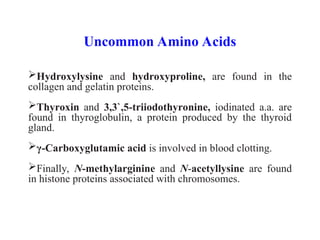
Uncommon Amino Acids
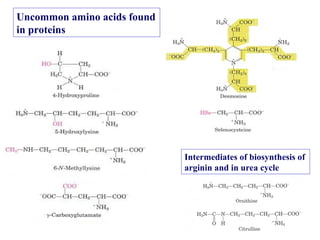
Hydroxylysine and hydroxyproline, are found in the
collagen and gelatin proteins.
Thyroxin and 3,3`,5-triiodothyronine, iodinated a.a. are
found in thyroglobulin, a protein produced by the thyroid
gland.
γ-Carboxyglutamic acid is involved in blood clotting.
Finally, N-methylarginine and N-acetyllysine are found
in histone proteins associated with chromosomes.
Uncommon amino acids found
in proteins
Intermediates of biosynthesis of
arginin and in urea cycle
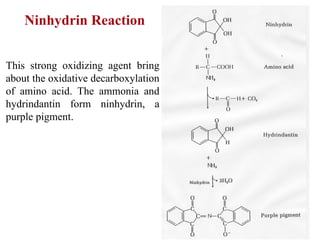
This strong oxidizing agent bring
about the oxidative decarboxylation
of amino acid. The ammonia and
hydrindantin form ninhydrin, a
purple pigment.
Ninhydrin Reaction
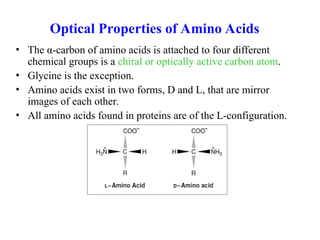
Optical Properties of Amino Acids
• The α-carbon of amino acids is attached to four different
chemical groups is a chiral or optically active carbon atom.
• Glycine is the exception.
• Amino acids exist in two forms, D and L, that are mirror
images of each other.
• All amino acids found in proteins are of the L-configuration.
Acidic and Basic properties of amino acids
 Amino acids in aqueous solution contain weakly acidic α-
carboxyl groups and weakly basic α-amino groups.
 Each of the acidic and basic amino acids contains an
ionizable group in its side chain.
 Thus, both free and some of the combined amino acids in
peptide linkages can act as buffers.
 The concentration of a weak acid (HA) and its conjugate base
(A-
) is described by the Henderson-Hasselbalch equation.
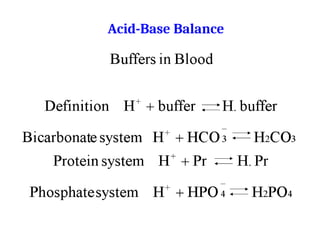
Acid-Base Balance
HENDERSON HASSELBALCH EQUATION
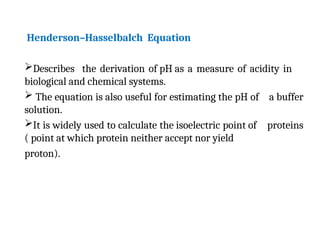
Henderson–Hasselbalch Equation
Describes the derivation of pH as a measure of acidity in
biological and chemical systems.
 The equation is also useful for estimating the pH of a buffer
solution.
It is widely used to calculate the isoelectric point of proteins
( point at which protein neither accept nor yield
proton).
The Henderson hasselbalch equation for acid is :-
pH = pKa + log [ Aˉ ]
[HA]
Here, pKa= -log(Ka)
where Ka is the acid dissociation constant, that is
pKa= -log [H3O+
][A-
]
[HA]
for the non-specific Brønsted acid-base reaction:
HA + H20 A-
+ H3O+
( Acid ) ( Conjugate base )
The Henderson Hasselbalch Equation for base is :
pOH = pKb + log [ BH+
]
-*[B]
where BH+
denotes the conjugate acid of the corresponding
base B.
B + H2O+
BH + OH-
(Base ) (Conjugate acid)
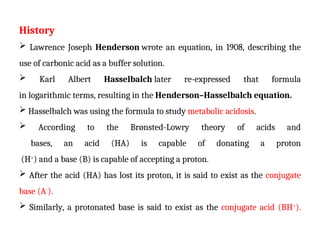
History
 Lawrence Joseph Henderson wrote an equation, in 1908, describing the
use of carbonic acid as a buffer solution.
 Karl Albert Hasselbalch later re-expressed that formula
in logarithmic terms, resulting in the Henderson–Hasselbalch equation.
 Hasselbalch was using the formula to study metabolic acidosis.
 According to the Brønsted-Lowry theory of acids and
bases, an acid (HA) is capable of donating a proton
(H+
) and a base (B) is capable of accepting a proton.
 After the acid (HA) has lost its proton, it is said to exist as the conjugate
base (A-
).
 Similarly, a protonated base is said to exist as the conjugate acid (BH+
).
The dissociation of an acid can be described by an
equilibrium expression
HA + H2O H3O+
+ A-
Consider the case of acetic acid (CH3COOH) and acetate anion
.
(CH3COO-
): CH3COOH + H2O CH3COO-
+ H3O+
Acetate is the conjugate base of acetic acid. Acetic acid and
acetate are a conjugate acid/base pair. We can describe this
relationship with an equilibrium constant:
Ka = [H3O+
][A-
]
[HA]
Taking the negative log of both sides of the equation gives
-logKa = -log [H3O+
][A-
]
[HA]
or, -logKa = -log [H3O+
] + (-log [A-
] )
[HA]
By definition,
pKa = -logKa and pH = -log[H3O+], so
pka=pH – log [A-]
[HA]
This equation can then be rearranged to give the
Henderson-Hasselbalch equation:
pH = pKa + log [A-] = pKa + log [conjugate base]
[HA] [acid]
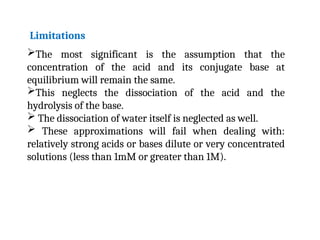
The most significant is the assumption that the
concentration of the acid and its conjugate base at
equilibrium will remain the same.
This neglects the dissociation of the acid and the
hydrolysis of the base.
 The dissociation of water itself is neglected as well.
 These approximations will fail when dealing with:
relatively strong acids or bases dilute or very concentrated
solutions (less than 1mM or greater than 1M).
Limitations
Properties of aminoacids
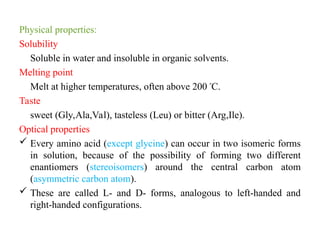
Physical properties:
Solubility
Soluble in water and insoluble in organic solvents.
Melting point
Melt at higher temperatures, often above 200 º
C.
Taste
sweet (Gly,Ala,Val), tasteless (Leu) or bitter (Arg,Ile).
Optical properties
 Every amino acid (except glycine) can occur in two isomeric forms
in solution, because of the possibility of forming two different
enantiomers (stereoisomers) around the central carbon atom
(asymmetric carbon atom).
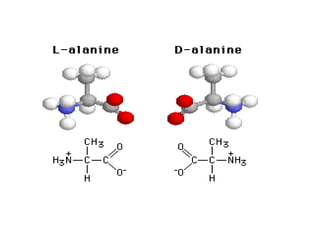
 These are called L- and D- forms, analogous to left-handed and
right-handed configurations.
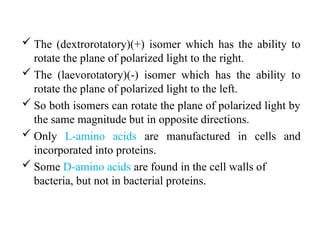
 The (dextrorotatory)(+) isomer which has the ability to
rotate the plane of polarized light to the right.
 The (laevorotatory)(-) isomer which has the ability to
rotate the plane of polarized light to the left.
 So both isomers can rotate the plane of polarized light by
the same magnitude but in opposite directions.
 Only L-amino acids are manufactured in cells and
incorporated into proteins.
 Some D-amino acids are found in the cell walls of
bacteria, but not in bacterial proteins.
All amino acids contain at least two ionizable groups, the
α-amino group and the α-carboxylic group.
 Some contain an additional acidic or basic group in their
side chain, which are responsible for the amino acids- acid-
base behaviour.
As a result of their ionizability, the following equilibrium
reaction can be written;
R-COOH R-COO-
+ H+
R-NH2 R-NH3
+
An amino acid can have several forms depending on the
pH of the system.
Amphoteric nature (Acid-base behaviour)
 At low pH or acid conditions, the amino group (-NH2)
is protonated by the addition of a proton (H+
) from the
acid.
 At high pH or basic conditions, the carboyxlic acid (-
COOH) is deprotonated by the removal of a proton.
 They can donate or accept a proton. Hence, amino acids
are amphoteric (or amphiprotic); they can react either as an
acid or as a base.
There is an internal transfer of a hydrogen ion from the -
COOH group to the -NH2 group to leave an ion with both a
negative charge and a positive charge.
A zwitterion is a compound with no overall electrical charge,
but which contains separate parts which are positively and
negatively charged.
All neutral amino acids are present in the Zwitter ions form
at physiological pH (around 7.4), the carboxyl group will be
unprotonated and the amino group will be protonated.
At low pH, aminoacid is positively charged (cation) while at
high pH, it is negatively charged (anion).
Eg: leucine at pH 6.0, carries both positive and negative
charges-exists as zwitter ion.
Zwitter ions
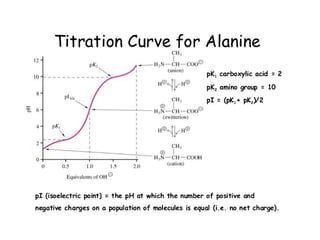
Isoelectric point (pI)
The pH at which essentially all amino acid is in the
zwitterions form, with very low and equal concentrations of the
positive and negative ions.
The amino acid does not migrate in an electric field, as they
carries no net charge and thus, the molecule is electrically
neutral.
In more acidic media (pH<pI), the concentration of positive
ions increases while the concentration of the zwitterion
decreases.
In a more basic media (pH>pI), the concentration of negative
ions increases while the concentration of the zwitterion
decreases.
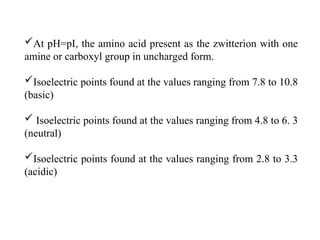
At pH=pI, the amino acid present as the zwitterion with one
amine or carboxyl group in uncharged form.
Isoelectric points found at the values ranging from 7.8 to 10.8
(basic)
 Isoelectric points found at the values ranging from 4.8 to 6. 3
(neutral)
Isoelectric points found at the values ranging from 2.8 to 3.3
(acidic)
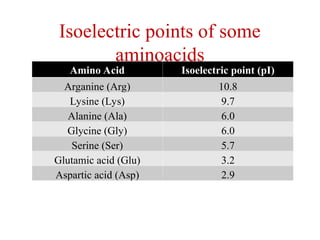
Isoelectric points of some
aminoacids
Amino Acid Isoelectric point (pI)
Arganine (Arg) 10.8
Lysine (Lys) 9.7
Alanine (Ala) 6.0
Glycine (Gly) 6.0
Serine (Ser) 5.7
Glutamic acid (Glu) 3.2
Aspartic acid (Asp) 2.9
Chemical properties
The general reactions of amino acids are mostly due to the presence of
two functional groups namely carboxyl (-COOH) group and amino (-
NH2) group.
Reactions due to –COOH group
1. Aminoacids form salts with bases (-COONa) and esters with alcohols
(COOR’).
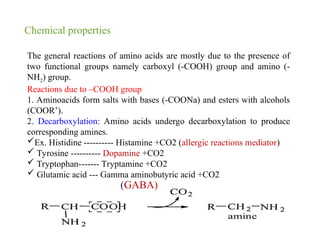
2. Decarboxylation: Amino acids undergo decarboxylation to produce
corresponding amines.
Ex. Histidine ---------- Histamine +CO2 (allergic reactions mediator)
 Tyrosine ---------- Dopamine +CO2
 Tryptophan------- Tryptamine +CO2
 Glutamic acid --- Gamma aminobutyric acid +CO2
(GABA)
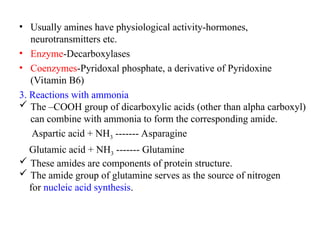
• Usually amines have physiological activity-hormones,
neurotransmitters etc.
• Enzyme-Decarboxylases
• Coenzymes-Pyridoxal phosphate, a derivative of Pyridoxine
(Vitamin B6)
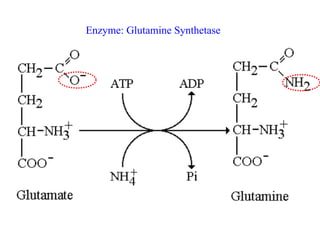
3. Reactions with ammonia
 The –COOH group of dicarboxylic acids (other than alpha carboxyl)
can combine with ammonia to form the corresponding amide.
Aspartic acid + NH3 ------- Asparagine
Glutamic acid + NH3 ------- Glutamine
 These amides are components of protein structure.
 The amide group of glutamine serves as the source of nitrogen
for nucleic acid synthesis.
Enzyme: Glutamine Synthetase
Reactions due to amino group
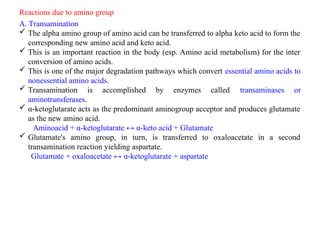
A. Transamination
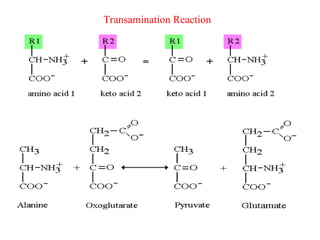
 The alpha amino group of amino acid can be transferred to alpha keto acid to form the
corresponding new amino acid and keto acid.
 This is an important reaction in the body (esp. Amino acid metabolism) for the inter
conversion of amino acids.
 This is one of the major degradation pathways which convert essential amino acids to
nonessential amino acids.
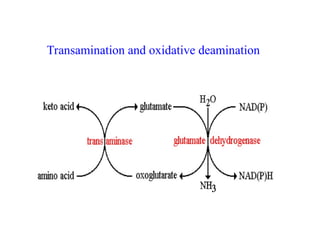
 Transamination is accomplished by enzymes called transaminases or
aminotransferases.
 α-ketoglutarate acts as the predominant aminogroup acceptor and produces glutamate
as the new amino acid.
Aminoacid + α-ketoglutarate ↔ α-keto acid + Glutamate
 Glutamate's amino group, in turn, is transferred to oxaloacetate in a second
transamination reaction yielding aspartate.
Glutamate + oxaloacetate ↔ α-ketoglutarate + aspartate
Transamination Reaction
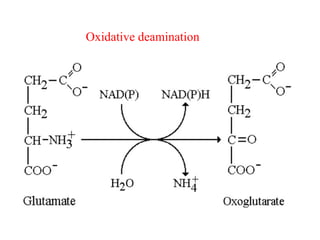
B. Oxidative deamination
 It is a form of deamination that generates oxoacids in the liver.
 This takes place in liver and kidney.
 The purpose of oxidative deamination is to provide ammonia for urea
synthesis and alpha-keto acids for a variety of reaction, including energy
generation.
 The alpha amino group is removed from the amino acid to form the
corresponding keto acid and ammonia.
 In the body, Glutamate is the only amino acid that undergoes rapid
oxidative deamination by using glutamate dehydrogenase, which
uses NAD or NADP as a coenzyme.
 This process leads to two distinct toxic compounds:
• Hydrogen Peroxide
• Ammonia.
Oxidative deamination
Transamination and oxidative deamination
• Reactions due to side chains
A. Ester formation by -OH group
 The hydroxyl amino acids can form esters with phosphoric acid.
 In this manner, the Serine and Threonine residues of proteins are
involved in the formation of phosphoproteins.
 Similarly these hydroxyl groups can form O-glycosidic bonds
with carbohydrate residues to form glycoproteins.
B. Reaction of the amide group
 The amide groups of Glutamine and Asparagine can form N-
glycosidic bonds with carbohydrate residues to form glycoproteins.
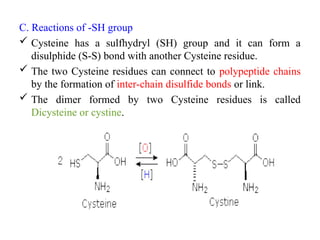
C. Reactions of -SH group
 Cysteine has a sulfhydryl (SH) group and it can form a
disulphide (S-S) bond with another Cysteine residue.
 The two Cysteine residues can connect to polypeptide chains
by the formation of inter-chain disulfide bonds or link.
 The dimer formed by two Cysteine residues is called
Dicysteine or cystine.
Peptide bond
 Amino acids are held together in a protein by covalent bonds or
linkages.
 These bonds are strong and serve as the cementing material between
the individual amino acids.
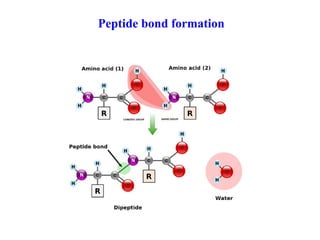
 Formation: Alpha carboxyl group of one amino acid reacts with
alpha amino group of another amino acid to form a peptide bond or
CO-NH bridge.
 Proteins are made by polymerization of amino acids through peptide
bonds.
 Two amino acids combined to form dipeptide. Three amino acids
form tripeptide. Four will make a tetrapeptide.
 Peptides containing more than 10 amino acids (decapeptide) are
referred as polypeptides.
 Big polypeptide chains containing more than 50 amino acids are
called proteins.
Peptide bond formation
 Acid hydrolysis (hydrochloric acid at higher temperature) of
peptides bonds will break the proteins into amino acids.
 But hydrochloric acid at body temperature will not break the
peptide bonds.
 Thus in the stomach, HCL alone will not be able to digest
proteins; it needs enzymes.
Biologically active peptides
Proteins can also be a good source of peptides with different
activities.
Such peptides are defined as biologically active (bioactive
peptides).
Bioactive peptides interact with proper body receptors and
such an effect can be beneficial or not.
Biopeptides as components of food have become an
interesting issue for scientific research.
Many of bioactive peptides are found in milk and dairy
products, plant, animal and microbial proteins.
Such peptides are known as the molecules involved in blood
pressure reduction, prolyl endopeptidase inhibition, and
immune system stimulation.
Such peptides are known as the molecules involved in blood
pressure reduction, prolyl endopeptidase inhibition, and
immune system stimulation.
The application of peptides for therapeutic purposes
especially in the field of the treatment of cancer, infections,
immunological system disorders, cardiovascular disorders is at
present the focus of interest of many research group.
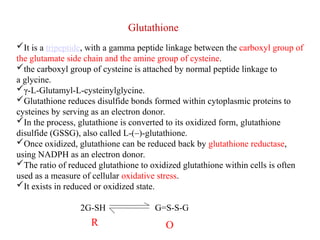
Glutathione
It is a tripeptide, with a gamma peptide linkage between the carboxyl group of
the glutamate side chain and the amine group of cysteine.
the carboxyl group of cysteine is attached by normal peptide linkage to
a glycine.
γ-L-Glutamyl-L-cysteinylglycine.
Glutathione reduces disulfide bonds formed within cytoplasmic proteins to
cysteines by serving as an electron donor.
In the process, glutathione is converted to its oxidized form, glutathione
disulfide (GSSG), also called L-(–)-glutathione.
Once oxidized, glutathione can be reduced back by glutathione reductase,
using NADPH as an electron donor.
The ratio of reduced glutathione to oxidized glutathione within cells is often
used as a measure of cellular oxidative stress.
It exists in reduced or oxidized state.
2G-SH G=S-S-G
R O
Glutathione has multiple functions:
It maintains levels of reduced glutaredoxin and glutathione peroxidase.
Glutathione (GSH) participates in leukotriene synthesis and is a cofactor for the
enzyme glutathione peroxidase.
It is one of the major endogenous antioxidant produced by the cells,
participating directly in the neutralization of free radicals and reactive oxygen
compounds.
It is used in metabolic and biochemical reactions such as DNA synthesis and
repair, protein synthesis, prostaglandin synthesis, amino acid transport, and
enzyme activation.
Thus, every system in the body can be affected by the state of the glutathione
system, especially the immune system, the nervous system, the gastrointestinal
system, and the lungs.
It has a vital function in iron metabolism.
It has roles in progression of the cell cycle, including cell death.
GSH levels regulate redox changes to nuclear proteins necessary for the
initiation of cell differentiation.
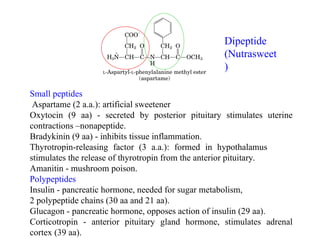
Small peptides
Aspartame (2 a.a.): artificial sweetener
Oxytocin (9 aa) - secreted by posterior pituitary stimulates uterine
contractions –nonapeptide.
Bradykinin (9 aa) - inhibits tissue inflammation.
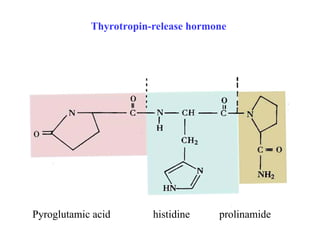
Thyrotropin-releasing factor (3 a.a.): formed in hypothalamus
stimulates the release of thyrotropin from the anterior pituitary.
Amanitin - mushroom poison.
Polypeptides
Insulin - pancreatic hormone, needed for sugar metabolism,
2 polypeptide chains (30 aa and 21 aa).
Glucagon - pancreatic hormone, opposes action of insulin (29 aa).
Corticotropin - anterior pituitary gland hormone, stimulates adrenal
cortex (39 aa).
Dipeptide
(Nutrasweet
)
Thyrotropin-release hormone
Pyroglutamic acid histidine prolinamide
• Peptide hormones secreted from peptidergic neurons
– Somatostatin-endocrine system
– kallidin-vasodilators-produced from plasma proteins by
snake venom enzymes.
– Thyrotropin-release hormone, Antidiuretic hormone
(vasopressin)-posterior pituitary gland-increases blood
pressure, stimulates kidney.
– Gastro-intestinal hormones-gastrin, secretin (peptides)
• Neuropeptides responsible for signal transduction.
– Enkephalin, Endorphin, Dynorphin, Substance P,
Neuropeptide Y
Peptides
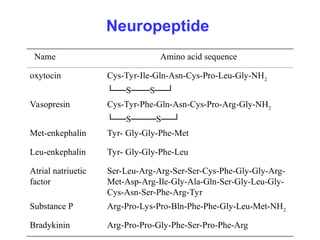
Neuropeptide
Name Amino acid sequence
oxytocin Cys-Tyr-Ile-Gln-Asn-Cys-Pro-Leu-Gly-NH2
└──S───S──┘
Vasopresin Cys-Tyr-Phe-Gln-Asn-Cys-Pro-Arg-Gly-NH2
└──S────S──┘
Met-enkephalin Tyr- Gly-Gly-Phe-Met
Leu-enkephalin Tyr- Gly-Gly-Phe-Leu
Atrial natriuetic
factor
Ser-Leu-Arg-Arg-Ser-Ser-Cys-Phe-Gly-Gly-Arg-
Met-Asp-Arg-Ile-Gly-Ala-Gln-Ser-Gly-Leu-Gly-
Cys-Asn-Ser-Phe-Arg-Tyr
Substance P Arg-Pro-Lys-Pro-Bln-Phe-Phe-Gly-Leu-Met-NH2
Bradykinin Arg-Pro-Pro-Gly-Phe-Ser-Pro-Phe-Arg
• Proteins are the most structurally complex molecules known.
– Each type of protein has a complex three-dimensional
shape or conformation.
• All protein polymers are constructed from the same set of 20
monomers, called amino acids.
• Polymers of proteins are called polypeptides.
• A protein consists of one or more polypeptides folded and
coiled into a specific conformation.
• The peptide bond allows for rotation around it and therefore
the protein can fold and orient the R groups in favorable
positions.
• Weak non-covalent interactions will hold the protein in its
functional shape – these are weak and will take many to hold
the shape.
Proteins
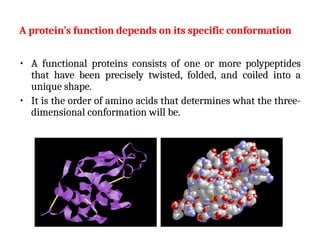
A protein’s function depends on its specific conformation
• A functional proteins consists of one or more polypeptides
that have been precisely twisted, folded, and coiled into a
unique shape.
• It is the order of amino acids that determines what the three-
dimensional conformation will be.
• A protein’s specific conformation determines its function.
• In almost every case, the function depends on its ability to
recognize and bind to some other molecule.
– For example, antibodies bind to particular foreign substances
that fit their binding sites.
– Enzyme recognize and bind to specific substrates, facilitating
a chemical reaction.
– Neurotransmitters pass signals from one cell to another by
binding to receptor sites on proteins in the membrane of the
receiving cell.
• A protein’s conformation can change in response to the
physical and chemical conditions.
• Changes in pH, salt concentration, temperature, or other
factors can unravel or denature a protein.
– These forces disrupt the hydrogen bonds, ionic bonds, and
disulfide bridges that maintain the protein’s shape.
• Proteins shape is determined by the sequence of the amino
acids
• The final shape is called the conformation and has the lowest
free energy possible.
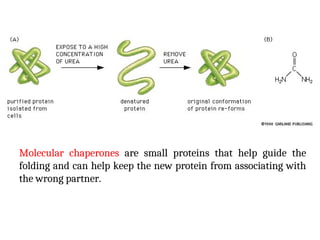
• Denaturation is the process of unfolding the protein
– Can be down with heat, pH or chemical compounds
– In the chemical compound, can remove and have the
protein renature or refold.
• Some proteins can return to their functional shape after
denaturation, but others cannot, especially in the crowded
environment of the cell.
– Usually denaturation is permanent.
Molecular chaperones are small proteins that help guide the
folding and can help keep the new protein from associating with
the wrong partner.
Favorable Interactions in Proteins
• Hydrophobic effect
– Release of water molecules from the structured solvation layer
around the molecule as protein folds increases the net entropy
• Hydrogen bonds
– Interaction of N-H and C=O of the peptide bond leads to local
regular structures such as -helices and -sheets
• London dispersion
– Medium-range weak attraction between all atoms contributes
significantly to the stability in the interior of the protein.
• Electrostatic interactions
– Long-range strong interactions between permanently charged
groups.
– Salt-bridges, esp. buried in the hydrophobic environment
strongly stabilize the protein
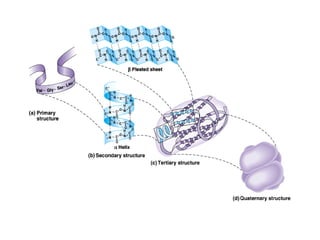
Levels of Protein Structure
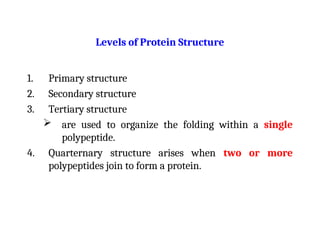
1. Primary structure
2. Secondary structure
3. Tertiary structure
 are used to organize the folding within a single
polypeptide.
4. Quarternary structure arises when two or more
polypeptides join to form a protein.
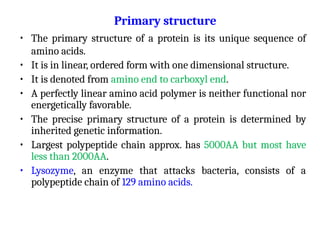
• The primary structure of a protein is its unique sequence of
amino acids.
• It is in linear, ordered form with one dimensional structure.
• It is denoted from amino end to carboxyl end.
• A perfectly linear amino acid polymer is neither functional nor
energetically favorable.
• The precise primary structure of a protein is determined by
inherited genetic information.
• Largest polypeptide chain approx. has 5000AA but most have
less than 2000AA.
• Lysozyme, an enzyme that attacks bacteria, consists of a
polypeptide chain of 129 amino acids.
Primary structure
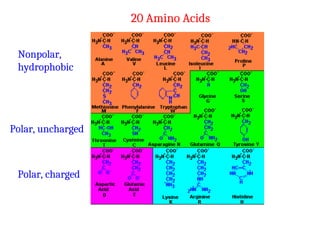
20 Amino Acids
Nonpolar,
hydrophobic
Polar, uncharged
Polar, charged
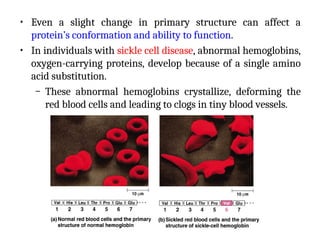
• Even a slight change in primary structure can affect a
protein’s conformation and ability to function.
• In individuals with sickle cell disease, abnormal hemoglobins,
oxygen-carrying proteins, develop because of a single amino
acid substitution.
– These abnormal hemoglobins crystallize, deforming the
red blood cells and leading to clogs in tiny blood vessels.
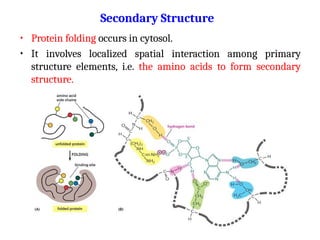
• Protein folding occurs in cytosol.
• It involves localized spatial interaction among primary
structure elements, i.e. the amino acids to form secondary
structure.
Secondary Structure
•The secondary structure of a protein results from
interactions at regular intervals along the polypeptide
backbone.
•It is a non-linear form with 3 –dimensional structure and
stabilized by hydrogen bonding in the peptide chain backbone.
•H-bonds form between 1) atoms involved in the peptide bond;
2) peptide bond atoms and R groups; 3) R groups.
•Typical shapes that develop from secondary structure
are coils (an alpha helix) or folds (beta pleated sheets).
2 regular folding patterns have been identified – formed
between the bonds of the peptide backbone.
-helix – protein turns like a spiral – fibrous proteins (hair,
nails, horns)
-sheet – protein folds back on itself as in a ribbon –globular
protein.
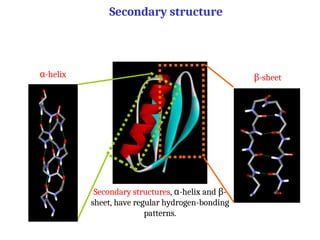
Secondary structure
-helix
α -sheet
β
Secondary structures, -helix and -
α β
sheet, have regular hydrogen-bonding
patterns.
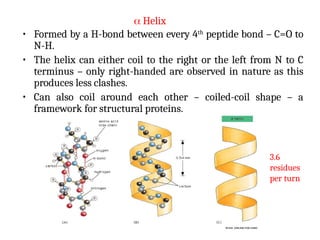
 Helix
• Formed by a H-bond between every 4th
peptide bond – C=O to
N-H.
• The helix can either coil to the right or the left from N to C
terminus – only right-handed are observed in nature as this
produces less clashes.
• Can also coil around each other – coiled-coil shape – a
framework for structural proteins.
3.6
residues
per turn
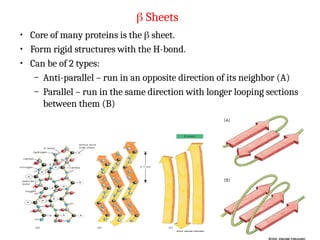
 Sheets
• Core of many proteins is the  sheet.
• Form rigid structures with the H-bond.
• Can be of 2 types:
– Anti-parallel – run in an opposite direction of its neighbor (A)
– Parallel – run in the same direction with longer looping sections
between them (B)
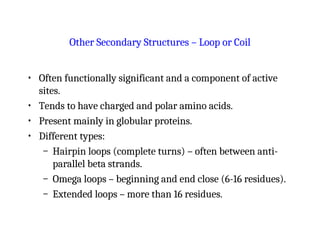
Other Secondary Structures – Loop or Coil
• Often functionally significant and a component of active
sites.
• Tends to have charged and polar amino acids.
• Present mainly in globular proteins.
• Different types:
– Hairpin loops (complete turns) – often between anti-
parallel beta strands.
– Omega loops – beginning and end close (6-16 residues).
– Extended loops – more than 16 residues.
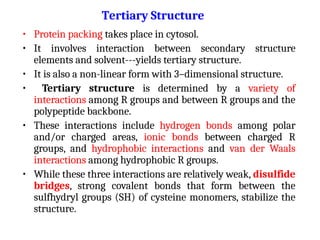
• Protein packing takes place in cytosol.
• It involves interaction between secondary structure
elements and solvent---yields tertiary structure.
• It is also a non-linear form with 3–dimensional structure.
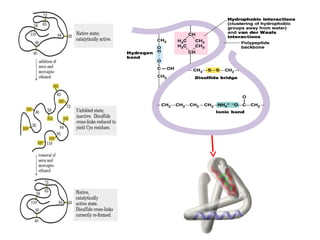
• Tertiary structure is determined by a variety of
interactions among R groups and between R groups and the
polypeptide backbone.
• These interactions include hydrogen bonds among polar
and/or charged areas, ionic bonds between charged R
groups, and hydrophobic interactions and van der Waals
interactions among hydrophobic R groups.
• While these three interactions are relatively weak, disulfide
bridges, strong covalent bonds that form between the
sulfhydryl groups (SH) of cysteine monomers, stabilize the
structure.
Tertiary Structure
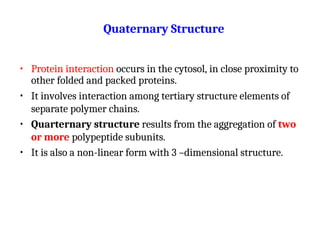
• Protein interaction occurs in the cytosol, in close proximity to
other folded and packed proteins.
• It involves interaction among tertiary structure elements of
separate polymer chains.
• Quarternary structure results from the aggregation of two
or more polypeptide subunits.
• It is also a non-linear form with 3 –dimensional structure.
Quaternary Structure
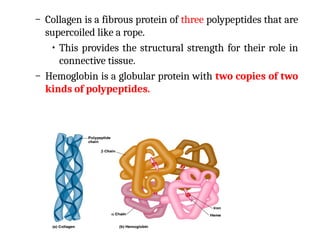
– Collagen is a fibrous protein of three polypeptides that are
supercoiled like a rope.
• This provides the structural strength for their role in
connective tissue.
– Hemoglobin is a globular protein with two copies of two
kinds of polypeptides.
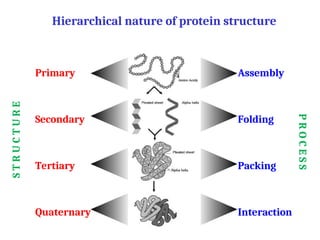
Hierarchical nature of protein structure
Primary
Secondary
Tertiary
Quaternary
Assembly
Folding
Packing
Interaction
S
T
R
U
C
T
U
R
E
P
R
O
C
E
S
S
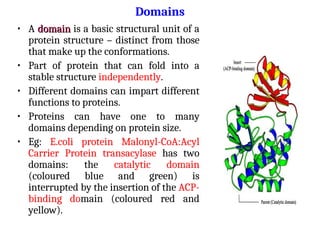
Domains
• A domain
domain is a basic structural unit of a
protein structure – distinct from those
that make up the conformations.
• Part of protein that can fold into a
stable structure independently.
• Different domains can impart different
functions to proteins.
• Proteins can have one to many
domains depending on protein size.
• Eg: E.coli protein Malonyl-CoA:Acyl
Carrier Protein transacylase has two
domains: the catalytic domain
(coloured blue and green) is
interrupted by the insertion of the ACP-
binding domain (coloured red and
yellow).
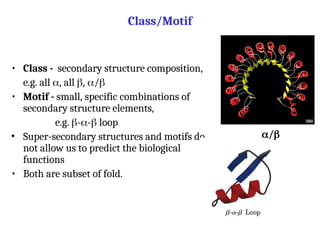
Class/Motif
• Class - secondary structure composition,
e.g. all , all , /
• Motif - small, specific combinations of
secondary structure elements,
e.g. -- loop
• Super-secondary structures and motifs do
not allow us to predict the biological
functions
• Both are subset of fold.
/
Summary
• Proteins are key players in our living systems.
• Proteins are polymers consisting of 20 kinds of amino
acids.
• Each protein folds into a unique three-dimensional
structure defined by its amino acid sequence.
• Protein structure has a hierarchical nature.
• Protein structure is closely related to its function.
• Protein structure prediction is a grand challenge of
computational biology.
Classification of proteins
I- Simple proteins:
i.e. on hydrolysis gives only amino acids
Examples:
1- Albumin and globulins: present in egg, milk and blood
They are proteins of high biological value i.e. contain all
essential amino acids and easily digested.
Types of globulins:
α1 globulin: e.g. antitrypsin: see later
α2 globulin:e.g. hepatoglobin: protein that binds hemoglobin to
prevent its excretion by the kidney
β-globulin: e.g. transferrin: protein that transport iron
γ-globulins = Immunoglobulins (antibodies) : responsible for
immunity.
2- Globins (Histones): They are basic proteins rich in histidine amino
acid.
They are present in : a - combined with DNA
b-combined with heme to form hemoglobin of RBCs.
3- Gliadines are the proteins present in cereals.
4- Scleroproteins: They are structural proteins, not digested.
include: keratin, collagen and elastin.
a- α-keratin: protein found in hair, nails, enamel of teeth and outer layer
of skin.
• It is α-helical polypeptide chain, rich in
cysteine and hydrophobic (non polar)
amino acids so it is water insoluble.
b- collagens:protein of connective tissues found in bone, teeth, cartilage,
tendons, skin and blood vessels.
• Collagen may be present as gel e.g. in extracellular matrix or in
vitreous humor of the eye.
• Collagens are the most important protein in mammals. They
form about 30% of total body proteins.
• There are more than 20 types of collagens, the most common
type is collagen I which constitutes about 90% of cell collagens.
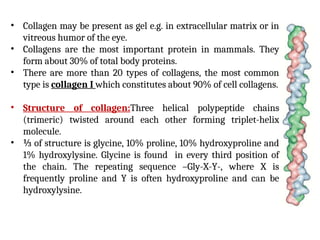
• Structure of collagen:Three helical polypeptide chains
(trimeric) twisted around each other forming triplet-helix
molecule.
• ⅓ of structure is glycine, 10% proline, 10% hydroxyproline and
1% hydroxylysine. Glycine is found in every third position of
the chain. The repeating sequence –Gly-X-Y-, where X is
frequently proline and Y is often hydroxyproline and can be
hydroxylysine.
Solubility: collagen is insoluble in all solvents and not digested.
•When collagen is heated with water or dil. HCl, it will be converted into
gelatin which is soluble , digestible and used as diet (as jelly). Gelatin is
classified as derived protein.
Some collagen diseases:
1- Scurvy: disease due to deficiency of vitamin C which is important
coenzyme for conversion of proline into hydroxyproline and lysine into
hydroxylysine. Thus, synthesis of collagen is decreased leading to
abnormal bone development, bleeding, loosing of teeth and swollen gum.
2- Osteogenesis Imperfecta (OI): Inherited disease resulting from
genetic deficiency or mutation in gene that synthesizes collagen type I
leading to abnormal bone formation in babies and frequent bone
fracture in children. It may be lethal.
C- Elastin: present in walls of large blood vessels (such as aorta). It is
very important in lungs, elastic ligaments, skin, cartilage,
.. It is elastic fiber that can be stretched to several times
as its normal length.
Structure: composed of 4 polypeptide chains (tetramer), similar to
collagen being having 33% glycine and rich in proline
but in that it has low hydroxyproline and absence of
hydroxy lysine.
Emphysema: is a chronic obstructive lung disease (obstruction of air
ways) resulting from deficiency of α1-antitrypsin
particularly in cigarette smokers.
Role of α1-antitrypsin: Elastin is a lung protein. Smoke stimulate
enzyme called elastase to be secreted form neutrophils
(in lung). Elastase cause destruction of elastin of lung.
α1-antitrypsin is an enzyme (secreted from liver) and inhibit elastase
and prevent destruction of elastin. So deficiency of α1-antitrypsin
especially in smokers leads to degradation of lung and destruction of
lung (loss of elasticity of lung, a disease called emphysema).
Conjugated proteins
i.e. On hydrolysis, give protein part and non protein part and
subclassified into:
1- Phosphoproteins: These are proteins conjugated with phosphate
group. Phosphorus is attached to oh group of serine or threonine.
e.g. Casein of milk and vitellin of yolk.
2- Lipoproteins:
These are proteins conjugated with lipids.
Functions: a- help lipids to transport in blood
b-Enter in cell membrane structure helping lipid soluble
substances to pass through cell membranes.
3- Glycoproteins:
proteins conjugated with sugar (carbohydrate)
e.g. – Mucin
- Some hormones such as erythropoeitin
- present in cell membrane structure
- blood groups.
4- Nucleoproteins: These are basic proteins ( e.g. histones)
conjugated with nucleic acid (DNA or RNA).
e.g. a- chromosomes: are proteins conjugated with DNA
b- Ribosomes: are proteins conjugated with RNA
5- Metalloproteins: These are proteins conjugated with metal like
iron, copper, zinc, ……
a- Iron-containing proteins: Iron may present in heme such as in
- hemoglobin (Hb)
- myoglobin ( protein of skeletal muscles and cardiacmuscle),
- cytochromes,
- catalase, peroxidases (destroy H2O2)
- tryptophan pyrrolase (desrtroy indole ring of tryptophan).
Iron may be present in free state (not in heme) as in:
- Ferritin: Main store of iron in the body. ferritin
is present in liver, spleen and bone marrow.
- Hemosidrin: another iron store.
- Transferrin: is the iron carrier protein in
plasma.
b- Copper containing proteins:
e.g. - Ceruloplasmin which oxidizes ferrous ions into ferric ions.
- Oxidase enzymes such as cytochrome oxidase.
c- Zn containing proteins: e.g. Insulin and carbonic anhydrase
d- Mg containing proteins:e.g. Kinases and phosphatases.
6-Chromoproteins: These are proteins conjugated with pigment.
- All proteins containing heme (Hb, myoglobin)
- Melanoprotein:e.g proteins of hair or iris which contain melanin.
Derived proteins
Produced from hydrolysis of simple proteins.
e.g. - Gelatin: from hydrolysis of collagen
- Peptone: from hydrolysis of albumin

Aminoacids -properties and classification

  • 1.
  • 2.
    Structural Feature ofProteins Proteins functionally diverse molecules in living systems such as:  Enzymes and polypeptide hormones.  Myosin, a contractile protein of muscle.  Bone, consisted from the protein collagen.  Blood proteins, such as hemoglobin and plasma albumin and immunoglobulins. All share the common structural feature of being linear polymers of amino acids
  • 3.
    Amino acids arebuilding blocks of proteins. Proteins are composed of 20 different amino acid (encoded by standard genetic code, construct proteins in all species ). Their molecules containing both amino and carboxyl groups attached to the same α-carbon (L- α -amino acids). Their chemical structure influences three dimensional structure of proteins. They are important intermediates in metabolism (porphyrins, purines, pyrimidines, creatine, urea etc). They can have hormonal and catalytic function. Several genetic disorders are caused due to amino acid metabolism errors. (aminoaciduria - presence of amino acids in urine)
  • 4.
    Structure of theamino acids Each amino acid has: 1. A carboxyl group (-COO- ) . 2. An amino group (-NH3 + ) . 3. Side chain ("R-group") bonded to the α-carbon atom.  These carboxyl and amino groups are combined in peptide linkage.  R groups vary in structure, size and electric charges and influence the solubility of amino acids in water.
  • 5.
    L-isomer is normallyfound in proteins. The basic structure of amino acids differ only in the structure of the side chain (R-group). L-isomer
  • 6.
    Nonionic and zwitterionforms of amino acids The zwitterion predominates at neutral pH Weak acid Weak base Zwitterion = in German for “hybrid ion”
  • 7.
    Classification of AminoAcids Nutritional Based on R group - Essential - Non polar aliphatic R group - Non-essential - Polar uncharged R group - Aromatic R group - Positively charged R group - Negatively charged R group
  • 8.
    Only carbon andhydrogen in their side chains. Generally unreactive but hydrophobic. Determining the 3-D structure of proteins (they tend to cluster on the inside of the molecule). The hydrocarbon R group in this class of amino acids is nonpolar and hydrophobic. Glycine has the simplest amino acid structure. The bulky side chain of valine, isoleucine and leucine are important in promoting hydrophobic interactions within protein structures. Non-Polar , aliphatic aminoacids
  • 9.
    Glycine (Gly) Alanine (Ala) Valine(Val) Leucine (Leu) Isoleucine (Ile)) Nonpolar (Hydrophobic) R Groups Proline (Pro) Tryptophan (Trp) Phenylalanine (Phe) Methionine (Met)
  • 10.
    The simplest aminoacid is Glycine, which has a single hydrogen atom as its side chain. Alanine, Valine, Leucine and Isoleucine have saturated hydrocarbon R groups (i.e. they only have hydrogen and carbon linked by single covalent bonds). Leucine and Isoleucine are isomers of each other. Alanine Valine Leucine Isoleucine
  • 11.
    Methionine Phenylalanine The sidechain of Methionine includes a sulfur atom but remains hydrophobic in nature. Phenylalanine is Alanine with an extra benzene (sometimes called a Phenyl) group on the end. Phenylalanine is highly hydrophobic and is found buried within globular proteins.
  • 12.
    Tryptophan is highlyhydrophobic and tends to be found immersed inside globular proteins. Structurally related to Alanine, but with a two ring (bicyclic) indole group added in place of the single aromatic ring found in Phenylalanine. The presence of the nitrogen group makes Tryptophan a little less hydrophobic than Phenylalanine.
  • 13.
    Proline is uniqueamongst the amino acids – its side chain is bonded to the backbone nitrogen as well as to the α-carbon. Because of this, proline is technically an imino rather than an amino acid. The ring is not reactive, but it does restrict the geometry of the backbone chain in any protein where it is present.
  • 14.
    The R groupof these amino acids is more soluble in water, or hydrophilic than those of non polar amino acids, because they contain functional groups that form hydrogen bond with water. Serine, Threonine, Cysteine, Proline, Asparagine, Glutamine. Polar uncharged aminoacids Their aromatic side chains are relatively nonpolar. All can participate in hydrophobic interactions. The OH group of tyrosine can form hydrogen bond and can act as an important functional group in the activity of some enzymes. Aromatic aminoacids
  • 15.
    Polar (Hydrophilic) RGroups Serine (Ser) Cysteine (cys) Glutamine (Gln) Asparagine (Asn) Tyrosine (Tyr) Threonine (Thr)
  • 16.
    Tyrosine is Phenylalaninewith an extra hydroxyl (-OH) group attached. It is polar and very weakly acidic. Tyrosine can play an important catalytic role in the active site of some enzymes. Serine and Threonine play important role in enzymes which regulate phosphorylation and energy metabolism.
  • 17.
    Cysteine has sulfur-containingside group.The group has the potential to be more reactive. It is not very polar. Cysteine is most important for its ability to link to another cysteine via the sulfur atoms to form a covalent disulfide bridge, important in the formation and maintenance of the tertiary (folded) structure in many proteins. SH HS CH2 CH2 CH CH COOH COOH NH2 NH2 - - - - - - S S
  • 18.
    Asparagine and Glutamineare the amide derivatives of Aspartate (Aspartic acid) and Glutamate (Glutamic acid). They cannot be ionised and are therefore uncharged. Asparagine Glutamine
  • 19.
    Aspartic acid (Asp)Glutamic acid (Glu) Negatively Charged R Groups Two amino acids with negatively charged (i.e. acidic) side chains - Aspartate (Aspartic acid) and Glutamate (Glutamic acid). These amino acids confer a negative charge on the proteins of which they are part.
  • 20.
    Positively Charged RGroups Lysine (Lys) Arginine (Arg) Histidine (His) Lysine and Arginine both have pKs around 10.0 and are therefore always positively charged at neutral pH. With a pK of 6.5, Histidine can be uncharged or positively charged depending upon its local environment. Histidine has an important role in the catalytic mechanism of enzymes and it is often found in the active site.
  • 21.
    Classification Based onChemical Constitution Small amino acids – Glycine, Alanine Branched amino acids – Valine, Leucine, Isoleucine Hydroxy amino acids (-OH group) – Serine, Threonine Sulfur amino acids – Cysteine, Methionine Aromatic amino acids – Phenylalanine, Tyrosine, Tryptophan Acidic amino acids and their derivatives – Aspartate, Asparagine, Glutamate, Glutamine Basic amino acids – Lysine, Arginine, Histidine Imino acid - Proline
  • 22.
    • Required indiet. • Humans incapable of forming it. • Essential carbon skeleton. Arginine* Histidine* Isoleucine Leucine Valine Lysine Methionine Threonine Phenylalanine Tryptophan * Essential in children, not in adults Essential Amino Acids in Humans
  • 23.
    • Not requiredin diet. • Can be formed from α-keto acids by transamination and subsequent reactions. Alanine Asparagine Aspartate Glutamate Glutamine Glycine Proline Serine Cysteine (from Met*) Tyrosine (from Phe*) * Essential amino acids Non-Essential Amino Acids in Humans
  • 24.
    Uncommon Amino Acids Hydroxylysineand hydroxyproline, are found in the collagen and gelatin proteins. Thyroxin and 3,3`,5-triiodothyronine, iodinated a.a. are found in thyroglobulin, a protein produced by the thyroid gland. γ-Carboxyglutamic acid is involved in blood clotting. Finally, N-methylarginine and N-acetyllysine are found in histone proteins associated with chromosomes.
  • 25.
    Uncommon amino acidsfound in proteins Intermediates of biosynthesis of arginin and in urea cycle
  • 26.
    This strong oxidizingagent bring about the oxidative decarboxylation of amino acid. The ammonia and hydrindantin form ninhydrin, a purple pigment. Ninhydrin Reaction
  • 27.
    Optical Properties ofAmino Acids • The α-carbon of amino acids is attached to four different chemical groups is a chiral or optically active carbon atom. • Glycine is the exception. • Amino acids exist in two forms, D and L, that are mirror images of each other. • All amino acids found in proteins are of the L-configuration.
  • 28.
    Acidic and Basicproperties of amino acids  Amino acids in aqueous solution contain weakly acidic α- carboxyl groups and weakly basic α-amino groups.  Each of the acidic and basic amino acids contains an ionizable group in its side chain.  Thus, both free and some of the combined amino acids in peptide linkages can act as buffers.  The concentration of a weak acid (HA) and its conjugate base (A- ) is described by the Henderson-Hasselbalch equation.
  • 29.
  • 30.
  • 31.
    Henderson–Hasselbalch Equation Describes thederivation of pH as a measure of acidity in biological and chemical systems.  The equation is also useful for estimating the pH of a buffer solution. It is widely used to calculate the isoelectric point of proteins ( point at which protein neither accept nor yield proton).
  • 32.
    The Henderson hasselbalchequation for acid is :- pH = pKa + log [ Aˉ ] [HA] Here, pKa= -log(Ka) where Ka is the acid dissociation constant, that is pKa= -log [H3O+ ][A- ] [HA] for the non-specific Brønsted acid-base reaction: HA + H20 A- + H3O+ ( Acid ) ( Conjugate base )
  • 33.
    The Henderson HasselbalchEquation for base is : pOH = pKb + log [ BH+ ] -*[B] where BH+ denotes the conjugate acid of the corresponding base B. B + H2O+ BH + OH- (Base ) (Conjugate acid)
  • 34.
    History  Lawrence JosephHenderson wrote an equation, in 1908, describing the use of carbonic acid as a buffer solution.  Karl Albert Hasselbalch later re-expressed that formula in logarithmic terms, resulting in the Henderson–Hasselbalch equation.  Hasselbalch was using the formula to study metabolic acidosis.  According to the Brønsted-Lowry theory of acids and bases, an acid (HA) is capable of donating a proton (H+ ) and a base (B) is capable of accepting a proton.  After the acid (HA) has lost its proton, it is said to exist as the conjugate base (A- ).  Similarly, a protonated base is said to exist as the conjugate acid (BH+ ).
  • 35.
    The dissociation ofan acid can be described by an equilibrium expression HA + H2O H3O+ + A- Consider the case of acetic acid (CH3COOH) and acetate anion . (CH3COO- ): CH3COOH + H2O CH3COO- + H3O+ Acetate is the conjugate base of acetic acid. Acetic acid and acetate are a conjugate acid/base pair. We can describe this relationship with an equilibrium constant: Ka = [H3O+ ][A- ] [HA]
  • 36.
    Taking the negativelog of both sides of the equation gives -logKa = -log [H3O+ ][A- ] [HA] or, -logKa = -log [H3O+ ] + (-log [A- ] ) [HA] By definition, pKa = -logKa and pH = -log[H3O+], so pka=pH – log [A-] [HA] This equation can then be rearranged to give the Henderson-Hasselbalch equation: pH = pKa + log [A-] = pKa + log [conjugate base] [HA] [acid]
  • 37.
    The most significantis the assumption that the concentration of the acid and its conjugate base at equilibrium will remain the same. This neglects the dissociation of the acid and the hydrolysis of the base.  The dissociation of water itself is neglected as well.  These approximations will fail when dealing with: relatively strong acids or bases dilute or very concentrated solutions (less than 1mM or greater than 1M). Limitations
  • 38.
  • 39.
    Physical properties: Solubility Soluble inwater and insoluble in organic solvents. Melting point Melt at higher temperatures, often above 200 º C. Taste sweet (Gly,Ala,Val), tasteless (Leu) or bitter (Arg,Ile). Optical properties  Every amino acid (except glycine) can occur in two isomeric forms in solution, because of the possibility of forming two different enantiomers (stereoisomers) around the central carbon atom (asymmetric carbon atom).  These are called L- and D- forms, analogous to left-handed and right-handed configurations.
  • 40.
     The (dextrorotatory)(+)isomer which has the ability to rotate the plane of polarized light to the right.  The (laevorotatory)(-) isomer which has the ability to rotate the plane of polarized light to the left.  So both isomers can rotate the plane of polarized light by the same magnitude but in opposite directions.  Only L-amino acids are manufactured in cells and incorporated into proteins.  Some D-amino acids are found in the cell walls of bacteria, but not in bacterial proteins.
  • 42.
    All amino acidscontain at least two ionizable groups, the α-amino group and the α-carboxylic group.  Some contain an additional acidic or basic group in their side chain, which are responsible for the amino acids- acid- base behaviour. As a result of their ionizability, the following equilibrium reaction can be written; R-COOH R-COO- + H+ R-NH2 R-NH3 + An amino acid can have several forms depending on the pH of the system. Amphoteric nature (Acid-base behaviour)
  • 43.
     At lowpH or acid conditions, the amino group (-NH2) is protonated by the addition of a proton (H+ ) from the acid.  At high pH or basic conditions, the carboyxlic acid (- COOH) is deprotonated by the removal of a proton.  They can donate or accept a proton. Hence, amino acids are amphoteric (or amphiprotic); they can react either as an acid or as a base.
  • 44.
    There is aninternal transfer of a hydrogen ion from the - COOH group to the -NH2 group to leave an ion with both a negative charge and a positive charge. A zwitterion is a compound with no overall electrical charge, but which contains separate parts which are positively and negatively charged. All neutral amino acids are present in the Zwitter ions form at physiological pH (around 7.4), the carboxyl group will be unprotonated and the amino group will be protonated. At low pH, aminoacid is positively charged (cation) while at high pH, it is negatively charged (anion). Eg: leucine at pH 6.0, carries both positive and negative charges-exists as zwitter ion. Zwitter ions
  • 45.
    Isoelectric point (pI) ThepH at which essentially all amino acid is in the zwitterions form, with very low and equal concentrations of the positive and negative ions. The amino acid does not migrate in an electric field, as they carries no net charge and thus, the molecule is electrically neutral. In more acidic media (pH<pI), the concentration of positive ions increases while the concentration of the zwitterion decreases. In a more basic media (pH>pI), the concentration of negative ions increases while the concentration of the zwitterion decreases.
  • 46.
    At pH=pI, theamino acid present as the zwitterion with one amine or carboxyl group in uncharged form. Isoelectric points found at the values ranging from 7.8 to 10.8 (basic)  Isoelectric points found at the values ranging from 4.8 to 6. 3 (neutral) Isoelectric points found at the values ranging from 2.8 to 3.3 (acidic)
  • 47.
    Isoelectric points ofsome aminoacids Amino Acid Isoelectric point (pI) Arganine (Arg) 10.8 Lysine (Lys) 9.7 Alanine (Ala) 6.0 Glycine (Gly) 6.0 Serine (Ser) 5.7 Glutamic acid (Glu) 3.2 Aspartic acid (Asp) 2.9
  • 49.
    Chemical properties The generalreactions of amino acids are mostly due to the presence of two functional groups namely carboxyl (-COOH) group and amino (- NH2) group. Reactions due to –COOH group 1. Aminoacids form salts with bases (-COONa) and esters with alcohols (COOR’). 2. Decarboxylation: Amino acids undergo decarboxylation to produce corresponding amines. Ex. Histidine ---------- Histamine +CO2 (allergic reactions mediator)  Tyrosine ---------- Dopamine +CO2  Tryptophan------- Tryptamine +CO2  Glutamic acid --- Gamma aminobutyric acid +CO2 (GABA)
  • 50.
    • Usually amineshave physiological activity-hormones, neurotransmitters etc. • Enzyme-Decarboxylases • Coenzymes-Pyridoxal phosphate, a derivative of Pyridoxine (Vitamin B6) 3. Reactions with ammonia  The –COOH group of dicarboxylic acids (other than alpha carboxyl) can combine with ammonia to form the corresponding amide. Aspartic acid + NH3 ------- Asparagine Glutamic acid + NH3 ------- Glutamine  These amides are components of protein structure.  The amide group of glutamine serves as the source of nitrogen for nucleic acid synthesis.
  • 51.
  • 52.
    Reactions due toamino group A. Transamination  The alpha amino group of amino acid can be transferred to alpha keto acid to form the corresponding new amino acid and keto acid.  This is an important reaction in the body (esp. Amino acid metabolism) for the inter conversion of amino acids.  This is one of the major degradation pathways which convert essential amino acids to nonessential amino acids.  Transamination is accomplished by enzymes called transaminases or aminotransferases.  α-ketoglutarate acts as the predominant aminogroup acceptor and produces glutamate as the new amino acid. Aminoacid + α-ketoglutarate ↔ α-keto acid + Glutamate  Glutamate's amino group, in turn, is transferred to oxaloacetate in a second transamination reaction yielding aspartate. Glutamate + oxaloacetate ↔ α-ketoglutarate + aspartate
  • 53.
  • 54.
    B. Oxidative deamination It is a form of deamination that generates oxoacids in the liver.  This takes place in liver and kidney.  The purpose of oxidative deamination is to provide ammonia for urea synthesis and alpha-keto acids for a variety of reaction, including energy generation.  The alpha amino group is removed from the amino acid to form the corresponding keto acid and ammonia.  In the body, Glutamate is the only amino acid that undergoes rapid oxidative deamination by using glutamate dehydrogenase, which uses NAD or NADP as a coenzyme.  This process leads to two distinct toxic compounds: • Hydrogen Peroxide • Ammonia.
  • 55.
  • 56.
  • 57.
    • Reactions dueto side chains A. Ester formation by -OH group  The hydroxyl amino acids can form esters with phosphoric acid.  In this manner, the Serine and Threonine residues of proteins are involved in the formation of phosphoproteins.  Similarly these hydroxyl groups can form O-glycosidic bonds with carbohydrate residues to form glycoproteins. B. Reaction of the amide group  The amide groups of Glutamine and Asparagine can form N- glycosidic bonds with carbohydrate residues to form glycoproteins.
  • 58.
    C. Reactions of-SH group  Cysteine has a sulfhydryl (SH) group and it can form a disulphide (S-S) bond with another Cysteine residue.  The two Cysteine residues can connect to polypeptide chains by the formation of inter-chain disulfide bonds or link.  The dimer formed by two Cysteine residues is called Dicysteine or cystine.
  • 59.
    Peptide bond  Aminoacids are held together in a protein by covalent bonds or linkages.  These bonds are strong and serve as the cementing material between the individual amino acids.  Formation: Alpha carboxyl group of one amino acid reacts with alpha amino group of another amino acid to form a peptide bond or CO-NH bridge.  Proteins are made by polymerization of amino acids through peptide bonds.  Two amino acids combined to form dipeptide. Three amino acids form tripeptide. Four will make a tetrapeptide.  Peptides containing more than 10 amino acids (decapeptide) are referred as polypeptides.  Big polypeptide chains containing more than 50 amino acids are called proteins.
  • 60.
  • 61.
     Acid hydrolysis(hydrochloric acid at higher temperature) of peptides bonds will break the proteins into amino acids.  But hydrochloric acid at body temperature will not break the peptide bonds.  Thus in the stomach, HCL alone will not be able to digest proteins; it needs enzymes.
  • 62.
    Biologically active peptides Proteinscan also be a good source of peptides with different activities. Such peptides are defined as biologically active (bioactive peptides). Bioactive peptides interact with proper body receptors and such an effect can be beneficial or not. Biopeptides as components of food have become an interesting issue for scientific research. Many of bioactive peptides are found in milk and dairy products, plant, animal and microbial proteins. Such peptides are known as the molecules involved in blood pressure reduction, prolyl endopeptidase inhibition, and immune system stimulation.
  • 63.
    Such peptides areknown as the molecules involved in blood pressure reduction, prolyl endopeptidase inhibition, and immune system stimulation. The application of peptides for therapeutic purposes especially in the field of the treatment of cancer, infections, immunological system disorders, cardiovascular disorders is at present the focus of interest of many research group.
  • 64.
    Glutathione It is atripeptide, with a gamma peptide linkage between the carboxyl group of the glutamate side chain and the amine group of cysteine. the carboxyl group of cysteine is attached by normal peptide linkage to a glycine. γ-L-Glutamyl-L-cysteinylglycine. Glutathione reduces disulfide bonds formed within cytoplasmic proteins to cysteines by serving as an electron donor. In the process, glutathione is converted to its oxidized form, glutathione disulfide (GSSG), also called L-(–)-glutathione. Once oxidized, glutathione can be reduced back by glutathione reductase, using NADPH as an electron donor. The ratio of reduced glutathione to oxidized glutathione within cells is often used as a measure of cellular oxidative stress. It exists in reduced or oxidized state. 2G-SH G=S-S-G R O
  • 65.
    Glutathione has multiplefunctions: It maintains levels of reduced glutaredoxin and glutathione peroxidase. Glutathione (GSH) participates in leukotriene synthesis and is a cofactor for the enzyme glutathione peroxidase. It is one of the major endogenous antioxidant produced by the cells, participating directly in the neutralization of free radicals and reactive oxygen compounds. It is used in metabolic and biochemical reactions such as DNA synthesis and repair, protein synthesis, prostaglandin synthesis, amino acid transport, and enzyme activation. Thus, every system in the body can be affected by the state of the glutathione system, especially the immune system, the nervous system, the gastrointestinal system, and the lungs. It has a vital function in iron metabolism. It has roles in progression of the cell cycle, including cell death. GSH levels regulate redox changes to nuclear proteins necessary for the initiation of cell differentiation.
  • 66.
    Small peptides Aspartame (2a.a.): artificial sweetener Oxytocin (9 aa) - secreted by posterior pituitary stimulates uterine contractions –nonapeptide. Bradykinin (9 aa) - inhibits tissue inflammation. Thyrotropin-releasing factor (3 a.a.): formed in hypothalamus stimulates the release of thyrotropin from the anterior pituitary. Amanitin - mushroom poison. Polypeptides Insulin - pancreatic hormone, needed for sugar metabolism, 2 polypeptide chains (30 aa and 21 aa). Glucagon - pancreatic hormone, opposes action of insulin (29 aa). Corticotropin - anterior pituitary gland hormone, stimulates adrenal cortex (39 aa). Dipeptide (Nutrasweet )
  • 67.
  • 68.
    • Peptide hormonessecreted from peptidergic neurons – Somatostatin-endocrine system – kallidin-vasodilators-produced from plasma proteins by snake venom enzymes. – Thyrotropin-release hormone, Antidiuretic hormone (vasopressin)-posterior pituitary gland-increases blood pressure, stimulates kidney. – Gastro-intestinal hormones-gastrin, secretin (peptides) • Neuropeptides responsible for signal transduction. – Enkephalin, Endorphin, Dynorphin, Substance P, Neuropeptide Y Peptides
  • 69.
    Neuropeptide Name Amino acidsequence oxytocin Cys-Tyr-Ile-Gln-Asn-Cys-Pro-Leu-Gly-NH2 └──S───S──┘ Vasopresin Cys-Tyr-Phe-Gln-Asn-Cys-Pro-Arg-Gly-NH2 └──S────S──┘ Met-enkephalin Tyr- Gly-Gly-Phe-Met Leu-enkephalin Tyr- Gly-Gly-Phe-Leu Atrial natriuetic factor Ser-Leu-Arg-Arg-Ser-Ser-Cys-Phe-Gly-Gly-Arg- Met-Asp-Arg-Ile-Gly-Ala-Gln-Ser-Gly-Leu-Gly- Cys-Asn-Ser-Phe-Arg-Tyr Substance P Arg-Pro-Lys-Pro-Bln-Phe-Phe-Gly-Leu-Met-NH2 Bradykinin Arg-Pro-Pro-Gly-Phe-Ser-Pro-Phe-Arg
  • 70.
    • Proteins arethe most structurally complex molecules known. – Each type of protein has a complex three-dimensional shape or conformation. • All protein polymers are constructed from the same set of 20 monomers, called amino acids. • Polymers of proteins are called polypeptides. • A protein consists of one or more polypeptides folded and coiled into a specific conformation. • The peptide bond allows for rotation around it and therefore the protein can fold and orient the R groups in favorable positions. • Weak non-covalent interactions will hold the protein in its functional shape – these are weak and will take many to hold the shape. Proteins
  • 71.
    A protein’s functiondepends on its specific conformation • A functional proteins consists of one or more polypeptides that have been precisely twisted, folded, and coiled into a unique shape. • It is the order of amino acids that determines what the three- dimensional conformation will be.
  • 72.
    • A protein’sspecific conformation determines its function. • In almost every case, the function depends on its ability to recognize and bind to some other molecule. – For example, antibodies bind to particular foreign substances that fit their binding sites. – Enzyme recognize and bind to specific substrates, facilitating a chemical reaction. – Neurotransmitters pass signals from one cell to another by binding to receptor sites on proteins in the membrane of the receiving cell. • A protein’s conformation can change in response to the physical and chemical conditions. • Changes in pH, salt concentration, temperature, or other factors can unravel or denature a protein.
  • 73.
    – These forcesdisrupt the hydrogen bonds, ionic bonds, and disulfide bridges that maintain the protein’s shape. • Proteins shape is determined by the sequence of the amino acids • The final shape is called the conformation and has the lowest free energy possible. • Denaturation is the process of unfolding the protein – Can be down with heat, pH or chemical compounds – In the chemical compound, can remove and have the protein renature or refold. • Some proteins can return to their functional shape after denaturation, but others cannot, especially in the crowded environment of the cell. – Usually denaturation is permanent.
  • 74.
    Molecular chaperones aresmall proteins that help guide the folding and can help keep the new protein from associating with the wrong partner.
  • 75.
    Favorable Interactions inProteins • Hydrophobic effect – Release of water molecules from the structured solvation layer around the molecule as protein folds increases the net entropy • Hydrogen bonds – Interaction of N-H and C=O of the peptide bond leads to local regular structures such as -helices and -sheets • London dispersion – Medium-range weak attraction between all atoms contributes significantly to the stability in the interior of the protein. • Electrostatic interactions – Long-range strong interactions between permanently charged groups. – Salt-bridges, esp. buried in the hydrophobic environment strongly stabilize the protein
  • 76.
    Levels of ProteinStructure 1. Primary structure 2. Secondary structure 3. Tertiary structure  are used to organize the folding within a single polypeptide. 4. Quarternary structure arises when two or more polypeptides join to form a protein.
  • 77.
    • The primarystructure of a protein is its unique sequence of amino acids. • It is in linear, ordered form with one dimensional structure. • It is denoted from amino end to carboxyl end. • A perfectly linear amino acid polymer is neither functional nor energetically favorable. • The precise primary structure of a protein is determined by inherited genetic information. • Largest polypeptide chain approx. has 5000AA but most have less than 2000AA. • Lysozyme, an enzyme that attacks bacteria, consists of a polypeptide chain of 129 amino acids. Primary structure
  • 78.
  • 79.
    • Even aslight change in primary structure can affect a protein’s conformation and ability to function. • In individuals with sickle cell disease, abnormal hemoglobins, oxygen-carrying proteins, develop because of a single amino acid substitution. – These abnormal hemoglobins crystallize, deforming the red blood cells and leading to clogs in tiny blood vessels.
  • 80.
    • Protein foldingoccurs in cytosol. • It involves localized spatial interaction among primary structure elements, i.e. the amino acids to form secondary structure. Secondary Structure
  • 81.
    •The secondary structureof a protein results from interactions at regular intervals along the polypeptide backbone. •It is a non-linear form with 3 –dimensional structure and stabilized by hydrogen bonding in the peptide chain backbone. •H-bonds form between 1) atoms involved in the peptide bond; 2) peptide bond atoms and R groups; 3) R groups. •Typical shapes that develop from secondary structure are coils (an alpha helix) or folds (beta pleated sheets). 2 regular folding patterns have been identified – formed between the bonds of the peptide backbone. -helix – protein turns like a spiral – fibrous proteins (hair, nails, horns) -sheet – protein folds back on itself as in a ribbon –globular protein.
  • 82.
    Secondary structure -helix α -sheet β Secondarystructures, -helix and - α β sheet, have regular hydrogen-bonding patterns.
  • 83.
     Helix • Formedby a H-bond between every 4th peptide bond – C=O to N-H. • The helix can either coil to the right or the left from N to C terminus – only right-handed are observed in nature as this produces less clashes. • Can also coil around each other – coiled-coil shape – a framework for structural proteins. 3.6 residues per turn
  • 84.
     Sheets • Coreof many proteins is the  sheet. • Form rigid structures with the H-bond. • Can be of 2 types: – Anti-parallel – run in an opposite direction of its neighbor (A) – Parallel – run in the same direction with longer looping sections between them (B)
  • 85.
    Other Secondary Structures– Loop or Coil • Often functionally significant and a component of active sites. • Tends to have charged and polar amino acids. • Present mainly in globular proteins. • Different types: – Hairpin loops (complete turns) – often between anti- parallel beta strands. – Omega loops – beginning and end close (6-16 residues). – Extended loops – more than 16 residues.
  • 86.
    • Protein packingtakes place in cytosol. • It involves interaction between secondary structure elements and solvent---yields tertiary structure. • It is also a non-linear form with 3–dimensional structure. • Tertiary structure is determined by a variety of interactions among R groups and between R groups and the polypeptide backbone. • These interactions include hydrogen bonds among polar and/or charged areas, ionic bonds between charged R groups, and hydrophobic interactions and van der Waals interactions among hydrophobic R groups. • While these three interactions are relatively weak, disulfide bridges, strong covalent bonds that form between the sulfhydryl groups (SH) of cysteine monomers, stabilize the structure. Tertiary Structure
  • 88.
    • Protein interactionoccurs in the cytosol, in close proximity to other folded and packed proteins. • It involves interaction among tertiary structure elements of separate polymer chains. • Quarternary structure results from the aggregation of two or more polypeptide subunits. • It is also a non-linear form with 3 –dimensional structure. Quaternary Structure
  • 89.
    – Collagen isa fibrous protein of three polypeptides that are supercoiled like a rope. • This provides the structural strength for their role in connective tissue. – Hemoglobin is a globular protein with two copies of two kinds of polypeptides.
  • 91.
    Hierarchical nature ofprotein structure Primary Secondary Tertiary Quaternary Assembly Folding Packing Interaction S T R U C T U R E P R O C E S S
  • 92.
    Domains • A domain domainis a basic structural unit of a protein structure – distinct from those that make up the conformations. • Part of protein that can fold into a stable structure independently. • Different domains can impart different functions to proteins. • Proteins can have one to many domains depending on protein size. • Eg: E.coli protein Malonyl-CoA:Acyl Carrier Protein transacylase has two domains: the catalytic domain (coloured blue and green) is interrupted by the insertion of the ACP- binding domain (coloured red and yellow).
  • 93.
    Class/Motif • Class -secondary structure composition, e.g. all , all , / • Motif - small, specific combinations of secondary structure elements, e.g. -- loop • Super-secondary structures and motifs do not allow us to predict the biological functions • Both are subset of fold. /
  • 94.
    Summary • Proteins arekey players in our living systems. • Proteins are polymers consisting of 20 kinds of amino acids. • Each protein folds into a unique three-dimensional structure defined by its amino acid sequence. • Protein structure has a hierarchical nature. • Protein structure is closely related to its function. • Protein structure prediction is a grand challenge of computational biology.
  • 95.
    Classification of proteins I-Simple proteins: i.e. on hydrolysis gives only amino acids Examples: 1- Albumin and globulins: present in egg, milk and blood They are proteins of high biological value i.e. contain all essential amino acids and easily digested. Types of globulins: α1 globulin: e.g. antitrypsin: see later α2 globulin:e.g. hepatoglobin: protein that binds hemoglobin to prevent its excretion by the kidney β-globulin: e.g. transferrin: protein that transport iron γ-globulins = Immunoglobulins (antibodies) : responsible for immunity.
  • 96.
    2- Globins (Histones):They are basic proteins rich in histidine amino acid. They are present in : a - combined with DNA b-combined with heme to form hemoglobin of RBCs. 3- Gliadines are the proteins present in cereals. 4- Scleroproteins: They are structural proteins, not digested. include: keratin, collagen and elastin. a- α-keratin: protein found in hair, nails, enamel of teeth and outer layer of skin. • It is α-helical polypeptide chain, rich in cysteine and hydrophobic (non polar) amino acids so it is water insoluble. b- collagens:protein of connective tissues found in bone, teeth, cartilage, tendons, skin and blood vessels.
  • 97.
    • Collagen maybe present as gel e.g. in extracellular matrix or in vitreous humor of the eye. • Collagens are the most important protein in mammals. They form about 30% of total body proteins. • There are more than 20 types of collagens, the most common type is collagen I which constitutes about 90% of cell collagens. • Structure of collagen:Three helical polypeptide chains (trimeric) twisted around each other forming triplet-helix molecule. • ⅓ of structure is glycine, 10% proline, 10% hydroxyproline and 1% hydroxylysine. Glycine is found in every third position of the chain. The repeating sequence –Gly-X-Y-, where X is frequently proline and Y is often hydroxyproline and can be hydroxylysine.
  • 98.
    Solubility: collagen isinsoluble in all solvents and not digested. •When collagen is heated with water or dil. HCl, it will be converted into gelatin which is soluble , digestible and used as diet (as jelly). Gelatin is classified as derived protein. Some collagen diseases: 1- Scurvy: disease due to deficiency of vitamin C which is important coenzyme for conversion of proline into hydroxyproline and lysine into hydroxylysine. Thus, synthesis of collagen is decreased leading to abnormal bone development, bleeding, loosing of teeth and swollen gum. 2- Osteogenesis Imperfecta (OI): Inherited disease resulting from genetic deficiency or mutation in gene that synthesizes collagen type I leading to abnormal bone formation in babies and frequent bone fracture in children. It may be lethal.
  • 99.
    C- Elastin: presentin walls of large blood vessels (such as aorta). It is very important in lungs, elastic ligaments, skin, cartilage, .. It is elastic fiber that can be stretched to several times as its normal length. Structure: composed of 4 polypeptide chains (tetramer), similar to collagen being having 33% glycine and rich in proline but in that it has low hydroxyproline and absence of hydroxy lysine. Emphysema: is a chronic obstructive lung disease (obstruction of air ways) resulting from deficiency of α1-antitrypsin particularly in cigarette smokers. Role of α1-antitrypsin: Elastin is a lung protein. Smoke stimulate enzyme called elastase to be secreted form neutrophils (in lung). Elastase cause destruction of elastin of lung.
  • 100.
    α1-antitrypsin is anenzyme (secreted from liver) and inhibit elastase and prevent destruction of elastin. So deficiency of α1-antitrypsin especially in smokers leads to degradation of lung and destruction of lung (loss of elasticity of lung, a disease called emphysema). Conjugated proteins i.e. On hydrolysis, give protein part and non protein part and subclassified into: 1- Phosphoproteins: These are proteins conjugated with phosphate group. Phosphorus is attached to oh group of serine or threonine. e.g. Casein of milk and vitellin of yolk.
  • 101.
    2- Lipoproteins: These areproteins conjugated with lipids. Functions: a- help lipids to transport in blood b-Enter in cell membrane structure helping lipid soluble substances to pass through cell membranes. 3- Glycoproteins: proteins conjugated with sugar (carbohydrate) e.g. – Mucin - Some hormones such as erythropoeitin - present in cell membrane structure - blood groups. 4- Nucleoproteins: These are basic proteins ( e.g. histones) conjugated with nucleic acid (DNA or RNA). e.g. a- chromosomes: are proteins conjugated with DNA b- Ribosomes: are proteins conjugated with RNA
  • 102.
    5- Metalloproteins: Theseare proteins conjugated with metal like iron, copper, zinc, …… a- Iron-containing proteins: Iron may present in heme such as in - hemoglobin (Hb) - myoglobin ( protein of skeletal muscles and cardiacmuscle), - cytochromes, - catalase, peroxidases (destroy H2O2) - tryptophan pyrrolase (desrtroy indole ring of tryptophan). Iron may be present in free state (not in heme) as in: - Ferritin: Main store of iron in the body. ferritin is present in liver, spleen and bone marrow. - Hemosidrin: another iron store. - Transferrin: is the iron carrier protein in plasma.
  • 103.
    b- Copper containingproteins: e.g. - Ceruloplasmin which oxidizes ferrous ions into ferric ions. - Oxidase enzymes such as cytochrome oxidase. c- Zn containing proteins: e.g. Insulin and carbonic anhydrase d- Mg containing proteins:e.g. Kinases and phosphatases. 6-Chromoproteins: These are proteins conjugated with pigment. - All proteins containing heme (Hb, myoglobin) - Melanoprotein:e.g proteins of hair or iris which contain melanin. Derived proteins Produced from hydrolysis of simple proteins. e.g. - Gelatin: from hydrolysis of collagen - Peptone: from hydrolysis of albumin

Editor's Notes

  • #62 純化酵素是一件非常基本的工作,很多重要的研究,都脫不開酵素的純化工作。而大多數酵素的純化,基本上也脫不開一些最基本的原則。 首先,建立一個完善的酵素實驗室是很必要的;我們把許多實驗室內的運作細節一一交代,期望同學能認知這些經驗,確實接收並養成習慣,且期望應用到將來每個人的研究工作上。 最先遇到,但是最容易被忽視的步驟,就是材料處理及總蛋白質的抽取。將提醒你小心選擇採料的種類、時期、部位等,並選擇一個良好的粗抽取方式,以便有一個良好的開始。