Session Title: Collaborative Mix – teachers, students, programs and institutions Duration: 3:15PM to 3:55PM Presentation 30 mins  Q & A 10 mins Room No: B114-116 Presenter: Abdul Rehman,  The International College (THINC) Manager Learning and Educational Technologies Contact:  [email_address]   Welcome to BbSummit Middle East
A thought before we start… Employers community drives home the requirement for any learner to strive ahead in search for "knowledge" or "skills". How does a student collaborate with other peers or a superior student or another institution or hunt alternate learning path? What are terms for a "Collaborative Model" in a "Dynamically" and "Academically Intelligent Way“ with knowledge being delivered in "appropriate time" Collaboration within e-Learning will define the learning package ie. Linear (deterministic) and non-linear (dynamic) approach as Assessment will gauge what comes out. These two pathways can be possible if the Learning Management System could sense the “intelligence” within itself.
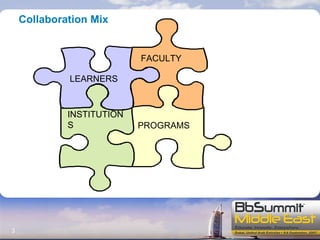
Collaboration Mix LEARNERS FACULTY PROGRAMS INSTITUTIONS
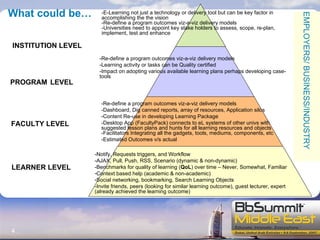
What could be… LEARNER LEVEL FACULTY LEVEL PROGRAM   LEVEL INSTITUTION LEVEL -E-Learning not just a technology or delivery tool but can be key factor in accomplishing the the vision -Re-define a program outcomes viz-a-viz delivery models -Universities need to appoint key stake holders to assess, scope, re-plan, implement, test and enhance -Notify, Requests triggers, and Workflow  -AJAX, Pull, Push, RSS, Scenario (dynamic & non-dynamic)  -Benchmarks for quality of learning ( QoL ) over time – Never, Somewhat, Familiar Context based help (academic & non-academic)  Social networking, bookmarking, Search Learning Objects -Invite friends, peers (looking for similar learning outcome), guest lecturer, expert (already achieved the learning outcome) -Re-define a program outcomes viz-a-viz delivery models -Dashboard, Dig canned reports, array of resources, Application silos -Content Re-use in developing Learning Package -Desktop App (FacultyPack) connects to eL systems of other univs with  suggested lesson plans and hunts for all learning resources and objects -Facilitators Integrating all the gadgets, tools, mediums, components, etc -Estimated Outcomes v/s actual -Re-define a program outcomes viz-a-viz delivery models -Learning activity or tasks can be Quality certified -Impact on adopting various available learning plans perhaps developing case-tools EMPLOYERS/ BUSINESS/INDUSTRY
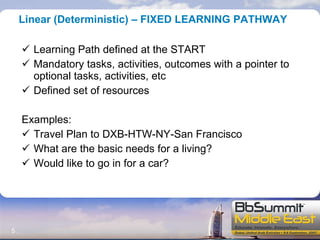
Linear (Deterministic) – FIXED LEARNING PATHWAY Learning Path defined at the START Mandatory tasks, activities, outcomes with a pointer to optional tasks, activities, etc Defined set of resources Examples: Travel Plan to DXB-HTW-NY-San Francisco What are the basic needs for a living? Would like to go in for a car?
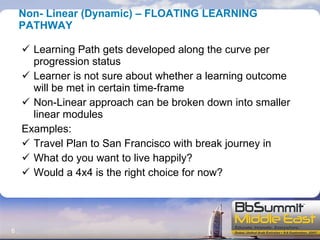
Non- Linear (Dynamic) – FLOATING LEARNING PATHWAY Learning Path gets developed along the curve per progression status Learner is not sure about whether a learning outcome will be met in certain time-frame Non-Linear approach can be broken down into smaller linear modules Examples: Travel Plan to San Francisco with break journey in  What do you want to live happily? Would a 4x4 is the right choice for now?
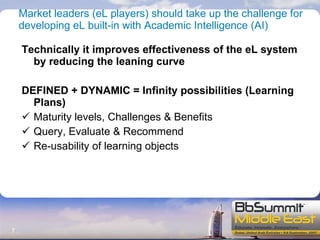
Market leaders (eL players) should take up the challenge for developing eL built-in with Academic Intelligence (AI) Technically it improves effectiveness of the eL system by reducing the leaning curve DEFINED + DYNAMIC = Infinity possibilities (Learning Plans) Maturity levels, Challenges & Benefits Query, Evaluate & Recommend Re-usability of learning objects
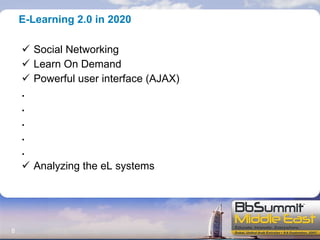
E-Learning 2.0 in 2020 Social Networking Learn On Demand Powerful user interface (AJAX) . . . . . Analyzing the eL systems
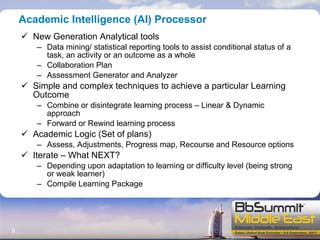
Academic Intelligence (AI) Processor New Generation Analytical tools Data mining/ statistical reporting tools to assist conditional status of a task, an activity or an outcome as a whole Collaboration Plan Assessment Generator and Analyzer Simple and complex techniques to achieve a particular Learning Outcome  Combine or disintegrate learning process – Linear & Dynamic approach Forward or Rewind learning process Academic Logic (Set of plans) Assess, Adjustments, Progress map, Recourse and Resource options Iterate – What NEXT? Depending upon adaptation to learning or difficulty level (being strong or weak learner) Compile Learning Package
THANK YOU We will have a 10 minutes for Q & A

Bb Summit Middle East Presentation - Sep\'07

  • 1.
    Session Title: CollaborativeMix – teachers, students, programs and institutions Duration: 3:15PM to 3:55PM Presentation 30 mins Q & A 10 mins Room No: B114-116 Presenter: Abdul Rehman, The International College (THINC) Manager Learning and Educational Technologies Contact: [email_address] Welcome to BbSummit Middle East
  • 2.
    A thought beforewe start… Employers community drives home the requirement for any learner to strive ahead in search for "knowledge" or "skills". How does a student collaborate with other peers or a superior student or another institution or hunt alternate learning path? What are terms for a "Collaborative Model" in a "Dynamically" and "Academically Intelligent Way“ with knowledge being delivered in "appropriate time" Collaboration within e-Learning will define the learning package ie. Linear (deterministic) and non-linear (dynamic) approach as Assessment will gauge what comes out. These two pathways can be possible if the Learning Management System could sense the “intelligence” within itself.
  • 3.
    Collaboration Mix LEARNERSFACULTY PROGRAMS INSTITUTIONS
  • 4.
    What could be…LEARNER LEVEL FACULTY LEVEL PROGRAM LEVEL INSTITUTION LEVEL -E-Learning not just a technology or delivery tool but can be key factor in accomplishing the the vision -Re-define a program outcomes viz-a-viz delivery models -Universities need to appoint key stake holders to assess, scope, re-plan, implement, test and enhance -Notify, Requests triggers, and Workflow -AJAX, Pull, Push, RSS, Scenario (dynamic & non-dynamic) -Benchmarks for quality of learning ( QoL ) over time – Never, Somewhat, Familiar Context based help (academic & non-academic) Social networking, bookmarking, Search Learning Objects -Invite friends, peers (looking for similar learning outcome), guest lecturer, expert (already achieved the learning outcome) -Re-define a program outcomes viz-a-viz delivery models -Dashboard, Dig canned reports, array of resources, Application silos -Content Re-use in developing Learning Package -Desktop App (FacultyPack) connects to eL systems of other univs with suggested lesson plans and hunts for all learning resources and objects -Facilitators Integrating all the gadgets, tools, mediums, components, etc -Estimated Outcomes v/s actual -Re-define a program outcomes viz-a-viz delivery models -Learning activity or tasks can be Quality certified -Impact on adopting various available learning plans perhaps developing case-tools EMPLOYERS/ BUSINESS/INDUSTRY
  • 5.
    Linear (Deterministic) –FIXED LEARNING PATHWAY Learning Path defined at the START Mandatory tasks, activities, outcomes with a pointer to optional tasks, activities, etc Defined set of resources Examples: Travel Plan to DXB-HTW-NY-San Francisco What are the basic needs for a living? Would like to go in for a car?
  • 6.
    Non- Linear (Dynamic)– FLOATING LEARNING PATHWAY Learning Path gets developed along the curve per progression status Learner is not sure about whether a learning outcome will be met in certain time-frame Non-Linear approach can be broken down into smaller linear modules Examples: Travel Plan to San Francisco with break journey in What do you want to live happily? Would a 4x4 is the right choice for now?
  • 7.
    Market leaders (eLplayers) should take up the challenge for developing eL built-in with Academic Intelligence (AI) Technically it improves effectiveness of the eL system by reducing the leaning curve DEFINED + DYNAMIC = Infinity possibilities (Learning Plans) Maturity levels, Challenges & Benefits Query, Evaluate & Recommend Re-usability of learning objects
  • 8.
    E-Learning 2.0 in2020 Social Networking Learn On Demand Powerful user interface (AJAX) . . . . . Analyzing the eL systems
  • 9.
    Academic Intelligence (AI)Processor New Generation Analytical tools Data mining/ statistical reporting tools to assist conditional status of a task, an activity or an outcome as a whole Collaboration Plan Assessment Generator and Analyzer Simple and complex techniques to achieve a particular Learning Outcome Combine or disintegrate learning process – Linear & Dynamic approach Forward or Rewind learning process Academic Logic (Set of plans) Assess, Adjustments, Progress map, Recourse and Resource options Iterate – What NEXT? Depending upon adaptation to learning or difficulty level (being strong or weak learner) Compile Learning Package
  • 10.
    THANK YOU Wewill have a 10 minutes for Q & A