Challenges around the undergraduate experience: Designing programs, units and classes for student engagement A/Professor Mark Freeman A/Dean (Learning and Teaching) [email_address]
Participant learning outcomes Describe some of the considerations impacting today’s UG students learning Evaluate the potential usefulness of some different in-class learning activities Identify some useful strategies (eg. engaging UG students at the program-level) Value learning as fun and interesting sometimes
Interactive ‘work’shop Instructions Change tables.  Number off 1 to 6 on current table.  All those number ‘1’ move to table 1.  Number ‘2’ move to table 2. etc Sit next to someone you don’t know. Spend 1 minute each telling your life story. After 2 minutes introduce your pair partner to others on the table (Someone may need to facilitate)
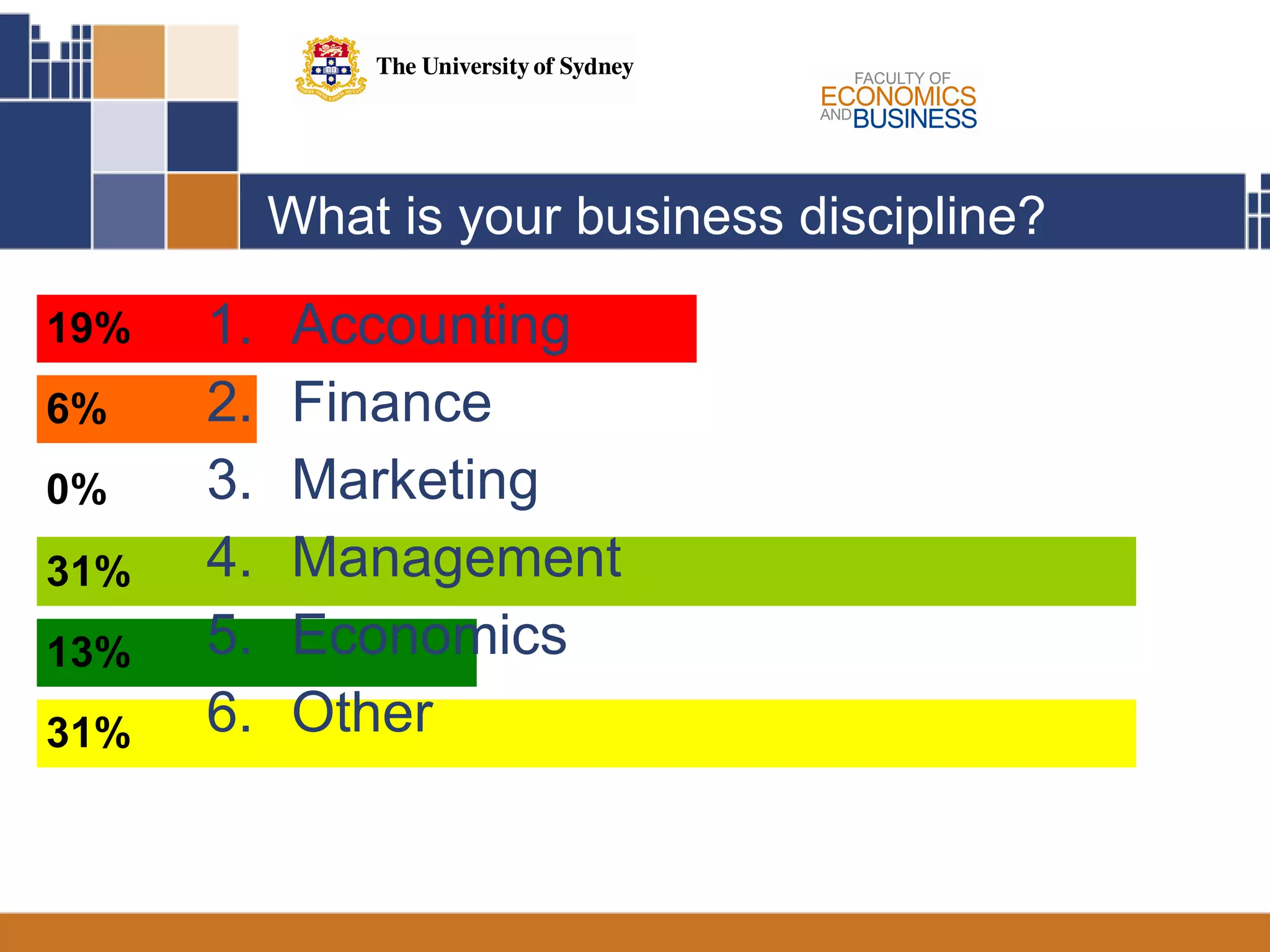
What is your business discipline? Accounting Finance Marketing Management Economics Other
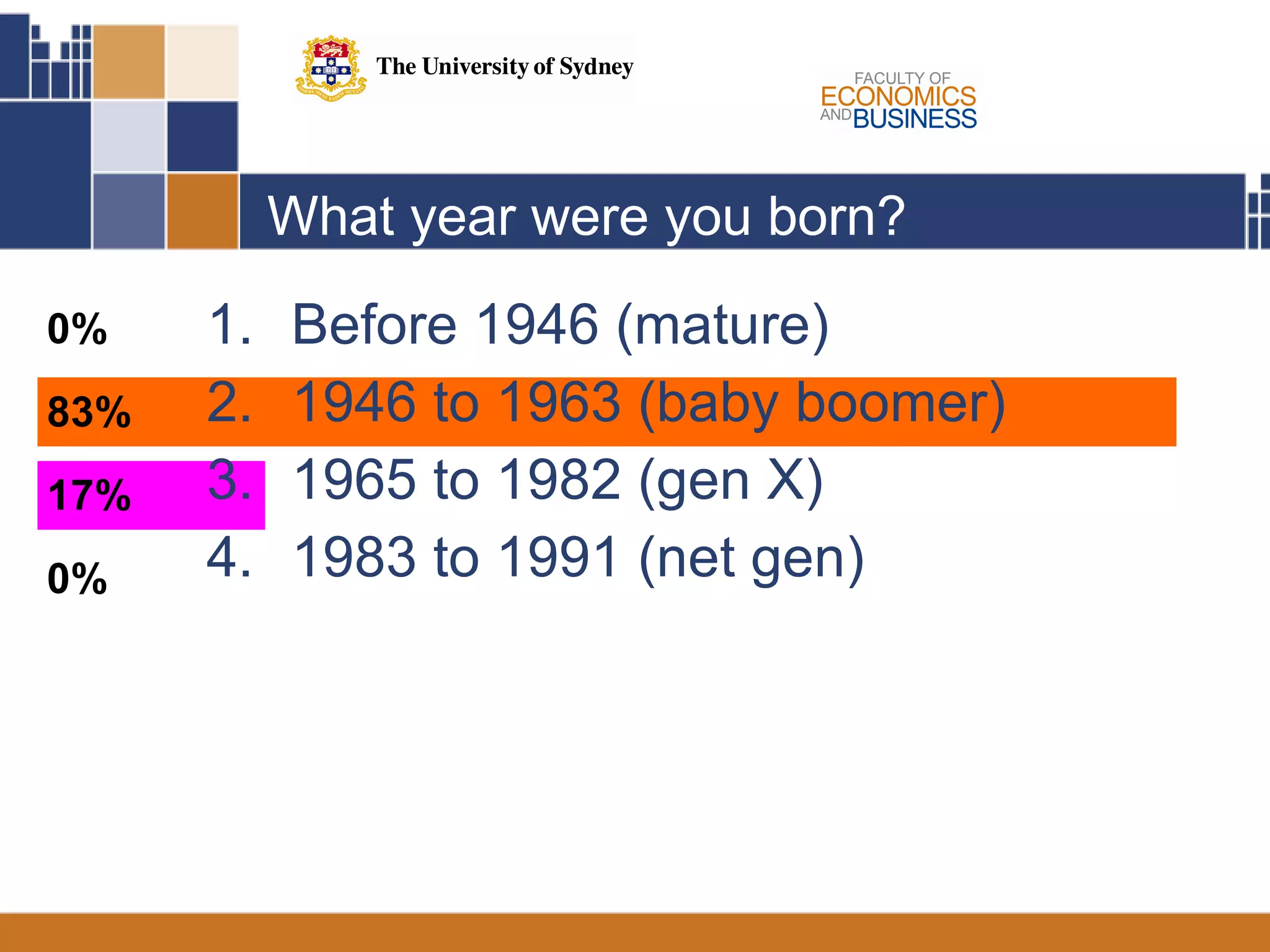
What year were you born? Before 1946 (mature) 1946 to 1963 (baby boomer) 1965 to 1982 (gen X) 1983 to 1991 (net gen)
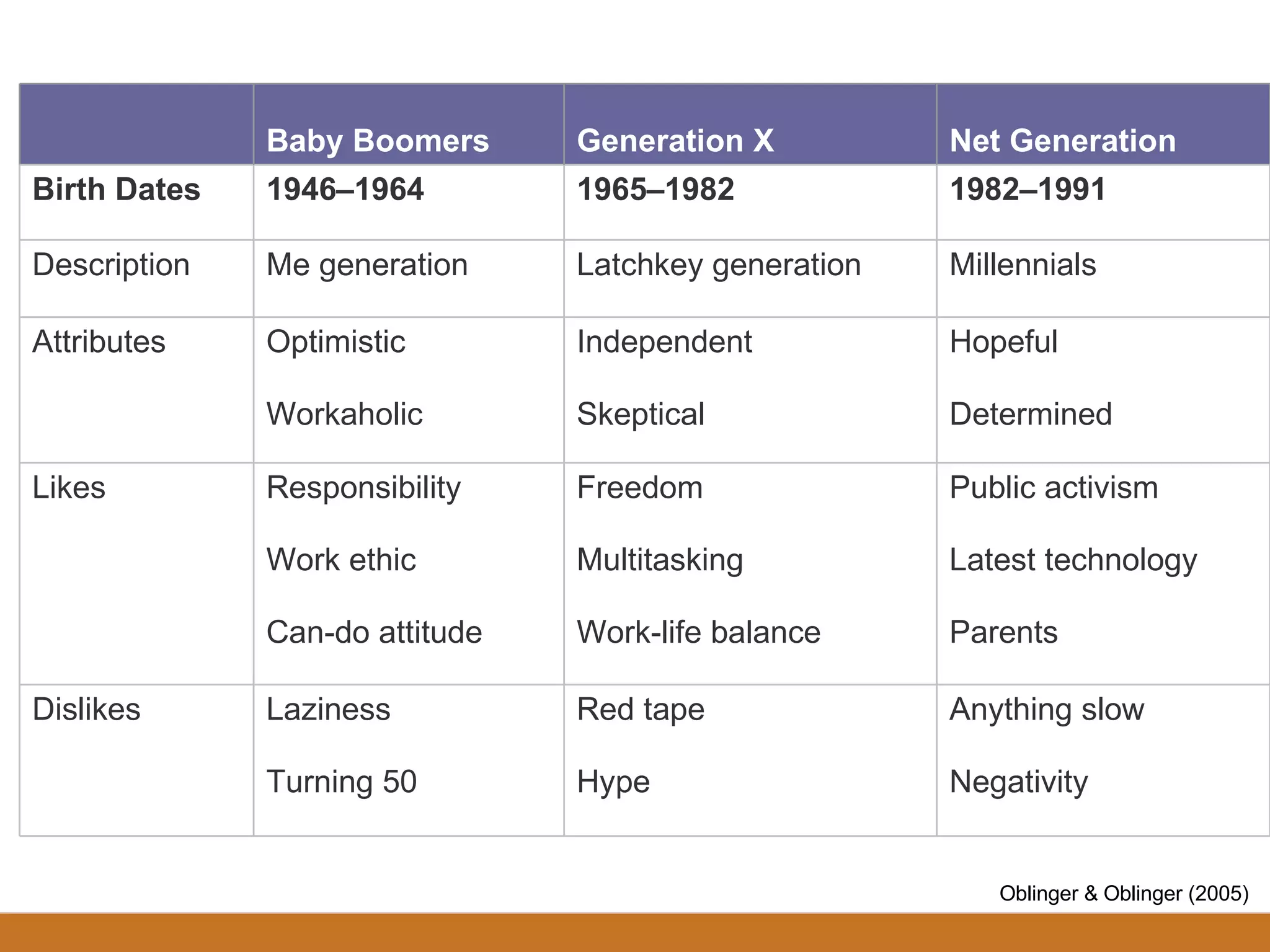
Baby boomers and Millennials Oblinger & Oblinger (2005) Negativity Hype Turning 50 Anything slow Red tape Laziness Dislikes Parents Work-life balance Can-do attitude Latest technology Multitasking Work ethic Public activism Freedom Responsibility Likes Determined Skeptical Workaholic Hopeful Independent Optimistic Attributes Millennials Latchkey generation Me generation Description 1982–1991 1965–1982 1946–1964 Birth Dates Net Generation Generation X Baby Boomers  
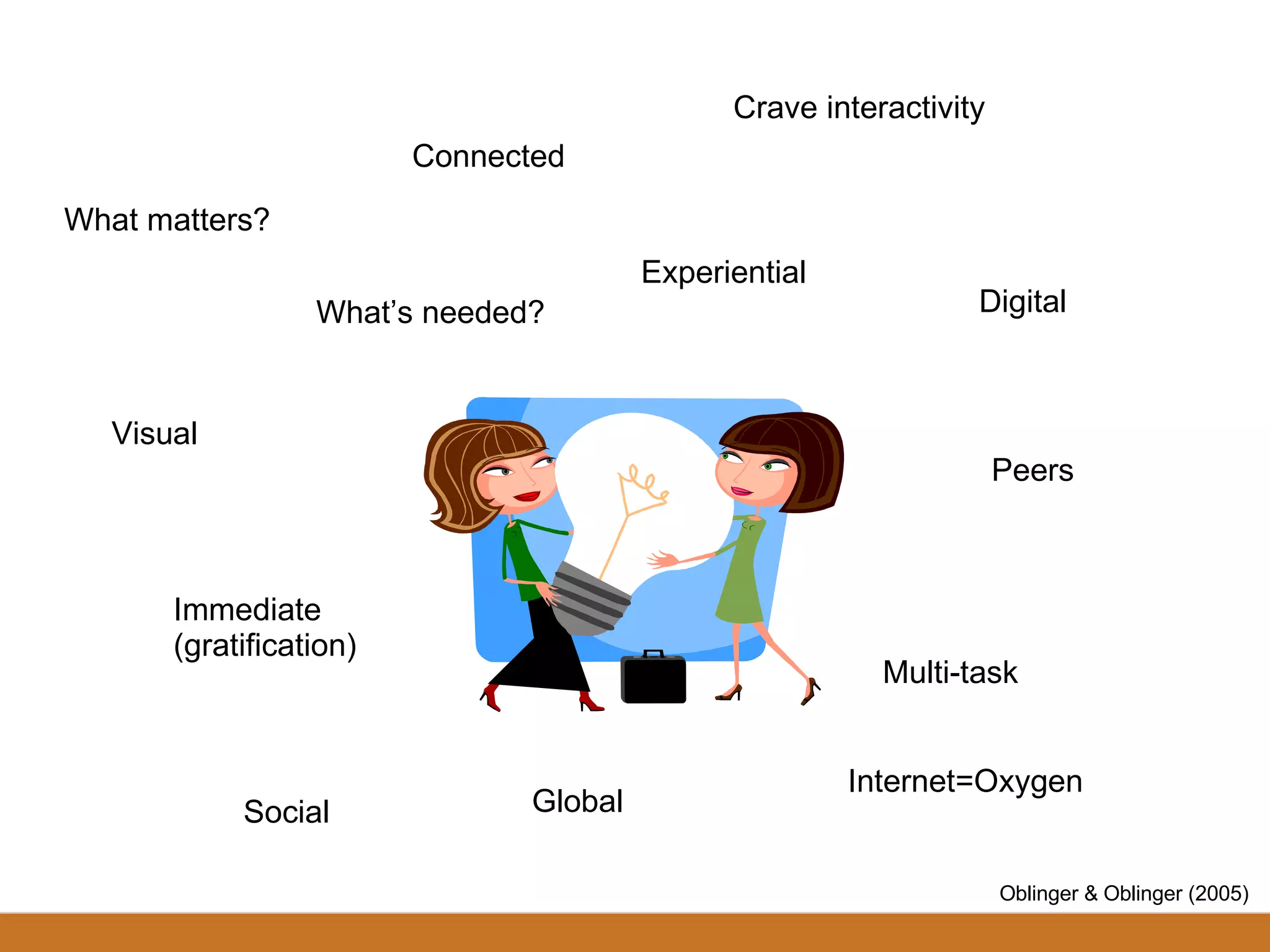
Millennials at a glance Visual  Digital  Connected  Immediate (gratification)  Multi-task  Experiential  Social  Peers  What’s needed? Crave interactivity  What matters? Global Oblinger & Oblinger (2005) Internet=Oxygen
Scratch where itchy! “ Digital Natives accustomed to the twitch-speed, multitasking, random-access, graphics-first, active, connected, fun, fantasy, quick-payoff world of their video games, MTV, and Internet are bored by most of today's education, well-meaning as it may be.  But worse, the  many skills  that new technology [has] actually enhanced (for example, parallel processing, graphics awareness, and random access) -- which have profound implications for their learning --  are almost totally ignored by educators ” Prensky (2001)
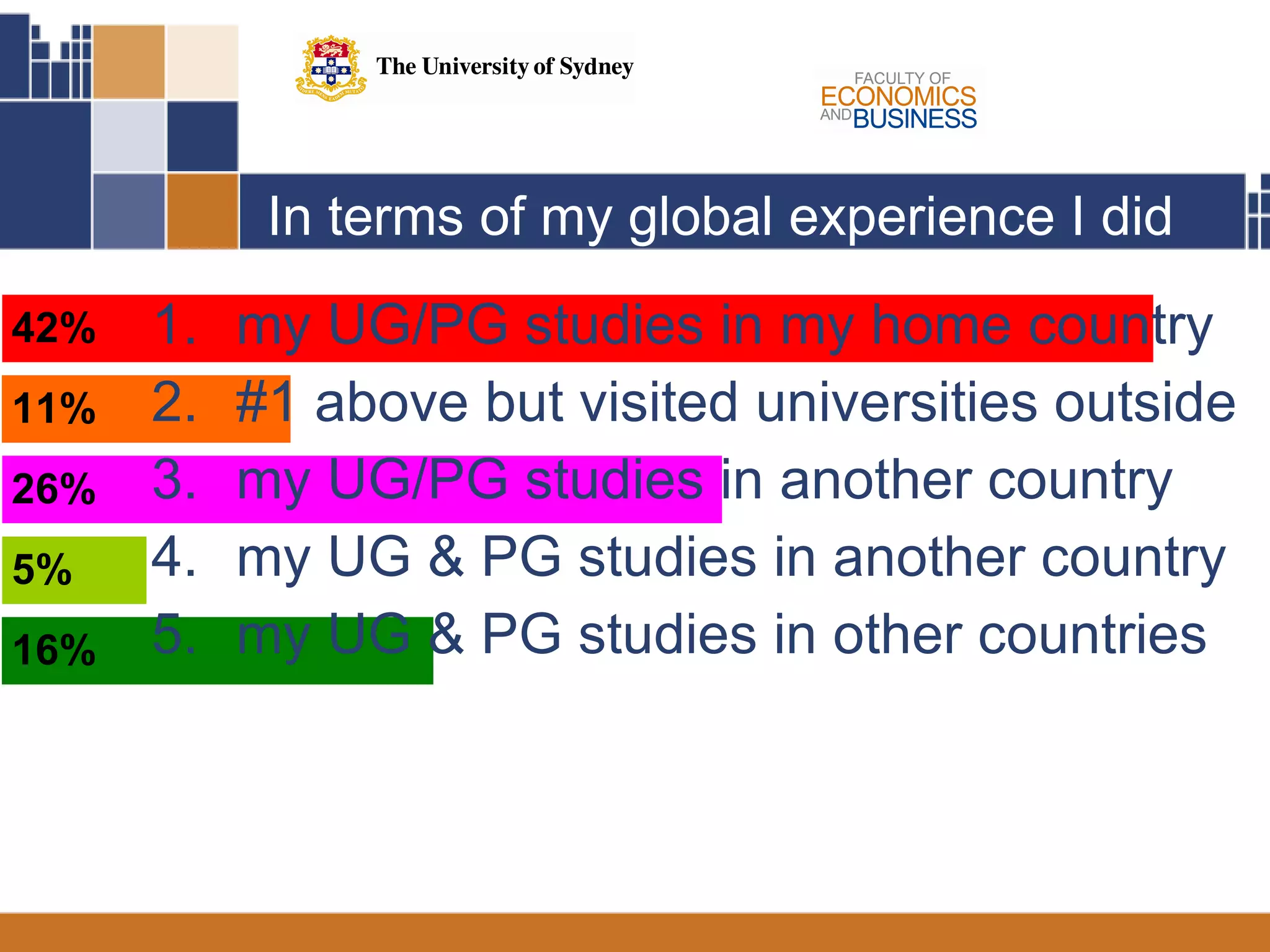
In terms of my global experience I did my UG/PG studies in my home country  #1 above but visited universities outside my UG/PG studies in another country my UG & PG studies in another country my UG & PG studies in other countries
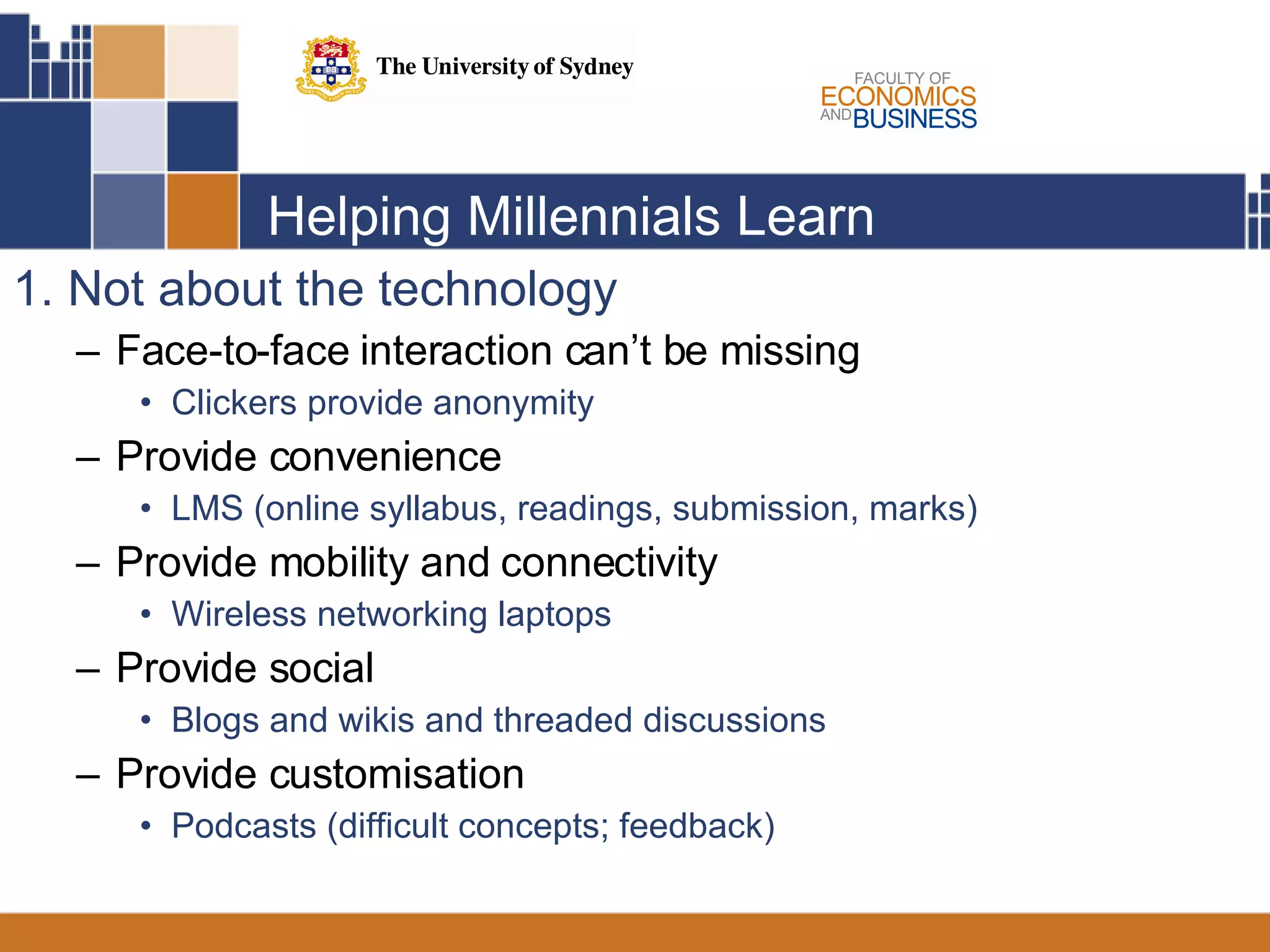
Helping Millennials Learn 1. Not about the technology Face-to-face interaction can’t be missing Clickers provide anonymity Provide convenience LMS (online syllabus, readings, submission, marks) Provide mobility and connectivity Wireless networking laptops Provide social Blogs and wikis and threaded discussions Provide customisation Podcasts (difficult concepts; feedback)
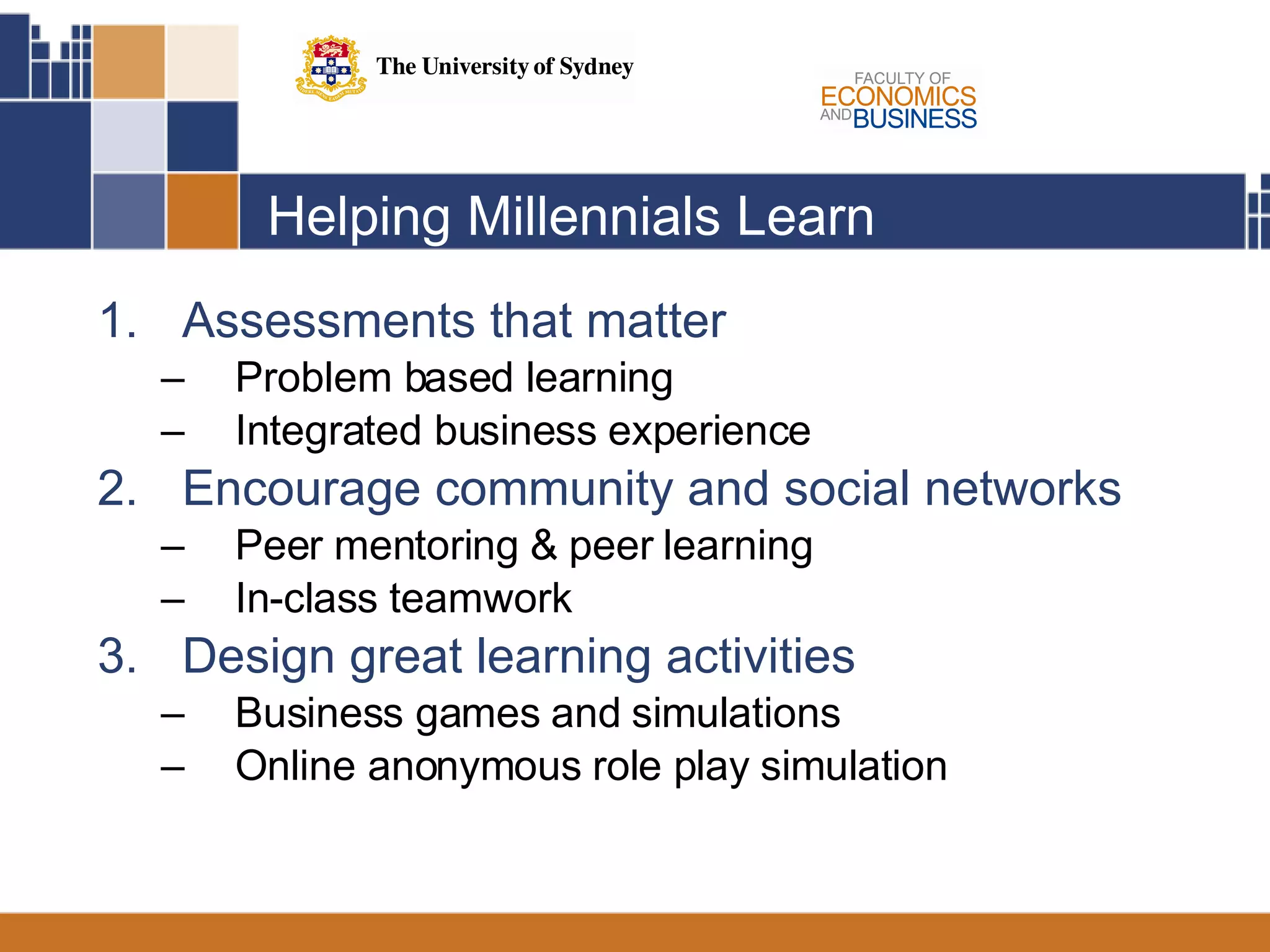
Helping Millennials Learn Assessments that matter Problem based learning  Integrated business experience  Encourage community and social networks Peer mentoring & peer learning In-class teamwork Design great learning activities Business games and simulations Online anonymous role play simulation
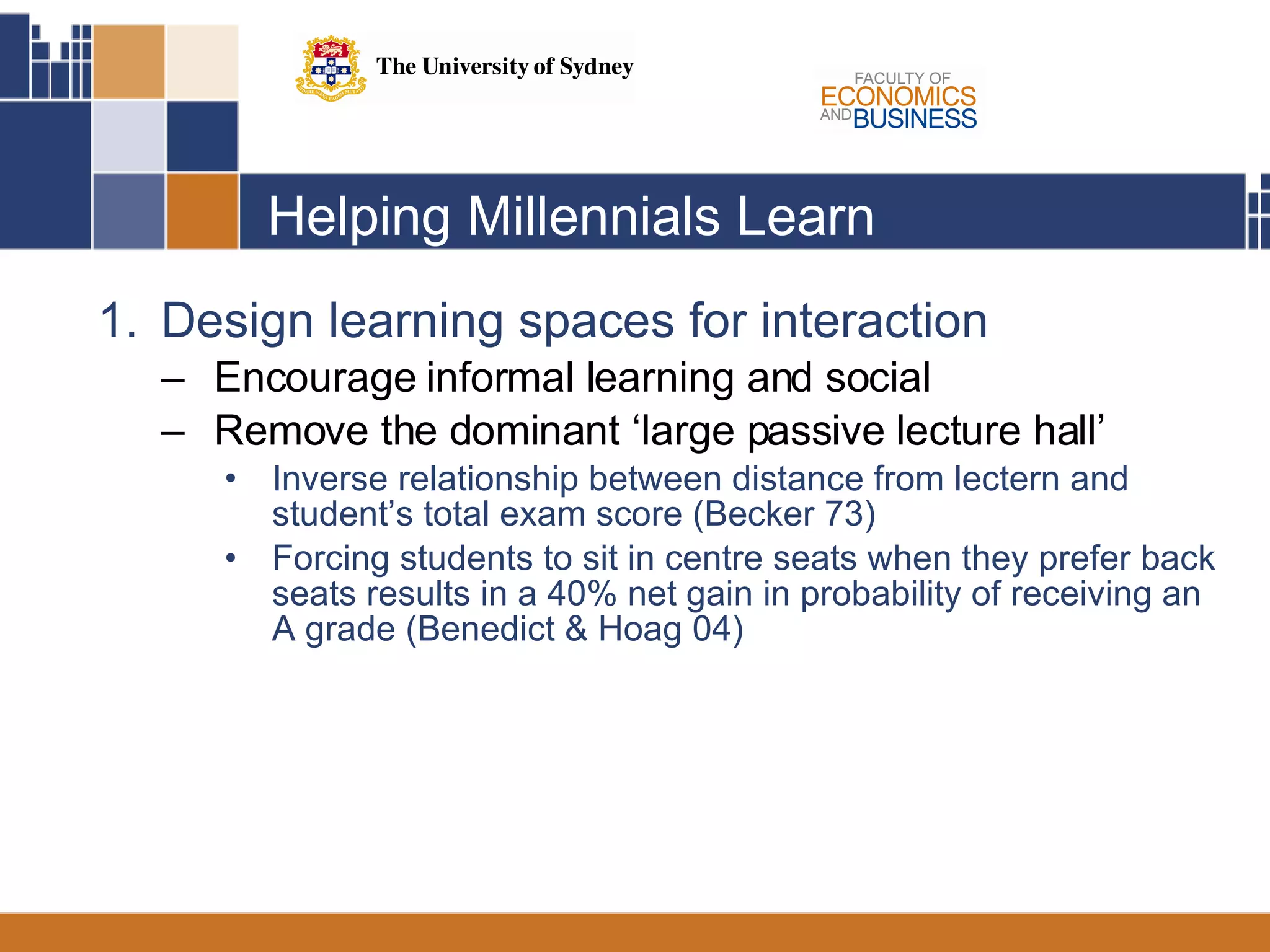
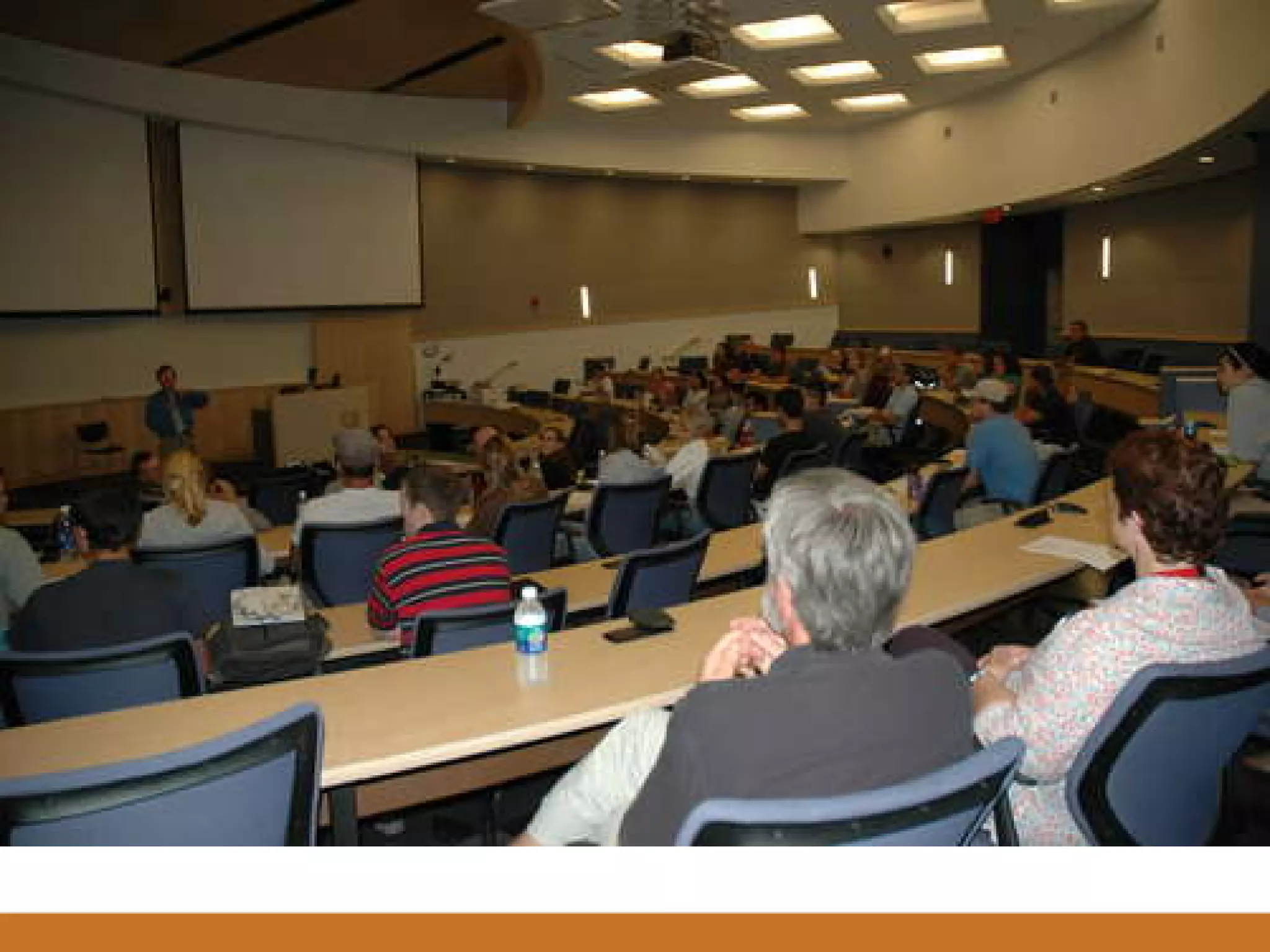
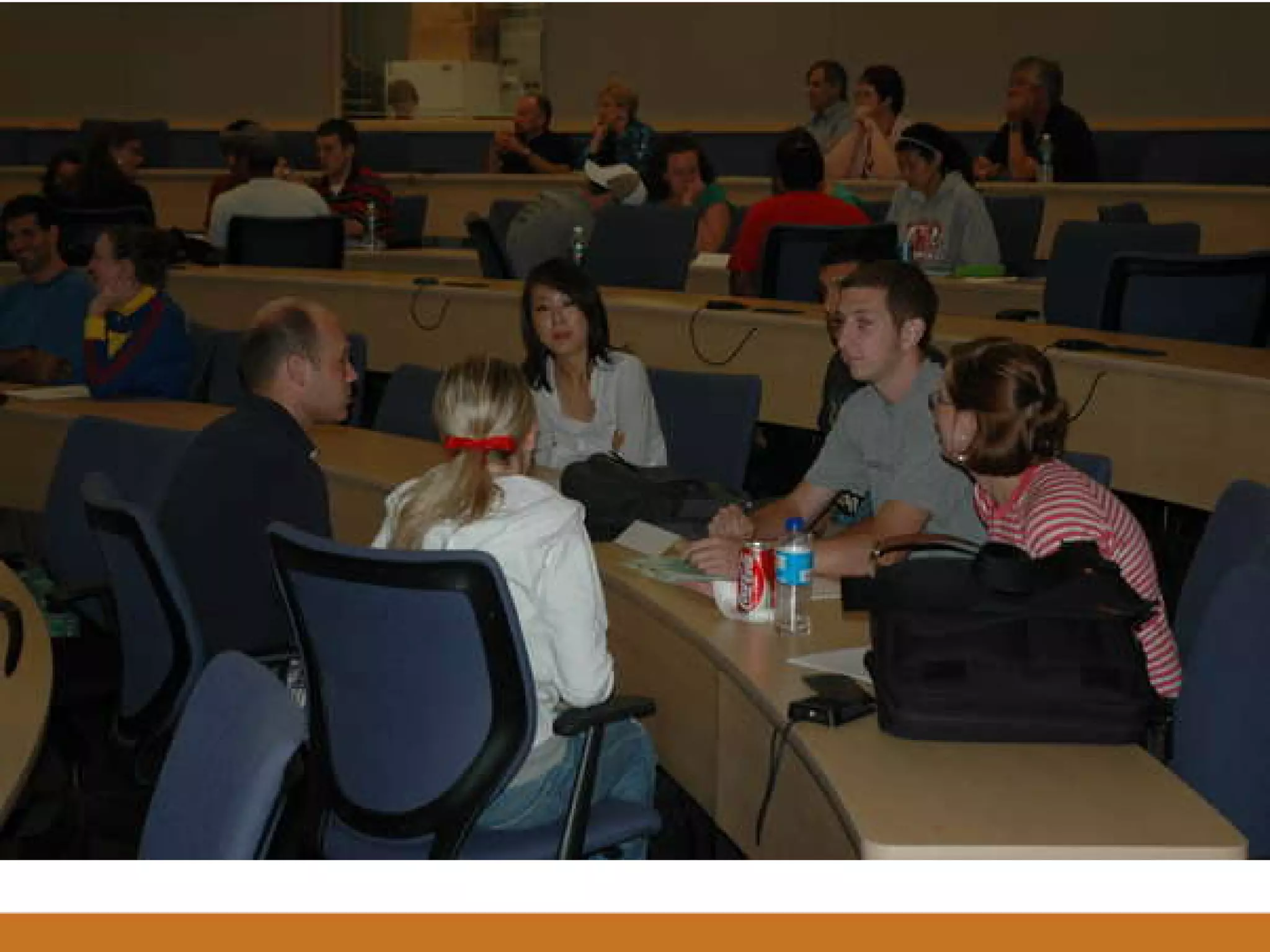
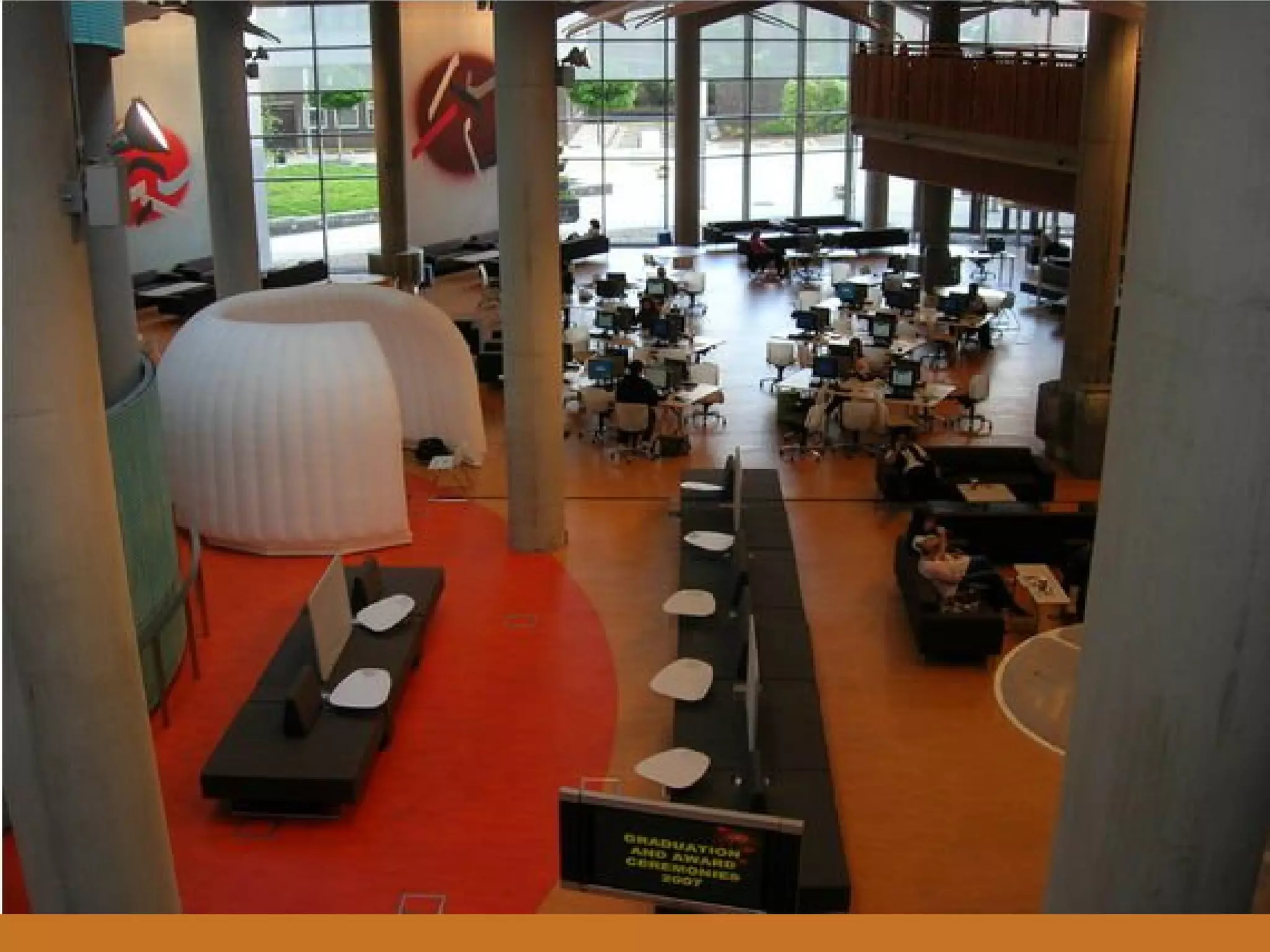
Helping Millennials Learn Design learning spaces for interaction Encourage informal learning and social Remove the dominant ‘large passive lecture hall’ Inverse relationship between distance from lectern and student’s total exam score (Becker 73)  Forcing students to sit in centre seats when they prefer back seats results in a 40% net gain in probability of receiving an A grade (Benedict & Hoag 04)
TBL class 1
TBL class 2
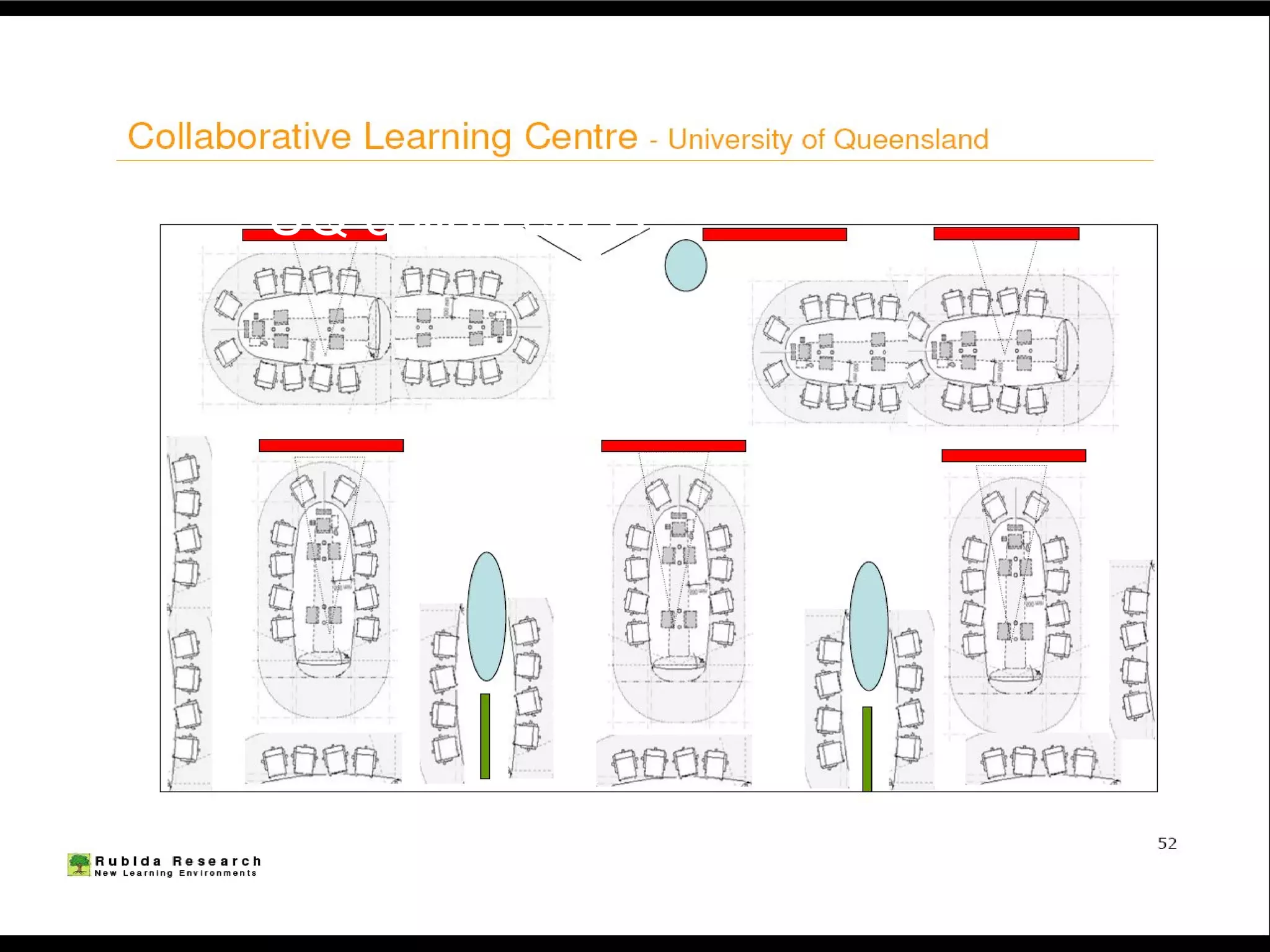
UQ collab class
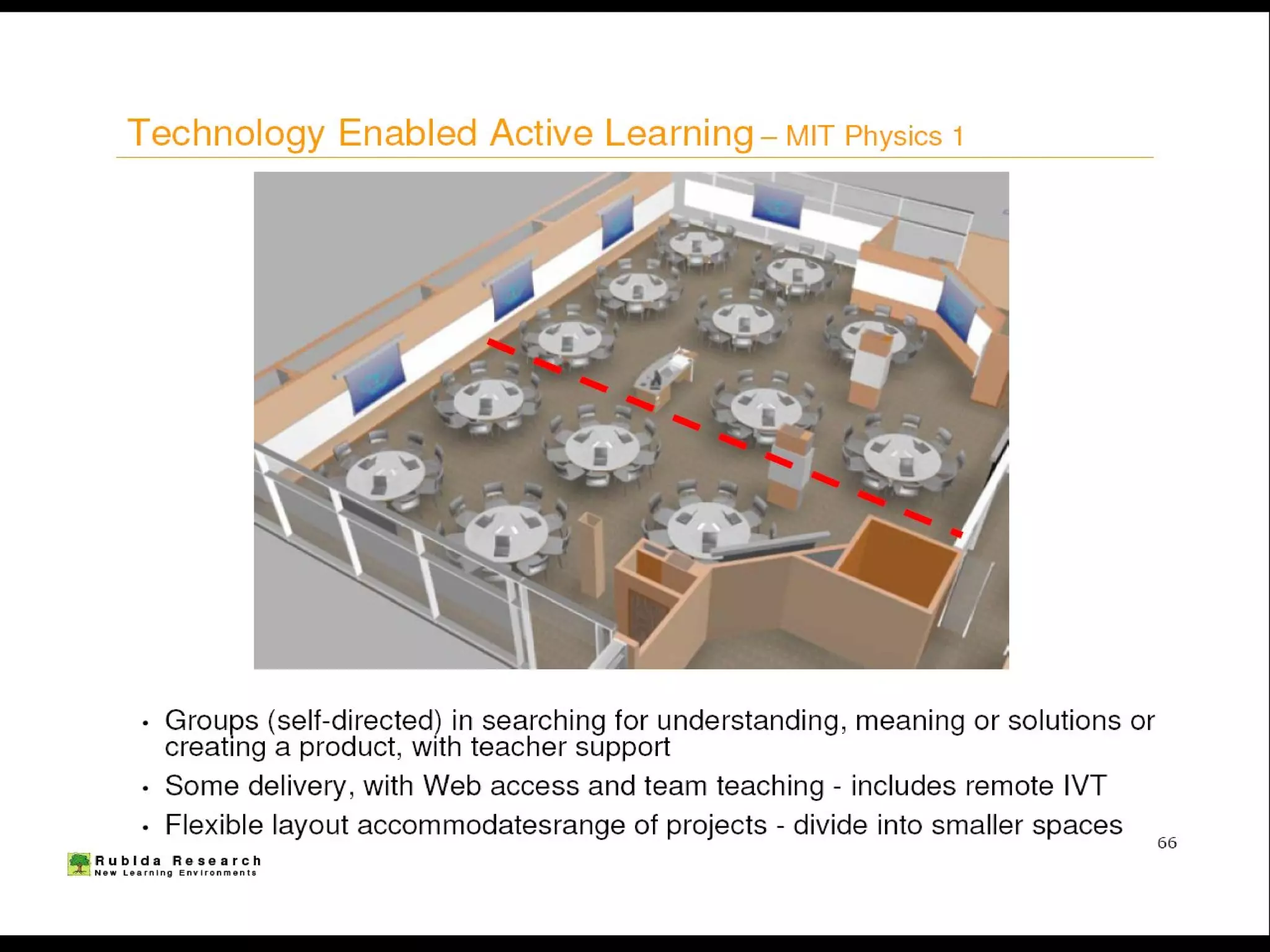
MIT class
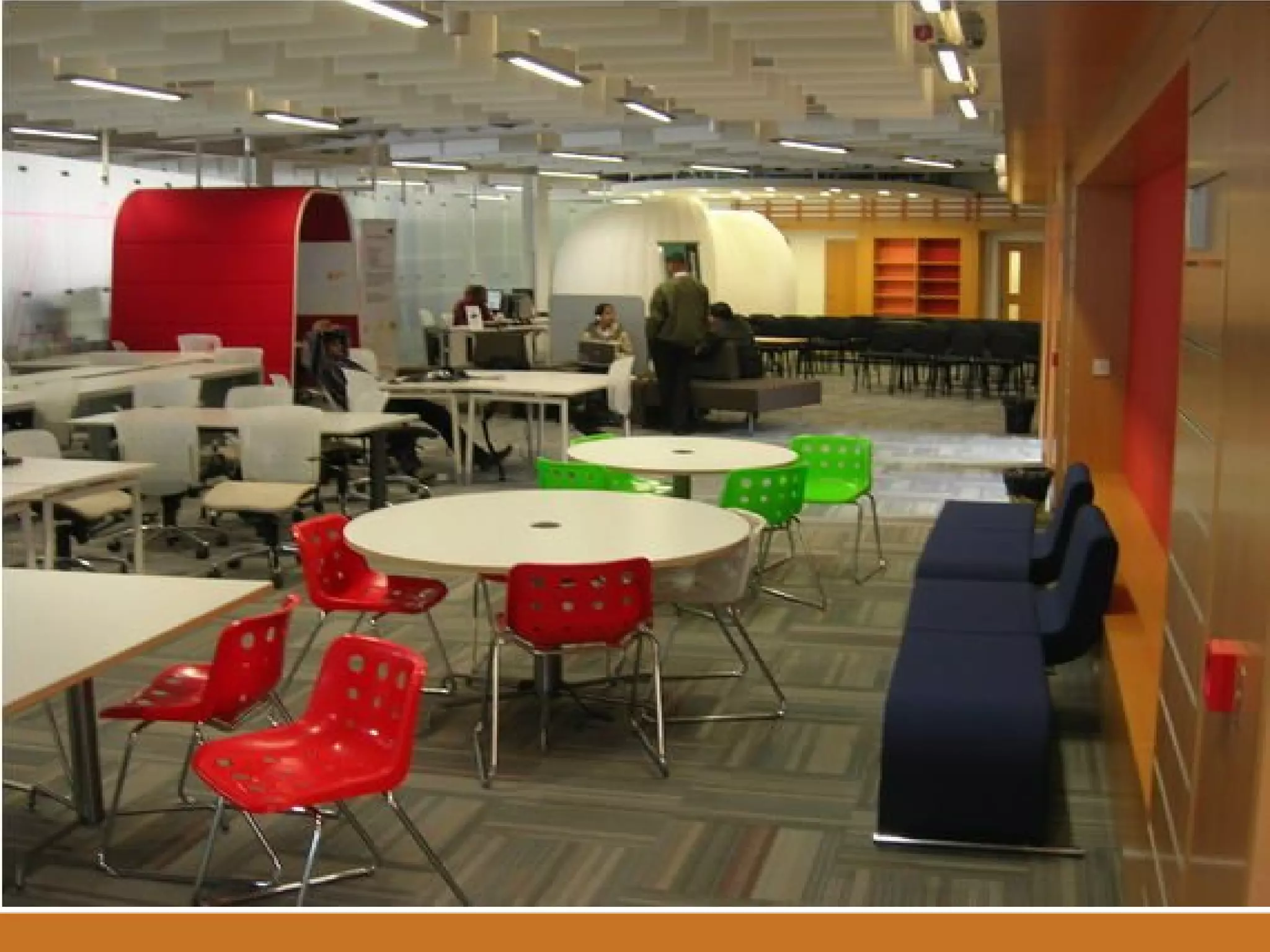
Caledonian flexible space
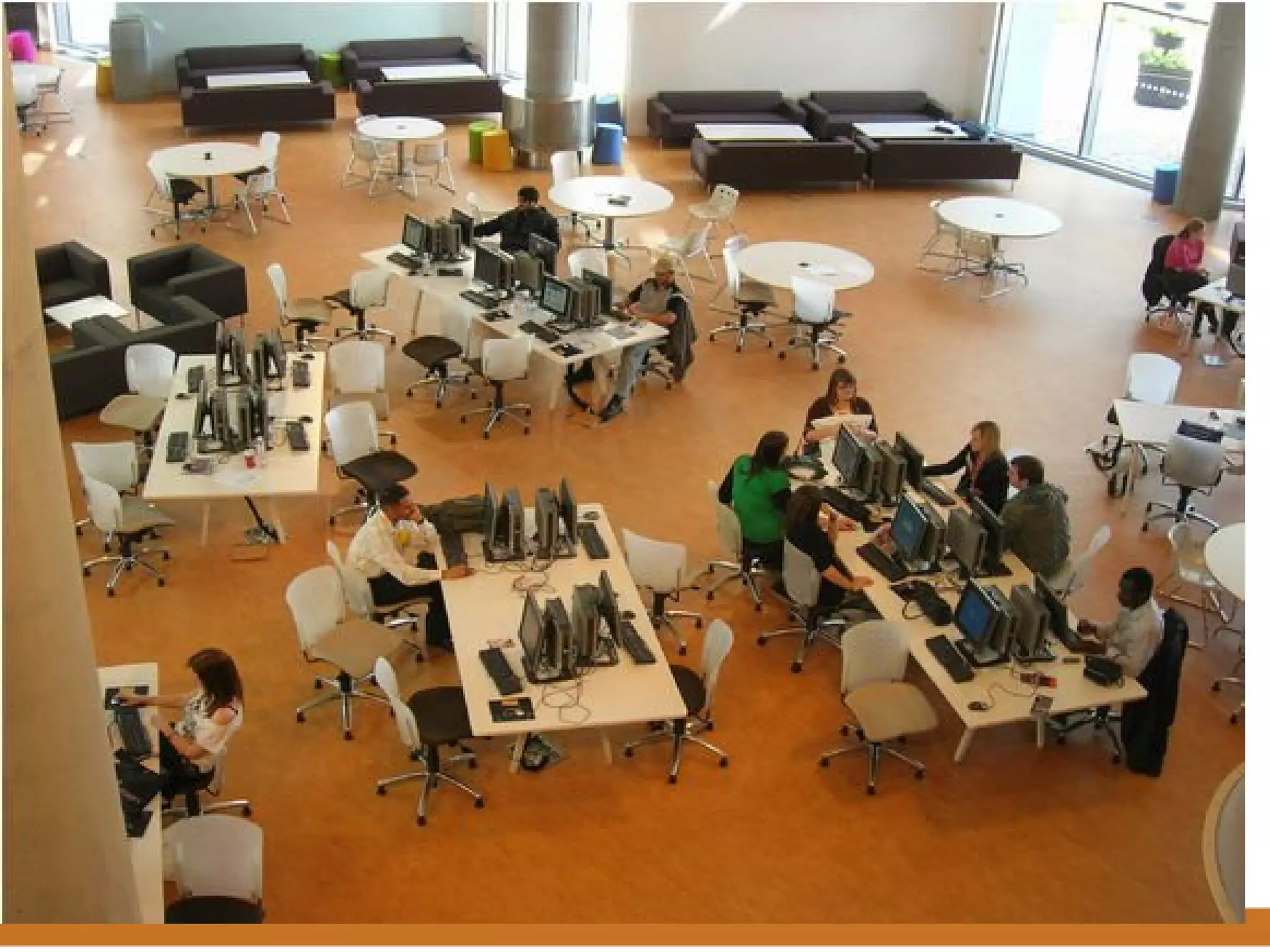
Caledonian informal
Caledonian informal
Helping Millennials Learn 6.  Interactive engagement is the key  Definition:  heads on  (always) &  hands on  (usually)  Co-create knowledge in/out, peers, TA, faculty, administrators, work Feedback as immediate as possible US developed National Survey of Student Engagement (NSSE) in 2000
Good practice designing for learning Encourages student-faculty contact Develops student reciprocity & cooperation Uses active learning techniques Gives prompt feedback Emphasizes time on task Communicates high expectations Respects diverse talents and ways of learning  (Chickering & Gamson, 87;  Chickering & Ehrrmann,  96)
Complete ‘The Minute Paper’  (page 4)
Strategic school-level questions How can we design better learning spaces? How can we harness learning research and technology to improve student interaction and academic efficiency? How can we design better programs? How can AAPBS work strategically to support academic leaders with these in achieving the AAPBS mission?
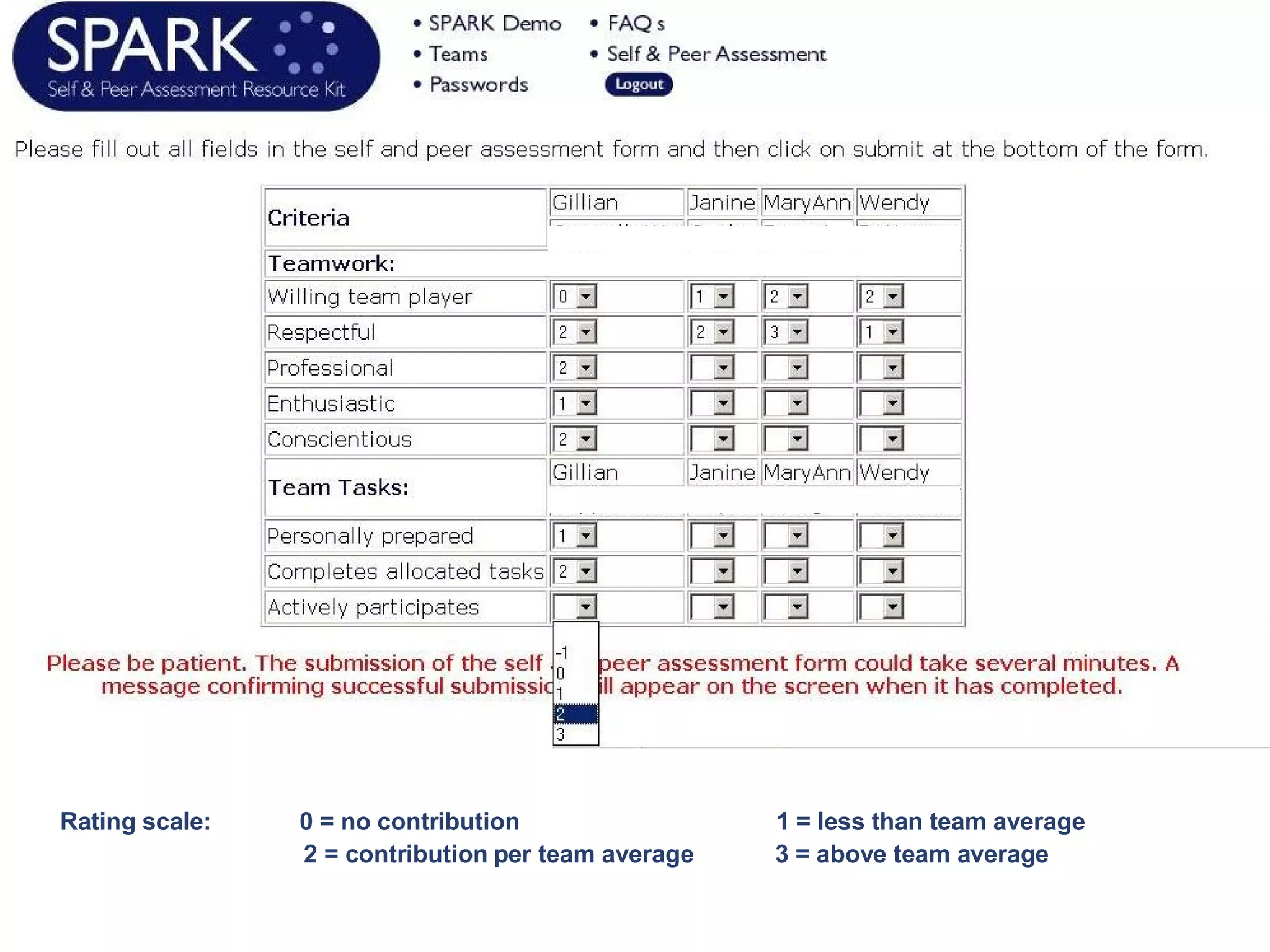
How does SPARK work? Rating scale:  0 = no contribution  1 = less than team average 2 = contribution per team average  3 = above team average
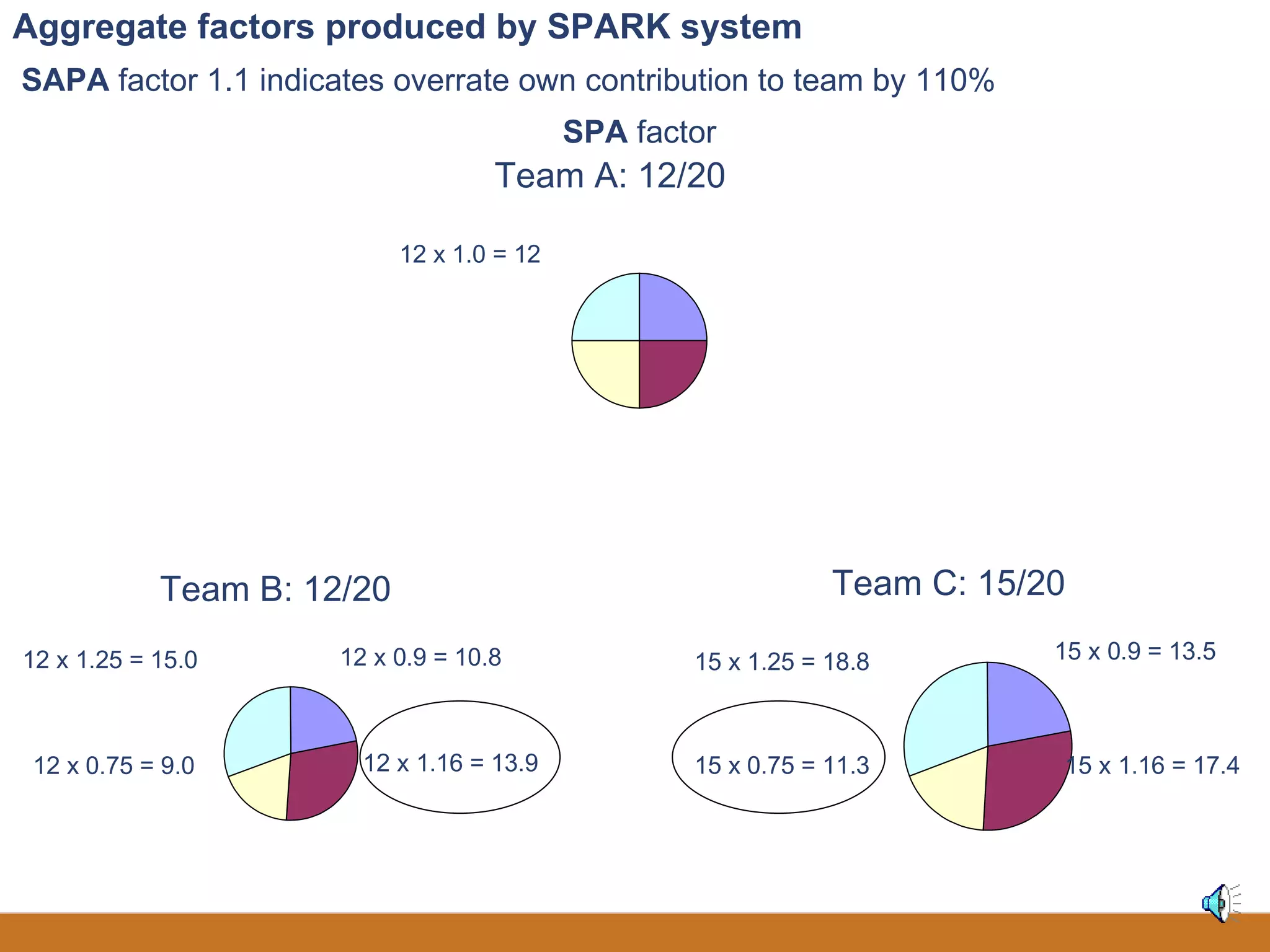
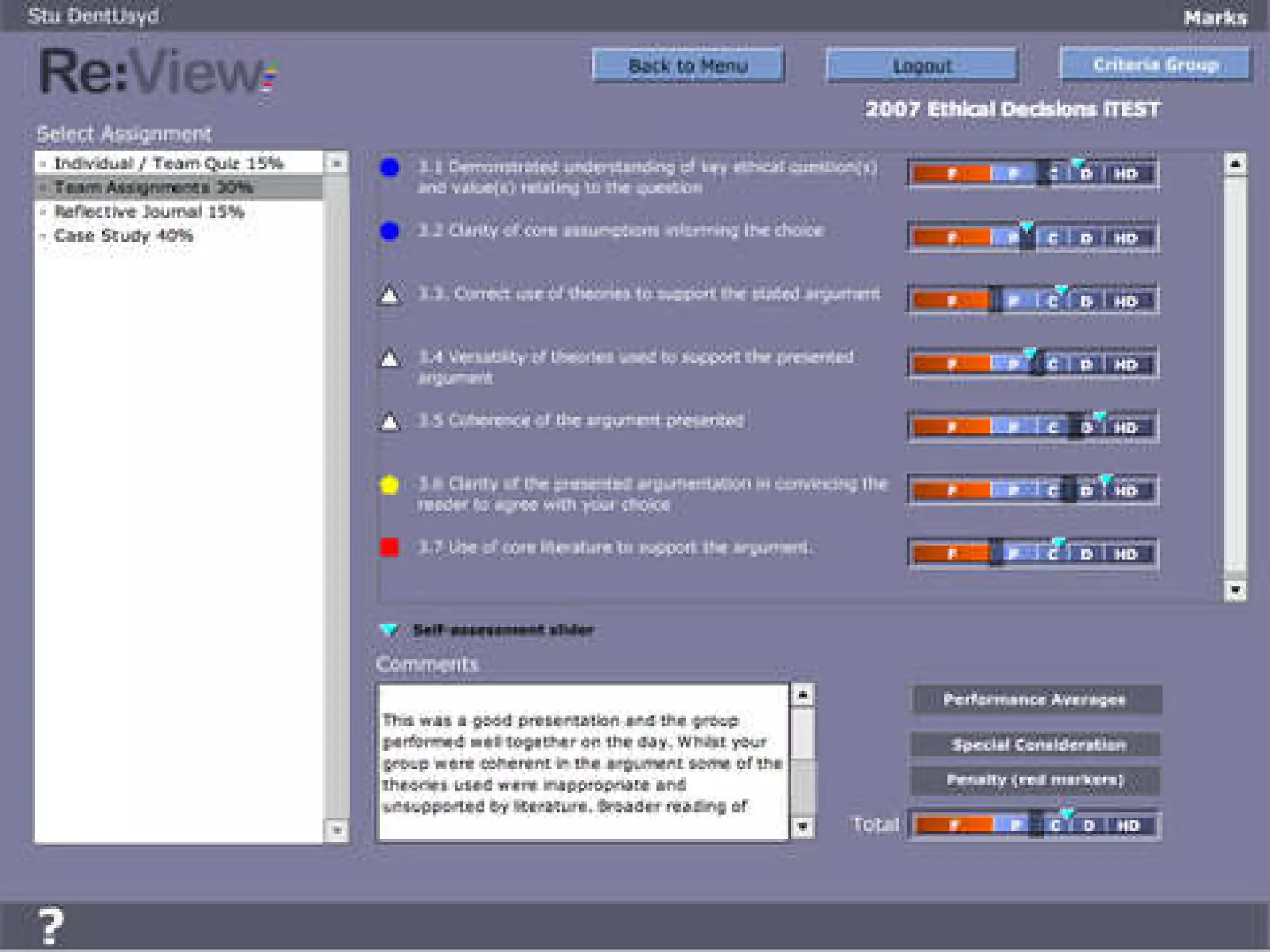
How will SPARK affect marks?  Aggregate factors produced by SPARK system SAPA  factor 1.1 indicates overrate own contribution to team by 110% SPA  factor Team C: 15/20 15 x 0.9 = 13.5 15 x 1.16 = 17.4 15 x 0.75 = 11.3 15 x 1.25 = 18.8 Team B: 12/20 12 x 0.9 = 10.8 12 x 1.16 = 13.9 12 x 1.25 = 15.0 12 x 0.75 = 9.0 Team A: 12/20 12 x 1.0 = 12
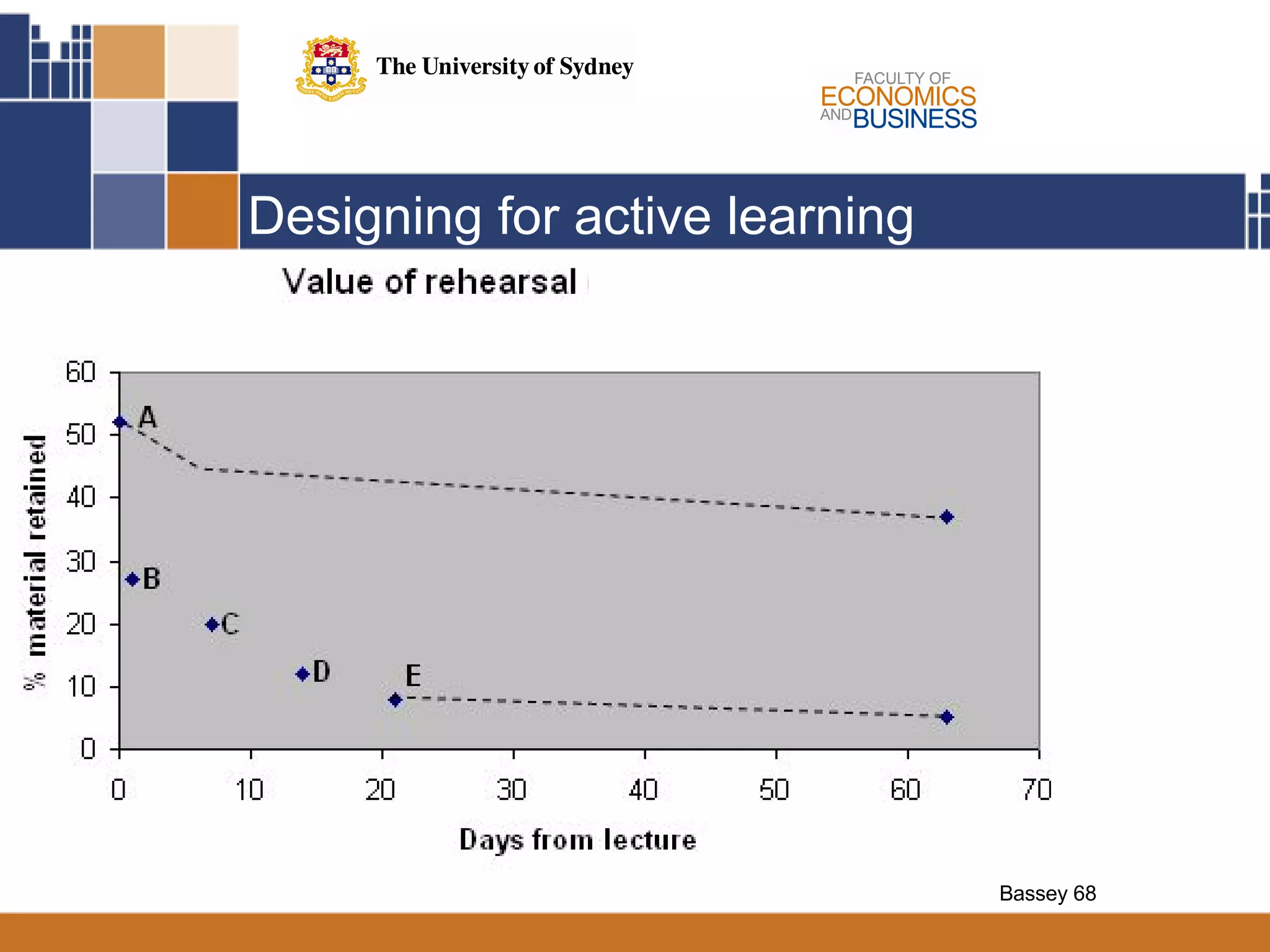
Designing for active learning Bassey 68
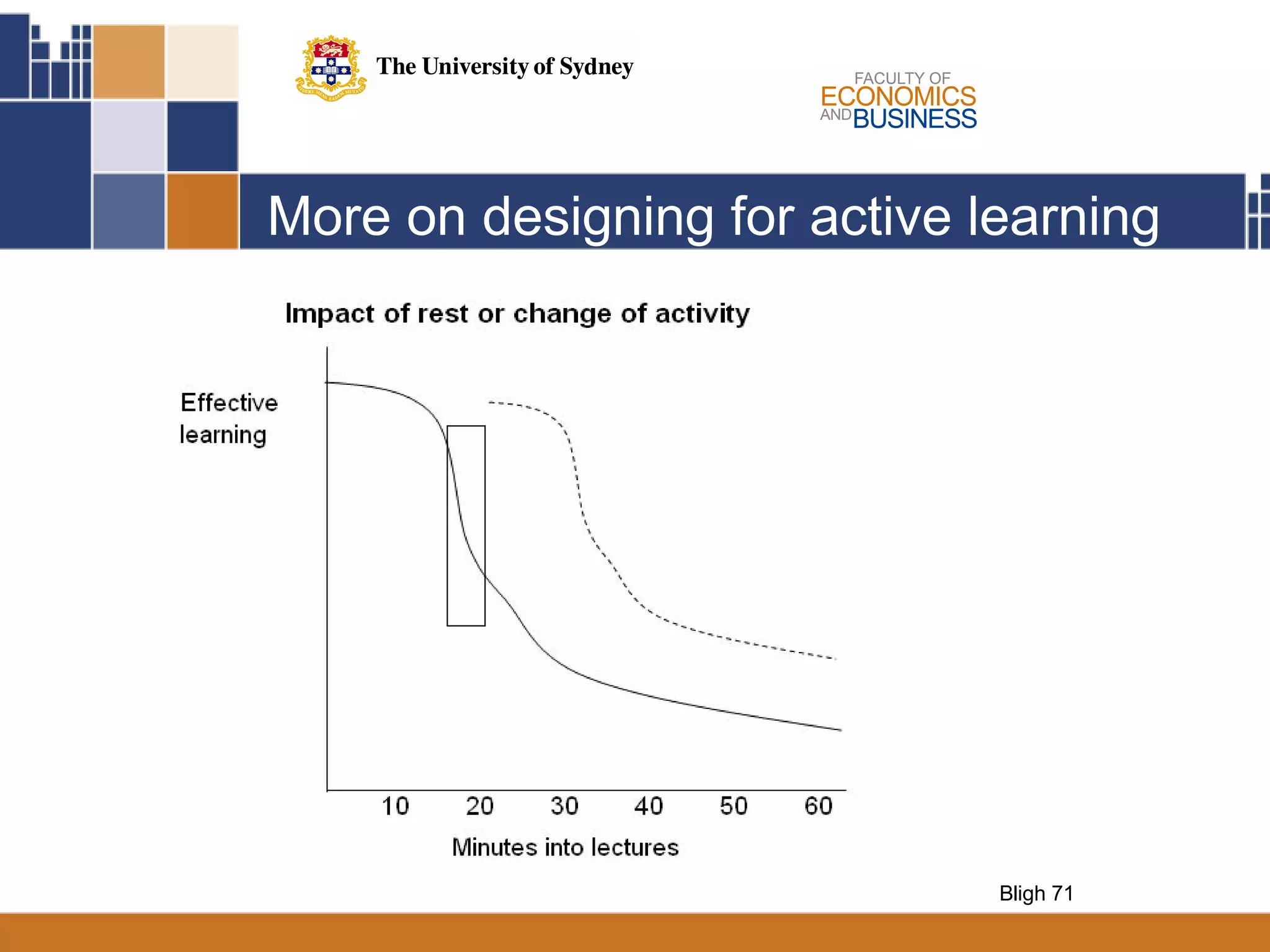
More on designing for active learning Bligh 71
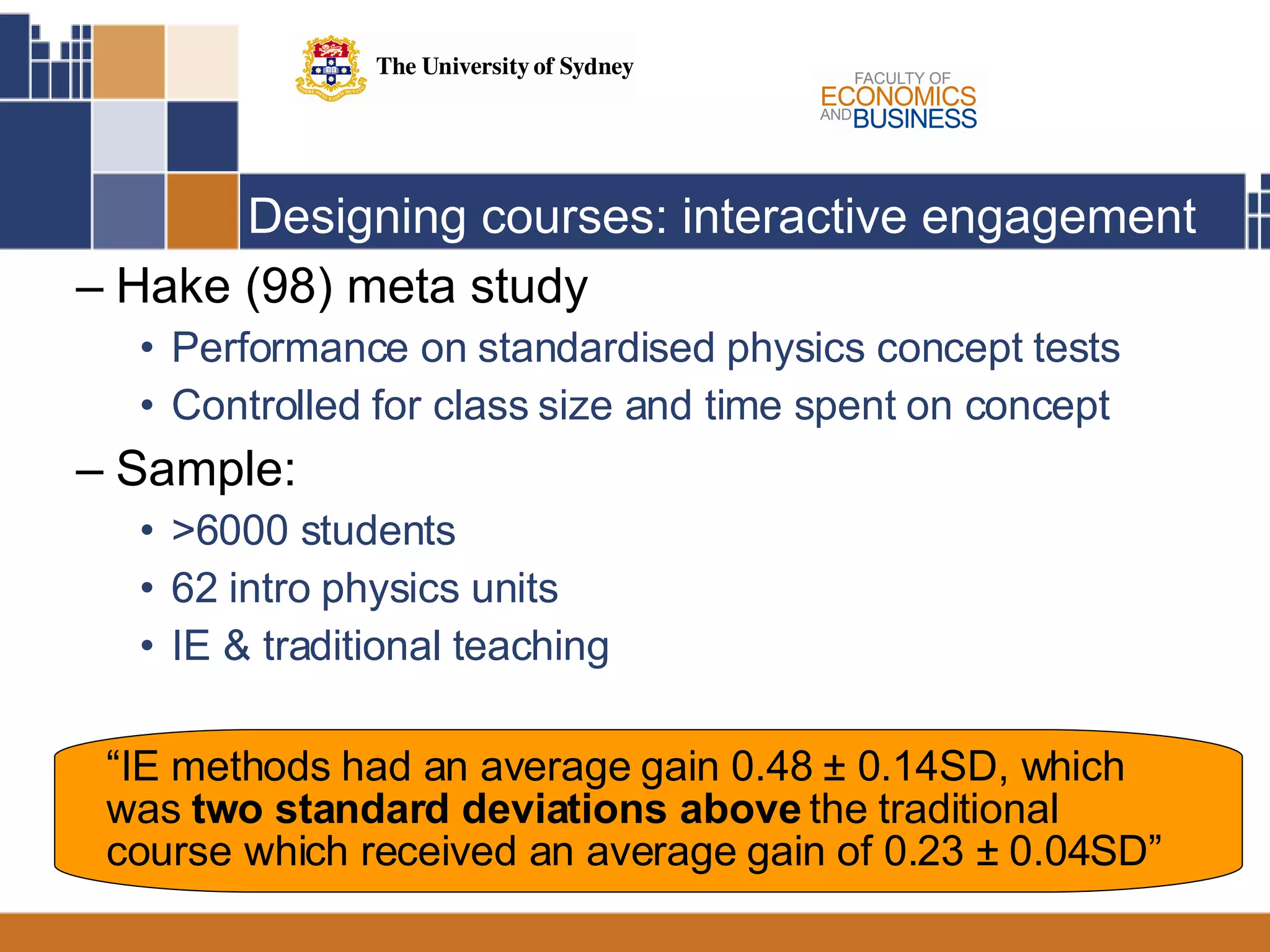
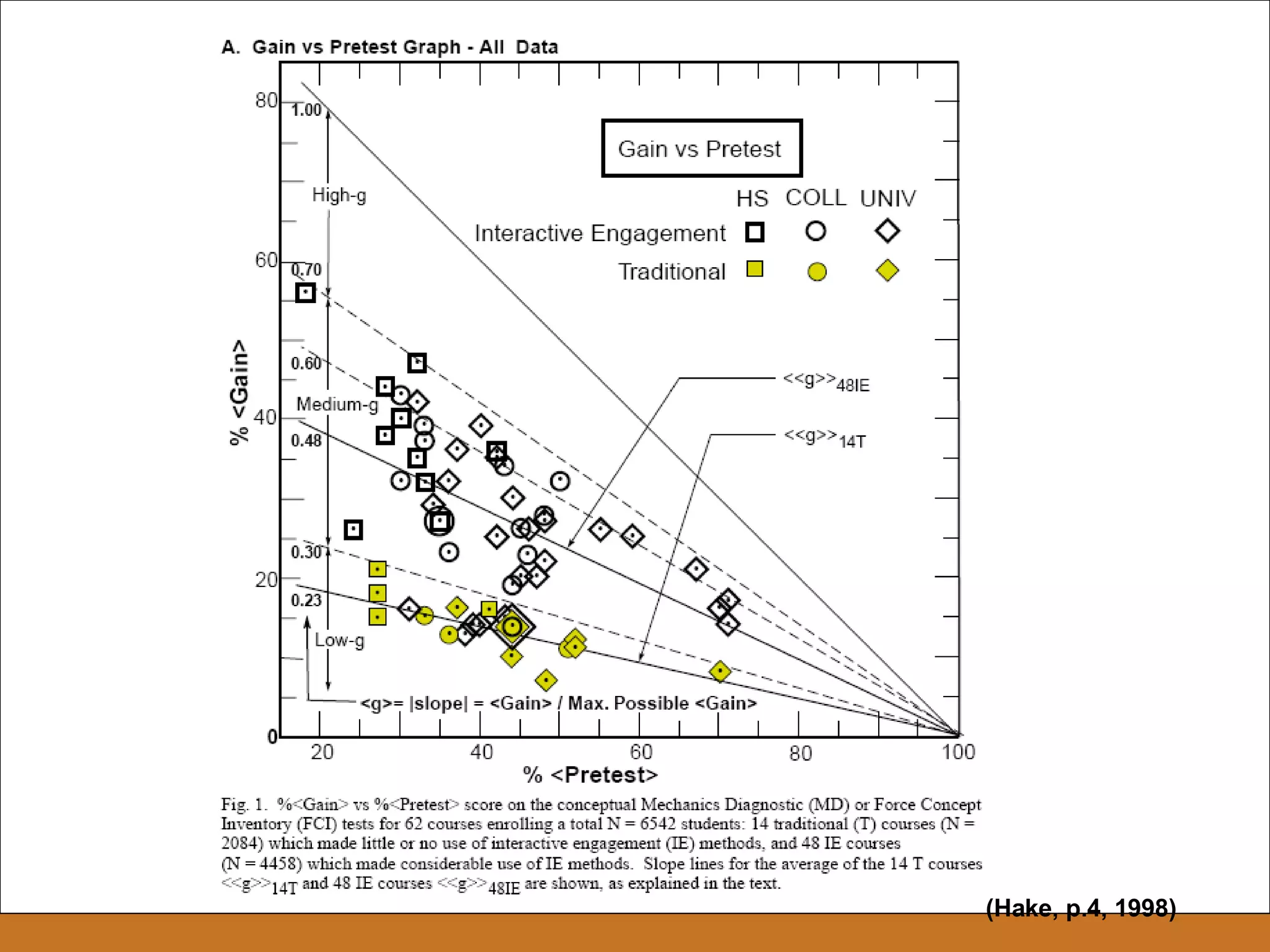
Designing courses: interactive engagement  Hake (98) meta study  Performance on standardised physics concept tests Controlled for class size and time spent on concept Sample:  >6000 students 62 intro physics units IE & traditional teaching  “ IE methods had an average gain 0.48  ± 0.14SD, which was  two standard deviations above  the traditional course which received an average gain of 0.23 ± 0.04SD”
(Hake, p.4, 1998)
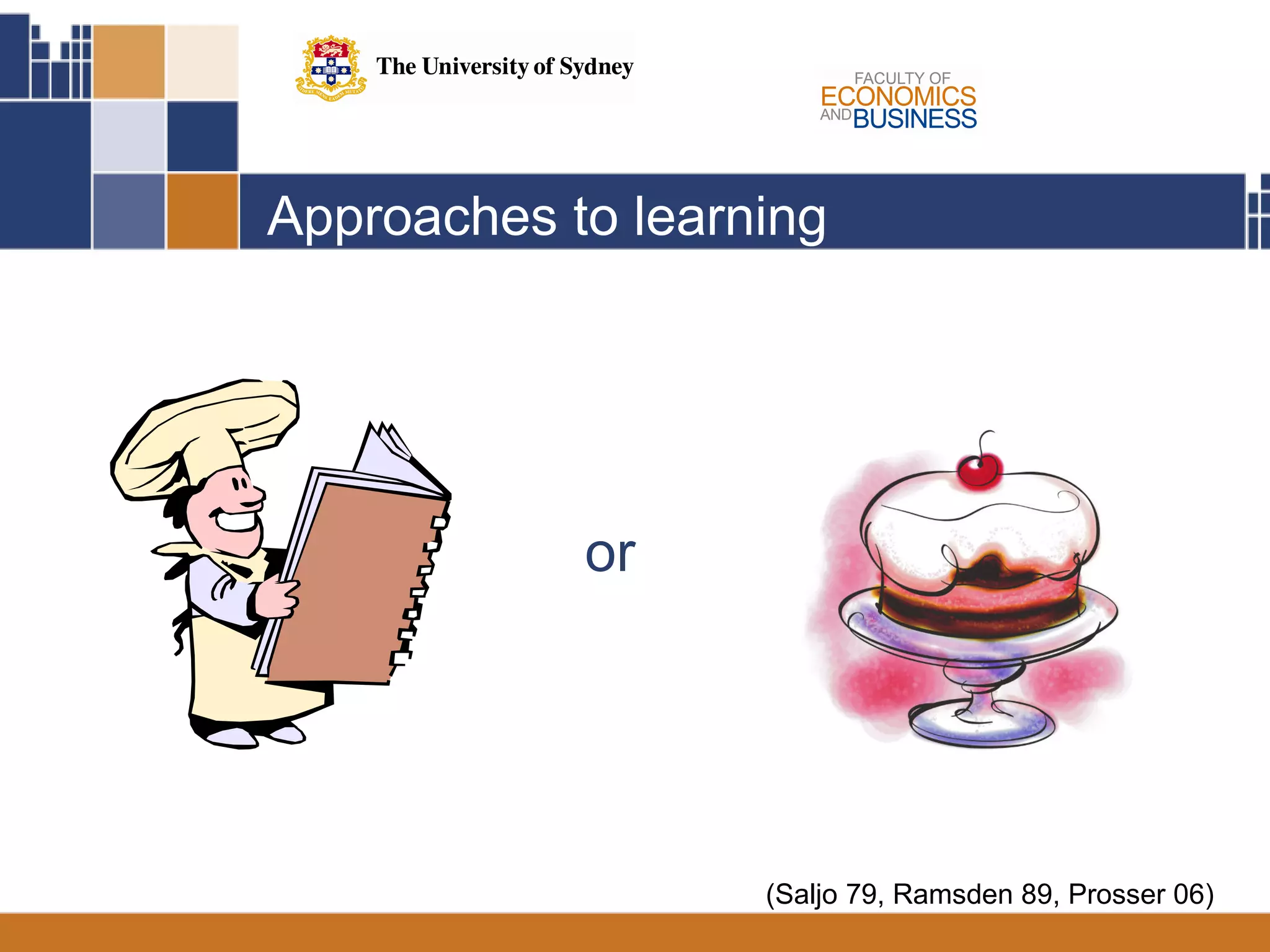
Approaches to learning or (Saljo 79, Ramsden 89, Prosser 06)
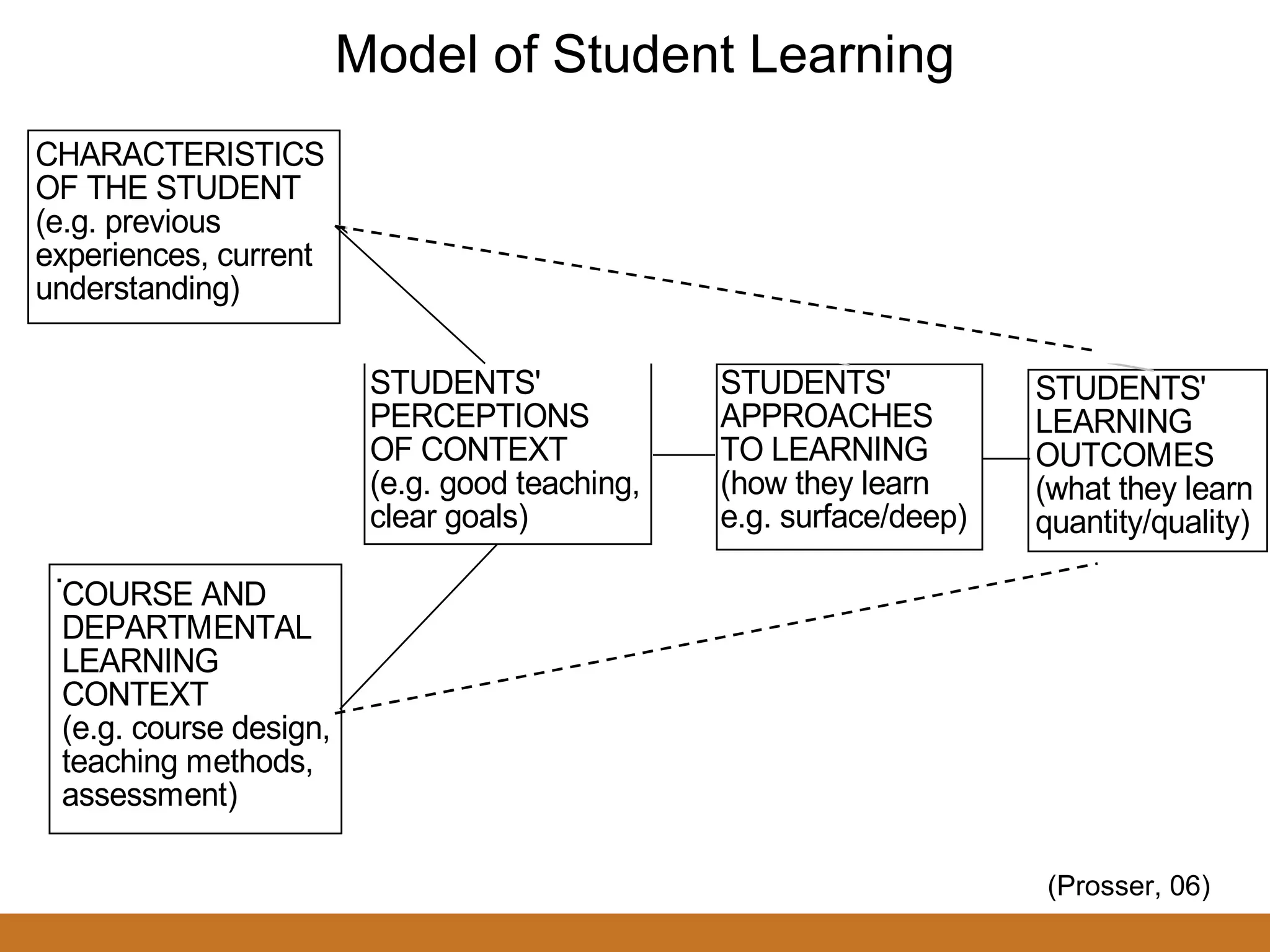
Model of student learning (Prosser 06) Model of Student Learning (Prosser, 06)
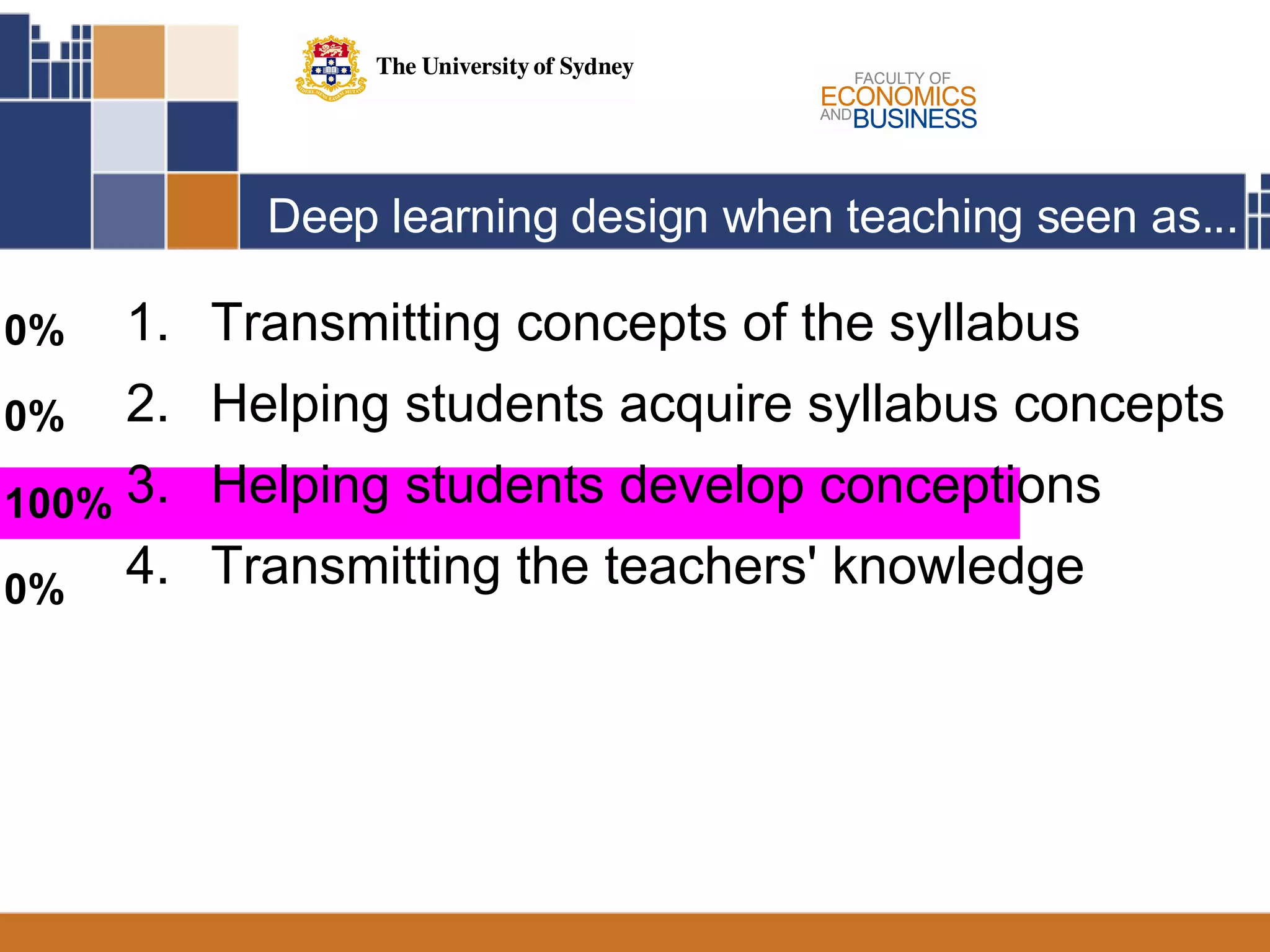
Deep learning design when teaching seen as... Transmitting concepts of the syllabus Helping students acquire syllabus concepts Helping students develop conceptions Transmitting the teachers' knowledge
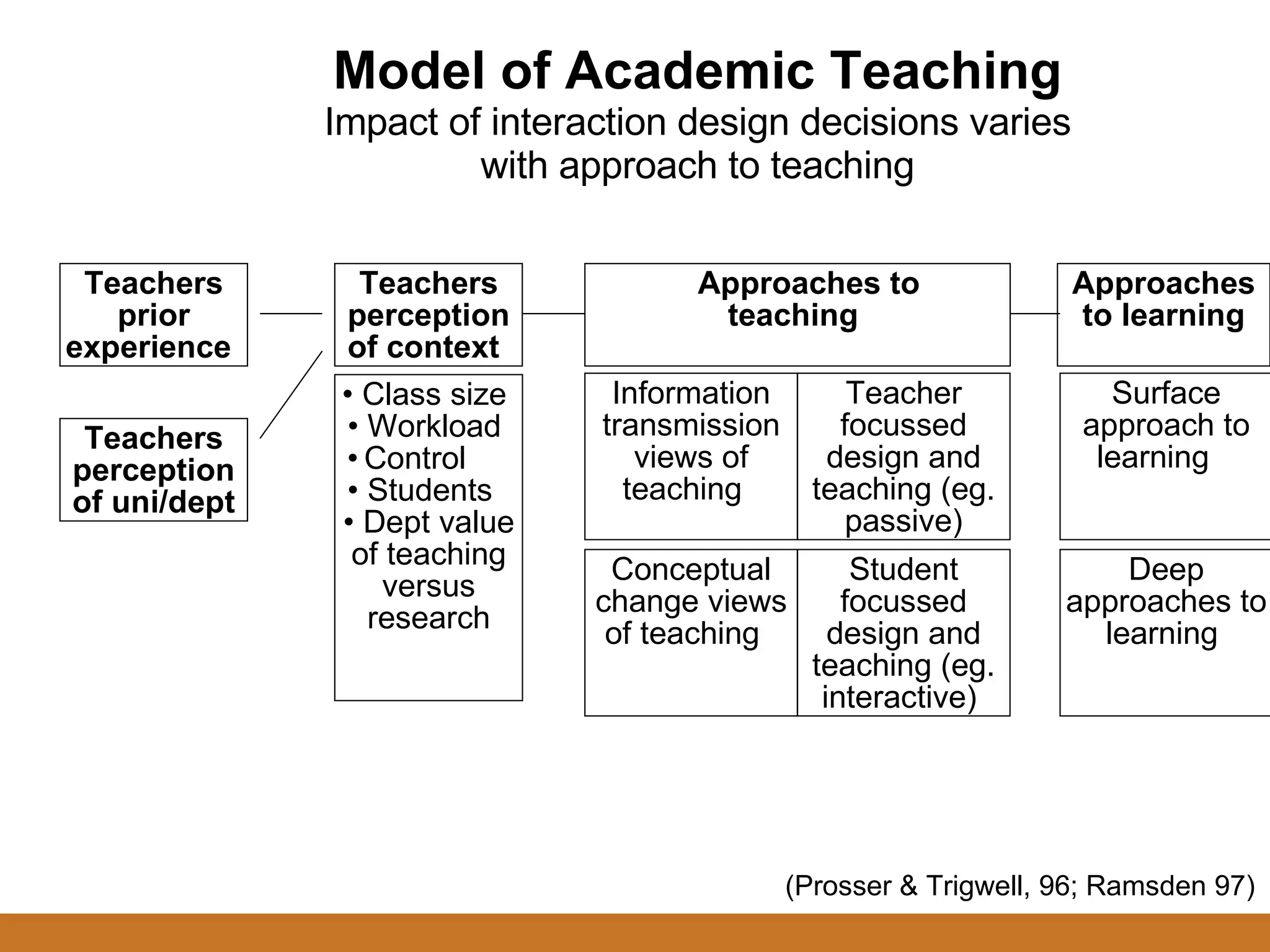
Impact of L&T activities varies with approach  Teachers perception of context ) ccfffcc Approaches to  cccc  teaching  hhhddddddddddddddd Approaches to learning  hh (Prosser & Trigwell, 96; Ramsden 97) •  Class size  •   Workload  •   Control  •   Students  •   Dept value of teaching versus research  hhhhhhhhhhhhhhhhhhhh Teachers prior experience ) Teachers perception of uni/dept Model of Academic Teaching Impact of interaction design decisions varies with approach to teaching Information transmission views of teaching  sface surface) Conceptual change views of teaching   hhhhhhhhhhhhhhhhhhhhhh Teacher focussed design and teaching (eg. passive) Student focussed design and teaching (eg. interactive)  Surface approach to learning  sffface surface) Deep approaches to learning  hffffffffhhhhhhh
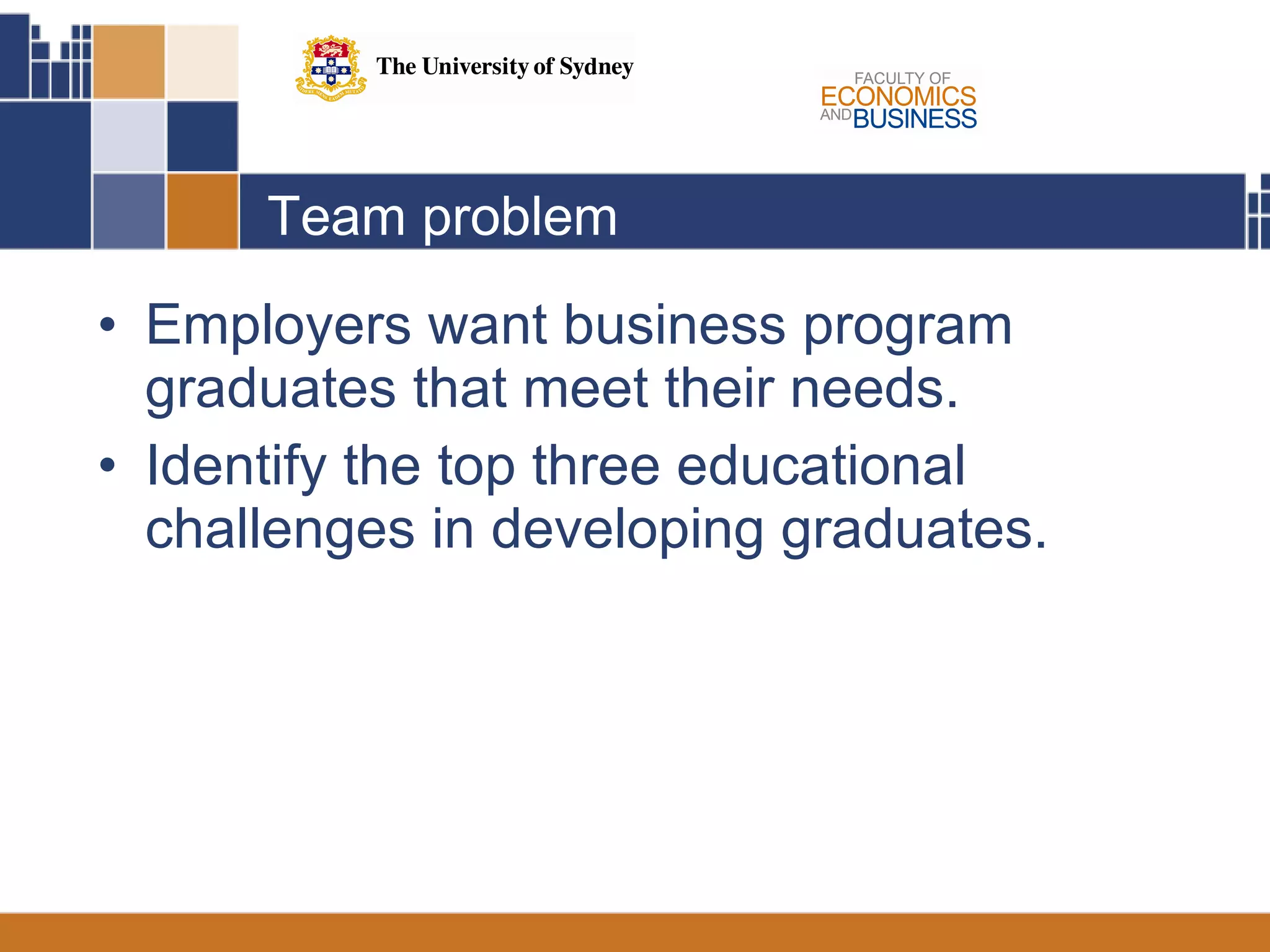
Team problem Employers want business program graduates that meet their needs.  Identify the top three educational challenges in developing graduates.
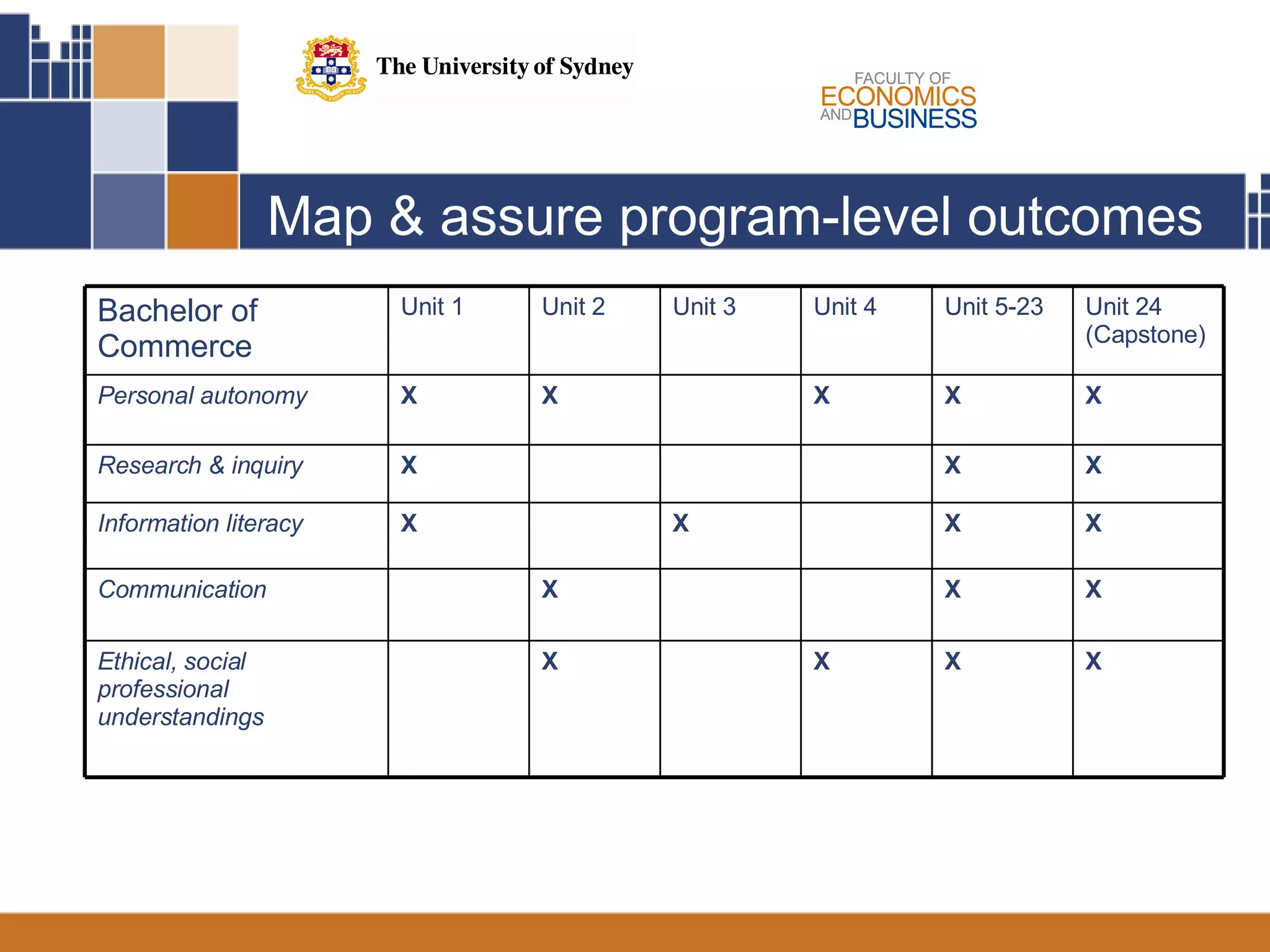
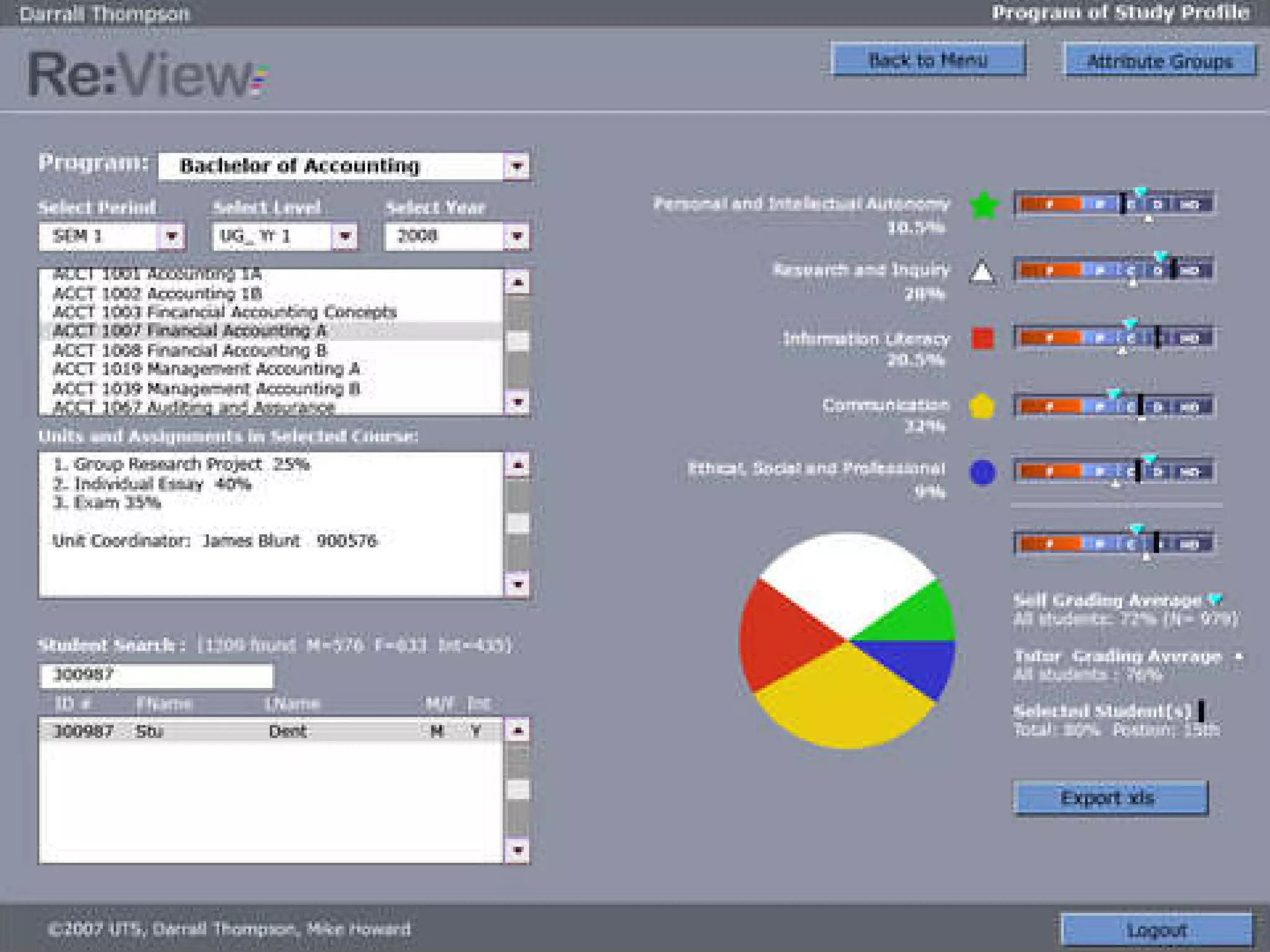
Map & assure program-level outcomes  X X X X X Unit 5-23 X X X X X Unit 24 (Capstone) X X Ethical, social professional understandings X Communication X X Information literacy X Research & inquiry X X X Personal autonomy Unit 4 Unit 3 Unit 2 Unit 1 Bachelor of Commerce
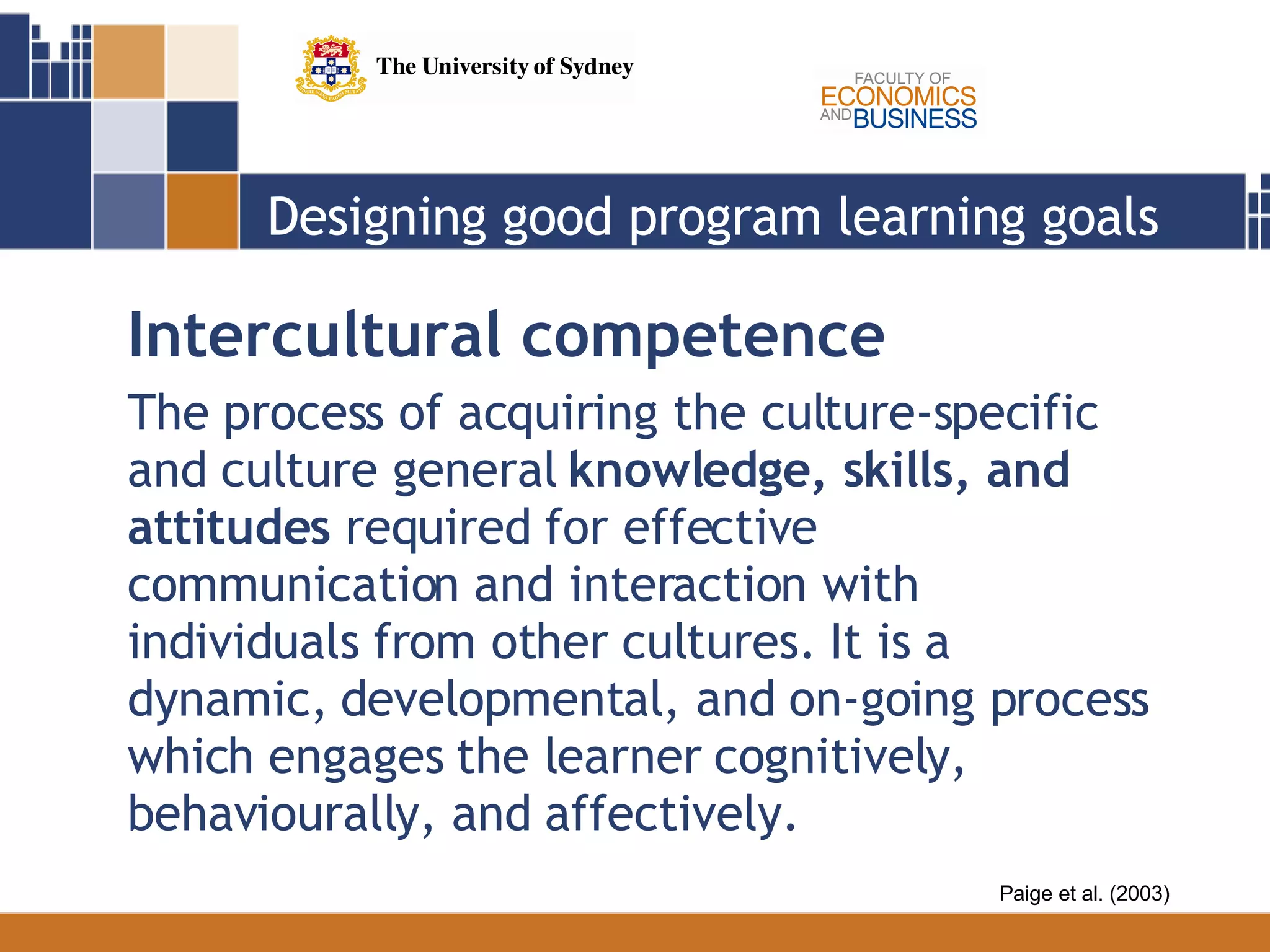
Designing good program learning goals Intercultural competence The process of acquiring the culture-specific and culture general  knowledge, skills, and attitudes  required for effective communication and interaction with individuals from other cultures. It is a dynamic, developmental, and on-going process which engages the learner cognitively, behaviourally, and affectively.  Paige et al. (2003)
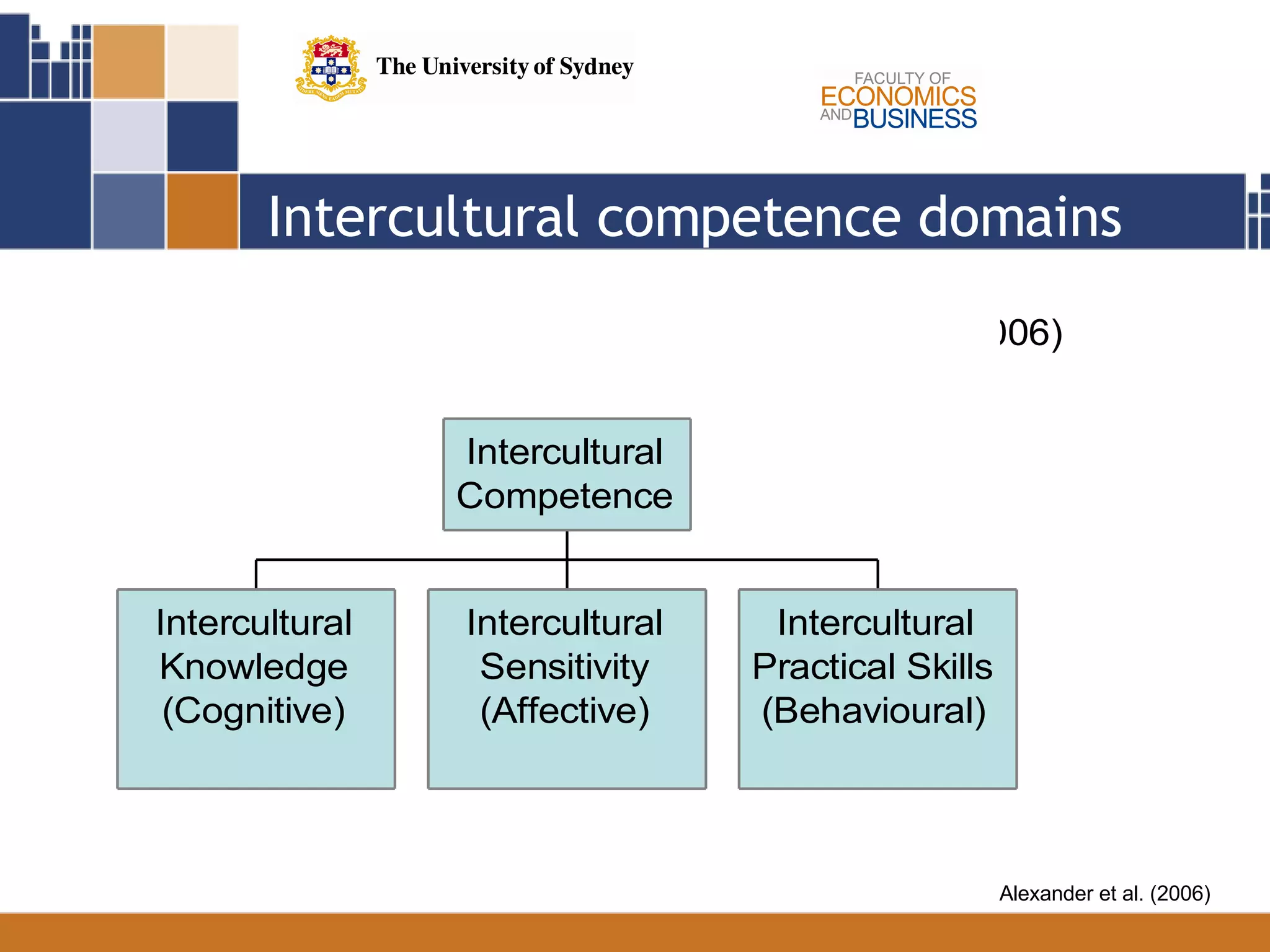
Intercultural competence domains Alexander et al. (2006)
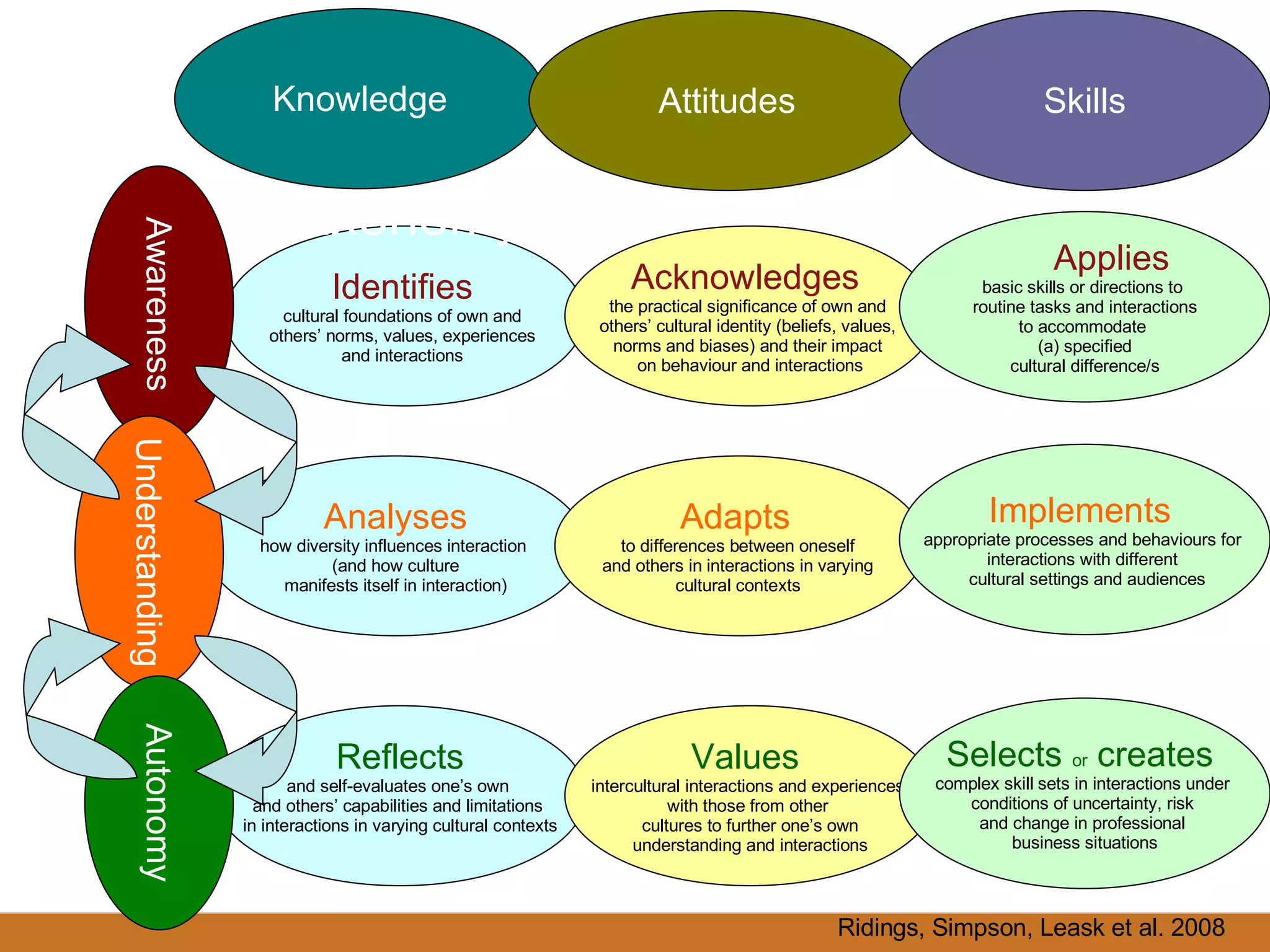
Taxonomy DIC 3 3 3 3 3 3 3 Knowledge Identifies   cultural foundations of own and  others’ norms, values, experiences  and interactions  Analyses  how diversity influences interaction  (and how culture manifests itself in interaction) Reflects and self-evaluates one’s own  and others’ capabilities and limitations  in interactions in varying cultural contexts Attitudes Acknowledges  the practical significance of own and  others’ cultural identity (beliefs, values,  norms and biases) and their impact  on behaviour and interactions Values  intercultural interactions and experiences  with those from other  cultures to further one’s own understanding and interactions Adapts  to differences between oneself  and others in interactions in varying  cultural contexts  Skills Implements  appropriate processes and behaviours for  interactions with different  cultural settings and audiences Selects  or  creates  complex skill sets in interactions under  conditions of uncertainty, risk  and change in professional  business situations Applies   basic skills or directions to  routine tasks and interactions to accommodate  (a) specified cultural difference/s Awareness Understanding Autonomy Ridings, Simpson, Leask et al. 2008
 
acctg
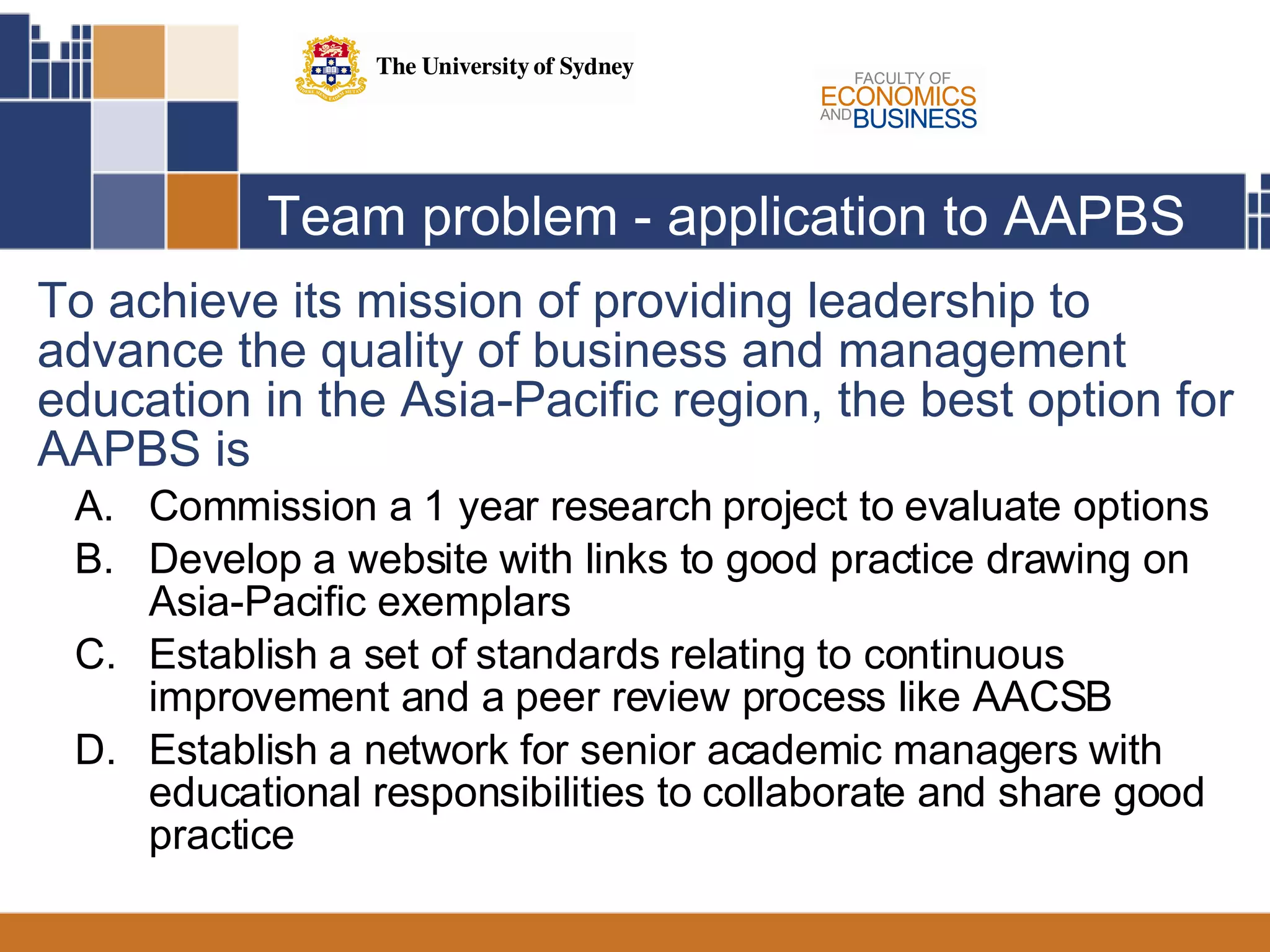
Team problem - application to AAPBS To achieve its mission of providing leadership to advance the quality of business and management education in the Asia-Pacific region, the best option for AAPBS is Commission a 1 year research project to evaluate options Develop a website with links to good practice drawing on Asia-Pacific exemplars Establish a set of standards relating to continuous improvement and a peer review process like AACSB Establish a network for senior academic managers with educational responsibilities to collaborate and share good practice
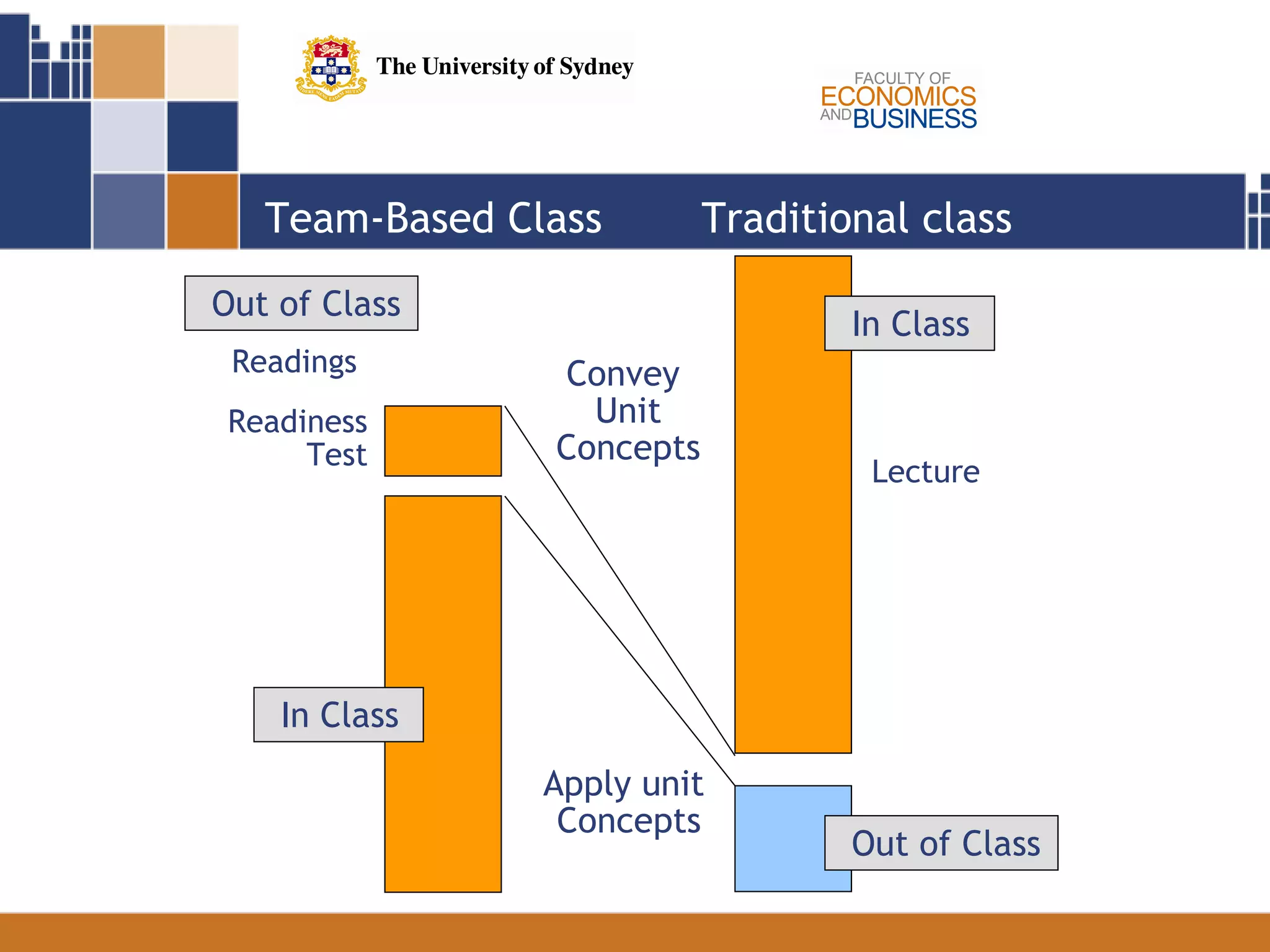
Convey Unit Concepts Apply unit Concepts Traditional class Team-Based Class Readiness Test Readings Lecture In Class Out of Class In Class Out of Class
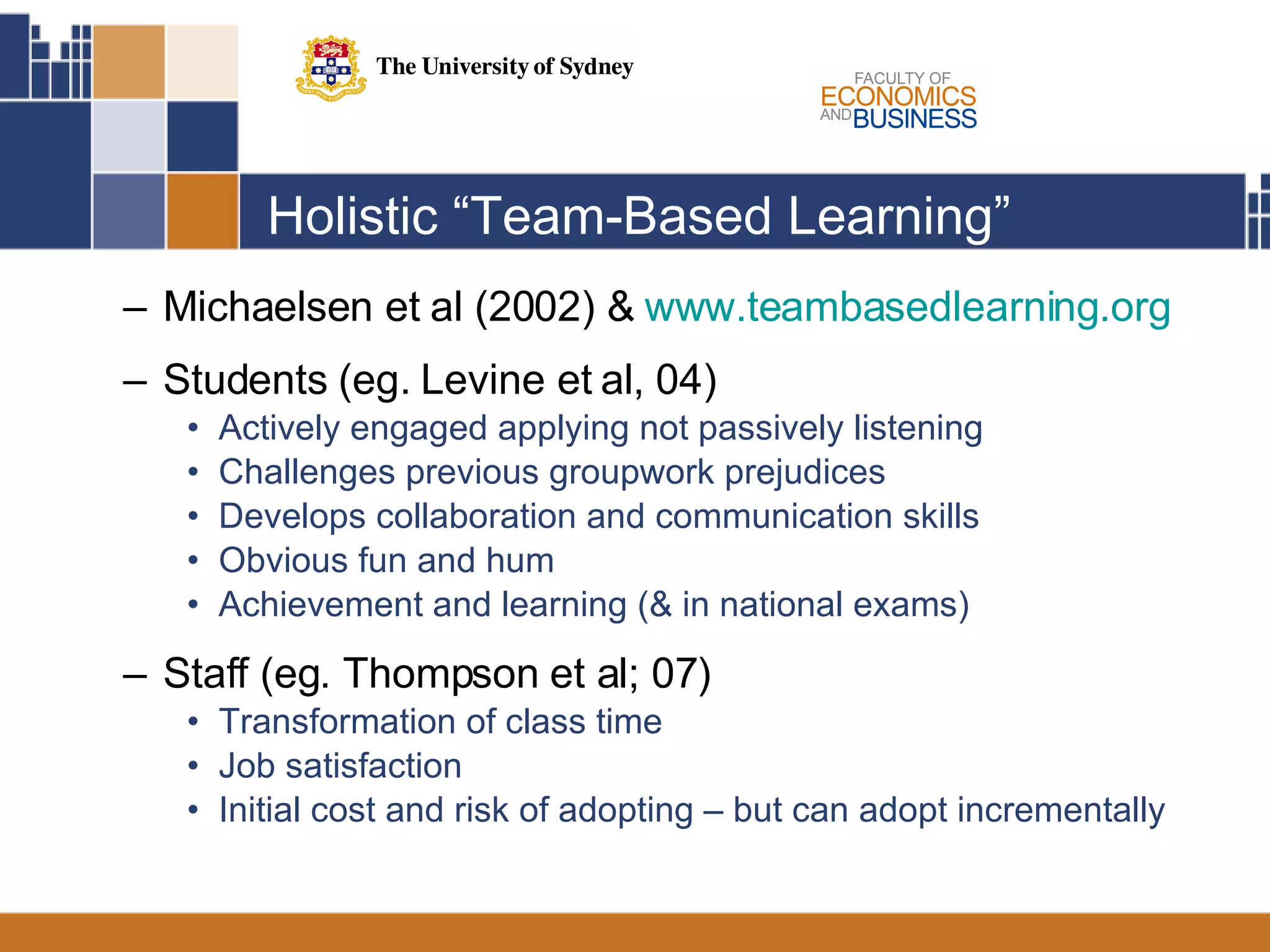
Holistic “Team-Based Learning” Michaelsen et al (2002) &  www.teambasedlearning.org Students (eg. Levine et al, 04) Actively engaged applying not passively listening Challenges previous groupwork prejudices Develops collaboration and communication skills Obvious fun and hum Achievement and learning (& in national exams) Staff (eg. Thompson et al; 07) Transformation of class time Job satisfaction  Initial cost and risk of adopting – but can adopt incrementally
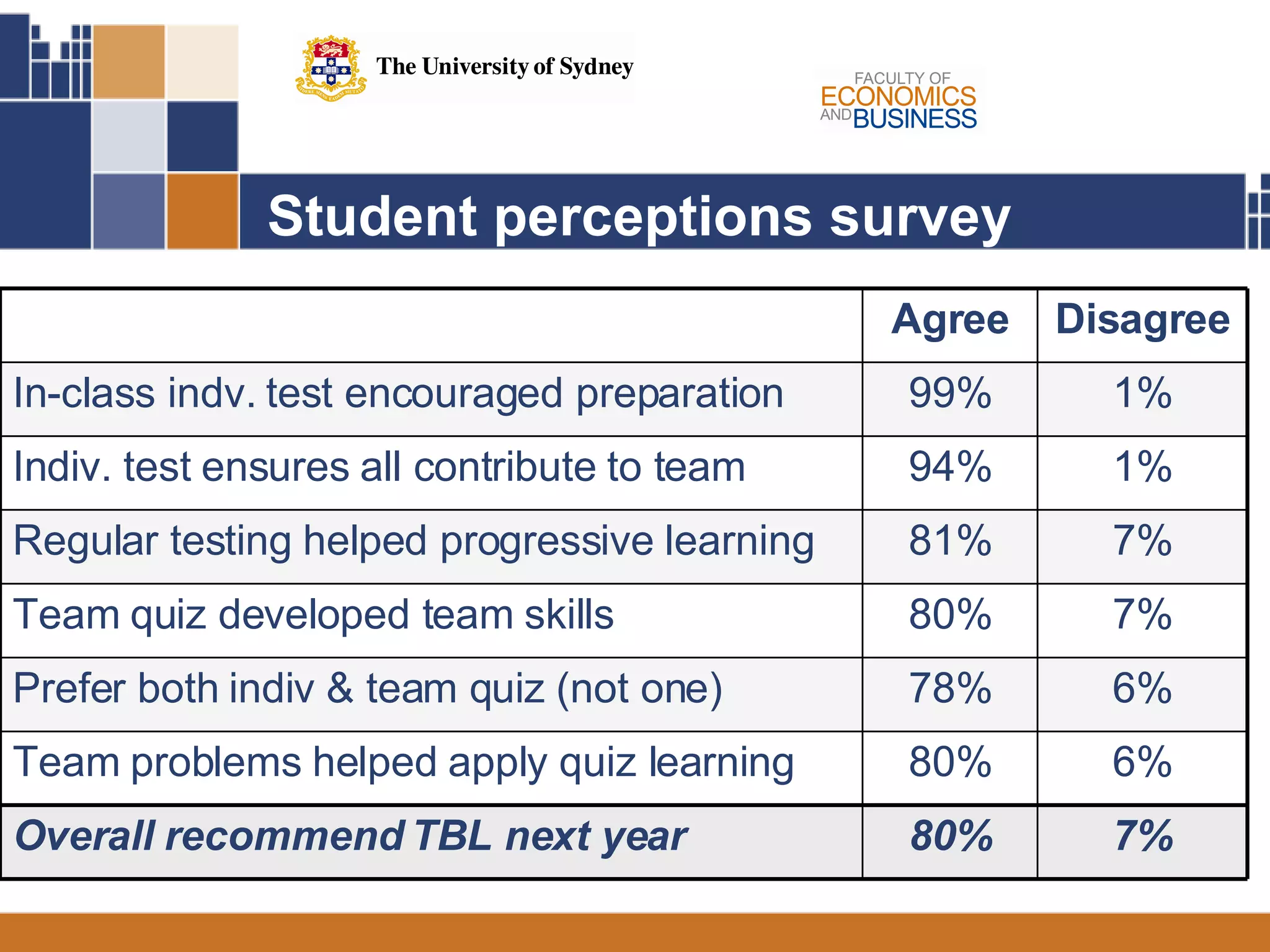
Student perceptions survey 7% 80% Overall recommend TBL next year 6% 78% Prefer both indiv & team quiz (not one) 7% 80% Team quiz developed team skills 1% 94% Indiv. test ensures all contribute to team 1% 99% In-class indv. test encouraged preparation 6% 80% Team problems helped apply quiz learning 7% 81% Regular testing helped progressive learning Disagree Agree
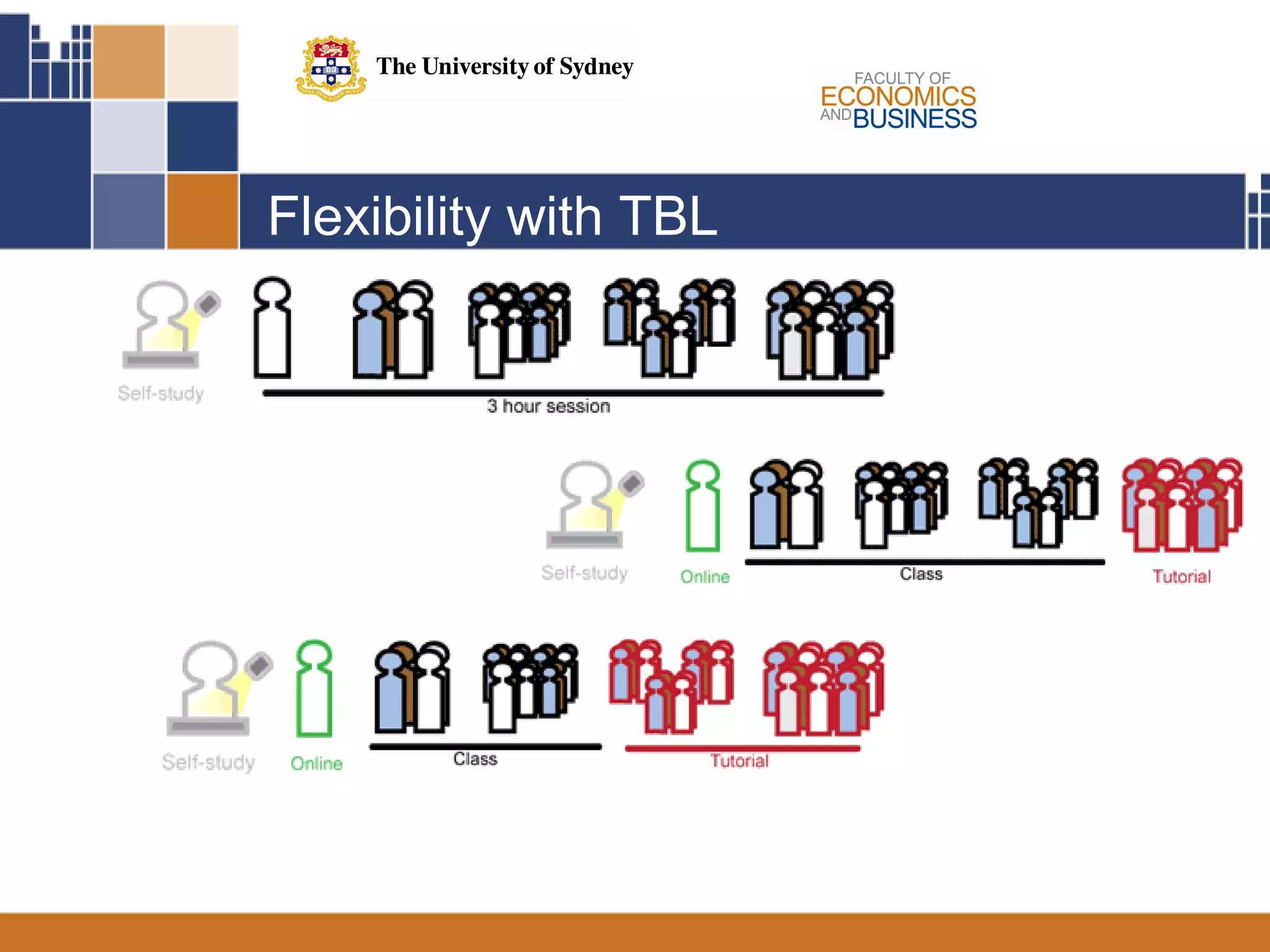
Flexibility with TBL
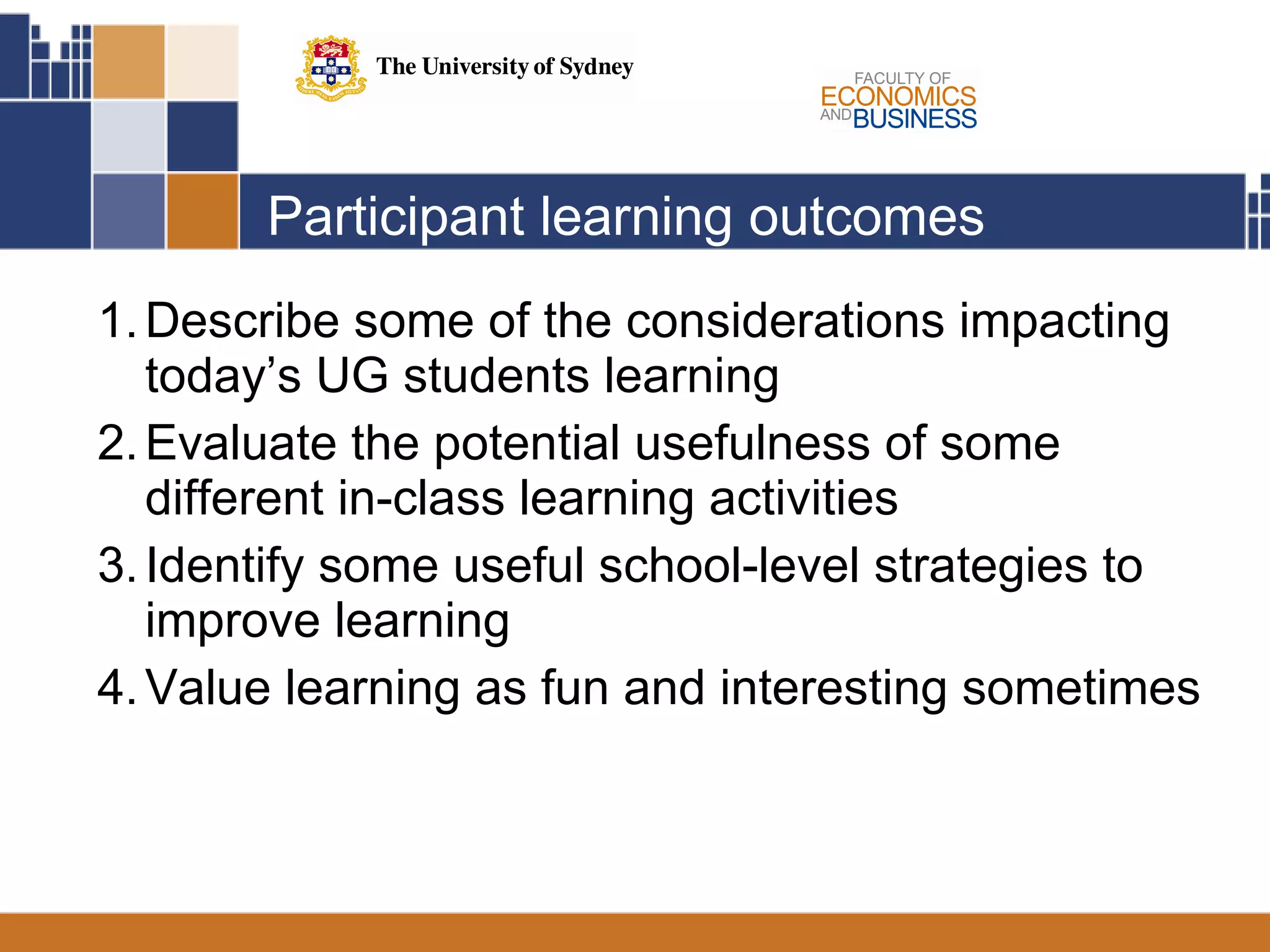
Participant learning outcomes Describe some of the considerations impacting today’s UG students learning Evaluate the potential usefulness of some different in-class learning activities Identify some useful school-level strategies to improve learning Value learning as fun and interesting sometimes
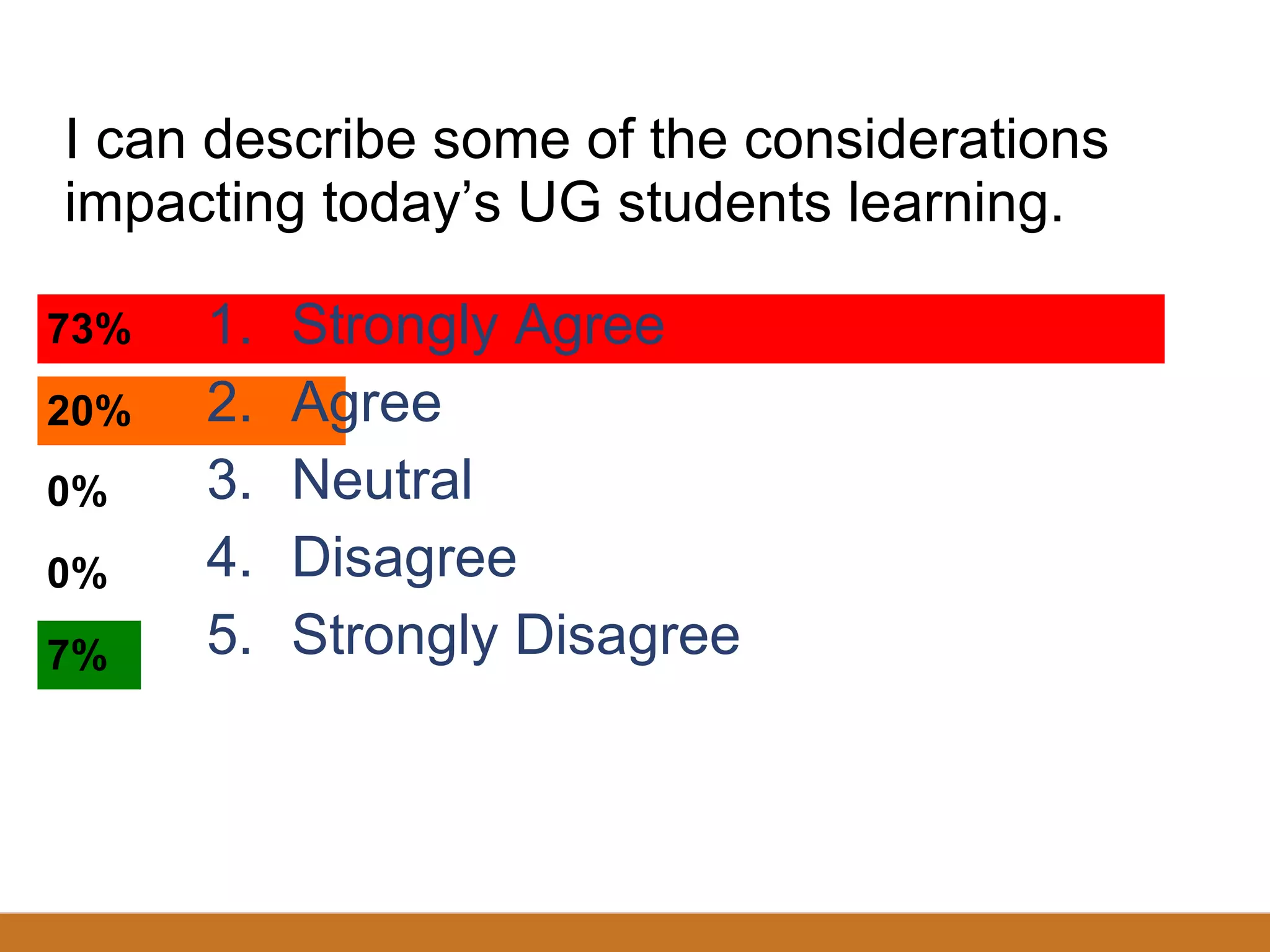
I can describe some of the considerations impacting today’s UG students learning. Strongly Agree Agree Neutral Disagree Strongly Disagree
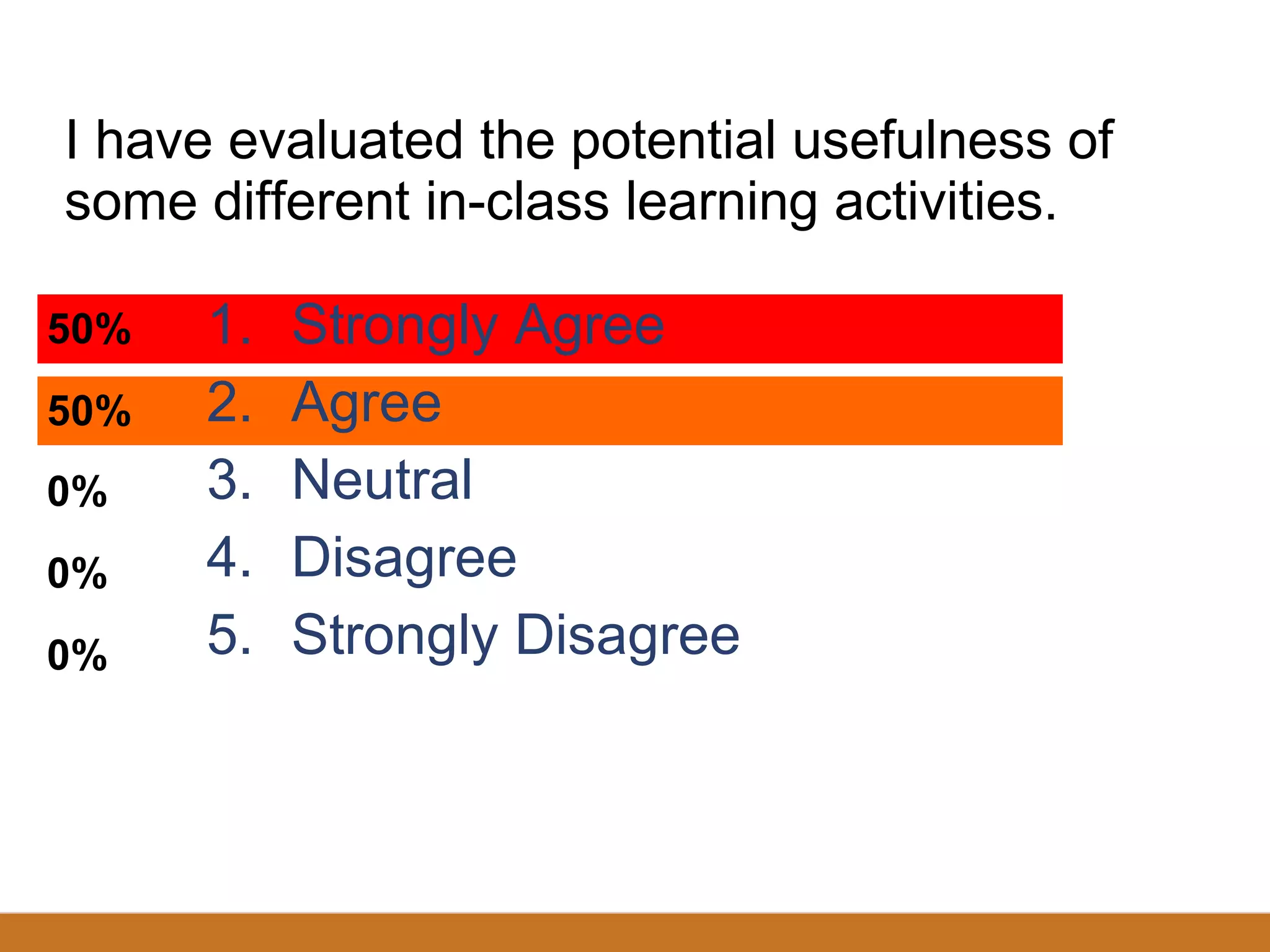
I have evaluated the potential usefulness of some different in-class learning activities. Strongly Agree Agree Neutral Disagree Strongly Disagree I have evaluated the potential usefulness of some different in-class learning activities.
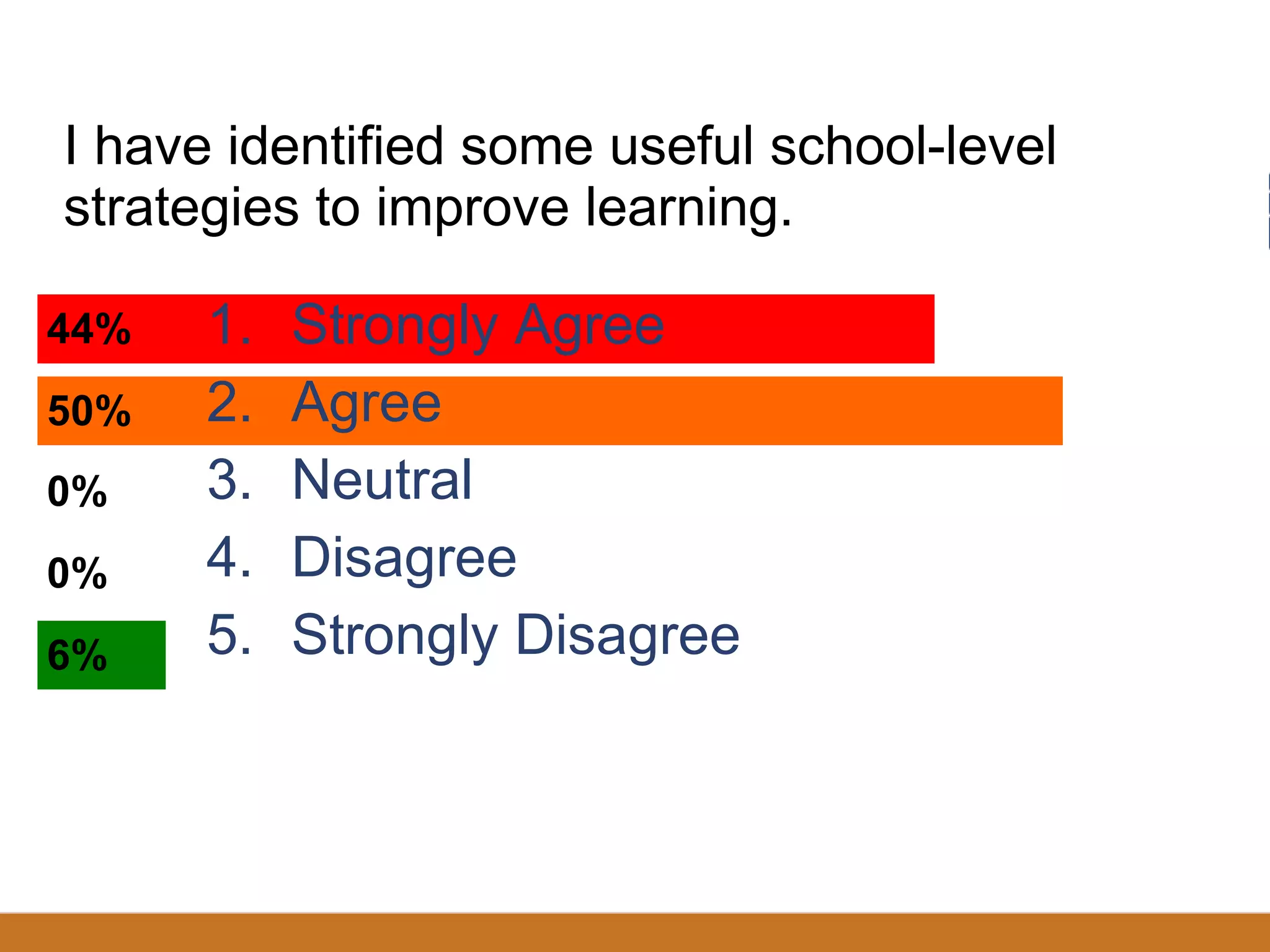
I have identified some useful school-level strategies for improving learning? Strongly Agree Agree Neutral Disagree Strongly Disagree I have identified some useful school-level strategies to improve learning.
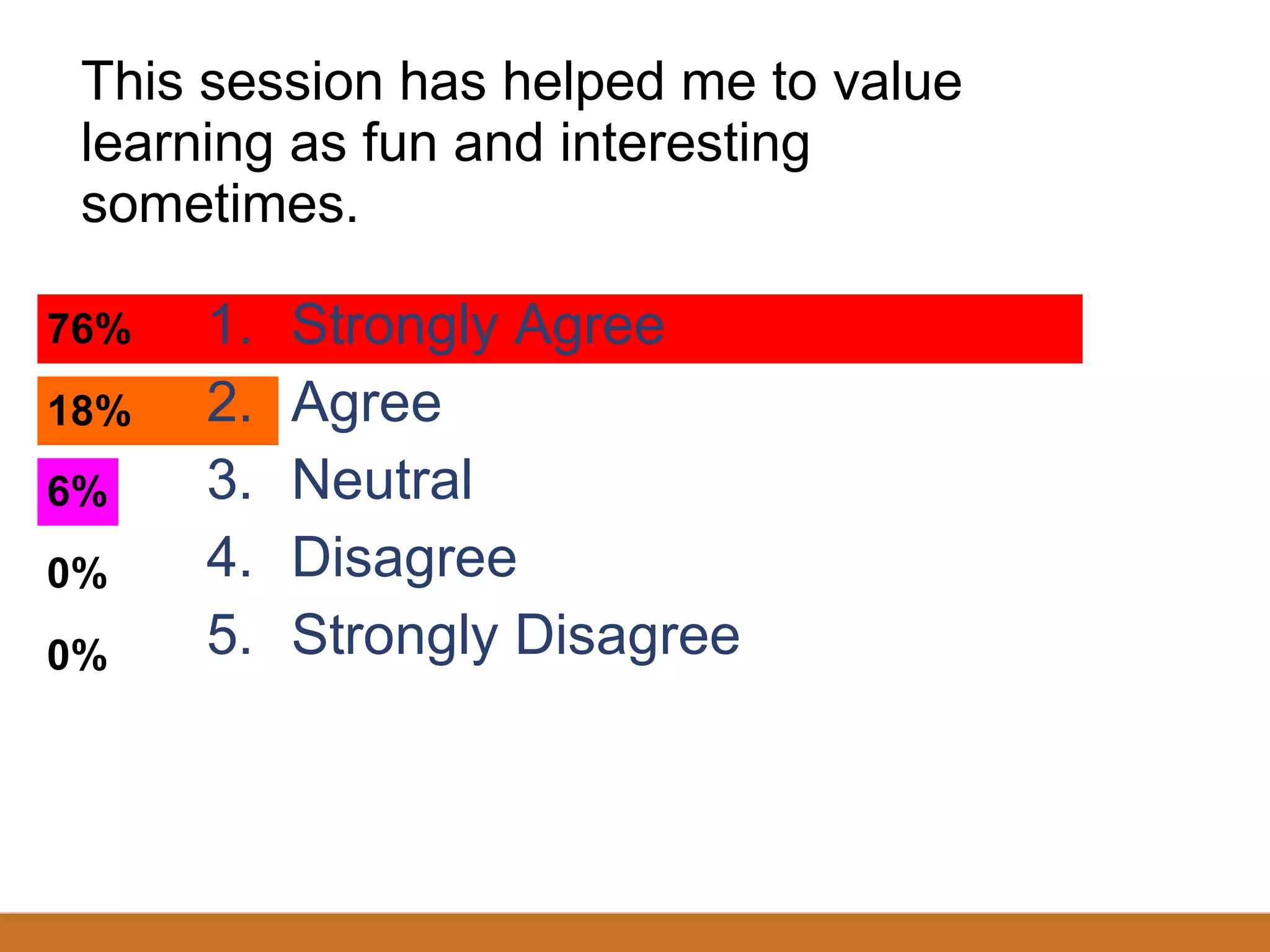
This session has helped me to value learning as fun and interesting sometimes. Strongly Agree Agree Neutral Disagree Strongly Disagree
Thank you …. Q & A
References Papers and books Epstein, M.L., Epstein, B.B., & Brosvic, G.M. (2001). Immediate feedback during academic testing.  Psychological Reports . 88, 889-894. Freeman M, McKenzie J. (2002) ‘SPARK: A Confidential Web-Based Template for Self and Peer Assessment of Student Teamwork: Benefits of Evaluating Across Different Subjects',  British Journal of Educational Technology , vol.33:5, pp. 551 - 569.  Michaelsen,  L.K., Knight, A.B & Fink, L.D. (2004)  Team-Based Learning: A Transformative Use of Small Groups in College Teaching . Stylus Publishing, Sterling VA  Oblinger, D. and Oblinger, J. (2005) Is it age or IT: First steps toward understanding the Net generation.  Educating the net generation . Educause Pelaez, N., (2002) “Problem-Based Writing with Peer Review Improves Academic Performance in Physiology,”  Advances in Physiology Education , 26, pp174-184. Race, P., (2000)  500 Tips on Group Learning . Routledge, London. Good websites http://www.heacademy.ac.uk/business/   http://www.economicsnetwork.ac.uk/   http://teaching.econ.usyd.edu.au/   http://ipeer.apsc.ubc.ca/wiki/index.php/IPeer   www.educause.edu/educatingthenetgen
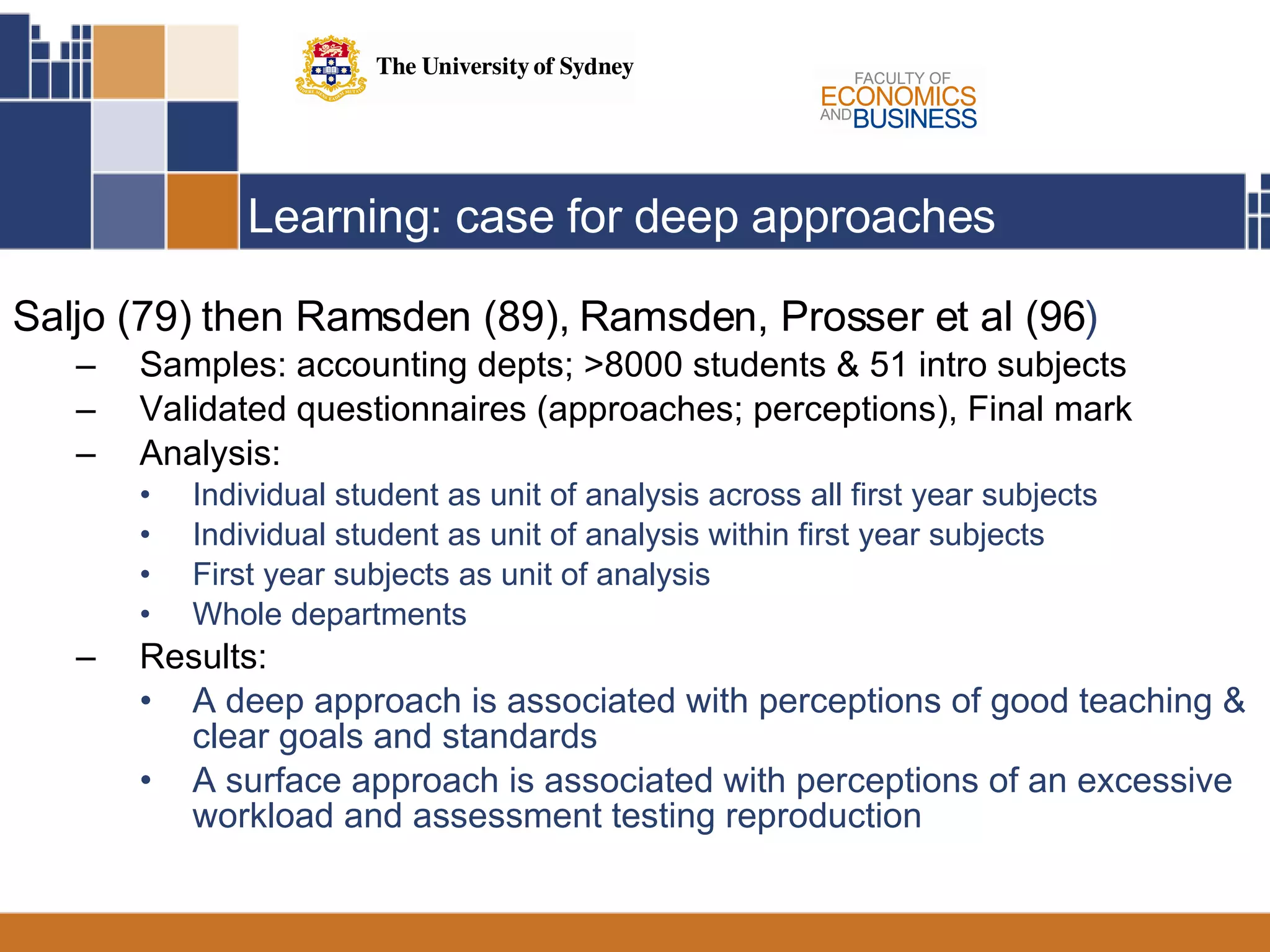
Learning: case for deep approaches Saljo (79) then Ramsden (89), Ramsden, Prosser et al (96 ) Samples: accounting depts; >8000 students & 51 intro subjects  Validated questionnaires (approaches; perceptions), Final mark Analysis:  Individual student as unit of analysis across all first year subjects Individual student as unit of analysis within first year subjects First year subjects as unit of analysis Whole departments Results: A deep approach is associated with perceptions of good teaching & clear goals and standards  A surface approach is associated with perceptions of an excessive workload and assessment testing reproduction
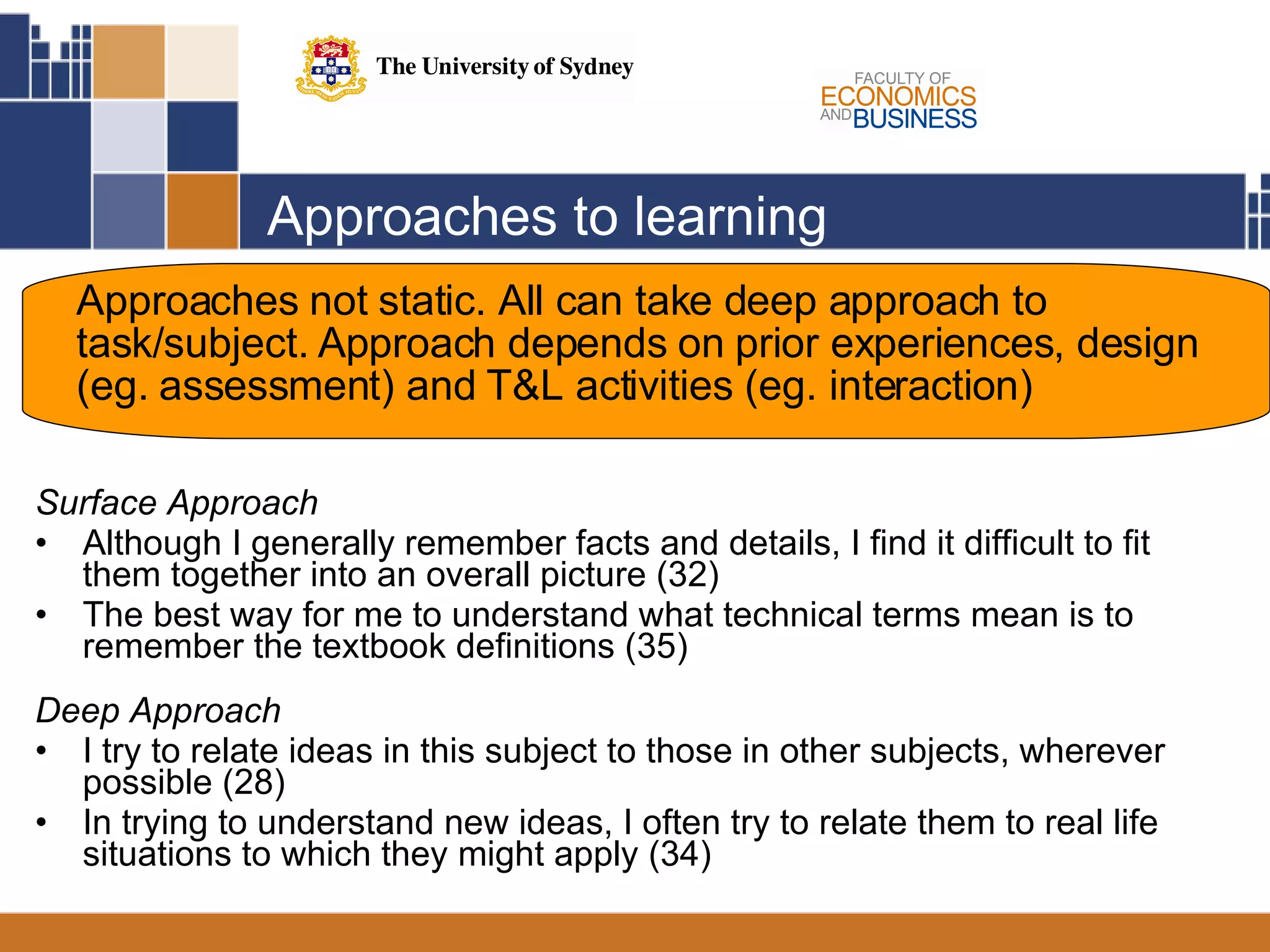
Approaches to learning Surface Approach Although I generally remember facts and details, I find it difficult to fit them together into an overall picture (32) The best way for me to understand what technical terms mean is to remember the textbook definitions (35) Deep Approach I try to relate ideas in this subject to those in other subjects, wherever possible (28) In trying to understand new ideas, I often try to relate them to real life situations to which they might apply (34) Approaches not static. All can take deep approach to task/subject. Approach depends on prior experiences, design (eg. assessment) and T&L activities (eg. interaction)
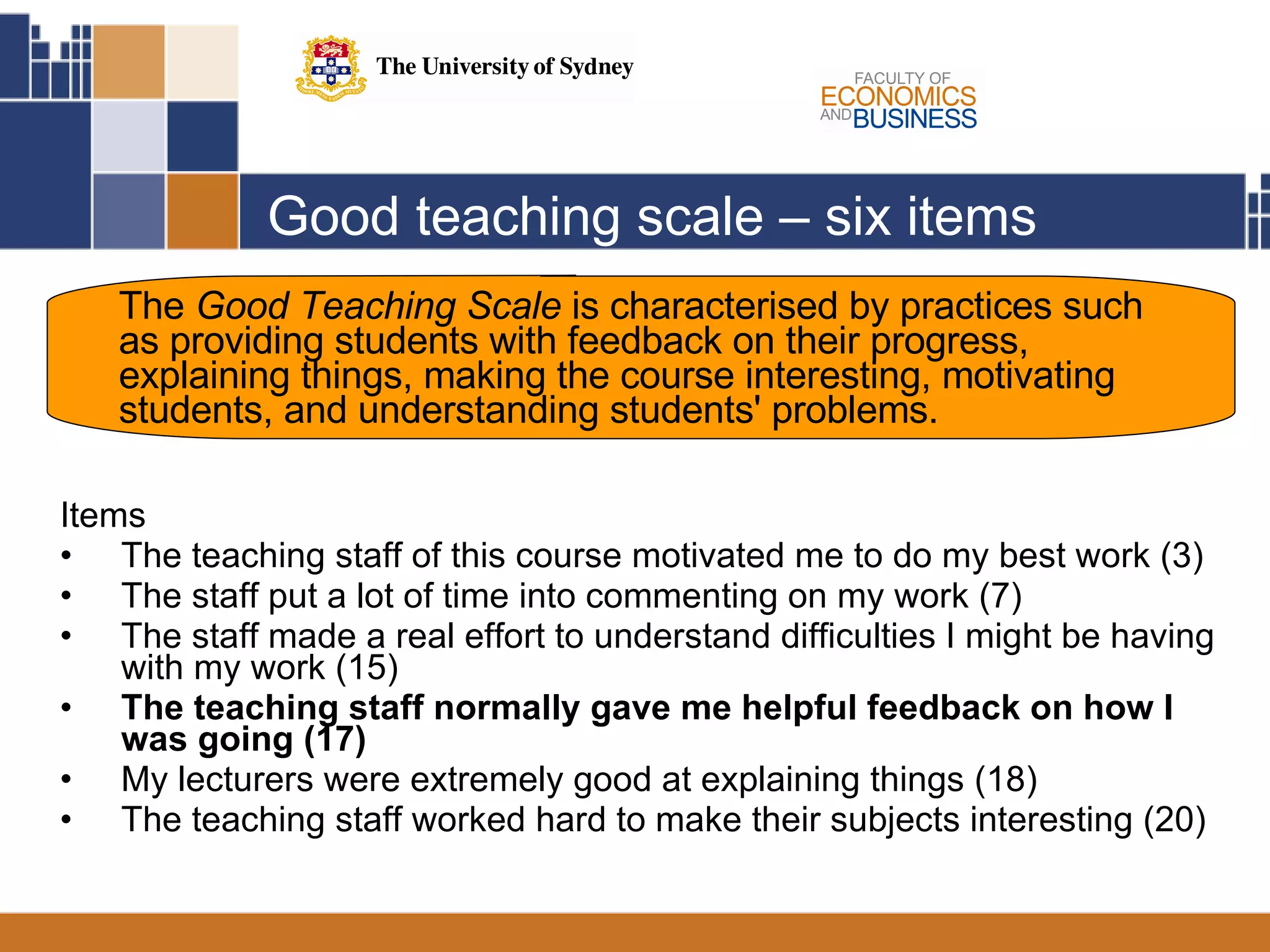
Good teaching scale – six items Items The teaching staff of this course motivated me to do my best work (3) The staff put a lot of time into commenting on my work (7) The staff made a real effort to understand difficulties I might be having with my work (15) The teaching staff normally gave me helpful feedback on how I was going (17) My lecturers were extremely good at explaining things (18) The teaching staff worked hard to make their subjects interesting (20) The  Good Teaching Scale  is characterised by practices such as providing students with feedback on their progress, explaining things, making the course interesting, motivating students, and understanding students' problems.

Mark Freeman Ug Challenges Final With Results

  • 1.
    Challenges around theundergraduate experience: Designing programs, units and classes for student engagement A/Professor Mark Freeman A/Dean (Learning and Teaching) [email_address]
  • 2.
    Participant learning outcomesDescribe some of the considerations impacting today’s UG students learning Evaluate the potential usefulness of some different in-class learning activities Identify some useful strategies (eg. engaging UG students at the program-level) Value learning as fun and interesting sometimes
  • 3.
    Interactive ‘work’shop InstructionsChange tables. Number off 1 to 6 on current table. All those number ‘1’ move to table 1. Number ‘2’ move to table 2. etc Sit next to someone you don’t know. Spend 1 minute each telling your life story. After 2 minutes introduce your pair partner to others on the table (Someone may need to facilitate)
  • 4.
    What is yourbusiness discipline? Accounting Finance Marketing Management Economics Other
  • 5.
    What year wereyou born? Before 1946 (mature) 1946 to 1963 (baby boomer) 1965 to 1982 (gen X) 1983 to 1991 (net gen)
  • 6.
    Baby boomers andMillennials Oblinger & Oblinger (2005) Negativity Hype Turning 50 Anything slow Red tape Laziness Dislikes Parents Work-life balance Can-do attitude Latest technology Multitasking Work ethic Public activism Freedom Responsibility Likes Determined Skeptical Workaholic Hopeful Independent Optimistic Attributes Millennials Latchkey generation Me generation Description 1982–1991 1965–1982 1946–1964 Birth Dates Net Generation Generation X Baby Boomers  
  • 7.
    Millennials at aglance Visual Digital Connected Immediate (gratification) Multi-task Experiential Social Peers What’s needed? Crave interactivity What matters? Global Oblinger & Oblinger (2005) Internet=Oxygen
  • 8.
    Scratch where itchy!“ Digital Natives accustomed to the twitch-speed, multitasking, random-access, graphics-first, active, connected, fun, fantasy, quick-payoff world of their video games, MTV, and Internet are bored by most of today's education, well-meaning as it may be. But worse, the many skills that new technology [has] actually enhanced (for example, parallel processing, graphics awareness, and random access) -- which have profound implications for their learning -- are almost totally ignored by educators ” Prensky (2001)
  • 9.
    In terms ofmy global experience I did my UG/PG studies in my home country #1 above but visited universities outside my UG/PG studies in another country my UG & PG studies in another country my UG & PG studies in other countries
  • 10.
    Helping Millennials Learn1. Not about the technology Face-to-face interaction can’t be missing Clickers provide anonymity Provide convenience LMS (online syllabus, readings, submission, marks) Provide mobility and connectivity Wireless networking laptops Provide social Blogs and wikis and threaded discussions Provide customisation Podcasts (difficult concepts; feedback)
  • 11.
    Helping Millennials LearnAssessments that matter Problem based learning Integrated business experience Encourage community and social networks Peer mentoring & peer learning In-class teamwork Design great learning activities Business games and simulations Online anonymous role play simulation
  • 12.
    Helping Millennials LearnDesign learning spaces for interaction Encourage informal learning and social Remove the dominant ‘large passive lecture hall’ Inverse relationship between distance from lectern and student’s total exam score (Becker 73) Forcing students to sit in centre seats when they prefer back seats results in a 40% net gain in probability of receiving an A grade (Benedict & Hoag 04)
  • 13.
  • 14.
  • 15.
  • 16.
  • 17.
  • 18.
  • 19.
  • 20.
    Helping Millennials Learn6. Interactive engagement is the key Definition: heads on (always) & hands on (usually) Co-create knowledge in/out, peers, TA, faculty, administrators, work Feedback as immediate as possible US developed National Survey of Student Engagement (NSSE) in 2000
  • 21.
    Good practice designingfor learning Encourages student-faculty contact Develops student reciprocity & cooperation Uses active learning techniques Gives prompt feedback Emphasizes time on task Communicates high expectations Respects diverse talents and ways of learning (Chickering & Gamson, 87; Chickering & Ehrrmann, 96)
  • 22.
    Complete ‘The MinutePaper’ (page 4)
  • 23.
    Strategic school-level questionsHow can we design better learning spaces? How can we harness learning research and technology to improve student interaction and academic efficiency? How can we design better programs? How can AAPBS work strategically to support academic leaders with these in achieving the AAPBS mission?
  • 24.
    How does SPARKwork? Rating scale: 0 = no contribution 1 = less than team average 2 = contribution per team average 3 = above team average
  • 25.
    How will SPARKaffect marks? Aggregate factors produced by SPARK system SAPA factor 1.1 indicates overrate own contribution to team by 110% SPA factor Team C: 15/20 15 x 0.9 = 13.5 15 x 1.16 = 17.4 15 x 0.75 = 11.3 15 x 1.25 = 18.8 Team B: 12/20 12 x 0.9 = 10.8 12 x 1.16 = 13.9 12 x 1.25 = 15.0 12 x 0.75 = 9.0 Team A: 12/20 12 x 1.0 = 12
  • 26.
    Designing for activelearning Bassey 68
  • 27.
    More on designingfor active learning Bligh 71
  • 28.
    Designing courses: interactiveengagement Hake (98) meta study Performance on standardised physics concept tests Controlled for class size and time spent on concept Sample: >6000 students 62 intro physics units IE & traditional teaching “ IE methods had an average gain 0.48 ± 0.14SD, which was two standard deviations above the traditional course which received an average gain of 0.23 ± 0.04SD”
  • 29.
  • 30.
    Approaches to learningor (Saljo 79, Ramsden 89, Prosser 06)
  • 31.
    Model of studentlearning (Prosser 06) Model of Student Learning (Prosser, 06)
  • 32.
    Deep learning designwhen teaching seen as... Transmitting concepts of the syllabus Helping students acquire syllabus concepts Helping students develop conceptions Transmitting the teachers' knowledge
  • 33.
    Impact of L&Tactivities varies with approach Teachers perception of context ) ccfffcc Approaches to cccc teaching hhhddddddddddddddd Approaches to learning hh (Prosser & Trigwell, 96; Ramsden 97) • Class size • Workload • Control • Students • Dept value of teaching versus research hhhhhhhhhhhhhhhhhhhh Teachers prior experience ) Teachers perception of uni/dept Model of Academic Teaching Impact of interaction design decisions varies with approach to teaching Information transmission views of teaching sface surface) Conceptual change views of teaching hhhhhhhhhhhhhhhhhhhhhh Teacher focussed design and teaching (eg. passive) Student focussed design and teaching (eg. interactive) Surface approach to learning sffface surface) Deep approaches to learning hffffffffhhhhhhh
  • 34.
    Team problem Employerswant business program graduates that meet their needs. Identify the top three educational challenges in developing graduates.
  • 35.
    Map & assureprogram-level outcomes X X X X X Unit 5-23 X X X X X Unit 24 (Capstone) X X Ethical, social professional understandings X Communication X X Information literacy X Research & inquiry X X X Personal autonomy Unit 4 Unit 3 Unit 2 Unit 1 Bachelor of Commerce
  • 36.
    Designing good programlearning goals Intercultural competence The process of acquiring the culture-specific and culture general knowledge, skills, and attitudes required for effective communication and interaction with individuals from other cultures. It is a dynamic, developmental, and on-going process which engages the learner cognitively, behaviourally, and affectively. Paige et al. (2003)
  • 37.
    Intercultural competence domainsAlexander et al. (2006)
  • 38.
    Taxonomy DIC 33 3 3 3 3 3 Knowledge Identifies cultural foundations of own and others’ norms, values, experiences and interactions Analyses how diversity influences interaction (and how culture manifests itself in interaction) Reflects and self-evaluates one’s own and others’ capabilities and limitations in interactions in varying cultural contexts Attitudes Acknowledges the practical significance of own and others’ cultural identity (beliefs, values, norms and biases) and their impact on behaviour and interactions Values intercultural interactions and experiences with those from other cultures to further one’s own understanding and interactions Adapts to differences between oneself and others in interactions in varying cultural contexts Skills Implements appropriate processes and behaviours for interactions with different cultural settings and audiences Selects or creates complex skill sets in interactions under conditions of uncertainty, risk and change in professional business situations Applies basic skills or directions to routine tasks and interactions to accommodate (a) specified cultural difference/s Awareness Understanding Autonomy Ridings, Simpson, Leask et al. 2008
  • 39.
  • 40.
  • 41.
    Team problem -application to AAPBS To achieve its mission of providing leadership to advance the quality of business and management education in the Asia-Pacific region, the best option for AAPBS is Commission a 1 year research project to evaluate options Develop a website with links to good practice drawing on Asia-Pacific exemplars Establish a set of standards relating to continuous improvement and a peer review process like AACSB Establish a network for senior academic managers with educational responsibilities to collaborate and share good practice
  • 42.
    Convey Unit ConceptsApply unit Concepts Traditional class Team-Based Class Readiness Test Readings Lecture In Class Out of Class In Class Out of Class
  • 43.
    Holistic “Team-Based Learning”Michaelsen et al (2002) & www.teambasedlearning.org Students (eg. Levine et al, 04) Actively engaged applying not passively listening Challenges previous groupwork prejudices Develops collaboration and communication skills Obvious fun and hum Achievement and learning (& in national exams) Staff (eg. Thompson et al; 07) Transformation of class time Job satisfaction Initial cost and risk of adopting – but can adopt incrementally
  • 44.
    Student perceptions survey7% 80% Overall recommend TBL next year 6% 78% Prefer both indiv & team quiz (not one) 7% 80% Team quiz developed team skills 1% 94% Indiv. test ensures all contribute to team 1% 99% In-class indv. test encouraged preparation 6% 80% Team problems helped apply quiz learning 7% 81% Regular testing helped progressive learning Disagree Agree
  • 45.
  • 46.
    Participant learning outcomesDescribe some of the considerations impacting today’s UG students learning Evaluate the potential usefulness of some different in-class learning activities Identify some useful school-level strategies to improve learning Value learning as fun and interesting sometimes
  • 47.
    I can describesome of the considerations impacting today’s UG students learning. Strongly Agree Agree Neutral Disagree Strongly Disagree
  • 48.
    I have evaluatedthe potential usefulness of some different in-class learning activities. Strongly Agree Agree Neutral Disagree Strongly Disagree I have evaluated the potential usefulness of some different in-class learning activities.
  • 49.
    I have identifiedsome useful school-level strategies for improving learning? Strongly Agree Agree Neutral Disagree Strongly Disagree I have identified some useful school-level strategies to improve learning.
  • 50.
    This session hashelped me to value learning as fun and interesting sometimes. Strongly Agree Agree Neutral Disagree Strongly Disagree
  • 51.
  • 52.
    References Papers andbooks Epstein, M.L., Epstein, B.B., & Brosvic, G.M. (2001). Immediate feedback during academic testing. Psychological Reports . 88, 889-894. Freeman M, McKenzie J. (2002) ‘SPARK: A Confidential Web-Based Template for Self and Peer Assessment of Student Teamwork: Benefits of Evaluating Across Different Subjects', British Journal of Educational Technology , vol.33:5, pp. 551 - 569. Michaelsen, L.K., Knight, A.B & Fink, L.D. (2004) Team-Based Learning: A Transformative Use of Small Groups in College Teaching . Stylus Publishing, Sterling VA Oblinger, D. and Oblinger, J. (2005) Is it age or IT: First steps toward understanding the Net generation. Educating the net generation . Educause Pelaez, N., (2002) “Problem-Based Writing with Peer Review Improves Academic Performance in Physiology,” Advances in Physiology Education , 26, pp174-184. Race, P., (2000) 500 Tips on Group Learning . Routledge, London. Good websites http://www.heacademy.ac.uk/business/ http://www.economicsnetwork.ac.uk/ http://teaching.econ.usyd.edu.au/ http://ipeer.apsc.ubc.ca/wiki/index.php/IPeer www.educause.edu/educatingthenetgen
  • 53.
    Learning: case fordeep approaches Saljo (79) then Ramsden (89), Ramsden, Prosser et al (96 ) Samples: accounting depts; >8000 students & 51 intro subjects Validated questionnaires (approaches; perceptions), Final mark Analysis: Individual student as unit of analysis across all first year subjects Individual student as unit of analysis within first year subjects First year subjects as unit of analysis Whole departments Results: A deep approach is associated with perceptions of good teaching & clear goals and standards A surface approach is associated with perceptions of an excessive workload and assessment testing reproduction
  • 54.
    Approaches to learningSurface Approach Although I generally remember facts and details, I find it difficult to fit them together into an overall picture (32) The best way for me to understand what technical terms mean is to remember the textbook definitions (35) Deep Approach I try to relate ideas in this subject to those in other subjects, wherever possible (28) In trying to understand new ideas, I often try to relate them to real life situations to which they might apply (34) Approaches not static. All can take deep approach to task/subject. Approach depends on prior experiences, design (eg. assessment) and T&L activities (eg. interaction)
  • 55.
    Good teaching scale– six items Items The teaching staff of this course motivated me to do my best work (3) The staff put a lot of time into commenting on my work (7) The staff made a real effort to understand difficulties I might be having with my work (15) The teaching staff normally gave me helpful feedback on how I was going (17) My lecturers were extremely good at explaining things (18) The teaching staff worked hard to make their subjects interesting (20) The Good Teaching Scale is characterised by practices such as providing students with feedback on their progress, explaining things, making the course interesting, motivating students, and understanding students' problems.