BAYESIAN NEURAL
NETWORKS
Introduction
Neural networks
Bayesian neural networks
Malina Kirn, Scientific ComputingNovember 11,
2008
1
Approximating the probability
November 11, 2008Bayesian Neural Networks, Malina Kirn
2
 We wish to develop some algorithm that will
approximate the probability that a given event is
signal.
 The MC then has the input distribution (x(1)…x(n))
and the truth/target value (y(1)…y(n)), which will
take the value of 0 (for background) or 1 (for
signal).
 We want P(y(n+1)=1|x(n+1),(x(1),y(1))…(x(n),y(n)))
 An intelligent algorithm will capitalize on
correlations (possibly non-linear) in x.
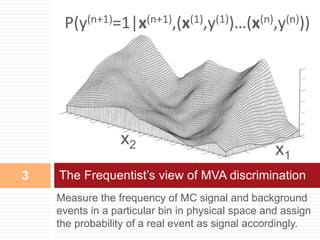
Measure the frequency of MC signal and background
events in a particular bin in physical space and assign
the probability of a real event as signal accordingly.
The Frequentist’s view of MVA discrimination3
P(y(n+1)=1|x(n+1),(x(1),y(1))…(x(n),y(n)))
x1
x2
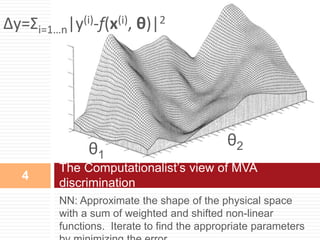
NN: Approximate the shape of the physical space
with a sum of weighted and shifted non-linear
functions. Iterate to find the appropriate parameters
The Computationalist’s view of MVA
discrimination
4
Δy=Σi=1…n|y(i)-f(x(i), θ)|2
θ1
θ2
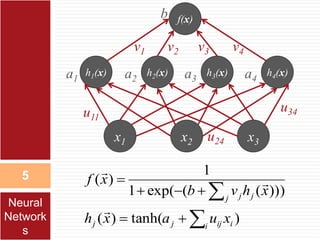
Neural
network
s
5
f(x)
h1(x) h2(x) h3(x) h4(x)
x1 x2 x3
v1 v2 v3 v4
u11
u34
u24
b
a1 a2 a3 a4
)tanh()(
)))((exp(1
1
)(





i iijjj
j jj
xuaxh
xhvb
xf



Neural
Network
s
November 11, 2008Bayesian Neural Networks, Malina Kirn6
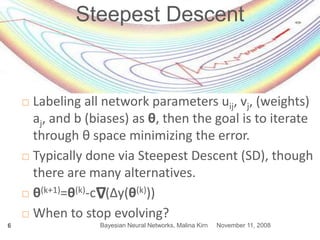
Steepest Descent
 Labeling all network parameters uij, vj, (weights)
aj, and b (biases) as θ, then the goal is to iterate
through θ space minimizing the error.
 Typically done via Steepest Descent (SD), though
there are many alternatives.
 θ(k+1)=θ(k)-c (Δy(θ(k)))
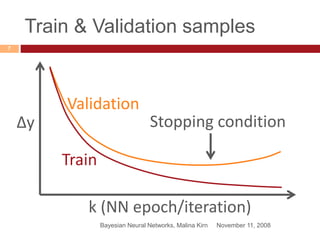
 When to stop evolving?
Δ
Train & Validation samples
November 11, 2008Bayesian Neural Networks, Malina Kirn
7
Δy
k (NN epoch/iteration)
Stopping condition
Validation
Train
Number of hidden nodes and
layers?
November 11, 2008Bayesian Neural Networks, Malina Kirn
8
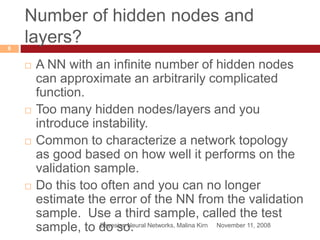
 A NN with an infinite number of hidden nodes
can approximate an arbitrarily complicated
function.
 Too many hidden nodes/layers and you
introduce instability.
 Common to characterize a network topology
as good based on how well it performs on the
validation sample.
 Do this too often and you can no longer
estimate the error of the NN from the validation
sample. Use a third sample, called the test
sample, to do so.
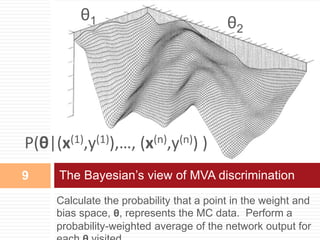
Calculate the probability that a point in the weight and
bias space, θ, represents the MC data. Perform a
probability-weighted average of the network output for
The Bayesian’s view of MVA discrimination9
P(θ|(x(1),y(1)),…, (x(n),y(n)) )
θ1 θ2
Bayesian Neural Network
November 11, 2008Bayesian Neural Networks, Malina Kirn
10



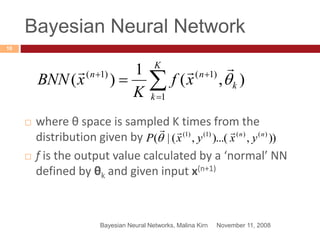
K
k
k
nn
xf
K
xBNN
1
)1()1(
),(
1
)( 

 where θ space is sampled K times from the
distribution given by
 f is the output value calculated by a ‘normal’ NN
defined by θk and given input x(n+1)
)),)...(,(|( )()()1()1( nn
yxyxP


Bayes’ Theorem
November 11, 2008Bayesian Neural Networks, Malina Kirn
11
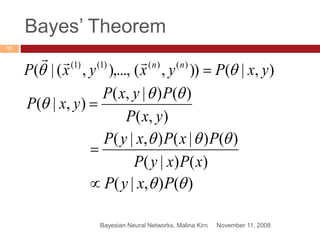
)()|(
)()|(),|(
xPxyP
PxPxyP 

),|()),(),...,,(|( )()()1()1(
yxPyxyxP nn
 

),(
)()|,(
),|(
yxP
PyxP
yxP

 
)(),|(  PxyP
Calculating the posterior
November 11, 2008Bayesian Neural Networks, Malina Kirn
12
)(),|(),|(  PxyPyxP 


n
i
ii
xyPxyP 1
)()(
),|(),|( 
This is exactly what the NN is doing! f(x(i),θ) is the
probability that y(i)=1 given x(i) and θ and 1-f(x(i),θ)
is the probability that y(i)=0.
)()(
1)(
1
)(
)),(1(),(),|(
ii
yin
i
yi
xfxfxyP 

  

Calculating the posterior
November 11, 2008Bayesian Neural Networks, Malina Kirn
13
)(),|(),|(  PxyPyxP 
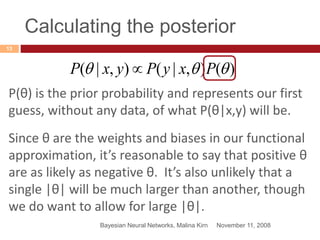
P(θ) is the prior probability and represents our first
guess, without any data, of what P(θ|x,y) will be.
Since θ are the weights and biases in our functional
approximation, it’s reasonable to say that positive θ
are as likely as negative θ. It’s also unlikely that a
single |θ| will be much larger than another, though
we do want to allow for large |θ|.
Priors & hyperpriors
November 11, 2008Bayesian Neural Networks, Malina Kirn
14
 Model the prior probability for each θ as a gaussian
centered about zero with width σ.
 Typically have classes - u’s, v’s (weights), a’s, b (biases)
and one σ for each class (σu, σv, σa, σb)
 What should σ be? Model P(σ), the hyperprior, as a
function that allows large values with a few chosen
parameters, the hyperparameters.
 





 
 

 dP
x
dPPP )(
2
exp
2
1
)()|()( 2
2
Sampling θ space
November 11, 2008Bayesian Neural Networks, Malina Kirn
15
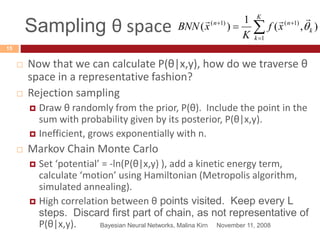
 Now that we can calculate P(θ|x,y), how do we traverse θ
space in a representative fashion?
 Rejection sampling
 Draw θ randomly from the prior, P(θ). Include the point in the
sum with probability given by its posterior, P(θ|x,y).
 Inefficient, grows exponentially with n.
 Markov Chain Monte Carlo
 Set ‘potential’ = -ln(P(θ|x,y) ), add a kinetic energy term,
calculate ‘motion’ using Hamiltonian (Metropolis algorithm,
simulated annealing).
 High correlation between θ points visited. Keep every L
steps. Discard first part of chain, as not representative of
P(θ|x,y).



K
k
k
nn
xf
K
xBNN
1
)1()1(
),(
1
)( 

Stopping condition
November 11, 2008Bayesian Neural Networks, Malina Kirn
16
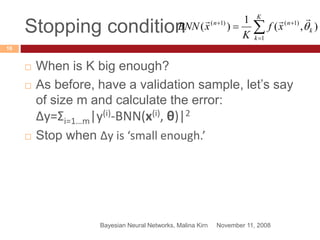
 When is K big enough?
 As before, have a validation sample, let’s say
of size m and calculate the error:
Δy=Σi=1…m|y(i)-BNN(x(i), θ)|2
 Stop when Δy is ‘small enough.’



K
k
k
nn
xf
K
xBNN
1
)1()1(
),(
1
)( 

Why use BNN?
November 11, 2008Bayesian Neural Networks, Malina Kirn
17
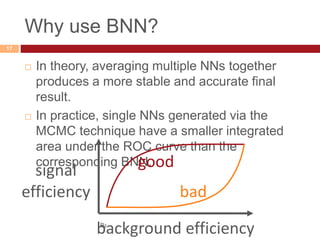
 In theory, averaging multiple NNs together
produces a more stable and accurate final
result.
 In practice, single NNs generated via the
MCMC technique have a smaller integrated
area under the ROC curve than the
corresponding BNN.
background efficiency
signal
efficiency
good
bad

Bayesian Neural Networks

  • 1.
    BAYESIAN NEURAL NETWORKS Introduction Neural networks Bayesianneural networks Malina Kirn, Scientific ComputingNovember 11, 2008 1
  • 2.
    Approximating the probability November11, 2008Bayesian Neural Networks, Malina Kirn 2  We wish to develop some algorithm that will approximate the probability that a given event is signal.  The MC then has the input distribution (x(1)…x(n)) and the truth/target value (y(1)…y(n)), which will take the value of 0 (for background) or 1 (for signal).  We want P(y(n+1)=1|x(n+1),(x(1),y(1))…(x(n),y(n)))  An intelligent algorithm will capitalize on correlations (possibly non-linear) in x.
  • 3.
    Measure the frequencyof MC signal and background events in a particular bin in physical space and assign the probability of a real event as signal accordingly. The Frequentist’s view of MVA discrimination3 P(y(n+1)=1|x(n+1),(x(1),y(1))…(x(n),y(n))) x1 x2
  • 4.
    NN: Approximate theshape of the physical space with a sum of weighted and shifted non-linear functions. Iterate to find the appropriate parameters The Computationalist’s view of MVA discrimination 4 Δy=Σi=1…n|y(i)-f(x(i), θ)|2 θ1 θ2
  • 5.
    Neural network s 5 f(x) h1(x) h2(x) h3(x)h4(x) x1 x2 x3 v1 v2 v3 v4 u11 u34 u24 b a1 a2 a3 a4 )tanh()( )))((exp(1 1 )(      i iijjj j jj xuaxh xhvb xf    Neural Network s
  • 6.
    November 11, 2008BayesianNeural Networks, Malina Kirn6 Steepest Descent  Labeling all network parameters uij, vj, (weights) aj, and b (biases) as θ, then the goal is to iterate through θ space minimizing the error.  Typically done via Steepest Descent (SD), though there are many alternatives.  θ(k+1)=θ(k)-c (Δy(θ(k)))  When to stop evolving? Δ
  • 7.
    Train & Validationsamples November 11, 2008Bayesian Neural Networks, Malina Kirn 7 Δy k (NN epoch/iteration) Stopping condition Validation Train
  • 8.
    Number of hiddennodes and layers? November 11, 2008Bayesian Neural Networks, Malina Kirn 8  A NN with an infinite number of hidden nodes can approximate an arbitrarily complicated function.  Too many hidden nodes/layers and you introduce instability.  Common to characterize a network topology as good based on how well it performs on the validation sample.  Do this too often and you can no longer estimate the error of the NN from the validation sample. Use a third sample, called the test sample, to do so.
  • 9.
    Calculate the probabilitythat a point in the weight and bias space, θ, represents the MC data. Perform a probability-weighted average of the network output for The Bayesian’s view of MVA discrimination9 P(θ|(x(1),y(1)),…, (x(n),y(n)) ) θ1 θ2
  • 10.
    Bayesian Neural Network November11, 2008Bayesian Neural Networks, Malina Kirn 10    K k k nn xf K xBNN 1 )1()1( ),( 1 )(    where θ space is sampled K times from the distribution given by  f is the output value calculated by a ‘normal’ NN defined by θk and given input x(n+1) )),)...(,(|( )()()1()1( nn yxyxP  
  • 11.
    Bayes’ Theorem November 11,2008Bayesian Neural Networks, Malina Kirn 11 )()|( )()|(),|( xPxyP PxPxyP   ),|()),(),...,,(|( )()()1()1( yxPyxyxP nn    ),( )()|,( ),|( yxP PyxP yxP    )(),|(  PxyP
  • 12.
    Calculating the posterior November11, 2008Bayesian Neural Networks, Malina Kirn 12 )(),|(),|(  PxyPyxP    n i ii xyPxyP 1 )()( ),|(),|(  This is exactly what the NN is doing! f(x(i),θ) is the probability that y(i)=1 given x(i) and θ and 1-f(x(i),θ) is the probability that y(i)=0. )()( 1)( 1 )( )),(1(),(),|( ii yin i yi xfxfxyP      
  • 13.
    Calculating the posterior November11, 2008Bayesian Neural Networks, Malina Kirn 13 )(),|(),|(  PxyPyxP  P(θ) is the prior probability and represents our first guess, without any data, of what P(θ|x,y) will be. Since θ are the weights and biases in our functional approximation, it’s reasonable to say that positive θ are as likely as negative θ. It’s also unlikely that a single |θ| will be much larger than another, though we do want to allow for large |θ|.
  • 14.
    Priors & hyperpriors November11, 2008Bayesian Neural Networks, Malina Kirn 14  Model the prior probability for each θ as a gaussian centered about zero with width σ.  Typically have classes - u’s, v’s (weights), a’s, b (biases) and one σ for each class (σu, σv, σa, σb)  What should σ be? Model P(σ), the hyperprior, as a function that allows large values with a few chosen parameters, the hyperparameters.              dP x dPPP )( 2 exp 2 1 )()|()( 2 2
  • 15.
    Sampling θ space November11, 2008Bayesian Neural Networks, Malina Kirn 15  Now that we can calculate P(θ|x,y), how do we traverse θ space in a representative fashion?  Rejection sampling  Draw θ randomly from the prior, P(θ). Include the point in the sum with probability given by its posterior, P(θ|x,y).  Inefficient, grows exponentially with n.  Markov Chain Monte Carlo  Set ‘potential’ = -ln(P(θ|x,y) ), add a kinetic energy term, calculate ‘motion’ using Hamiltonian (Metropolis algorithm, simulated annealing).  High correlation between θ points visited. Keep every L steps. Discard first part of chain, as not representative of P(θ|x,y).    K k k nn xf K xBNN 1 )1()1( ),( 1 )(  
  • 16.
    Stopping condition November 11,2008Bayesian Neural Networks, Malina Kirn 16  When is K big enough?  As before, have a validation sample, let’s say of size m and calculate the error: Δy=Σi=1…m|y(i)-BNN(x(i), θ)|2  Stop when Δy is ‘small enough.’    K k k nn xf K xBNN 1 )1()1( ),( 1 )(  
  • 17.
    Why use BNN? November11, 2008Bayesian Neural Networks, Malina Kirn 17  In theory, averaging multiple NNs together produces a more stable and accurate final result.  In practice, single NNs generated via the MCMC technique have a smaller integrated area under the ROC curve than the corresponding BNN. background efficiency signal efficiency good bad