Machine Learning
K-means, E.M. and Mixture models
                VU Pham
           phvu@fit.hcmus.edu.vn

       Department of Computer Science

             November 22, 2010


                Machine Learning
Remind: Three Main Problems in ML

• Three main problems in ML:
    – Regression: Linear Regression, Neural net...
    – Classification: Decision Tree, kNN, Bayessian Classifier...
    – Density Estimation: Gauss Naive DE,...

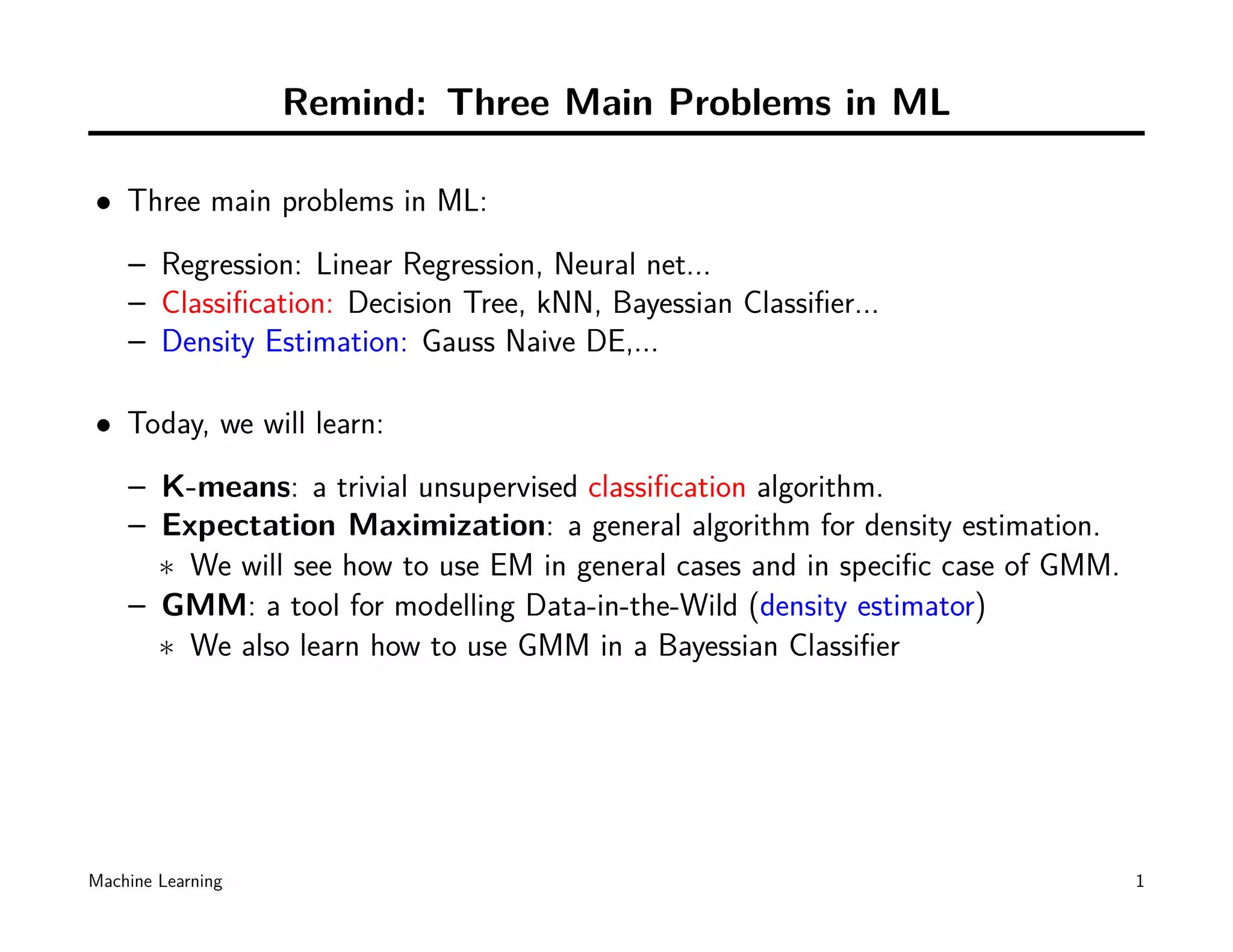
• Today, we will learn:
    – K-means: a trivial unsupervised classification algorithm.
    – Expectation Maximization: a general algorithm for density estimation.
      ∗ We will see how to use EM in general cases and in specific case of GMM.
    – GMM: a tool for modelling Data-in-the-Wild (density estimator)
      ∗ We also learn how to use GMM in a Bayessian Classifier


Machine Learning                                                                 1
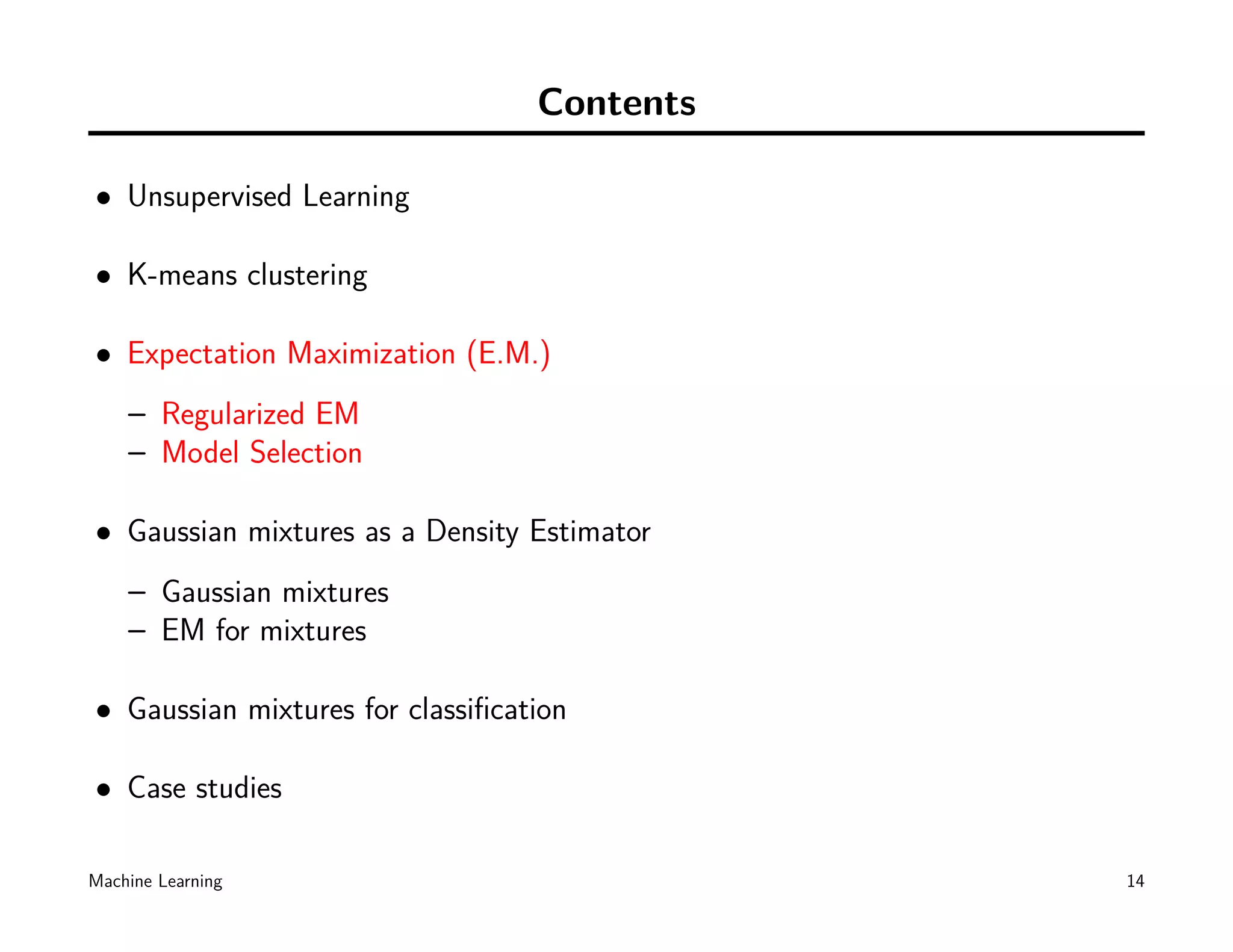
Contents

• Unsupervised Learning

• K-means clustering

• Expectation Maximization (E.M.)
    – Regularized EM
    – Model Selection

• Gaussian mixtures as a Density Estimator
    – Gaussian mixtures
    – EM for mixtures

• Gaussian mixtures for classification

• Case studies

Machine Learning                             2
Unsupervised Learning
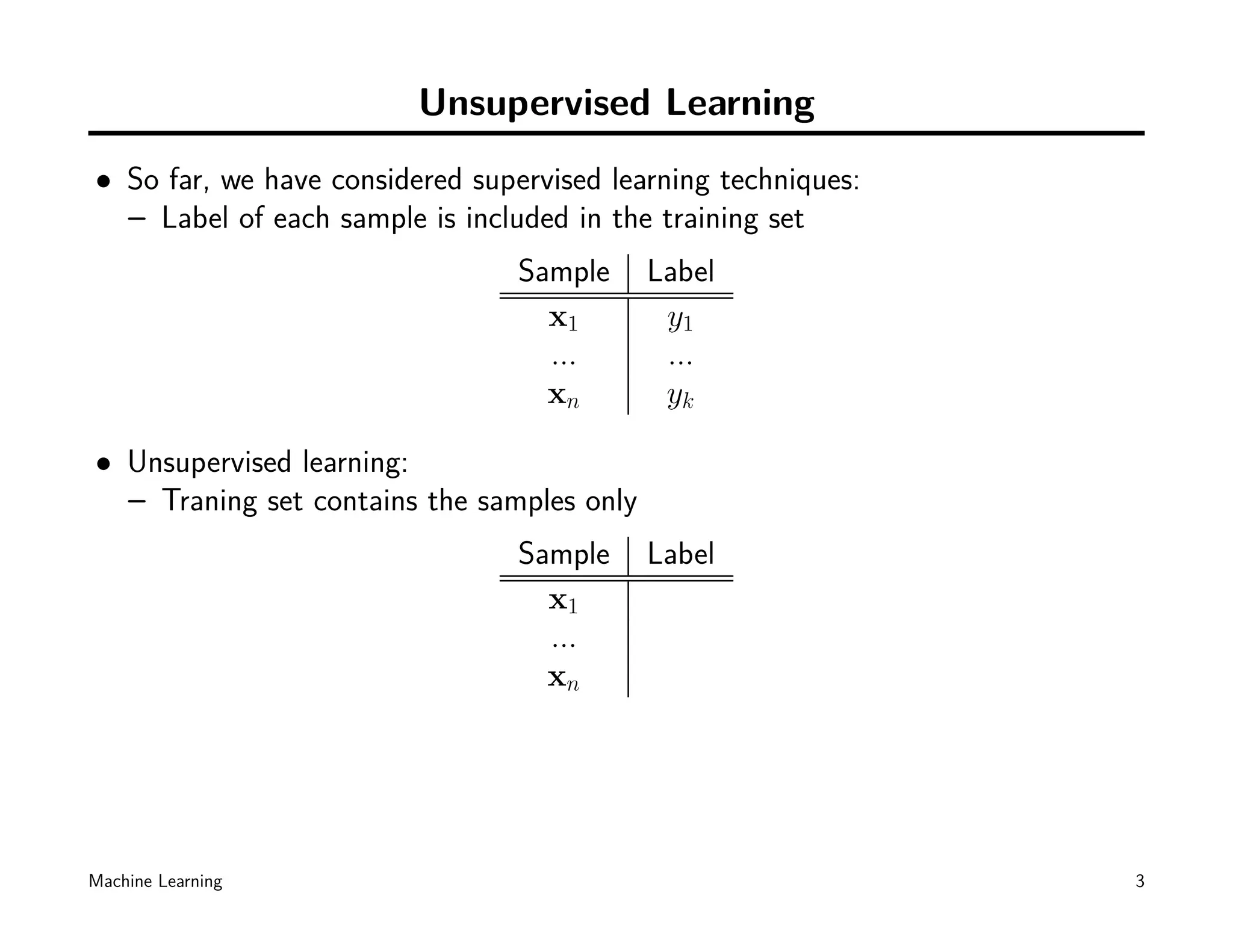
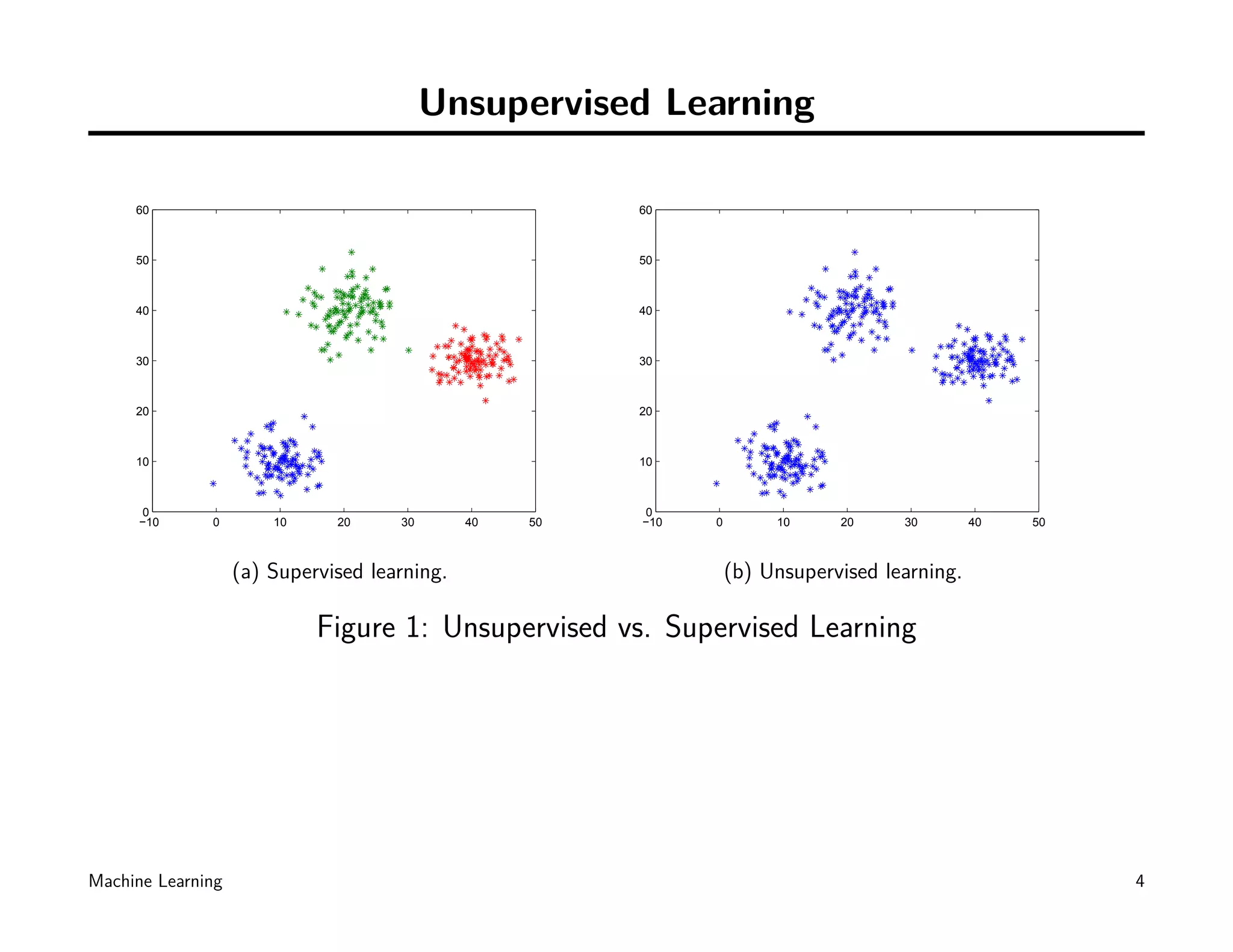
• So far, we have considered supervised learning techniques:
  – Label of each sample is included in the training set
                                 Sample     Label
                                   x1        y1
                                   ...       ...
                                   xn        yk

• Unsupervised learning:
  – Traning set contains the samples only
                                 Sample     Label
                                   x1
                                   ...
                                   xn


Machine Learning                                               3
Unsupervised Learning

     60                                                 60


     50                                                 50


     40                                                 40


     30                                                 30


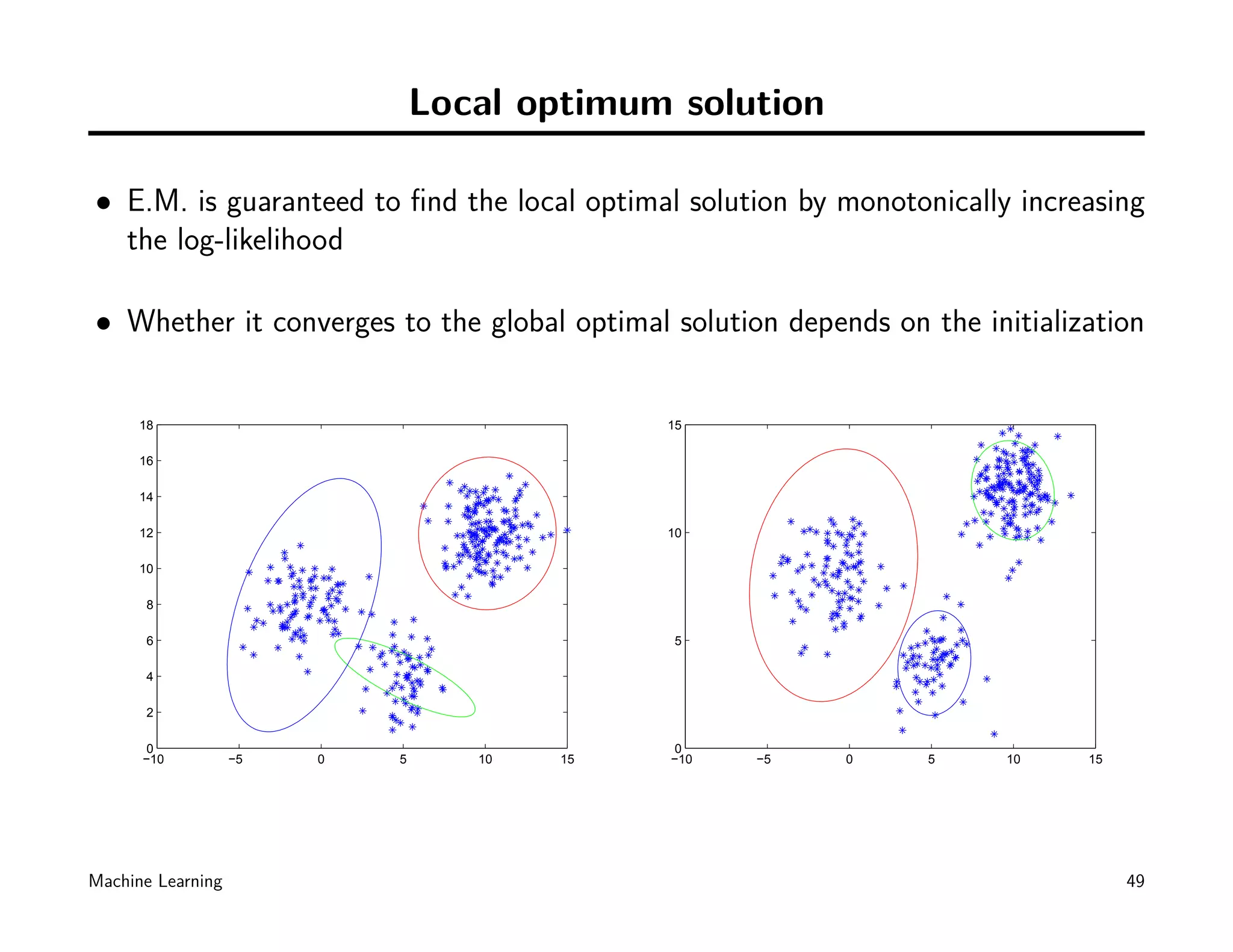
     20                                                 20


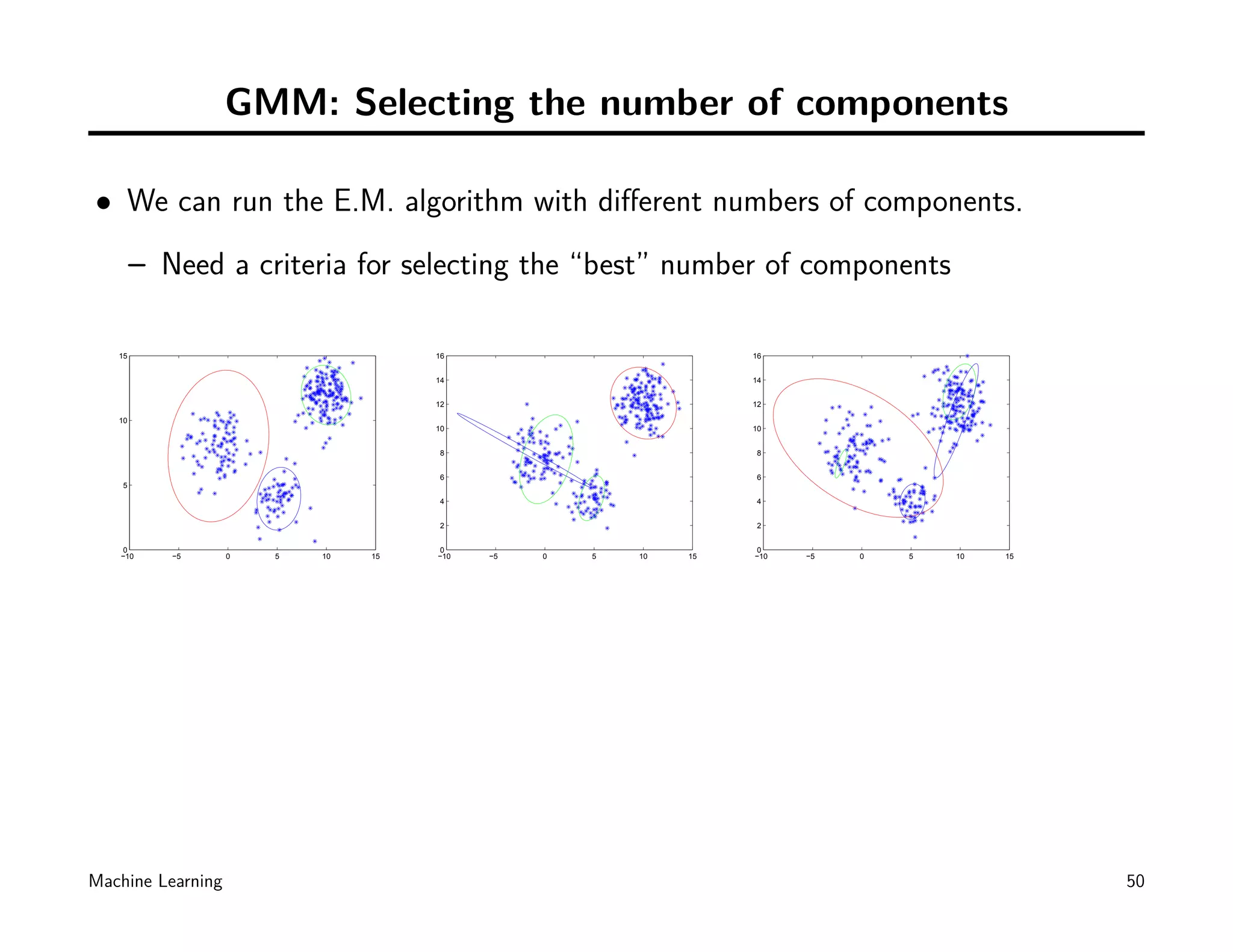
     10                                                 10


      0                                                 0
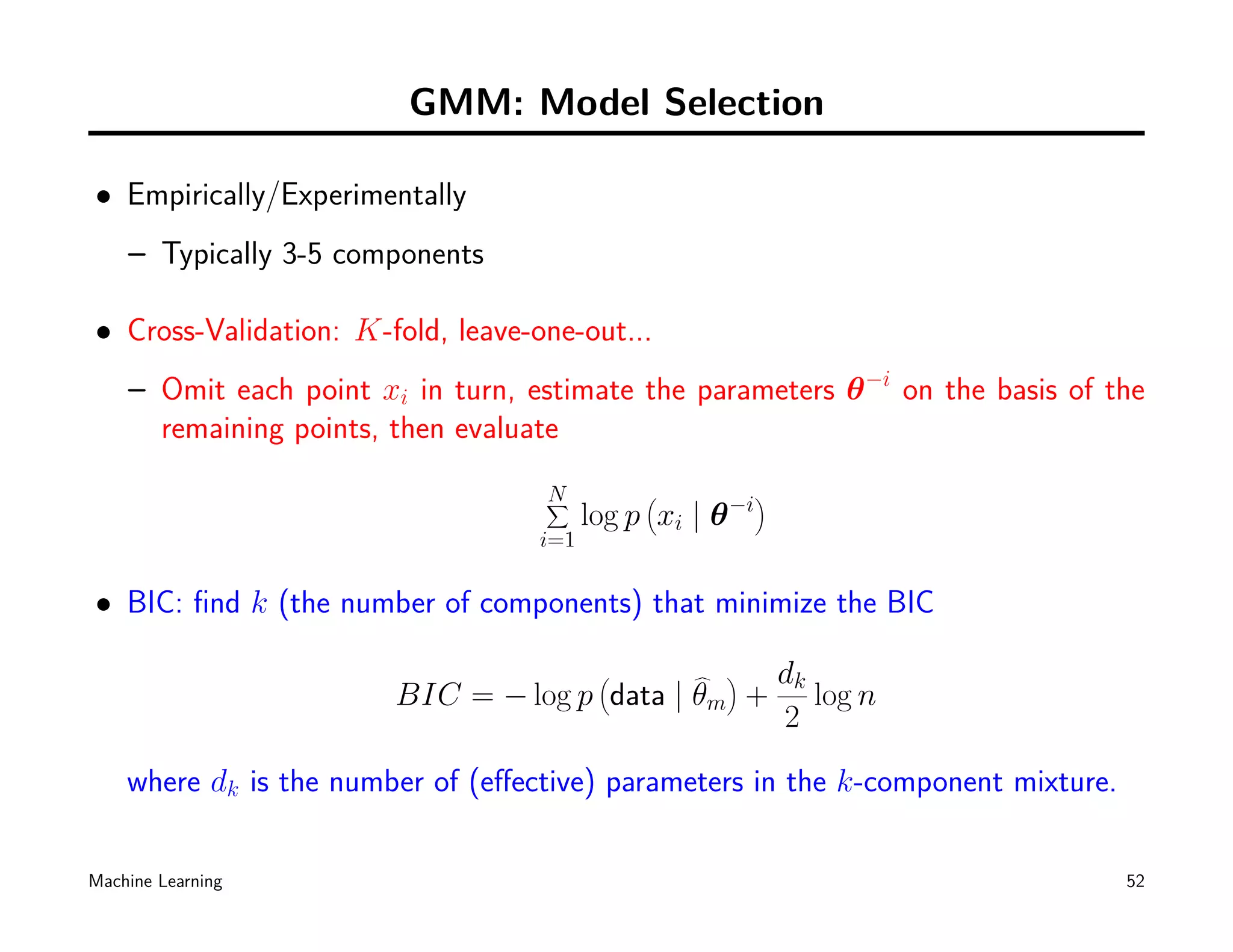
      −10     0        10     20     30       40   50   −10   0        10     20     30        40   50


                   (a) Supervised learning.                       (b) Unsupervised learning.

                            Figure 1: Unsupervised vs. Supervised Learning


Machine Learning                                                                                         4
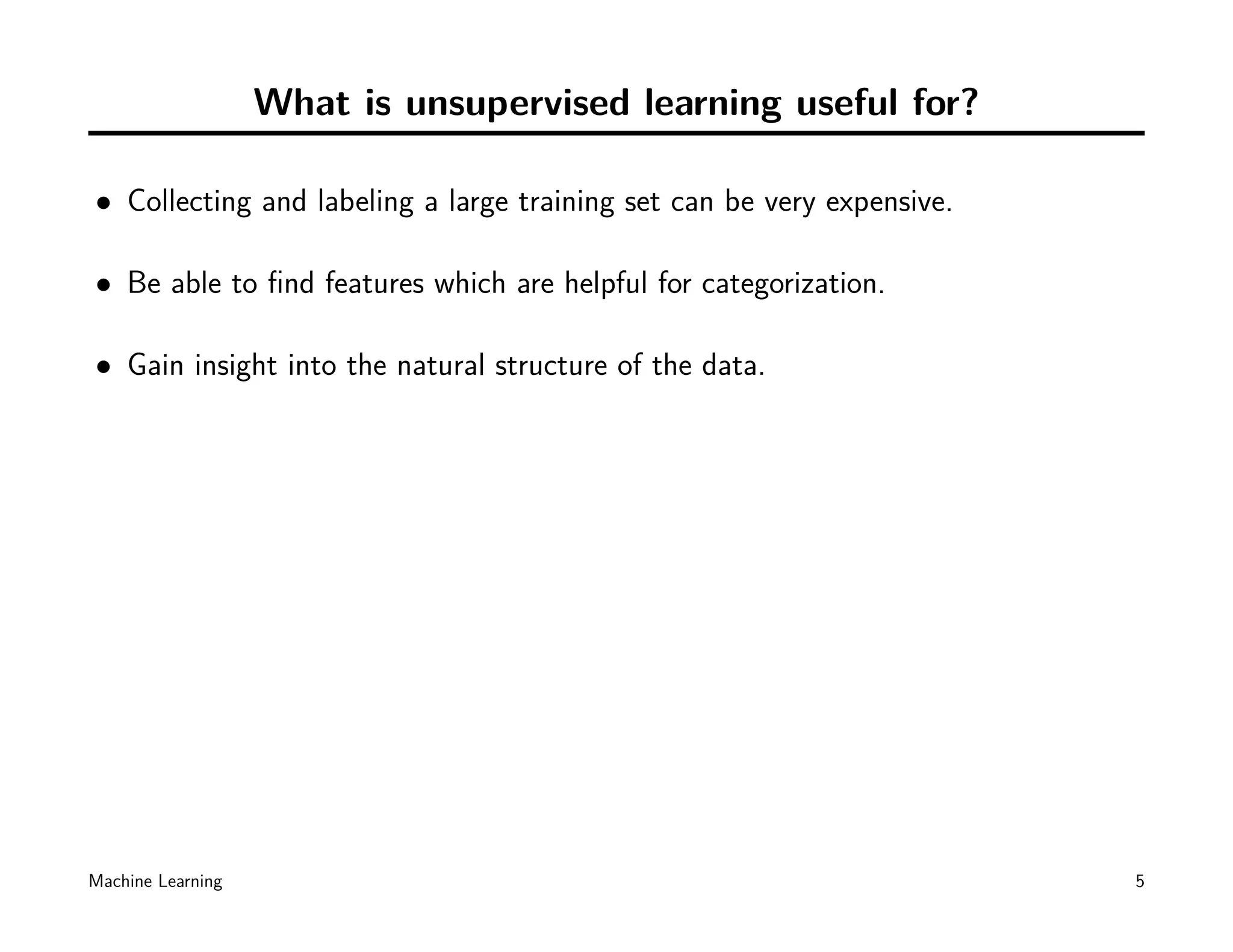
What is unsupervised learning useful for?

• Collecting and labeling a large training set can be very expensive.

• Be able to find features which are helpful for categorization.

• Gain insight into the natural structure of the data.


Machine Learning                                                        5
Contents

• Unsupervised Learning

• K-means clustering

• Expectation Maximization (E.M.)
    – Regularized EM
    – Model Selection

• Gaussian mixtures as a Density Estimator
    – Gaussian mixtures
    – EM for mixtures

• Gaussian mixtures for classification

• Case studies

Machine Learning                             6
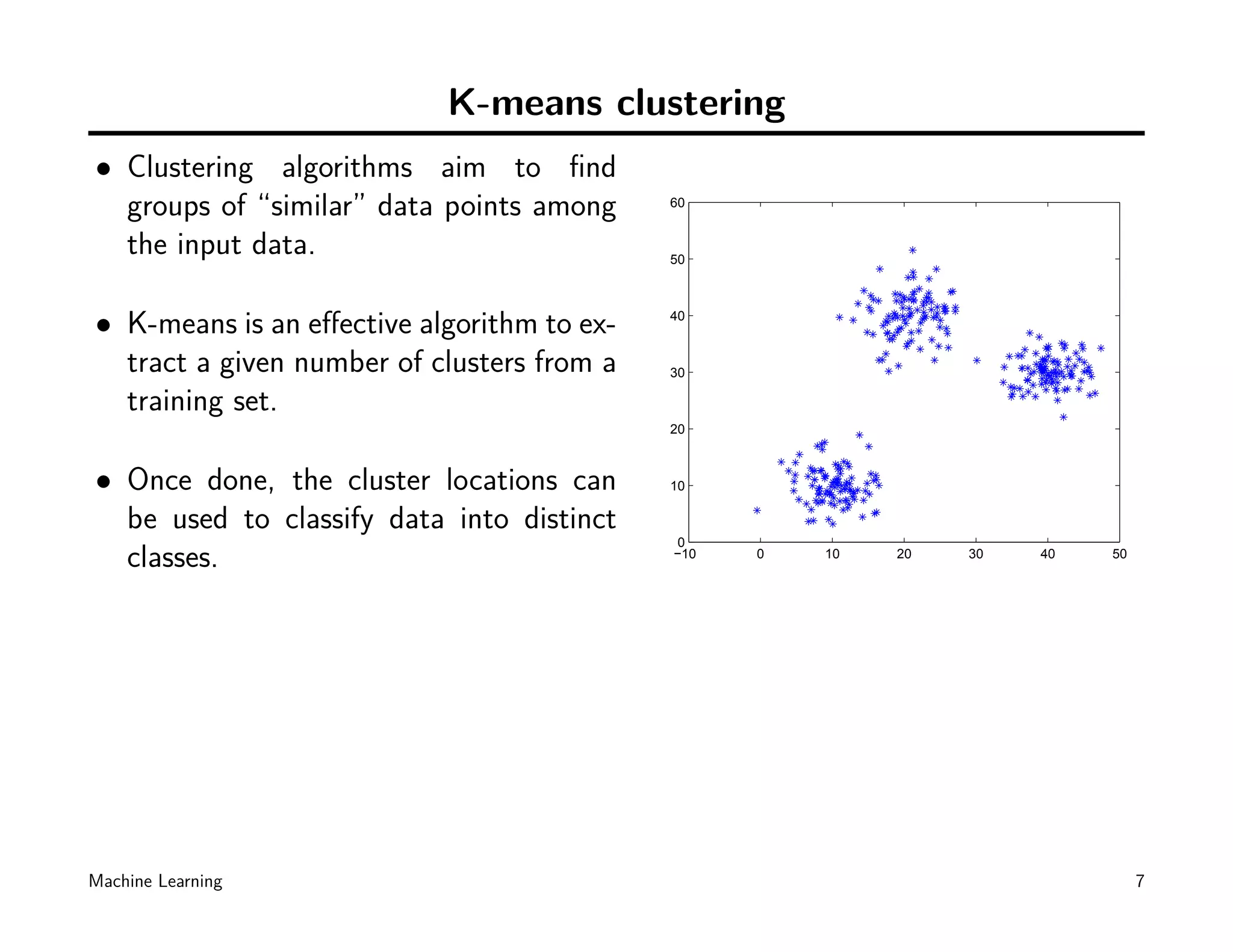
K-means clustering
• Clustering algorithms aim to find
  groups of “similar” data points among     60


  the input data.                           50


• K-means is an effective algorithm to ex-   40


  tract a given number of clusters from a   30

  training set.
                                            20


• Once done, the cluster locations can      10

  be used to classify data into distinct
                                            0
  classes.                                  −10   0   10   20   30   40   50


Machine Learning                                                               7
K-means clustering

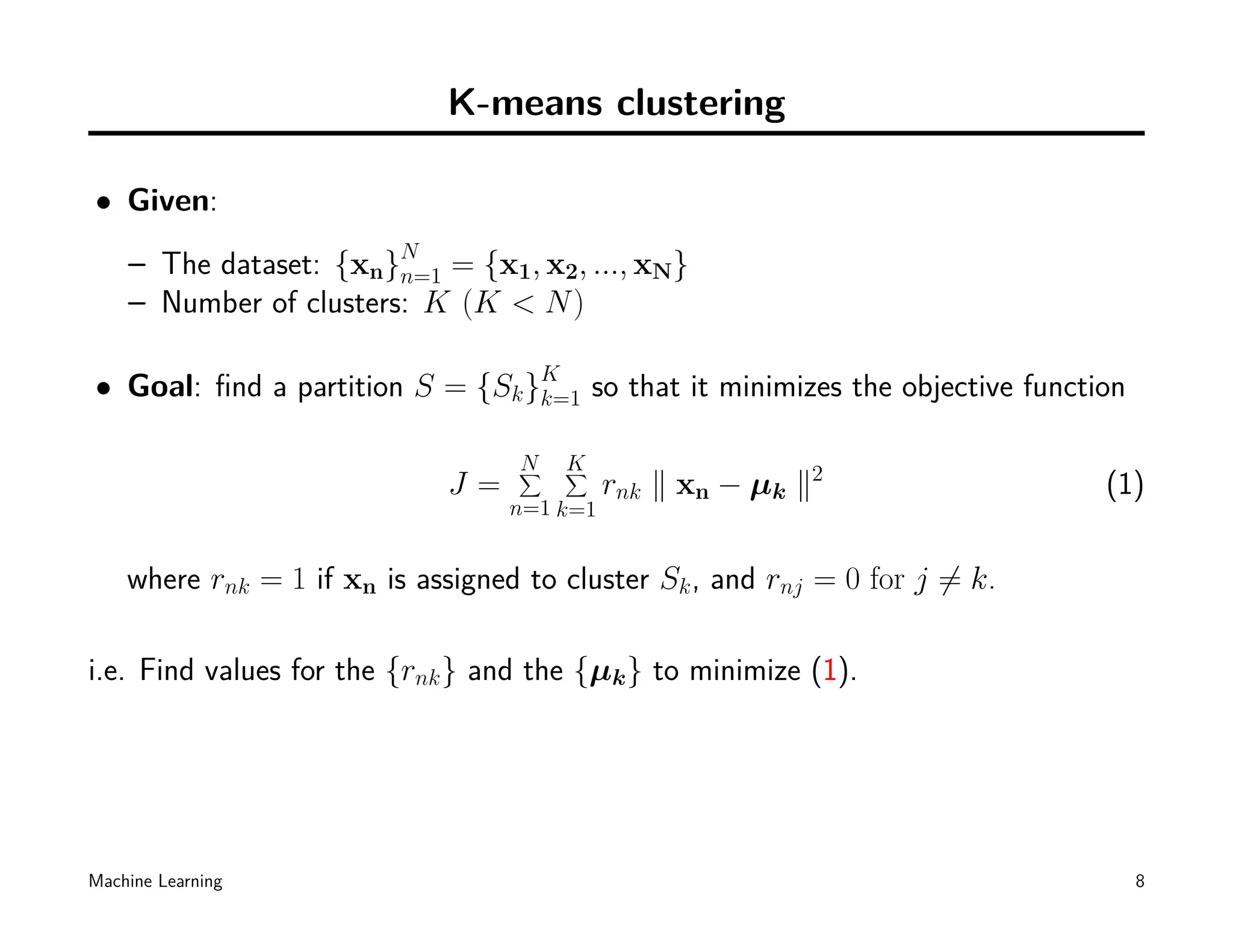
• Given:
    – The dataset: {xn}N = {x1, x2, ..., xN}
                        n=1
    – Number of clusters: K (K < N )

• Goal: find a partition S = {Sk }K so that it minimizes the objective function
                                 k=1

                                    N
                                    ∑   K
                                        ∑
                              J=             rnk ∥ xn − µk ∥2                 (1)
                                   n=1 k=1


    where rnk = 1 if xn is assigned to cluster Sk , and rnj = 0 for j ̸= k.

i.e. Find values for the {rnk } and the {µk } to minimize (1).


Machine Learning                                                                 8
K-means clustering
                                 N
                                 ∑   K
                                     ∑
                           J=             rnk ∥ xn − µk ∥2
                                n=1 k=1


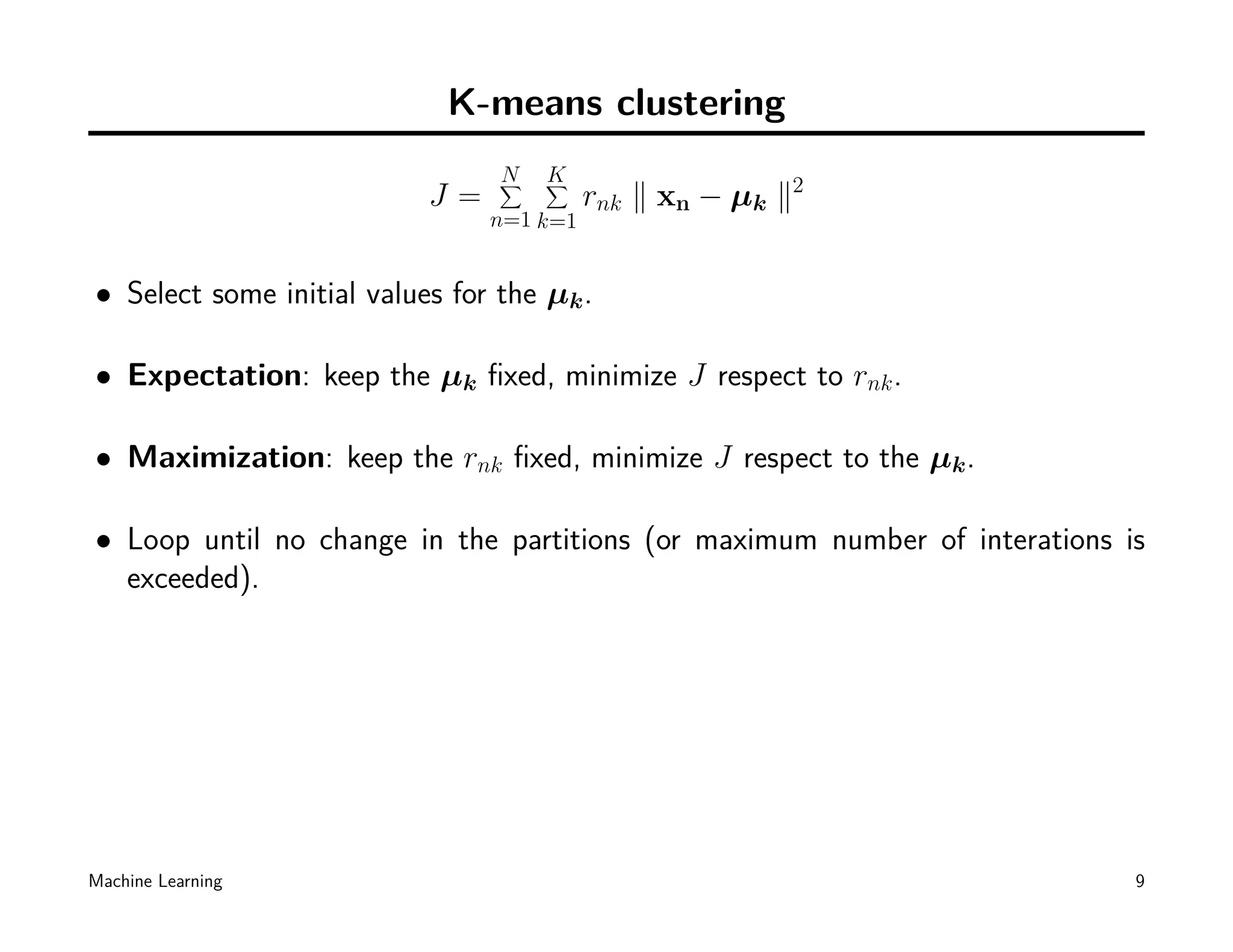
• Select some initial values for the µk .

• Expectation: keep the µk fixed, minimize J respect to rnk .

• Maximization: keep the rnk fixed, minimize J respect to the µk .

• Loop until no change in the partitions (or maximum number of interations is
  exceeded).


Machine Learning                                                            9
K-means clustering
                                  N
                                  ∑   K
                                      ∑
                            J=              rnk ∥ xn − µk ∥2
                                  n=1 k=1


• Expectation: J is linear function of rnk
                              
                              
                              1 if k = arg minj ∥ xn − µj ∥2
                              
                              
                              
                              
                      rnk   =
                             
                             
                             0
                               otherwise


• Maximization: setting the derivative of J with respect to µk to zero, gives:
                                              ∑
                                               n rnk xn
                                      µk =        ∑
                                                  n rnk


    Convergence of K-means: assured [why?], but may lead to local minimum of J
    [8]


Machine Learning                                                                 10
K-means clustering: How to understand?
                                 N
                                 ∑   K
                                     ∑
                            J=             rnk ∥ xn − µk ∥2
                                 n=1 k=1


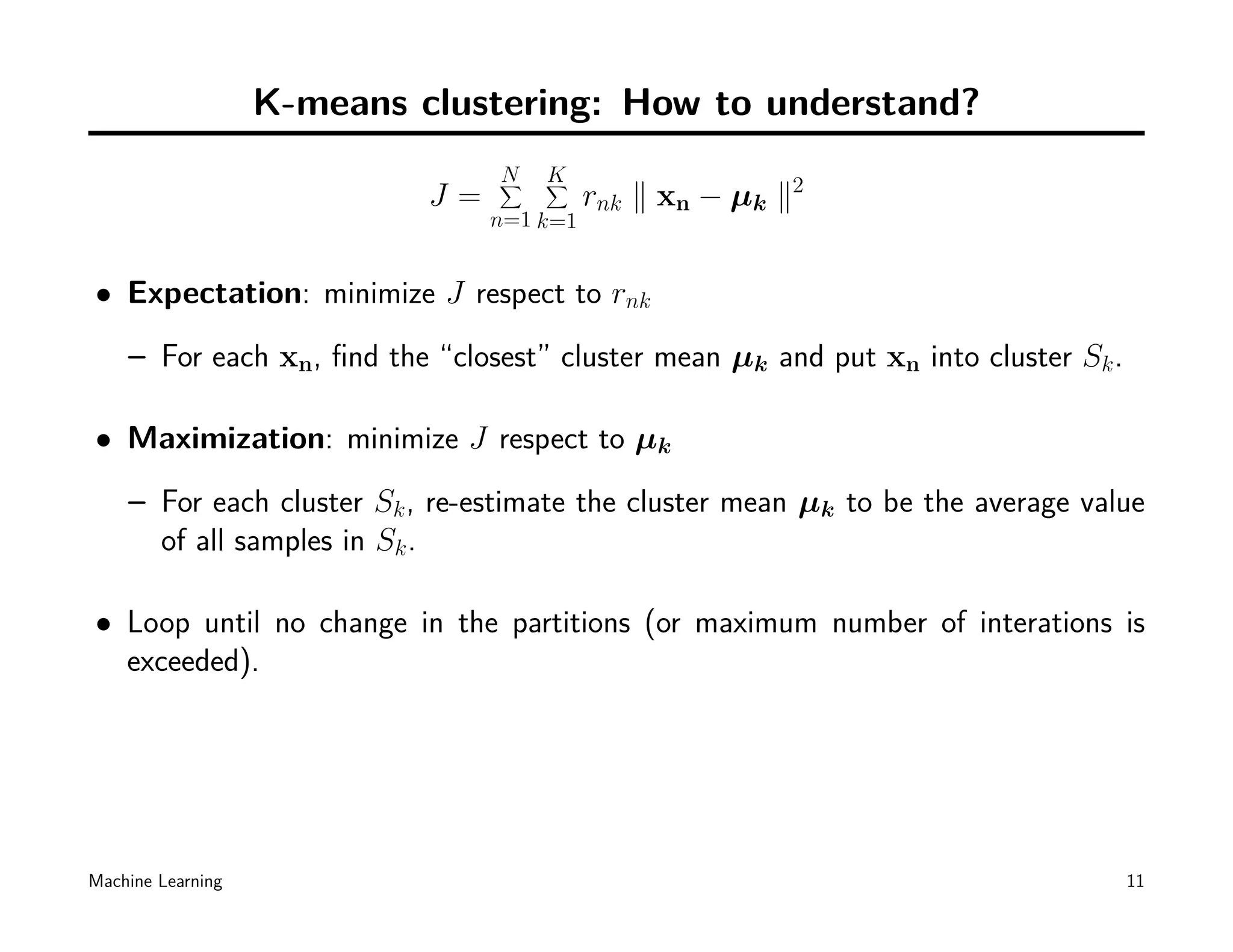
• Expectation: minimize J respect to rnk
    – For each xn, find the “closest” cluster mean µk and put xn into cluster Sk .

• Maximization: minimize J respect to µk
    – For each cluster Sk , re-estimate the cluster mean µk to be the average value
      of all samples in Sk .

• Loop until no change in the partitions (or maximum number of interations is
  exceeded).


Machine Learning                                                                    11
K-means clustering: Demonstration


Machine Learning                                       12
K-means clustering: some variations

• Initial cluster centroids:
    – Randomly selected
    – Iterative procedure: k-mean++ [2]

• Number of clusters K:
                                        √
    – Empirically/experimentally: 2 ∼       n
    – Learning [6]

• Objective function:
    – General dissimilarity measure: k-medoids algorithm.

• Speeding up:
    – kd-trees for pre-processing [7]
    – Triangle inequality for distance calculation [4]

Machine Learning                                            13
Contents

• Unsupervised Learning

• K-means clustering

• Expectation Maximization (E.M.)
    – Regularized EM
    – Model Selection

• Gaussian mixtures as a Density Estimator
    – Gaussian mixtures
    – EM for mixtures

• Gaussian mixtures for classification

• Case studies

Machine Learning                             14
Expectation Maximization


                   E.M.
Machine Learning                              15
Expectation Maximization

• A general-purpose algorithm for MLE in a wide range of situations.

• First formally stated by Dempster, Laird and Rubin in 1977 [1]
    – We even have several books discussing only on EM and its variations!

• An excellent way of doing our unsupervised learning problem, as we will see
    – EM is also used widely in other domains.


Machine Learning                                                                16
EM: a solution for MLE

• Given a statistical model with:
    –   a   set X of observed data,
    –   a   set Z of unobserved latent data,
    –   a   vector of unknown parameters θ,
    –   a   likelihood function L (θ; X, Z) = p (X, Z | θ)

• Roughly speaking, the aim of MLE is to determine θ = arg maxθ L (θ; X, Z)
    – We known the old trick: partial derivatives of the log likelihood...
    – But it is not always tractable [e.g.]
    – Other solutions are available.


Machine Learning                                                              17
EM: General Case

                                     L (θ; X, Z) = p (X, Z | θ)

• EM is just an iterative procedure for finding the MLE

• Expectation step: keep the current estimate θ (t) fixed, calculate the expected
  value of the log likelihood function
                    (            )
                   Q θ|θ   (t)
                                     = E [log L (θ; X, Z)] = E [log p (X, Z | θ)]


• Maximization step: Find the parameter that maximizes this quantity
                                                             (              )
                                      θ   (t+1)
                                                  = arg max Q θ | θ   (t)
                                                        θ


Machine Learning                                                                    18
EM: Motivation

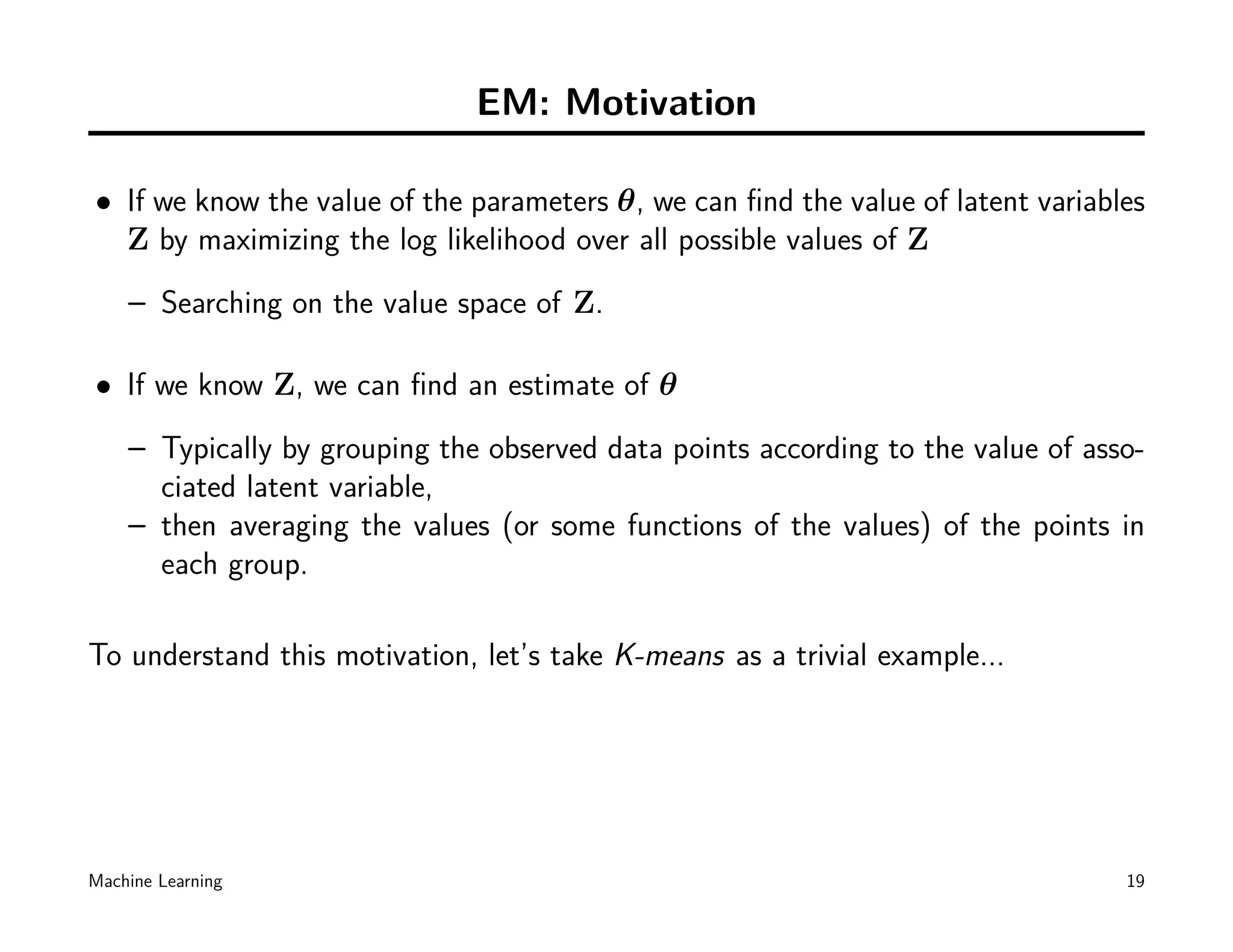
• If we know the value of the parameters θ, we can find the value of latent variables
  Z by maximizing the log likelihood over all possible values of Z
    – Searching on the value space of Z.

• If we know Z, we can find an estimate of θ
    – Typically by grouping the observed data points according to the value of asso-
      ciated latent variable,
    – then averaging the values (or some functions of the values) of the points in
      each group.

To understand this motivation, let’s take K-means as a trivial example...


Machine Learning                                                                  19
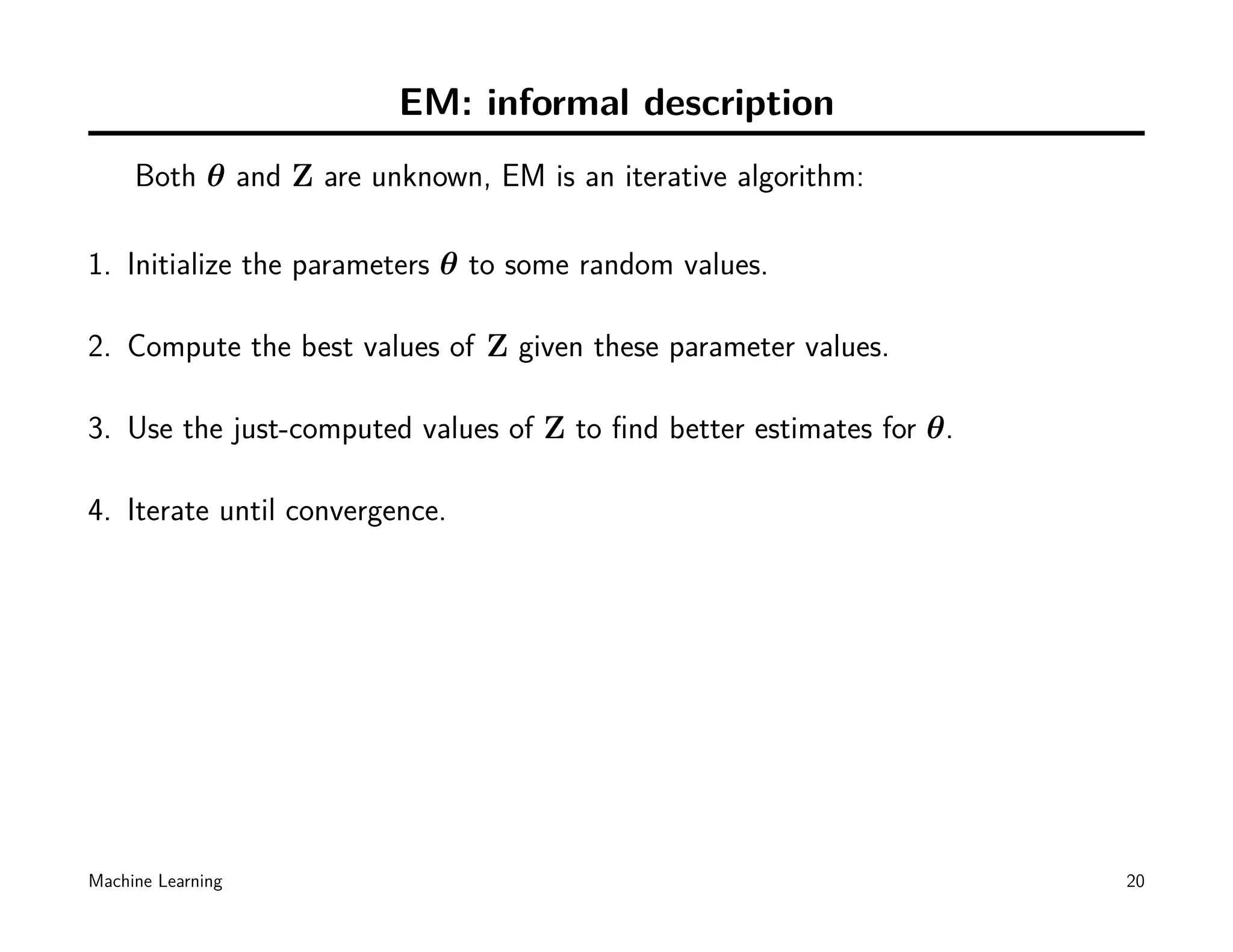
EM: informal description
     Both θ and Z are unknown, EM is an iterative algorithm:

1. Initialize the parameters θ to some random values.

2. Compute the best values of Z given these parameter values.

3. Use the just-computed values of Z to find better estimates for θ.

4. Iterate until convergence.


Machine Learning                                                      20
EM Convergence

• E.M. Convergence: Yes
    – After each iteration, p (X, Z | θ) must increase or remain   [NOT OBVIOUS]
    – But it can not exceed 1 [OBVIOUS]
    – Hence it must converge [OBVIOUS]

• Bad news: E.M. converges to local optimum.
    – Whether the algorithm converges to the global optimum depends on the ini-
      tialization.

• Let’s take K-means as an example, again...

• Details can be found in [9].


Machine Learning                                                                   21
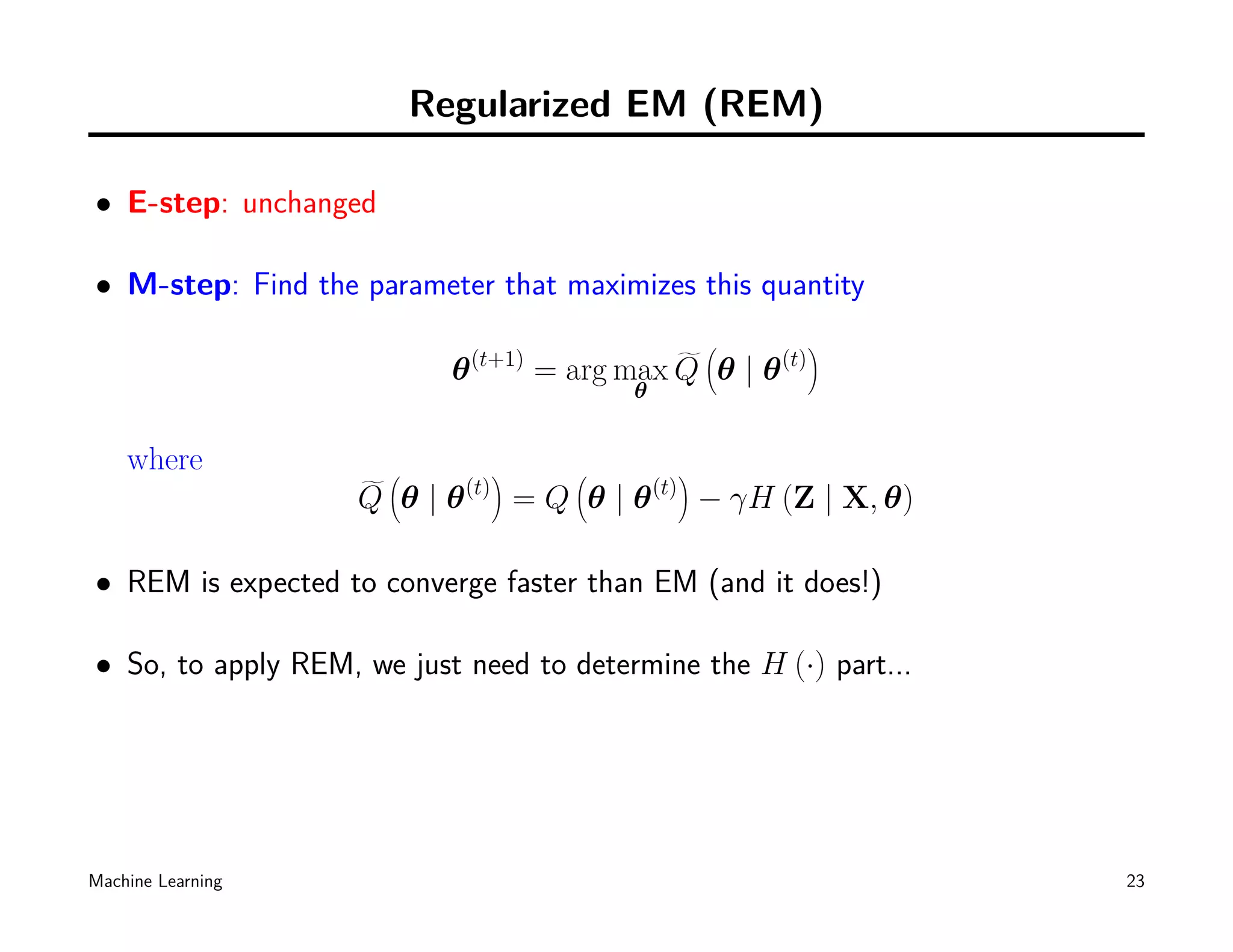
Regularized EM (REM)

• EM tries to inference the latent (missing) data Z from the observations X
    – We want to choose the missing data that has a strong probabilistic relation
      to the observations, i.e. we assume that the observations contains lots of
      information about the missing data.
    – But E.M. does not have any control on the relationship between the missing
      data and the observations!

• Regularized EM (REM) [5] tries to optimized the penalized likelihood

                    L (θ | X, Z) = L (θ | X, Z) − γH (Z | X, θ)

    where H (Y ) is Shannon’s entropy of the random variable Y :
                                           ∑
                              H (Y ) = −       p (y) log p (y)
                                           y

    and the positive value γ is the regularization parameter. [When γ = 0?]

Machine Learning                                                               22
Regularized EM (REM)

• E-step: unchanged

• M-step: Find the parameter that maximizes this quantity
                                                            (          )
                            θ   (t+1)
                                        = arg max Q θ | θ        (t)
                                              θ


    where             (           )       (             )
                    Q θ|θ   (t)
                                      =Q θ|θ      (t)
                                                            − γH (Z | X, θ)

• REM is expected to converge faster than EM (and it does!)

• So, to apply REM, we just need to determine the H (·) part...


Machine Learning                                                              23
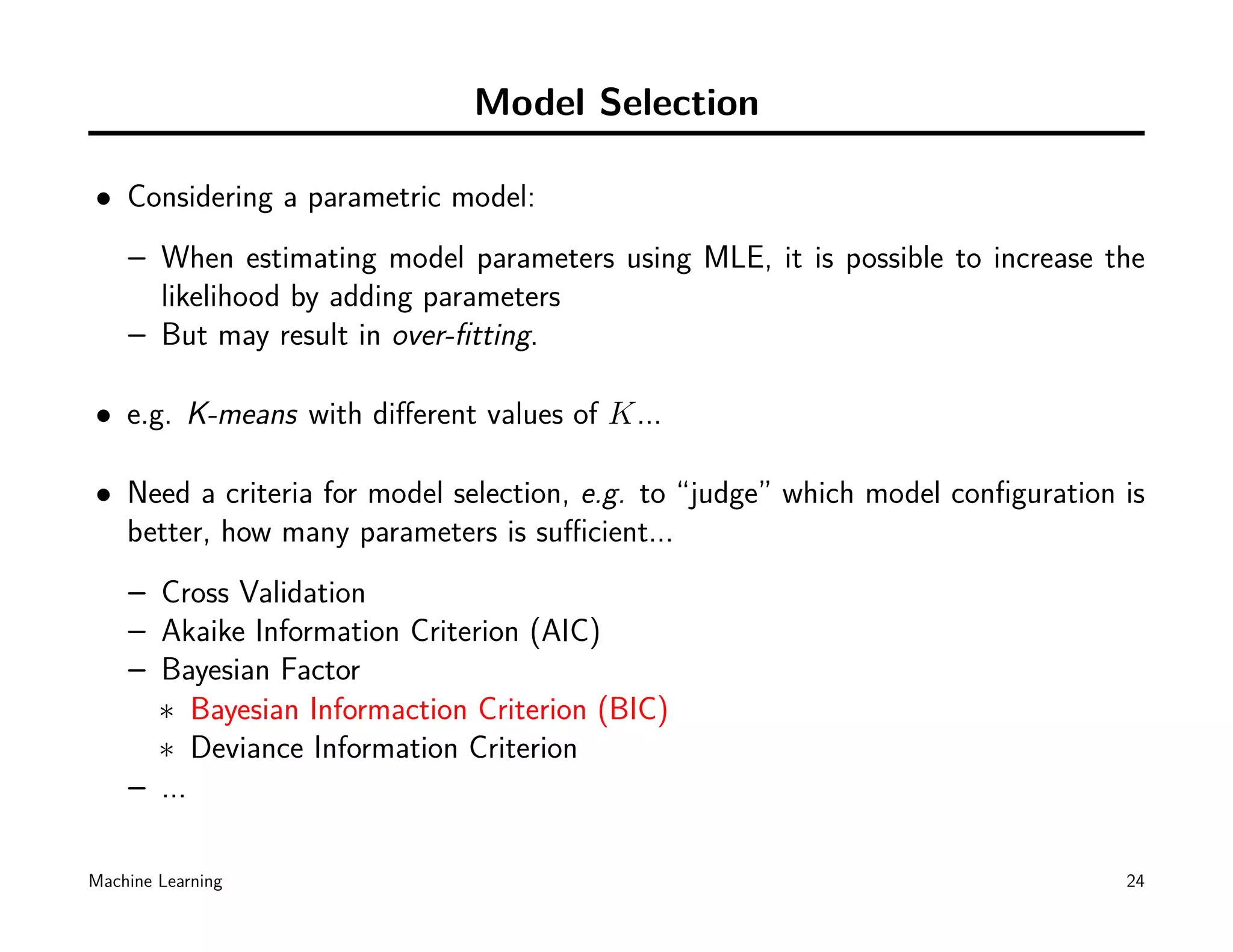
Model Selection

• Considering a parametric model:
    – When estimating model parameters using MLE, it is possible to increase the
      likelihood by adding parameters
    – But may result in over-fitting.

• e.g. K-means with different values of K...

• Need a criteria for model selection, e.g. to “judge” which model configuration is
  better, how many parameters is sufficient...
    – Cross Validation
    – Akaike Information Criterion (AIC)
    – Bayesian Factor
      ∗ Bayesian Informaction Criterion (BIC)
      ∗ Deviance Information Criterion
    – ...

Machine Learning                                                                24
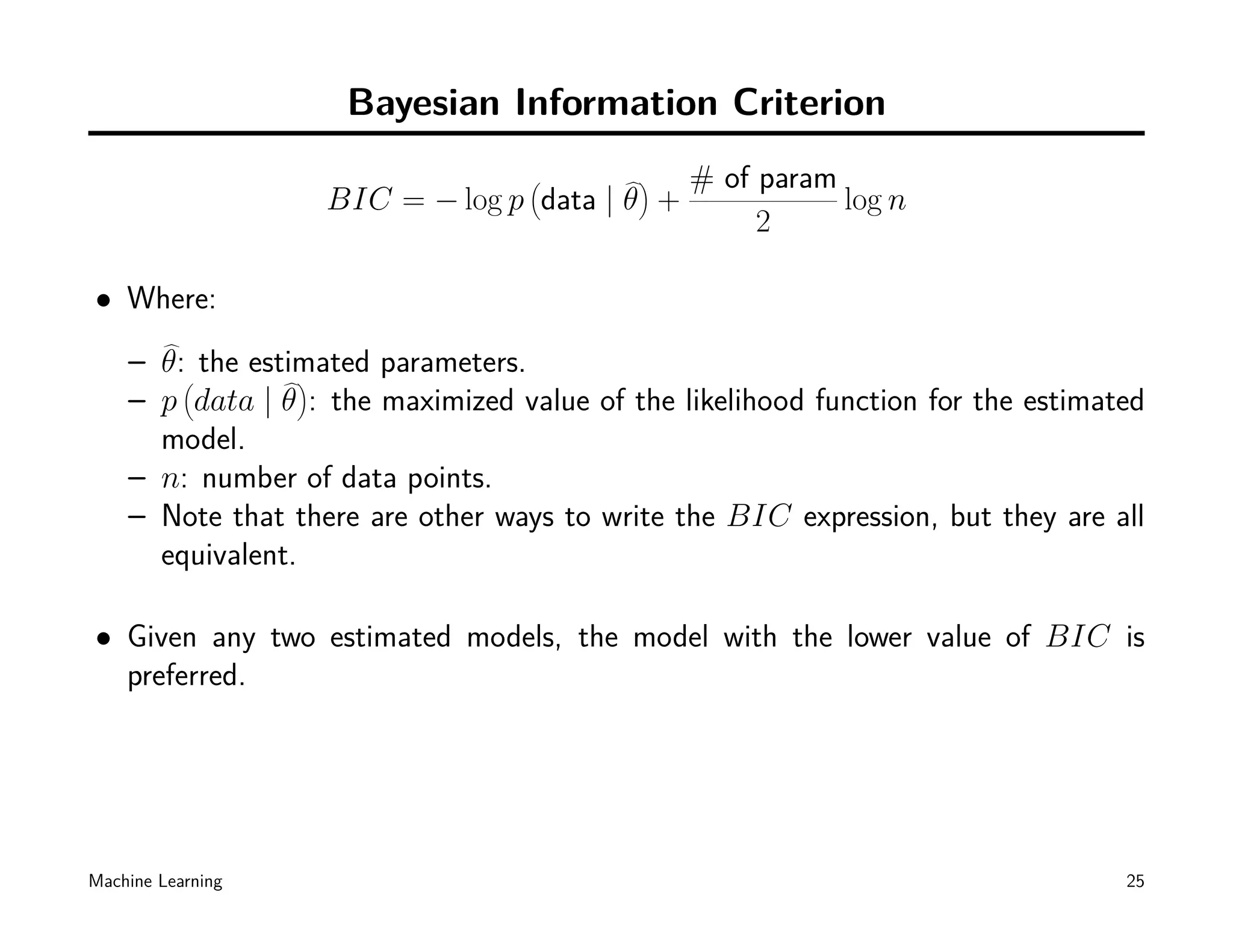
Bayesian Information Criterion
                                   (       )   # of param
                   BIC = − log p data | θ +               log n
                                                    2

• Where:
    – θ:( the estimated parameters.
                  )
    – p data | θ : the maximized value of the likelihood function for the estimated
      model.
    – n: number of data points.
    – Note that there are other ways to write the BIC expression, but they are all
      equivalent.

• Given any two estimated models, the model with the lower value of BIC is
  preferred.


Machine Learning                                                                 25
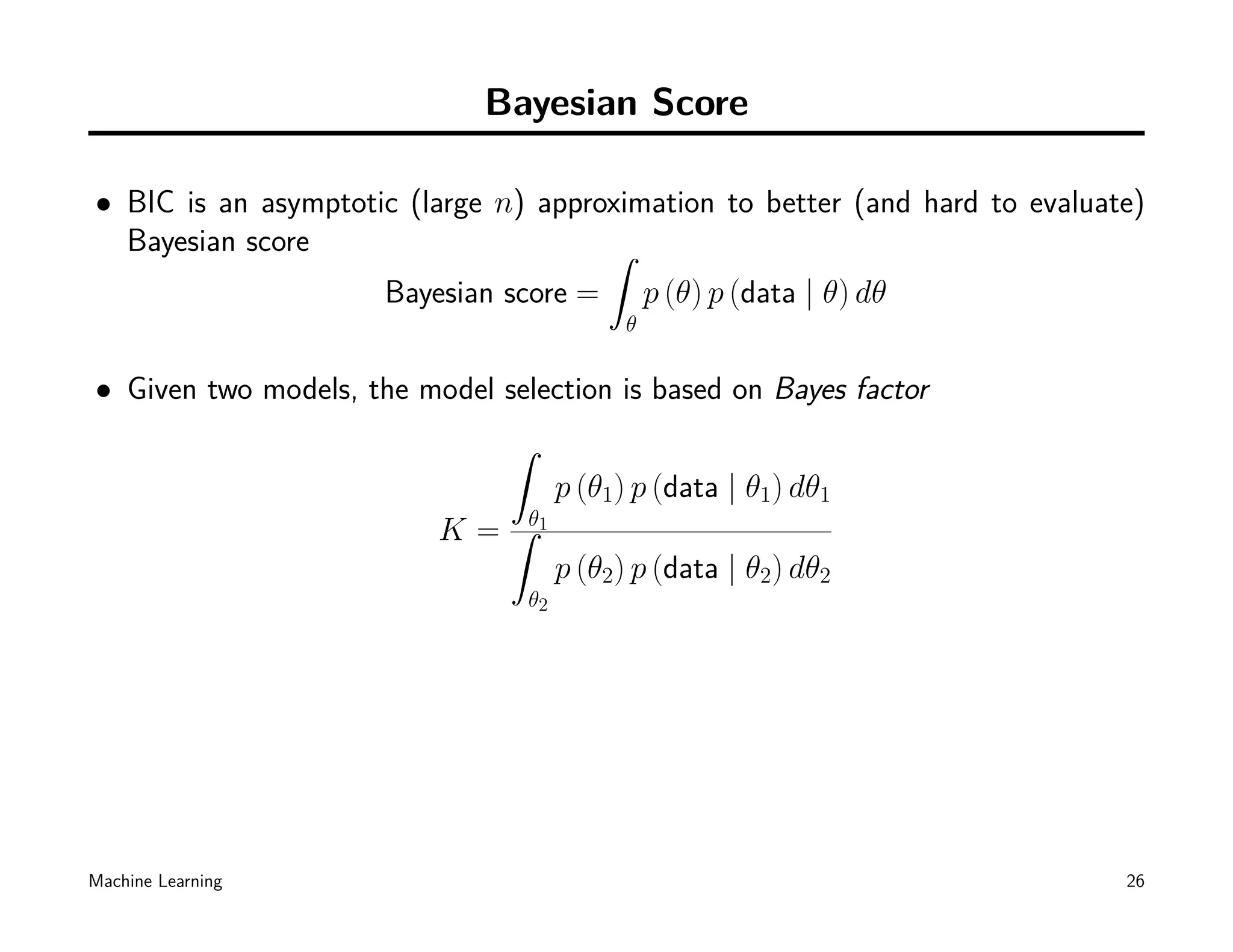
Bayesian Score

• BIC is an asymptotic (large n) approximation to better (and hard to evaluate)
  Bayesian score                      ˆ
                     Bayesian score = p (θ) p (data | θ) dθ
                                            θ


• Given two models, the model selection is based on Bayes factor
                               ˆ
                                      p (θ1) p (data | θ1) dθ1
                          K = ˆθ1
                                      p (θ2) p (data | θ2) dθ2
                                 θ2


Machine Learning                                                             26
Contents

• Unsupervised Learning

• K-means clustering

• Expectation Maximization (E.M.)
    – Regularized EM
    – Model Selection

• Gaussian mixtures as a Density Estimator
    – Gaussian mixtures
    – EM for mixtures

• Gaussian mixtures for classification

• Case studies

Machine Learning                             27
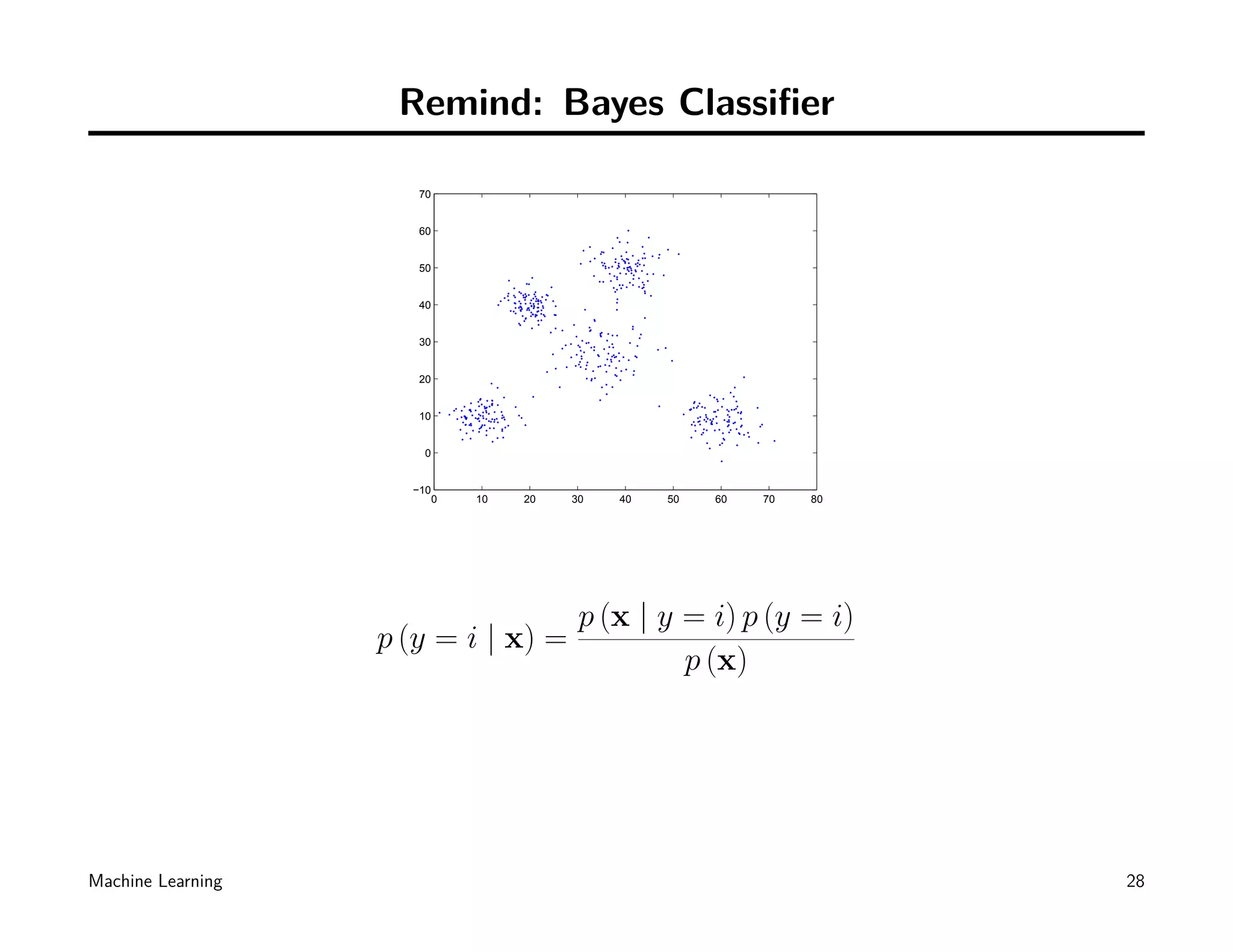
Remind: Bayes Classifier

                      70


                      60


                      50


                      40


                      30


                      20


                      10


                       0


                     −10
                           0   10   20   30   40   50   60   70   80


                                   p (x | y = i) p (y = i)
                   p (y = i | x) =
                                            p (x)


Machine Learning                                                       28
Remind: Bayes Classifier

                                     70


                                     60


                                     50


                                     40


                                     30


                                     20


                                     10


                                      0


                                 −10
                                          0   10   20   30   40    50     60    70       80


     In case of Gaussian Bayes Classifier:

                                                              [                               ]
                                                                                     T
                                          d/2
                                             1
                                                        exp       −2
                                                                   1
                                                                        (x − µi) Σi (x − µi) pi
                                      (2π) ∥Σi ∥1/2
                   p (y = i | x) =
                                                                        p (x)

     How can we deal with the denominator p (x)?

Machine Learning                                                                                  29
Remind: The Single Gaussian Distribution

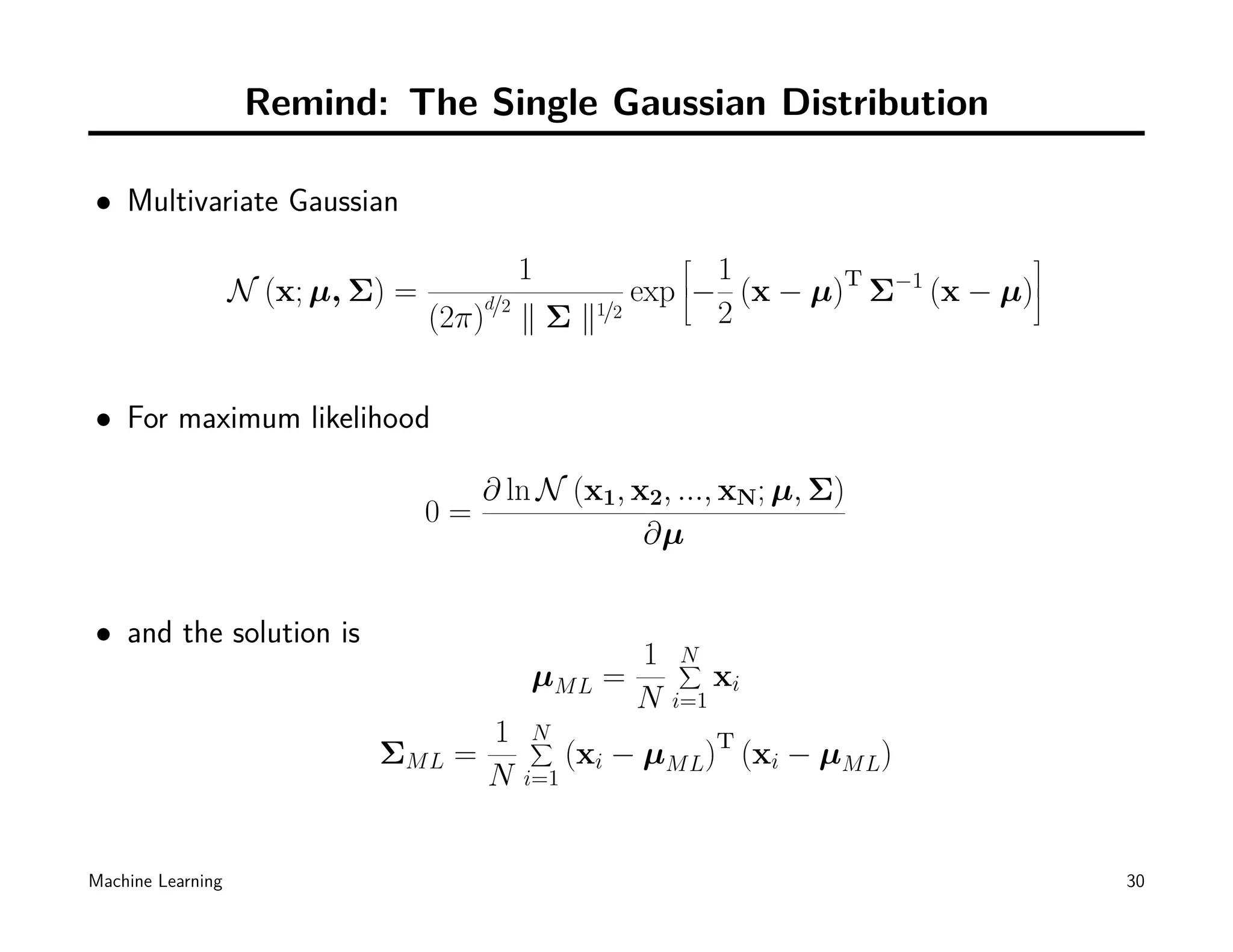
• Multivariate Gaussian
                                                                           
                                         1            1
                   N (x; µ, Σ) =     d/2       exp −
                                                   
                                                        (x − µ)T Σ−1 (x − µ)
                                                                            
                                 (2π) ∥ Σ ∥1/2        2


• For maximum likelihood

                                      ∂ ln N (x1, x2, ..., xN; µ, Σ)
                                 0=
                                                   ∂µ


• and the solution is
                                                    1   N
                                                        ∑
                                          µM L    =           xi
                                                    N   i=1
                                      1   N
                                          ∑
                             ΣM L   =           (xi − µM L)T (xi − µM L)
                                      N   i=1


Machine Learning                                                                30
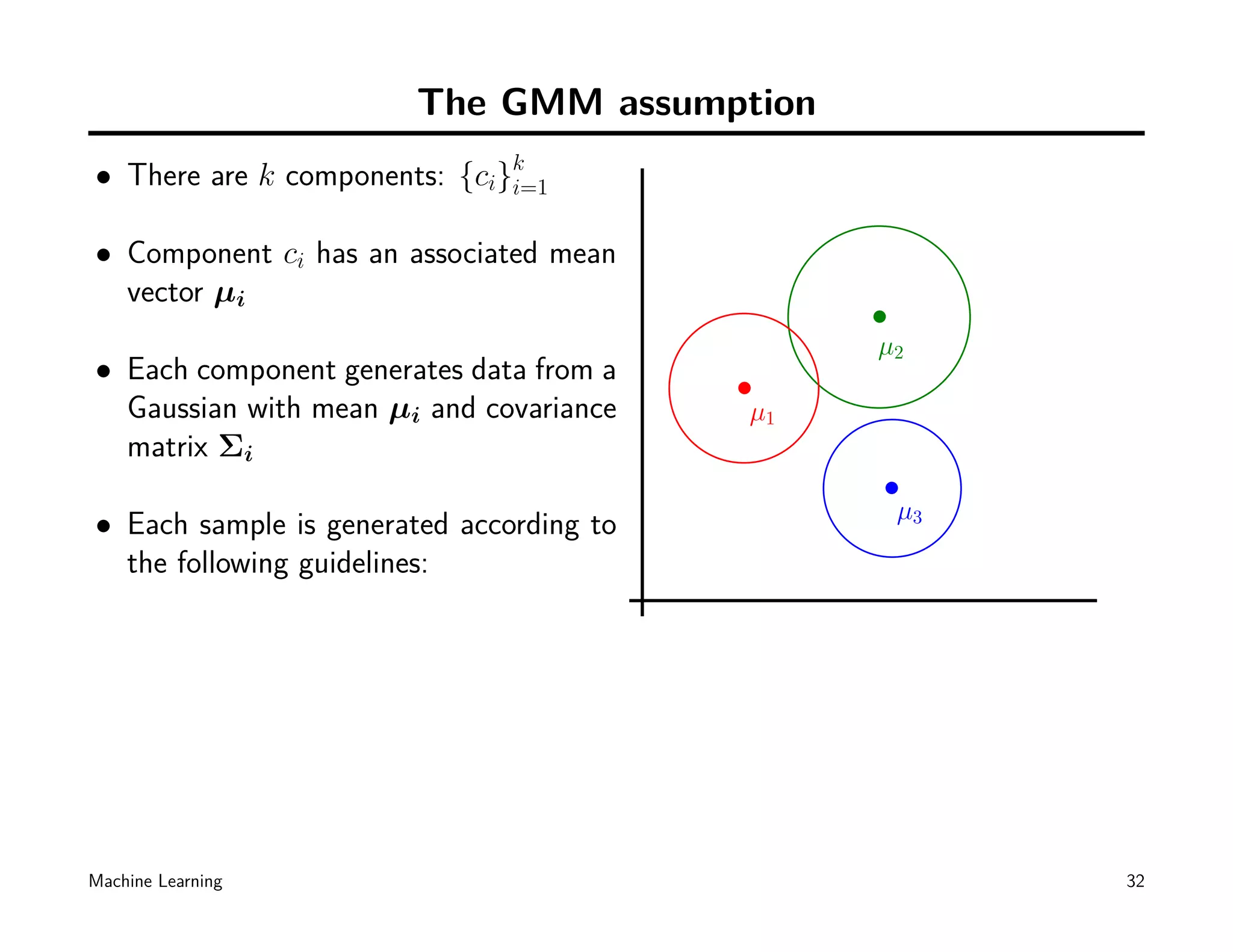
The GMM assumption
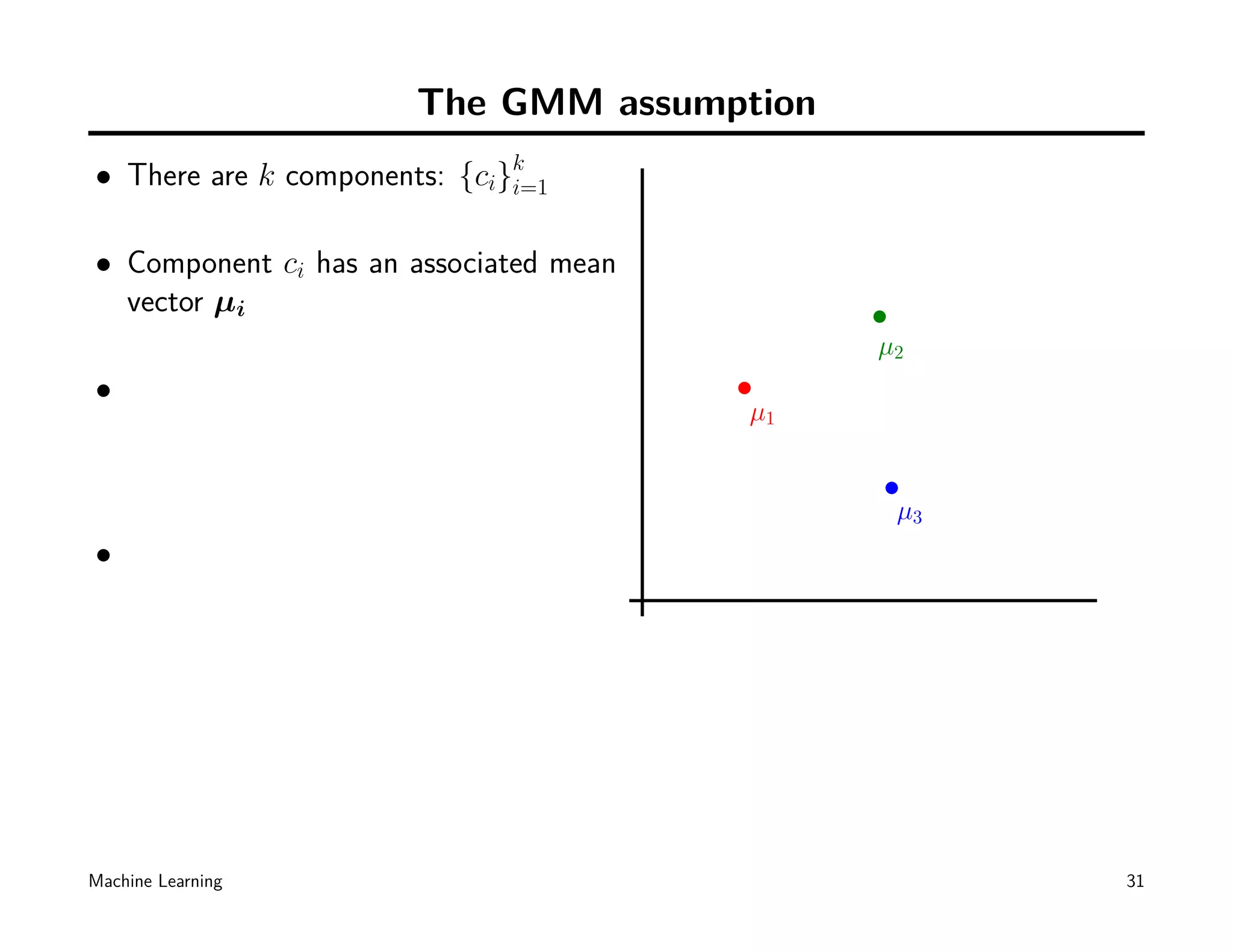
• There are k components: {ci}k
                              i=1


• Component ci has an associated mean
  vector µi
                                             µ2
•
                                        µ1


                                              µ3
•


Machine Learning                                   31
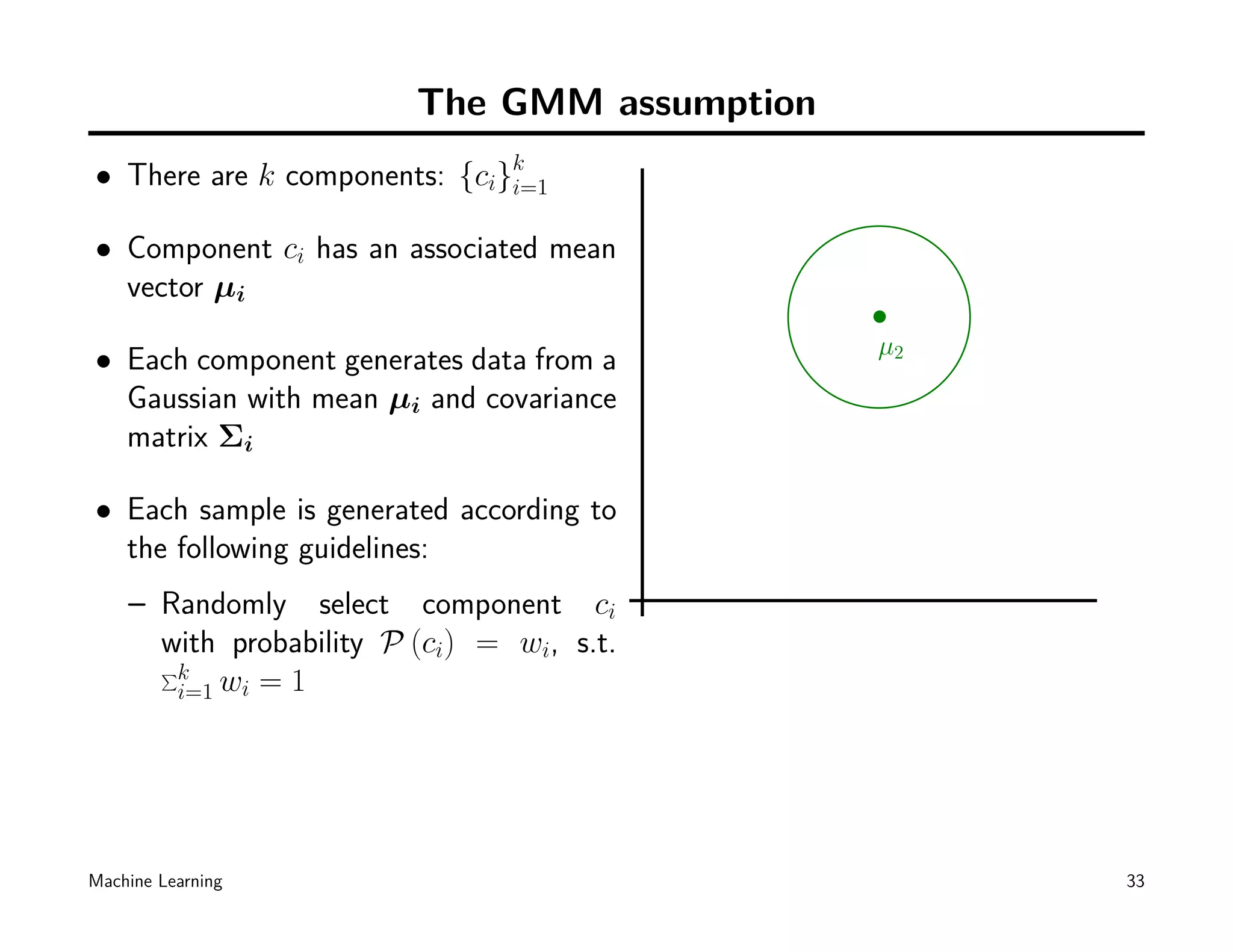
The GMM assumption
• There are k components: {ci}k
                              i=1


• Component ci has an associated mean
  vector µi
                                               µ2
• Each component generates data from a
  Gaussian with mean µi and covariance    µ1
  matrix Σi

• Each sample is generated according to         µ3
  the following guidelines:


Machine Learning                                     32
The GMM assumption
• There are k components: {ci}k
                              i=1

• Component ci has an associated mean
  vector µi

• Each component generates data from a        µ2
  Gaussian with mean µi and covariance
  matrix Σi

• Each sample is generated according to
  the following guidelines:
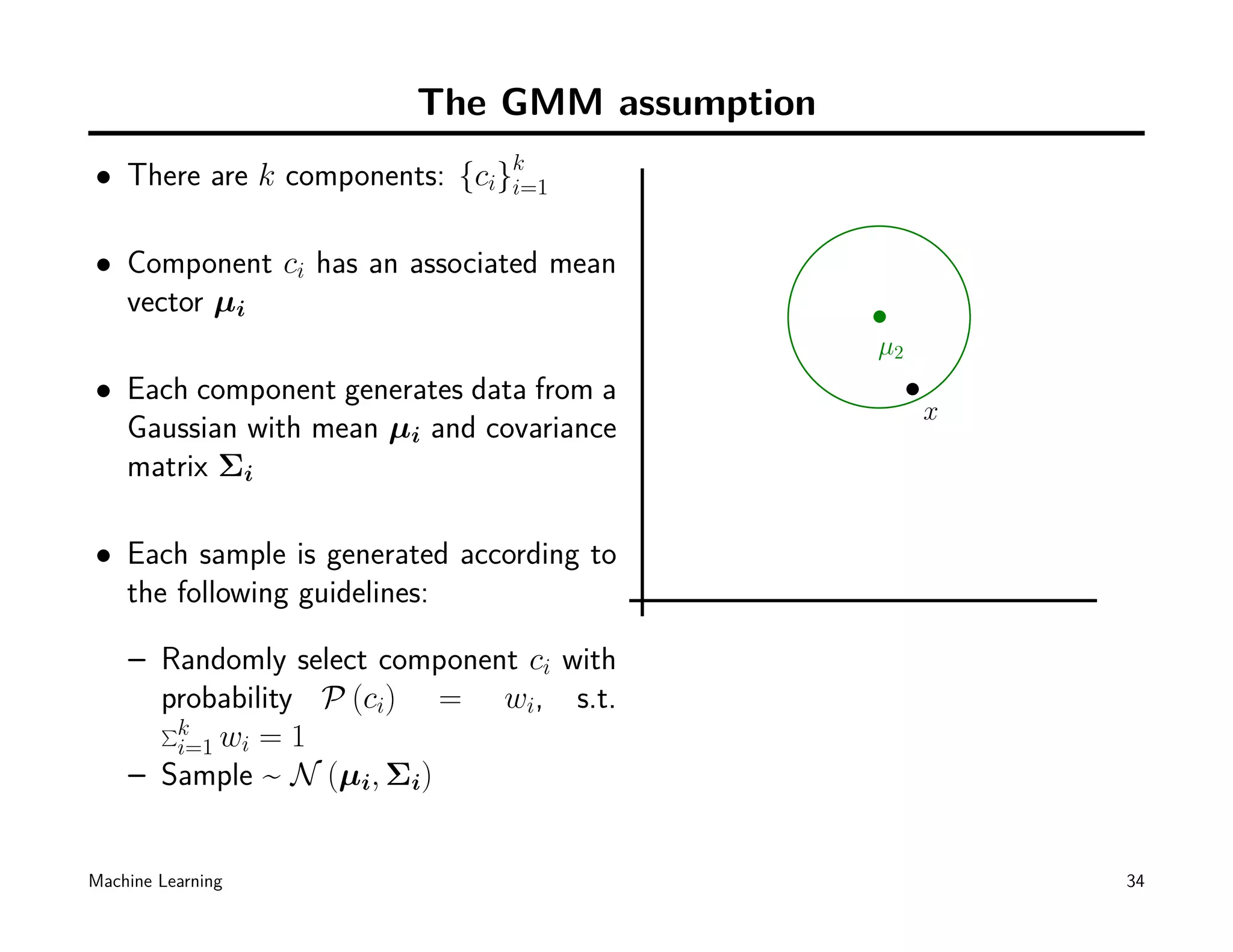
    – Randomly select component ci
      with probability P (ci) = wi, s.t.
      ∑k
       i=1 wi = 1


Machine Learning                                   33
The GMM assumption
• There are k components: {ci}k
                              i=1


• Component ci has an associated mean
  vector µi
                                             µ2
• Each component generates data from a
                                                  x
  Gaussian with mean µi and covariance
  matrix Σi

• Each sample is generated according to
  the following guidelines:

    – Randomly select component ci with
      probability P (ci) = wi, s.t.
      ∑k
       i=1 wi = 1
    – Sample ~ N (µi, Σi)


Machine Learning                                      34
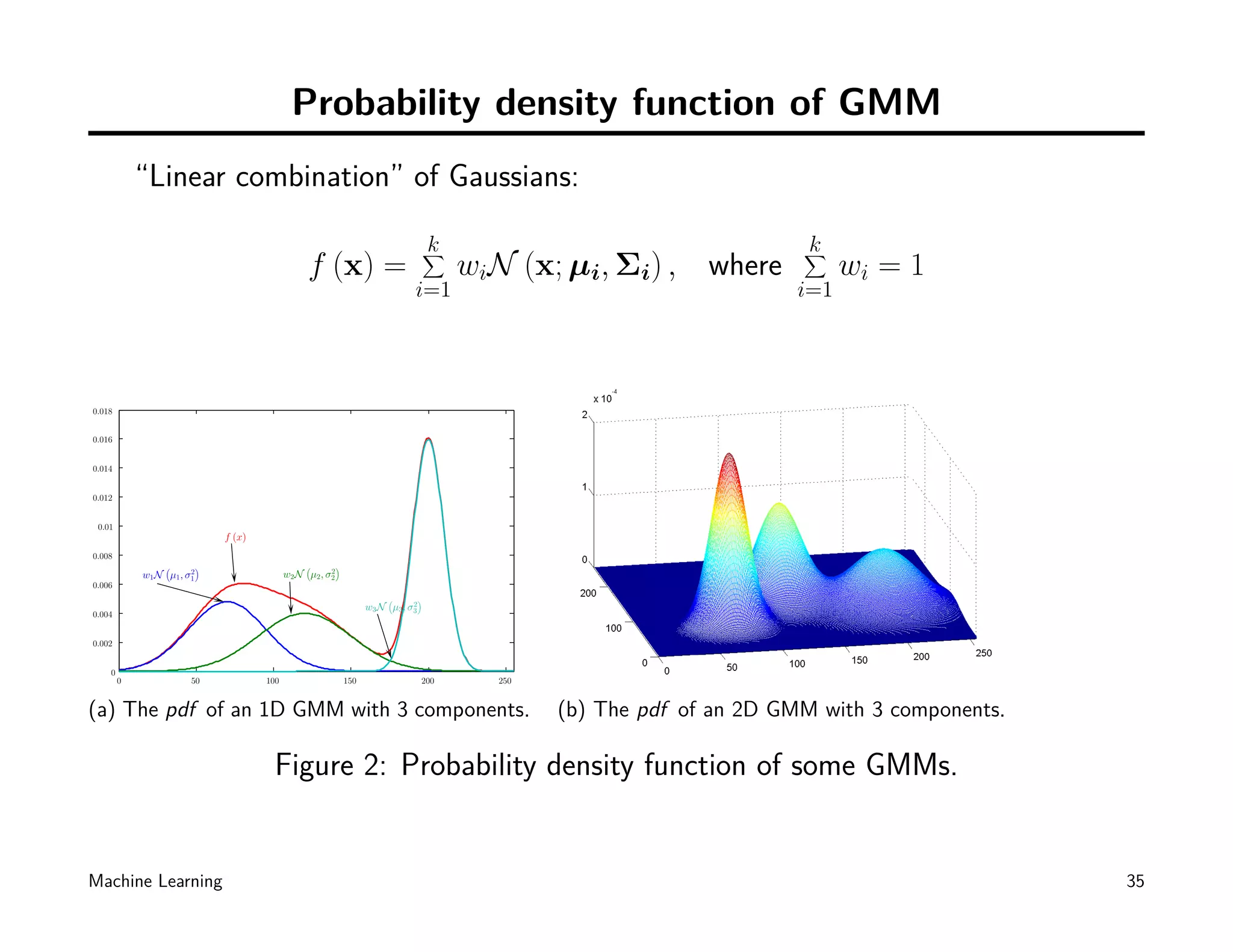
Probability density function of GMM
            “Linear combination” of Gaussians:

                                                                              k
                                                                              ∑                                    k
                                                                                                                   ∑
                                               f (x) =                              wiN (x; µi, Σi) , where              wi = 1
                                                                          i=1                                      i=1


0.018


0.016


0.014


0.012


 0.01
                            f (x)
0.008
                                                     2
                       2
            w1 N µ1 , σ1                  w2 N µ2 , σ2
0.006

                                                                          2
                                                               w3 N µ3 , σ3
0.004


0.002


    0
        0              50           100                  150                  200     250


(a) The pdf of an 1D GMM with 3 components.                                                 (b) The pdf of an 2D GMM with 3 components.

                                      Figure 2: Probability density function of some GMMs.


Machine Learning                                                                                                                          35
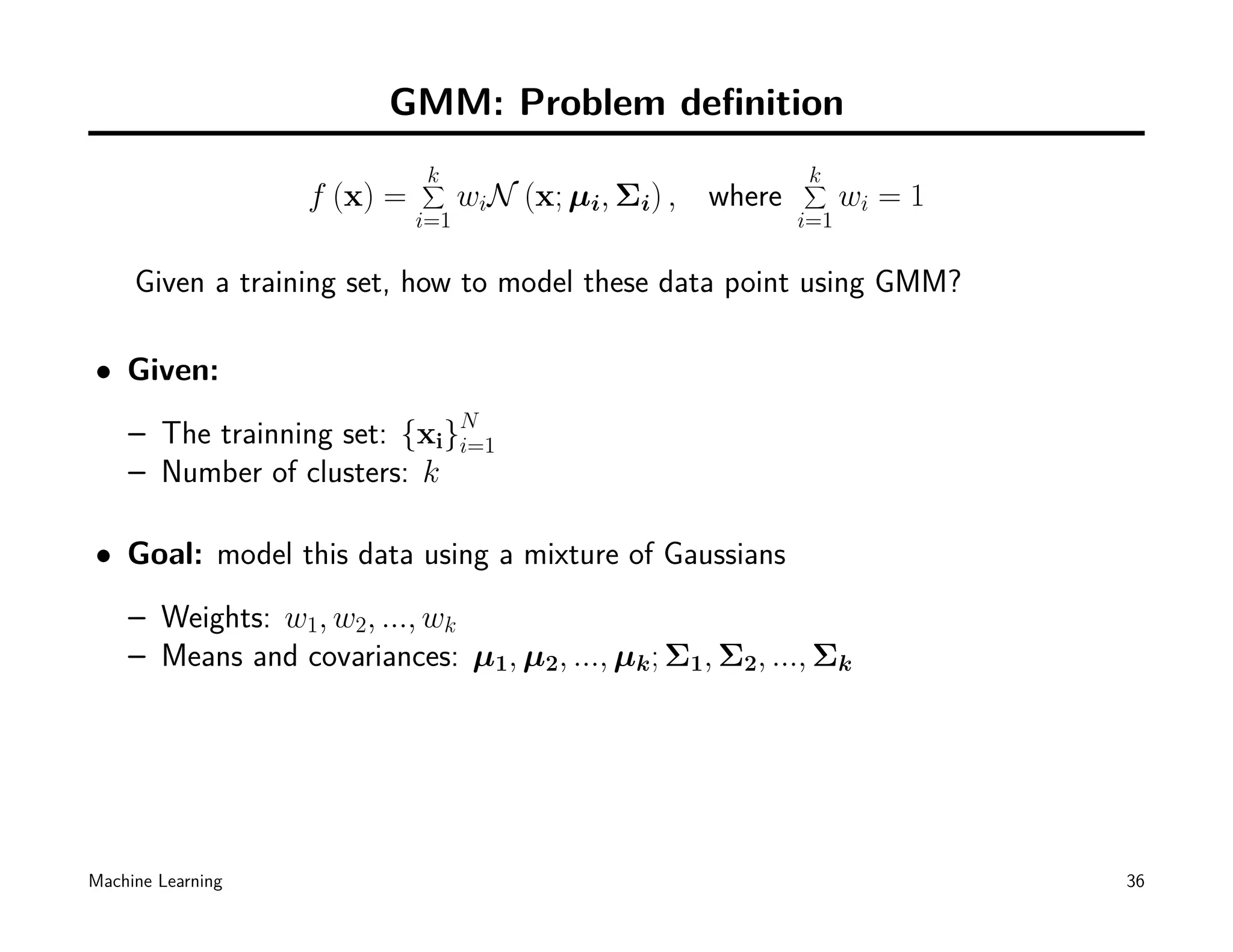
GMM: Problem definition
                             k
                             ∑                               k
                                                             ∑
                   f (x) =         wiN (x; µi, Σi) , where         wi = 1
                             i=1                             i=1

     Given a training set, how to model these data point using GMM?

• Given:
    – The trainning set: {xi}N
                             i=1
    – Number of clusters: k

• Goal: model this data using a mixture of Gaussians
    – Weights: w1, w2, ..., wk
    – Means and covariances: µ1, µ2, ..., µk ; Σ1, Σ2, ..., Σk


Machine Learning                                                            36
Computing likelihoods in unsupervised case
                                 k
                                 ∑                                        k
                                                                          ∑
                       f (x) =         wiN (x; µi, Σi) , where                  wi = 1
                                 i=1                                      i=1


• Given a mixture of Gaussians, denoted by G. For any x, we can define the
  likelihood:

                        P (x | G) = P (x | w1, µ1, Σ1, ..., wk , µk , Σk )
                                            k
                                            ∑
                                        =         P (x | ci) P (ci)
                                            i=1
                                             k
                                             ∑
                                        =         wiN (x; µi, Σi)
                                            i=1


• So we can define likelihood for the whole training set [Why?]
                                                           N
                                                           ∏
                       P (x1, x2, ..., xN | G) =               P (xi | G)
                                                           i=1
                                                            N ∑
                                                            ∏  k
                                                       =             wj N (xi; µj , Σj )
                                                           i=1 j=1


Machine Learning                                                                           37
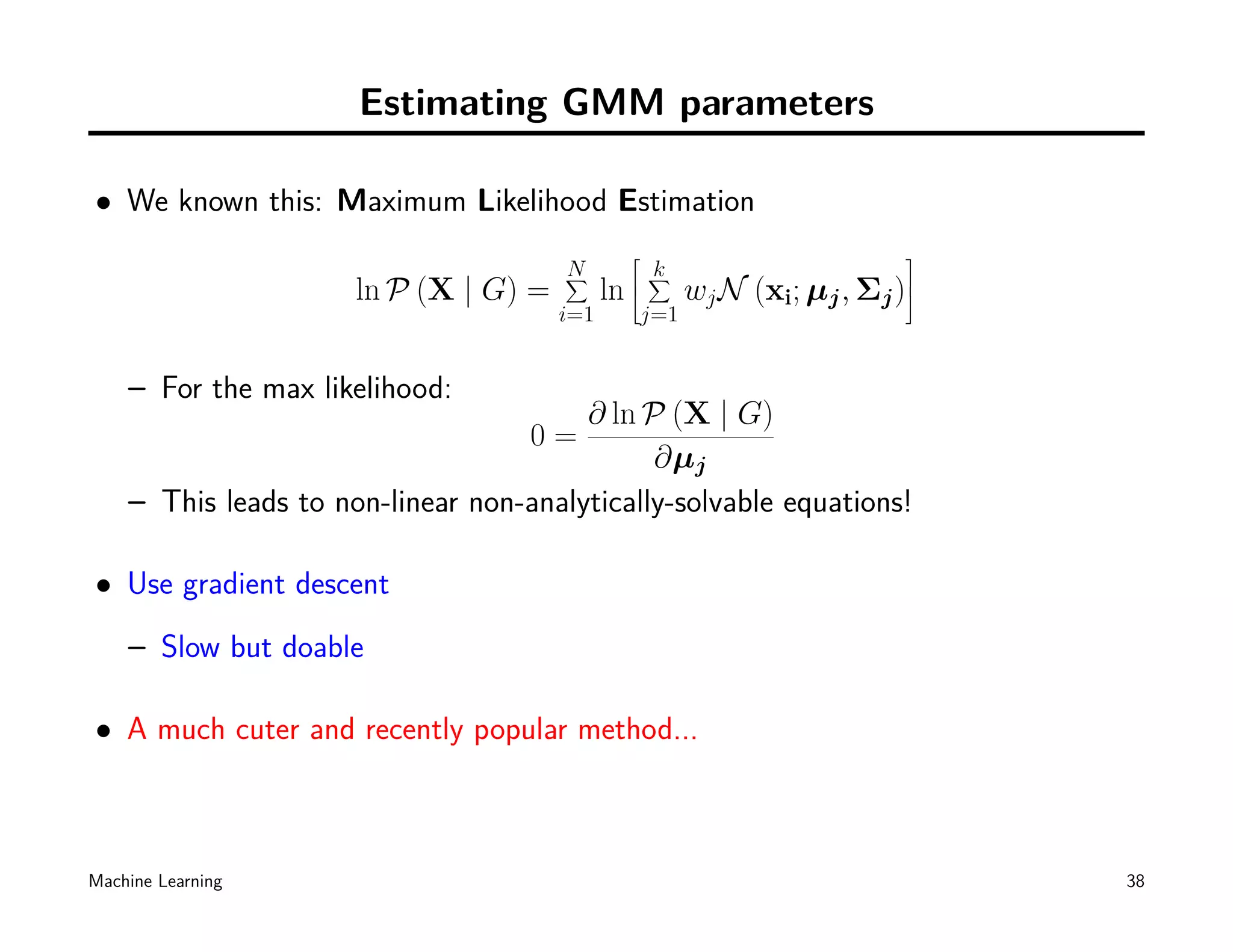
Estimating GMM parameters

• We known this: Maximum Likelihood Estimation
                                                                          
                                       N
                                       ∑            k
                                                    ∑
                      ln P (X | G) =         ln 
                                                       wj N (xi; µj , Σj )
                                                                           
                                       i=1      j=1


    – For the max likelihood:
                                        ∂ ln P (X | G)
                                    0=
                                              ∂µj
    – This leads to non-linear non-analytically-solvable equations!

• Use gradient descent
    – Slow but doable

• A much cuter and recently popular method...


Machine Learning                                                               38
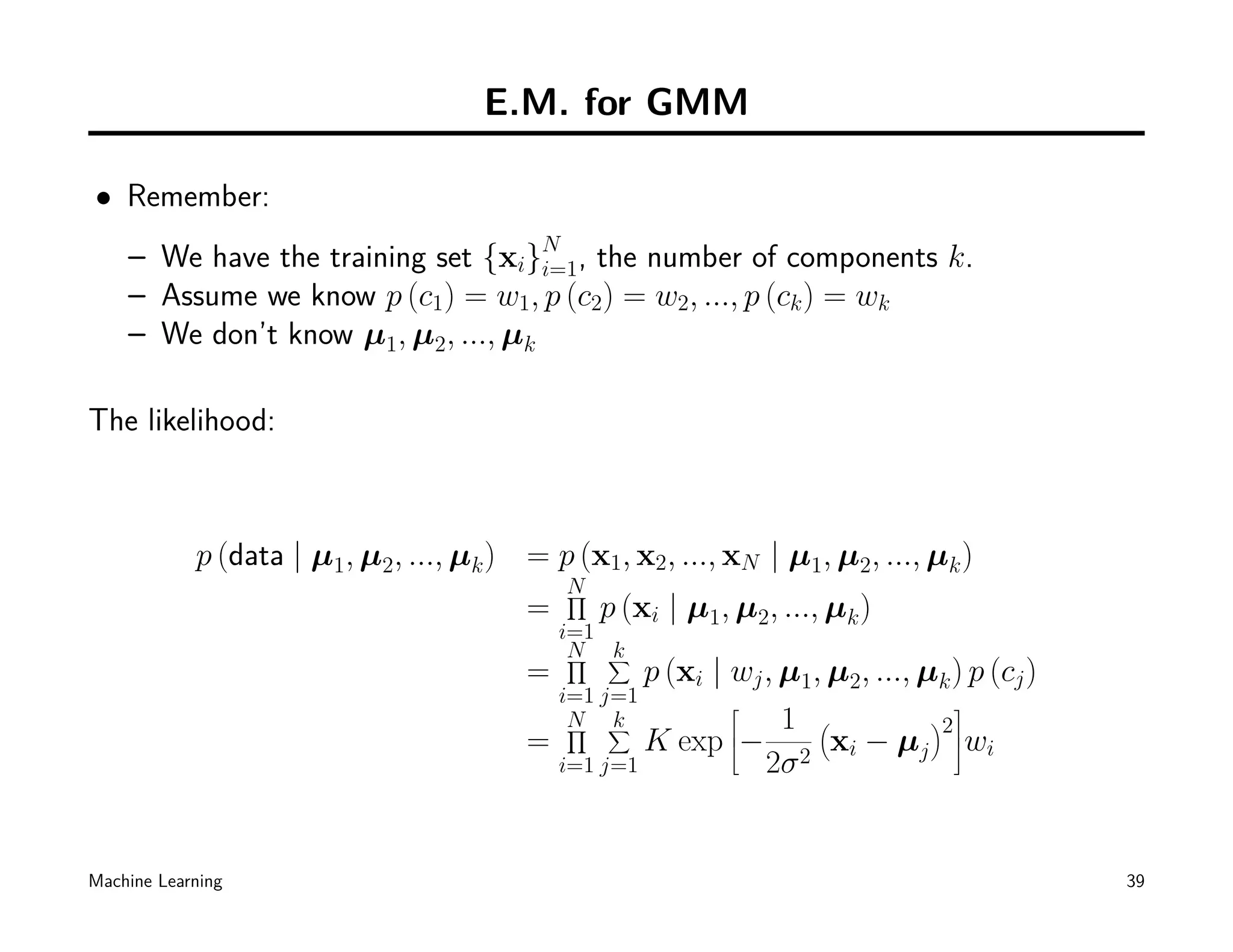
E.M. for GMM

• Remember:
    – We have the training set {xi}N , the number of components k.
                                    i=1
    – Assume we know p (c1) = w1, p (c2) = w2, ..., p (ck ) = wk
    – We don’t know µ1, µ2, ..., µk

The likelihood:


            p (data | µ1, µ2, ..., µk ) = p (x1, x2, ..., xN | µ1, µ2, ..., µk )
                                            N
                                            ∏
                                        =       p (xi | µ1, µ2, ..., µk )
                                            i=1
                                             N ∑
                                             ∏  k
                                        =         p (xi | wj , µ1, µ2, ..., µk ) p (cj )
                                            i=1 j=1                           
                                             N ∑
                                             ∏   k             1 (           )
                                                                              2
                                        =         K exp − 2 xi − µj wi
                                                          
                                          i=1 j=1            2σ


Machine Learning                                                                           39
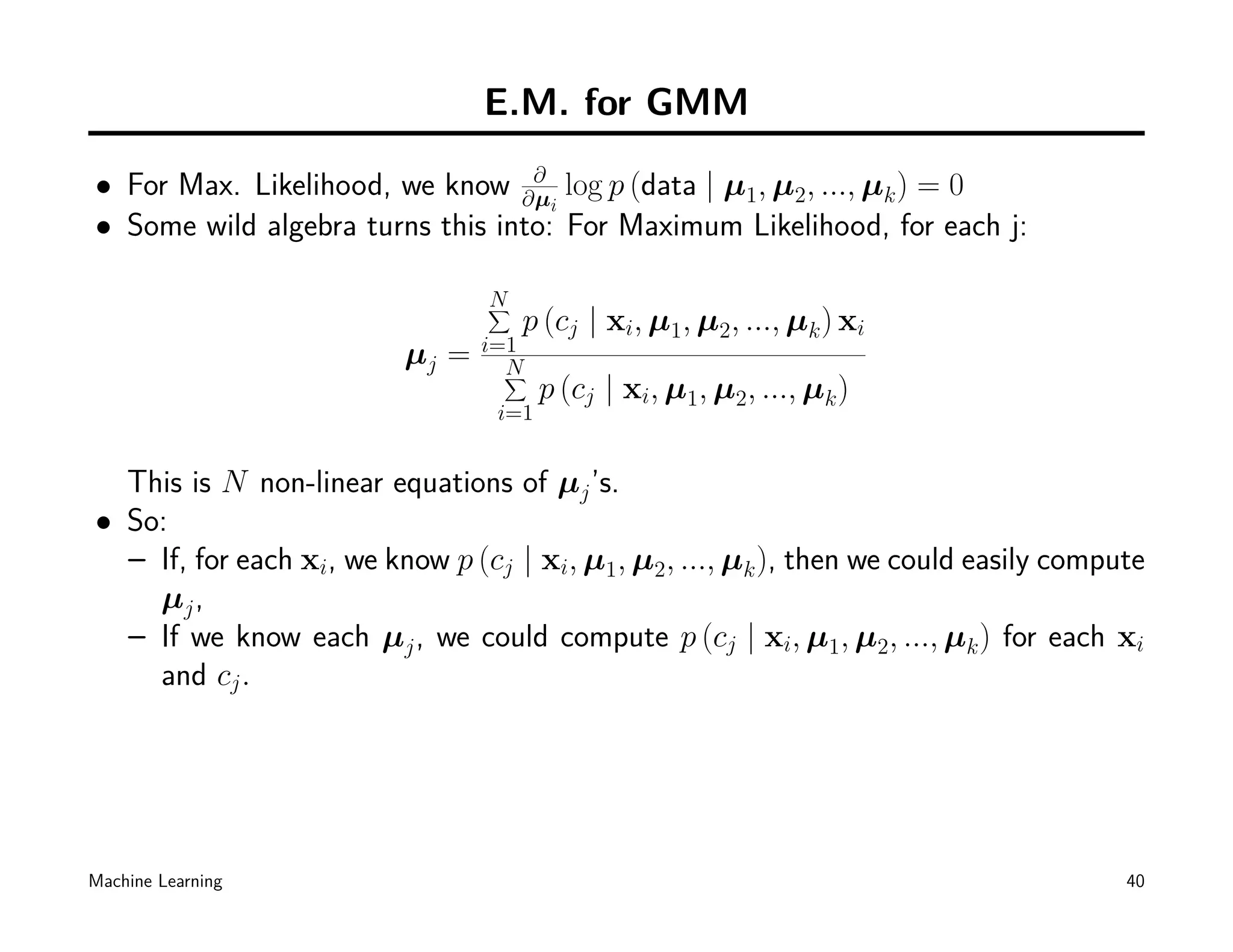
E.M. for GMM

• For Max. Likelihood, we know ∂µ log p (data | µ1, µ2, ..., µk ) = 0
                                  ∂
                                    i
• Some wild algebra turns this into: For Maximum Likelihood, for each j:

                                N
                                ∑
                                    p (cj | xi, µ1, µ2, ..., µk ) xi
                                i=1
                         µj =     N
                                  ∑
                                       p (cj | xi, µ1, µ2, ..., µk )
                                 i=1


  This is N non-linear equations of µj ’s.
• So:
  – If, for each xi, we know p (cj | xi, µ1, µ2, ..., µk ), then we could easily compute
    µj ,
  – If we know each µj , we could compute p (cj | xi, µ1, µ2, ..., µk ) for each xi
    and cj .


Machine Learning                                                                      40
E.M. for GMM

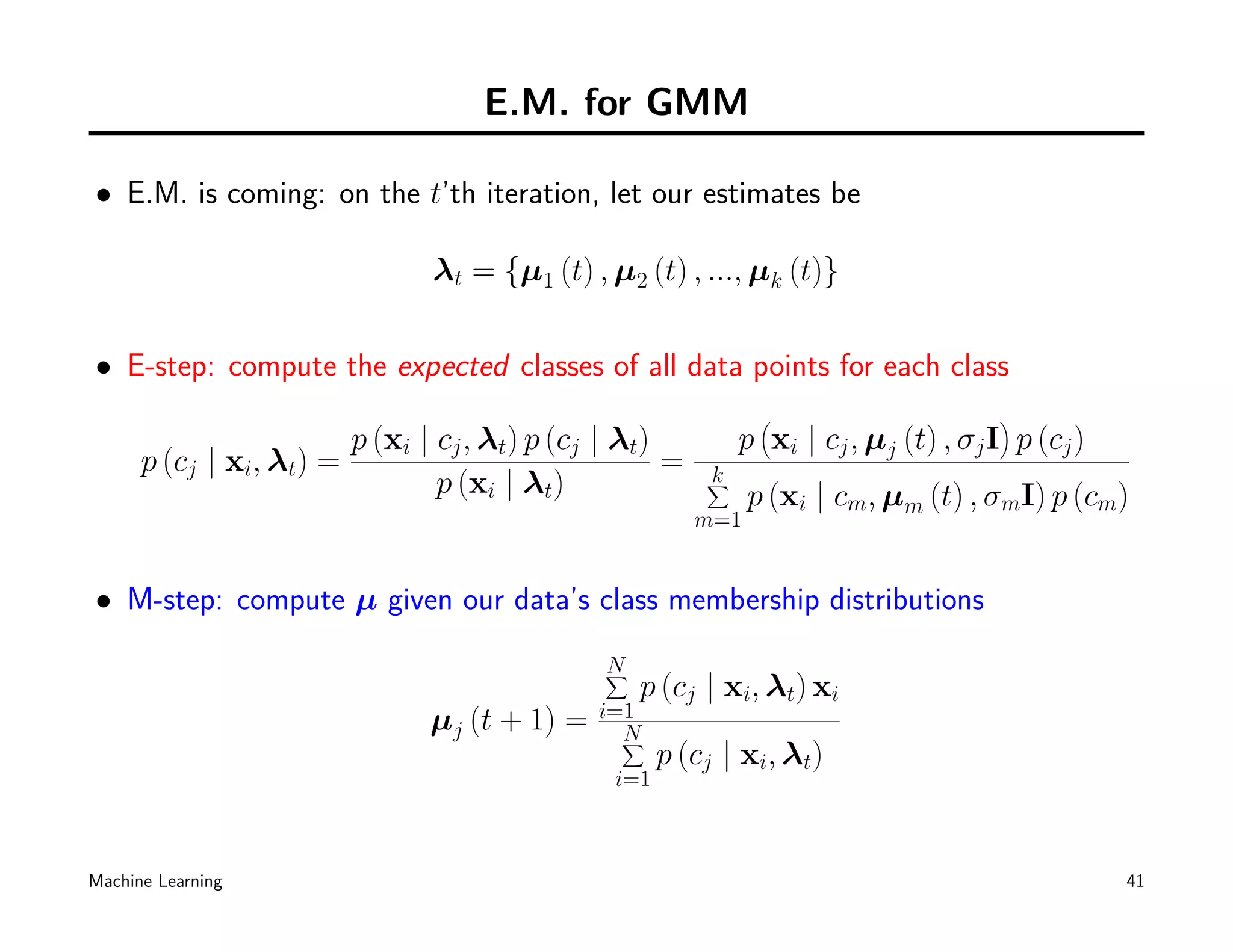
• E.M. is coming: on the t’th iteration, let our estimates be

                                 λt = {µ1 (t) , µ2 (t) , ..., µk (t)}

• E-step: compute the expected classes of all data points for each class
                                                                  (                    )
                          p (xi | cj , λt) p (cj | λt)         p xi | cj , µj (t) , σj I p (cj )
      p (cj | xi, λt) =                                =
                                  p (xi | λt)              k
                                                           ∑
                                                                 p (xi | cm, µm (t) , σmI) p (cm)
                                                           m=1


• M-step: compute µ given our data’s class membership distributions
                                                N
                                                ∑
                                                    p (cj | xi, λt) xi
                                                i=1
                                 µj (t + 1) =     N
                                                  ∑
                                                       p (cj | xi, λt)
                                                 i=1


Machine Learning                                                                                   41
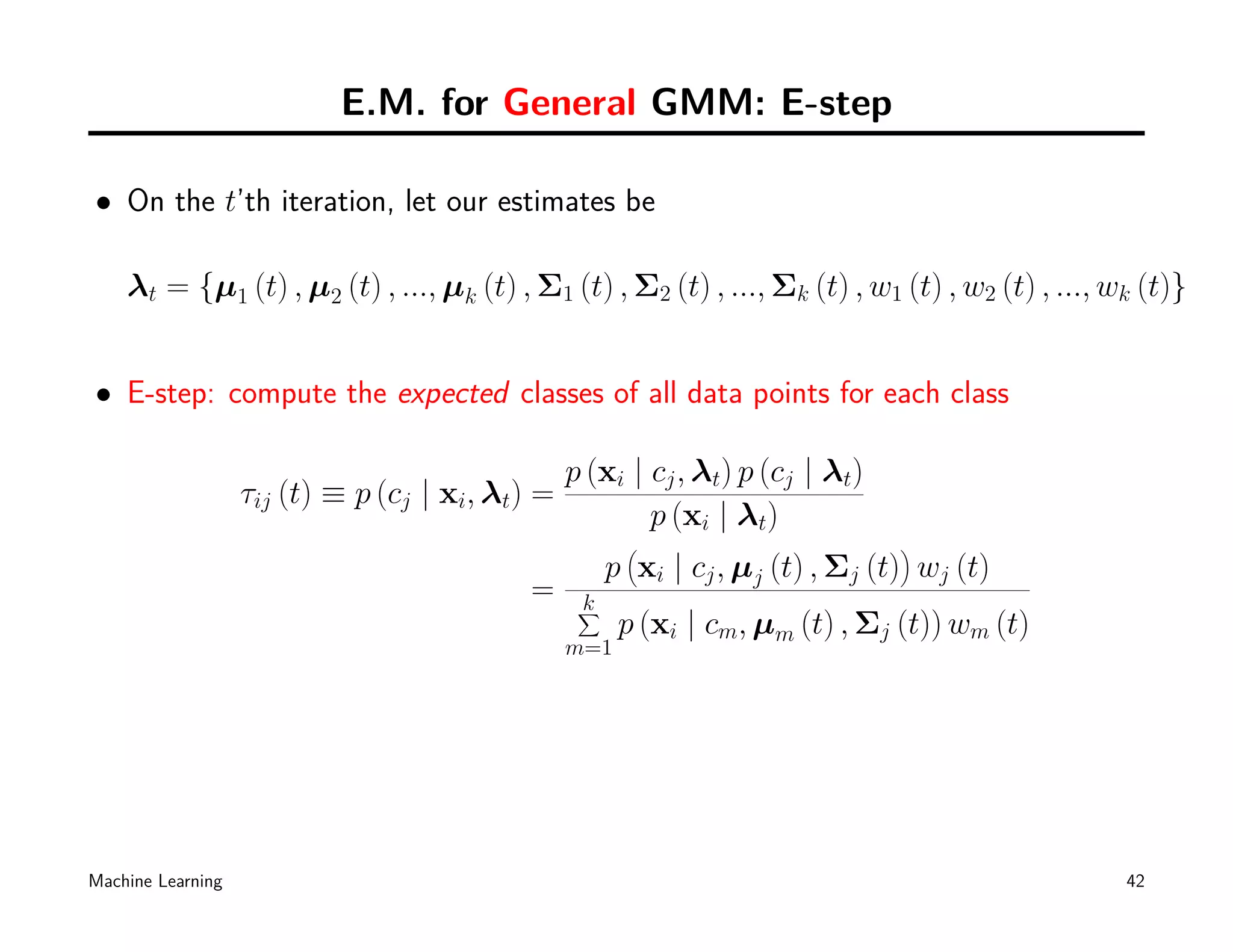
E.M. for General GMM: E-step

• On the t’th iteration, let our estimates be

    λt = {µ1 (t) , µ2 (t) , ..., µk (t) , Σ1 (t) , Σ2 (t) , ..., Σk (t) , w1 (t) , w2 (t) , ..., wk (t)}


• E-step: compute the expected classes of all data points for each class

                                                 p (xi | cj , λt) p (cj | λt)
                   τij (t) ≡ p (cj | xi, λt) =
                                                         p (xi | λt)
                                                       (                        )
                                                      p xi | cj , µj (t) , Σj (t) wj (t)
                                            =     k
                                                  ∑
                                                       p (xi | cm, µm (t) , Σj (t)) wm (t)
                                                 m=1


Machine Learning                                                                                  42
E.M. for General GMM: M-step

• M-step: compute µ given our data’s class membership distributions

                        N
                        ∑                                                   N
                                                                            ∑
                              p (cj | xi, λt)                                   p (cj | xi, λt) xi
                        i=1                                                 i=1
      wj (t + 1) =                                        µj (t + 1) =        N
                                     N                                        ∑
                                                                              p (cj | xi, λt)
                                                                             i=1
                        1     N
                              ∑                                                1        N
                                                                                        ∑
                    =               τij (t)                             =                  τij (t) xi
                        N     i=1                                         N wj (t + 1) i=1


                            N
                            ∑                   [                      ][                  ]
                                                                                            T
                                  p (cj | xi, λt) xi − µj (t + 1) xi − µj (t + 1)
                            i=1
            Σj (t + 1) =                            N
                                                    ∑
                                                          p (cj | xi, λt)
                                                    i=1
                               1        N
                                        ∑         [               ][              ]
                                                                                   T
                        =                  τij (t) xi − µj (t + 1) xi − µj (t + 1)
                          N wj (t + 1) i=1


Machine Learning                                                                                     43
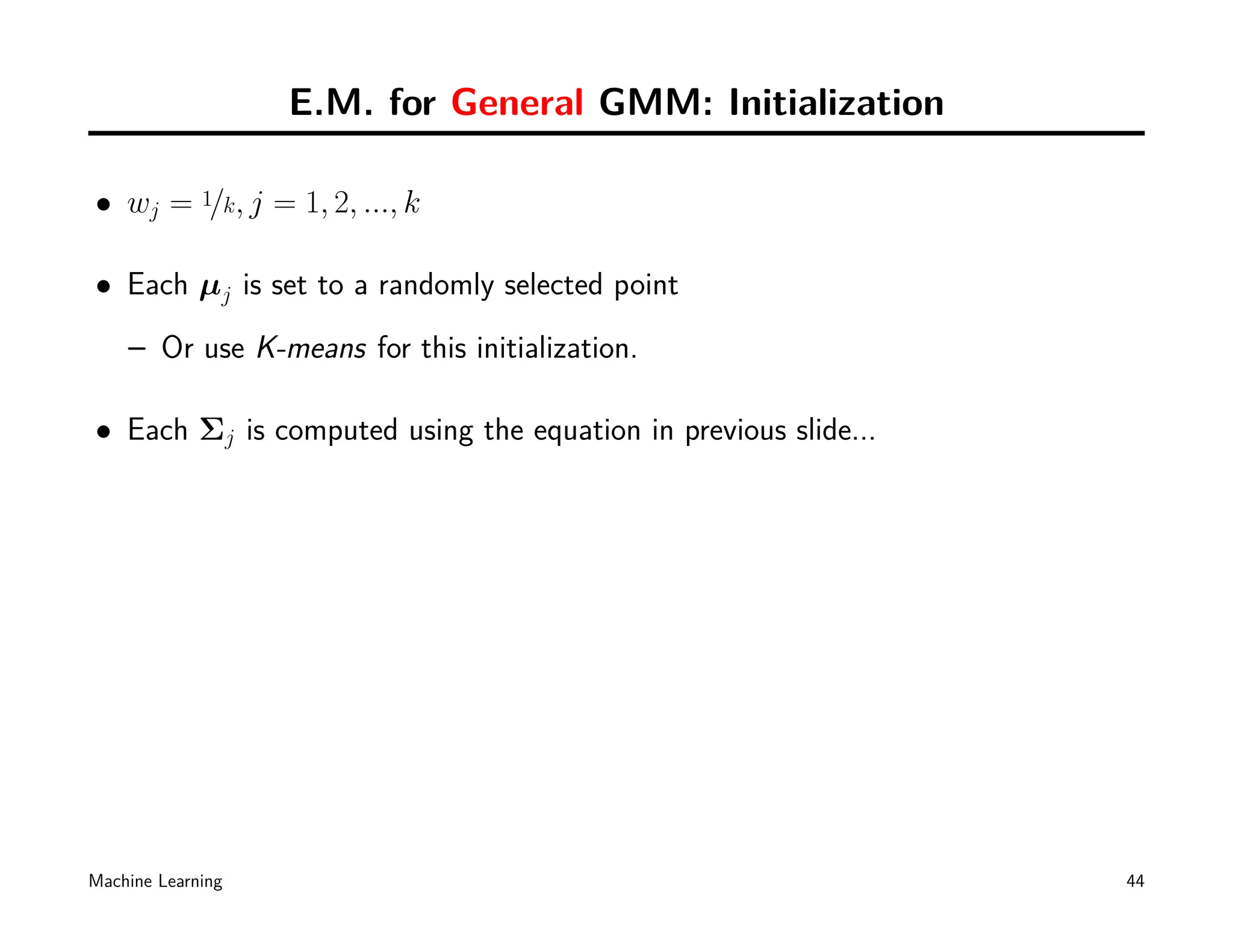
E.M. for General GMM: Initialization

• wj = 1/k, j = 1, 2, ..., k

• Each µj is set to a randomly selected point
    – Or use K-means for this initialization.

• Each Σj is computed using the equation in previous slide...


Machine Learning                                                44
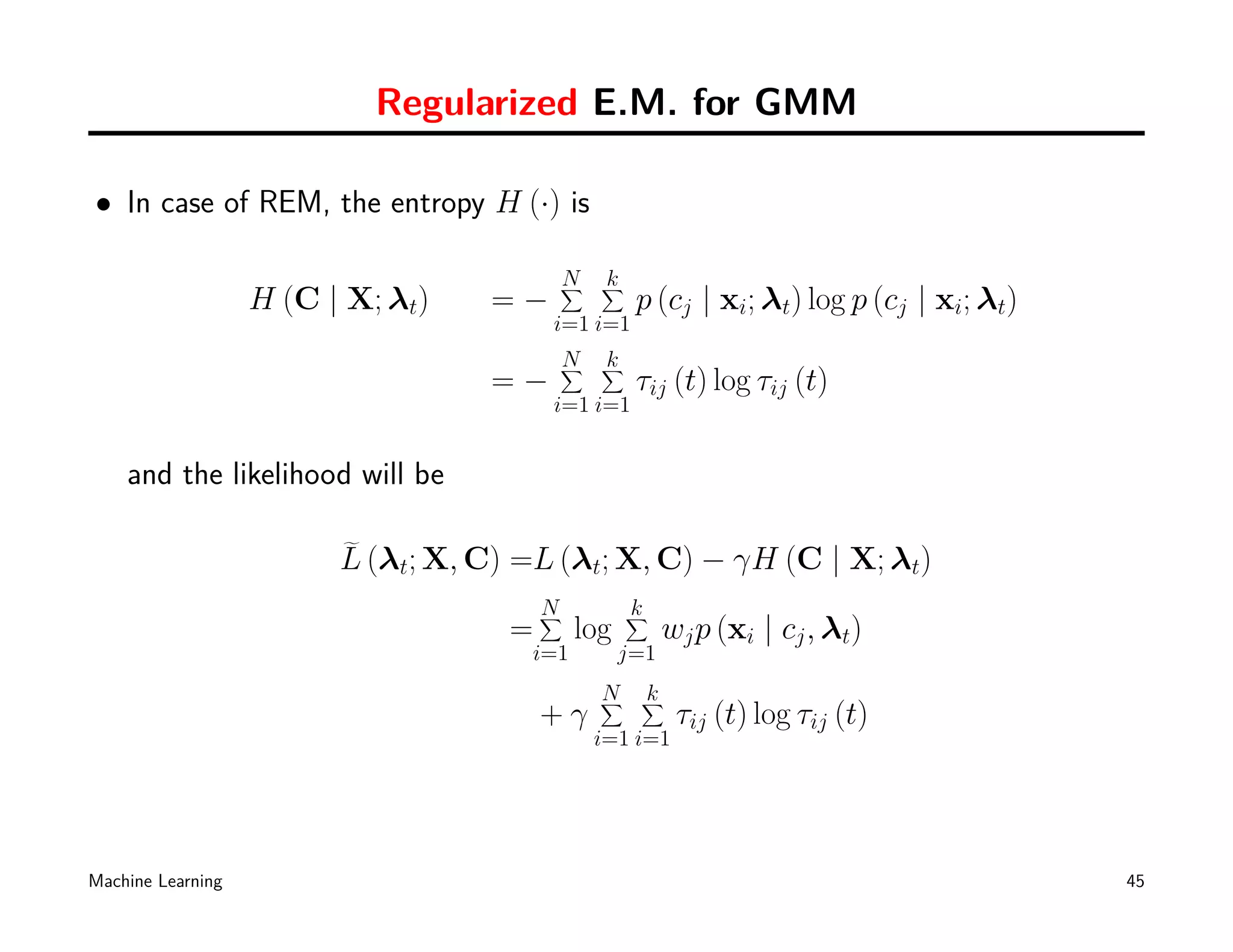
Regularized E.M. for GMM

• In case of REM, the entropy H (·) is

                                         N
                                         ∑     k
                                               ∑
                   H (C | X; λt)   =−               p (cj | xi; λt) log p (cj | xi; λt)
                                         i=1 i=1
                                         N
                                         ∑     k
                                               ∑
                                   =−               τij (t) log τij (t)
                                         i=1 i=1


    and the likelihood will be

                         L (λt; X, C) =L (λt; X, C) − γH (C | X; λt)
                                         N
                                         ∑         k
                                                   ∑
                                     =       log         wj p (xi | cj , λt)
                                       i=1         j=1
                                               N
                                               ∑    k
                                                    ∑
                                         +γ               τij (t) log τij (t)
                                              i=1 i=1


Machine Learning                                                                          45
Regularized E.M. for GMM

• Some algebra [5] turns into:

                                     N
                                     ∑
                                           p (cj | xi, λt) (1 + γ log p (cj | xi, λt))
                                     i=1
                   wj (t + 1) =
                                                                 N
                                 1         N
                                           ∑
                               =                 τij (t) (1 + γ log τij (t))
                                 N         i=1


                                 N
                                 ∑
                                     p (cj | xi, λt) xi (1 + γ log p (cj | xi, λt))
                   µj (t + 1) = i=1
                                  N
                                  ∑
                                        p (cj | xi, λt) (1 + γ log p (cj | xi, λt))
                                  i=1
                                      1        N
                                               ∑
                             =                    τij (t) xi (1 + γ log τij (t))
                                 N wj (t + 1) i=1


Machine Learning                                                                         46
Regularized E.M. for GMM

• Some algebra [5] turns into (cont.):

                                       1        N
                                                ∑
                   Σj (t + 1) =                    τij (t) (1 + γ log τij (t)) dij (t + 1)
                                  N wj (t + 1) i=1

    where                                 [                ][                  ]
                                                                               T
                         dij (t + 1) = xi − µj (t + 1) xi − µj (t + 1)


Machine Learning                                                                             47
Demonstration

• EM for GMM

• REM for GMM


Machine Learning                   48
Local optimum solution

• E.M. is guaranteed to find the local optimal solution by monotonically increasing
  the log-likelihood

• Whether it converges to the global optimal solution depends on the initialization


      18                                     15

      16

      14

      12                                     10

      10

       8

       6                                      5

       4

       2

      0                                      0
      −10          −5   0   5      10   15   −10    −5     0     5      10    15


Machine Learning                                                                   49
GMM: Selecting the number of components

• We can run the E.M. algorithm with different numbers of components.
        – Need a criteria for selecting the “best” number of components

   15                                16                           16


                                     14                           14


                                     12                           12

   10
                                     10                           10


                                      8                            8


                                      6                            6
    5

                                      4                            4


                                      2                            2


   0                                 0                            0
   −10     −5      0   5   10   15   −10   −5   0   5   10   15   −10   −5   0   5   10   15


Machine Learning                                                                               50
GMM: Model Selection

• Empirically/Experimentally [Sure!]

• Cross-Validation [How?]

• BIC

• ...


Machine Learning                               51
GMM: Model Selection

• Empirically/Experimentally
    – Typically 3-5 components

• Cross-Validation: K-fold, leave-one-out...
    – Omit each point xi in turn, estimate the parameters θ −i on the basis of the
      remaining points, then evaluate
                                    N         (              )
                                    ∑                   −i
                                         log p xi | θ
                                   i=1

• BIC: find k (the number of components) that minimize the BIC

                                          (         )     dk
                        BIC = − log p data | θm          + log n
                                                          2

    where dk is the number of (effective) parameters in the k-component mixture.

Machine Learning                                                                  52
Contents

• Unsupervised Learning

• K-means clustering

• Expectation Maximization (E.M.)
    – Regularized EM
    – Model Selection

• Gaussian mixtures as a Density Estimator
    – Gaussian mixtures
    – EM for mixtures

• Gaussian mixtures for classification

• Case studies

Machine Learning                             53
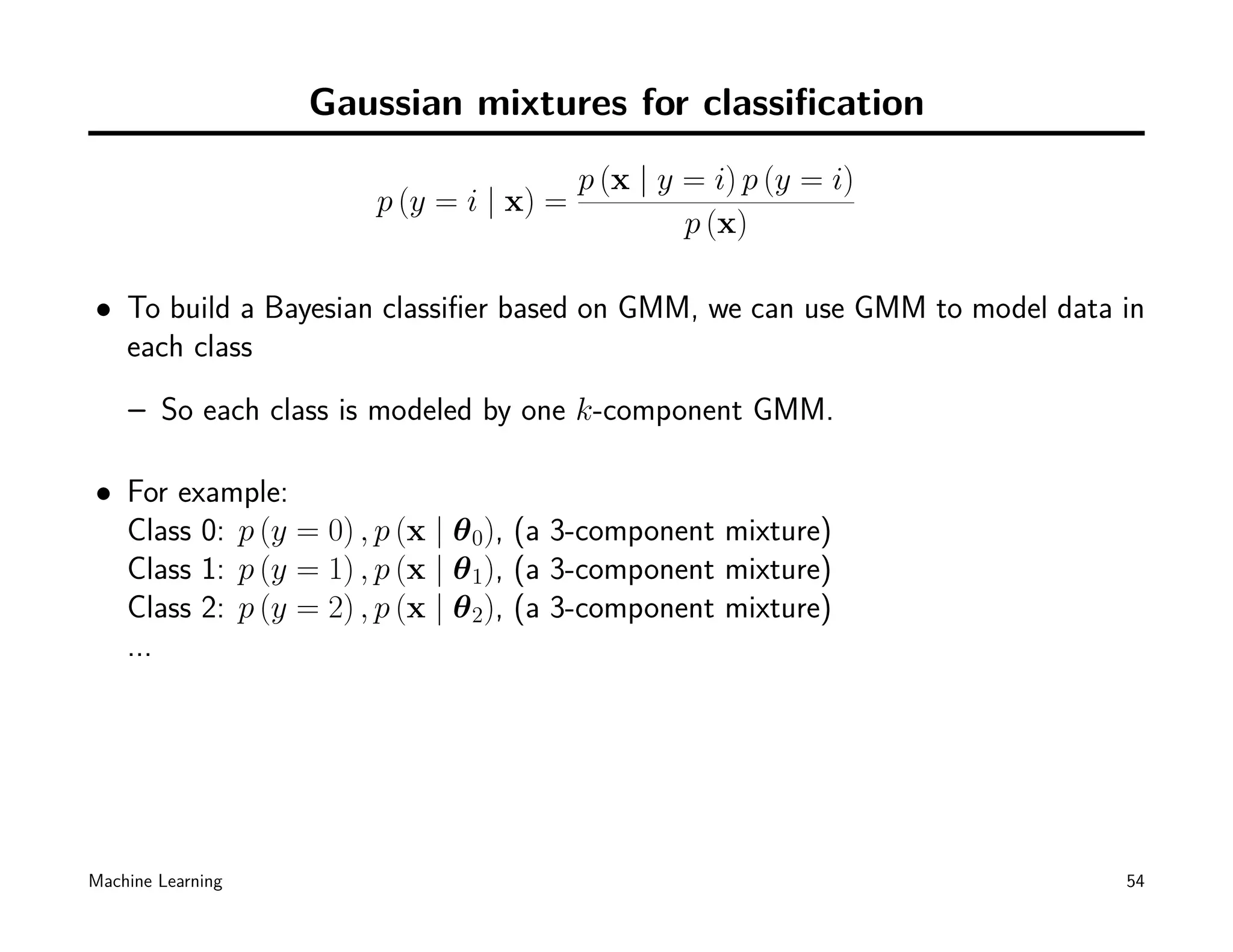
Gaussian mixtures for classification
                                        p (x | y = i) p (y = i)
                      p (y = i | x) =
                                                 p (x)

• To build a Bayesian classifier based on GMM, we can use GMM to model data in
  each class
    – So each class is modeled by one k-component GMM.

• For example:
  Class 0: p (y = 0) , p (x | θ 0), (a 3-component mixture)
  Class 1: p (y = 1) , p (x | θ 1), (a 3-component mixture)
  Class 2: p (y = 2) , p (x | θ 2), (a 3-component mixture)
  ...


Machine Learning                                                           54
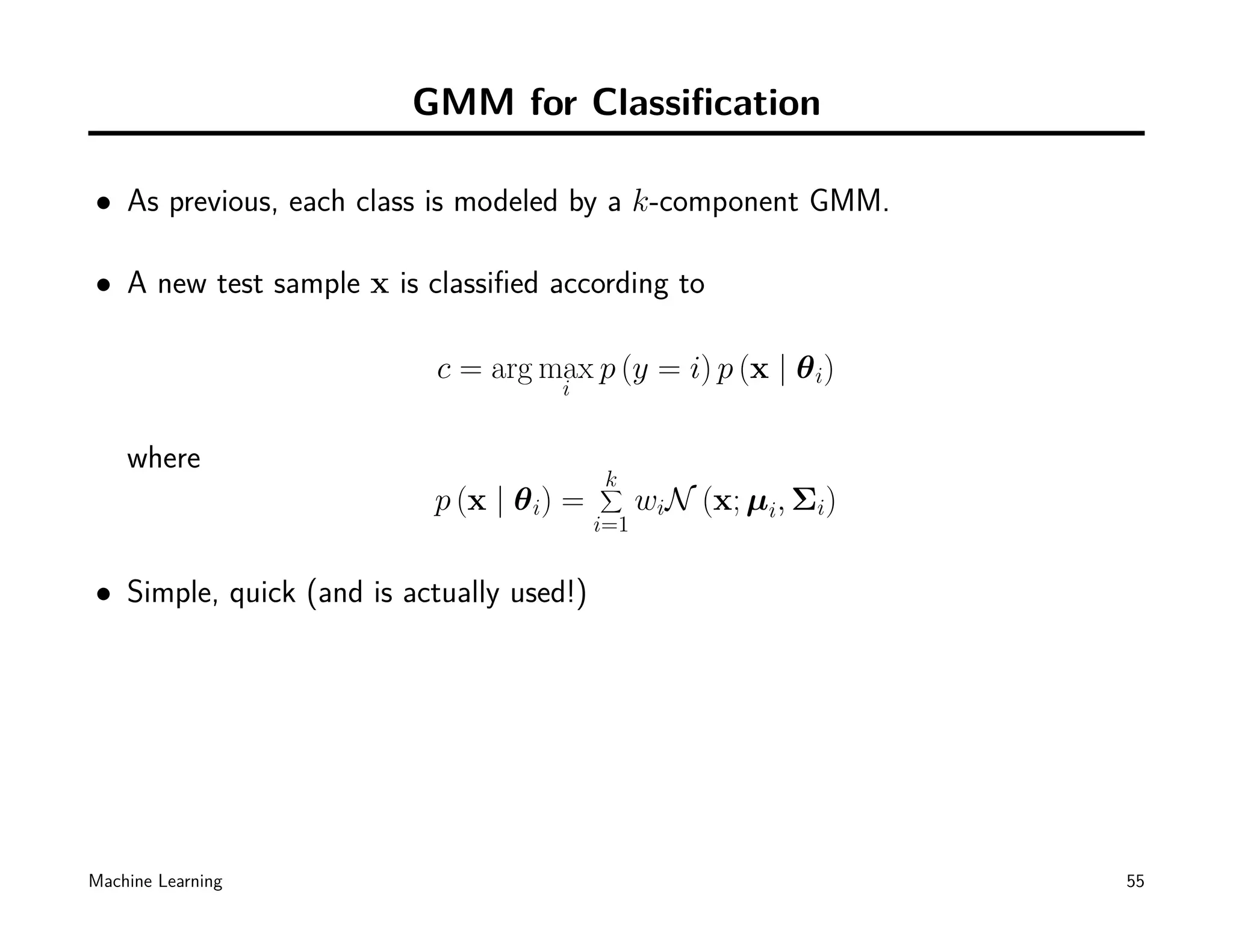
GMM for Classification

• As previous, each class is modeled by a k-component GMM.

• A new test sample x is classified according to

                           c = arg max p (y = i) p (x | θ i)
                                     i


    where
                                          k
                                          ∑
                          p (x | θ i) =         wiN (x; µi, Σi)
                                          i=1


• Simple, quick (and is actually used!)


Machine Learning                                                  55
Contents

• Unsupervised Learning

• K-means clustering

• Expectation Maximization (E.M.)
    – Regularized EM
    – Model Selection

• Gaussian mixtures as a Density Estimator
    – Gaussian mixtures
    – EM for mixtures

• Gaussian mixtures for classification

• Case studies

Machine Learning                             56
Case studies

• Background subtraction
    – GMM for each pixel

• Speech recognition
    – GMM for the underlying distribution of feature vectors of each phone

• Many, many others...


Machine Learning                                                             57
What you should already know?

• K-means as a trivial classifier

• E.M. - an algorithm for solving many MLE problems

• GMM - a tool for modeling data
    – Note 1: We can have a mixture model of many different types of distribution,
      not only Gaussians
    – Note 2: Compute the sum of Gaussians may be expensive, some approximations
      are available [3]

• Model selection:
    – Bayesian Information Criterion


Machine Learning                                                               58
Q&A


Machine Learning         59
References

[1] N. Laird A. Dempster and D. Rubin. Maximum likelihood from incomplete data
    via the em algorithm. Journal of the Royal Statistical Society. Series B (Method-
    ological), 39(1):pp. 1–38., 1977.

[2] David Arthur and Sergei Vassilvitskii. k-means ++ : The Advantages of Careful
    Seeding. In Proceedings of the eighteenth annual ACM-SIAM symposium on
    Discrete algorithms, volume 8, pages 1027–1035, 2007.

[3] N. Gumerov C. Yang, R. Duraiswami and L. Davis. Improved fast gauss transform
    and efficient kernel density estimation. In IEEE International Conference on
    Computer Vision, pages pages 464–471, 2003.

[4] Charles Elkan. Using the Triangle Inequality to Accelerate k-Means. In Proceed-

Machine Learning                                                                   60
ings of the Twentieth International Conference on Machine Learning (ICML),
     2003.

[5] Keshu Zhang Haifeng Li and Tao Jiang. The regularized em algorithm. In
    Proceedings of the 20th National Conference on Artificial Intelligence, pages
    pages 807 – 812, Pittsburgh, PA, 2005.

[6] Greg Hamerly and Charles Elkan. Learning the k in k-means. In In Neural
    Information Processing Systems. MIT Press, 2003.

[7] Tapas Kanungo, David M Mount, Nathan S Netanyahu, Christine D Piatko, Ruth
    Silverman, and Angela Y Wu. An efficient k-means clustering algorithm: anal-
    ysis and implementation. IEEE Transactions on Pattern Analysis and Machine
    Intelligence, 24(7):881–892, July 2002.

[8] J MacQueen. Some methods for classification and analysis of multivariate obser-
    vations. In Proceedings of 5th Berkeley Symposium on Mathematical Statistics
    and Probability, volume 233, pages 281–297. University of California Press, 1967.

Machine Learning                                                                   61
[9] C.F. Wu. On the convergence properties of the em algorithm. The Annals of
    Statistics, 11:95–103, 1983.


Machine Learning                                                           62

K-means, EM and Mixture models

  • 1.
    Machine Learning K-means, E.M.and Mixture models VU Pham phvu@fit.hcmus.edu.vn Department of Computer Science November 22, 2010 Machine Learning
  • 2.
    Remind: Three MainProblems in ML • Three main problems in ML: – Regression: Linear Regression, Neural net... – Classification: Decision Tree, kNN, Bayessian Classifier... – Density Estimation: Gauss Naive DE,... • Today, we will learn: – K-means: a trivial unsupervised classification algorithm. – Expectation Maximization: a general algorithm for density estimation. ∗ We will see how to use EM in general cases and in specific case of GMM. – GMM: a tool for modelling Data-in-the-Wild (density estimator) ∗ We also learn how to use GMM in a Bayessian Classifier Machine Learning 1
  • 3.
    Contents • Unsupervised Learning •K-means clustering • Expectation Maximization (E.M.) – Regularized EM – Model Selection • Gaussian mixtures as a Density Estimator – Gaussian mixtures – EM for mixtures • Gaussian mixtures for classification • Case studies Machine Learning 2
  • 4.
    Unsupervised Learning • Sofar, we have considered supervised learning techniques: – Label of each sample is included in the training set Sample Label x1 y1 ... ... xn yk • Unsupervised learning: – Traning set contains the samples only Sample Label x1 ... xn Machine Learning 3
  • 5.
    Unsupervised Learning 60 60 50 50 40 40 30 30 20 20 10 10 0 0 −10 0 10 20 30 40 50 −10 0 10 20 30 40 50 (a) Supervised learning. (b) Unsupervised learning. Figure 1: Unsupervised vs. Supervised Learning Machine Learning 4
  • 6.
    What is unsupervisedlearning useful for? • Collecting and labeling a large training set can be very expensive. • Be able to find features which are helpful for categorization. • Gain insight into the natural structure of the data. Machine Learning 5
  • 7.
    Contents • Unsupervised Learning •K-means clustering • Expectation Maximization (E.M.) – Regularized EM – Model Selection • Gaussian mixtures as a Density Estimator – Gaussian mixtures – EM for mixtures • Gaussian mixtures for classification • Case studies Machine Learning 6
  • 8.
    K-means clustering • Clusteringalgorithms aim to find groups of “similar” data points among 60 the input data. 50 • K-means is an effective algorithm to ex- 40 tract a given number of clusters from a 30 training set. 20 • Once done, the cluster locations can 10 be used to classify data into distinct 0 classes. −10 0 10 20 30 40 50 Machine Learning 7
  • 9.
    K-means clustering • Given: – The dataset: {xn}N = {x1, x2, ..., xN} n=1 – Number of clusters: K (K < N ) • Goal: find a partition S = {Sk }K so that it minimizes the objective function k=1 N ∑ K ∑ J= rnk ∥ xn − µk ∥2 (1) n=1 k=1 where rnk = 1 if xn is assigned to cluster Sk , and rnj = 0 for j ̸= k. i.e. Find values for the {rnk } and the {µk } to minimize (1). Machine Learning 8
  • 10.
    K-means clustering N ∑ K ∑ J= rnk ∥ xn − µk ∥2 n=1 k=1 • Select some initial values for the µk . • Expectation: keep the µk fixed, minimize J respect to rnk . • Maximization: keep the rnk fixed, minimize J respect to the µk . • Loop until no change in the partitions (or maximum number of interations is exceeded). Machine Learning 9
  • 11.
    K-means clustering N ∑ K ∑ J= rnk ∥ xn − µk ∥2 n=1 k=1 • Expectation: J is linear function of rnk   1 if k = arg minj ∥ xn − µj ∥2     rnk =   0  otherwise • Maximization: setting the derivative of J with respect to µk to zero, gives: ∑ n rnk xn µk = ∑ n rnk Convergence of K-means: assured [why?], but may lead to local minimum of J [8] Machine Learning 10
  • 12.
    K-means clustering: Howto understand? N ∑ K ∑ J= rnk ∥ xn − µk ∥2 n=1 k=1 • Expectation: minimize J respect to rnk – For each xn, find the “closest” cluster mean µk and put xn into cluster Sk . • Maximization: minimize J respect to µk – For each cluster Sk , re-estimate the cluster mean µk to be the average value of all samples in Sk . • Loop until no change in the partitions (or maximum number of interations is exceeded). Machine Learning 11
  • 13.
  • 14.
    K-means clustering: somevariations • Initial cluster centroids: – Randomly selected – Iterative procedure: k-mean++ [2] • Number of clusters K: √ – Empirically/experimentally: 2 ∼ n – Learning [6] • Objective function: – General dissimilarity measure: k-medoids algorithm. • Speeding up: – kd-trees for pre-processing [7] – Triangle inequality for distance calculation [4] Machine Learning 13
  • 15.
    Contents • Unsupervised Learning •K-means clustering • Expectation Maximization (E.M.) – Regularized EM – Model Selection • Gaussian mixtures as a Density Estimator – Gaussian mixtures – EM for mixtures • Gaussian mixtures for classification • Case studies Machine Learning 14
  • 16.
    Expectation Maximization E.M. Machine Learning 15
  • 17.
    Expectation Maximization • Ageneral-purpose algorithm for MLE in a wide range of situations. • First formally stated by Dempster, Laird and Rubin in 1977 [1] – We even have several books discussing only on EM and its variations! • An excellent way of doing our unsupervised learning problem, as we will see – EM is also used widely in other domains. Machine Learning 16
  • 18.
    EM: a solutionfor MLE • Given a statistical model with: – a set X of observed data, – a set Z of unobserved latent data, – a vector of unknown parameters θ, – a likelihood function L (θ; X, Z) = p (X, Z | θ) • Roughly speaking, the aim of MLE is to determine θ = arg maxθ L (θ; X, Z) – We known the old trick: partial derivatives of the log likelihood... – But it is not always tractable [e.g.] – Other solutions are available. Machine Learning 17
  • 19.
    EM: General Case L (θ; X, Z) = p (X, Z | θ) • EM is just an iterative procedure for finding the MLE • Expectation step: keep the current estimate θ (t) fixed, calculate the expected value of the log likelihood function ( ) Q θ|θ (t) = E [log L (θ; X, Z)] = E [log p (X, Z | θ)] • Maximization step: Find the parameter that maximizes this quantity ( ) θ (t+1) = arg max Q θ | θ (t) θ Machine Learning 18
  • 20.
    EM: Motivation • Ifwe know the value of the parameters θ, we can find the value of latent variables Z by maximizing the log likelihood over all possible values of Z – Searching on the value space of Z. • If we know Z, we can find an estimate of θ – Typically by grouping the observed data points according to the value of asso- ciated latent variable, – then averaging the values (or some functions of the values) of the points in each group. To understand this motivation, let’s take K-means as a trivial example... Machine Learning 19
  • 21.
    EM: informal description Both θ and Z are unknown, EM is an iterative algorithm: 1. Initialize the parameters θ to some random values. 2. Compute the best values of Z given these parameter values. 3. Use the just-computed values of Z to find better estimates for θ. 4. Iterate until convergence. Machine Learning 20
  • 22.
    EM Convergence • E.M.Convergence: Yes – After each iteration, p (X, Z | θ) must increase or remain [NOT OBVIOUS] – But it can not exceed 1 [OBVIOUS] – Hence it must converge [OBVIOUS] • Bad news: E.M. converges to local optimum. – Whether the algorithm converges to the global optimum depends on the ini- tialization. • Let’s take K-means as an example, again... • Details can be found in [9]. Machine Learning 21
  • 23.
    Regularized EM (REM) •EM tries to inference the latent (missing) data Z from the observations X – We want to choose the missing data that has a strong probabilistic relation to the observations, i.e. we assume that the observations contains lots of information about the missing data. – But E.M. does not have any control on the relationship between the missing data and the observations! • Regularized EM (REM) [5] tries to optimized the penalized likelihood L (θ | X, Z) = L (θ | X, Z) − γH (Z | X, θ) where H (Y ) is Shannon’s entropy of the random variable Y : ∑ H (Y ) = − p (y) log p (y) y and the positive value γ is the regularization parameter. [When γ = 0?] Machine Learning 22
  • 24.
    Regularized EM (REM) •E-step: unchanged • M-step: Find the parameter that maximizes this quantity ( ) θ (t+1) = arg max Q θ | θ (t) θ where ( ) ( ) Q θ|θ (t) =Q θ|θ (t) − γH (Z | X, θ) • REM is expected to converge faster than EM (and it does!) • So, to apply REM, we just need to determine the H (·) part... Machine Learning 23
  • 25.
    Model Selection • Consideringa parametric model: – When estimating model parameters using MLE, it is possible to increase the likelihood by adding parameters – But may result in over-fitting. • e.g. K-means with different values of K... • Need a criteria for model selection, e.g. to “judge” which model configuration is better, how many parameters is sufficient... – Cross Validation – Akaike Information Criterion (AIC) – Bayesian Factor ∗ Bayesian Informaction Criterion (BIC) ∗ Deviance Information Criterion – ... Machine Learning 24
  • 26.
    Bayesian Information Criterion ( ) # of param BIC = − log p data | θ + log n 2 • Where: – θ:( the estimated parameters. ) – p data | θ : the maximized value of the likelihood function for the estimated model. – n: number of data points. – Note that there are other ways to write the BIC expression, but they are all equivalent. • Given any two estimated models, the model with the lower value of BIC is preferred. Machine Learning 25
  • 27.
    Bayesian Score • BICis an asymptotic (large n) approximation to better (and hard to evaluate) Bayesian score ˆ Bayesian score = p (θ) p (data | θ) dθ θ • Given two models, the model selection is based on Bayes factor ˆ p (θ1) p (data | θ1) dθ1 K = ˆθ1 p (θ2) p (data | θ2) dθ2 θ2 Machine Learning 26
  • 28.
    Contents • Unsupervised Learning •K-means clustering • Expectation Maximization (E.M.) – Regularized EM – Model Selection • Gaussian mixtures as a Density Estimator – Gaussian mixtures – EM for mixtures • Gaussian mixtures for classification • Case studies Machine Learning 27
  • 29.
    Remind: Bayes Classifier 70 60 50 40 30 20 10 0 −10 0 10 20 30 40 50 60 70 80 p (x | y = i) p (y = i) p (y = i | x) = p (x) Machine Learning 28
  • 30.
    Remind: Bayes Classifier 70 60 50 40 30 20 10 0 −10 0 10 20 30 40 50 60 70 80 In case of Gaussian Bayes Classifier: [ ] T d/2 1 exp −2 1 (x − µi) Σi (x − µi) pi (2π) ∥Σi ∥1/2 p (y = i | x) = p (x) How can we deal with the denominator p (x)? Machine Learning 29
  • 31.
    Remind: The SingleGaussian Distribution • Multivariate Gaussian   1 1 N (x; µ, Σ) = d/2 exp −  (x − µ)T Σ−1 (x − µ)  (2π) ∥ Σ ∥1/2 2 • For maximum likelihood ∂ ln N (x1, x2, ..., xN; µ, Σ) 0= ∂µ • and the solution is 1 N ∑ µM L = xi N i=1 1 N ∑ ΣM L = (xi − µM L)T (xi − µM L) N i=1 Machine Learning 30
  • 32.
    The GMM assumption •There are k components: {ci}k i=1 • Component ci has an associated mean vector µi µ2 • µ1 µ3 • Machine Learning 31
  • 33.
    The GMM assumption •There are k components: {ci}k i=1 • Component ci has an associated mean vector µi µ2 • Each component generates data from a Gaussian with mean µi and covariance µ1 matrix Σi • Each sample is generated according to µ3 the following guidelines: Machine Learning 32
  • 34.
    The GMM assumption •There are k components: {ci}k i=1 • Component ci has an associated mean vector µi • Each component generates data from a µ2 Gaussian with mean µi and covariance matrix Σi • Each sample is generated according to the following guidelines: – Randomly select component ci with probability P (ci) = wi, s.t. ∑k i=1 wi = 1 Machine Learning 33
  • 35.
    The GMM assumption •There are k components: {ci}k i=1 • Component ci has an associated mean vector µi µ2 • Each component generates data from a x Gaussian with mean µi and covariance matrix Σi • Each sample is generated according to the following guidelines: – Randomly select component ci with probability P (ci) = wi, s.t. ∑k i=1 wi = 1 – Sample ~ N (µi, Σi) Machine Learning 34
  • 36.
    Probability density functionof GMM “Linear combination” of Gaussians: k ∑ k ∑ f (x) = wiN (x; µi, Σi) , where wi = 1 i=1 i=1 0.018 0.016 0.014 0.012 0.01 f (x) 0.008 2 2 w1 N µ1 , σ1 w2 N µ2 , σ2 0.006 2 w3 N µ3 , σ3 0.004 0.002 0 0 50 100 150 200 250 (a) The pdf of an 1D GMM with 3 components. (b) The pdf of an 2D GMM with 3 components. Figure 2: Probability density function of some GMMs. Machine Learning 35
  • 37.
    GMM: Problem definition k ∑ k ∑ f (x) = wiN (x; µi, Σi) , where wi = 1 i=1 i=1 Given a training set, how to model these data point using GMM? • Given: – The trainning set: {xi}N i=1 – Number of clusters: k • Goal: model this data using a mixture of Gaussians – Weights: w1, w2, ..., wk – Means and covariances: µ1, µ2, ..., µk ; Σ1, Σ2, ..., Σk Machine Learning 36
  • 38.
    Computing likelihoods inunsupervised case k ∑ k ∑ f (x) = wiN (x; µi, Σi) , where wi = 1 i=1 i=1 • Given a mixture of Gaussians, denoted by G. For any x, we can define the likelihood: P (x | G) = P (x | w1, µ1, Σ1, ..., wk , µk , Σk ) k ∑ = P (x | ci) P (ci) i=1 k ∑ = wiN (x; µi, Σi) i=1 • So we can define likelihood for the whole training set [Why?] N ∏ P (x1, x2, ..., xN | G) = P (xi | G) i=1 N ∑ ∏ k = wj N (xi; µj , Σj ) i=1 j=1 Machine Learning 37
  • 39.
    Estimating GMM parameters •We known this: Maximum Likelihood Estimation   N ∑ k ∑ ln P (X | G) = ln   wj N (xi; µj , Σj )  i=1 j=1 – For the max likelihood: ∂ ln P (X | G) 0= ∂µj – This leads to non-linear non-analytically-solvable equations! • Use gradient descent – Slow but doable • A much cuter and recently popular method... Machine Learning 38
  • 40.
    E.M. for GMM •Remember: – We have the training set {xi}N , the number of components k. i=1 – Assume we know p (c1) = w1, p (c2) = w2, ..., p (ck ) = wk – We don’t know µ1, µ2, ..., µk The likelihood: p (data | µ1, µ2, ..., µk ) = p (x1, x2, ..., xN | µ1, µ2, ..., µk ) N ∏ = p (xi | µ1, µ2, ..., µk ) i=1 N ∑ ∏ k = p (xi | wj , µ1, µ2, ..., µk ) p (cj ) i=1 j=1   N ∑ ∏ k 1 ( ) 2 = K exp − 2 xi − µj wi  i=1 j=1 2σ Machine Learning 39
  • 41.
    E.M. for GMM •For Max. Likelihood, we know ∂µ log p (data | µ1, µ2, ..., µk ) = 0 ∂ i • Some wild algebra turns this into: For Maximum Likelihood, for each j: N ∑ p (cj | xi, µ1, µ2, ..., µk ) xi i=1 µj = N ∑ p (cj | xi, µ1, µ2, ..., µk ) i=1 This is N non-linear equations of µj ’s. • So: – If, for each xi, we know p (cj | xi, µ1, µ2, ..., µk ), then we could easily compute µj , – If we know each µj , we could compute p (cj | xi, µ1, µ2, ..., µk ) for each xi and cj . Machine Learning 40
  • 42.
    E.M. for GMM •E.M. is coming: on the t’th iteration, let our estimates be λt = {µ1 (t) , µ2 (t) , ..., µk (t)} • E-step: compute the expected classes of all data points for each class ( ) p (xi | cj , λt) p (cj | λt) p xi | cj , µj (t) , σj I p (cj ) p (cj | xi, λt) = = p (xi | λt) k ∑ p (xi | cm, µm (t) , σmI) p (cm) m=1 • M-step: compute µ given our data’s class membership distributions N ∑ p (cj | xi, λt) xi i=1 µj (t + 1) = N ∑ p (cj | xi, λt) i=1 Machine Learning 41
  • 43.
    E.M. for GeneralGMM: E-step • On the t’th iteration, let our estimates be λt = {µ1 (t) , µ2 (t) , ..., µk (t) , Σ1 (t) , Σ2 (t) , ..., Σk (t) , w1 (t) , w2 (t) , ..., wk (t)} • E-step: compute the expected classes of all data points for each class p (xi | cj , λt) p (cj | λt) τij (t) ≡ p (cj | xi, λt) = p (xi | λt) ( ) p xi | cj , µj (t) , Σj (t) wj (t) = k ∑ p (xi | cm, µm (t) , Σj (t)) wm (t) m=1 Machine Learning 42
  • 44.
    E.M. for GeneralGMM: M-step • M-step: compute µ given our data’s class membership distributions N ∑ N ∑ p (cj | xi, λt) p (cj | xi, λt) xi i=1 i=1 wj (t + 1) = µj (t + 1) = N N ∑ p (cj | xi, λt) i=1 1 N ∑ 1 N ∑ = τij (t) = τij (t) xi N i=1 N wj (t + 1) i=1 N ∑ [ ][ ] T p (cj | xi, λt) xi − µj (t + 1) xi − µj (t + 1) i=1 Σj (t + 1) = N ∑ p (cj | xi, λt) i=1 1 N ∑ [ ][ ] T = τij (t) xi − µj (t + 1) xi − µj (t + 1) N wj (t + 1) i=1 Machine Learning 43
  • 45.
    E.M. for GeneralGMM: Initialization • wj = 1/k, j = 1, 2, ..., k • Each µj is set to a randomly selected point – Or use K-means for this initialization. • Each Σj is computed using the equation in previous slide... Machine Learning 44
  • 46.
    Regularized E.M. forGMM • In case of REM, the entropy H (·) is N ∑ k ∑ H (C | X; λt) =− p (cj | xi; λt) log p (cj | xi; λt) i=1 i=1 N ∑ k ∑ =− τij (t) log τij (t) i=1 i=1 and the likelihood will be L (λt; X, C) =L (λt; X, C) − γH (C | X; λt) N ∑ k ∑ = log wj p (xi | cj , λt) i=1 j=1 N ∑ k ∑ +γ τij (t) log τij (t) i=1 i=1 Machine Learning 45
  • 47.
    Regularized E.M. forGMM • Some algebra [5] turns into: N ∑ p (cj | xi, λt) (1 + γ log p (cj | xi, λt)) i=1 wj (t + 1) = N 1 N ∑ = τij (t) (1 + γ log τij (t)) N i=1 N ∑ p (cj | xi, λt) xi (1 + γ log p (cj | xi, λt)) µj (t + 1) = i=1 N ∑ p (cj | xi, λt) (1 + γ log p (cj | xi, λt)) i=1 1 N ∑ = τij (t) xi (1 + γ log τij (t)) N wj (t + 1) i=1 Machine Learning 46
  • 48.
    Regularized E.M. forGMM • Some algebra [5] turns into (cont.): 1 N ∑ Σj (t + 1) = τij (t) (1 + γ log τij (t)) dij (t + 1) N wj (t + 1) i=1 where [ ][ ] T dij (t + 1) = xi − µj (t + 1) xi − µj (t + 1) Machine Learning 47
  • 49.
    Demonstration • EM forGMM • REM for GMM Machine Learning 48
  • 50.
    Local optimum solution •E.M. is guaranteed to find the local optimal solution by monotonically increasing the log-likelihood • Whether it converges to the global optimal solution depends on the initialization 18 15 16 14 12 10 10 8 6 5 4 2 0 0 −10 −5 0 5 10 15 −10 −5 0 5 10 15 Machine Learning 49
  • 51.
    GMM: Selecting thenumber of components • We can run the E.M. algorithm with different numbers of components. – Need a criteria for selecting the “best” number of components 15 16 16 14 14 12 12 10 10 10 8 8 6 6 5 4 4 2 2 0 0 0 −10 −5 0 5 10 15 −10 −5 0 5 10 15 −10 −5 0 5 10 15 Machine Learning 50
  • 52.
    GMM: Model Selection •Empirically/Experimentally [Sure!] • Cross-Validation [How?] • BIC • ... Machine Learning 51
  • 53.
    GMM: Model Selection •Empirically/Experimentally – Typically 3-5 components • Cross-Validation: K-fold, leave-one-out... – Omit each point xi in turn, estimate the parameters θ −i on the basis of the remaining points, then evaluate N ( ) ∑ −i log p xi | θ i=1 • BIC: find k (the number of components) that minimize the BIC ( ) dk BIC = − log p data | θm + log n 2 where dk is the number of (effective) parameters in the k-component mixture. Machine Learning 52
  • 54.
    Contents • Unsupervised Learning •K-means clustering • Expectation Maximization (E.M.) – Regularized EM – Model Selection • Gaussian mixtures as a Density Estimator – Gaussian mixtures – EM for mixtures • Gaussian mixtures for classification • Case studies Machine Learning 53
  • 55.
    Gaussian mixtures forclassification p (x | y = i) p (y = i) p (y = i | x) = p (x) • To build a Bayesian classifier based on GMM, we can use GMM to model data in each class – So each class is modeled by one k-component GMM. • For example: Class 0: p (y = 0) , p (x | θ 0), (a 3-component mixture) Class 1: p (y = 1) , p (x | θ 1), (a 3-component mixture) Class 2: p (y = 2) , p (x | θ 2), (a 3-component mixture) ... Machine Learning 54
  • 56.
    GMM for Classification •As previous, each class is modeled by a k-component GMM. • A new test sample x is classified according to c = arg max p (y = i) p (x | θ i) i where k ∑ p (x | θ i) = wiN (x; µi, Σi) i=1 • Simple, quick (and is actually used!) Machine Learning 55
  • 57.
    Contents • Unsupervised Learning •K-means clustering • Expectation Maximization (E.M.) – Regularized EM – Model Selection • Gaussian mixtures as a Density Estimator – Gaussian mixtures – EM for mixtures • Gaussian mixtures for classification • Case studies Machine Learning 56
  • 58.
    Case studies • Backgroundsubtraction – GMM for each pixel • Speech recognition – GMM for the underlying distribution of feature vectors of each phone • Many, many others... Machine Learning 57
  • 59.
    What you shouldalready know? • K-means as a trivial classifier • E.M. - an algorithm for solving many MLE problems • GMM - a tool for modeling data – Note 1: We can have a mixture model of many different types of distribution, not only Gaussians – Note 2: Compute the sum of Gaussians may be expensive, some approximations are available [3] • Model selection: – Bayesian Information Criterion Machine Learning 58
  • 60.
  • 61.
    References [1] N. LairdA. Dempster and D. Rubin. Maximum likelihood from incomplete data via the em algorithm. Journal of the Royal Statistical Society. Series B (Method- ological), 39(1):pp. 1–38., 1977. [2] David Arthur and Sergei Vassilvitskii. k-means ++ : The Advantages of Careful Seeding. In Proceedings of the eighteenth annual ACM-SIAM symposium on Discrete algorithms, volume 8, pages 1027–1035, 2007. [3] N. Gumerov C. Yang, R. Duraiswami and L. Davis. Improved fast gauss transform and efficient kernel density estimation. In IEEE International Conference on Computer Vision, pages pages 464–471, 2003. [4] Charles Elkan. Using the Triangle Inequality to Accelerate k-Means. In Proceed- Machine Learning 60
  • 62.
    ings of theTwentieth International Conference on Machine Learning (ICML), 2003. [5] Keshu Zhang Haifeng Li and Tao Jiang. The regularized em algorithm. In Proceedings of the 20th National Conference on Artificial Intelligence, pages pages 807 – 812, Pittsburgh, PA, 2005. [6] Greg Hamerly and Charles Elkan. Learning the k in k-means. In In Neural Information Processing Systems. MIT Press, 2003. [7] Tapas Kanungo, David M Mount, Nathan S Netanyahu, Christine D Piatko, Ruth Silverman, and Angela Y Wu. An efficient k-means clustering algorithm: anal- ysis and implementation. IEEE Transactions on Pattern Analysis and Machine Intelligence, 24(7):881–892, July 2002. [8] J MacQueen. Some methods for classification and analysis of multivariate obser- vations. In Proceedings of 5th Berkeley Symposium on Mathematical Statistics and Probability, volume 233, pages 281–297. University of California Press, 1967. Machine Learning 61
  • 63.
    [9] C.F. Wu.On the convergence properties of the em algorithm. The Annals of Statistics, 11:95–103, 1983. Machine Learning 62